


Friday, October 25, 2019

This Is What Worries Me

In this disintegrative phase, people are increasingly indignant if their magical-thinking "solution" is challenged.
It's practically un-American to confess you're worried. Can-do self-help and cheerfulness are expected, promoted and rewarded. So to say I'm profoundly worried about the state of the nation is to swim against the optimistic zeitgeist.
Nonetheless, I'm worried, because I sense the long-wave/cycle disintegrative phase is gathering momentum. Though the timing and outcome are unknown, these phases end badly when people lose their ability to learn new ideas, experiment, cooperate and adapt.
As I've noted in previous posts, economic decline manifests as social and political decay. People are angry, easily inflamed, seeking scapegoats, hardening their own views, all of which manifest economic decline and insecurity.
People are increasingly demanding that everyone agree with them, rather than seek solutions and common ground. People aren't really seeking solutions or common ground, they seek confirmation that you concur 100% with their views, and if you don't, they are indignant: how dare you disagree with me!
This is not a healthy development. People are increasingly prone to repeat their positions dogmatically, and your refusal to agree 100% increases their dogmatism and their agitation.
After three or four such outbursts--we cannot call them exchanges, because nothing is being exchanged--there's nothing to say.
It's extremely dangerous when people stop being interested in solutions and finding common ground, and are only interested in confirming that everyone agrees with them. This is psychologically akin to seeking scapegoats to blame for all our troubles or projecting our Monster Id onto some "other."
As the social fabric unravels, extremes quickly become normalized: another giant homeless encampment springs up and our ability to consider this extraordinarily troubling dissipates in a haze of normalization.
When everything is unraveling, our herd instinct kicks in, and we become increasingly skittish and uneasy. One manifestation of this group anxiety is conflicts suddenly break out over nothing: riots at ball games, demonstrations that become free-for-alls, family gatherings that suddenly dissolve in extreme acrimony over some trivial event.
I'm witnessing these behaviors in comments and correspondence. The Oftwominds audience has always been genteel. People disagree or correct me with civility, and I respond in kind. One of the motives behind the title "of two minds" is that there are generally several perspectives and I can change my mind as new information or experiences are presented.
But this is not what I'm seeing: I'm seeing once reasonable people harden their views into a seething dogmatism, and expressing indignation or anger if I don't agree with them 100%.
I'm afraid these readers never bothered to understand my work, which is admittedly outside the mainstream; they found something they didn't like and keyed off of that.
The turmoil over "facts" and "fake news" is another manifestation. As financial commentator Ben Hunt recently put it, the "tells" are all being manipulated to support a dominant narrative. So the unemployment rate, consumer inflation and the stock market are all manipulated to support the illusion that all is going swimmingly.
As the distance between these fantasy "facts" and experiential reality widen, trust in these "tells" (i.e. trustworthy indicators) declines.
As trust in these "facts" and the "experts" who gin them up declines, the corporate media and authorities double-down in support of their fictitious "facts": any doubters are "conspiracy theorists," purveyors of "fake news," or dastardly Russian stooges repeating "Kremlin talking points."
There is no middle ground left in such a state, and indeed, no desire for middle ground, as the mere existence of middle ground would mean whomever demands 100% agreement with their position is not going to get it.
In this disintegrative phase, people are increasingly indignant if their magical-thinking "solution" is challenged. Technology, to take a common example, will magically solve all our problems. Challenging this as unrealistic or impossible triggers a great indignation in the true believer: again, how dare you doubt tech innovation will save us! Or Universal Basic Income, Medicare For All, and so on.
As a small-time trader in financial markets, I'm accustomed to contemplating several conflicting points of view: some are bullish, some are bearish, some are neutral. Everyone makes their case, and if you decide to make a trade, you're going to be right or wrong. Once you realize you're wrong about the direction of the market, you can either change your mind and exit the trade, or you can double-down and absorb losses in the belief/hope that the market will eventually do what you're betting it will do.
This doubling-down is a dangerous strategy, because we tend to harden our convictions as the market turns against our bet. This leads us to suffer catastrophic losses, when we could have exited the trade with modest losses early on.
In other words, to reduce our anxiety and uncertainty, we harden our views and become dogmatic, blocking out all evidence that our position is untenable / not a solution.
This is what I fear is taking hold in the U.S. Rather than reinforce the traits of successful adaptation and problem-solving--flexibility, experimentation, developing an appetite for numerous small failures as the necessary foundation of advancement, keeping an open mind--we're embracing the Dark Side of the herd instinct, doubling down on rigid, dogmatic, inflexible, untenable positions, a strategy that leads to catastrophic losses and collapse.
This is why I wrote my book Pathfinding our Destiny: Preventing the Final Fall of Our Democratic Republic, to explain why the traits of successful adaptation are essential to surviving disintegrative phases. Once we lose interest in actual solutions, with all the sacrifices, experimentation, uncertainties and failures that real solutions require, solutions become impossible.


My recent books:
Money and Work Unchained $6.95 (Kindle), $15 (print) Read the first section for free (PDF).


If you found value in this content, please join me in seeking solutions by becoming a $1/month patron of my work via patreon.com.

NOTE: Contributions/subscriptions are acknowledged in the order received. Your name and email remain confidential and will not be given to any other individual, company or agency.
 
Thank you, Craig H. ($50), for your marvelously generous contribution to this site-- I am greatly honored by your steadfast support and readership.
 

Read more...

Wednesday, October 23, 2019

The Unraveling Quickens

Even if we don't measure the erosion of intangible capital, the social and political consequences of this impoverishment are manifesting in all sorts of ways.
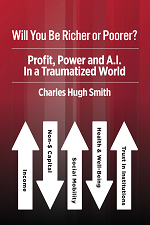
The central thesis of my new book Will You Be Richer or Poorer? is the financial "wealth" we've supposedly gained (or at least a few of us have gained) in the past 20 years has masked the unraveling of our intangible capital: the resilience of our economy, our social capital, i.e. our ability to find common ground and solve real-world problems, our sense that the playing field, while not entirely level, is not two-tiered, and our sense of economic security--have all been shredded.
The unraveling of everything that actually matters is quickening. While every "news" outlet cheerleads the stock market ("The Dow soared today as investor optimism rose... blah blah blah"), our "leadership" and our media don't even attempt to measure what's unraveling, much less address the underlying causes.
The hope is that if we ignore what's unraveling, it will magically go away. But that's not how reality works.
The unraveling is gathering momentum because prices have been pushing higher while wages lag, feeding the rising precariousness and inequality of our economy. The connection between people losing ground and social disorder/disunity has been well established by historians such as Peter Turchin Ages of Discord and David Hackett Fischer The Great Wave: Price Revolutions and the Rhythm of History.
In our era, trust in the legitimacy of our institutions is unraveling because the statistics presented as "facts" are so clearly designed to support the status quo narrative that everything's getting better every day in every way rather than the politically unwelcome reality that the bottom 95% are losing ground and whatever they do earn and own is increasingly at risk from forces outside their control.
Economic decay leads to social and political disorder / disunity. The sudden rise of vast homeless encampments is one manifestation of the social fabric unraveling. In the political realm, the insanity of accusing Democratic candidates of being "Russian agents" matches the hysterical destructiveness of the McCarthy era in the 1950s.
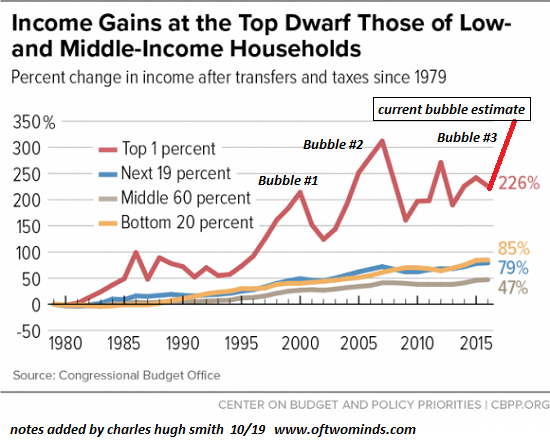
It all starts with economic decay, so let's look at some charts. Here's a chart of income inequality which helps drive wealth inequality.
Note that the only group that benefited from the past 20 years of speculative bubbles is the top 1%. The whole idea that inflating bubbles creates a "wealth effect" that "trickles down" is preposterous, as evidenced by the decline of the middle 60% of households while the speculators and owners of bubble-assets skimmed the vast majority of income gains.
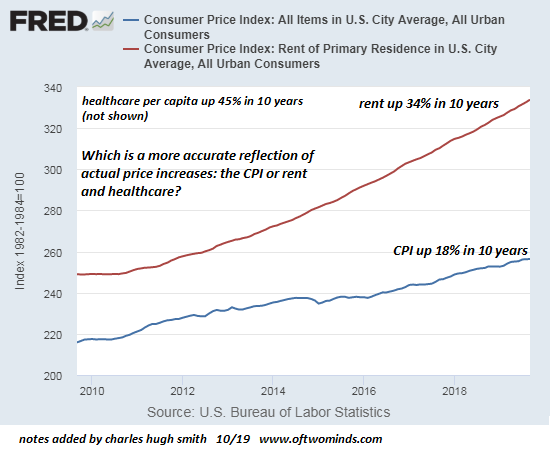
Meanwhile, we're told inflation is less than 2% annually while rising costs have outpaced meager wage increases. What's a more realistic measure of real-world inflation--the official Consumer Price Index (CPI) at 18% over ten years or rent and healthcare at 34% and 45%?
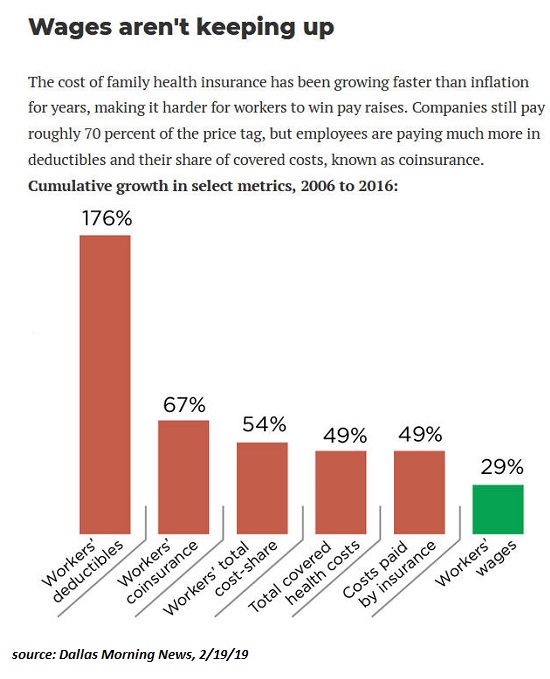
According to the Chapwood Index, real-world inflation in urban America is running 9% to 13% annually. This is more in line with reality than the bogus CPI, as evidenced by this chart of wages and healthcare costs:
Even if we don't measure the erosion of intangible capital, the social and political consequences of this impoverishment are manifesting in all sorts of ways: large-scale social disorder is breaking out around the globe, and the political middle ground has completely vanished: no matter which way an issue is decided, one camp will refuse to accept the outcome.
The only way forward with any chance of success is to start by acknowledging the decay of our economy due to rampant financialization, legalized looting, the pathologies of "winner take most" speculation and the realities of a two-tiered system in which entrenched elites are "more equal" than the rest of us, economically, socially and politically. We have to accept the limits of technology to reverse the unraveling and assess the damage that's already been done to our shared capital.
Acting as if the system is working just fine and the problem is perception/optics is accelerating the unraveling.
Money and Work Unchained $6.95 (Kindle), $15 (print) Read the first section for free (PDF).


If you found value in this content, please join me in seeking solutions by becoming a $1/month patron of my work via patreon.com.

NOTE: Contributions/subscriptions are acknowledged in the order received. Your name and email remain confidential and will not be given to any other individual, company or agency.
 
Thank you, Louis B. ($50), for your magnificently generous contribution to this site-- I am greatly honored by your support and readership.
 

Read more...

Monday, October 21, 2019

Prying Open the Overton Window

If you're truly interested in finding solutions to humanity's pressing problems, then start helping us pry open the Overton Window.
The Overton Window describes the spectrum of concepts, policies and approaches that can be publicly discussed without being ridiculed or marginalized as "too radical," "unworkable," "crazy," etc. The narrower the Overton Window, the greater the impoverishment of public dialog and the fewer the solutions available.
Those holding power in a socio-economic-political system that's unraveling devote their remaining energy to closing the Overton Window so that only "approved" narratives and policies that support the status quo are "allowed" into the public sphere.
Everything outside this narrow band of status-quo-supportive narratives is immediately disparaged as "fake news," "Kremlin talking points," or other highly charged accusations designed to close the Overton Window--a process Noam Chomsky and Edward Herman called manufacturing consent: if no "outside" ideas are allowed, people accept the status quo as "all there is and all there can possibly be."
This narrow Overton Window benefits those in power who are "legally looting" the system.
There is another source of a narrow Overton Window: the cultural, social and political elites have no new ideas and so they cling to doing more of what's failed, relying on the past successes of now-failing strategies to cement their power.
Michael Grant described how this failure of imagination and devotion to the past leads inevitably to decline and collapse in his excellent account The Fall of the Roman Empire, a short book I have been recommending since 2009:
There was no room at all, in these ways of thinking, for the novel, apocalyptic situation which had now arisen, a situation which needed solutions as radical as itself. (The Status Quo) attitude is a complacent acceptance of things as they are, without a single new idea.
This acceptance was accompanied by greatly excessive optimism about the present and future. Even when the end was only sixty years away, and the Empire was already crumbling fast, Rutilius continued to address the spirit of Rome with the same supreme assurance.
This blind adherence to the ideas of the past ranks high among the principal causes of the downfall of Rome. If you were sufficiently lulled by these traditional fictions, there was no call to take any practical first-aid measures at all.
That describes the U.S. and indeed the entire global economy to a tee. All the "approved solutions" are retreads from 90 years ago: fiscal stimulus (now called MMT), lowering interest rates via central bank manipulation (now called QE), increasing social welfare (now called Universal Basic Income, UBI)--all "solutions" from the early 1930s, when the global economic system fell into its last Great Crisis.
That these will all fail is already baked in because this is not 1930. The situation is fundamentally different, but like generals who obsess over how best to fight the last war, the system's Overton Window is stuck in 1930.
The most important job of the alternative media is to pry open the Overton Window so new solutions become possible. We have been trained to believe that technology is our savior, and that "new solutions" arise only from technology. But the reality is that technology itself won't solve economic-social-political problems; it can at best enable new solutions.
In other words, there is no teleology in technology that magically causes technology to generate a sustainable economy or distribute political power equitably. We have to set those goals and use technology to serve economic, social and political innovations.
As I often say here, if you don't change the way money is created and distributed, you change nothing because the way money is created and distributed defines everything else in the way the system functions.
For my part, I've proposed a labor-backed currency that is unlike any other system for creating and distributing "money." I describe this system in my book A radically beneficial World, and in an essay The Architecture of a Labor-Backed Cryptocurrency System, the Largent (June 2016)--scroll to the bottom of the page to read it.
In the three years since the publication of the book and essay, I've gained a new appreciation for the potential for privately issued 'paper' money that is "backed" by transactions of goods and services. The advent of private-sector (i.e. non-state) blockchain currencies such as bitcoin has cracked open the Overton Window to a refreshing degree, but blockchain cryptocurrencies are only one of many potential systems of "money" that would better serve humanity that the doomed-to-implode fiat currencies issued by elites-dominated governments and central banks.
Technology is enabling new solutions, but only if we can conceptualize those solutions and pry open the Overton Window to let them into the public sphere.
If you're truly interested in finding solutions to humanity's pressing problems, then start helping us pry open the Overton Window. Those who dogmatically demand we all agree with their 1930s "solutions" and who marginalize any and all new ideas that threaten the status quo power structure are the problem, not the solution.
Prying open the Overton Window is the point of my new book Will You Be Richer or Poorer? Profit, Power and A.I. in a Traumatized World.


My recent books:
Money and Work Unchained $6.95 (Kindle), $15 (print) Read the first section for free (PDF).


If you found value in this content, please join me in seeking solutions by becoming a $1/month patron of my work via patreon.com.

NOTE: Contributions/subscriptions are acknowledged in the order received. Your name and email remain confidential and will not be given to any other individual, company or agency.
 
Thank you, Simons C. ($25), for your superbly generous contribution to this site-- I am greatly honored by your steadfast support and readership.

Read more...

Saturday, October 19, 2019

What We've Lost

This is only a partial list of what we've lost to globalism, cheap credit and the Tyranny of Price which generates the Landfill Economy.
A documentary on the decline of small farms and the rural economy in France highlights what we've lost in the decades-long rush to globalize and financialize everything on the planet-- what we call Neoliberalism, the ideology of turning everything into a global market controlled by The Tyranny of Price and cheap credit issued to corporations and banks by central banks.
After Winter, Spring (2012) was made by an American who moved to a small village in the Dordogne region of France to recover something of her childhood on a small Pennsylvania farm.
The farmers--self-described as paysanspeasants in English, (a translation I don't consider entirely accurate, for reasons too complex to go into here)-- describe the financial difficulties of earning enough to survive without outside jobs.
One young farmer who is taking over the family dairy from his aging parents encapsulates the economic reality of small farms: in the 1960s, they had 3 or 4 cows, now they have 100, but their income is the same.
Corporate mega-farms can produce huge quantities of agricultural products of questionable quality because they have the scale, access to cheap credit and expertise to deal with the voluminous bureaucratic paperwork imposed by the EU and the French government. (One slip-up on a form and you're sunk if you're a one- or two-person operation.)
Artisanal producers can't compete, and will never be able to compete in a global marketplace where there is always a cheaper source. (Up to half a small farmer's income comes from EU subsidies, which the EU is trying to cut.)
Financial survival requires one spouse have an outside job, or the farmers must operate farm tours, an onsite auberge (restaurant) or equivalent higher-margin business, all of which increases the capital they must borrow to fund the expansion and the risk of bankruptcy should the venture fail to cover its costs.
The documentary echoes the themes of an earlier French documentary, Profils Paysans, a three-part series of which only the third film Modern Life (2008) has English Subtitles.
The financial uncertainties and endless hard work are running up against generational realities: relatively few young people have the necessary passion for farming and the appetite for risk and hard work. Across the developed world, from Japan to the U.S. to France, there are few (if any) successors in line to take over the small family farms.
The small family farm--and the knowledge of how to grow food and raise animals--is dying away with the passing of our elderly farmers. The average age of farmers in many nations is well above 60. Many of the paysans (male and female) profiled in these documentaries are in their 80s.
The land is sold for residential development (i.e. exurb sprawl, overwhelming infrastructure such as roads, water systems, etc. designed for much small populations) or abandoned.
These documentaries only partially capture the enormous distance between "modern life" and the human-Nature relationship required to make land sustainably productive.
It's important to preserve wilderness, but we don't eat what grows or roams in wilderness. Wildlife can't survive solely on isolated preserves, either; Corporate Big Ag monoculture fields offer little to no habitat for wildlife.
Corporate Big Ag doesn't maintain the polycultures needed to support insects, birds and other wildlife; small farms provide niches and habitats for all sorts of life that doesn't serve a direct financial interest of the owners.
The widening divide between the modern lifestyle--completely ignorant and dismissive of rural productive polyculture--and those who still hold knowledge of artisanal, small-scale, localized production of high quality food--is already unbridgeable.
One elderly farmer described how his non-French neighbor complained about the cowbells on his few cattle. This resident's dogs could bark freely, but the cowbells were an annoyance beyond tolerance?
This is a manifestation of the complete alienation of "modern life" from the production of food. The modern urban/exurb resident doesn't want to smell hay (hay fever!) or manure (oh my, all animal poop should vanish instantly or I can't bear it) or any other exposure to the realities of raising livestock, killing animals so we can eat them or any other reality of food. All of these processes should be done thousands of miles away, and the food shipped by air in nice plastic containers to our supermarkets.
Neoliberal economists insist nothing has been lost; the plastic food in the plastic containers is "market efficiency" (never mind the dependence on cheap credit and cheap jet fuel). As for all the intangible economic, social and cultural capital that's been lost--it has no value in globalized Neoliberal economies.
One almost hopes that Corporate Big Ag disappears due to mono-crop plagues and people start going hungry to the point that they begin to take an interest in relearning all that's been cavalierly tossed away in favor of plastic food in plastic packaging and endless hours slumped on sofas "consuming" videos and "engaging" social media.
We've lost so much in the conquest of localized, small-scale polycultural farming by Neoliberal globalism and the dominance of cheap-credit-fueled Corporate Big Ag, yet we're only dimly aware of what's been lost because it isn't measured or valued in Neoliberal economies.
We've lost the knowledge of even partial self-sufficiency; we've lost a diversified local economy that can feed itself; we've lost "food security," the resilience provided by food grown locally rather than being flown in from thousands of miles away; we've lost the cultural habits of helping neighbors bring in their harvest, of celebrating the shared work around a communal table; we've lost any Nature-based cultural identity; we've lost the cultural and economic capital of interwoven small farms; we've lost the habitats for wildlife that are unique to polyculture farming, and we've lost any meaningful connection to the land and Nature.
It's not just small farms that are being lost--it's the entire rural economy of villages and towns that are supported by farm income and products.
This is only a partial list of what we've lost to globalism, cheap credit and the Tyranny of Price which generates the Landfill Economy: always buy the cheapest corporate product-- price is all that matters, even if the quality is appalling. Just throw the low-quality items and food in the Landfill and buy new stuff on credit.)
These documentaries link directly to a 1,180 page two-volume work by historian Fernand Braudel, his last work:
I realize relatively few other readers would tackle a 1,200 page series with the same relish I have, or feel the same regret that I've finished the books, for my understanding of France, the history of agriculture, modern capitalism and prosperous rural economies is immeasurably richer.
What we've lost is a localized, resilient, diverse rural economy with a wealth of cultural and practical skills and wisdom. We only have a few years to save this immense wealth from complete and irretrievable loss.
What we've lost, whether we measure it or not is the subject my new book, Will You Be Richer or Poorer? Profit, Power and A.I. in a Traumatized World(Read the first section for free (PDF)The book explores all the forms of wealth that we've lost or squandered. This applies not just to rural life and the rural, localized economy, but to our urban life, our society, our culture and our economy.


My recent books:
Money and Work Unchained $6.95 (Kindle), $15 (print) Read the first section for free (PDF).


If you found value in this content, please join me in seeking solutions by becoming a $1/month patron of my work via patreon.com.

NOTE: Contributions/subscriptions are acknowledged in the order received. Your name and email remain confidential and will not be given to any other individual, company or agency.
 
Thank you, P. Murphy ($30), for your superbly generous contribution to this site-- I am greatly honored by your steadfast support and readership.
 

Read more...

Terms of Service

All content on this blog is provided by Trewe LLC for informational purposes only. The owner of this blog makes no representations as to the accuracy or completeness of any information on this site or found by following any link on this site. The owner will not be liable for any errors or omissions in this information nor for the availability of this information. The owner will not be liable for any losses, injuries, or damages from the display or use of this information. These terms and conditions of use are subject to change at anytime and without notice.


Our Privacy Policy:


Correspondents' email is strictly confidential. This site does not collect digital data from visitors or distribute cookies. Advertisements served by a third-party advertising network (Investing Channel) may use cookies or collect information from visitors for the purpose of Interest-Based Advertising; if you wish to opt out of Interest-Based Advertising, please go to Opt out of interest-based advertising (The Network Advertising Initiative). If you have other privacy concerns relating to advertisements, please contact advertisers directly. Websites and blog links on the site's blog roll are posted at my discretion.


PRIVACY NOTICE FOR EEA INDIVIDUALS


This section covers disclosures on the General Data Protection Regulation (GDPR) for users residing within EEA only. GDPR replaces the existing Directive 95/46/ec, and aims at harmonizing data protection laws in the EU that are fit for purpose in the digital age. The primary objective of the GDPR is to give citizens back control of their personal data. Please follow the link below to access InvestingChannel’s General Data Protection Notice. https://stg.media.investingchannel.com/gdpr-notice/


Notice of Compliance with The California Consumer Protection Act
This site does not collect digital data from visitors or distribute cookies. Advertisements served by a third-party advertising network (Investing Channel) may use cookies or collect information from visitors for the purpose of Interest-Based Advertising. If you do not want any personal information that may be collected by third-party advertising to be sold, please follow the instructions on this page: Limit the Use of My Sensitive Personal Information.


Regarding Cookies:


This site does not collect digital data from visitors or distribute cookies. Advertisements served by third-party advertising networks such as Investing Channel may use cookies or collect information from visitors for the purpose of Interest-Based Advertising; if you wish to opt out of Interest-Based Advertising, please go to Opt out of interest-based advertising (The Network Advertising Initiative) If you have other privacy concerns relating to advertisements, please contact advertisers directly.


Our Commission Policy:

As an Amazon Associate I earn from qualifying purchases. I also earn a commission on purchases of precious metals via BullionVault. I receive no fees or compensation for any other non-advertising links or content posted on my site.

  © Blogger templates Newspaper III by Ourblogtemplates.com 2008

Back to TOP