






Tuesday, June 08, 2021

The Sources of Rip-Your-Face-Off Inflation Few Dare Discuss

We're getting a real-world economics lesson in rip-your-face-off increases in prices, and the tuition is about to go up--way up.
Inflation will be transitory, blah-blah-blah--I beg to differ, for these reasons. There are numerous structural sources of inflation, which I define as prices rise while the quality and quantity of goods and services remain the same or diminish. Since the word inflation is so loaded, let's use the more neutral (and more accurate) term decline in purchasing power: an hour of your labor buys fewer goods and services of lesser quality than it did a decade ago or a generation ago.

While the conventional discussion focuses on monetary inflation, i.e. expansion of money supply, the real rip-your-face-off sources have nothing to do with money supply. The rip-your-face-off sources are scarcities that cannot be filled by substitution or globalization.

Consider skilled hands-on labor as an example. Let's say some essential parts in essential infrastructure require welding. There is no substitute for skilled welders. But wait, doesn't economic dogma hold that whenever costs rise, a cheaper substitute will magically manifest out of a swirl of dust? That dogma is false in cases such as skilled labor.

The only substitute for a skilled welder is another skilled welder, and while theory holds that there will be cheaper welders who can be brought in from elsewhere, this is also not true: due to deficiencies in education and a cultural bias against manual labor, there is a shortage of skilled welders virtually everywhere.

But wait, can't we just offshore the project? Globalization always lowers costs, right? So by all means, load your busted boat trailer on a container ship to China, find a welder in Shanghai to do the work, and then ship the boat trailer back. Weeks later, you discover the plan and the specs weren't followed, so all the time and money was wasted. It would have been so much cheaper and faster if you'd just paid the welder in town a few extra bucks and had it done right in a few hours.

But wait--we'll just automate welding and have a robot do it all for next to nothing. OK, fine, pal--you manufacture the robot and program it to trundle out to the busted boat trailer, examine the breaks and do the welding so it actually works again. Go ahead and do that (at gargantuan expense), and then let's see the robot do it right in dozens of different jobs in all sorts of situations, and then add up the cost of all that compared to the relatively low cost of an experienced welder.

Meanwhile, back in the real world, people with high levels of craft skills and experience are scarce, and the fantasy of robots replacing them are untethered from reality.

As I've noted before, central banks can conjure trillions of dollars out of thin air but they can't conjure up experienced, motivated workers willing to work for lousy pay. As I noted last week, the minimum wage would have to double to even get close to the purchasing power of the minimum wage I earned two generations ago. If an economy can't pay its workers enough to live, it doesn't deserve to exist and should be shoveled into the dustbin of history.

Will Skilled Hands-On Labor Finally Become More Valuable? (8/20/20)

Fans of automation are rarely if ever the people tasked with designing, manufacturing and programming robots. Fans of automation don't recognize any limits on the cost and efficacy of automation because their faith in technology is quasi-religious, but in the real world, there are many tasks that don't lend themselves to automation.

If automation was as cheap and easy as many seem to think, then why does Amazon need 1.3 million human employees? In terms of automation, what could be easier than vast warehouses, vehicles and delivery? Amazon certainly has the money and talent to automate everything that can be automated, so why is Amazon hiring hundreds of thousands of humans and boosting wages for 500,000 humans? Amazon to raise pay for 500,000 workers (April 2021, NYT.com)

Although it's heresy to true believers in automation, humans are cheaper and create more value than robots in many settings. Simply put, there are limits on the cost effectiveness and value creation of robotics and automation.

A strong case can be made that automation has drastically reduced the quality of services and created the illusion of effectiveness. For example, you go online, check the inventory in your local outlet, drive down there and discover a bare shelf even though the online app indicates dozens in stock. Where is the value in this travesty of a mockery of a sham?

Those at the top of the wealth-power pyramid avoid the systems they profit from like the plague. Abysmal customer service, poor quality goods, apps that don't work--that's all the debt-serfs will ever experience. Those who own the systems know how awful it all is and they never touch any of the goods and services they pour into the slop buckets of the commoners.

Few seem to have noticed that we're already on the downside of Peak Globalization: labor costs are rising in China, too, for the same reason labor costs are rising here and elsewhere: the number of people willing to do dirty, boring, difficult work for low pay and no benefits is diminishing. Some of this scarcity is due to demographics, as the workforce shrinks, some of it is increasing opportunities for flexible gig work that pays as well or better, and some is a rejection of the status quo. Post-Pandemic Metamorphosis: Never Going Back (6/7/21).

Young Chinese take a stand against pressures of modern life -- by lying down (Washington Post)

Apologists for the wunnerfulness of globalization also fail to take into account the nationalization of critical resources or resources being cut off for geopolitical reasons. Nice copper mine you got there, but now it's ours, and we're raising prices. Go find a substitute for copper, cobalt, rare earths-- gosh, there are no substitutes? Wait a minute, economists promised us scarcity was impossible because there's always a substitute.

In the real world, essentials for which there are no substitutes are scarce, and the world is awakening to the power of those who control these essentials. Globalization was always based on the notion that there was always another place to stripmine, but now the entire planet has been stripmined, put under the plow or clearcut.

The primary source of cost-cutting and profit-boosting--lowering quality and reducing quantities-- have reached limits: if the package gets any smaller, we'll need a microscope to see it. Cutting corners has been going on so long that there are no corners left to be trimmed. Shrinkflation has reduced cereal boxes such that the boxes are not wide enough to stand up on the shelf.

Producers have to raise prices to maintain profits, period. And anyone who lets profit margins slip is cashiered, to be replaced by someone even more pathological and ruthless.

So let's review the sources of inflation:

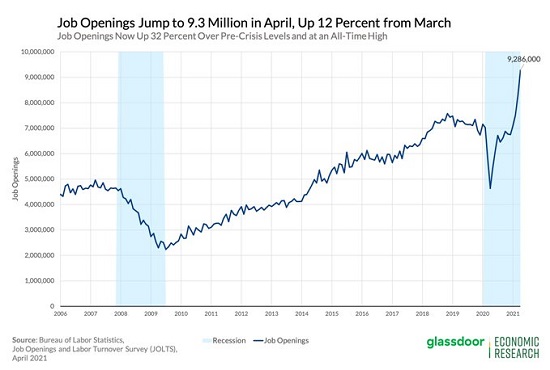
-- Scarcities of labor across the board. (see job openings chart below).

-- Deglobalization / Peak Globalization.

-- Cost and value-creation limits on automation.

-- All the corners have been cut, now prices have to rise or companies will bankrupt themselves.

-- The 'Take This Job and Shove It' Recession (5/12/21) -- Never Going Back -- people are abandoning the status quo hamster wheel.

Few are willing to acknowledge these sources because they run counter the the fantasy world narrative that's spinning the frenzied hamster wheel. Purchasing power is prosperity, and since purchasing power is in free-fall, so is prosperity--at least for the bottom 90%. Trillions in free money have masked the decline temporarily, but what's transitory isn't inflation-- it's the illusion of prosperity that's transitory. And that's why nobody in a position of power wants to discuss prices being driven by scarcities caused by actual physical limits.

Those who think prices can't double or triple haven't experienced scarcities caused by actual physical limits. There are no substitutes for essentials or skilled labor, globalization has already stripmined the planet and central banks can't print experienced workers willing to work for rapidly devaluing wages in dead-end jobs while billionaires pay pennies in taxes.

We're getting a real-world economics lesson in rip-your-face-off increases in prices, and the tuition is about to go up--way up.


If you found value in this content, please join me in seeking solutions by becoming a $1/month patron of my work via patreon.com.

My new book is available! A Hacker's Teleology: Sharing the Wealth of Our Shrinking Planet 20% and 15% discounts (Kindle $7, print $17, audiobook now available $17.46)

Read excerpts of the book for free (PDF).

The Story Behind the Book and the Introduction.


Recent Podcasts:

Charles Hugh Smith on the Era of Accelerating Expropriations (38 min) (FRA Roundtable Insight)

Covid Has Triggered The Next Great Financial Crisis (34:46)

My COVID-19 Pandemic Posts


My recent books:

A Hacker's Teleology: Sharing the Wealth of Our Shrinking Planet (Kindle $8.95, print $20, audiobook $17.46) Read the first section for free (PDF).

Will You Be Richer or Poorer?: Profit, Power, and AI in a Traumatized World
(Kindle $5, print $10, audiobook) Read the first section for free (PDF).

Pathfinding our Destiny: Preventing the Final Fall of Our Democratic Republic ($5 (Kindle), $10 (print), ( audiobook): Read the first section for free (PDF).

The Adventures of the Consulting Philosopher: The Disappearance of Drake $1.29 (Kindle), $8.95 (print); read the first chapters for free (PDF)

Money and Work Unchained $6.95 (Kindle), $15 (print) Read the first section for free (PDF).


Become a $1/month patron of my work via patreon.com.


NOTE: Contributions/subscriptions are acknowledged in the order received. Your name and email remain confidential and will not be given to any other individual, company or agency.

Thank you, Kathleen P.-L. ($25), for your extremely generous contribution to this site -- I am greatly honored by your support and readership.


Thank you, Kerry W. ($25), for your splendidly generous contribution to this site -- I am greatly honored by your steadfast support and readership.

Read more...

Sunday, June 06, 2021

Post-Pandemic Metamorphosis: Never Going Back

People caught on that the returns on the frenzied hamster wheel of "normal" have been diminishing for decades, but everyone was too busy to notice.

The superficial "return to normal" narrative focuses solely on first order effects: now that people can dispense with masks and social distancing, they are resuming their pre-pandemic spending orgy with a vengeance, which augurs great profits for Corporate America and higher tax revenues. Yea for "return to normal."

This superficial narrative ignores second-order effects of the pandemic. Recall that first order effects: every action has a consequence. Second order effects: every consequence has its own consequence. We can also think of these as direct (first order) and indirect (second order) effects.

The pandemic's first order effect was to shut down the frenzied hamster wheel of American life. The consequence of the pandemic--shutdown--had its own consequence: people had the opportunity to experience life outside the frenzied hamster wheel, and ask themselves why they tolerated the dead-end purposelessness, demeaning rigidity and life-draining stress of the whole spinning contraption.

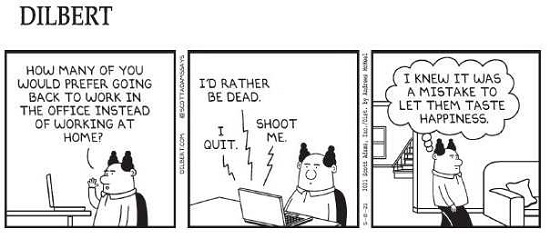
For a great many people and dynamics, the pandemic was a transformative catalyst, and there is no going back to pre-pandemic "normal." Many people experienced a liberty and expansiveness they'd either never experienced or forgot that such things even existed. This experience triggered a Metamorphosis, and they're never going back to pre-pandemic "normal" because "normal" was a nightmarish landscape of exploitation, drudgery, pathology and meaningless servitude.

Consider the re-chaining of the digital workforce to the Cubicle Plantation, where "free" (heh) snacks are supposed to compensate for the dreary Underworld of catatonic-inducing meetings and the rest of the plantation's soul-crushing routines.

Many wage-slaves feel they have no choice but many others have decided they're never going back.


A great many of the working poor have also decided they're never going back, and the time away from their low-paid wage slavery opened up new possibilities, from better-paying jobs to flexible gigs to getting by on informal earnings and part-time work.

Though none of the spending orgy cheerleaders seems to have noticed, global tourism caught a potentially fatal disease in the pandemic's shutdown, as residents discovered their cities, beaches and neighborhoods were actually beautiful and liveable again once the tourists all went away.

While all the corporations and investor-"hosts" profiteering from overcrowded, ruined cities and islands cheer the return of the millions, the residents are vowing to never go back. In Venice, the residents don't want the giant cruise ships returning ever again. In Hawaii, only 14% of the residents approve of a return to the pre-pandemic crush that was ruining the state.

Freed of the burdens of tourism, people are now asking cui bono, to whose benefit? The apologists and PR hacks answer is always the $10/hour dead-end jobs, but the residents no longer buy the bogus PR, as they realize all the "benefits" flow to distant investors, not residents.

The overwhelming majority of Hawaii residents want far fewer tourists, and want those tourists to pay a lot more for the privilege of visiting. They also want limits on how many visitors are allowed daily into beach and other parks, and they want the visitors to pay admission and parking fees so locals can go for free. (Hawaii's annual visitor count topped 1 million in 1969, when I was in high school, and the state was already crowded with tourists. In 2019, the annual visitor count topped 10.4 million.)

Residents from Barcelona to Maui want investor-owned BnBs in residential neighborhoods banned, as the global investor class has bought up real estate in "must-see" locales to profiteer off tourism, over-burdening infrastructure, destroying local neighborhoods and pricing locals out of homes.

The spending orgy cheerleaders are promoting a fantasy version of a time machine in which we reset the calendar to September 2019 and everything "goes back to normal." Sorry, cheerleaders: second-order effects can't be reversed and the cultural revolution is well under way.

People caught on that the returns on the frenzied hamster wheel of "normal" have been diminishing for decades, but everyone was too busy to notice. They all attributed their burnout, exhaustion and emptiness to specifics within their own lives, but now they've awakened to the reality that burnout, exhaustion and emptiness have always been systemic, i.e. the consequence of the system as the returns for participants diminish with every passing day.


If you found value in this content, please join me in seeking solutions by becoming a $1/month patron of my work via patreon.com.

My new book is available! A Hacker's Teleology: Sharing the Wealth of Our Shrinking Planet 20% and 15% discounts (Kindle $7, print $17, audiobook now available $17.46)

Read excerpts of the book for free (PDF).

The Story Behind the Book and the Introduction.


Recent Podcasts:

Charles Hugh Smith on the Era of Accelerating Expropriations (38 min) (FRA Roundtable Insight)

Covid Has Triggered The Next Great Financial Crisis (34:46)

My COVID-19 Pandemic Posts


My recent books:

A Hacker's Teleology: Sharing the Wealth of Our Shrinking Planet (Kindle $8.95, print $20, audiobook $17.46) Read the first section for free (PDF).

Will You Be Richer or Poorer?: Profit, Power, and AI in a Traumatized World
(Kindle $5, print $10, audiobook) Read the first section for free (PDF).

Pathfinding our Destiny: Preventing the Final Fall of Our Democratic Republic ($5 (Kindle), $10 (print), ( audiobook): Read the first section for free (PDF).

The Adventures of the Consulting Philosopher: The Disappearance of Drake $1.29 (Kindle), $8.95 (print); read the first chapters for free (PDF)

Money and Work Unchained $6.95 (Kindle), $15 (print) Read the first section for free (PDF).


Become a $1/month patron of my work via patreon.com.


NOTE: Contributions/subscriptions are acknowledged in the order received. Your name and email remain confidential and will not be given to any other individual, company or agency.

Thank you, John K. ($50), for your monumentally generous contribution to this site -- I am greatly honored by your support and readership.


Thank you, Michael K. ($50), for your splendidly generous contribution to this site -- I am greatly honored by your support and readership.

Read more...

Friday, June 04, 2021

A Couple Things About Inflation

The higher they push phantom "assets" based on exponential increases in leverage, the greater the air gap between essential tangibles and fantasy.

Inflation is in the news, but there are a couple of things about inflation that don't get much coverage. Let's start with the trope that inflation is always a monetary phenomenon. Actually, no.

When nutrient-rich soil and fresh water reserves are depleted, crop yields decline and as human population and appetites for animal protein soar, food becomes scarce. When food becomes scarce, prices rise accordingly. It doesn't matter what you do with money supply, prices will rise in relation to everything used as "money:" gold, shells, paper with colorful pictures printed on it, giant stone disks, quatloos, cryptocurrencies, etc.

You could eliminate "money" entirely and the relative cost of food would rise even in a barter-only system.

What few seem to grasp is that there is a hierarchy of needs that ruthlessly separates "needs" from "wants," and the value of "wants" quickly drops to zero in real scarcities. When you're hungry, I mean really hungry, the value of your yacht, collectible muscle car, NFT, etc. falls to zero if those with food have zero interest in your "valuables." An ounce of gold for an egg? It all depends on what's actually a need.

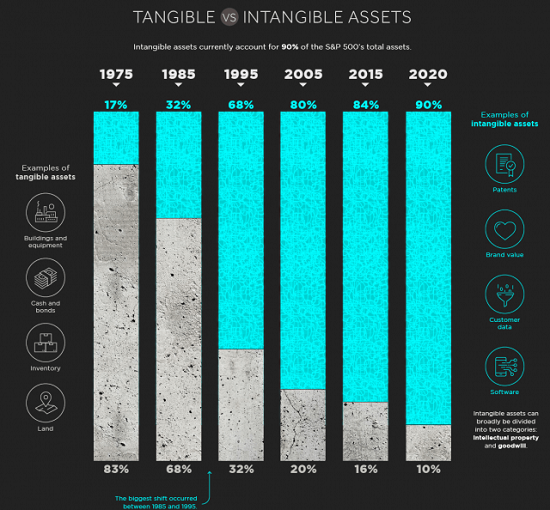
In a similar fashion, real scarcity separates phantom intangible assets from real assets. If you glance at the chart of tangible and intangible assets below, you'll note that phantom intangible assets are now the overwhelming majority of what's laughably called "assets."

You want to trade your shares in XYZ Corporation for a 50-pound bag of rice? How do I know the "value" of shares in XYZ Corporation won't be zero tomorrow? No, thank you. Come back when you have something tangible and tangibly useful (i.e. it will hold its value tomorrow) to trade for the rice.

We inhabit a fantasy world in which scarcity has been banished by the gods of globalized markets and phantom assets built on sandcastles of leverage are the most valuable assets on the planet. Global stocks are now worth $115 trillion, woo-hoo.

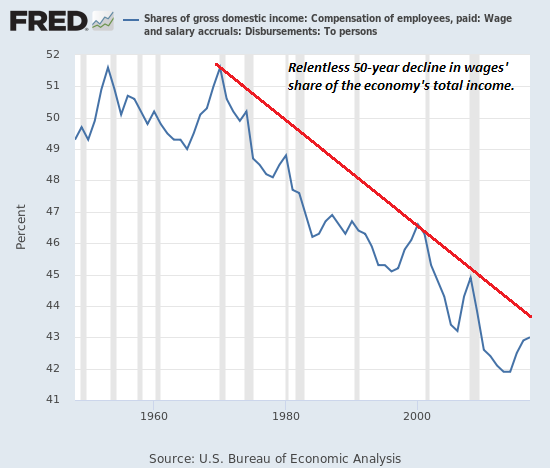
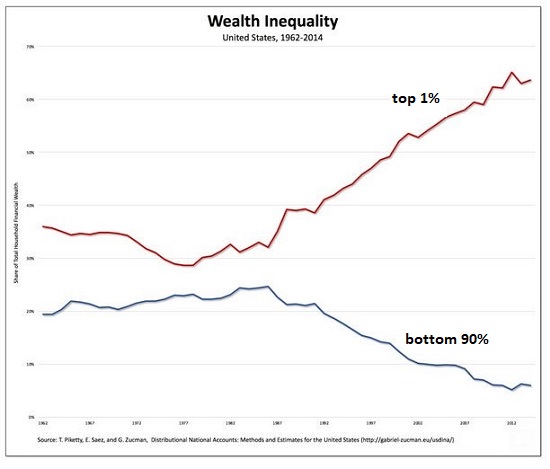
Meanwhile, back in the real world, the vast majority of humanity trades their labor for food and other essentials. The funny thing about human labor is that thanks to population growth, globalization and financialization, the relative value of labor has been in decline for decades. (see chart below) This means that as prices of essentials rise due to scarcities, the quantities of tangibles that labor can buy decline, meaning those trading their labor for essentials can afford fewer essentials.

In other words, their prosperity is in a free-fall as scarcities push up prices of essentials.

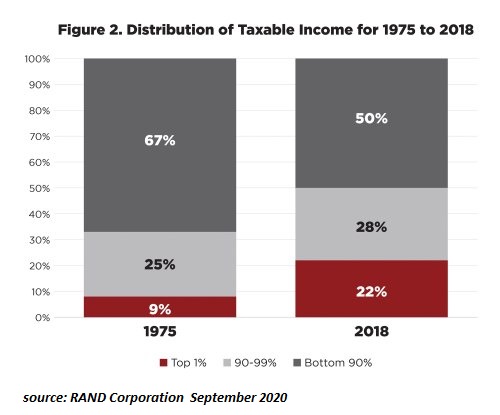
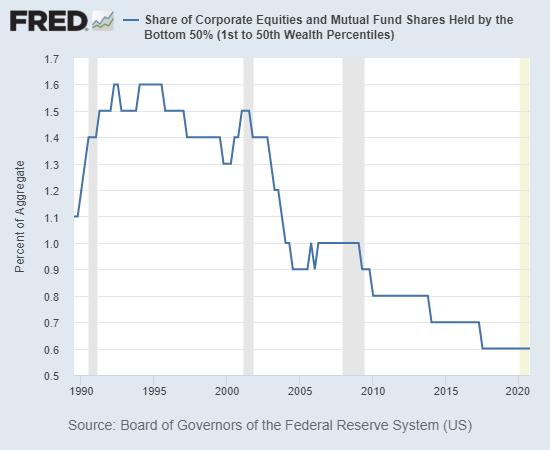
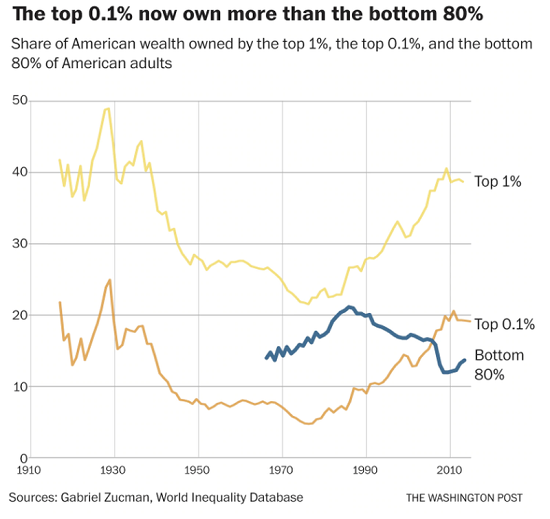
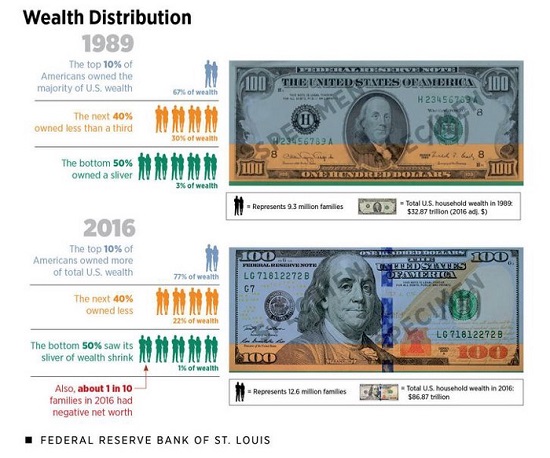
This free-fall of labor's value and thus of prosperity is visible in the RAND chart of income 1975-2018 and in the Federal Reserve database chart of the wealth held by the bottom 50% of American households. The RAND chart of income by the top 1%, top 9% and bottom 90% shows that 25% of the bottom 90%'s income--virtually all from labor--has been transferred to the top 1% (the share of taxable income going to the top 1% rose 2.5-fold) and to a lesser degree, to the top 9%. (Recall that the top 9% mostly rely on earnings from labor, hence their modest increase compared to the top 1%.)

The pathetically thin slice of wealth held by the bottom 50% of American households has fallen to near-zero. It's fallen by 2/3 since the recent peak in the mid-1990s, the last "boom" that trickled down to the bottom 90%.

The bottom 50% have no reserves to draw upon as prices of tangible essentials rise. They have no wealth to sell, and the value of their labor as measured in purchasing power of essentials is in an accelerating decline.

This is a longstanding reality of civilization. As productivity rises, the human population expands up to the carrying capacity of the biosphere. Labor's earnings rise as producers expand production to meet rising demand. Human population and appetites for goodies keep expanding, overshooting sustainable supply while labor expands to the point that it is in oversupply. Wages decline and labor thus loses purchasing power just as prices of essentials soar. Discontent and disorder increase and states and civilizations fall.

I've long recommended these books on the fundamental cycle of civilization:

The Great Wave: Price Revolutions and the Rhythm of History

Ages of Discord

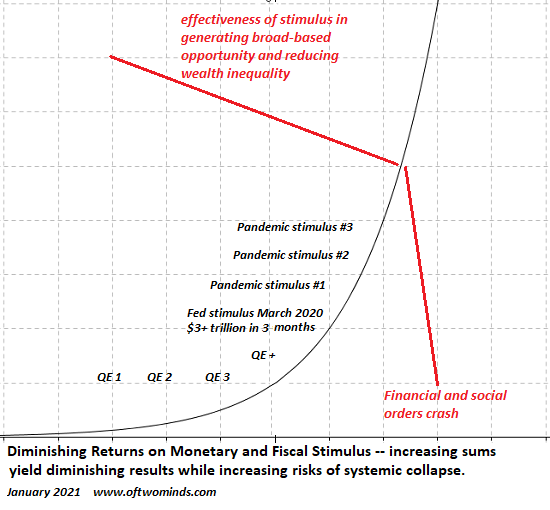
This leads us to the last chart of diminishing returns on the phantom fixes of monetary manipulation and bread and circuses free money. The Federal Reserve can create currency out of thin air but it can't conjure up productive land, fresh water, copper ore, oil, or food.

The Fed can conjure up phantom "wealth" based on leverage but this relies on a heavily hyped faith in a fantasy world in which all tangible scarcities are magically turned to abundance by central bank money creation and low interest rates, and a splash of technocrat pixie dust: carbon taxes, windmills and drones flitting about.

The returns on fantasies and phantom "assets" are also in a free-fall. Monetary and fiscal stimulus is skyrocketing to keep the travesty of a mockery of a sham "prosperity" from collapsing into a putrid sinkhole of failed financial farce.

The higher they push phantom "assets" based on exponential increases in leverage, the greater the air gap between essential tangibles and fantasy.


If you found value in this content, please join me in seeking solutions by becoming a $1/month patron of my work via patreon.com.

My new book is available! A Hacker's Teleology: Sharing the Wealth of Our Shrinking Planet 20% and 15% discounts (Kindle $7, print $17, audiobook now available $17.46)

Read excerpts of the book for free (PDF).

The Story Behind the Book and the Introduction.


Recent Podcasts:

Charles Hugh Smith on the Era of Accelerating Expropriations (38 min) (FRA Roundtable Insight)

Covid Has Triggered The Next Great Financial Crisis (34:46)

My COVID-19 Pandemic Posts


My recent books:

A Hacker's Teleology: Sharing the Wealth of Our Shrinking Planet (Kindle $8.95, print $20, audiobook $17.46) Read the first section for free (PDF).

Will You Be Richer or Poorer?: Profit, Power, and AI in a Traumatized World
(Kindle $5, print $10, audiobook) Read the first section for free (PDF).

Pathfinding our Destiny: Preventing the Final Fall of Our Democratic Republic ($5 (Kindle), $10 (print), ( audiobook): Read the first section for free (PDF).

The Adventures of the Consulting Philosopher: The Disappearance of Drake $1.29 (Kindle), $8.95 (print); read the first chapters for free (PDF)

Money and Work Unchained $6.95 (Kindle), $15 (print) Read the first section for free (PDF).


Become a $1/month patron of my work via patreon.com.


NOTE: Contributions/subscriptions are acknowledged in the order received. Your name and email remain confidential and will not be given to any other individual, company or agency.

Thank you, James Michael S. ($200), for your beyond-outrageously generous contribution to this site -- I am greatly honored by your steadfast support and readership.


Thank you, Oliver M. ($5/month), for your splendidly generous subscription to this site -- I am greatly honored by your support and readership.

Read more...

Wednesday, June 02, 2021

(Not) Living Large on Social Security

For about 1 in 4, Social Security provides at least 90 percent of their income.

How many retired workers are getting less than $1,000 per month in Social Security benefits? The question came up and I was curious enough to find the answer, and download the data into an Excel spreadsheet which I saved as a PDF that you can review here. Note that this data is for the 46.5 million retired workers only, and does not include benefits paid to survivors, spouses, disabled, etc.

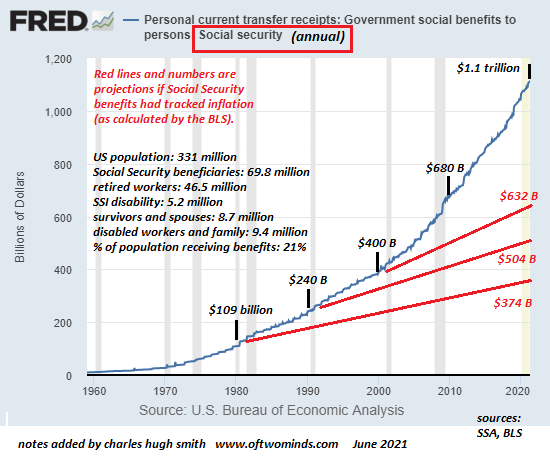
This led to a deep dive into the basic numbers of Social Security beneficiaries and expenses, which are summarized in the chart below. Here are the basics:

Population of the US: 331 million
Social Security beneficiaries: 69.8 million (21% of the population)
Retired workers: 46.5 million (14% of the population)
Survivors and spouses: 8.7 million
Disabled workers and families: 9.4 million
SSI disability: 5.2 million
Projected annual cost 2021: $1.1 trillion

It turns out that 23.4% of all retired workers receive less than $1,000 a month in Social Security (SSA) benefits. Note that $148.50 is deducted monthly from the SSA benefit for Medicare Part B for retirees age 65 and older, so the net cash received is $148.50 less than the full benefit for everyone in Medicare (age 65 and older).

Roughly half of all retired workers receive $1,500 or less per month.

76% of all retired workers receive less than $2,000 a month.

91% of all retired workers receive less than $2,500 a month.

98% of all retired workers receive less than $3,000 a month.

4,201 beneficiaries receive $4,000 or more per month.

For roughly half of the elderly, Social Security provides 50 percent of their income, and for about 1 in 4, it provides at least 90 percent of their income. The top 10% of senior households enjoy average incomes of about $230,000. Social Security Benefits Are Modest (Center on Budget and Policy Priorities)

In summary, few are living large on Social Security benefits.

The chart below depicts the accelerating costs of SSA retirement and disability benefits. As a guideline, I extended the SSA expenditures in 1980, 1990 and 2000 if the expenditures had tracked inflation, as calculated by the Bureau of Labor Statistics (BLS). Clearly, the programs' costs are rising faster than inflation as the number of retirees and disabled expands.

You can find further data on these Social Security Administration pages:

Retired worker beneficiaries in current payment status at the end of December 2020

Social Security Administration Monthly Statistical Snapshot, April 2021


If you found value in this content, please join me in seeking solutions by becoming a $1/month patron of my work via patreon.com.

My new book is available! A Hacker's Teleology: Sharing the Wealth of Our Shrinking Planet 20% and 15% discounts (Kindle $7, print $17, audiobook now available $17.46)

Read excerpts of the book for free (PDF).

The Story Behind the Book and the Introduction.


Recent Podcasts:

Charles Hugh Smith on the Era of Accelerating Expropriations (38 min) (FRA Roundtable Insight)

Covid Has Triggered The Next Great Financial Crisis (34:46)

My COVID-19 Pandemic Posts


My recent books:

A Hacker's Teleology: Sharing the Wealth of Our Shrinking Planet (Kindle $8.95, print $20, audiobook $17.46) Read the first section for free (PDF).

Will You Be Richer or Poorer?: Profit, Power, and AI in a Traumatized World
(Kindle $5, print $10, audiobook) Read the first section for free (PDF).

Pathfinding our Destiny: Preventing the Final Fall of Our Democratic Republic ($5 (Kindle), $10 (print), ( audiobook): Read the first section for free (PDF).

The Adventures of the Consulting Philosopher: The Disappearance of Drake $1.29 (Kindle), $8.95 (print); read the first chapters for free (PDF)

Money and Work Unchained $6.95 (Kindle), $15 (print) Read the first section for free (PDF).


Become a $1/month patron of my work via patreon.com.


NOTE: Contributions/subscriptions are acknowledged in the order received. Your name and email remain confidential and will not be given to any other individual, company or agency.

Thank you, Kwai H. ($5/month), for your marvelously generous subscription to this site -- I am greatly honored by your support and readership.


Thank you, Saw-Whet Farm ($50), for your splendidly generous contribution to this site -- I am greatly honored by your support and readership.

Read more...

Sunday, May 30, 2021

Why the Minimum Wage Should Be $18/Hour

What does it say about our "prosperity" if we can't even afford to equal the purchasing power of the minimum wage paid 50 years ago? It says the 1% got the mine and the bottom 90% got the shaft.

Given the rising prosperity we keep hearing about, shouldn't we be able to provide minimum wage workers the same purchasing power they enjoyed 50 years ago in 1970? This is a very simple proposition: either can provide minimum wage workers the same purchasing power they enjoyed 50 years ago or we can't, and if we can't, then all the claims about "rising prosperity" are revealed as false.

Since I was a minimum wage earner in 1970 at age 16, I have first-hand experience of the purchasing power of minimum wages in the 1970-1974 era. Let's keep it simple: how many hours of minimum wage labor did it take to buy a new economy car, a new house and rent a studio apartment in one of the most expensive cities in the U.S.?

To keep it simple, let's set aside taxes and just use the basic minimum wage, not the net wage.

Never mind all the fancy statistical footwork of hedonics, substitution and weighting that are deployed to arbitrarily lower the rate of consumer price inflation. In the real world, wage earners bought whatever cars and houses were available at the time, and rented whatever apartments were available at the time.

The only accurate way to measure the purchasing power of labor is to ask: how many hours of labor did it require to pay the rent, buy a new car or buy a new house? Any other measure is just sleight of hand intended to obscure the collapse of wages' purchasing power.

In 1970, I earned $1.65 an hour. A new economy car (Ford Maverick or VW beetle) was $2,000, so it took about 1,200 hours of work to buy a new economy car.

A new house cost on average about $26,000 in 1970, so it took 15,750 hours of minimum wage labor to buy a new house.

At today's federal minimum wage of $7.25/hour, it takes 3,000 hours to buy a basic 2021 Honda Civic or equivalent which costs $22,000. To buy a new economy car today with 1,200 hours of minimum wage labor, the minimum wage would need to be $18.30 /hour: 1,200 time $18.30 = $21,960.

At today's federal minimum wage of $7.25/hour, it takes 56,000 hours to buy the average priced house which now costs $408,000. Let's say there are houses available for $300,000, so it takes 41,380 hours of minimum wage labor to buy a house.

To buy a new house for $408,000 with 15,750 hours of labor, the wage would need to be $25.90/hour. To buy a $300,000 home with 15,750 hours of labor, the wage would need to be $19/hour.

Moving forward a few years to 1974, the minimum wage increased to $2/hour, and I rented a small studio apartment in Honolulu, one of the most expensive cities in the U.S. for $120/month. Thus it took 60 hours of minimum wage labor to pay the rent.

Studio apartments in Honolulu are now around $1,100/month rent, so to pay the rent with 60 hours of minimum wage labor, the minimum wage would need to be $18.30/hour.

In 1974, I paid $89.25 in tuition and $27 student fees per semester to attend the University of Hawaii at Manoa. (These numbers stick in your head when you're paying for them in cash earned at low-paying jobs while you're carrying a full five courses a semester.) That's $233 per year. At a wage of $2/hour, it took 116 hours of labor to pay the annual tuition and fees.

The current cost of tuition and fees at the University of Hawaii at Manoa is $12,186 per year. To pay the tuition and fees with 116 hours of work, the hourly wage would need to be $105/hour. If America gets any more "prosperous," I won't know whether to puke or go blind.

To equal the purchasing power of minimum wages in 1970-1074, the minimum wage would have to be at least $18/hour. Anything less does not equal the purchasing power of the minimum wage paid 50 years ago, and no amount of statistical trickery can erase this reality.

What does it say about our "prosperity" if we can't even afford to equal the purchasing power of the minimum wage paid 50 years ago? It says the 1% got the mine and the bottom 90% got the shaft.


sources:

https://www.dol.gov/agencies/whd/minimum-wage/history/chart
https://www.bls.gov/data/inflation_calculator.htm
http://www.1970sflashback.com/1970/economy.asp
http://www.thepeoplehistory.com/70scars.html
https://www.statista.com/statistics/240991/average-sales-prices-of-new-homes-sold-in-the-us/
https://files.eric.ed.gov/fulltext/ED086037.pdf


If you found value in this content, please join me in seeking solutions by becoming a $1/month patron of my work via patreon.com.

My new book is available! A Hacker's Teleology: Sharing the Wealth of Our Shrinking Planet 20% and 15% discounts (Kindle $7, print $17, audiobook now available $17.46)

Read excerpts of the book for free (PDF).

The Story Behind the Book and the Introduction.


Recent Podcasts:

Charles Hugh Smith on the Era of Accelerating Expropriations (38 min) (FRA Roundtable Insight)

Covid Has Triggered The Next Great Financial Crisis (34:46)

My COVID-19 Pandemic Posts


My recent books:

A Hacker's Teleology: Sharing the Wealth of Our Shrinking Planet (Kindle $8.95, print $20, audiobook $17.46) Read the first section for free (PDF).

Will You Be Richer or Poorer?: Profit, Power, and AI in a Traumatized World
(Kindle $5, print $10, audiobook) Read the first section for free (PDF).

Pathfinding our Destiny: Preventing the Final Fall of Our Democratic Republic ($5 (Kindle), $10 (print), ( audiobook): Read the first section for free (PDF).

The Adventures of the Consulting Philosopher: The Disappearance of Drake $1.29 (Kindle), $8.95 (print); read the first chapters for free (PDF)

Money and Work Unchained $6.95 (Kindle), $15 (print) Read the first section for free (PDF).


Become a $1/month patron of my work via patreon.com.


NOTE: Contributions/subscriptions are acknowledged in the order received. Your name and email remain confidential and will not be given to any other individual, company or agency.

Thank you, Robert H. ($50), for your marvelously generous contribution to this site -- I am greatly honored by your support and readership.


Thank you, Herb S. ($200), for your beyond-outrageously generous contribution to this site -- I am greatly honored by your steadfast support and readership.

Read more...

Terms of Service

All content on this blog is provided by Trewe LLC for informational purposes only. The owner of this blog makes no representations as to the accuracy or completeness of any information on this site or found by following any link on this site. The owner will not be liable for any errors or omissions in this information nor for the availability of this information. The owner will not be liable for any losses, injuries, or damages from the display or use of this information. These terms and conditions of use are subject to change at anytime and without notice.


Our Privacy Policy:


Correspondents' email is strictly confidential. This site does not collect digital data from visitors or distribute cookies. Advertisements served by a third-party advertising network (Investing Channel) may use cookies or collect information from visitors for the purpose of Interest-Based Advertising; if you wish to opt out of Interest-Based Advertising, please go to Opt out of interest-based advertising (The Network Advertising Initiative). If you have other privacy concerns relating to advertisements, please contact advertisers directly. Websites and blog links on the site's blog roll are posted at my discretion.


PRIVACY NOTICE FOR EEA INDIVIDUALS


This section covers disclosures on the General Data Protection Regulation (GDPR) for users residing within EEA only. GDPR replaces the existing Directive 95/46/ec, and aims at harmonizing data protection laws in the EU that are fit for purpose in the digital age. The primary objective of the GDPR is to give citizens back control of their personal data. Please follow the link below to access InvestingChannel’s General Data Protection Notice. https://stg.media.investingchannel.com/gdpr-notice/


Notice of Compliance with The California Consumer Protection Act
This site does not collect digital data from visitors or distribute cookies. Advertisements served by a third-party advertising network (Investing Channel) may use cookies or collect information from visitors for the purpose of Interest-Based Advertising. If you do not want any personal information that may be collected by third-party advertising to be sold, please follow the instructions on this page: Limit the Use of My Sensitive Personal Information.


Regarding Cookies:


This site does not collect digital data from visitors or distribute cookies. Advertisements served by third-party advertising networks such as Investing Channel may use cookies or collect information from visitors for the purpose of Interest-Based Advertising; if you wish to opt out of Interest-Based Advertising, please go to Opt out of interest-based advertising (The Network Advertising Initiative) If you have other privacy concerns relating to advertisements, please contact advertisers directly.


Our Commission Policy:

As an Amazon Associate I earn from qualifying purchases. I also earn a commission on purchases of precious metals via BullionVault. I receive no fees or compensation for any other non-advertising links or content posted on my site.

  © Blogger templates Newspaper III by Ourblogtemplates.com 2008

Back to TOP