

Friday, August 28, 2020

How Extremes Become More Extreme, Triggering Collapse

The extremes are not visible to the vast majority of participants, and so they are exposed to high levels of risk they don't see or understand.
The question "Is the weather becoming more extreme?" opens up endless debates because our perceptions may differ from actual measurements since we're prone to recency bias, where what happened recently looms much larger than events of a decade or century ago.
In the realm of economics and markets, our perceptions of extremes are backed up with data: based on the ratio of stock valuations to GDP and corporate sales (not profits, because profits are easily gamed) to GDP, the stock market has never been as over-valued as it is today.
The rally in global stocks off the March lows is the steepest such rally ever. The unemployment rate is equally extreme, as is the Federal Reserve's money-printing: $3 trillion has been created out of thin air since February 26 as the Fed's balance sheet rose from $4 trillion to $7 trillion.
Financial/market extremes are becoming more extreme.
The disruptive social and political consequences of systemic unfairness and extreme wealth inequality are still unfolding, as are the global consequences of the Covid-19 pandemic.
Setting aside the specifics, can we discern systemic dynamics that could make extremes become more extreme?
Feedback loops are one such dynamic. Somewhat counter-intuitively, when feedback arises to moderate the intensity of a trend, that's negative feedback. When feedback intensifies the trend, it's positive feedback.
Why is this counter-intuitive? If a bad trend is moderated by negative feedback, that's good (positive). If a bad trend gathers momentum due to positive feedback, that's bad (negative).
When an insect population explodes higher due to ideal conditions, birds and other predators feast on the over-supply, reducing the infestation. This negative feedback moderates the damage inflicted by the infestation.
If a rapidly expanding insect horde has few predators and its range and mobility increase with every generation, allowing it to find new food sources, this positive feedback enables a vast expansion in each generation--exactly what's we're witnessing with locusts.
Positive feedback leads to runaway systems, i.e. run to failure where the system accelerates until it collapses.
If the system is isolated, then the damage is contained. But if the system is interconnected with others, then its failure could trigger the collapse of other systems, either as a direct (first-order) effect or as an indirect (second-order) effect.
In other words, in highly inter-connected systems, one failure can trigger a domino effect that can become non-linear once second-order effects manifest.
For example, consider the direct effects of the pandemic on small Main Street businesses. Surveys have found that around 40% of small business owners are planning to close permanently. The reasons were not surveyed, but the obvious reason is the owners don't see a 100% return of their revenues as likely, and so it's prudent to staunch the losses by closing now rather than risk catastrophic losses by re-opening.
The first-order effect of urban disorder is the destruction of some small businesses. This may push indecisive owners into closing for good, or considering moving to a safer locale outside the city.
The second-order effect is the re-assessment of business owners on the likelihood of further disorder in the future. If that seems probable, or even possible, the uncertainty that creates could cause customers to avoid downtown areas, even if no further disorder occurs. The uncertainty alone will diminish commerce that was already crushed by the pandemic.
There is another class of dynamics I call hidden extremes because the long-term trend appears benign even as it reaches breaking points with the potential to collapse the system.
Cost is my ongoing example. The costs of operating a small business have been rising far faster than official inflation or incomes for years. Rent, utilities, licensing fees, taxes, wages, labor overhead, insurance--virtually every category of expense has climbed inexorably for years.
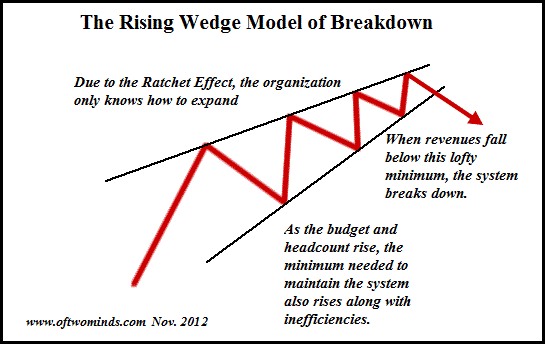
These increases in fixed costs (costs that are unrelated the number of customers served) have pushed many small businesses closer to the edge of insolvency. To compensate,owners have cut employee hours and shouldered more of the day-to-day work themselves. But there is a limit on this kind of workaround; the owner can only work so many hours a day, and every additional hour increases the odds of burnout, a complete collapse of the owner's ability to continue over-working.
I call this the Rising Wedge Model of Breakdown: costs ratchet higher effortlessly, but reducing costs encounters extreme resistance.
In other words, a consequential percentage of small businesses were at their extreme limit in the rising wedge even before the pandemic. Now the wedge has broken as their revenues falling by even a modest percentage is enough to trigger losses they cannot sustain.
Another dynamic that can make extremes even more extreme is the Pareto Distribution, a.k.a. the 80/20 Rule: the vital 20% wields outsized influence over the 80%, and the 20% of the 20% (4%) exerts outsized influence over 80% of the 80% (64%).
Just as 80% of sales come from the top 20% of sales staff and the top 20% of households end up with 80% of the wealth, the top 4% can wield non-linear influence over the 64% if they gain the power to enforce a positive feedback loop to increase their power at the expense of the 64%.
While we hope the best 4% will gain this influence, history suggests that the worst 4% (sociopaths, etc.) are highly motivated to seek power in a vacuum or when the opportunity presents itself.
The 64% tend to hope for the best even as the 4% tighten their grip on the economy and social order. This is the totalitarian feedback loop illustrated by the rise of the Nazis in Germany and the Communists in Russia.
But the 4% need not wield direct power; it is enough that they threaten or disrupt the certainty of the 64%.
For example, if the movement to de-fund police departments triggers mass resignations of police officers, the 4% criminal element will quickly increase their predation on the 64%, who will then lose the presumption of relative safety required to conduct commerce.
Again, uncertainty becomes a self-reinforcing feedback that disrupts the economy and the social order, because people make different decisions when they lack certainty in outcomes and the future.
In other words, the actual crime rate need not increase by much to trigger a complete recalculation of risk and uncertainty that could then trigger a mass exodus from city centers by small businesses and the top 20% of households with the most to lose and the most mobility.
Once these sectors abandon the city, the economy and social order collapse to levels that no one thought possible. Again, the point here is effects everyone thinks are linear quickly become non-linear: thus a 10% increase in crime doesn't cause a linear 10% reduction in commerce, it triggers a 50% decline in commerce which then unleashes a second wave of decline as the loss of 50% of small businesses reduces the attractiveness and safety of the hollowed-out neighborhood.
In my analysis, costs for small businesses and urban residents were already at extremes that were hidden or accepted as "normal." What few understood was how pushing costs into the top of the rising wedge made the entire system vulnerable to non-linear breakdown. This breakdown is what I see unfolding in the economy and the social order.
Extremes will become more extreme because the positive feedback loops of the Pareto Distribution are overwhelming the moderating negative feedback loops of resilience (i.e. buffers), certainty and institutional trust/credibility.
The financial system is extremely vulnerable to disruption and collapse for the same reasons: the extremes are not visible to the vast majority of participants, and so they are exposed to high levels of risk they don't see or understand.
Recent Podcasts:
Money and Work Unchained $6.95 (Kindle), $15 (print) Read the first section for free (PDF).


If you found value in this content, please join me in seeking solutions by becoming a $1/month patron of my work via patreon.com.

NOTE: Contributions/subscriptions are acknowledged in the order received. Your name and email remain confidential and will not be given to any other individual, company or agency.
Thank you, Craig D. ($5/month), for your splendidly generous pledge to this site -- I am greatly honored by your support and readership.
 
Thank you, David ($5/month), for your marvelously generous pledge to this site -- I am greatly honored by your support and readership.

Read more...

Thursday, August 27, 2020

America's Metastasizing Class Wars

Class wars are the inevitable result of an economic system in which 'anything goes if you're rich enough and winners take most'. 
The traditional class war has been waged between wage-earners (who sell their labor) and their employers (owners of capital and the means of production). These classes have been assigned various names (proletariat, bourgeoisie, capitalists, etc.) but these broad class definitions don't describe all the class conflicts emerging in the modern U.S. economy.
Before we dig deeper, let's stipulate that ownership of various forms of capital still defines class: the wealthy live off unearned income skimmed from capital and everyone else lives off earned income from selling their labor. (Those without either source of income become dependents of the State).
What you own or don't own defines your class interests, but these have been fragmented into a multitude of sub-classes. Six years ago I took a stab at defining America's Nine Classes: The New Class Hierarchy (April 29, 2014), to which I would now add a tenth class, gig economy precariat, who paradoxically may own one of the means of production such as the car needed to become an Uber driver, but the precariat doesn't own the controlling means of production, which is the Uber platform.
As a consequence, all the profits flow to the owners of the platform. Since the gig economy is not traditional hourly employment, there is no employer-provided security at all.
My taxonomy of class in America:
1. The Deep State.
2. The Oligarchs.
3. New Nobility.
4. Upper Caste.
5. State Nomenklatura.
6. The Middle Class.
7. The Working Poor.
8. State Dependents.
9. Mobile Creatives.
To which we add a new category of the working poor who lack even the minimal security of the conventional Working Poor (such as Amazon fulfillment center workers):
10. Gig economy precariat.
For the purposes of today's discussion, let's focus on the conflicts between four classes:
1. The Central State, which includes the elected government, the permanent Deep State, the Federal Reserve and and the managers/technocrats who run the State Nomenklatura.
2. The owners of Capital and political influence (The Oligarchs and New Nobility).
3. The Upper Caste, the top 10% of the private sector.
4. The lower classes of wage-earners and state dependents.
It comes as no surprise that there is no class conflict between the State and the Oligarchs / New Nobility since ours is a state-corporate system in which the state enforces the privileges of the super-wealthy /corporations, as the political class depends on the owners of capital for campaign contributions. In return, the super-wealthy and corporations are awarded tax breaks and subsidies which lower their tax burdens below the rates paid by wage-earners.
The conflicts between the Central State and the Upper Caste which pays the majority of income taxes are sharpening. While Social Security taxes weigh heavily on lower-income workers, the bottom 50% pay almost no federal income taxes and those between 51% and 89% pay a modest percent of all income taxes.
Unlike the managers/technocrats of the State Nomenklatura who are guaranteed benefit and pensions (since the state can always print the money to pay them), the private-sector Upper Caste must rely on 401Ks and their own private wealth--all of which is exposed to the hazards of state actions (raising taxes, firing up inflation, etc.) and whatever market forces are still outside the control of the Federal Reserve.
The Upper Caste resents the heavy taxes they pay as the state fails to provide even the basics of security and infrastructure. From the point of view of the Upper Caste, the state provides substandard education for their children, potholed roadways, modest Social Security and no healthcare until retirement (Medicare).
Upper Caste entrepreneurs resent the heavy regulatory burdens and the privileges lavished on corporations and the super-wealthy.
The Upper Caste also resents the Oligarchs and New Nobility who pay a lower percentage of their income in taxes. The Financial Aristocracy can work the tax system to report income as capital gains (a much lower rate than earned income) and use a vast cornucopia of tax breaks and subsidies to reduce their tax burden.
The wage-earning lower classes resent the Upper Caste and the Oligarchs for obvious reasons, but they also resent the State dependents, many of whom live better than those working one of America's tens of millions of low-paid, few-benefits jobs.
You might expect State dependents to love their servitude, but they have reasons to resent the State as well. Dependency breeds resentment, and this is exacerbated by loads of paperwork (imposed to weed out fraud and scammers) and the general inadequacy of many state benefits.
Meanwhile, the state managers/technocrats and politicos live in the same bubbles as the New Nobility. (The Oligarchs live in a much more rarified bubble, of course.) For these Protected Few, the system works great for me so it must work great for everyone else. Alas, it only works for the top slice of American society which vigorously maintains the bubble separating it from the coarse realities of the bottom 80%.
In summary, class wars are the inevitable result of an economic system in which anything goes if you're rich enough and winners take most. While the working poor are recruited to fight and die in the Imperial Project, the super-wealthy focus on philanthro-capitalist foundations which are simply non-profit extensions of their for-profit power.
Social Mobility between classes has decayed, and people grasp this. Go ahead and do all the right things--borrow a fortune to get a college degree, build your resume with low-paying jobs working ridiculous hours, and so on, and eventually conclude you're a precariat just like everyone else. Maybe a better paid precariat, or maybe a poorly paid precariat, but that narrow band is all the Financial Mobility you're ever going to get.
The winners in this system are protected by the State, while the losers are stripmined by crushing taxes or humiliated by their abject dependence on the state. Even if they don't understand the exact mechanisms of financial control--the Federal Reserve's bag of tricks, for example--they understand the rich get richer and the state protects them from the lower classes.
The danger to the state is not who rebels but who opts out. Outright rebellion suits the state, as it can turn its monopoly on force on the citizenry. But when those keeping everything glued together have had enough and find a way to quit, the entire system starts unraveling in ways the state is powerless to stop.
If the Upper Caste starts opting out, the private sector loses its tax donkeys and managerial expertise. If what remains of the middle class opts out, what's left of America's civic glue disappears.
If the working poor opt out, the scut work required to provide the upper classes with their comforts will not get done. (Hey, Mr. State Bureaucrat and Mr. Financier, here's a saw and a knife. Butcher your own meat.)
Those trapped in the lower reaches of America's class system might decide to follow Johnny Paycheck and Take This Job And Shove It (2:31). Becoming a dependent of the State is looking better all the time.
State Nomenklatura managers/technocrats also have reasons to opt out. Their efforts to keep the whole thing glued together are not appreciated, for as I've noted here before, governing in an era of unraveling discord is no longer fun.
Conflicts within the upper reaches of the Deep State are also deepening as those seeking to extend the status quo regardless of cost are meeting resistance from camps who recognize the impossibility of maintaining the current trajectory of soaring inequality and the infinite demands of the Imperial Project.
There's only so much inequality and unfairness an over-promised populace can bear, and America is well past that point.
To those who claim "people can't afford to quit," just watch. Those who've had enough will find a way to opt out. There's plenty of woodwork to disappear into.
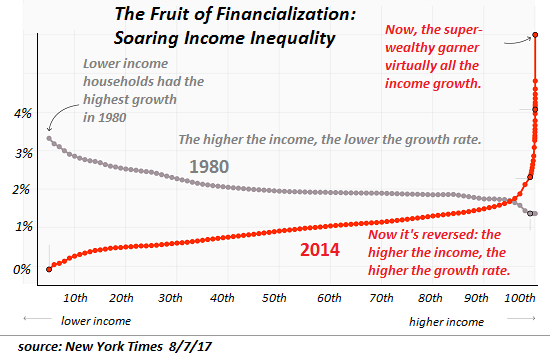
Here's a chart of the Oligarchy and New Nobility's skim of virtually all gains in the economy. Anything goes if you're rich enough and winners take most.
Recent Podcasts:
My COVID-19 Pandemic Posts


My recent books:
Money and Work Unchained $6.95 (Kindle), $15 (print) Read the first section for free (PDF).


If you found value in this content, please join me in seeking solutions by becoming a $1/month patron of my work via patreon.com.

NOTE: Contributions/subscriptions are acknowledged in the order received. Your name and email remain confidential and will not be given to any other individual, company or agency.
Thank you, Matthew S. ($5/month), for your magnificently generous pledge to this site -- I am greatly honored by your support and readership.
Thank you, Richard O. ($25), for your marvelously generous contribution to this site -- I am greatly honored by your steadfast support and readership.

Read more...

Tuesday, August 25, 2020

The Pandemic Is Accelerating Trends That Are Disrupting the Foundations of the Economy

The problem is the economy that's left has no means of creating tens of millions of jobs to replace those lost as the 1959 economic model collapses.
Fundamentally, the economy of 2019 was not very different from the economy of 1959: people went shopping at retail stores, were educated at sprawling college campuses, went to work downtown, drove to the doctor's office or hospital, caught a flight at the airport, and so on.
The daily routine of the vast majority of the workforce was no different from 1959. In 2019, the commutes were longer, white-collar workers stared at screens rather than typewriters, factory workers tended robots and so on, but the fundamentals of everyday life and the nature of work were pretty much the same.
Beneath the surface, the fundamental change in the economy was financialization, the commodification of everything into a financial asset or income stream that could then be leveraged, bundled and sold globally at an immense profit by Wall Street financiers.
This layer of speculative asset-income mining had no relation to the actual work being done; it existed in its own derealized realm.
For decades, these two realms--the structure of everyday life (to borrow Braudel's apt term) and the abstract, derealized but oh so profitable realm of financialization--co-existed in an uneasy state of loosely bound systems.
If you squinted hard enough and repeated the mantras often enough, you could persuade yourself there was still some connection between the everyday-life economy and the realm of financialization.
The two realms have now disconnected, and the real-world economy has been ripped from its moorings, as patterns of work and every-day life that stretch back 70 years to the emergence of the postwar era unravel and dissolve.
The trends that are currently fatally disrupting retail, education, office work and healthcare have been in place for years. When I wrote my 2013 book about the digitized future of higher education in a low-cost union of high-touch and low-touch learning, The Nearly Free University, all these trends were already clearly visible to those willing to look beyond the models embedded in the economy for decades or even centuries.
Visionaries like Peter Drucker foresaw the complete disruption of the education and healthcare sectors as far back as 1994. Post-Capitalist Society.
The problem with this disruption is it eliminates tens of millions of jobs--not just the low-paying jobs in retail and dining-out, but high-paying jobs in university administration, healthcare, and other core service sectors.
The last real-world connection between everyday life and financialization was the over-supply of everything that could be financialized: the way to reap the big profits was expand whatever could be leveraged and sold. So retail and commercial space ballooned, colleges proliferated, cafes sprang up on every corner, etc.
Meanwhile, financialization's unquenchable thirst for higher profits stripped everything of the redundancy and buffers required to stabilize the system in times of crisis. So hospitals no longer kept inventory because by the logic of financialization, all that mattered was maximizing the return on capital--nothing else could possibly matter in the derealized realm of speculative profiteering.
Now healthcare finds itself trapped between the pincers of financialization's stripmining and the collapse of retail in-person demand--the financial foundation of the entire system. Under the relentless pressure of financialization's stripmining and profteering, healthcare only survives if it can bill somebody somewhere a staggering amount for everything from office visits to procedures to hospital stays to medications.
Once that avalanche of billing dries up, the entire sector implodes: a sector that accounts for almost 20% of the U.S. economy.
Higher education is also imploding, and for the same reason: its output no longer justified its enormous cost structure. The same can be said of overbuilt retail and commercial space: the financial justification for sky-high rents have imploded and will never come back. The over-supply is so monumental and the collapse of demand so permanent, the gigantic pyramid of debt and speculative excess piled on all these excesses is collapsing.
A bailout by the Federal Reserve won't change the fundamentals of the collapse of financialization; all the Fed can do is reserve scarce lifeboat seats for its billionaire banker-financier pals. (Warren, you know Bill, have you met Jamie, Jeff, Tim and the rest of the Zillionaire Rat-Pack?)
Despite the record highs in the stock market--the ultimate expression of financialization disconnected from the real-world economy--financialization is also imploding. Financialization still claimed a connection to the real world of income streams and the value of the collateral underlying all the speculative profiteering: the high rents paid by the restaurants on the ground floor and the businesses for office space above justified the high value of the collateral, the commercial building.
Foundational swaths of the real-world economy have been swept away, and so the collateral is largely worthless. Lots of people want their employer to start paying for business-class airline seats again so they can jet around the country on somebody else's dime, staying in pricey hotels and attending conferences, but these activities no longer have any financial justification.
The economy of 1959 is finally expiring. The enormous time and money sinks of transporting humans hither and yon no longer have any financial justification.
The problem is the economy that's left has no means of creating tens of millions of jobs to replace those lost as the 1959 economic model collapses. We all know that automation is replacing human labor, but the real change is the collapse of the financial justification for the enormously costly systems we now depend on to generate jobs: healthcare, retail, tourism, dining out, education, working downtown, and all the professions dependent on managing all this complexity.
While the elimination of low-skill jobs--a longstanding trend--is attracting attention, the implosion of the 1959 economic model and financialization will soon sweep away millions of high-paying professional jobs that no longer have any financial justification.
As the 1959 economy implodes, so does the tax system based on payroll taxes and property taxes. This article sketches out the perverse incentives for employers to invest in automation rather than hire workers: Covid-19 Is Dividing the American Worker (WSJ.com)
There are alternatives, but they require accepting the implosion of both the 1959 economic model and its evil offspring, financialization.
I sketched out an alternative way of organizing work, everyday life and finance in my book A Radically Beneficial World. There are alternative ways of organizing civilization other than the insanely wasteful and exploitive system we now inhabit.
Recent Podcasts:
Money and Work Unchained $6.95 (Kindle), $15 (print) Read the first section for free (PDF).


If you found value in this content, please join me in seeking solutions by becoming a $1/month patron of my work via patreon.com.

NOTE: Contributions/subscriptions are acknowledged in the order received. Your name and email remain confidential and will not be given to any other individual, company or agency.
Thank you, Tedd K.-H. ($5/month), for your magnificently generous pledge to this site -- I am greatly honored by your support and readership.
 
Thank you, Steve D. ($5/month), for your marvelously generous pledge to this site -- I am greatly honored by your support and readership.

Read more...

Terms of Service

All content on this blog is provided by Trewe LLC for informational purposes only. The owner of this blog makes no representations as to the accuracy or completeness of any information on this site or found by following any link on this site. The owner will not be liable for any errors or omissions in this information nor for the availability of this information. The owner will not be liable for any losses, injuries, or damages from the display or use of this information. These terms and conditions of use are subject to change at anytime and without notice.

RE: European Union AI Act, and Our Use of Generative AI Tools and Agents Policy

All text on this site is composed by Charles Hugh Smith or by a credited guest-author. No Generative AI Tools are used in the composition / writing of any text or graphic content created by Charles Hugh Smith. This site deploys no AI agents or generative AI tools. This site is not responsible for the disclosures, use or non-use of AI agents or generative AI tools in advertisements displayed by Investing Channel or other ad placement services.

Audio files generated by text-to-audio transcription tools are identified as such.

Our Privacy Policy:

Correspondents' email is strictly confidential. This site does not collect digital data from visitors or distribute cookies. Advertisements served by third-party advertising networks such as Investing Channel may use cookies or collect information from visitors for the purpose of Interest-Based Advertising; if you wish to opt out of Interest-Based Advertising, please go to Opt out of interest-based advertising (The Network Advertising Initiative) If you have other privacy concerns relating to advertisements, please contact advertisers directly.

PRIVACY NOTICE FOR EEA INDIVIDUALS

This section covers disclosures on the General Data Protection Regulation (GDPR) for users residing within EEA only. GDPR replaces the existing Directive 95/46/ec, and aims at harmonizing data protection laws in the EU that are fit for purpose in the digital age. The primary objective of the GDPR is to give citizens back control of their personal data. Please follow the link below to access InvestingChannel's General Data Protection Notice.
https://stg.media.investingchannel.com/gdpr-notice/

Notice of Compliance with The California Consumer Protection Act

This site does not collect digital data from visitors or distribute cookies. Advertisements served by a third-party advertising network (Investing Channel) may use cookies or collect information from visitors for the purpose of Interest-Based Advertising. If you do not want any personal information that may be collected by third-party advertising to be sold, please follow the instructions on this page: Do Not Sell My Personal Information.

Regarding Cookies:

This site does not collect digital data from visitors or distribute cookies. Advertisements served by third-party advertising networks such as Investing Channel may use cookies or collect information from visitors for the purpose of Interest-Based Advertising; if you wish to opt out of Interest-Based Advertising, please go to Opt out of interest-based advertising (The Network Advertising Initiative) If you have other privacy concerns relating to advertisements, please contact advertisers directly.

Our Commission Policy:

Though I earn a small commission on Amazon.com books and gift certificates and gold (BullionVault) purchased via links on my site, I receive no fees or compensation for any other non-advertising links or content posted on my site.

Copyright Notice:

All original images (Drawings and Photographs), text (essays, books and works of fiction), audio and video recordings, musical compositions, graphic design, graphic design elements and HTML coding on this site are the copyrighted work of Charles Hugh Smith unless otherwise credited or noted. They are published as information for the private use of site visitors, and any reproduction or redistribution of this content or coding in any media in any format or distribution channel (text, audio, video/film, web) without the written permission of the copyright holder is strictly prohibited. All rights in all media reserved globally.

  © Blogger templates Newspaper III by Ourblogtemplates.com 2008

Back to TOP