Tuesday, October 13, 2020

Why We're Doomed: Our Delusional Faith in Incremental Change

Better not to risk any radical evolution that might fail, and so failure is thus assured.

When times are good, modest reforms are all that's needed to maintain the ship's course. By "good times," I mean eras of rising prosperity which generate bigger budgets, profits, tax revenues, paychecks, etc., eras characterized by high levels of stability and predictability.

Since stability has been the norm for 75 years, institutions and conventional thinking have both been optimized for incremental change. This is an analog of natural selection in Nature: when the organism's environment is stable, there's little pressure to favor random mutations, as these can be risky.

Why risk big changes when everything's working fine as is?

Absent any big changes in their environment, organisms' genetic programming remains stable. Unlike natural selection's process of generating random mutations and testing their efficacy and advantages over the existing programming, human organizations quickly habituate to stable eras by institutionalizing incremental changes as the only available process for reform / change.

Radical reforms are not just frowned on as 1) unneccesary and 2) needlessly risky, there is no institutionalized process to propose, test and adopt radical changes because there is no need for such a process.

Nature has such a process: punctuated equilibirium. When faced with a rapidly changing environment, organisms face intense evolutionary pressure to adapt or die. Mutations which confer a significant advantage in the new environment become part of the species' genetic programming as those with the adaptation bear offspring who carry the advantageous adaptation. Those without the advantageous adaptation die and those with the adaptation thrive and multiply.

Once the environment stabilizes in "the new normal," the evolutionary pressure lets up and the species returns to the stability of relatively few changes in its genetic programming.

Organisms which have lost the ability to adapt to rapid change die off once they encounter instability. Species that constantly face instability and rapid change will selectively favor genetic traits which optimize rapid evolution.

Nature tends to retain a basement closet full of fast-evolution tricks just in case the organism faces novel challenges.

Alas, human organizations and conventional thinking have no such closet of fast-evolution tricks. Rather, human organizations and conventional thinking marshal formidable forces to suppress anything which threatens the status quo, because why risk upsetting the feeding trough unless it's absolutely necessary?

Therein lies the fatal problem: radical adaptation is never absolutely necessary in human organizations and conventional thinking until it's too late--and even then, the leadership and conventional thinking will fatalistically accept oblivion rather than opt for a risky strategy of testing every mutation and fast-tracking whatever has promise, even though the odds of failure are high since 1) the challenge is novel and therefore unpredictable and 2) most mutations will fail to provide the radical advantages needed to meet the challenge.

In other words, what's absolutely necessary to human organizations and conventional thinking is the suppression of potentially dangerous novel ideas because the worst-case scenario is that the novel ideas upset the feeding trough all the insiders have come to depend on.

Unfortunately for human organizations and conventional thinking, novel challenges demand precisely what they're incapable of: risky rapid evolution. The risks will never seem worth it because some insiders might lose their spot at the feeding trough.

Since this loss is viewed as catastrophic by those at risk, they will fight with everything they have to stymie any radical reforms. Ironically, their resistance to rapid evolution only guarantees the demise of the entire organization / status quo, including the spot at the trough they were so eager to defend at all costs.

As the crisis deepens, the default setting in organizations and conventional thinking is that incremental changes and reforms will be enough, because they've been enough for four generations. I call this entirely natural default setting the delusional faith in incremental change because this faith isn't guided by history or the logic of causality; it's simply convenient and easy.

Nobody gets fired or demoted for agreeing to do more of what's failed spectacularly.

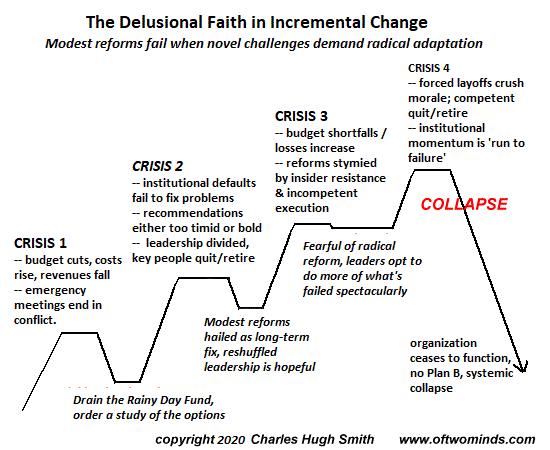
I've prepared a chart of the delusional faith in incremental change showing how each new crisis is met by incremental institutionalized defaults that are completely inadequate to the novel challenges that have arisen. The blindness to the need for radical adaption has been institutionalized as well: this is what worked in the past, so it will work now. Why risk everything when we have procedures that have worked well?

Each stage of the crisis draws whatever conventional response causes the least pain. First, the "rainy day fund" is drained to keep everyone at the feeding trough. Studies of options are funded, and so on.

The recommendations are either too timid and clearly inadequate or they're too bold and risky. So incremental policy and budget tweaks are adopted as acceptable institutional defaults.

But rifts open in the leadership as the farsighted few demand rapid, radical adaptations and the conventional risk-averse crowd digs in their heels. The farsighted few are pushed out or quit / retire, eliminating the only people who had the ability and experience to actually pull off a radical change of course.

A reshuffling of leadership evokes hope that the modest reforms will work magic. Alas, incremental tweaks only work in eras of stability. They fail miserably in unstable eras of rapidly-evolving challenges.

As everything runs to failure, the only acceptable path is to do more of what's failed spectacularly, a default to low-risk incrementalism that only accelerates the final inevitable collapse.

The delusional faith in incremental change guarantees systemic failure. Better not to risk any radical evolution that might fail, and so failure is thus assured.

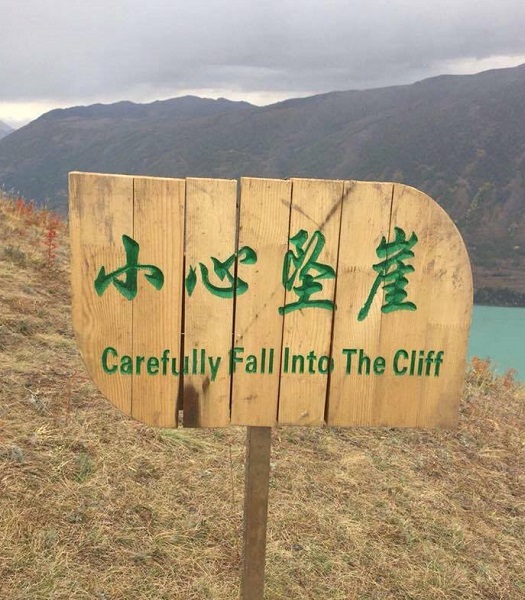
This is why our status quo is doomed:


My new book is available! A Hacker's Teleology: Sharing the Wealth of Our Shrinking Planet 20% and 15% discounts (Kindle $7, print $17)

Read excerpts of the book for free (PDF).

The Story Behind the Book and the Introduction.


Recent Podcasts:

FRA Roundtable: Richard and I discuss Inflation (37 min)

AxisOfEasy Salon #25: Tired: Anti-Copyright Wired: Post-Copyright (1 hr)

Demystifying Four D Reality (with Chuck Ochelli, 1 hr)

What Could Go Wrong? (43 minutes, with Gordon Long)


My COVID-19 Pandemic Posts


My recent books:

A Hacker's Teleology: Sharing the Wealth of Our Shrinking Planet (Kindle $8.95, print $20, audiobook coming soon) Read the first section for free (PDF).

Will You Be Richer or Poorer?: Profit, Power, and AI in a Traumatized World
(Kindle $5, print $10, audiobook) Read the first section for free (PDF).

Pathfinding our Destiny: Preventing the Final Fall of Our Democratic Republic ($5 (Kindle), $10 (print), ( audiobook): Read the first section for free (PDF).

The Adventures of the Consulting Philosopher: The Disappearance of Drake $1.29 (Kindle), $8.95 (print); read the first chapters for free (PDF)

Money and Work Unchained $6.95 (Kindle), $15 (print) Read the first section for free (PDF).


If you found value in this content, please join me in seeking solutions by becoming a $1/month patron of my work via patreon.com.


NOTE: Contributions/subscriptions are acknowledged in the order received. Your name and email remain confidential and will not be given to any other individual, company or agency.

Thank you, Jim B. ($5/month), for your marvelously generous subscription to this site -- I am greatly honored by your support and readership.   Thank you, Bill S. ($5/month), for your magnificently generous subscription to this site -- I am greatly honored by your support and readership.

Read more...

Monday, October 12, 2020

Our Simulacrum Economy

In the hyper-real casino, everyone has access to the terrors of losing, but only a few know the joys of the rigged games that guarantee a few big winners by design.

Readers once routinely chastised me for over-using simulacrum to describe our economy and society. The problem is this word perfectly describes the hollowed-out, rigged economy and social order we inhabit and so synonyms don't quite cut it: it's not the same as simulation or imitation or counterfeit.

My use (or over-use) dates back to the 2009 publication of my book Survival+, which included a chapter titled Simulacrum and the Politics of Experience. I use simulacrum to describe a carefully constructed representation of a once-authentic system that is intended to shape our behavior to suit the interests of those constructing the simulacrum.

The simulacrum has the look and feel of the once-authentic system but it's rigged to benefit the few whose interests are better served by the simulacrum than they could ever be served by an authentic system.

As I wrote in Survival+: A simulacrum is used to distort a reality that, once revealed, would cause the target audience to act in ways that would not serve the interests of those deploying the simulacrum.

The point of a simulacrum is to mimic an authentic system realistically enough so nobody notices it's rigged to benefit the few at the expense of the many. This is different from a simulation--for example, a flight simulator--that models the actual experience.

It's also not a faux copy or counterfeit of the authentic system; it is a replacement that's real in every way.

French Postmodernist Jean Baudrillard's 1981 book Simulacra and Simulation attempts to differentiate Simulacra and Simulation by noting that a simulacrum is not a copy of an original (i.e. a counterfeit) because the original is no longer accessible. As a result, the simulacrum becomes not just real but hyper-real.

For an example, consider capitalism which in its classical form is the risking of capital to generate financial and social gains that were not possible in a pre-capital economy.

The labor and materials needed to construct a major canal, for example, were beyond the reach of villages or even towns, and so their economies remained localized and poor due to the inability to reach distant, more lucrative markets.

Once capital could be assembled in sufficient size, the localized, fragmented economies were unified by the canal, and commerce expanded exponentially as a result, benefiting everyone with access to the canal: laborers, farmers, craftspeople, traders and those who risked the money to construct the canal.

Contrast this authentic form of capitalism with the monopoly-finance-state version we inhabit, a simulacrum of authentic capitalism that retains enough superficial similarities to the original that the vast majority of participants don't even realize that their experience of this simulacrum is entirely different from an experience of authentic capitalism.

Rather than draw benefits from this hyper-real monopoly-finance-state version, the vast majority of participants are exploited, as the value of their labor and capital is extracted by the simulacrum version of "capitalism" which divvies up the extracted value between the monopolies / cartels who control most of the valuable economic activity, the financial sector that parasitically feeds on the real economy and the state, which extracts wealth to feed its vast network of dependents, enforcers and minders of the entire system.

In this hyper-real simulacrum, a vast fortune is never more than a couple of stock gambles, TikTok clips or YouTube videos away. Or for those wary of the casino, the enormous mortgage taken on for life promises access to the riches of the Everything Bubble.

In the hyper-real casino, everyone has access to the terrors of losing, but only a few know the joys of the rigged games that guarantee a few big winners by design and a fortunate few who stumbled into the game at a propitious moment.

As Baudrillard anticipated, the authentic original version of capitalism is no longer accessible. The simulacrum that we call capitalism is rigged, and the mechanisms are so cleverly obscured that the vast majority of participants willingly allow themselves to be exploited, disempowered or marginalized because they have no experience or even reference point to the authentic original version, as it no longer exists.

Everything they know and experience--the economic models, symbols, signifiers, narratives, adverts, etc., and their own conceptions of value and agency, have all been so thoroughly debauched that they have no idea that the authentic original has been lost.

The problem is our system only survives by cannibalizing its weakest parts, and once they've been consumed, the system can no longer sustain itself and it expires.

Simulacra are not fake, but they are profoundly unstable and prone to collapse. Everything gluing the monopoly-finance-state system together is unraveling due to the excesses of extraction and exploitation the system has perfected.

Once the rigged system collapses, we'll have an opportunity to assemble an authentic economy, a new original that isn't rigged to benefit the few at the expense of the many. This is what I discuss in my new book A Hacker's Teleology: Sharing the Wealth of Our Shrinking Planet, (free excerpt (PDF).


My new book is available! A Hacker's Teleology: Sharing the Wealth of Our Shrinking Planet 20% and 15% discounts (Kindle $7, print $17)

Read excerpts of the book for free (PDF).

The Story Behind the Book and the Introduction.


Recent Podcasts:

AxisOfEasy Salon #25: Tired: Anti-Copyright Wired: Post-Copyright (1 hr)

Demystifying Four D Reality (with Chuck Ochelli, 1 hr)

What Could Go Wrong? (43 minutes, with Gordon Long)


My COVID-19 Pandemic Posts


My recent books:

A Hacker's Teleology: Sharing the Wealth of Our Shrinking Planet (Kindle $8.95, print $20, audiobook coming soon) Read the first section for free (PDF).

Will You Be Richer or Poorer?: Profit, Power, and AI in a Traumatized World
(Kindle $5, print $10, audiobook) Read the first section for free (PDF).

Pathfinding our Destiny: Preventing the Final Fall of Our Democratic Republic ($5 (Kindle), $10 (print), ( audiobook): Read the first section for free (PDF).

The Adventures of the Consulting Philosopher: The Disappearance of Drake $1.29 (Kindle), $8.95 (print); read the first chapters for free (PDF)

Money and Work Unchained $6.95 (Kindle), $15 (print) Read the first section for free (PDF).


If you found value in this content, please join me in seeking solutions by becoming a $1/month patron of my work via patreon.com.


NOTE: Contributions/subscriptions are acknowledged in the order received. Your name and email remain confidential and will not be given to any other individual, company or agency.

Thank you, Susan M. ($10/month), for your outrageously generous subscription to this site -- I am greatly honored by your steadfast support and readership.   Thank you, Alan T. ($5/month), for your magnificently generous subscription to this site -- I am greatly honored by your support and readership.

Read more...

Sunday, October 11, 2020

How We Institutionalized Incompetence

And so we face the ultimate irony: 'bailing-out-everything' destroys the entire rotten system.

You've probably noticed things no longer work as well as they once did. For example, the store's online inventory says something is in stock and when you get to the store, it's not on the shelf. A small issue, but telling nonetheless.

Or you might call a local government agency to get an explanation of how a new fee is calculated, and nobody's ever available to explain it--or sort out your punitive late fee even though you paid on time.

You've probably noticed services cost a lot more now, but the quality has eroded. Sure, it's easy to blame it all on the pandemic, but quality has been eroding as costs have risen for years.

You've probably noticed massive cost overruns in public projects. That $1 billion bridge is now $3 billion--oh, sorry, make that $4 billion. If we ever get it finished, better estimate $5 billion.

You've probably noticed that enormous investments in infrastructure, education, reducing homelessness, etc. don't actually improve the situation or fix what's broken. Even the most basic projects take years or decades, congestion and homelessness increase, and education that's not aligned with the real economy flounders on.

You've probably noticed that all the highly paid analysts, academics, think-tank gurus, private-sector hotshots, etc. are either clueless, incoherent or delusional. All their "solutions" boil down to one recommendation: keep the feeding trough filled to the brim, no matter how many hogs are gorging themselves.

Incompetence is now so ubiquitous, so embedded, so obvious and so intractable that we finally have to recognize that America has institutionalized incompetence. Why? That's an interesting question with no one answer.

Broadly speaking, self-interest is all that matters. Every decision is made to maximize self-interest while cloaking the predation with sickly-sweet propaganda of the most transparent type.

Institutions protect insiders because every insider must mask their self-interest and the general failure of the institution. Insiders protect other insiders lest transparency reveal the insiders' skims and scams and the failure of the institution to fulfill its purpose.

Risk is to be avoided at all costs because any failure might reveal the systemic failure of the entire organization. So as Louis-Vincent Gave recently explained, CYA Is the Guiding Principle Of Our Time. If insiders just maintain the status quo and don't rock the boat with any risky innovations or policies, no one will look too deeply at the systemic failures or the rising risks of the whole rotten mess collapsing.

This is how we've devolved to doing more of what's failed spectacularly. Indeed, spectacular failure is the excuse for bigger budgets, more staffing, more studies, etc.

America's core businesses are monopoly and corruption. In either case, the customer / end-user can be ignored because they have no real choice. Or the choice is false: your choice of healthcare insurance provider, Internet provider, etc. is between two equally predatory companies.

As a result of the network effect, quasi-monopolies abound in Big Tech. Yes, there are alternative platforms for posting videos other than YouTube, but few will see your content because "everybody goes to YouTube." So content providers have to not just promote their content, they have to promote the alternative platform in a system that's rigged to favor the monopoly-platforms.

Corruption also limits transparency and competition just like monopolies and cartels. Insiders rig the hiring process so cronies and relatives get the jobs, and so on. Those tasked with oversight look the other way because their cushy post-retirement position awaits them if they just keep their mouth shut.

Then there are the incompetent elites at the top. They've punched all the right cards--elite university, multiple diplomas, internship with the right judges, investment bank, etc.--but they've learned absolutely nothing other than how to navigate a corrupt system that protects or even rewards incompetence.

What the ruling elites learn in America is somebody will bail me out. The government will fund the financial bailout, the fines will be wrist-slaps, the university will slip me into a highly paid position out of the limelight, and so on.

And always, always, always, the feeding trough will be filled to the brim, no matter what the cost or the incompetence. Sacrifice and discipline have been reduced to platitudes in America's elites, whose core competence is issuing mea culpas when caught.

An enormous percentage of well-paid "work" is compliance-related. As the pursuit of self-interest has decayed competence, we've become obsessed with monitoring and ticking endless boxes to conform to accepted practices, whether they make sense or not.

This is the essence of BS work: all the compliance busy-work has nothing to do with the actual production of goods and services or innovation or excellence; as the late David Graeber said of BS work: everyone doing it knows it's worthless.

Compliance is the perfect cover for institutionalized incompetence. The irony is rather rich: systemic incompetence is papered over by incompetent compliance measures, all of which drain the feeding trough.

There's only one way left to fill the feeding trough being drained by systemic incompetence: trillions in "free money" forever. That this extravaganza of endless "free money" debauches the currency is ignored, because all the ruling incompetents have been trained to be utterly confident that somebody will bail me out.

And so we face the ultimate irony: bailing-out-everything destroys the entire rotten system. Competence now means successfully navigating incompetent systems corrupted by self-interest. This means avoiding all risk and leaving everything as it is, lest someone notice the systemic failure.

What we've institutionalized is run to failure: we'll just keep doing more of what's failed spectacularly until the entire status quo collapses in a fetid heap of greed, self-interest and gross incompetence.


My new book is available! A Hacker's Teleology: Sharing the Wealth of Our Shrinking Planet 20% and 15% discounts (Kindle $7, print $17)

Read excerpts of the book for free (PDF).

The Story Behind the Book and the Introduction.


Recent Podcasts:

AxisOfEasy Salon #25: Tired: Anti-Copyright Wired: Post-Copyright (1 hr)

Demystifying Four D Reality (with Chuck Ochelli, 1 hr)

What Could Go Wrong? (43 minutes, with Gordon Long)


My COVID-19 Pandemic Posts


My recent books:

A Hacker's Teleology: Sharing the Wealth of Our Shrinking Planet (Kindle $8.95, print $20, audiobook coming soon) Read the first section for free (PDF).

Will You Be Richer or Poorer?: Profit, Power, and AI in a Traumatized World
(Kindle $5, print $10, audiobook) Read the first section for free (PDF).

Pathfinding our Destiny: Preventing the Final Fall of Our Democratic Republic ($5 (Kindle), $10 (print), ( audiobook): Read the first section for free (PDF).

The Adventures of the Consulting Philosopher: The Disappearance of Drake $1.29 (Kindle), $8.95 (print); read the first chapters for free (PDF)

Money and Work Unchained $6.95 (Kindle), $15 (print) Read the first section for free (PDF).


If you found value in this content, please join me in seeking solutions by becoming a $1/month patron of my work via patreon.com.


NOTE: Contributions/subscriptions are acknowledged in the order received. Your name and email remain confidential and will not be given to any other individual, company or agency.

Thank you, Donald C. ($50), for your marvelously generous contribution to this site -- I am greatly honored by your steadfast support and readership.   Thank you, Thomas G. ($50), for your magnificently generous contribution to this site -- I am greatly honored by your support and readership.

Read more...

Friday, October 09, 2020

Has Our Luck Finally Run Out?

We are woefully unprepared for a long run of bad luck.

Long-term cycles escape our notice because they play out over many years or even decades; few noticed the decreasing rainfall in the Mediterranean region in 150 A.D. but this gradual decline in rainfall slowly but surely reduced the grain harvests of the Roman Empire, which coupled with rising populations resulted in a reduced caloric intake for many people.

This weakened their immune systems in subtle ways, leaving them more vulnerable to the Antonine Plague of 165 AD.

The decline of temperatures in Northern Europe in the early 1300s led to "years without summer" and failed grain harvests which reduced the caloric intake of most people, leaving them weakened and more vulnerable to the Black Plague which swept Europe in 1347.

I've mentioned the book The Fate of Rome: Climate, Disease, and the End of an Empire a number of times as a source for understanding the impact of natural cycles on human civilization.

It's important to note that the natural cycles and pandemics of 200 AD didn't just cripple the Roman Empire; this same era saw the collapse of the mighty Parthian Empire of Persia, the kingdoms of India and the Han Dynasty in China.

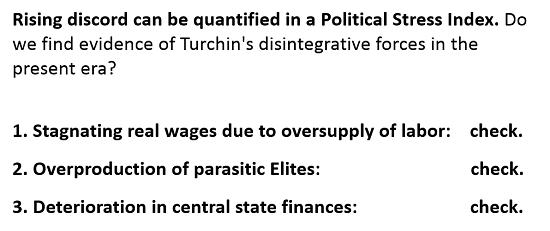
In addition to natural cycles, there are human socio-economic cycles of debt and decay of civic values and the social contract: a proliferation of parasitic elites, a weakening of state finances and a decline in the purchasing power of wages/labor.

The rising dependence on debt and its eventual collapse is a cycle noted by Kondratieff and others, and Peter Turchin listed these three dynamics as the key drivers of decisive discord of the kind that brings down empires and nations.

All three are playing out globally in the present.

In this context, the election of Donald Trump in 2016 was a political expression of long-brewing discontent with precisely these issues: the rise of self-serving parasitic elites, the decay/corruption of the social contract and state finances and the decades-long decline in the purchasing power of wages/labor.

Which brings us to karma, a topic of some confusion in Western cultures more familiar with Divine Retribution than with actions having consequences even without Divine Intervention, which is the essence of karma.

Broadly speaking, the U.S. squandered the opportunities presented by the end of the Cold War 30 years ago on hubristic Exceptionalism, wars of choice, parasitic elites and an unprecedented waste of resources on unproductive consumption.

Now the plan--for lack of any real plan--is to borrow trillions of dollars to fund an even more spectacular orgy of unproductive consumption, on the bizarre belief that "money" can be conjured out of thin air in essentially infinite quantities and squandered, and there will magically be no consequences of this trickery in the real world.

Actions have consequences, and after 30 years of waste, fraud and corruption being normalized by the parasitic elites while the purchasing power of labor decayed, the karmic consequences can no longer be delayed by doing more of what's hollowed out the economy and society.

Which brings us to luck. As a general rule, historians seek explanations which leave luck out of the equation. This gives us a false confidence in the predictability and power of human will and action and cycles. Yes, cycles and human action influence outcomes, but we do a great disservice by shunting luck into the shadows as a non-factor.

If Emperor Pius had chosen someone other than Marcus Aurelius as his successor, someone weak, vain and self-absorbed like so many of Rome's late-stage emperors, then Rome would have fallen by 170 AD as the Antonine Plague crippled finances and the army, and the invading hordes would have swept the empire into the dustbin of history.

It can be argued that only Marcus Aurelius had the experience and character to sell off the Imperial treasure to raise the money needed to pay the soldiers and spend virtually his entire term in power in the front lines of battle, preserving Rome from complete collapse.

That was good judgement by Pius but also good luck.

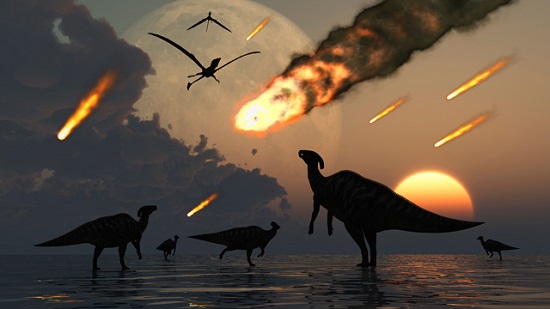
As we ponder luck, consider the estimate that had the meteorite that wiped out the dinosaurs 65 million years ago struck the Earth 30 minutes earlier or later, it would not have generated the Nuclear Winter that destroyed the dinosaurs. (A direct hit in deep water would have spawned a monstrous tsunami, but no dust cloud. A direct hit on land would have raised a dust cloud but without the water vapor / steam generated by the vaporization of millions of gallons of sea water, the cloud wouldn't have risen high enough to encircle the planet.)

That was bad luck for the dinosaurs, and good luck for the mammals who replaced them.

The global economy has been extraordinarily lucky for 75 years. Food and energy have been cheap and abundant. (If you think food and energy are expensive now, think about prices doubling or tripling, and then doubling again.)

In our complacency and hubris, we attribute this to our wonderful technologies, which we assume guarantee us permanent surpluses of energy and food. The idea that technology has reached hard limits or that it could fail doesn't occur to us.

We've taken good luck to be our birthright because it's all we've known. We attribute this good fortune to things within our control--technology, wise investments and policies, etc. The possibility that all these powers that we consider so godlike are insignificant doesn't occur to us because we've enjoyed the favorable winds of luck without even being aware of it.

We are woefully unprepared for a long run of bad luck. My sense is the cycles have turned and the good luck has drained from the hour-glass. Energy and food will no longer be cheap and abundant, our luck in leadership will vanish, and our vaunted technologies will fail to maintain an abundance so vast that we can squander the finite wealth of soil, water, resources and energy on mindless consumption.

I'm reminded of a line from an Albert King song, Born Under a Bad Sign (composed by Booker T. Jones and William Bell): "If it wasn't for bad luck, I wouldn't have no luck at all."

The next five years might have us singing this line with feeling.


My new book is available! A Hacker's Teleology: Sharing the Wealth of Our Shrinking Planet 20% and 15% discounts (Kindle $7, print $17)

Read excerpts of the book for free (PDF).

The Story Behind the Book and the Introduction.


Recent Podcasts:

AxisOfEasy Salon #25: Tired: Anti-Copyright Wired: Post-Copyright (1 hr)

Demystifying Four D Reality (with Chuck Ochelli, 1 hr)

What Could Go Wrong? (43 minutes, with Gordon Long)


My COVID-19 Pandemic Posts


My recent books:

A Hacker's Teleology: Sharing the Wealth of Our Shrinking Planet (Kindle $8.95, print $20, audiobook coming soon) Read the first section for free (PDF).

Will You Be Richer or Poorer?: Profit, Power, and AI in a Traumatized World
(Kindle $5, print $10, audiobook) Read the first section for free (PDF).

Pathfinding our Destiny: Preventing the Final Fall of Our Democratic Republic ($5 (Kindle), $10 (print), ( audiobook): Read the first section for free (PDF).

The Adventures of the Consulting Philosopher: The Disappearance of Drake $1.29 (Kindle), $8.95 (print); read the first chapters for free (PDF)

Money and Work Unchained $6.95 (Kindle), $15 (print) Read the first section for free (PDF).


If you found value in this content, please join me in seeking solutions by becoming a $1/month patron of my work via patreon.com.


NOTE: Contributions/subscriptions are acknowledged in the order received. Your name and email remain confidential and will not be given to any other individual, company or agency.

Thank you, Henry B. ($50), for your marvelously generous contribution to this site -- I am greatly honored by your support and readership.   Thank you, Michael R. ($50), for your magnificently generous contribution to this site -- I am greatly honored by your support and readership.

Read more...

Thursday, October 08, 2020

A Hard Rain Is Going to Fall

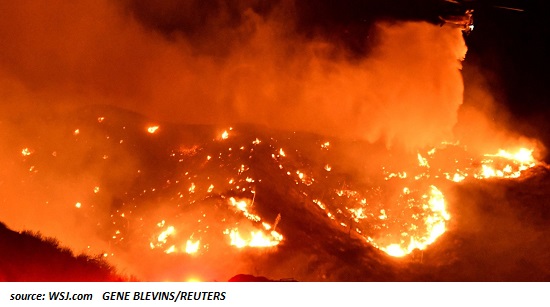
The status quo is about to discover that it can't stop the hard rain or protect its fragile sandcastles.

You'll recognize A Hard Rain Is Going to Fall as a cleaned-up rendition of Bob Dylan's classic "A Hard Rain's a-Gonna Fall". Since the world had just avoided a nuclear conflict in the Cuban Missile Crisis, commentators reckoned Dylan was referencing a nuclear rain. But he denied this connection in a radio interview, stating: "...it's just a hard rain. It isn't the fallout rain. I mean some sort of end that's just gotta happen...." ( Source)

Which brings us to the present and America's dependence on the sandcastles of monopoly, corruption, free money and a two-tier legal/political system. You know, BAU--business as usual. A hard rain's a-gonna fall on these sand castles because, well, the end of unsustainable stuff has just gotta happen, as the man said.

Here's the problem with monopoly, corruption, free money and a two-tier legal/political system: they impoverish and diminish everyone who isn't an insider or in the top 10% Protected Class, as these are institutionalized forms of legalized looting: monopolies and cartels raise costs by smothering competition, corruption is a hidden tax on everyone not at the feeding trough, free money devalues the dollar, robbing everyone forced to use it, and a two-tier legal system enriches the few (corporate criminals never go to prison) and undermines the social contract via blatant unfairness and lack of justice.

As for the two-tier political system: monopoly, corruption and Fed free money have undermined democracy. Regardless of who wins the election, lobbyists and billionaires will still dominate the day-to-day business of political pay-to-play.

By enriching and protecting the few at the expense of the many, America's business as usual has eroded the social contract and trust in institutions and authority. When everybody's on the take and has an insider skim, then denying a conflict of interest simply confirms the ubiquity of conflicts of interest.

The pendulum has swung to such extremes of unfairness, corruption and inequality that the swing back will be monumental in scale and duration.

Another reason a hard rain's gonna fall is America's core institutions have been obsolete for years or decades, but those feeding at the trough refuse to allow any change that threatens their place at the trough.

Peter Drucker explained how tectonic shifts in the economic order obsoletes entire sectors in his 1993 book Post-Capitalist Society. Drucker mentions higher education and healthcare as sectors ripe for the plow, yet these politically sacrosanct sectors have ground on unchanged for decades, vacuuming up trillions in borrowed money to keep from being obsoleted.

Despite the best efforts of self-serving insiders, sand castles still melt in a hard rain. Speaking of sand castles, consider the vast number of sectors teetering on massive excess capacity: commercial real estate, retail space, restaurants, etc. Two generations ago, going to a restaurant--even a fast-food outlet--was a rare event. Since then, it somehow became a birthright to eat out once or twice a day.

A hard rain's a-gonna fall on over-capacity and debt-dependent spending. Free money for financiers constructed a fragile sandcastle of too much of everything but actual value, so now the status quo frantically seeks to protect every melting sandcastle of over-capacity.

The status quo is about to discover that it can't stop the hard rain or protect its fragile sandcastles. Whatever piles of sand are left after the rain will be swept away by the karmic tide as the pendulum swings back: the way of the Tao is reversal.


My new book is available! A Hacker's Teleology: Sharing the Wealth of Our Shrinking Planet 20% and 15% discounts (Kindle $7, print $17)

Read excerpts of the book for free (PDF).

The Story Behind the Book and the Introduction.


Recent Podcasts:

Demystifying Four D Reality (with Chuck Ochelli, 1 hr)

What Could Go Wrong? (43 minutes, with Gordon Long)

AxisOfEasy Salon #24: It’s Not a Conspiracy. It’s a Culture. (1 hr)


My COVID-19 Pandemic Posts


My recent books:

A Hacker's Teleology: Sharing the Wealth of Our Shrinking Planet (Kindle $8.95, print $20, audiobook coming soon) Read the first section for free (PDF).

Will You Be Richer or Poorer?: Profit, Power, and AI in a Traumatized World
(Kindle $5, print $10, audiobook) Read the first section for free (PDF).

Pathfinding our Destiny: Preventing the Final Fall of Our Democratic Republic ($5 (Kindle), $10 (print), ( audiobook): Read the first section for free (PDF).

The Adventures of the Consulting Philosopher: The Disappearance of Drake $1.29 (Kindle), $8.95 (print); read the first chapters for free (PDF)

Money and Work Unchained $6.95 (Kindle), $15 (print) Read the first section for free (PDF).


If you found value in this content, please join me in seeking solutions by becoming a $1/month patron of my work via patreon.com.


NOTE: Contributions/subscriptions are acknowledged in the order received. Your name and email remain confidential and will not be given to any other individual, company or agency.

Thank you, Keith R. ($5/month), for your marvelously generous pledge to this site -- I am greatly honored by your support and readership.   Thank you, Richard H. ($20), for your most generous contribution to this site -- I am greatly honored by your support and readership.

Read more...

Terms of Service

All content on this blog is provided by Trewe LLC for informational purposes only. The owner of this blog makes no representations as to the accuracy or completeness of any information on this site or found by following any link on this site. The owner will not be liable for any errors or omissions in this information nor for the availability of this information. The owner will not be liable for any losses, injuries, or damages from the display or use of this information. These terms and conditions of use are subject to change at anytime and without notice.

RE: European Union AI Act, and Our Use of Generative AI Tools and Agents Policy

All text on this site is composed by Charles Hugh Smith or by a credited guest-author. No Generative AI Tools are used in the composition / writing of any text or graphic content created by Charles Hugh Smith. This site deploys no AI agents or generative AI tools. This site is not responsible for the disclosures, use or non-use of AI agents or generative AI tools in advertisements displayed by Investing Channel or other ad placement services.

Audio files generated by text-to-audio transcription tools are identified as such.

Our Privacy Policy:

Correspondents' email is strictly confidential. This site does not collect digital data from visitors or distribute cookies. Advertisements served by third-party advertising networks such as Investing Channel may use cookies or collect information from visitors for the purpose of Interest-Based Advertising; if you wish to opt out of Interest-Based Advertising, please go to Opt out of interest-based advertising (The Network Advertising Initiative) If you have other privacy concerns relating to advertisements, please contact advertisers directly.

PRIVACY NOTICE FOR EEA INDIVIDUALS

This section covers disclosures on the General Data Protection Regulation (GDPR) for users residing within EEA only. GDPR replaces the existing Directive 95/46/ec, and aims at harmonizing data protection laws in the EU that are fit for purpose in the digital age. The primary objective of the GDPR is to give citizens back control of their personal data. Please follow the link below to access InvestingChannel's General Data Protection Notice.
https://stg.media.investingchannel.com/gdpr-notice/

Notice of Compliance with The California Consumer Protection Act

This site does not collect digital data from visitors or distribute cookies. Advertisements served by a third-party advertising network (Investing Channel) may use cookies or collect information from visitors for the purpose of Interest-Based Advertising. If you do not want any personal information that may be collected by third-party advertising to be sold, please follow the instructions on this page: Do Not Sell My Personal Information.

Regarding Cookies:

This site does not collect digital data from visitors or distribute cookies. Advertisements served by third-party advertising networks such as Investing Channel may use cookies or collect information from visitors for the purpose of Interest-Based Advertising; if you wish to opt out of Interest-Based Advertising, please go to Opt out of interest-based advertising (The Network Advertising Initiative) If you have other privacy concerns relating to advertisements, please contact advertisers directly.

Our Commission Policy:

Though I earn a small commission on Amazon.com books and gift certificates and gold (BullionVault) purchased via links on my site, I receive no fees or compensation for any other non-advertising links or content posted on my site.

Copyright Notice:

All original images (Drawings and Photographs), text (essays, books and works of fiction), audio and video recordings, musical compositions, graphic design, graphic design elements and HTML coding on this site are the copyrighted work of Charles Hugh Smith unless otherwise credited or noted. They are published as information for the private use of site visitors, and any reproduction or redistribution of this content or coding in any media in any format or distribution channel (text, audio, video/film, web) without the written permission of the copyright holder is strictly prohibited. All rights in all media reserved globally.

  © Blogger templates Newspaper III by Ourblogtemplates.com 2008

Back to TOP