



Sunday, June 11, 2023

Everything Is Being Repriced, Starting with Risk

The global risk premium has increased dramatically and is increasing in an unpredictable arc. This structural trend of higher risks will reprice everything.

The global economy is changing in fundamental ways, and this is repricing everything: the cost of money/credit, the price of assets, the value of hedges and insurance, and so on. The core driver in all this repricing is risk, for it's the reappraisal of risk that forces the repricing of everything.

When risk is low and transparent, the risk premium is low and this is reflected in low, stable costs. When risk soars and is difficult to assess, the risk premium rises and this pushes costs higher.

In terms of asset valuations, higher risks reprice assets higher or lower based on the risk profile: what happens to the asset if liquidity dries up in a risk-driven crisis? If credit dries up, what happens to demand for the asset?

Risk tends to be self-reinforcing. If we look around and see everyone else is confident that risk is theoretical rather than real, we stop buying hedges against bad things happening, and we pay a premium for assets that do well in low-risk eras.

But if we see other people getting defensive--selling assets, paying down debt, reducing spending and risk-on investing--then we pull in our horns, too.

What changed?

The global economy began a cycle in the early 1990s of declining risk throughout the system due to these risk-reducing changes:


1. The dissolution of the USSR and the end of the hyper-expensive, heightened-risk Cold War.

2. The flood of low-cost oil as all the super-giant fields discovered in the 1970s began peak production.

3. China emerged as the low-cost "workshop of the world," enabling 30 years of soaring corporate profits as corporations reduced costs by offshoring production to China.

4. This offshoring boosted profits while deflating the costs of production due to much lower labor costs, lax / non-existent environmental standards and Chinese producers' willingness to accept razor-thin profit margins.

5. The reduction in global risk and the deflationary impact of Globalization (offshoring and opening new markets) enabled central banks to lower interest rates for 30 years without sparking inflation and private-sector banking/lending to expand credit and leverage, effectively globalizing / commoditizing financial instruments that hedged risks (Financialization).

6. After a decade-long lag (the 1980s), the advances in personal computing, software and desktop publishing finally began generating productivity increases.

7. The economic theology of Neoliberalism was embraced globally. Neoliberalism claims "markets solve all problems" and so the universal solution is to turn everything into a market by reducing regulations and state oversight.

All of these forces tended to restrain prices of commodities, goods and services and reduce systemic risks while expanding markets, financial "innovations" and profits. This created a global "virtuous cycle" in which each dynamic reinforced the others.

This "virtuous cycle" ended in the 2008-09 Global Financial Meltdown, but was papered over for a decade by extreme policies:

1. China launched the largest credit expansion in history (Russell Napier's phrase) to counter the meltdown

2. The Federal Reserve and other central banks began a policy of financial repression (i.e. centrally managing financial markets rather than let market forces dictate liquidity, price, risk, etc.), leading to Zero Interest Rate Policy (ZIRP) that was effectively negative-rates since inflation continued sputtering along at 1.5% tp 2%.

Why did the "virtuous cycle" end? The basic answer is diminishing returns: the returns on any new policy or dynamic such as Neoliberalism, globalization or financialization follow an S-Curve, where the initial returns are stupendous (the boost phase) and then as the dynamics become ubiquitous, the returns diminish until they stagnate. At that point, the system decays unless new more extreme measures are applied--for example, China's debt to GDP ratio doubling from 140% to 280% and interest rates being suppressed to zero.
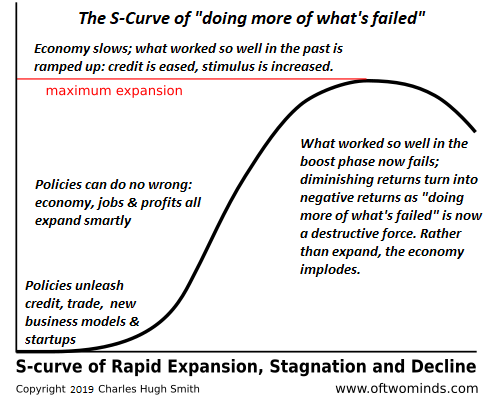


Another factor is the cannibalization of domestic markets once globalization had skimmed the easy returns. Financialization starts out looking "innovative" by claiming it can hedge all risks at low cost, effectively lowering the risk of playing financial games to zero. As Benoit Mandelbrot and other explained, this isn't possible for structural/mathematical reasons (markets are inherently fractal and prone to instability),

As the easy gains diminish, financialization takes assets that were once low-risk and commoditizes them into "instruments" that can be sold globally, suppressing the visibility of risk with deceptive packaging. This is what happened to home mortgages, which went from being highly regulated and low-risk to being poorly regulated /fraudulent and packaged into highly deceptive mortgage-backed securities that masked the true risk--high--behind flim-flam claims of low risk.

As costs rose in China and other producing nations, labor costs began rising, along with higher taxes and some attempts to reduce the choking air pollution and poisoned water/soil that inevitably result from uncontrolled industrialization.

Suppressing the cost of capital/credit to near-zero generated a tsunami wave of borrowed capital, both within the banking sector and the ballooning non-banking (shadow banking) sectors. This low-cost credit was then unleashed into global markets to chase any high-yield investment, which of course means gambling on risky assets while supposedly hedging the bets against losses.

All this financial engineering--ZIRP, cheap, abundant credit, the chase for yield--ultimately depends on liquidity, i.e. the presence of buyers in size to create a market for anyone who seeks to sell an asset. If liquidity dries up for whatever reason--a bank crisis, a market panic, etc.--then sellers run out of buyers and the market reprices the asset at lower and lower levels until buyers emerge. In a collapsing-liquidity market, there are few buyers at any price.

The potential wipeout of "wealth" i.e. asset valuations would bring down the entire global financial system, for all those assets are collateral for the world's immense mountain of credit/debt.

The evaporation of liquidity in 2008-09 is what former Fed Chairman Alan Greenspan identified as the risk he did not anticipate.

So what changed around 2007-09? Globalization and Financialization moved from "virtuous cycle" to stagnation / decline, policies became more extreme to bury rising systemic risks, and the addition of a billion new workers aspiring to all the commodity-consuming luxuries of the middle class lifestyle soaked up surplus production of oil and other commodities. With surpluses gone, prices had to start rising.

Post-Covid lockdown and recovery, China's policies changed from "open to the world" and "peaceful rise" to aggressive militarization and territorial claims and the restriction of Chinese society's access to the outside world.

All of these factors exposed the risks that had been successfully obscured: the risks that global supply chains can break down or be disrupted by geopolitics; the risk that financialization games can blow up; the risk that Neoliberalism failed to suppress risks of fraud and exploitation; the risks that soaring debt outpaces expansion of the real-world economy, generating debt crises, and the risks of extreme policies generating unintended consequences (moral hazard, extreme risk-taking, too much debt, etc.) and blowback (re-industrialization, trade wars, etc.).

On top of these risks, there are now demographic, capital, labor and resource sources of risks. Geopolitical tensions are rising, which is historically typical in eras where essential commodities become scarce and/or unavailable /costly. This is incentivizing re-industrialization, reshoring, friendshoring, etc., all of which are national-security issues aimed at reducing dependency on rivals or risky supply chains.

In effect, the nation-state has to take the driver's seat from quasi-deregulated markets, the Neoliberal ideal. In reality, deregulated is the happy-story codeword for centrally managed to benefit the few at the expense of the many.

This re-industrialization is also driven by the transition to non-hydrocarbon energy sources, a goal that will require far more capital than most expect even as it underperforms unrealistic expectations. The demand for trillions in new investment will pressure credit for consumption (new homes, vehicles, vacations, etc.), pushing the cost of credit higher regardless of any other conditions.

In the past decade, birth rates in many developed and developing economies have cratered while the workforce ages and enters retirement. Both of these developments mean pension and social welfare programs launched when there where 5 workers for every retiree are no longer sustainable now that there are only 2 fulltime workers for every retiree/recipient of social welfare.

The decline of the workforce also introduces two other dynamics: potential labor shortages and the stagnation of demand, as older people consume far less than new households having children. As marriage rates and birth rates plummet, so do the prospects for consumption-driven economic growth.

The policy extremes of ZIRP, moral hazard, credit expansion and the chasing of yields has inflated The Everything Bubble which has put the price of housing and vehicles out of reach of the bottom 60% (or in many regions, the bottom 80%) of households.)

This rising inequality erodes social cohesion and fosters an alternative lifestyle in which young workers opt out of the rat race to acquire an upper-middle class income and wealth. This diminishes the pool of potential buyers of all the overpriced assets, further reducing liquidity on a demographic/structural basis.

Simply put, the rising tide of wealth and profits hasn't raised all boats. The top 5% have garnered the vast majority of the gains in asset appreciation, capital gains and profits. This generates a background of rising risk of social disorder.
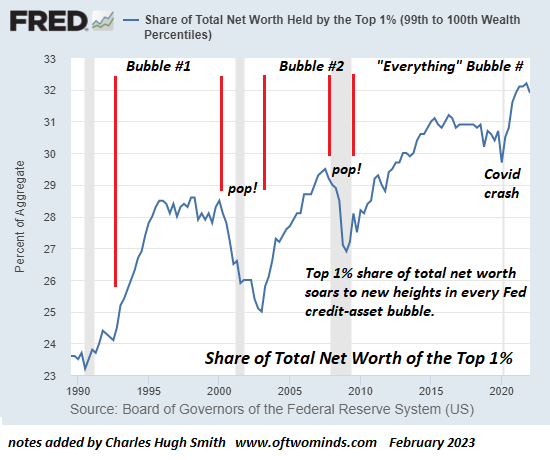
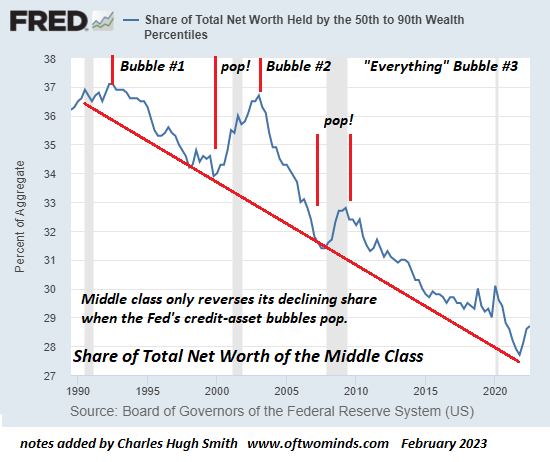


On top of all this, 30 years of moderate inflation have reversed into a era of sustained inflation, which despite the hopes of many commentators, will not be transitory. This era of inflation is driven by: 1. Excessive debt levels that can only be managed by inflating the debt down to manageable levels 2. Scarcities of essentials which push prices above what consumers can afford while not being high enough to fund massive new investments needed to increase supply. 3. The cost of capital must rise to reflect the rising risk premium globally.

All the tricks deployed to restore confidence in 2008-09 have reached such extremes that now systemic risk--of default, conflicts, broken supply chains, geopolitical blackmail, scarcities of essential commodities and perhaps the least understood risk, the evaporation of liquidity as credit and buyers of risk-on assets become scarce--is rising dramatically.

These risks are difficult to assess or hedge completely, and the inter-dependence of the global economy and financial system--a tightly bound system--mean risk in one area quickly spreads to the rest of the system.

This structural rise in systemic risks raises costs and changes the risk-reward calculation on every asset.

Take housing as an example. When we're confident housing will rise 30% every decade like clockwork, we'll pay today's prices with the expectation that the house will gain 30% in the coming decade. But as the financial risk premium rises, and we have to factor in the risk that the house might lose 30% of its value going forward, we become wary of paying today's high price.

As others also become wary, the recognition of risk reinforces itself and as prices drop, our wariness increases and we decide to wait until the risks of further decline become clearer.

The problem with assessing risk is the full risks are never clear until it's too late.

Everything is being repriced, including risk, the cost of capital and labor and the value of all assets. This repricing is currently modest, but as risks manifest, we can anticipate an acceleration of repricing. If liquidity dries up--buyers for houses and stocks suddenly withdraw from the market--the price declines can be dramatic and self-reinforcing.

In a system maintained by ever-greater extremes, confidence erodes very quickly once the next extreme fails to move the needle. At that point, all bets are off because confidence in the policymakers' ability to "save the day" vanishes. And once confidence vanishes, so does liquidity. Once markets are illiquid, the problem isn't limited to the declining valuation--the real problem becomes finding a buyer who will enable you to convert the asset into cash.

The global risk premium has increased dramatically and is increasing in an unpredictable arc. This structural trend of higher risks will reprice everything.

This will generate consequences and opportunities which I discuss in my books Global Crisis, National Renewal and Self-Reliance in the 21st Century.


This essay was drawn from my Weekly Musings Reports sent exclusively to subscribers, patrons and Substack subscribers. Thank you very much for supporting my work.

New Podcast: Charles Hugh Smith on Getting Ready for a Real Recession (38 min) (38 min)


My new book is now available at a 10% discount ($8.95 ebook, $18 print): Self-Reliance in the 21st Century.

Read the first chapter for free (PDF)

Read excerpts of all three chapters

Podcast with Richard Bonugli: Self Reliance in the 21st Century (43 min)


My recent books:

The Asian Heroine Who Seduced Me (Novel) print $10.95, Kindle $6.95 Read an excerpt for free (PDF)

When You Can't Go On: Burnout, Reckoning and Renewal $18 print, $8.95 Kindle ebook; audiobook Read the first section for free (PDF)

Global Crisis, National Renewal: A (Revolutionary) Grand Strategy for the United States (Kindle $9.95, print $24, audiobook) Read Chapter One for free (PDF).

A Hacker's Teleology: Sharing the Wealth of Our Shrinking Planet (Kindle $8.95, print $20, audiobook $17.46) Read the first section for free (PDF).

Will You Be Richer or Poorer?: Profit, Power, and AI in a Traumatized World
(Kindle $5, print $10, audiobook) Read the first section for free (PDF).

The Adventures of the Consulting Philosopher: The Disappearance of Drake (Novel) $4.95 Kindle, $10.95 print); read the first chapters for free (PDF)

Money and Work Unchained $6.95 Kindle, $15 print)
Read the first section for free


Become a $1/month patron of my work via patreon.com.

Subscribe to my Substack for free


NOTE: Contributions/subscriptions are acknowledged in the order received. Your name and email remain confidential and will not be given to any other individual, company or agency.

Thank you, Suzanne S. ($70), for your monumentally generous contribution to this site -- I am greatly honored by your steadfast support and readership.


Thank you, John G. ($5/month), for your most generous pledge to this site -- I am greatly honored by your support and readership.


Thank you, Allan H. ($10/month), for your outrageously generous pledge to this site -- I am greatly honored by your steadfast support and readership.


Thank you, Daniel T. ($1/month), for your most generous pledge to this site -- I am greatly honored by your support and readership.

Read more...

Thursday, June 08, 2023

12 Ways to Cut the Chains of Financial Serfdom

Just because nobody talks about financial serfdom doesn't mean it's not real.

Ours is a neofeudal economy of financial serfs in servitude to a Financial Aristocracy. The Financial Nobility / Aristocracy own all the debt and the serfs owe the debt to the Aristocracy. The serfs own assets that don't generate much income, the Aristocracy owns assets that generate trillions of dollars in income. The serfs pay high tax rates if they make above-poverty wages, the Financial Nobility pay low taxes thanks to tax-avoidance scams arranged by the Aristocracy's toadies and lackeys in the Central State. The serfs create value, the Financial Nobility is parasitic.

That we are powerless is one of the key social control myths constantly promoted by the Status Quo. What better way to keep the serfs passive than to reinforce a belief in their powerlessness against Financial Feudalism?

But we are not powerless. Our complicity gives the Financial Aristocracy its power. Remove our complicity and the Aristocracy implodes.

The pathway of liberation is to opt out of financial feudalism. Here are twelve paths any adult can legally pursue in the course of their daily lives:

1. Support the decentralized, non-market economy. The core ideology of consumerism and financialization is that non-market assets and experiences have no status or financial value. This includes social capital, meals with friends, projects done cooperatively with friends, home gardens and dozens of other decentralized activities that cannot be financialized into centralized market transactions. Identity and social status are established in the non-market economy by collaboration, sharing, reciprocity, conviviality and generosity.

Decentralized means localized; farmers markets are examples of local market economies where the transactions are in cash (so banks can't skim transactions fees) and the money stays in the local economy rather than flowing to some distant concentration of capital.

If you start valuing non-market assets and experiences as the most important markers of status, you are resisting both financialization and consumerism.

Top-down centralized "solutions" imposed by the Central State are the problem, not the solution, as they further the concentration of wealth and power into unstable monocultures. Stop looking to overly complex fake-reforms and centralized solutions to unsustainable systems and start exploring decentralized, localized solutions that bypass both the Central State and the Financial Aristocracy.

2. Stop participating in financialization. Financialization is the insidious imperative of the Financial Aristocracy that seeks to turn every human interaction into a financial transaction that can be charged a fee, and transform all assets into financialized instruments that can be commoditized and sold for immensely profitable fees.

As the finances of local governments implode under the weight of their protected fiefdoms, many are heeding the siren song of financialization as a temporary (and inevitably disastrous) "fix" to their structural insolvency. For example, the revenue stream from parking meters is financialized into an asset that is sold to a private corporation. When parking fees double, the residents of the city have no recourse via democracy or petition, as the meters in their city are now "owned" by a distant concentration of capital that can double late fees, charge outrageous transaction costs, etc., at will.

This is how financialization inevitably transitions into financial tyranny.

The erosion of America's middle class security has several structural causes, but chief among them was the financialization of the housing market. This has led to serial bubbles of housing valuations and the widespread extraction of equity for consumption--the classic "windfall" that financialization always produces in its first toxic blush.

3. Redefine self-interest to exclude debt-servitude and dependence on consumerism and the Central State. Unless you are long retired and have no other option, minimize reliance on the State. Reliance on the State weakens the correlation between sustained effort and gain, so the work ethic and entrepreneurism both atrophy as they no longer offer competitive advantages in a system where bread and circuses are guaranteed by the State.

4. Act on your awareness that the nature of prosperity and financial security is changing. Dependence on centralized concentrations of power (Wall Street and the Central State) is now an extremely risky wager that what is demonstrably unsustainable will magically become sustainable via pixie dust or more Federal Reserve trickery. Security flows from resilience, self-reliance, decentralized, diversified sources of income and abundant social capital, not speculation fueled by Fed policies and Wall Street.

5. Stop supporting distant concentrations of capital that subvert democracy by using their gargantuan profits to buy the machinery of State governance and regulation. For example, stop watching broadcast programming owned by the six global media corporations that control the vast majority of the media/marketing complex.

Stop eroding your health and sending your money to corporate headquarters by no longer frequenting fast-food restaurants and by no longer buying unhealthy packaged foods from corporate agribusiness.

Close your accounts with Wall Street investment firms and the "too big to fail" banks that dominate the mortgage, credit and debt markets in the U.S. If you need such an account to transact your business, maintain low balances so the banks cannot sweep your capital for their own use every day.

6. Stop supporting the debt-and-leverage based Financial Aristocracy. Liquidate all debt as soon as possible, take on no new debt except for short periods of time, explore localized or crowd-sourced private-capital loans that exclude the banks and limit the number of financial transactions that enrich the banks and Wall Street.

7. Transfer your assets out of Wall Street and into local enterprises or assets that do not enrich and empower Wall Street. Buy assets you control 100%, without the mediation of Wall Street.

8. Refuse to participate in consumerist status identifiers and the social defeat they create. Stop admiring and respecting those displaying status signifiers (supercars, $300 million yachts, etc.); start thinking of them as pathetic prisoners of a pathological mindset. Stop judging people based on their lack of status signifiers. Free your own mind from the toxic sociopathology of consumerism and social defeat. Stop watching commercial television and streaming corporate distractions and minimize your exposure to marketing and consumerist propaganda.

9. Vote in every election with an eye on rewarding honesty and truth and punishing empty promises. Unless the incumbent has renounced corporate contributions, unsustainable debt, financial tyranny and Central State encroachment of civil liberties, then vote against the incumbent, for they are just another lackey of the State-Plutocracy partnership. Avoid voting for either the Demopublican or Republicrat branches of the plutocracy; vote for an independent or third party candidate.

Remember that resistance isn't just about refusing to participate in pathological neofeudalism; it’s about establishing a sustainable alternative to the unsustainable State-Aristocracy partnership. When people say that voting for a third-party candidate is "wasting your vote," reply that voting for either of the plutocrat parties is the real waste of a vote because their "leadership" is dooming the nation to destabilization and insolvency. As independents pick up more and more "wasted" votes, they shift from being "marginalized" to becoming powerful voices of integrity and transparency.

10. Stop supporting inflationary policies such as money creation - QE by the Federal Reserve and Federal deficit spending. Act on your knowledge that inflation is theft and that the Federal Reserve is a private consortium of banks that is the enabler and protector of the parasitic Financial Aristocracy.

11. Become healthy, active and fit. Refuse to consume unhealthy junk food and packaged food, refuse to squander much of your time in sedentary "consumption" of corporate "entertainment" and digital distraction, and devote your energy and time to mastery, new skills, developing social capital and friendships, projects you own and enterprises that benefit your true self-interest. Refuse to follow the marketing/media siren song into chronic ill-health, social-media addiction and social defeat.

12. Embrace self-directed plans and construct a resilient, community-based, localized life of identity and meaning. Build a social ecology of positive, productive, collaborative, non-pathological people of like minds and spirits. Be powerful via Self-Reliance, not powerless via apathy, passivity and complicity.

For more on these ways to break free of serfdom, check out my books Resistance, Revolution, Liberation: A Model for Positive Change, An Unconventional Guide to Investing in Troubled Times and Self-Reliance in the 21st Century.

Here is Neofeudal Financial Serfdom in three charts: just because nobody talks about neofeudalism doesn't mean it's not real:


New Podcast: Charles Hugh Smith on Getting Ready for a Real Recession (38 min) (38 min)

My new book is now available at a 10% discount ($8.95 ebook, $18 print): Self-Reliance in the 21st Century.

Read the first chapter for free (PDF)

Read excerpts of all three chapters

Podcast with Richard Bonugli: Self Reliance in the 21st Century (43 min)


My recent books:

The Asian Heroine Who Seduced Me (Novel) print $10.95, Kindle $6.95 Read an excerpt for free (PDF)

When You Can't Go On: Burnout, Reckoning and Renewal $18 print, $8.95 Kindle ebook; audiobook Read the first section for free (PDF)

Global Crisis, National Renewal: A (Revolutionary) Grand Strategy for the United States (Kindle $9.95, print $24, audiobook) Read Chapter One for free (PDF).

A Hacker's Teleology: Sharing the Wealth of Our Shrinking Planet (Kindle $8.95, print $20, audiobook $17.46) Read the first section for free (PDF).

Will You Be Richer or Poorer?: Profit, Power, and AI in a Traumatized World
(Kindle $5, print $10, audiobook) Read the first section for free (PDF).

The Adventures of the Consulting Philosopher: The Disappearance of Drake (Novel) $4.95 Kindle, $10.95 print); read the first chapters for free (PDF)

Money and Work Unchained $6.95 Kindle, $15 print)
Read the first section for free


Become a $1/month patron of my work via patreon.com.

Subscribe to my Substack for free


NOTE: Contributions/subscriptions are acknowledged in the order received. Your name and email remain confidential and will not be given to any other individual, company or agency.

Thank you, David E. ($60), for your monumentally generous contribution to this site -- I am greatly honored by your steadfast support and readership.


Thank you, John G. ($10.80), for your most generous contribution to this site -- I am greatly honored by your support and readership.


Thank you, John L. ($5/month), for your splendidly generous pledge to this site -- I am greatly honored by your support and readership.


Thank you, Scott C. ($54), for your magnificently generous contribution to this site -- I am greatly honored by your steadfast support and readership.

Read more...

Wednesday, June 07, 2023

Look Around and What Do You See? Social Defeat

How often do you see acknowledgements that social defeat and social depression are rampant in America?

If you do a search for social defeat, you find hundreds of links to studies of rodents. Here, we demonstrate that social defeat stress (R-SDS) impairs goal-directed motivation in male mice. "Social defeat is initiated when a male rodent is introduced into the home cage of an older, aggressive, dominant male." "The social defeat stress model." And so on.

When applied to humans, the definitions are generalized in psychological terms: "The definition of Social Defeat is the loss of power, status, or self-esteem as a result of verbal or physical abuse by others." "Social defeat (SD) is defined as a feeling of having lost the fight leading to a loss of valuable status or of important personal goals." And so on.

In my analysis, social defeat is a complex response to systemic economic, social and political inequalities. In other words, social defeat is the only possible outcome of structurally generated extreme asymmetries of wealth, income and power. Downward mobility excels in creating and distributing social defeat.

Social defeat arises in strict social hierarchies in which the few dominate the many. Overcrowding exacerbates the many ills of social defeat within these social hierarchies based on dominance.

In my lexicon, social defeat manifests as a spectrum of anxiety, insecurity, chronic stress, powerlessness, and fear of declining social status. Countless studies have identified the destructive consequences of chronic social defeat: social avoidance, passivity, depression, hyper-aggression, increased food intake and body mass, drug addiction, and so on.

What do you see when you look around? I see all the manifestations of widespread chronic social defeat. When the system has been rigged to favor the dominant few at the expense of the many, the only possible outcome is systemic social defeat which manifests as all the ills listed above.

Downward mobility and social defeat lead to social depression. Here are the conditions that characterize social depression:

1. Unrealistically lofty expectations of endlessly rising prosperity have been instilled in generations of citizens as a birthright.

2. Part-time and unemployed people are marginalized, not just financially but socially.

3. Widening income/wealth disparity as those in the top 10% pull away from the shrinking middle class.

4. A systemic decline in social/economic mobility as it becomes increasingly difficult to obtain middle class security or hold onto it.

5. A widening disconnect between higher education and employment: a college/university degree no longer guarantees a stable, good-paying job. (This is what historian Peter Turchin calls overproduction of elites.)

6. A failure in the Status Quo institutions and mainstream media to recognize social depression as a reality.

7. A systemic failure of imagination within state and private-sector institutions on how to address social depression issues.

8. The abandonment of middle class aspirations by the generations ensnared by the social depression: young people no longer aspire to (because they cannot afford) families or homeownership.

9. A loss of hope in the young generations as a result of the above conditions.

The rising tide of collective anger arising from social depression is visible in many places: road rage, violent street clashes between groups seething for a fight, the destruction of friendships for holding the "incorrect" ideological views, and so on.

The unwelcome reality is that America chose economic and financial policies that transferred $50 trillion from labor to politically powerful capital. If this doesn't seem possible, please read the RAND study in its entirety: Trends in Income From 1975 to 2018.

Next, read the summary from Time.com The Top 1% of Americans Have Taken $50 Trillion From the Bottom 90% -- And That's Made the U.S. Less Secure.

Here's an excerpt:

There are some who blame the current plight of working Americans on structural changes in the underlying economy--on automation, and especially on globalization. According to this popular narrative, the lower wages of the past 40 years were the unfortunate but necessary price of keeping American businesses competitive in an increasingly cutthroat global market. But in fact, the $50 trillion transfer of wealth the RAND report documents has occurred entirely within the American economy, not between it and its trading partners. No, this upward redistribution of income, wealth, and power wasn't inevitable; it was a choice--a direct result of the trickle-down policies we chose to implement since 1975.

We chose to cut taxes on billionaires and to deregulate the financial industry. We chose to allow CEOs to manipulate share prices through stock buybacks, and to lavishly reward themselves with the proceeds. We chose to permit giant corporations, through mergers and acquisitions, to accumulate the vast monopoly power necessary to dictate both prices charged and wages paid. We chose to erode the minimum wage and the overtime threshold and the bargaining power of labor. For four decades, we chose to elect political leaders who put the material interests of the rich and powerful above those of the American people.


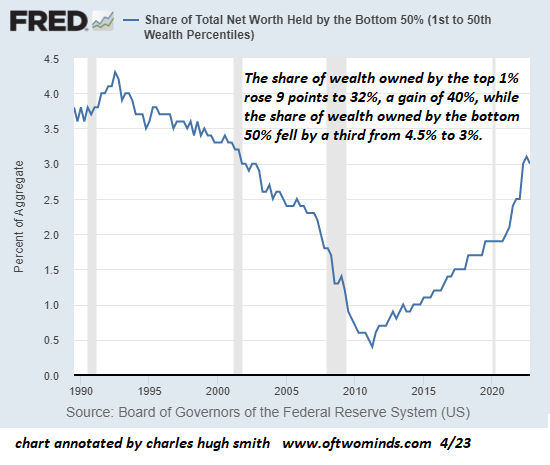
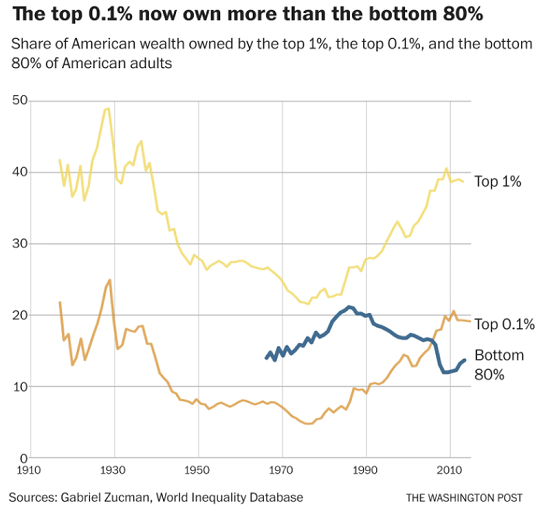
Those who gained the pilfered wealth credit their "hard work." That's not the full story. Policies stripmined labor and the middle class and funneled the trillions to well-connected capital via tax loopholes, subsidies, favorable tax write-offs, family trusts and many other policy decisions that could only benefit the top 0.1%, who now own more of America's wealth than the bottom 80%.

While the bottom 50% of America's households lost ground as their share of the nation's wealth shrank by a third to a meager 3%, the share of the top 1% soared by 40% to 32%.

How often do you see acknowledgements that social defeat and social depression are rampant in America, and that the causes are systemic, the result of policies chosen by the nation's leadership elites? Shall we be brutally honest and admit the answer is never?

And what do you expect to be served at the banquet of consequences of this systemic generation of social defeat and social depression? Perhaps a pendulum swing to the opposite extreme?


New Podcast: Charles Hugh Smith on Getting Ready for a Real Recession (38 min) (38 min)

My new book is now available at a 10% discount ($8.95 ebook, $18 print): Self-Reliance in the 21st Century.

Read the first chapter for free (PDF)

Read excerpts of all three chapters

Podcast with Richard Bonugli: Self Reliance in the 21st Century (43 min)


My recent books:

The Asian Heroine Who Seduced Me (Novel) print $10.95, Kindle $6.95 Read an excerpt for free (PDF)

When You Can't Go On: Burnout, Reckoning and Renewal $18 print, $8.95 Kindle ebook; audiobook Read the first section for free (PDF)

Global Crisis, National Renewal: A (Revolutionary) Grand Strategy for the United States (Kindle $9.95, print $24, audiobook) Read Chapter One for free (PDF).

A Hacker's Teleology: Sharing the Wealth of Our Shrinking Planet (Kindle $8.95, print $20, audiobook $17.46) Read the first section for free (PDF).

Will You Be Richer or Poorer?: Profit, Power, and AI in a Traumatized World
(Kindle $5, print $10, audiobook) Read the first section for free (PDF).

The Adventures of the Consulting Philosopher: The Disappearance of Drake (Novel) $4.95 Kindle, $10.95 print); read the first chapters for free (PDF)

Money and Work Unchained $6.95 Kindle, $15 print)
Read the first section for free


Become a $1/month patron of my work via patreon.com.

Subscribe to my Substack for free


NOTE: Contributions/subscriptions are acknowledged in the order received. Your name and email remain confidential and will not be given to any other individual, company or agency.

Thank you, Robert B. ($25), for your extremely generous contribution to this site -- I am greatly honored by your steadfast support and readership.


Thank you, Michael S. ($5/month), for your wondrously generous pledge to this site -- I am greatly honored by your support and readership.


Thank you, Paul S. ($5/month), for your splendidly generous pledge to this site -- I am greatly honored by your support and readership.


Thank you, Kim T. ($1/month), for your most generous pledge to this site -- I am greatly honored by your support and readership.

Read more...

Sunday, June 04, 2023

What Happens When the Competent Opt Out?

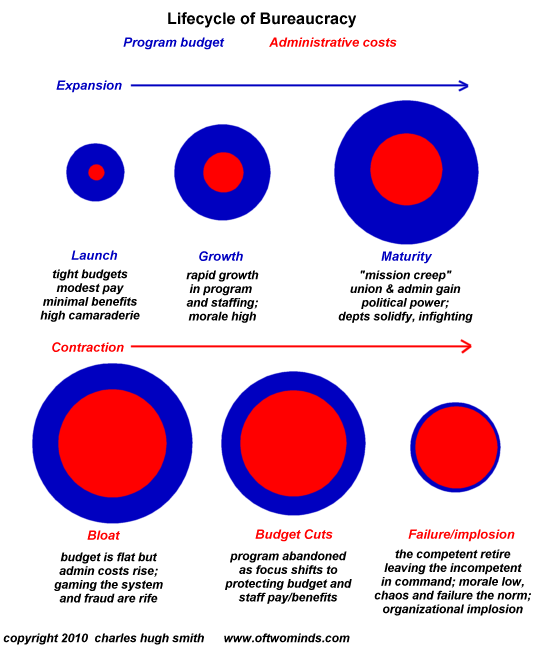
By this terminal stage, the competent have been driven out, quit or burned out.

What happens with the competent retire, burn out or opt out? It's a question few bother to ask because the base assumption is that there is an essentially limitless pool of competent people who can be tapped or trained to replace those who retire, burn out or opt out, i.e. quit in favor of a lifestyle that doesn't require much in the way of income or stress.

These assumptions are no longer valid. A great many essential services that are tightly bound to other essential services are cracking as the competent decide (or realize) they're done with the rat-race.

The drivers of the Competent Opting Out are obvious yet difficult to quantify. Those retiring, burning out and opting out will deny they're leaving for these reasons because it's not politic to be so honest and direct. They will offer time-honored dodges such as "pursue other opportunities" or "family obligations."

1. The steady increase in workloads, paperwork, compliance and make-work (i.e. work that has nothing to do with the institution's actual purpose and mission) that lead to burnout. There is only so much we can accomplish, and if we're burdened with ever-increasing demands for paperwork, compliance, useless meetings, training sessions, etc., then we no longer have the time or energy to perform our productive work.

I wrote a short book on my experience of Burnout. I believe it is increasingly common in jobs that demand responsibility and accountability yet don't provide the tools and time to fulfill these demands. Once you've burned out, you cannot continue. That option no longer exists.

For others, the meager rewards simply aren't worth the sacrifices required. The theme song playing in the background is the Johnny Paycheck classic Take this job and shove it.

Healthcare workloads, paperwork and compliance are one example of many. Failure to complete all the make-work can have dire consequences, so it becomes necessary to do less "real work" in order to complete all the work that has little or nothing to do with actual patient care. Alternatively, the workload expands to the point that it breaks the competent and they leave.

2. Loss of autonomy, control, belonging, rewards, accomplishment and fairness. Professor Christina Malasch pioneered research on the causes of burnout, which can be summarized as any work environment that reduces autonomy, control, belonging, rewards, accomplishment and fairness. Despite a near-infinite avalanche of corporate happy-talk ("we're all family,"--oh, barf) this describes a great many work environments in the US: in a word, depersonalized. Everyone is a replaceable cog in a great impersonal machine optimized to maximize profits for shareholders.

3. The politicization of the work environment. Let's begin by distinguishing between policies enforcing equal opportunity, pay, standards and accountability, policies required to fulfill the legal promises embedded in the nation's social contract, and politicization, which demands allegiance and declarations of loyalty to political ideologies that have nothing to do with the work being done or the standards of accountability necessary to the operation of the complex institution or enterprise.

The problem with politicization is that it is 1) intrinsically inauthentic and 2) it substitutes the ideologically pure for the competent. Rigid, top-down hierarchies (including not just Communist regimes but corporations and institutions) demand expressions of fealty (the equivalent of loyalty oaths) and compliance to ideological demands (check the right boxes of party indoctrination, "self-criticism," "struggle sessions," etc.).

The correct verbiage and ideological enthusiasm become the basis of advancement rather than accountability to standards of competence. The competent are thus replaced with the politically savvy. Since competence is no longer being selected for, it's replaced by what is being selected for, political compliance.

It doesn't matter what flavor of ideological purity holds sway--conservative, progressive, communist or religious--all fatally erode competence by selecting for ideological compliance. Everyone knows the enthusiasm is inauthentic and only for show, but artifice and inauthenticity are perfectly adequate for the politicization taskmasters.

4. The competent must cover for the incompetent. As the competent tire of the artifice and make-work and quit, the remaining competent must work harder to keep everything glued together. Their commitment to high standards and accountability are their undoing, as the slack-masters and incompetent either don't care ("I'm just here to qualify for my pension") or they've mastered the processes of masking their incompetence, often by blaming the competent or the innocent for their own failings.

This additional workload crushes the remaining competent who then burn out and quit, go on disability or opt out, changing their lifestyle to get by on far less income, work, responsibility and far less exposure to the toxic work environments created by depersonalization, politicization and the elevation of the incompetent.

5. As the competent leadership leaves, the incompetent takes the reins, blind to their own incompetence. It all looked so easy when the competent were at the helm, but reality is a cruel taskmaster, and all the excuses that worked as an underling wear thin once the incompetent are in leadership roles.

By this terminal stage, the competent have been driven out, quit or burned out. There's only slack-masters and incompetent left, and the toxic work environment has been institutionalized, so no competent individual will even bother applying, much less take a job doomed to burnout and failure.

This is why systems are breaking down before our eyes and why the breakdowns will spread with alarming rapidity due the tightly bound structure of complex systems.


New Podcast: Charles Hugh Smith on Getting Ready for a Real Recession (38 min) (38 min)

My new book is now available at a 10% discount ($8.95 ebook, $18 print): Self-Reliance in the 21st Century.

Read the first chapter for free (PDF)

Read excerpts of all three chapters

Podcast with Richard Bonugli: Self Reliance in the 21st Century (43 min)


My recent books:

The Asian Heroine Who Seduced Me (Novel) print $10.95, Kindle $6.95 Read an excerpt for free (PDF)

When You Can't Go On: Burnout, Reckoning and Renewal $18 print, $8.95 Kindle ebook; audiobook Read the first section for free (PDF)

Global Crisis, National Renewal: A (Revolutionary) Grand Strategy for the United States (Kindle $9.95, print $24, audiobook) Read Chapter One for free (PDF).

A Hacker's Teleology: Sharing the Wealth of Our Shrinking Planet (Kindle $8.95, print $20, audiobook $17.46) Read the first section for free (PDF).

Will You Be Richer or Poorer?: Profit, Power, and AI in a Traumatized World
(Kindle $5, print $10, audiobook) Read the first section for free (PDF).

The Adventures of the Consulting Philosopher: The Disappearance of Drake (Novel) $4.95 Kindle, $10.95 print); read the first chapters for free (PDF)

Money and Work Unchained $6.95 Kindle, $15 print)
Read the first section for free


Become a $1/month patron of my work via patreon.com.

Subscribe to my Substack for free


NOTE: Contributions/subscriptions are acknowledged in the order received. Your name and email remain confidential and will not be given to any other individual, company or agency.

Thank you, James L. ($25), for your extremely generous contribution to this site -- I am greatly honored by your support and readership.


Thank you, Charles K.D. ($5/month), for your wondrously generous pledge to this site -- I am greatly honored by your steadfast support and readership.


Thank you, Lumi V. ($5/month), for your splendidly generous pledge to this site -- I am greatly honored by your support and readership.


Thank you, Buck V. ($100), for your outrageously generous contribution to this site -- I am greatly honored by your steadfast support and readership.

Read more...

Thursday, June 01, 2023

A Nation of Junkies: The Empty Future of a Stimulus-Speculation Economy

Now that the US economy is totally dependent on trillions of dollars in stimulus and speculative gains reaped from the stimulus, there is no Real Economy left to pick up the pieces when the credit-stimulus-speculation bubbles all pop.

When economists speak of organic growth, they're referring to growth that arises naturally from the expansion of population, advances in productivity gained from better training and wise investments and the fruits of innovation.

Organic growth doesn't need constant stimulus, nor is it dependent on speculation. It doesn't need to be juiced by central banks and government to function. In an economy that isn't dependent on stimulus, the role of central banks is limited to being the lender of last resort in periodic financial crises, and government's role is to serve the common good by funding what fosters the common good but isn't profitable enough for private companies to pursue, for example, rural electrification and critical infrastructure.

Compare this Real Economy with the Artificial Economy we now have that is completely dependent on central bank and government stimulus and rampant speculation. If either the stimulus or speculation disappeared, the economy would collapse. Without constantly increasing monetary and fiscal stimulus, the asset bubbles inflated by stimulus would collapse.

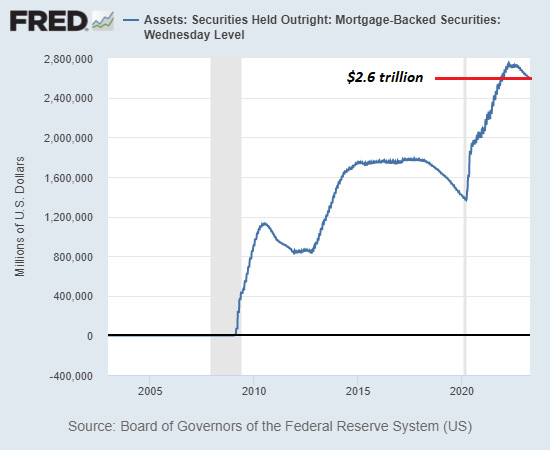
Every decision in this stimulus-speculation-dependent economy is keyed off of Federal Reserve stimulus or federal spending guarantees. Consider the decision to buy or build a residence to live in or hold as an investment. This decision is now keyed to Federal Reserve manipulation--scrape away the sugar-coating and this is what it is--of mortgage rates and the market for mortgages (mortgage backed securities) and federal government backstops and guarantees.

Glance at the first chart below of the Fed's "intervention" in the mortgage market: somehow the housing / mortgage market survived without the Fed owning any mortgage backed securities prior to 2009, but now the Fed must intervene to the tune of trillions of dollars to keep the housing / mortgage market from imploding.

All this stimulus is sold as "help" but it all ends up "helping" the wealthiest few at the expense of the bottom 90%. Look at the two charts below of the percentage of wealth held by the top 1% and the percentage of wealth held by the middle class, those households between 50% and 90% in terms of household income. Every new Fed / federal stimulus pushes the wealth of the 1% higher and the wealth of the middle class lower.

To those pushing the stimulus, the soaring wealth of the top 1% is "success" because that's their circle of colleagues and pals. If we're doing great, everyone must be doing great. Such is the hubris and denial olf our financial and political leadership.

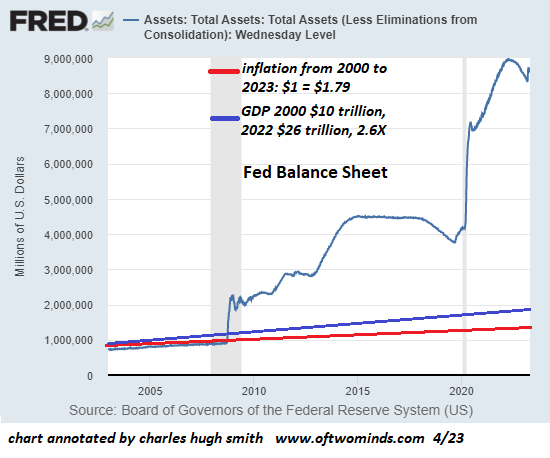
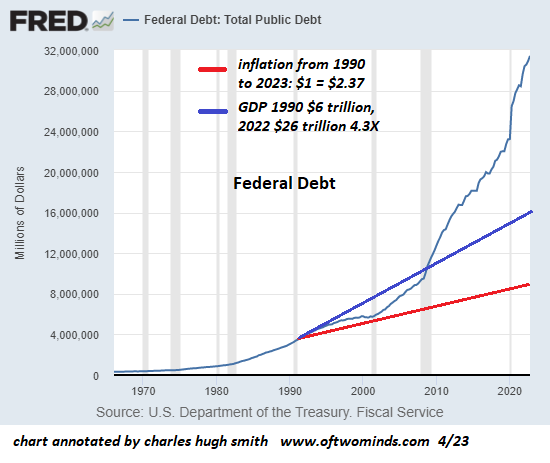
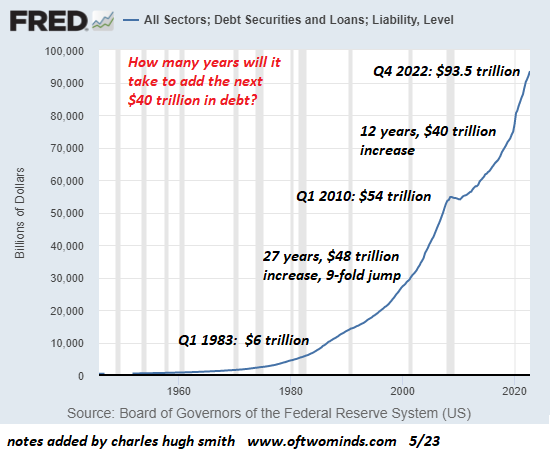
You'll notice three charts all display parabolic rises: the Fed balance sheet, federal debt and total debt. The primary form of stimulus is credit: expand the availability of credit and (until recently) make it cheaper to borrow by manipulating interest rates lower.

All this "free money" fueled a dependency on speculation for "growth," a dependency that has hollowed out the economy. As a direct result of all this stimulus / credit, corporations have bought tens of thousands of homes as rentals, inflating another housing bubble. Investors have snapped up tens of thousands of dwellings to cash in on the short-term rental (AirBnB etc.) boom, effectively distorting the long-term rental markets and pushing rents higher.

Debt and stimulus tracing parabolic ascents cannot end well. Eventually they collapse under their own weight.

Every junkie has an excuse. Every junkie proclaims I can stop any time. Now that the US economy is totally dependent on trillions of dollars in stimulus and speculative gains reaped from the stimulus, there is no Real Economy left to pick up the pieces when the credit-stimulus-speculation bubbles all pop.

And so we're treated to the infantile charades of the Federal Reserve and our elected officials, both bleating how wunnerful everything is while in private, with the mics safely muted, they're desperate to push the inevitable implosion off just a few more months. They have no alternative, and no way to return to an unmanipulated economy that isn't dependent on ever larger injections of stimulus and parabolic increases in debt.

The problem, friends, is the US economy has run out of veins for the coming injections of stimulus. The costs of dependency on artifices of stimulus and mood enhancement--everything's wunnerful!--are coming due, as they always do.

Unfortunately, there's no solution other than Cold Turkey, the collapse of all stimulus and all speculation. We're about to find out just how unpleasant Cold Turkey can be, and babbling rants of denial will only make it worse.


New Podcast: Charles Hugh Smith on Getting Ready for a Real Recession (38 min) (38 min)

My new book is now available at a 10% discount ($8.95 ebook, $18 print): Self-Reliance in the 21st Century.

Read the first chapter for free (PDF)

Read excerpts of all three chapters

Podcast with Richard Bonugli: Self Reliance in the 21st Century (43 min)


My recent books:

The Asian Heroine Who Seduced Me (Novel) print $10.95, Kindle $6.95 Read an excerpt for free (PDF)

When You Can't Go On: Burnout, Reckoning and Renewal $18 print, $8.95 Kindle ebook; audiobook Read the first section for free (PDF)

Global Crisis, National Renewal: A (Revolutionary) Grand Strategy for the United States (Kindle $9.95, print $24, audiobook) Read Chapter One for free (PDF).

A Hacker's Teleology: Sharing the Wealth of Our Shrinking Planet (Kindle $8.95, print $20, audiobook $17.46) Read the first section for free (PDF).

Will You Be Richer or Poorer?: Profit, Power, and AI in a Traumatized World
(Kindle $5, print $10, audiobook) Read the first section for free (PDF).

The Adventures of the Consulting Philosopher: The Disappearance of Drake (Novel) $4.95 Kindle, $10.95 print); read the first chapters for free (PDF)

Money and Work Unchained $6.95 Kindle, $15 print)
Read the first section for free


Become a $1/month patron of my work via patreon.com.

Subscribe to my Substack for free


NOTE: Contributions/subscriptions are acknowledged in the order received. Your name and email remain confidential and will not be given to any other individual, company or agency.

Thank you, William H. ($50), for your extremely generous contribution to this site -- I am greatly honored by your steadfast support and readership.


Thank you, Seeker ($5/month), for your wondrously generous pledge to this site -- I am greatly honored by your support and readership.


Thank you, Kitty B. ($5/month), for your splendidly generous pledge to this site -- I am greatly honored by your support and readership.


Thank you, Richard H. ($50), for your superbly generous contribution to this site -- I am greatly honored by your steadfast support and readership.

Read more...

Terms of Service

All content on this blog is provided by Trewe LLC for informational purposes only. The owner of this blog makes no representations as to the accuracy or completeness of any information on this site or found by following any link on this site. The owner will not be liable for any errors or omissions in this information nor for the availability of this information. The owner will not be liable for any losses, injuries, or damages from the display or use of this information. These terms and conditions of use are subject to change at anytime and without notice.

RE: European Union AI Act, and Our Use of Generative AI Tools and Agents Policy

All text on this site is composed by Charles Hugh Smith or by a credited guest-author. No Generative AI Tools are used in the composition / writing of any text or graphic content created by Charles Hugh Smith. This site deploys no AI agents or generative AI tools. This site is not responsible for the disclosures, use or non-use of AI agents or generative AI tools in advertisements displayed by Investing Channel or other ad placement services.

Audio files generated by text-to-audio transcription tools are identified as such.

Our Privacy Policy:

Correspondents' email is strictly confidential. This site does not collect digital data from visitors or distribute cookies. Advertisements served by third-party advertising networks such as Investing Channel may use cookies or collect information from visitors for the purpose of Interest-Based Advertising; if you wish to opt out of Interest-Based Advertising, please go to Opt out of interest-based advertising (The Network Advertising Initiative) If you have other privacy concerns relating to advertisements, please contact advertisers directly.

PRIVACY NOTICE FOR EEA INDIVIDUALS

This section covers disclosures on the General Data Protection Regulation (GDPR) for users residing within EEA only. GDPR replaces the existing Directive 95/46/ec, and aims at harmonizing data protection laws in the EU that are fit for purpose in the digital age. The primary objective of the GDPR is to give citizens back control of their personal data. Please follow the link below to access InvestingChannel's General Data Protection Notice.
https://stg.media.investingchannel.com/gdpr-notice/

Notice of Compliance with The California Consumer Protection Act

This site does not collect digital data from visitors or distribute cookies. Advertisements served by a third-party advertising network (Investing Channel) may use cookies or collect information from visitors for the purpose of Interest-Based Advertising. If you do not want any personal information that may be collected by third-party advertising to be sold, please follow the instructions on this page: Do Not Sell My Personal Information.

Regarding Cookies:

This site does not collect digital data from visitors or distribute cookies. Advertisements served by third-party advertising networks such as Investing Channel may use cookies or collect information from visitors for the purpose of Interest-Based Advertising; if you wish to opt out of Interest-Based Advertising, please go to Opt out of interest-based advertising (The Network Advertising Initiative) If you have other privacy concerns relating to advertisements, please contact advertisers directly.

Our Commission Policy:

Though I earn a small commission on Amazon.com books and gift certificates and gold (BullionVault) purchased via links on my site, I receive no fees or compensation for any other non-advertising links or content posted on my site.

Copyright Notice:

All original images (Drawings and Photographs), text (essays, books and works of fiction), audio and video recordings, musical compositions, graphic design, graphic design elements and HTML coding on this site are the copyrighted work of Charles Hugh Smith unless otherwise credited or noted. They are published as information for the private use of site visitors, and any reproduction or redistribution of this content or coding in any media in any format or distribution channel (text, audio, video/film, web) without the written permission of the copyright holder is strictly prohibited. All rights in all media reserved globally.

  © Blogger templates Newspaper III by Ourblogtemplates.com 2008

Back to TOP