



Wednesday, August 09, 2023

I'm Not Really Enjoying the Show

Let's dispense with human presidential candidates and conventions, and replace both the candidates and their supporters with idealized AI fabrications.

The Show Must Go On, but I'm not really enjoying the show. One reason why is I Keep Changing Channels But It's Still the Same Program, i.e. the programming and marketing are now homogenized. Another is Even the Aliens Are Boring, i.e. everything is so sensationalized and hyped that we are now desensitized to it all.

A third reason is our culture has perfected the craft of self-parody, rendering parody impossible. To parody foolish excess, we exaggerate a two-patty burger into a four-patty burger: oops, they've already hyped four-patty burgers.

To parody the fossilization of American politics, we create a parody in which 77-year olds are the vibrant young-uns in the halls of power. Dang, the halls of power are already choked with more elderly than the USSR's creaky leadership just before it collapsed in a heap.

To parody the homogenization and infantilization of Hollywood, we create a parody in which the dominant "tentpoles" generating steady profits are endlessly proliferating comic book superheroes. Darn, that's already the case.

To parody the media's desperate competition for "engagement," we create a parody in which everything becomes a global existential crisis. Heh, there's no way to parody anything that's already been driven to excess via the mastery of self-parody.

Irony has also been shown the door. The core dynamic of the modern world isn't--as is constantly hyped--innovation; it's marketing, persuading someone to transfer value--money, loyalty, votes, engagement-- for something (tangible or intangible) without regard to the eventual costs and consequences of the exchange.

The irony is authenticity is faked to make the sale. But the fraud of mimicking authenticity to make the sale is now so embedded, so ubiquitous, that the irony is lost: we are living in a Philip K. Dick story come to life in which real young women fabricating fake lives of glamor and luxury to boost their Only Fans income are now competing with digitized imaginary young women that are idealized versions (like Barbie) of the sexually compelling female.

In a culture stripped of irony and parody, a movie based on an idealized female doll introduced 64 years ago reaps $1 billion in sales and sparks thousands of earnest cultural commentaries. Barbie as a marketing phenomenon has of course evolved: idealized male Ken was introduced a few years later, along with an ever-expanding line of ethnic Barbies. Barbie is clearly an "authentic" cultural icon.

If the aliens are watching us, one hopes they have a refined sense of absurdist humor.

As for AI: what's marketed as "artificial intelligence" is certainly artificial, but it isn't remotely intelligent. By mimicking humanity's natural language abilities, ChatAI programs make a marketing claim of authenticity that is entirely fraudulent. There is no "there there" in terms of understanding, predictive acumen or any other form of what once passed for intelligence.

The entire point of this bogus AI is to automate the processes of marketing, homogenization and hype, to streamline and reduce the costs of faking authenticity to make the sale. As in a Philip K. Dick story, where the protagonist ends up asking if he is in fact a robot and not a human as he assumed--our own authenticity must be questioned, as what we assume is "the real me" turns out to be nothing but a jumble of marketing cliches that reads like an obituary: he was a Steelers fan, loved the music of Nashville, was an avid BBQer, etc.

With parody and irony both enfeebled, the show is now tediously humorless. What can we say about a show in which the once-compelling topic of alien visitations to Earth are reduced to another boring congressional hearing on CSPAN, a parody in which the possibility of an alien presence is reduced to ashes while whatever is being marketed at the moment is hyped as the "crisis" you must pay attention to?

It's impossible to parody what is already an absurdist parody. Consider the ceaseless adverts for low-quality processed / fast-food in which ecstasy can be yours ("this greasy sugar-bomb tastes good!") for a low, low price and the rest of the adverts, which are for pharmaceutical medications for all the diseases created by consuming low-quality processed / fast-food, ads that include an eye-watering list of side-effects that is impossible to parody, as it already includes "and in rare cases, death."

Hmm. So we can expire from metabolic and other lifestyle disorders in the pursuit of infantile "it tastes so good!" or we can expire from the supposed cure, after suffering from a list of side-effects that would qualify as banned protocols of torture. Absurdist irony, you are now live, action!

So desperate are we for authentic authenticity that "the real thing" becomes an irresistible marketing platform. You may have come across a young woman's artful videos of her preparing real food in a beautiful rural setting in China. Her name is Li Ziqi. Her videos have logged almost 3 billion views. They are remarkable for their composition and for her culinary, gardening and handicraft skills, which are clearly real. She brought the mythology of an authentic life close to the Earth into being, and the global desperation for some shred of unpackaged, unprogrammed, unmarketed authenticity generated her vast audience.

Alas, her authentic skills were packaged so entrancingly with a commercial purpose. Thanks to a marketing deal, her global audience exploded, as did the sales of her line of products in China. She suddenly stopped issuing new videos two years ago, and it seems legal / commercial conflicts were at the heart of her disappearance: Li Ziqi's Online Pastoral Poetics: Millions of people subscribed to her vision of an idyllic rural existence. Who was she, and why did she disappear? (New Yorker)

It's doubtful that many of her millions of viewers actually wanted to spend hours tending gardens and making real food from real produce; they found pleasure in the mythology, not the reality. This is the problem with authenticity: it's demanding and requires discipline and an inner life immune to marketing.

To grasp why the show is no longer enjoyable, we turn once again to Philip K. Dick, who offered an insightful description of authenticity in How to Build a Universe That Doesn't Fall Apart Two Days Later:

"The authentic human being is one of us who instinctively knows what he should not do, and, in addition, he will balk at doing it. He will refuse to do it, even if this brings down dread consequences to him and to those whom he loves. This, to me, is the ultimately heroic trait of ordinary people; they say no to the tyrant and they calmly take the consequences of this resistance. Their deeds may be small, and almost always unnoticed, unmarked by history. Their names are not remembered, nor did these authentic humans expect their names to be remembered. I see their authenticity in an odd way: not in their willingness to perform great heroic deeds. but in their quiet refusals. In essence, they cannot be compelled to be what they are not."

In conclusion, I offer an idea: let's dispense with human presidential candidates and conventions, and replace both the candidates and their supporters with idealized AI fabrications. Thanks to AI, the fake candidates can engage in realistic fake debates, and their fake supporters can clap, cheer and jeer on cue.

In a world stripped of authenticity, irony and parody, such a substitution makes marketing sense. Let's get the show rolling, and make the sale. It's just a guess, of course, but I think the aliens would approve.


My new book is now available at a 10% discount ($8.95 ebook, $18 print): Self-Reliance in the 21st Century.

Read the first chapter for free (PDF)

Read excerpts of all three chapters

Podcast with Richard Bonugli: Self Reliance in the 21st Century (43 min)


My recent books:

The Asian Heroine Who Seduced Me (Novel) print $10.95, Kindle $6.95 Read an excerpt for free (PDF)

When You Can't Go On: Burnout, Reckoning and Renewal $18 print, $8.95 Kindle ebook; audiobook Read the first section for free (PDF)

Global Crisis, National Renewal: A (Revolutionary) Grand Strategy for the United States (Kindle $9.95, print $24, audiobook) Read Chapter One for free (PDF).

A Hacker's Teleology: Sharing the Wealth of Our Shrinking Planet (Kindle $8.95, print $20, audiobook $17.46) Read the first section for free (PDF).

Will You Be Richer or Poorer?: Profit, Power, and AI in a Traumatized World
(Kindle $5, print $10, audiobook) Read the first section for free (PDF).

The Adventures of the Consulting Philosopher: The Disappearance of Drake (Novel) $4.95 Kindle, $10.95 print); read the first chapters for free (PDF)

Money and Work Unchained $6.95 Kindle, $15 print)
Read the first section for free


Become a $1/month patron of my work via patreon.com.

Subscribe to my Substack for free


NOTE: Contributions/subscriptions are acknowledged in the order received. Your name and email remain confidential and will not be given to any other individual, company or agency.

Thank you, Daniel L. ($50), for your superbly generous contribution to this site -- I am greatly honored by your steadfast support and readership.


Thank you, user2200 ($20), for your most generous contribution to this site -- I am greatly honored by your support and readership.

Read more...

Monday, August 07, 2023

Fooled by What We Measure, Enlightened by What We Don't Measure

Economists and pundits steer well clear of the eventual social and political consequences of America's entrenched neofeudal wealth-income inequality.

Economists and pundits are falling all over themselves to declare the US is chugging along splendidly, and to express their frustration with the public for their curmudgeonly lack of enthusiasm. For example: If this is a bad economy, please tell me what a good economy would look like We should acknowledge that things are going well, even as we continue to look for problems to solve and How the Recession Doomers Got the U.S. Economy So Wrong.

My intention is not to slam Noah Smith or Derek Thompson. I follow their work and gain value from their analysis.

The point I want to make is we only manage what we measure, and the reliance on statistics that are overly broad and easily distorted/gamed leads to generalizations that ignore consequential cause and effect: we are fooled by overly broad and easily distorted/gamed statistics and enlightened by looking at what is not measured or measured inadequately.

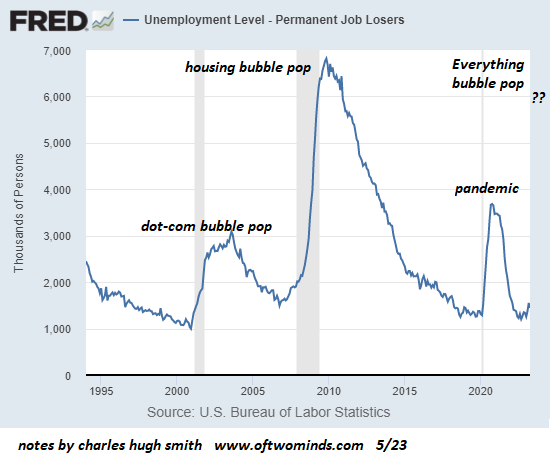
The consensus holds that inflation is declining rapidly and unemployment remains low, so the economy is doing great. Please glance at Chart #1 below to see what enthuses the mainstream: the unemployment rate is near historic lows.

But this measure leaves out a great deal of consequential factors. It's well-known that the unemployment rate is distorted / gamed by leaving out everyone who is in the workforce but not "actively seeking work." So what does this official unemployment rate actually measure? Not the percentage of the workforce that has a job.

Nor does it measure underemployment--those working far below their potential--or job insecurity or the percentage of workers being pushed into burnout--all consequential reflections of the real economy. All of these are potentially causal factors in why US productivity has fallen so dramatically.

And speaking of productivity, that's the ultimate source of prosperity--not speculative bubbles or debt-binging. If productivity is tanking, eventually there are negative economic consequences that will be distributed to some segments of the populace, very likely asymmetrically.

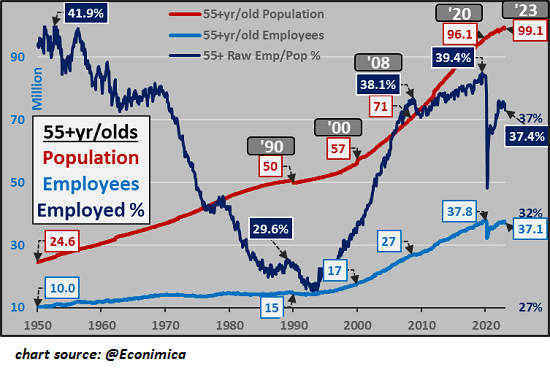
Such a broad-brush measure also ignores the consequences of demographics. Please glance at chart #2 below, of the 55 and over population and workforce. Note that virtually all the 20+ million jobs the US economy added in the past two decades are in this older workforce, which is of course steaming steadily into retirement, even as the percentage of this cohort who continues working has soared.

In other words, virtually all the job growth is the result of older workers working longer. Yes, 70 is the new 50, but try doing the same work at 70 that you did when you were 50. Sure, some people forego retirement because they love their work so much, but we don't measure how many are still working because they have to for pressing financial reasons.

Have you observed the age of service workers and skilled workers recently? Do you reckon they really love working at Burger King so much that they're doing it for enjoyment?

What if we measured financial pressures and job insecurity rather than risibly bogus "unemployment"? Would the economy still look so wonderful and resilient?

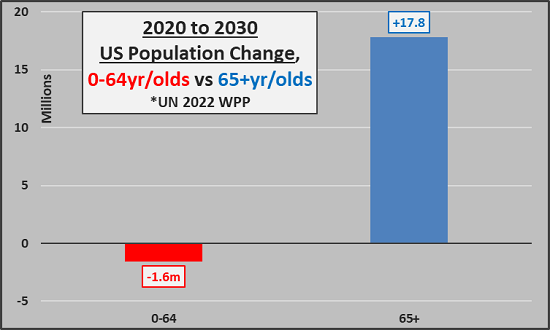
Chart #3 shows that virtually all the population growth ahead is in the cohort of older workers 65+ years old heading into retirement. So the workforce is rapidly aging and the unspoken / unexamined assumption is tens of millions of new workers will enter the workforce with the same skills, motivation, dedication and values as the tens of millions retiring.


But the demographics simply don't support this breezy assumption.

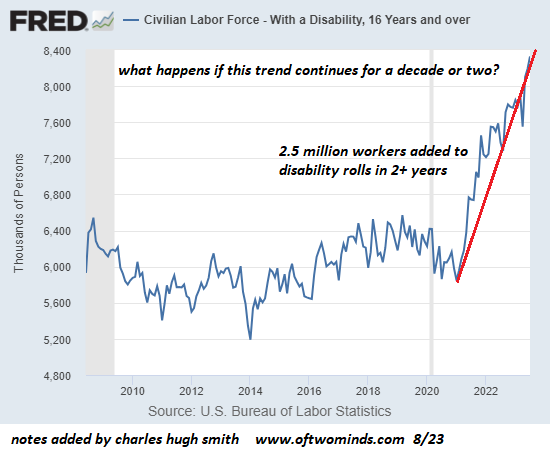
Now glance at chart #4 which depicts the extraordinary rise in the number of workers who are now disabled. The causes of this are being debated (the pandemic obviously plays a role), but 2.5 million workers leaving the workforce in a few years is something that could be consequential if the trend continues. An assumption that this is a one-off is baseless until proven otherwise.


Once again, demographics, productivity and factors such as disability and burnout are not part of the unemployment, GDP and inflation measures currently being touted as proof of economic nirvana.

Item #1 of what's not even measured is the crapification of goods and services. I addressed this in The "Crapification" of the U.S. Economy Is Now Complete (February 9, 2022) and Stainless Steal (February 26, 2023).

How do we measure the "inflation"--i.e. a loss of purchasing power--when appliances that lasted 20 years a generation ago now break down in 5 years? Where does that 75% decline in utility and durability show up in the official inflation data? How about the tools that once lasted a lifetime now breaking after a few years?

It's been estimated that America's food has lost 30% of its nutritive value in the past few decades. Protein per gram has dropped, trace nutrients have dropped, and so on. Rather than pursue sustainably nutrient-rich soil, Big Ag has maximized profits by dumping natural-gas-derived chemical fertilizers on depleted soil to boost production of nutrient-poor, tasteless "product." A product deemed "organic" offers no guarantee that the soil isn't depleted of nutrients.

Could this decline have anything to do with the American populace's increasingly poor health? Nobody knows because these massive declines in quality and value aren't measured and are certainly not part of the risibly bogus measures of unemployment, GDP and inflation.

The official inflation rate ignores the multi-decade decline in the purchasing power of wages. Rents have soared 25% in a few years, and economists are looking at 5% increases in wages and worrying about the potential inflationary impact of workers' wages not keeping up with real-world inflation.

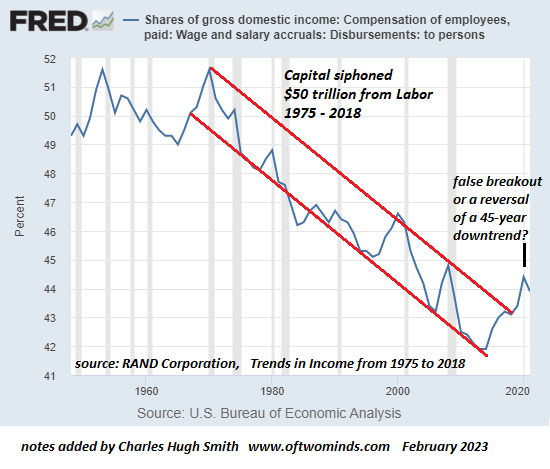
Cheerleading economists and pundits never mention the $50 trillion siphoned from labor by capital over the past 45 years. They also don't mention the rising trend of loading more work on employees rather than hire more employees, or as a response to not being able to find qualified new hires.

Funny how rosy the picture can be tinted when all the consequential forces are ignored. But this studied ignorance characterizes the American elite, who delight in whining about airfares and travel delays, and finding someone to fix their pool pump. I address our Terminally Stratified Society here:

The Wealthy Are Not Like You and Me--Our Terminally Stratified Society (August 3, 2023)

This protected elite don't have to put up with the crapified goods and services which generate their capital gains and income. Their wealth and income enable their detachment from the crapified economy the bottom 90% experience. Their experience of the bottom 90% is as service workers, delivery people, etc. who serve their entitled tastes.

Correspondent Tomasz G. provided a telling excerpt from Houellebecq's The Possibility of an Island:

"... the rich certainly like the company of the rich, no doubt it calms them, it's nice for them to meet beings subject to the same torments as they are, and who seem to form a relationship with them that is not totally about money; it's nice for them to convince themselves that the human species is not uniquely made up of predators and parasites... "

As correspondent Ryan R. observed, America's privileged elites "were born on third, stole home (via asset inflation) and still think they hit that home run."

We know who the parasites are, but economists and pundits are safely blind to America's neofeudal aristocracy. After all, who butters the bread of economists and pundits?

Is it unsurprising there are no measures of neofeudalism or elite privilege? As for the incredible concentration of wealth in the top tiers and the resulting decline in the bottom 90%'s share of the nation's wealth--nothing to see here, just globalization and financialization doing their thing. What matters is booking my next flight to yet another conference of economists and pundits where we nod our heads and dare not admit all the conferences are nothing but echo chambers of the privileged elites.

Cheerleading economists and pundits completely ignore the consequences of the system being rigged to favor capital and the already-wealthy who were given the means to buy assets back when they were cheap and affordable to the middle-class. Now that the system generates speculative credit-asset bubbles to create "the wealth effect," assets such as homes in desirable regions are out of reach of the bottom 90%.

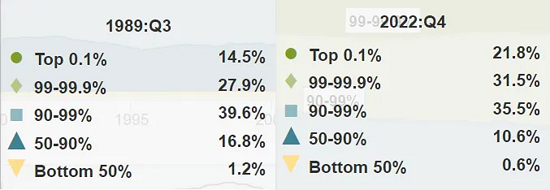
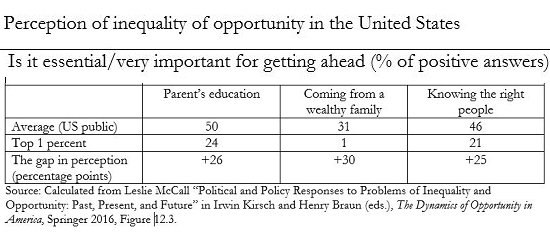
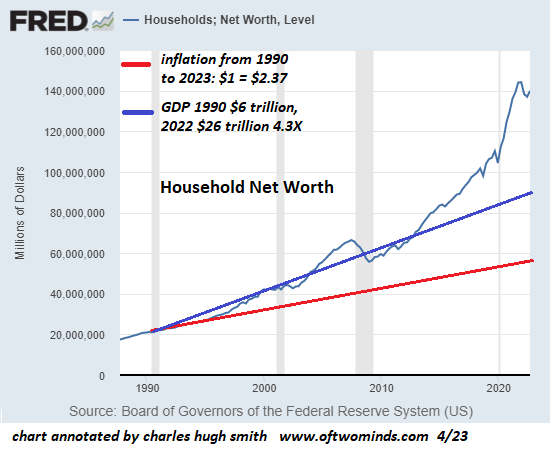
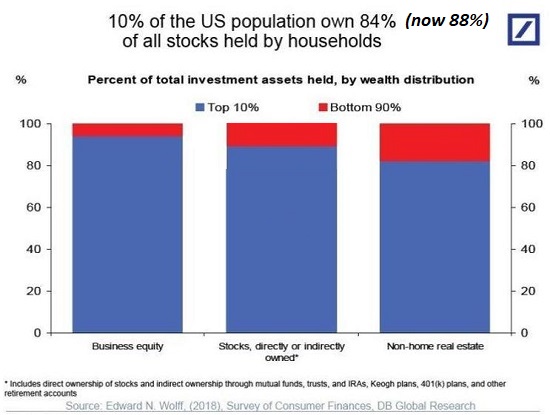
Please study the six charts below of wealth inequality. Try not to laugh out loud when you see that the top 1% reckon that "coming from a wealthy family" has near-zero impact on "getting ahead in America."

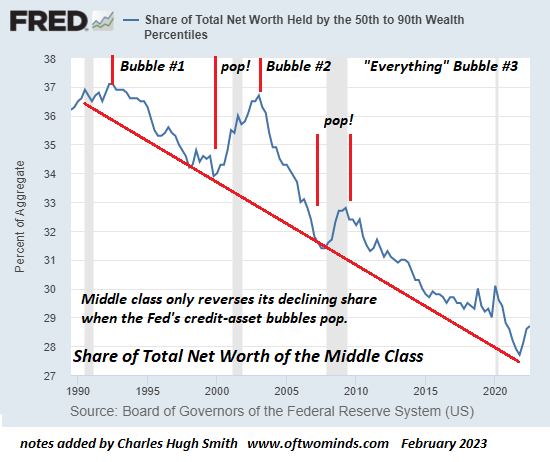
Also note the steady decline in the middle class percentage of national wealth, and how the middle class's share only rises when the credit-asset bubbles that have enriched the top 10% deflate, a bubble-pop that never lasts longer than a few months thanks to the policies that favor the already-rich at the expense of those who don't own stocks, rental properties, municipal bonds, etc.

Economists and pundits steer well clear of the eventual social and political consequences of America's entrenched neofeudal wealth-income inequality. That this neofeudal configuration is inherently destabilizing--never mind, we don't measure that, look at the wunnerful unemployment and inflation charts!

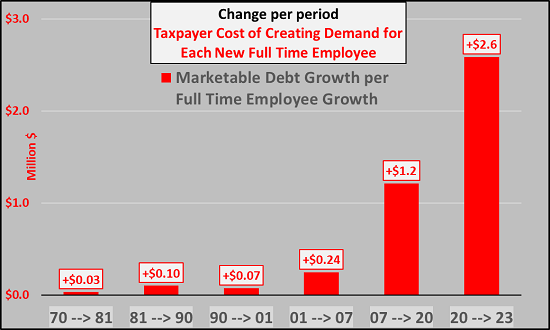
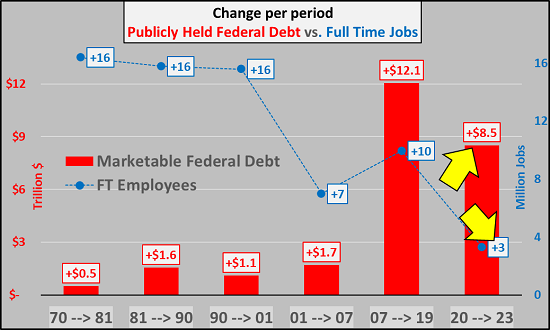
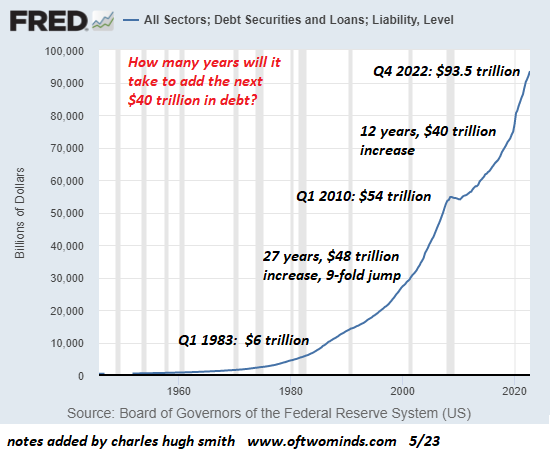
Lastly, consider the skyrocketing federal debt in terms of how many jobs are created in the era of soaring federal spending and debt. (Charts courtesy of CH / Economica) Debt doesn't matter to economists and pundits, and neither does its diminishing effect on GDP and employment. The same can be said of total debt (public and private), which is skyrocketing (last chart): diminishing returns writ large as higher interest rates are embedded in the policy excesses and neofeudal structure of the past 45 years.

In essence, nothing that is consequential is properly quantified, so the pundit class keeps insisting everything is wunnerful and is mystified why people are so foolishly dissatisfied with our wunnerful economy. The reason why people are not buying the fantasyland story is they have to live and work in the crapified real economy, as serfs serving the economist-punditry-elite aristocracy.

If we want to avoid being led astray by misleading measures, we must seek enlightenment in what isn't being measured or is cast aside as inconvenient to the "economy is wunnerful" party line.


My new book is now available at a 10% discount ($8.95 ebook, $18 print): Self-Reliance in the 21st Century.

Read the first chapter for free (PDF)

Read excerpts of all three chapters

Podcast with Richard Bonugli: Self Reliance in the 21st Century (43 min)


My recent books:

The Asian Heroine Who Seduced Me (Novel) print $10.95, Kindle $6.95 Read an excerpt for free (PDF)

When You Can't Go On: Burnout, Reckoning and Renewal $18 print, $8.95 Kindle ebook; audiobook Read the first section for free (PDF)

Global Crisis, National Renewal: A (Revolutionary) Grand Strategy for the United States (Kindle $9.95, print $24, audiobook) Read Chapter One for free (PDF).

A Hacker's Teleology: Sharing the Wealth of Our Shrinking Planet (Kindle $8.95, print $20, audiobook $17.46) Read the first section for free (PDF).

Will You Be Richer or Poorer?: Profit, Power, and AI in a Traumatized World
(Kindle $5, print $10, audiobook) Read the first section for free (PDF).

The Adventures of the Consulting Philosopher: The Disappearance of Drake (Novel) $4.95 Kindle, $10.95 print); read the first chapters for free (PDF)

Money and Work Unchained $6.95 Kindle, $15 print)
Read the first section for free


Become a $1/month patron of my work via patreon.com.

Subscribe to my Substack for free


NOTE: Contributions/subscriptions are acknowledged in the order received. Your name and email remain confidential and will not be given to any other individual, company or agency.

Thank you, Richard O. ($50), for your marvelously generous contribution to this site -- I am greatly honored by your steadfast support and readership.


Thank you, Sigma M. ($10/month), for your outrageously generous subscription to this site -- I am greatly honored by your steadfast support and readership.

Read more...

Thursday, August 03, 2023

The Wealthy Are Not Like You and Me--Our Terminally Stratified Society

History suggests such a stratified society cannot endure as a democracy.

When we say "The Wealthy Are Not Like You and Me," most people will assume we're talking about ultra-high-net-worth individuals (UHNWIs) with $30 million or more in assets or even the hyper-rich worth hundreds of millions or billionaires.

I'm not discussing the tiny class of UHNWIs here, I'm discussing the 8 million households of the top 5% and the 13 million households of the top 10% who own 70% of all assets and almost 90% of income-producing assets such as stocks, bonds, rental properties, etc. Not the uber-wealthy or hyper-wealthy, just the wealthy who own a million or two in assets not counting their primary residence.

A recent survey reports that there are 13.6 million households that have a net worth of $1 million or more (about 10% of the 132 million US households), and about 8 million US households have a net worth of $2 million or more (about 6% of households), not including the value of their primary residence. .

This top 10% collect about 50% of all income and account for about 40% of all consumption.

The topic here is the increasingly impermeable barrier between the top 5% and the bottom 95%, a matter not just of financial inequality but of sociological separation discussed by Christopher Lasch in his 1996 book The Revolt of the Elites and the Betrayal of Democracy.

I want to stipulate that I am not slamming the class of people I'm describing here. Rather, I am observing them as an anthropologist observes tribes, classes and cultures.

I recently met up with some old friends from our college days. At the time, they were students living in a cookie-cutter high-rise apartment with the usual hand-me-down furniture and concrete-block / pine boards book-shelving.

Now they live in a multi-million dollar house in an exclusive neighborhood, surrounded by $5 million McMansions recently built on small lots after the original homes were demolished. They too demolished the house inherited from parents and built a new luxe home.

What struck me as a journalist / analyst was how wealthy there are, and how all their friends are wealthy. They don't interact with the bottom 95% of "normal" people except as their housecleaning maids, repair or delivery person, etc., as interchangeable, commoditized laborers who are effectively peasants / peons in our highly stratified neofeudal economy. They don't actually know any "normal" people as friends or even colleagues; their friends are all wealthy people like themselves.

We might say this impermeable class divide is natural, but this overlooks three key factors.

One is that the barrier between the wealthy and the not-wealthy was once more permeable. As Lasch observed, America's elites have separated themselves from the rest of society in exclusive enclaves and in a mobile lifestyle detached from place.

Other commentators have written about the same sociological trend of elites living in bubbles populated by other elites: in elite universities, in exclusive social groups, in exclusive neighborhoods no normal household can possibly afford, etc.

Lasch's point was this economic / lifestyle stratification is toxic to democracy, a reality that is playing out in all sorts of ways.

Another factor is all the wealthy people I know became wealthy as a direct result of financial help from their parents. Every wealthy person I know (with a very few exceptions)--and by that I mean people who live in homes worth $750,000 or more in value and who own other substantial financial assets that generate capital gains and income--attended university funded by their parents, and whose first home purchase was enabled by help from their parents or in-laws.

I've also observed that this class of privileged people often tout their "bootstrapping" while neglecting to list the full measure of financial support they received from their family. Everyone wants to claim "I did it all myself" but this rings hollow once the facts of the matter come out.

This class also inherited substantial wealth when their parents passed away, or from trusts established by the parents to transfer their wealth prior to their death.

Lastly, all the wealthy people I know bought or acquired assets long ago at prices that were affordable to households with normal middle-class incomes. At today's valuations, the homes and assets they bought decades ago are no longer affordable to any household below the top 10%.

Another shared characteristic of the wealthy who inherited their wealth and benefited tremendously from the past 30 years of asset inflation is that they uniformly attribute their wealth to their hard work. Yes, they worked hard, but so did most of the bottom 95% who aren't wealthy.

The deciding factor wasn't the wealth they created as entrepreneurs or workers; it was the assets they were able to buy long ago as the direct result of financial help from their parents--or put another way, the wealth generated by the monumental inflation of assets their parents bought decades ago.

Scrape away the 1) parents-paid university, 2) the parental help in buying their first property, 3) their ability to save money in IRAs and 401Ks as a result of having low-cost mortgages (or no mortgage at all) and invest these savings in other assets at low prices, and 4) the rampant asset inflation of the past 30 years, and how much wealth would they own that was solely the result of their earnings / frugality?

Yes, there are wealthy entrepreneurs who earned their wealth by creating value in an enterprise, but once again, scrape away the enterprises that are bubble-dependent real estate and stock-market based ventures, and how many entrepreneurs actually created wealth via creating value? Take away the 30 years of asset inflation and the answer is very few.

Much of what the wealthy claim as brilliance is nothing more than the good fortune of living in a multi-decade era of ever-rising asset valuations.

Some friends inherited portfolios of dividend-paying stocks that had been on auto-reinvestment of dividends for 50 or 60 years. Small stakes invested back then are now worth $1 million or more. Others inherited gold purchased at low prices decades ago. These are just two examples of many transfers of wealth that rarely get mentioned.

As a general rule, the wealthy don't reveal all the help they received, or attribute their wealth to asset inflation. They tout their long service in academia or Corporate America, their wise investing, their hard work, etc.

I know this because I've benefited from the same asset inflation, though I didn't benefit from an inheritance or much help from my parents ( I did receive a rusting old VW that needed an engine rebuild--a real plus at the time as I needed a car to get to work). But even the accomplishments I can claim credit for--working my way through university by working 24-32 hours a week, fully self-supported, and building my own house at the age of 27--are out of reach of the majority of "normal people" now.

University tuition and fees have skyrocketed, and so have rents. It's almost impossible for a young person to make enough income from 30 hours of work per week to pay all the university costs, the rent for a tiny studio ($135 per month in 1975) and maintain an old car, plus groceries, beer, etc.

There is one other factor that must be described in this stratification of wealth: the role of frugality. My wife and I lived in the cheapest, crummiest studio in the city for years, worked Saturdays on construction side-jobs, did our own auto maintenance, etc. to save up the money to buy a lot and building materials to build our own house. I know many other people, mostly immigrants but some native-born Americans, who followed the same route of extremely disciplined frugality to save up the down payment needed to buy a house.

But even the path of frugality is steeper now. The rent for even the crummiest studio is sky-high, used cars cost a small fortune and wages have stagnated for 45 years, a fact I've often noted in my blog posts. Even wages in construction have stagnated.

Adjusted for inflation / purchasing power, I made more money as a 23-year old carpenter/tradecraft worker in 1976 than I've ever made since. In other words, it took fewer hours of work in 1976 to pay for basic shelter, food, utilities and transport than it does now. (See chart below of wages share of the economy: it topped in 1975.)

When the economic stratification was less pronounced and less entrenched, you might have had a spectrum of neighbors. Now the wealthy only know other wealthy people, because no one who isn't wealthy can possibly buy a home in their exclusive enclaves or enter their social circles of people wealthy enough to donate to the arts or politics.

In the bubble of the wealthy, one hears about the travails of finding people to fix pool pumps, wealthy acquaintances who scored a beachfront rental for only $7,000 a month and endless stories of jetting around. One also hears strained efforts to show how frugal they are, as if scoring discounted airline flights is the sort of frugality that will eventually build up a down payment for an insanely over-valued house in their enclave.

Extreme stratification is now the norm globally. The barrier between those who inherited wealth or who had enough help to buy assets decades ago and those without parental wealth to help them now is impermeable. Even as younger generations lobby for more housing to be built, it's still unaffordable unless it's heavily subsidized.

Here are a few links describing aspects of this impermeable stratification:

New Grads Chasing 'TikTok Lifestyles' Struggle In NYC As Rents Surge

A Tale of Paradise, Parking Lots and My Mother's Berkeley Backyard (NYT.com) NIMBYs and YIMBYs--older wealthier residents don't want new multi-story housing to change their enclaves, younger people want more housing to (hopefully) lower rents.

Majority of flights taken by a small percentage of flyers

The Saving Glut of the Rich

A bit of realism and humility are in order. Yes, we worked hard, but we're not wealthy because we're so brilliant or even because we're so frugal. We're wealthy because the global economy is structured to inflate asset bubbles. Those who bought or were given assets decades ago have benefited, those entering university and the workforce now cannot afford the same things we bought with average incomes without inheriting wealth from their families.

Those inside the bubble of wealth who only associate with other wealthy people don't seem to notice the social / financial stratification or its profoundly negative consequences. Perhaps they think this is how everyone lives, fretting about finding cheap laborers and cheap flights, or they discount their own wealth as merely "comfortable." Perhaps they think "since I'm doing great, everyone's doing great."

They have lost touch with those who didn't get to buy assets on the cheap, who didn't get their university education paid for by their family, who don't have an inheritance or a down payment provided by the Bank of Mom and Dad.

History suggests such a stratified society cannot endure as a democracy.


This essay was drawn from my Weekly Musings Reports sent exclusively to subscribers, patrons and Substack subscribers. Thank you very much for supporting my work.


My new book is now available at a 10% discount ($8.95 ebook, $18 print): Self-Reliance in the 21st Century.

Read the first chapter for free (PDF)

Read excerpts of all three chapters

Podcast with Richard Bonugli: Self Reliance in the 21st Century (43 min)


My recent books:

The Asian Heroine Who Seduced Me (Novel) print $10.95, Kindle $6.95 Read an excerpt for free (PDF)

When You Can't Go On: Burnout, Reckoning and Renewal $18 print, $8.95 Kindle ebook; audiobook Read the first section for free (PDF)

Global Crisis, National Renewal: A (Revolutionary) Grand Strategy for the United States (Kindle $9.95, print $24, audiobook) Read Chapter One for free (PDF).

A Hacker's Teleology: Sharing the Wealth of Our Shrinking Planet (Kindle $8.95, print $20, audiobook $17.46) Read the first section for free (PDF).

Will You Be Richer or Poorer?: Profit, Power, and AI in a Traumatized World
(Kindle $5, print $10, audiobook) Read the first section for free (PDF).

The Adventures of the Consulting Philosopher: The Disappearance of Drake (Novel) $4.95 Kindle, $10.95 print); read the first chapters for free (PDF)

Money and Work Unchained $6.95 Kindle, $15 print)
Read the first section for free


Become a $1/month patron of my work via patreon.com.

Subscribe to my Substack for free


NOTE: Contributions/subscriptions are acknowledged in the order received. Your name and email remain confidential and will not be given to any other individual, company or agency.

Thank you, Wendell D. ($50), for your marvelously generous contribution to this site -- I am greatly honored by your steadfast support and readership.


Thank you, Judith G. ($50), for your magnificently generous contribution to this site -- I am greatly honored by your steadfast support and readership.

Read more...

Tuesday, August 01, 2023

Even the Aliens Are Boring

Everything is boring, even the aliens.

Sometimes truth is best revealed tongue-in-cheek, that is, in semi-serious banter rather than supposedly serious analysis.

Consider the recent flood-tide of "news" about extraterrestrial vehicles, a.k.a. UFOs and UAPs--(formerly Unidentified Aerial Phenomena, now Unidentified Anomalous Phenomena, to include underwater phenomena.

Prolific podcaster (1,314 podcasts and counting) Tommy Corrigan and I tackled the UAP mystery--why are UAPs now an officially sanctioned "thing"?--in a free-form conversation, Aliens Are Boring (1:08 hrs).

As you can tell from the title of our podcast, the truth is the Powers That Be have managed to make the aliens boring. Rather than the "revelations" being "stunning" or "shocking," the entire exercise was as boring as everything else the PTB manage.

Transforming what could be the biggest story in history into a boring committee meeting devoid of any real evidence is quite an accomplishment. As Tommy opined, what would qualify as "interesting" would be Presidents Xi, Putin and Biden appearing on stage together to announce a global consortium to deal with the alien presence, and video of recovered alien bodies and spacecraft wreckage.

Instead, we got a boring committee meeting with sworn testimony, i.e. a nothing-burger of rehashed pilot accounts from the New York Time's 2017 report. 2 Navy Airmen and an Object That 'Accelerated Like Nothing I've Ever Seen'

In a word, boring. Tic-Tacs, saucers, hovering lights, blah-blah-blah.

The only interesting aspect of the the whole charade is the question, why now? The question, cui bono, to whose benefit?, remains unanswered. Who benefits from the distraction or the narrative?

OK, we get the PR cover story. The American public deserves to know,, National Security is at stake, and so on. But what's the real motivation? Who benefits from this stage-managed emergence of weird stuff that's been ridiculed and dismissed by the Powers That Be for 75 years?

The most likely answer to many is this is just a larger-scale rollout of the usual False Flag template: a threat has emerged which we must counter. The template is worn at the edges because it's been used so many times. For example, North Vietnamese gunboats fired on US Navy vessels, so we really had no choice but to launch a multi-year bombing campaign involving thousands of aircraft and military personnel that cost many their lives and squandered countless billions of dollars.

Never mind the "attack" was fabricated for PR purposes. It worked great, as it always does. The public rallies around vastly increased "defense" spending and skeptical inquiries are derided as "unpatriotic" / dangerous to National Security.

Due to its over-use, the public is finally wise to the template, and so how much traction this rollout of the alien threat to National Security will have is not yet visible.

Until the public gets to see the alien corpses on ice and the shattered spacecraft bits, it's a non-starter.

Further down the "truthiness" chain, we ask: why are the aliens as boring as everything else? Tommy and I discuss the possibility--again, tongue-in-cheek--that the Powers That Be are themselves so bored by their control of all the machinery of the modern world that they decided to unleash the alien wild-card as a rare "what the heck" moment of freedom from the demands of controlling everything, just to see where it goes.

Humans habituate rather quickly to ceaseless hysterical crises. The crises pile up and we tune out. Those generating the crises for the benefit of various players start realizing the endless crises are slipping inexorably into the same boring trough as entertainment, "news", AI (LLMs, blah-blah-blah), economics, politics and the rest of the tightly controlled narratives.

Where's the outrage"? It burned out long ago. There's nothing left but the mind-dulling, hyper-boring derangement of channel-surfing and the social-media / TikTok / Only Fans scroll of repetitive rubbish. Crises, shmises, give me something new.

Sorry, there isn't anything that's actually new--it's just the same old tired frenzy of crisis, over-acting, existential threats, secret cabals, terrorists who hate our freedoms, tricked-up statistics, phony exposes, celebrity apologies, blah-blah-blah, all intended to spin the money-maker, our attention, the polite word for addiction.

We habituate to stimulus of any kind, even the addictive variety. Just as the Ibogaine dosage has to be constantly increased to get the same effect, until there's no effect at all, the Powers That Be have to constantly increase the dosage of crisis, frenzy, drama, threats, thrills, fake exposes, etc. to keep the narratives functioning as intended: distracting, deranging and fragmenting the increasingly burned-out, bored audience.

In other words, maybe, just maybe, the UAP / aliens story being released into the wild is the result of the Powers That Be's own immense boredom. Running the machinery is so tedious and predictable that how can it not be boring?

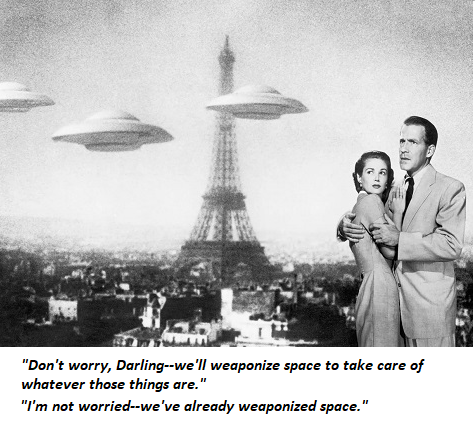
Or, as some anticipate, the "UAPs are now a thing" story is the cover for the unveiling of the weaponization of space that's already well underway. That would be mildly interesting, but to the degree it's already been anticipated, it too would quickly slide into the boring bin.

The problem may well be terminal boredom with the whole shebang. Everything has been so relentlessly hyped to grab "attention" that the dosage now exceeds the event horizon of any possible effect: the screaming, shouting cacophony of "news", crises, threats, revelations, scandals, cover-ups, PR, marketing, narrative-control, gambling, gaming, threadbare outrage, bogus statistics, etc. no longer move the needle. Everything is boring, even the aliens.

If you want to listen to another hour of "experts" discussing the bogus inflation data / cover-up / conspiracy-theory du jour, this isn't it. This is pure free-form fun, at least for Tommy and I. Aliens Are Boring (1:09 hrs). (Occasional free-form profanity.)


My new book is now available at a 10% discount ($8.95 ebook, $18 print): Self-Reliance in the 21st Century.

Read the first chapter for free (PDF)

Read excerpts of all three chapters

Podcast with Richard Bonugli: Self Reliance in the 21st Century (43 min)


My recent books:

The Asian Heroine Who Seduced Me (Novel) print $10.95, Kindle $6.95 Read an excerpt for free (PDF)

When You Can't Go On: Burnout, Reckoning and Renewal $18 print, $8.95 Kindle ebook; audiobook Read the first section for free (PDF)

Global Crisis, National Renewal: A (Revolutionary) Grand Strategy for the United States (Kindle $9.95, print $24, audiobook) Read Chapter One for free (PDF).

A Hacker's Teleology: Sharing the Wealth of Our Shrinking Planet (Kindle $8.95, print $20, audiobook $17.46) Read the first section for free (PDF).

Will You Be Richer or Poorer?: Profit, Power, and AI in a Traumatized World
(Kindle $5, print $10, audiobook) Read the first section for free (PDF).

The Adventures of the Consulting Philosopher: The Disappearance of Drake (Novel) $4.95 Kindle, $10.95 print); read the first chapters for free (PDF)

Money and Work Unchained $6.95 Kindle, $15 print)
Read the first section for free


Become a $1/month patron of my work via patreon.com.

Subscribe to my Substack for free


NOTE: Contributions/subscriptions are acknowledged in the order received. Your name and email remain confidential and will not be given to any other individual, company or agency.

Thank you, Kristi I. ($5/month), for your marvelously generous pledge to this site -- I am greatly honored by your support and readership.


Thank you, Alan H. ($20), for your most generous contribution to this site -- I am greatly honored by your support and readership.

Read more...

Monday, July 31, 2023

Lessons from the Unraveling of the Roman Empire: Simplification, Localization

The fragmentation, simplification and localization of the post-Imperial era offers us lessons we ignore at our peril.

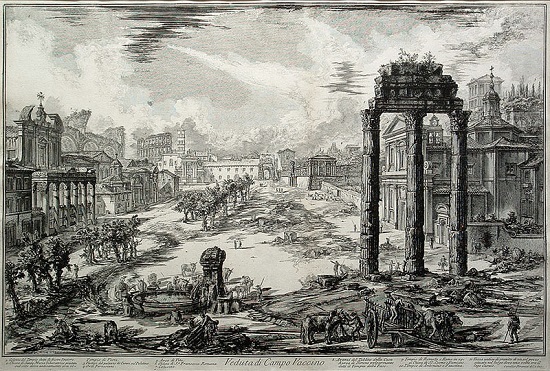
There is an entire industry devoted to "why the Roman Empire collapsed," but the post-collapse era may be offer us higher value lessons. The post-collapse era, long written off as The Dark Ages, is better understood as a period of adaptation to changing conditions, specifically, the relocalization and simplification of the economy and governance.

As historian Chris Wickham has explained in his books Medieval Europe and The Inheritance of Rome: Illuminating the Dark Ages 400-1000, the medieval era is best understood as a complex process of social, political and economic natural selection: while the Western Roman Empire unraveled, the Eastern Roman Empire (Byzantium) continued on for almost 1,000 years after the fall of the Western Roman Empire, and the social and political structures of the Western Roman Empire influenced Europe for hundreds of years.

In broad-brush, the Roman Empire was a highly centralized, tightly bound system that was remarkably adaptive despite its enormous size and the slow pace of transport and communication. Roman society was both highly hierarchical--the elites claimed superiority and worked hard to master the necessary tools of authority-- slaves were integral to the building and maintenance of Rome's vast infrastructure--and open to meritocracy, as the Roman Army and other classes were open to advancement by anyone in the sprawling empire: every free person became a Roman Citizen once their territory was absorbed into the Empire.

When the Empire fell apart, the model of centralized control/power continued on in the reigns of the so-called Barbarian kingdoms (Goths, Vandals, etc.) and Charlemagne (768-814), over 300 years after the fall of Rome. (When the Ottomans finally conquered Constantinople in 1453, they also adopted many of the bureaucratic structures of the Byzantine Empire.)

Over time, however, the feudal model of localized fiefdoms nominally loyal to a weak central monarchy replaced the centralized model of governance. This adaptation fit the highly fragmented nature of European societies in this era.

But centralized influence never went away. The Christian churches based in Rome and Constantinople continued to exert centralized influence in politically fragmented regions, and monarchies continued to exist, in various states of strength and weakness. The Holy Roman Empire--as Voltaire is reputed to have observed, "neither Holy, Roman or an Empire"--had an enormously complex history in Germany and the rest of Europe. The monarchies in England and France remained in place, and the city-states of northern Italy wielded influence via trade and shifting alliances.

In other words, the Medieval era was ultimately a complex competition between overlapping models of governance and sharing resources, a competition between centralized and localized (what Wickham calls "cellular") nodes of power and the various ways that rulers and those they ruled dealt with each other.

Throughout the era, the legitimacy of rulers ultimately flowed from public assemblies, a tradition inherited from Rome that manifested in aristocratic courts and the church's leadership (bishops, etc.) and eventually, in parliaments. This tension played out in the sharing of costs and resources and the general direction of the state.

As a general rule, when monarchs consolidated too much power, they engaged in catastrophically costly and doomed wars (The Hundred Years War) because they were able to override or ignore the cautious counsel of elite assemblies.

Understood as a selective process of adapting to changing circumstances, this history offers us valuable lessons and templates for our future.

Once the centralized power of Rome fragmented, economic, social and political power simplified and relocalized. Trade volume shrank and trade routes vanished. Once the bureaucratic and military structures dictated by Rome collapsed, regions and localities were on their own.

Elites naturally sought out the best means to consolidate and expand their power, and residents (as a general rule, the peasantry and town-dwellers) sought to improve their own lives by reducing costs and securing access to resources.

The immense geographic, cultural, social and economic diversity of Europe was in effect freed to play out. This diversity is still evident; the European Union may have unified the European financial system, but cultural and social divisions have not dissolved.

Wickham distinguishes between two primary sources of income and wealth accessible to elites and governments: land and taxes. Collecting taxes requires an immense bureaucracy to identify and assess property owners, tenant farmers, merchants, collect duties on trade flows, etc. Taxes are the only reliable way to fund professional armies and the stupendous bureaucracy required to manage a complex centralized empire. The Byzantine Empire survived multiple rivals, invasions, etc. largely due to its competent tax collection bureaucracy, and European monarchies could only fund long, costly wars once they established tax collection bureaucracies.

Wealth from land--surplus skimmed from the labor of peasants--was adequate to fund highly localized nobility (many of which had one or two castles and a small fiefdom), but it wasn't reliable enough or large enough to support professional armies or vast centralized states.

How does this history offer a template for the next 20 years?

I have long held that the dominant global forces binding the global economy are globalization and financialization. Both have greatly increased the income and wealth that nation-states can tax to fund their vast structures: military, social welfare, and bureaucracies of management, regulation and control.

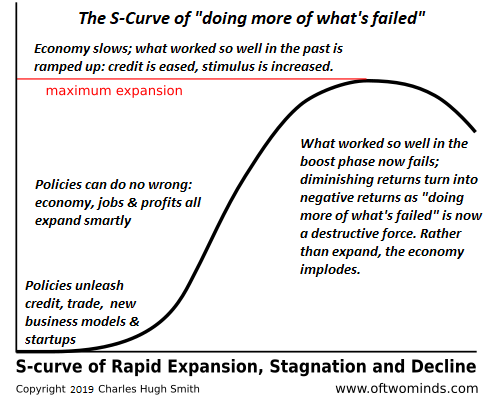
I have also held that globalization and financialization became hyper-structures prone to over-extension and the diminishing returns of the S-Curve. (see chart below) Both have reversed and are now in decline, a decline that I anticipate will accelerate unpredictably and rapidly as each dynamic is centralized and tightly bound, meaning each subsystem is highly interconnected with other subsystems. Should one break, the entire system unravels.

Globalization may appear to be decentralized, but the vast majority of global trade and capital flows through a few centralized nodes, and many aspects of trade depend on a very small number of routes and suppliers. This makes global trade exquisitely sensitive to disruption should any critical supplier or node fail.

Financialization is equally centralized and tightly bound, to the absurd degree that obscure financial structures (reverse repos, etc.) can trigger cascading crises in the real-world economy.

I anticipate a global simplification of trade and finance as fragile hyper-structures collapse as the failure of subsystems cascade through the entire system.

These systems have greatly accelerated extremes of wealth-income inequality by their very nature, and these vast distortions and imbalances are unsustainable. Also unsustainable is the immense expansion of the plundering of the planet's remaining resources via globalization and financialization. These dynamics will collapse under their own weight.

What will be left? Once the income and wealth that supported enormously costly nation-state governments contracts, central governments will no longer be able to fund their gargantuan systems. (States that attempt to fund their activities by printing money will only speed the collapse of their finances and thus their coherence.)

As in the post-Roman era, central authority may well continue, but its actual power and influence will be greatly reduced. Without expanding income and wealth to tax, the central state may attempt to extract most of the nation's surplus, but this stripmining of elites and commoners alike will trigger pushback and revolt.

A more sustainable response would be to offload most of the central government's financial burdens onto states, provinces, counties, etc., in effect pushing the impossible task of maintaining entitlements and promised spending on local entities.

Given the diversity of cultures, social values and economic dynamics in large nations and regions, we can anticipate a flowering of adaptations to these greatly reduced means. Some localities will favor increasing authoritarian controls, others will favor reducing authoritarian controls and ceding authority to the smallest units of public assembly.

Locales (shall we call them fiefdoms?) will divide naturally along geographic boundaries, just as fiefdoms in medieval Europe fell into natural boundaries shaped by rivers, valleys, mountain ranges, etc., and along economic and cultural borders.

This relocalization may manifest in the well-known forecasts of the US breaking into multiple regional states, or it might manifest as I suggest in a much-weakened but still influential central government ceding power to local political structures which may themselves fragment or form alliances with nearby entities with whom they share cultural and economic ties.

In other words, a churn of evolutionary adaptations can be expected. Just as there was no one post-Roman adaptation that worked equally well everywhere, we can expect there to be some adaptations of roughly equal success and many that are unsuccessful.

As individuals and households, we want to be located in successful adaptations that share our values and offer us agency, i.e. a say in public assemblies and the freedom to move and work as we see fit.

As I have outlined many times in the blog and in my books, locales that are highly dependent on long global supply chains and distant capital for their essentials will fare very poorly once those supply chains break and the capital dries up. Regions and locales that generate their own essentials (food, energy, metals, concrete, electronics, etc.), talent and capital are much more likely to generate enough resources to satisfy both local elites and the public.

As I explain in my book Self-Reliance, we who have lived in the past 75 years of expanding production and consumption of Everything have lost touch with both the natural world that sustains us and the social and practical skills needed to endure and prosper in an era in which the engines of centralized power and wealth (globalization and financialization) decay and collapse.

Some locales will choose to foster relocalization and individual agency. Others will cling on to failing models of authoritarian control and globalization / financialization.

Ironically, perhaps, the most successful regions will be prone to indulging in hubris and denial, just as the Roman elites, basking in their centuries of dominance, dismissed the "Barbarians" and clung to their delusions of grandeur even as their world fragmented around them.

Those locales left behind by globalization and financialization may well offer much better opportunities for successful adaptation, relocalization and individual / household agency.

It is human nature to find reasons to dismiss the storm clouds on the horizon. We look around and find solace in the apparent strength of our institutions and economy, while ignoring their sobering dependence on unsustainable hyper-globalization and hyper-financialization.

The fragmentation, simplification and localization of the post-Imperial era offers us lessons we ignore at our peril. It's important to view these lessons not just as an academic abstraction but as a guide to your own decisions about what places are most conducive to your security and well-being. Not every locale will do equally well, and the culture of many places may not be a great match for your own values and goals. If you decide to move, sooner is better than later.


This essay was drawn from my Weekly Musings Reports sent exclusively to subscribers, patrons and Substack subscribers. Thank you very much for supporting my work.


My new book is now available at a 10% discount ($8.95 ebook, $18 print): Self-Reliance in the 21st Century.

Read the first chapter for free (PDF)

Read excerpts of all three chapters

Podcast with Richard Bonugli: Self Reliance in the 21st Century (43 min)


My recent books:

The Asian Heroine Who Seduced Me (Novel) print $10.95, Kindle $6.95 Read an excerpt for free (PDF)

When You Can't Go On: Burnout, Reckoning and Renewal $18 print, $8.95 Kindle ebook; audiobook Read the first section for free (PDF)

Global Crisis, National Renewal: A (Revolutionary) Grand Strategy for the United States (Kindle $9.95, print $24, audiobook) Read Chapter One for free (PDF).

A Hacker's Teleology: Sharing the Wealth of Our Shrinking Planet (Kindle $8.95, print $20, audiobook $17.46) Read the first section for free (PDF).

Will You Be Richer or Poorer?: Profit, Power, and AI in a Traumatized World
(Kindle $5, print $10, audiobook) Read the first section for free (PDF).

The Adventures of the Consulting Philosopher: The Disappearance of Drake (Novel) $4.95 Kindle, $10.95 print); read the first chapters for free (PDF)

Money and Work Unchained $6.95 Kindle, $15 print)
Read the first section for free


Become a $1/month patron of my work via patreon.com.

Subscribe to my Substack for free


NOTE: Contributions/subscriptions are acknowledged in the order received. Your name and email remain confidential and will not be given to any other individual, company or agency.

Thank you, Max J. ($5/month), for your marvelously generous pledge to this site -- I am greatly honored by your steadfast support and readership.


Thank you, Robert S. ($10.80), for your most generous contribution to this site -- I am greatly honored by your support and readership.

Read more...

Terms of Service

All content on this blog is provided by Trewe LLC for informational purposes only. The owner of this blog makes no representations as to the accuracy or completeness of any information on this site or found by following any link on this site. The owner will not be liable for any errors or omissions in this information nor for the availability of this information. The owner will not be liable for any losses, injuries, or damages from the display or use of this information. These terms and conditions of use are subject to change at anytime and without notice.


Our Privacy Policy:


Correspondents' email is strictly confidential. This site does not collect digital data from visitors or distribute cookies. Advertisements served by a third-party advertising network (Investing Channel) may use cookies or collect information from visitors for the purpose of Interest-Based Advertising; if you wish to opt out of Interest-Based Advertising, please go to Opt out of interest-based advertising (The Network Advertising Initiative). If you have other privacy concerns relating to advertisements, please contact advertisers directly. Websites and blog links on the site's blog roll are posted at my discretion.


PRIVACY NOTICE FOR EEA INDIVIDUALS


This section covers disclosures on the General Data Protection Regulation (GDPR) for users residing within EEA only. GDPR replaces the existing Directive 95/46/ec, and aims at harmonizing data protection laws in the EU that are fit for purpose in the digital age. The primary objective of the GDPR is to give citizens back control of their personal data. Please follow the link below to access InvestingChannel’s General Data Protection Notice. https://stg.media.investingchannel.com/gdpr-notice/


Notice of Compliance with The California Consumer Protection Act
This site does not collect digital data from visitors or distribute cookies. Advertisements served by a third-party advertising network (Investing Channel) may use cookies or collect information from visitors for the purpose of Interest-Based Advertising. If you do not want any personal information that may be collected by third-party advertising to be sold, please follow the instructions on this page: Limit the Use of My Sensitive Personal Information.


Regarding Cookies:


This site does not collect digital data from visitors or distribute cookies. Advertisements served by third-party advertising networks such as Investing Channel may use cookies or collect information from visitors for the purpose of Interest-Based Advertising; if you wish to opt out of Interest-Based Advertising, please go to Opt out of interest-based advertising (The Network Advertising Initiative) If you have other privacy concerns relating to advertisements, please contact advertisers directly.


Our Commission Policy:

As an Amazon Associate I earn from qualifying purchases. I also earn a commission on purchases of precious metals via BullionVault. I receive no fees or compensation for any other non-advertising links or content posted on my site.

  © Blogger templates Newspaper III by Ourblogtemplates.com 2008

Back to TOP