

Wednesday, April 09, 2025

A Decade of Headwinds

These headwinds will persist for the next decade or two.

The stock market is rallying hard after a brutal sell-off--not an uncommon occurrence. As we savor our winnings in the ship's first-class casino, it's not a bad idea to step out onto the deck and gauge the weather.

There are headwinds. Not zephyrs, not gusts, just steady, strong headwinds.

1. Presidents Trump and Xi view each other an as existential challenge to the future prosperity of the nation they lead. Neither can afford to lose face by caving in, and each has a global strategy with no middle ground.

2. Global trade / capital flows are all over the map. Uncertainty is the word of the moment, but perhaps the more prescient description is unpredictability: if enterprises have no visibility on the future costs of trade, commodities, labor and capital, they have little choice but to avoid big bets until visibility is restored.

3. The American consumer is tapped out. Credit card charge-offs are rising, auto loan defaults are rising, air travel is faltering--there are many sources of evidence that consumers--especially the top 20% households whose spending has propped up the economy--have reached financial and perhaps psychological limits.

4. The Reverse Wealth Effect is kicking in as stocks and other assets roll over into volatility and potential trend changes into declines rather than advances. The top 10% who own the majority of income-producing assets and risk assets are seeing $10 trillion of losses followed by recoveries of $5 trillion. Swings of such magnitude do not support confidence in the stability of current valuations or offer visibility on the odds of future capital gains.

Just as enterprises must respond to poor visibility by reducing risk, households respond to increasing volatility and unpredictability by reducing borrowing and spending. Stable gains in asset valuations fuel the Wealth Effect, encouraging consumers to borrow and spend more because their wealth has increased. The Reverse Wealth Effect triggered by losses, volatility and low visibility encourages reducing risk, borrowing and spending.

5. There will be no "save" by the Federal Reserve or massive new Federal fiscal largesse. Tariffs and reshoring manufacturing are inflationary, so the Fed no longer has the freedom to create a few trillion dollars out of thin air to juice risk assets. The federal government's borrowing-and-spending spree threatens the integrity of the nation's currency and economy, so the the unlimited checkbook has been put in the drawer.

6. The two decades of deflation generated by China has ended. Central banks could play in the Zero-Interest Rate Policy sandbox because inflationary forces were all offset by the sustained deflationary forces of China's export machine and credit expansion. Now every economy, including China's, faces inflationary tides from a number of sources.

7. The sums required to rebuild America's industrial base will pinch speculative borrowing and consumer spending. Now that both the Fed and the federal government are restrained from borrowing and blowing additional trillions, private capital will have to be enticed into long-term investments in Treasury bonds and reshoring. The ways to incentivize long-term investing rather than consumption and speculation are recession and deflating asset bubbles. Both re-set expectations, risk appetites and incentives.

Everyone with direct experience of manufacturing and supply chain networks is telling us that reshoring will be a costly, long-term project, requiring the rebuilding of the entire ecosystem that's been lost to hyper-globalization's offshoring and hyper-financialization's predation.

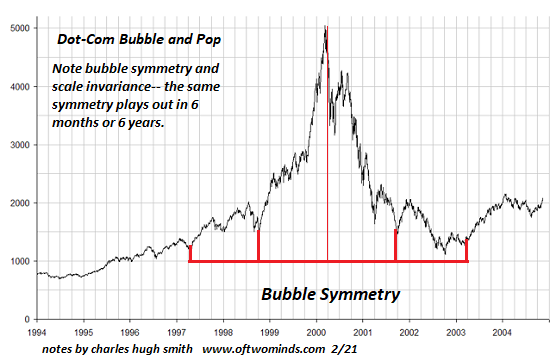
Note that all credit-driven asset bubbles pop. Yes, the market is rigged, but that doesn't mean it always goes up or it's easy to catch the declines. The dot-com bubble lost 80% of its peak valuation despite assurances that was "impossible."


8. Demographics are not supportive of risk-asset expansion. Courtesy of @Econimica, consider this chart of the year-over-year change in high and high-middle-income populations globally. The change is now negative--fewer folks are entering these categories. In response, global debt has soared, in effect offsetting the decline of consumer demographics with borrowed money.
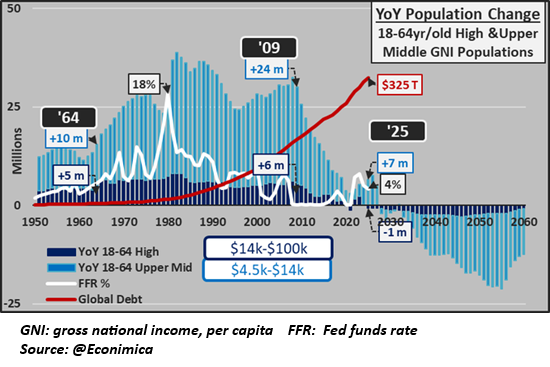


As the global Boomer population retires and needs at-home or institutional care, they will sell their assets to fund these soaring expenses: stocks, bonds, real estate--all will go on the auction block to raise cash.

The older cohort of investors is also more risk averse, as they know they don't have a decade or two to recover from a catastrophic decline in their assets' valuations.

None of these dynamics can be reversed. These headwinds will persist for the next decade or two.

New podcast: The Coming Global Recession will be Longer and Deeper than Most Analysts Anticipate (42 min)


My recent books:

Disclosure: As an Amazon Associate I earn from qualifying purchases originated via links to Amazon products on this site.

The Mythology of Progress, Anti-Progress and a Mythology for the 21st Century print $18, (Kindle $8.95, Hardcover $24 (215 pages, 2024) Read the Introduction and first chapter for free (PDF)

Self-Reliance in the 21st Century print $18, (Kindle $8.95, audiobook $13.08 (96 pages, 2022) Read the first chapter for free (PDF)

The Asian Heroine Who Seduced Me (Novel) print $10.95, Kindle $6.95 Read an excerpt for free (PDF)

When You Can't Go On: Burnout, Reckoning and Renewal $18 print, $8.95 Kindle ebook; audiobook Read the first section for free (PDF)

Global Crisis, National Renewal: A (Revolutionary) Grand Strategy for the United States (Kindle $9.95, print $24, audiobook) Read Chapter One for free (PDF).

A Hacker's Teleology: Sharing the Wealth of Our Shrinking Planet (Kindle $8.95, print $20, audiobook $17.46) Read the first section for free (PDF).

Will You Be Richer or Poorer?: Profit, Power, and AI in a Traumatized World
(Kindle $5, print $10, audiobook) Read the first section for free (PDF).

The Adventures of the Consulting Philosopher: The Disappearance of Drake (Novel) $4.95 Kindle, $10.95 print); read the first chapters for free (PDF)

Money and Work Unchained $6.95 Kindle, $15 print)
Read the first section for free


Become a $3/month patron of my work via patreon.com.

Subscribe to my Substack for free


NOTE: Contributions/subscriptions are acknowledged in the order received. Your name and email remain confidential and will not be given to any other individual, company or agency.

Thank you, Steve B. ($70), for your splendidly generous subscription to this site -- I am greatly honored by your steadfast support and readership.


Thank you, Christine M. ($70), for your marvelously generous subscription to this site -- I am greatly honored by your support and readership.


Thank you, Benjamin W. ($70), for your magnificently generous subscription to this site -- I am greatly honored by your support and readership.


Thank you, Chris G. ($32.40), for your superbly generous contribution to this site -- I am greatly honored by your support and readership.

Read more...

Monday, April 07, 2025

The Financial Kessler Effect

Like orbiting space debris, every loan that has been collateralized by an illiquid asset is a high-speed projectile with the potential to disable any other part of the system it impacts.

Complex systems can undergo what's known as phase shifts, where the state of the system changes abruptly. The classic example of this is liquid water turning to ice. Since the mechanisms at work--temperature, saline levels, etc.--is known and measurable, then this phase transition is predictable.

Complex systems with emergent properties are unpredictable, and so their phase transitions catch us off guard. The system looks stable, as the risk of sudden instability resolving in a phase shift is not visible.

Emergent properties arise from the interactions of various parts of the system rather than from the characteristics of the parts themselves. Interactions in complex systems that are tightly bound --i.e. highly interconnected--are dynamic and so the consequences of unexpected interactions are unpredictable.

In other words, we think we understand all the possible interactions, but we're forgetting second-order effects: first-order effects: interactions have consequences. Second order effects: consequences have consequences.

This illusion of control leads us to tinker with systems such as the global financial system to suppress any interactions we see as threatening the stability of the entire system. But this tinkering to lower risk has a hidden consequence.

As Nassim Taleb noted in a 2011 article: "Complex systems that have artificially suppressed volatility become extremely fragile, while at the same time exhibiting no visible risks."

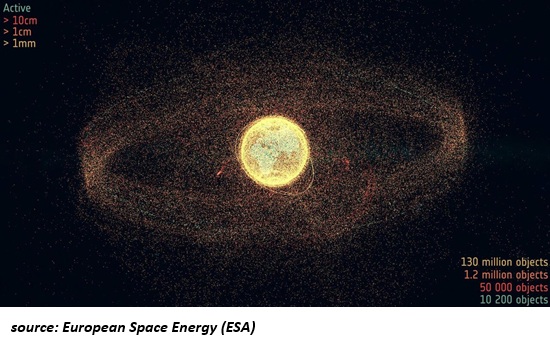
Which brings us to a second example of a phase shift: The Kessler Syndrome: The Kessler syndrome, proposed by NASA scientist Donald Kessler, describes a hypothetical scenario where the accumulation of space debris in Earth's orbit triggers a chain reaction of collisions, creating even more debris, potentially rendering parts of space unusable.

While this is described as "hypothetical," the potential for a Kessler Effect to occur rises sharply with the quantity of space junk / debris speeding around low-Earth orbits in what I call The Orbital Landfill, a space-age analog of The Landfill Economy we've created here on the planet's surface.

And voila, the number of bits of high-speed debris is rising, along with the number of satellites being lifted into orbit: Catastrophe Looms Above: Space Junk Problem Grew 'Significantly Worse' In 2024 That's brings us to the nightmare scenario that should fill you with dread: The Kessler Effect.

I submit that the Kessler Syndrome is an apt analogy for what may be happening in the global financial system: interactions that few anticipated are setting off second-order consequences that are themselves interacting with other parts of the system in unpredictable ways that will cascade, in effect clearing entire orbits of the global financial system.

So once a margin call impacts a functioning satellite and shatters it into random projectiles, the fallout / debris from that impact then strikes everything that is tightly bound to that part of the system.

These consequences then impact other parts, triggering margin calls and liquidation of assets that then shatter and those destructive projectiles become so numerous that they clear the entire orbit of functional parts of the system.

In a financial Kessler Effect, every critical element is shattered into dangerous debris that cascades through the entire global system.


Being tightly bound, the global financial system is exquisitely sensitive to cascading margin calls and forced liquidations of assets. Like orbiting space debris, every loan that has been collateralized by an illiquid asset (i.e. an asset that can't be sold with the click of a button and the transaction clears second later) is a high-speed projectile with the potential to disable any other part of the system it impacts.

The problem with markets that Taleb described so succinctly is that the risk of apparently liquid markets freezing up and becoming illiquid is not visible until it's too late to sell. Conventional market theory holds that there will always be a buyer to take an asset off a seller's hands. But buyers disappear in crashes, as nobody wants to catch the falling knife.

Assets that were presumed to be liquid become illiquid, and their valuation plummets. This collapse of collateral then triggers margin calls (loans being called in, demands for cash) which then trigger more liquidations into an illiquid market.

And that's how a Financial Kessler Effect clears entire orbits of the global financial system. What looked robust and low-risk is reduced to debris.

New podcast: The Coming Global Recession will be Longer and Deeper than Most Analysts Anticipate (42 min)


My recent books:

Disclosure: As an Amazon Associate I earn from qualifying purchases originated via links to Amazon products on this site.

The Mythology of Progress, Anti-Progress and a Mythology for the 21st Century print $18, (Kindle $8.95, Hardcover $24 (215 pages, 2024) Read the Introduction and first chapter for free (PDF)

Self-Reliance in the 21st Century print $18, (Kindle $8.95, audiobook $13.08 (96 pages, 2022) Read the first chapter for free (PDF)

The Asian Heroine Who Seduced Me (Novel) print $10.95, Kindle $6.95 Read an excerpt for free (PDF)

When You Can't Go On: Burnout, Reckoning and Renewal $18 print, $8.95 Kindle ebook; audiobook Read the first section for free (PDF)

Global Crisis, National Renewal: A (Revolutionary) Grand Strategy for the United States (Kindle $9.95, print $24, audiobook) Read Chapter One for free (PDF).

A Hacker's Teleology: Sharing the Wealth of Our Shrinking Planet (Kindle $8.95, print $20, audiobook $17.46) Read the first section for free (PDF).

Will You Be Richer or Poorer?: Profit, Power, and AI in a Traumatized World
(Kindle $5, print $10, audiobook) Read the first section for free (PDF).

The Adventures of the Consulting Philosopher: The Disappearance of Drake (Novel) $4.95 Kindle, $10.95 print); read the first chapters for free (PDF)

Money and Work Unchained $6.95 Kindle, $15 print)
Read the first section for free


Become a $3/month patron of my work via patreon.com.

Subscribe to my Substack for free


NOTE: Contributions/subscriptions are acknowledged in the order received. Your name and email remain confidential and will not be given to any other individual, company or agency.

Thank you, Ryan R. ($70), for your splendidly generous subscription to this site -- I am greatly honored by your steadfast support and readership.


Thank you, Diane M. ($25), for your most generous subscription to this site -- I am greatly honored by your support and readership.


Thank you, Steve W. ($70), for your magnificently generous subscription to this site -- I am greatly honored by your support and readership.


Thank you, Daniel T. ($32.40), for your superbly generous contribution to this site -- I am greatly honored by your support and readership.

Read more...

Friday, April 04, 2025

After the Tariff Earthquake

The fires that have been ignited are not yet visible.

There's a eerie calm after an earthquake. Those trapped in collapsed buildings are aware of the consequences, but the majority experience a silence, as if the world stopped and has yet to restart. The full consequences are as yet unknown, and so we breathe a sigh of relief. Whew. Everything looks OK.

But this initial assessment is off the mark, as much of the damage is not immediately visible. As reports start coming in of broken infrastructure and fires break out, we start realizing the immensity of the damage and the rising risks of conflagration. Uncertainty and rapidly accelerating chaos reign.

President Trump used a medical analogy for what I'm calling The Tariff Earthquake: the patient underwent a procedure and has had a shock, but it's all for the good as the healing is already underway.

We often use medical or therapeutic analogies, but in this case the earthquake analogy is more insightful in making sense of what happens to economic structures that have been systemically disrupted.

The key parallel is the damage is often hidden, and only manifests later. The scene after the initial shock looks normal, but water mains have been broken beneath the surface, foundations have cracked, and though structures look undamaged and safe, they're closer to collapse than we imagine, as the structural damage is hidden.

Another parallel is the potential for damage arising from forces other than the direct destruction from the temblor. The earthquake that destroyed much of San Francisco in 1906 damaged many structures, but the real devastation was the result of fires that started in the aftermath that could not be controlled due to the water mains being broken and streets clogged with debris, inhibiting the movement of the fire brigades, which were inadequate to the task even if movement had been unobstructed.

The earthquake damaged the city, but the fire is what destroyed it.

What was considered rock-solid and safe is revealed as vulnerable in ways that are poorly understood. Structures that met with official approval collapse despite the official declarations. What was deemed sound and safe cracked when the stresses exceeded the average range.

The Tariff Earthquake exhibits many of these same features. Much of the damage has yet to reveal itself; much remains uncertain as the chaos spreads. Like an earthquake, the damage is systemic: both infrastructure and households are disrupted. The potential for second-order effects (fires in the earthquake analogy) to prove more devastating than expected is high.

(First order effects: actions have consequences. Second order effects: consequences have consequences.)

The uncertainty is itself a destructive force. Enterprises must allocate capital and labor based on forecasts of future supply and demand. If the future is inherently unpredictable, forecasting becomes impossible and so conducting business becomes impossible.

Just as the 1906 fires sweeping through San Francisco were only contained by the US Army blowing up entire streets of houses to create a fire break, the containment efforts themselves may well be destructive. We had to destroy the village in order to save it is a tragic possibility.

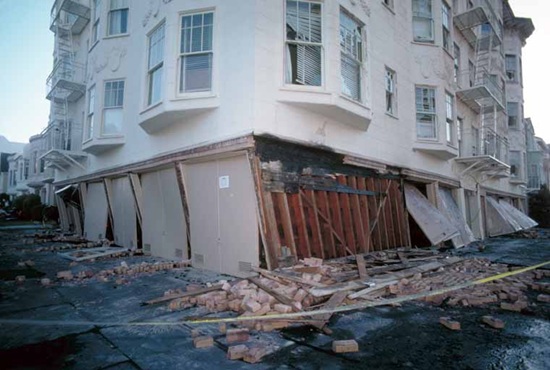
Here is a building damaged in the 1989 Loma Prieta earthquake that struck the San Francisco Bay region. The residents may have initially reckoned their home had survived intact, but the foundation and first floor were so severely damaged that the entire structure was at risk of collapse.


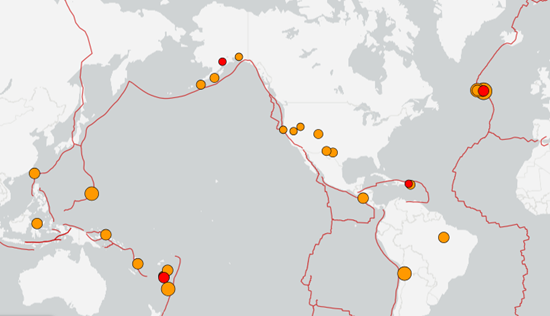
On this USGS map of recent earthquakes around the world, note the clustering of quakes on the "Ring of Fire" that traces out the dynamic zones where the planet's tectonic plates meet. Earthquakes can trigger other events along these dynamic intersections of tectonic forces.


In a similar fashion, The Tariff Earthquake is unleashing economic reactions across the globe, each of which influences all the other dynamic intersections, both directly and via second-order effects generated by the initial movement.

Anyone claiming to have a forecast of all the first-order and second-order effects of the The Tariff Earthquake will be wrong, as it's impossible to foresee the consequences of so many forces interacting or make an informed assessment of all the damage that's been wrought that's not yet visible.

The fires that have been ignited are not yet visible. They're smoldering but not yet alarming, and so the observers who are confident that everything's under control have yet to awaken to the potential for events to spiral out of control.

New podcast: The Coming Global Recession will be Longer and Deeper than Most Analysts Anticipate (42 min)


My recent books:

Disclosure: As an Amazon Associate I earn from qualifying purchases originated via links to Amazon products on this site.

The Mythology of Progress, Anti-Progress and a Mythology for the 21st Century print $18, (Kindle $8.95, Hardcover $24 (215 pages, 2024) Read the Introduction and first chapter for free (PDF)

Self-Reliance in the 21st Century print $18, (Kindle $8.95, audiobook $13.08 (96 pages, 2022) Read the first chapter for free (PDF)

The Asian Heroine Who Seduced Me (Novel) print $10.95, Kindle $6.95 Read an excerpt for free (PDF)

When You Can't Go On: Burnout, Reckoning and Renewal $18 print, $8.95 Kindle ebook; audiobook Read the first section for free (PDF)

Global Crisis, National Renewal: A (Revolutionary) Grand Strategy for the United States (Kindle $9.95, print $24, audiobook) Read Chapter One for free (PDF).

A Hacker's Teleology: Sharing the Wealth of Our Shrinking Planet (Kindle $8.95, print $20, audiobook $17.46) Read the first section for free (PDF).

Will You Be Richer or Poorer?: Profit, Power, and AI in a Traumatized World
(Kindle $5, print $10, audiobook) Read the first section for free (PDF).

The Adventures of the Consulting Philosopher: The Disappearance of Drake (Novel) $4.95 Kindle, $10.95 print); read the first chapters for free (PDF)

Money and Work Unchained $6.95 Kindle, $15 print)
Read the first section for free


Become a $3/month patron of my work via patreon.com.

Subscribe to my Substack for free


NOTE: Contributions/subscriptions are acknowledged in the order received. Your name and email remain confidential and will not be given to any other individual, company or agency.

Thank you, Randall R. ($200), for your beyond-outrageously generous founding subscription to this site -- I am greatly honored by your support and readership.


Thank you, Mark H. ($7/month), for your marvelously generous subscription to this site -- I am greatly honored by your support and readership.


Thank you, Michael R. ($70), for your magnificently generous subscription to this site -- I am greatly honored by your support and readership.


Thank you, Wanda O. ($70), for your superbly generous contribution to this site -- I am greatly honored by your support and readership.

Read more...

Wednesday, April 02, 2025

The Global Trade Game: Jokers Are Wild

There may be no winners of the game of Global Domination (tm), and that is likely the best outcome.

Okay, players: jokers are wild, but with a twist: the entire deck is jokers. Since everyone at the table will have five Aces, nobody wins.

Welcome to the Trade War Poker Table: nobody wins, as everyone has the same hand of jokers.

This is not to say that exploitive, mercantilist "free trade" (no such thing has ever existed) is desirable, much less possible. We're reaping the consequences of what was passed off as "free trade": corporations gleefully gutted National Security to boost profits by offshoring everything that could be offshored.

Every nation can impose tariffs or limit imports by other means. Tit for tat tariffs, concessions, grand deals, side deals--everyone has access to the same deck of cards. Who wins each round of play is an open question, as is who wins the game.

There are several time-tested strategies in the game for Global Domination (tm). One is domination gained by exporting far more than you import, building up treasure in the form of vast trade surpluses.

The problem with this strategy is eventually the nations being stripped by your mercantilist strategy wise up and limit your exports. There is only one way to get around this: military force, i.e. establish a Colonial Empire in which your colonies are forced to buy your surplus production (exports) via a bayonet in their back.

Absent force and a colonial empire, mercantilism is eventually defeated by its own success.

There is another way to play for Global Domination (tm), and it's the exact opposite of mercantilism: run large, sustained trade deficits by importing more than you export, which beneath the surface is a remarkable flow of trade: the importing nation "exports" its currency in size in exchange for goods and services.

Once this currency is "exported" in sufficient quantities, it becomes the dominant currency simply from its ubiquity, its liquidity (i.e. its quantity and ubiquity make it easy to trade everywhere) and its trustworthiness due to its wide ownership across global markets: since the currency is spread across the globe, the issuing nation no longer controls its valuation; that's now set by the market.

This is Global Domination (tm) via financing trade rather than by running trade surpluses by exporting tangible goods. Pick one, as you can't have both: either export goods to run mercantilist trade surpluses, and build up a trove of other nation's currencies, or "export" your own currency via sustained trade deficits so it becomes the global lingua franca of financing trade.

Due to the demands of the Cold War, this was the U.S. strategy in the postwar era. As I have often explained, the U.S. was not merely in an arms race with the Soviet Union; it was also in a war for influence and alliances. The strongest adhesive in alliances is self-interest; by absorbing the surplus production of its allies in Europe and Asia in exchange for dollars, the U.S. cemented alliances that essentially encircled the Soviet Empire.

This strategy was far more effective than open conflict, but it came with a cost. Just as the success of mercantilism generates its own undoing, so too does maintaining a reserve currency via trade deficits / exporting one's currency. Should the issuing nation (in this era, the U.S.) decide to limit imports and reduce its trade deficit, its currency will slowly lose the global scale needed to sustain its market dominance.

This is Triffin's Paradox, which I've addressed many times over the years: any currency--and the system for creating and distributing the currency--has two masters it cannot possibly serve equally: the domestic economy and the global economy. Any nation that wants to control the valuation of its currency cannot possibly achieve global financial dominance, as the only way to gain and maintain global financial dominance is to surrender control of the currency's valuation to the market via exporting currency in such vast quantities that the global market sets the value.

There's a profound irony in this. To manage the domestic economy, the state wants to control everything: the issuance of currency and its valuation via its relative abundance or scarcity, which is reflected in the cost of credit (i.e. interest rates) and asset prices.

But to gain the high ground in the global financial landscape, the currency must serve the global demand for a currency that is ubiquitous, extremely liquid and trustworthy precisely because its value cannot be reset by state diktat. The valuation of a truly global currency is constantly influenced by interest rates, bond issuance, demand and so on--all the features of a transparent marketplace.


The game of Global Domination (tm) will never be decided by a deck of jokers. The real game is 5-card draw: you play the cards you've been dealt by Nature, history, culture and chance. Every nation has a spectrum of strengths and weaknesses, advantages and disadvantages. Some are rich in resources, some are poor in resources. Some have advantageous geography, some less so. Some have cultural coherence, others have diversity; each is a strength and a weakness.

In Nature, the winner is not necessarily the strongest or the one most blessed by chance. The winner tends to be the one with the greatest capacity and incentives for flexibility, experimentation, a level playing field (i.e. social mobility) decentralized capital and all the traits of fast adaptation: if not an appetite then at least a capacity for a continual churn of instability, failure and self-criticism, which are the necessary components of experimentation.

There may be no winners of the game of Global Domination (tm), and that is likely the best outcome. Any form of dominance generates its own undoing.

New podcast: The Coming Global Recession will be Longer and Deeper than Most Analysts Anticipate (42 min)


My recent books:

Disclosure: As an Amazon Associate I earn from qualifying purchases originated via links to Amazon products on this site.

The Mythology of Progress, Anti-Progress and a Mythology for the 21st Century print $18, (Kindle $8.95, Hardcover $24 (215 pages, 2024) Read the Introduction and first chapter for free (PDF)

Self-Reliance in the 21st Century print $18, (Kindle $8.95, audiobook $13.08 (96 pages, 2022) Read the first chapter for free (PDF)

The Asian Heroine Who Seduced Me (Novel) print $10.95, Kindle $6.95 Read an excerpt for free (PDF)

When You Can't Go On: Burnout, Reckoning and Renewal $18 print, $8.95 Kindle ebook; audiobook Read the first section for free (PDF)

Global Crisis, National Renewal: A (Revolutionary) Grand Strategy for the United States (Kindle $9.95, print $24, audiobook) Read Chapter One for free (PDF).

A Hacker's Teleology: Sharing the Wealth of Our Shrinking Planet (Kindle $8.95, print $20, audiobook $17.46) Read the first section for free (PDF).

Will You Be Richer or Poorer?: Profit, Power, and AI in a Traumatized World
(Kindle $5, print $10, audiobook) Read the first section for free (PDF).

The Adventures of the Consulting Philosopher: The Disappearance of Drake (Novel) $4.95 Kindle, $10.95 print); read the first chapters for free (PDF)

Money and Work Unchained $6.95 Kindle, $15 print)
Read the first section for free


Become a $3/month patron of my work via patreon.com.

Subscribe to my Substack for free


NOTE: Contributions/subscriptions are acknowledged in the order received. Your name and email remain confidential and will not be given to any other individual, company or agency.

Thank you, DawgPond ($70), for your splendidly generous subscription to this site -- I am greatly honored by your support and readership.


Thank you, Lucia U. ($70), for your marvelously generous subscription to this site -- I am greatly honored by your support and readership.


Thank you, Peter C. ($70), for your magnificently generous subscription to this site -- I am greatly honored by your support and readership.


Thank you, Gavin G. ($70), for your superbly generous contribution to this site -- I am greatly honored by your support and readership.

Read more...

Monday, March 31, 2025

Why the Global Recession Will be Deeper and Longer Than Pundits Anticipate

The global recession will be deeper and longer than those relying on models based on the past two decades of hyper-globalization and hyper-financialization anticipate.

While everyone focuses on conflicts between nations, few look at the problems shared by nations. Richard Bonugli and I discuss both sets of problems in our latest podcast.

The conflict sphere is dominated by the trade wars that are bubbling up here in the first inning of the global rebalancing of national interests and global trade/financial frameworks. Supporting these frameworks benefits participating nations until they don't, at which point they're jettisoned.

The conviction that these frameworks, linch-pinned by the U.S. since the end of World War II in 1945, no longer serve America's core national security interests, is reaching a rough consensus, and as a result some describe the U.S. as a "rogue superpower." In other words, now that the U.S. is no longer the dumping ground for global surpluses of production, it's seen as "going rogue."

There's a certain naivete in the notion that any nation acts selflessly for the good of all. All nation-states act in their own interests, just as global corporations act to optimize shareholder value and profits while proclaiming the wonderfulness of their products and services. Nations support cooperative arrangements when it benefits them, and exit those arrangements when they morph from benefit to burden.

This rebalancing of cooperation and self-interest is taking place in the larger context of non-trade problems shared by all developed nations. Developing nations share many of these same problems as well: soaring debt loads, resource scarcities, corruption, mal-investment, high inflation, stagnating economies, aging populations, shrinking workforces, rising social costs and massive public health issues, many of which have been expanding rapidly behind the focus on trade and conflicting interests.

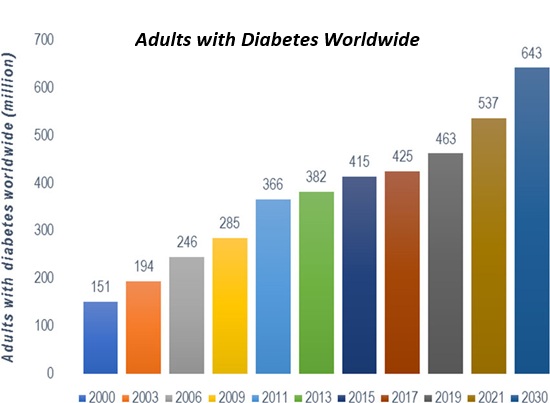
The ubiquity of these issues is striking. In some ways, developed nations share more problems than they seem to realize. Consider the global rise of lifestyle diseases generated by dramatic shifts in diets and fitness. These manifest as metabolic disorders (prediabetes, diabetes) and a broad range of other chronic diseases such as heart disease and cancers.

Metabolic disorders generated by changing lifestyles are now weighing heavily on nations around the world, from the U.S. and Mexico to China, India, the Mideast and beyond.


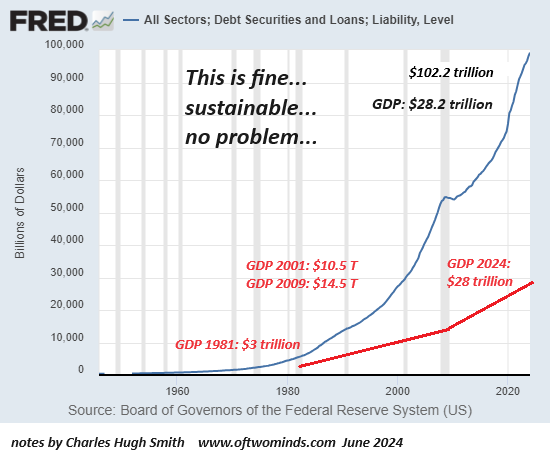
The problems generated by aging populations and declining birthrates are also shared by many nations. The same is true of rising debt levels, both public and private, which threaten to destabilize economies via either ruinously high inflation or fiscal frugality, i.e. austerity. Here is total credit in the U.S., a sobering chart that mirrors the debt loads of many other nations--debt that is outstripping GDP and income as interest rates rise in the new era of global inflationary forces.


The world's nations have awakened to the risks of becoming dependent on other nations for essential commodities, manufactured goods and markets. Tariffs may well be merely the at-bat players in the first innings. If history is any guide, outright bans on imports from selected nations will eventually be viewed as the only available option to rebalance national security priorities.

The degrees of national dependence will become increasingly consequential as mercantilist nations that have relied on exports for growth will find markets for their exports shutting down, crippling domestic growth. Nations that attempt to become self-sufficient will find the demands for capital investment will pressure consumer spending, even as the decline of cheap imports institutionalizes inflation and price increases that outstrip wage increases.

Stagflation will hinder both investment and consumer spending. Austerity will crimp fiscal borrowing and spending, and capital sloshing around the world seeking low-risk returns will face unprecedented challenges as capital controls proliferate and nations change the rules overnight.

I often focus on scale because this is a limiting factor. While there may well be growth opportunities for investing in developing nations, the scale of capital sloshing around global markets will find the investment pipelines the equivalent of a straw: there is no way to deploy $100 billion in small markets and economies, never mind $1 trillion or $10 trillion.

As Immanuel Wallerstein observed, Capitalism may no longer be attractive to capitalists as all these dynamics play out in a vast, inter-connected, unpredictable rebalancing of global interests and increasingly destabilizing attempts to solve complex, intractable problems with cobbled-together expediencies or doing more of what's already failed.

There won't be any "saves" in this rebalancing, and so the global recession will be deeper and longer than those relying on models based on the past two decades of hyper-globalization and hyper-financialization anticipate.

New podcast: The Coming Global Recession will be Longer and Deeper than Most Analysts Anticipate (42 min)


My recent books:

Disclosure: As an Amazon Associate I earn from qualifying purchases originated via links to Amazon products on this site.

The Mythology of Progress, Anti-Progress and a Mythology for the 21st Century print $18, (Kindle $8.95, Hardcover $24 (215 pages, 2024) Read the Introduction and first chapter for free (PDF)

Self-Reliance in the 21st Century print $18, (Kindle $8.95, audiobook $13.08 (96 pages, 2022) Read the first chapter for free (PDF)

The Asian Heroine Who Seduced Me (Novel) print $10.95, Kindle $6.95 Read an excerpt for free (PDF)

When You Can't Go On: Burnout, Reckoning and Renewal $18 print, $8.95 Kindle ebook; audiobook Read the first section for free (PDF)

Global Crisis, National Renewal: A (Revolutionary) Grand Strategy for the United States (Kindle $9.95, print $24, audiobook) Read Chapter One for free (PDF).

A Hacker's Teleology: Sharing the Wealth of Our Shrinking Planet (Kindle $8.95, print $20, audiobook $17.46) Read the first section for free (PDF).

Will You Be Richer or Poorer?: Profit, Power, and AI in a Traumatized World
(Kindle $5, print $10, audiobook) Read the first section for free (PDF).

The Adventures of the Consulting Philosopher: The Disappearance of Drake (Novel) $4.95 Kindle, $10.95 print); read the first chapters for free (PDF)

Money and Work Unchained $6.95 Kindle, $15 print)
Read the first section for free


Become a $3/month patron of my work via patreon.com.

Subscribe to my Substack for free


NOTE: Contributions/subscriptions are acknowledged in the order received. Your name and email remain confidential and will not be given to any other individual, company or agency.

Thank you, Larry M. ($70), for your splendidly generous subscription to this site -- I am greatly honored by your steadfast support and readership.


Thank you, Gordon L. ($70), for your marvelously generous subscription to this site -- I am greatly honored by your support and readership.


Thank you, Alan D. ($70), for your magnificently generous subscription to this site -- I am greatly honored by your support and readership.


Thank you, Kurt N. ($70), for your superbly generous contribution to this site -- I am greatly honored by your support and readership.

Read more...

Terms of Service

All content on this blog is provided by Trewe LLC for informational purposes only. The owner of this blog makes no representations as to the accuracy or completeness of any information on this site or found by following any link on this site. The owner will not be liable for any errors or omissions in this information nor for the availability of this information. The owner will not be liable for any losses, injuries, or damages from the display or use of this information. These terms and conditions of use are subject to change at anytime and without notice.


Our Privacy Policy:


Correspondents' email is strictly confidential. This site does not collect digital data from visitors or distribute cookies. Advertisements served by a third-party advertising network (Investing Channel) may use cookies or collect information from visitors for the purpose of Interest-Based Advertising; if you wish to opt out of Interest-Based Advertising, please go to Opt out of interest-based advertising (The Network Advertising Initiative). If you have other privacy concerns relating to advertisements, please contact advertisers directly. Websites and blog links on the site's blog roll are posted at my discretion.


PRIVACY NOTICE FOR EEA INDIVIDUALS


This section covers disclosures on the General Data Protection Regulation (GDPR) for users residing within EEA only. GDPR replaces the existing Directive 95/46/ec, and aims at harmonizing data protection laws in the EU that are fit for purpose in the digital age. The primary objective of the GDPR is to give citizens back control of their personal data. Please follow the link below to access InvestingChannel’s General Data Protection Notice. https://stg.media.investingchannel.com/gdpr-notice/


Notice of Compliance with The California Consumer Protection Act
This site does not collect digital data from visitors or distribute cookies. Advertisements served by a third-party advertising network (Investing Channel) may use cookies or collect information from visitors for the purpose of Interest-Based Advertising. If you do not want any personal information that may be collected by third-party advertising to be sold, please follow the instructions on this page: Limit the Use of My Sensitive Personal Information.


Regarding Cookies:


This site does not collect digital data from visitors or distribute cookies. Advertisements served by third-party advertising networks such as Investing Channel may use cookies or collect information from visitors for the purpose of Interest-Based Advertising; if you wish to opt out of Interest-Based Advertising, please go to Opt out of interest-based advertising (The Network Advertising Initiative) If you have other privacy concerns relating to advertisements, please contact advertisers directly.


Our Commission Policy:

As an Amazon Associate I earn from qualifying purchases. I also earn a commission on purchases of precious metals via BullionVault. I receive no fees or compensation for any other non-advertising links or content posted on my site.

  © Blogger templates Newspaper III by Ourblogtemplates.com 2008

Back to TOP