Tuesday, October 14, 2025

The Year When Everything Happens in No Particular Order

The pool of speculative fervor will be drained, as impossible as that seems in this moment in history.

2025 may go down as The Year When Everything Happened in No Particular Order, tracking William Gibson's famous line that "The future is already here, it's just not very evenly distributed."

Those expecting inflation will find it, those expecting deflation will find it, those expecting a stock rally will get a rally, those expecting a crash will get a crash, and so on.

The forces that drove reliable trends have all weakened or reversed:

1. ever-lower interest rates lowered the cost of credit/capital to near-zero.

2. the deflationary forces of globalization: everything got cheaper and disposable.

3. expanding workforces increased income and consumption.

4. credit/asset bubbles created wealth without productivity improvements or sacrifice.

5. energy supply kept up with rising consumption.

6. the external costs of the "waste is growth" Landfill Economy (pollution, depletion, etc.) were ignored / not priced in.

These titanic forces still have the momentum of recency bias: most people expect the rest of the 2020s to be an extension of the 40+year Bull Market in Everything.

Feedback (doing more of what's failed) and buffers (print more money and everything will be fixed) are working to maintain the status quo sand castles as the tide rises.

Those castles closest to the sea will dissolve first (the periphery I often refer to). Those with resources will be shoveling sand to build walls around their castles.

But the tide is relentless and so we're in a period of flux where those benefiting from the status quo are fighting the erosion of all the forces that enabled the status quo to reach such heights.

As they lose ground, they redouble their policy efforts, pushing policies to new extremes--extremes which further destabilize the system.

The global economy is a complex self-organizing adaptive system, and so blunt-force policies intended to protect the status quo stability end up generating unintended consequences which have their own consequences (the second-order effects I often mention).

Those trying to control the system find their control is imperfect.

Long cycles are now in play. Interest rates fell for 40 years--the longest such run in recent history. Now interest rates will rise for some period of time, likely culminating in a financial crisis with no easy resolution, because printing money--the solution for the past 40 years--will be the problem, not the solution.

Demographics are also in play. Workforces are shrinking, retirees living off the earnings of the workforce are soaring.

The world desires ever greater quantities of energy and consumption, but the cheap, easy to exploit materials have already been exploited. Now everything will become more expensive, regardless of technological improvements.

Physical, chemical and cost limits will matter.

Whatever we seek, we can find--but that may prove ephemeral.

Everyone's on the lookout for Black Swans, but that's not the way Black Swans work.

Speaking of swans, the tremendous speculative fervor that has become the dominant force in global markets is now so taken for granted, perhaps it is a Gray Swan nobody recognizes.

Huge fortunes have been made by betting on speculative bubbles rising higher than prudence suggested was possible.

These gains fire the imaginations of speculators large and small, and so any rally in a speculative asset--which now includes every asset--will be chased with great confidence.

The desire to speculate on something, anything, is still immensely strong. That desire will manifest in one asset after another, inflating new rallies and pulling in punters far and wide.

But the tides are relentless and any such speculative frenzy is unlikely to last as long as the proponents expect.

Machiavelli's wisdom applies here: "The wise man does at once what the fool does finally."

In other words, perhaps there will be no sure things anywhere in the speculative universe.

It may take multiple crashes to whittle away at this speculative fervor. The forces building sand castles will gain the upper hand for a short while, and spectacular gains will be reaped, and then the tides will erode the sand castles and the valuations will fall.

The process of draining the pool of speculative fervor takes time. If there is anything that's a sure thing, it's that the pool of speculative fervor will be drained, as impossible as that seems in this moment in history.


New podcast: KunstlerCast 430: Finance and The Ultra-Processed Life (1 hr)


Check out my new book Ultra-Processed Life and my updated Books and Films.

Become a $3/month patron of my work via patreon.com

Subscribe to my Substack for free


My recent books:

Disclosure: As an Amazon Associate I earn from qualifying purchases originated via links to Amazon products on this site.

Ultra-Processed Life
print $16, (Kindle $7.95, Hardcover $20 (129 pages, 2025) audiobook     Read the Introduction and first chapter for free (PDF)

The Mythology of Progress, Anti-Progress and a Mythology for the 21st Century print $16, (Kindle $6.95, audiobook, Hardcover $24 (215 pages, 2024) Read the Introduction and first chapter for free (PDF)

Self-Reliance in the 21st Century print $15, (Kindle $6.95, audiobook $13.08 (96 pages, 2022) Read the first chapter for free (PDF)

When You Can't Go On: Burnout, Reckoning and Renewal $15 print, $6.95 Kindle ebook; audiobook Read the first section for free (PDF)

Global Crisis, National Renewal: A (Revolutionary) Grand Strategy for the United States (Kindle $6.95, print $16, audiobook) Read Chapter One for free (PDF).

A Hacker's Teleology: Sharing the Wealth of Our Shrinking Planet (Kindle $6.95, print $15, audiobook $17.46) Read the first section for free (PDF).

Will You Be Richer or Poorer?: Profit, Power, and AI in a Traumatized World
(Kindle $3.95, print $12, audiobook) Read the first section for free (PDF).

The Adventures of the Consulting Philosopher: The Disappearance of Drake (Novel) $3.95 Kindle, $12 print); read the first chapters for free (PDF)

Money and Work Unchained $6.95 Kindle, $15 print)
Read the first section for free


Become a $3/month patron of my work via patreon.com.

Subscribe to my Substack for free


NOTE: Contributions/subscriptions are acknowledged in the order received. Your name and email remain confidential and will not be given to any other individual, company or agency.

Thank you, Brian C. ($7/month), for your magnificently generous subscription to this site -- I am greatly honored by your support and readership.


Thank you, Ian J.G. ($7/month), for your marvelously generous subscription to this site -- I am greatly honored by your support and readership.


Thank you, Muffinman8 ($7/month), for your superbly generous subscription to this site -- I am greatly honored by your support and readership.


Thank you, Jane V.F. ($7/month), for your splendidly generous subscription to this site -- I am greatly honored by your support and readership.

Read more...

Thursday, October 09, 2025

The True Meaning of Stoicism

Self-discipline isn't supposed to be punishing. Rather, it's friendly and encouraging. The encouraging Master is strict only in holding fast to moderation.

Today, "stoicism" means weathering adversity without complaint. There is much more to the philosophy of stoicism than that.

In its entirety, stoicism is a philosophy of wisdom much like Buddhism in its emphasis on virtue, self-control, renunciation of excess, self-improvement, detachment, cause and effect (The Four Noble Truths) and the cessation of suffering though understanding.

It also shares many similarities with Taoism in its view of living within Nature, accepting the limits of our control, rejecting wealth, status and power, and like Buddhism, finding liberation through practice, insight and understanding.

Here are some succinct excerpts on Stoicism from orionphilosophy.com:

The Stoics elaborated a detailed taxonomy of virtue, dividing virtue into four main types: wisdom, justice, courage, and moderation.

The Stoics believed that the path to happiness (which they called eudaimonia) was discovered through:

1. Accepting the world for what it is (rather that expecting it to be something it is not).

2. Being resistant to the draws of desire, addiction, pleasure, fear, or pain.

3. Understanding our own nature and acting in accordance with it.

4. Living with virtue.

Stoic philosophers believed that some of our negative emotions are simply caused by errors in our judgement, such as:

1. Having unrealistic expectations of the world, other people, or ourselves.

2. Trying to control things outside the reach of our influence.

3. Not accepting responsibility for the things within our control (our beliefs, actions, values, perspectives etc).

4. Not understanding the nature of the world or ourselves.

The Stoics did not look to eliminate emotions, they looked to lessen their hold on our peace of mind. This was achieved through reason, judgement, and self control.

The use of logic, discipline, meditation, and objectivity helped the Stoics keep their composure in times of difficulty, and remain clear headed to judge the best way to move forward.

The Stoic philosopher Epictetus said this:

"Some things are in our control and others not. Things in our control are opinion, pursuit, desire, aversion, and, in a word, whatever are our own actions. Things not in our control are body, property, reputation, command, and, in one word, whatever are not our actions."

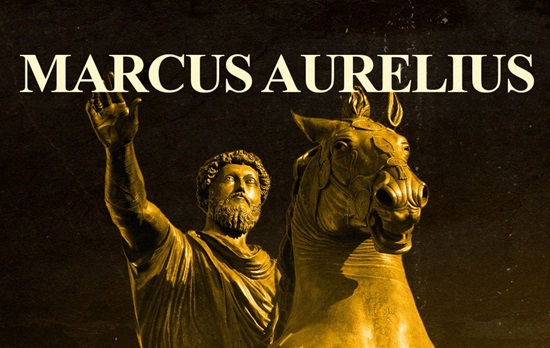
In his Meditations, Marcus Aurelius wrote:

"When you wake up in the morning, tell yourself: the people I deal with today will be meddling, ungrateful, arrogant, dishonest, jealous and surly. They are like this because they can't tell good from evil."

End of excerpts.

I would add four comments regarding Marcus Aurelius's Meditations.


1. So far as we know, the Meditations were his private notebook of self-improvement. The book was not composed for publication, though he may well have anticipated that as a possibility.

2. Much of his writings can be viewed as a relentless reduction of expectations. If we expect little, we're better prepared to accept adversity because it is what we anticipated.

If something a bit better transpires, we're delighted. If our expectations are too high, we suffer disappointment, depression, resentment, indignation, envy, etc.

3. The first chapter of the Meditations was an outpouring of gratitude to everyone who taught him valuable lessons and provided an example how to live a virtuous, kind and ethical life.

4. He was a strict taskmaster of himself, constantly seeking to better himself via actions and insights.

Let's extend this discussion of stoic virtue into self-discipline, a key element of stoicism's principles of self-control and moderation.

Our world is dominated by the drive to maximize profits. I contend (and am in good company doing so) that this economic dynamic now dominates society, culture and governance (politics).

As a result, everything is viewed through the prism of maximizing financial gain, as if all of human life boils down to this single drive.

In this context, both ends of the spectrum of indulgence and discipline are highly profitable, and so they are marketed to us with great zeal.

Moderation isn't profitable and so it's ignored, much like no one spends a fortune marketing carrots and broccoli, as these low-margin items cannot be as profitable as junk food.

(Deep-frying carrot-colored potato-starch sticks in low-quality fat, coating them in low-quality sugar and marketing them as a "healthy snack" replaces low-profit carrots with high-profit ultra-processed food--the essence of Ultra-Processed Life--my new book; you can read the first part for free.)

On the indulgence end, we're constantly told "we deserve" a treat, a luxury, etc., so go ahead and indulge yourself. We're shown scenes in which the joy of the participants indicates that indulging in pizza and alcohol while watching a football game on TV is the height of human happiness.

The not-so-subtle message in all this encapsulates the entirety of Modernism: the elevation of the Self as the One True Measure of Everything. This is the essence of narcissism and self-absorption.

A solipsistic focus on gratifying my desires, expressing my uniqueness with curated social media posts and possessions, and making my opinions known is the Modernist Project.

In marketers' clever hands, indulgence isn't self-destructive excess, it's the discovery of "the real you," the self freed from all the constraints of convention and the limits we place on ourselves, i.e. self-discipline.

Indulging ourselves via buying something is presented as freeing ourselves from the shackles of convention, a means of self-discovery and self-expression.

This distortion of the authentic project of acquiring oneself (in Kierkegaard's phrase) is highly profitable, as high-margin indulgences (triple-patty bacon cheeseburgers, luxury vehicles, jewelry, river cruises, etc.) can be marketed as "you deserve it."

In marketers' able hands, self-discovery and self-expression require the constant purchase of highly profitable products and services to become "the real you."

The other end of the spectrum--self-denial--is equally profitable, as high-margin home gyms, weight-loss programs, etc. are marketed as the extreme tools you need to restore your health and glorify your "real self" after decades of self-indulgence.

That the vast majority of the home-gym contraptions end up outside rusting and the majority of those who lose weight via strict diet regimes gain it back are testament to the ephemeral frailty of self-denial that can be purchased.

Equating self-denial with self-discipline distorts the true purpose of self-discipline, which is to maintain moderation, not unsustainable extremes.

Extremes of fitness and diet are profitably sold as the means to become "the real you," the self glorified as a photo-worthy body.

Self-discipline isn't the pursuit of extremes for the purpose of self-glorification; it's the pursuit of moderation for the purpose of well-being, learning, insight and self-cultivation.

The point of self-discipline isn't forcing oneself to extremes, it's to be a friend to yourself by limiting destructive excesses of self-indulgence and self-denial.

The media glorifies the gains of extreme self-privation, but such extremes are not sustainable nor are they desirable from the perspective of the cultivation of virtue, health and wisdom.

The point of self-discipline is not to become more self-glorifying than others, it's to master moderation.

For this, we don't need to buy any products or services. Moderation isn't profitable.

In the realm of moderation, any two-meter square of ground can be a gym. Any diet of a wide variety of real, unprocessed food and moderate servings can be a healthy diet.

Self-indulgence and self-privation are not pathways to self-discovery or self-expression. These extremes are brittle. Self-discipline in service of self-cultivation and moderation is flexible. The dead reed is brittle, the living reed is flexible.

Self-discipline isn't supposed to be punishing. Rather, it's friendly and encouraging. The encouraging Master is strict only in holding fast to moderation.

Moderation is flexible and that's why it's sustainable.

Stoicism isn't asceticism. As Marcus Aurelius showed, it's gratitude for what we have learned, lowering expectations of ourselves and the world, and the process of self-cultivation via self-discipline, learning and moderation--a pathway of self-reliance.

Self-reliance is a journey of learning, flexibility, lowering expectations, moderation, encouragement and self-cultivation. I wrote a book about it: Self-Reliance in the 21st Century. You can read the first chapter for free.


New podcast: KunstlerCast 430: Finance and The Ultra-Processed Life (1 hr)


Check out my new book Ultra-Processed Life and my updated Books and Films.

Become a $3/month patron of my work via patreon.com

Subscribe to my Substack for free


My recent books:

Disclosure: As an Amazon Associate I earn from qualifying purchases originated via links to Amazon products on this site.

Ultra-Processed Life
print $16, (Kindle $7.95, Hardcover $20 (129 pages, 2025) audiobook     Read the Introduction and first chapter for free (PDF)

The Mythology of Progress, Anti-Progress and a Mythology for the 21st Century print $16, (Kindle $6.95, audiobook, Hardcover $24 (215 pages, 2024) Read the Introduction and first chapter for free (PDF)

Self-Reliance in the 21st Century print $15, (Kindle $6.95, audiobook $13.08 (96 pages, 2022) Read the first chapter for free (PDF)

When You Can't Go On: Burnout, Reckoning and Renewal $15 print, $6.95 Kindle ebook; audiobook Read the first section for free (PDF)

Global Crisis, National Renewal: A (Revolutionary) Grand Strategy for the United States (Kindle $6.95, print $16, audiobook) Read Chapter One for free (PDF).

A Hacker's Teleology: Sharing the Wealth of Our Shrinking Planet (Kindle $6.95, print $15, audiobook $17.46) Read the first section for free (PDF).

Will You Be Richer or Poorer?: Profit, Power, and AI in a Traumatized World
(Kindle $3.95, print $12, audiobook) Read the first section for free (PDF).

The Adventures of the Consulting Philosopher: The Disappearance of Drake (Novel) $3.95 Kindle, $12 print); read the first chapters for free (PDF)

Money and Work Unchained $6.95 Kindle, $15 print)
Read the first section for free


Become a $3/month patron of my work via patreon.com.

Subscribe to my Substack for free


NOTE: Contributions/subscriptions are acknowledged in the order received. Your name and email remain confidential and will not be given to any other individual, company or agency.

Thank you, XXXX ($7/month), for your magnificently generous subscription to this site -- I am greatly honored by your support and readership.


Thank you, Femke V. ($7/month), for your marvelously generous subscription to this site -- I am greatly honored by your support and readership.


Thank you, Rodney L. ($7/month), for your superbly generous subscription to this site -- I am greatly honored by your support and readership.


Thank you, Roger E.K. ($7/month), for your splendidly generous subscription to this site -- I am greatly honored by your support and readership.

Read more...
Tuesday, October 07, 2025

Look Out Below

As I often note, making Plans B and C is free.

The stock market is always looking past "bad news" to front-run "good news." Once it became clear that the Titanic was indeed going to sink, the stock market would rally on the prospect of sharp growth in lifeboat shares. In other words, never mind the bad news, let's look beyond that and find some reason to rally.

This is a pattern that's easily visible in the past two decades. When it became clear that Covid was becoming a global pandemic, the US stock market rallied for weeks, something that struck sober analysts as completely disconnected from reality. Eventually reality intruded and the market crashed.

The same dynamic was also apparent in the run-up to the 2000 dot-com implosion--stocks rallied right up to March 6, 2000, before starting a two-year long controlled demolition--and the 2008-09 stock market crash, when shares of visible doomed General Motors and Fannie Mae both maintained lofty valuations that were completely disconnected from a painfully visible reality. (Fannie Mae shares went to near-zero in the subsequent crash.)

And so here we are again. The stock market is rallying despite overwhelming evidence that the US economy and global economy are heading for a deep recession. The justifications are either 1) the AI boom is changing everything or 2) the Federal Reserve will continue lowering interest rates and flood the market with liquidity, i.e. "The Fed Put" will save the stock market, just as its done for the past 25 years.

This assumption is completely detached from the painfully visible reality that the Fed and other central banks have finally awakened to the perverse consequences of "The Fed Put" (i.e. the policy of unleashing trillions in financial stimulus whenever the stock market swoons) and they are now responding to rallies based on front-running the (now viewed as guaranteed) Fed "save" of the stock market by reiterating their new policy which is to keep interest rates (bond yields) higher for longer. In other words, they are explicitly stating that they won't "save" the stock market because of 1) inflation and 2) the need to destroy the moral hazard created by "The Fed Put."

In the heady front-running rally prior to the crash, all seems well. Employment is strong, consumers are spending, etc.

The problem with this euphoric confidence is there are lag times between sharp increases in the cost of capital and goods and services and employment and spending. Notice how credit card balances have exploded higher. In previous recessions, reliance on credit cards to juice spending soared right up until the stock market began its free-fall. Then spending fell sharply.

The lag time is also visible in yield-curve inversions--long counted as a surefire precursor to recession. (When the 2-year Treasury bonds pays a higher yield than the long-term 30-year bond, this inverts the normal market in which longer-term bonds pay higher yields than short-term bonds.)

Many other indicators repeat the same message: we're at the cusp of a recession and market decline.

Many commentators note how tightening financial conditions take months to work through the economy, eventually affecting consumer spending, commercial borrowing, housing valuations, tax receipts, etc.

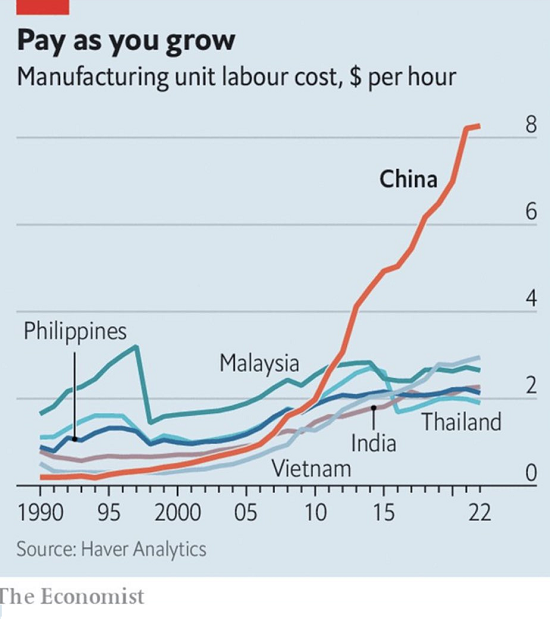
Globally, the forces pushing costs higher (i.e. inflation) cannot be reversed. Consider this chart of labor costs in China. As labor costs skyrocket, higher costs must be passed on to consumers.


There are also less easily measured trends at work. One factor that is not tracked and therefore poorly understood is how close to the edge many small businesses are. Those that survived the Covid lockdown have had to raise prices just to cover the sharp increases in their own costs. Small business isn't making big margins; rather, they're absorbing costs to keep the doors open. As some costs decline, they won't drop prices, as they need to finally make a profit.

Many owners are hovering on the edge of burnout, having compensated for higher costs by working longer hours themselves.

Any decline in consumer spending will push many of these business owners to finally give up. As for selling the business to new owners: few young people have the capital, appetite for risk and willingness to work long hours for uncertain returns to buy a small business. So the businesses close and there are no replacements: those enterprises, commercial spaces, employment and taxes paid all disappear, and they won't come back.

Those who operate small businesses themselves know that small business owners are viewed by local government as tax donkeys: they're business owners so they're doing well, let's jack up business license fees, etc.

Another factor is the change in speculative psychology once "investors" (i.e. gamblers) finally accept that the Titanic is in fact going to sink, that is, the Fed is not going to bail out the stock market with newly issued trillions. We can anticipate the stair-step down as confidence slips to denial, then anger, then grief and finally, acceptance.

As I often note, making Plans B and C is free. Making plans for how you'll respond to recession and/or a protracted stock market decline takes nothing but time. It's very difficult to act decisively before the herd turns and panics, which is why so few manage to do so.

We cannot anticipate every impact a recession and stock market free-fall will have on our household, but we can anticipate the possibility our income and wealth will be negatively affected and belt-tightening may be prudent. If the happy-crowd is right and there is no recession, having a plan didn't cost anything. But if the happy-crowd is wrong, those without a plan to act decisively before the herd panics will suffer more than those who had a plan and acted on it.


New podcast: KunstlerCast 430: Finance and The Ultra-Processed Life (1 hr)


Check out my new book Ultra-Processed Life and my updated Books and Films.

Become a $3/month patron of my work via patreon.com

Subscribe to my Substack for free


My recent books:

Disclosure: As an Amazon Associate I earn from qualifying purchases originated via links to Amazon products on this site.

Ultra-Processed Life
print $16, (Kindle $7.95, Hardcover $20 (129 pages, 2025) audiobook     Read the Introduction and first chapter for free (PDF)

The Mythology of Progress, Anti-Progress and a Mythology for the 21st Century print $16, (Kindle $6.95, audiobook, Hardcover $24 (215 pages, 2024) Read the Introduction and first chapter for free (PDF)

Self-Reliance in the 21st Century print $15, (Kindle $6.95, audiobook $13.08 (96 pages, 2022) Read the first chapter for free (PDF)

When You Can't Go On: Burnout, Reckoning and Renewal $15 print, $6.95 Kindle ebook; audiobook Read the first section for free (PDF)

Global Crisis, National Renewal: A (Revolutionary) Grand Strategy for the United States (Kindle $6.95, print $16, audiobook) Read Chapter One for free (PDF).

A Hacker's Teleology: Sharing the Wealth of Our Shrinking Planet (Kindle $6.95, print $15, audiobook $17.46) Read the first section for free (PDF).

Will You Be Richer or Poorer?: Profit, Power, and AI in a Traumatized World
(Kindle $3.95, print $12, audiobook) Read the first section for free (PDF).

The Adventures of the Consulting Philosopher: The Disappearance of Drake (Novel) $3.95 Kindle, $12 print); read the first chapters for free (PDF)

Money and Work Unchained $6.95 Kindle, $15 print)
Read the first section for free


Become a $3/month patron of my work via patreon.com.

Subscribe to my Substack for free


NOTE: Contributions/subscriptions are acknowledged in the order received. Your name and email remain confidential and will not be given to any other individual, company or agency.

Thank you, XXXX ($7/month), for your magnificently generous subscription to this site -- I am greatly honored by your support and readership.


Thank you, Femke V. ($7/month), for your marvelously generous subscription to this site -- I am greatly honored by your support and readership.


Thank you, Rodney L. ($7/month), for your superbly generous subscription to this site -- I am greatly honored by your support and readership.


Thank you, Roger E.K. ($7/month), for your splendidly generous subscription to this site -- I am greatly honored by your support and readership.

Read more...
Friday, October 03, 2025

The Golden Age of Spectacle

"The most useful expert, of course, is the one who can lie." Guy Debord

We're living in the golden age of Spectacle: whatever substance remains in politics is lost in the endless parade of outlandish political theater, finance is dominated by staged spectacles of media-savvy CEOs announcing the next trillion-dollar product, and online, all the world's a stage for everyone's spectacle.

French philosopher Guy Debord outlined the value of spectacle in a society and economy that is increasingly dependent on artifice rather than authenticity in his 1967 book, The Society of the Spectacle.

Here is how Debord described his 1967 book in his 1988 follow-up work, Comments on the Society of the Spectacle: "In 1967, in a book entitled The Society of the Spectacle, I showed what the modern spectacle was already in essence: the autocratic reign of the market economy which had acceded to an irresponsible sovereignty, and the totality of new techniques of government which accompanied this reign."

Debord is laying out a way to understand how society has become subsumed by economic forces, specifically markets ruled by the corporate-state.

This arrangement manages the populace by turning everything into a spectacle which in Debord's view is not "real life," it's a representation that we passively accept without understanding how it transforms our identity and social fabric from "being" to "having," i.e. buying and owning stuff that is a representation of who we are.

This representation is managed by technocratic expertise.

What we refer to as propaganda, marketing and narrative are for Debord all aspects of spectacle.

Spectacle as a simulation or facsimile of "real life" speaks to a profound alienation: we passively watch spectacle and take that passive consumption as "real life" without understanding it's all managed to maintain the dominance of those benefitting from this arrangement.

This echoes many related ideas (for example, "The Matrix" films), simulacra being passed off as the authentic "real thing," and Marx's concept of alienation in which the worker has been disconnected (alienated) from the product/value of their labor.

The core idea here is that Spectacle is inauthentic, fake, a simulation, a substitution of representation for substance, that creates a peculiarly unreality. These are the themes I explore in my book Ultra-Processed Life.

The entire appeal of social media can be seen as personalizing Spectacle, as we each gain audience and influence by making ourselves and our lives into unreal representations, i.e. spectacles.

Here are some illuminating excerpts from Debord:

"Because spectacle replaces real life with a mere mediated representation of life that cannot be experienced directly, it provides a framework where mass deceptions and lies can consistently and convincingly appear as true.

It has recreated our society without community, and it has obstructed the ability to communicate in general. Such processes and their ramifications ultimately mean people cannot truly experience life for themselves: they have become spectators, bound to an impoverished state of unlife"


In The Society of the Spectacle, Debord explains that the economy subjugating society first presented itself as an "obvious degradation of being into having," where human fulfilment was no longer attained through what one was, but instead only through what one bought and displayed. As society's capitulation to the economy accelerated, the decline from being into having shifted "from having into appearing."

With respect to knowledge, therefore, experts no longer have to be experts or have expertise, they only need to take on the appearance of expertise.

"All experts serve the state and the media and only in that way do they achieve their status. Every expert follows his master, for all former possibilities for independence have been gradually reduced to nil by present society's mode of organisation. The most useful expert, of course, is the one who can lie."

"The vague feeling that there has been a rapid invasion which has forced people to lead their lives in an entirely different way is now widespread; but this is experienced rather like some inexplicable change in the climate, or in some other natural equilibrium, a change faced with which ignorance knows only that it has nothing to say."
Debord

This reminds me of a comment French writer Michel Houellebecq made in an interview: "I have the impression of being caught up in a network of complicated, minute, stupid rules, and I have the impression of being herded towards a uniform kind of happiness, toward a kind of happiness that doesn't really make me happy."

A reliance on spectacle to create a peculiar unreality may not be solely modern.

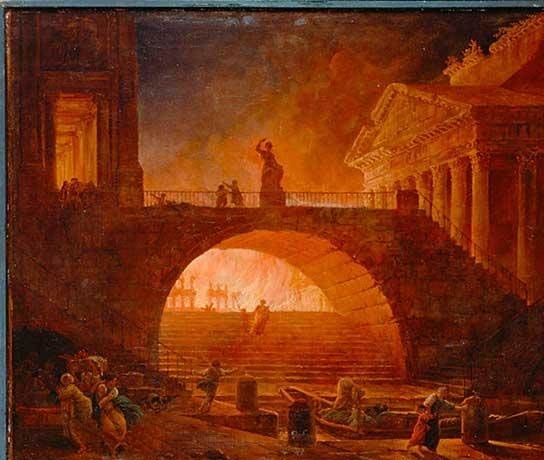
If we think of late Rome's extravagant spectacles--staged battles in the Coliseum, chariot races, etc.--they were representations of a Roman strength that was no longer real.

In the real world, Rome's power flowed from its vast importation of wheat from North Africa, its lucrative trade with the Mideast and India, its silver mines in Spain and its well-trained and provisioned legions.

Once these decayed or collapsed, the spectacles in Rome were no longer manifestations of power, they were representations of a power that was rapidly dissolving in the world beyond Rome.

As a final thought, consider how AI is being presented as automated expertise. But isn't AI just a representation of true expertise that "serves the state and the media" in a new theater of Spectacle?


New podcast: KunstlerCast 430: Finance and The Ultra-Processed Life (1 hr)


Check out my new book Ultra-Processed Life and my updated Books and Films.

Become a $3/month patron of my work via patreon.com

Subscribe to my Substack for free


My recent books:

Disclosure: As an Amazon Associate I earn from qualifying purchases originated via links to Amazon products on this site.

Ultra-Processed Life
print $16, (Kindle $7.95, Hardcover $20 (129 pages, 2025) audiobook     Read the Introduction and first chapter for free (PDF)

The Mythology of Progress, Anti-Progress and a Mythology for the 21st Century print $16, (Kindle $6.95, audiobook, Hardcover $24 (215 pages, 2024) Read the Introduction and first chapter for free (PDF)

Self-Reliance in the 21st Century print $15, (Kindle $6.95, audiobook $13.08 (96 pages, 2022) Read the first chapter for free (PDF)

When You Can't Go On: Burnout, Reckoning and Renewal $15 print, $6.95 Kindle ebook; audiobook Read the first section for free (PDF)

Global Crisis, National Renewal: A (Revolutionary) Grand Strategy for the United States (Kindle $6.95, print $16, audiobook) Read Chapter One for free (PDF).

A Hacker's Teleology: Sharing the Wealth of Our Shrinking Planet (Kindle $6.95, print $15, audiobook $17.46) Read the first section for free (PDF).

Will You Be Richer or Poorer?: Profit, Power, and AI in a Traumatized World
(Kindle $3.95, print $12, audiobook) Read the first section for free (PDF).

The Adventures of the Consulting Philosopher: The Disappearance of Drake (Novel) $3.95 Kindle, $12 print); read the first chapters for free (PDF)

Money and Work Unchained $6.95 Kindle, $15 print)
Read the first section for free


Become a $3/month patron of my work via patreon.com.

Subscribe to my Substack for free


NOTE: Contributions/subscriptions are acknowledged in the order received. Your name and email remain confidential and will not be given to any other individual, company or agency.

Thank you, KImberly ($70), for your magnificently generous subscription to this site -- I am greatly honored by your support and readership.


Thank you, Michael A. ($70), for your marvelously generous subscription to this site -- I am greatly honored by your support and readership.


Thank you, Syahir ($7/month), for your superbly generous subscription to this site -- I am greatly honored by your support and readership.


Thank you, Andrew ($7/month), for your splendidly generous subscription to this site -- I am greatly honored by your support and readership.

Read more...
Wednesday, October 01, 2025

Will AI Crash the Economy?

The lines of dominoes being toppled run through every nook and cranny of the economy.

As we all know, the problem with euphoria is the inevitable collision with reality and the resulting disillusionment. But wait--it gets worse.

The new love of your life, your savior who is going to make everything right again, is not just impossibly flawed--they're a con artist. Now that really hurts. They not only stole your heart, they stole your money.

Which brings us to the AI Boom / Bubble. The euphoria is literally immeasurable, but the disconnect from reality is easily visible and can be broken down into measurable bits:

1. AI revenues are orders of magnitude lighter than the sums being invested (capex, i.e. capital investment). The euphoria is based on the idea that revenues will catch up, but the second date is raising doubts about Prince Charming's non-flim-flammed revenues and prospects.

This report has raised eyebrows, and the real question is: OK, so let's say it underestimates revenues by 50%. That means we're at 3% of revenues needed to justify the capex rather than 2%. Maybe this is why Prince Charming invites his amour to poorly lit bistros--he's had, um, work done and he's wary of bright lighting.

$2 trillion in new revenue needed to fund AI's scaling trend (Bain & Company)

2. AI tools are inherently untrustworthy and lend themselves to generating "going through the motions" slop that gives the superficial appearance of value but actually has negative value as it's incomplete, misleading and/or incoherent. Sorting the wheat from the chaff actually takes more time because AI is so adept at generating a superficial gloss. In other words, AI generates time sinks rather than productivity.

AI-Generated 'Workslop' Is Destroying Productivity (Harvard Business Review)

People Overtrust AI-Generated Medical Advice despite Low Accuracy.

Add in that AI slop looks similar to authentic research and that AI tools have a measurable preference for AI-generated content (i.e. AI slop), and we have a toxic cocktail of untrustworthy output.

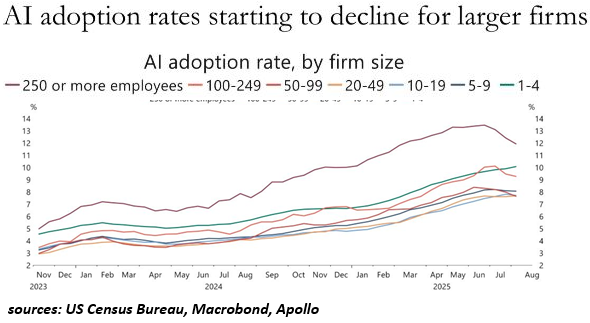
3. The rate at which major companies are adopting AI is rolling over. This chart reflects the peak of euphoria has been reached by those with the most resources to figure that out and the real-world utility of AI tools is yet to be determined.


The claim making the rounds is that it's not Prince Charming's fault that he's disappointed his enamored amour; she's making unrealistic demands on poor PC. In other words, it's the companies' fault that AI is underperforming. Is this the great promise of AI, to blame the mark and not the con-artist?

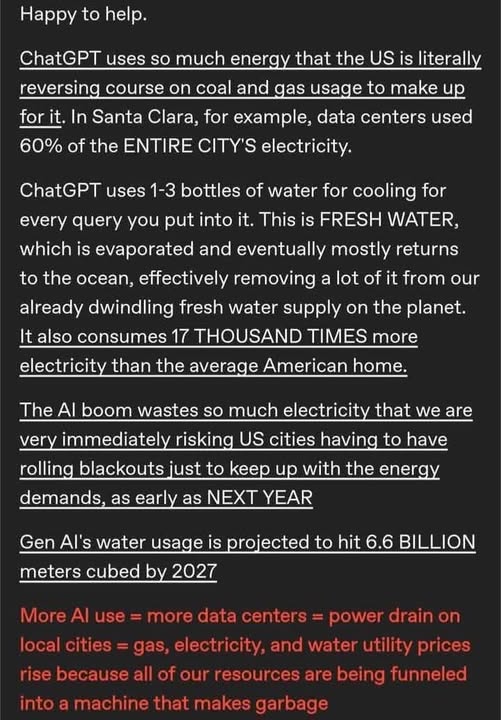
4. AI data centers are competing with other users for electricity, water and capital. The apologists' claim is that AI data centers are only a tiny little straw sipping on the grid's total energy, but this overlooks that price is set on the margins and demand for electricity and water by those with unlimited bank accounts will push prices up at rates far above the total additional consumption of AI data centers.

This reality is reflected anecdotally in household complaints that their utility bills have shot up from $250 to $800 a month. Yes, there are other factors at work--the need to invest in grid upgrades, higher insurance rates for catastrophic weather events, etc., but to ignore AI data centers' insatiable demand for water and electricity is like seeing Prince Charming palm your wallet and then making excuses for him.

How Can We Meet AI's Insatiable Demand for Compute Power? (Bain & Company)

By all means fact-check that 60% of Santa Clara's electricity goes to AI data centers: I did. It's true.


This is not to say there isn't a use-case for AI. The point here is the excesses of capital and resources heedlessly thrown at AI in the frenzy of euphoria will crash the economy. I know it seems like there are endless trillions to toss around, but back in the real world, capital isn't infinite, and capital squandered in mal-investments that have little to no real return is capital that could have been invested more productively elsewhere.

The same is true for water and electricity / energy. These resources are not infinite, and when someone with a bottomless bank account enters the market, prices will rise, which means consumers will be devoting scarce income to utilities, leaving them less to spend on other goods and services.

Companies spending scarce capital on AI will be forced to assess the actual financial costs and return on capital invested, and they will pull back. This retrenchment will reverse the parabolic rise of spending on AI, and that will deflate the AI Bubble that has inflated the entire stock market into a euphoric bubble that has now exceeded the extreme euphoria of the dot-com era bubble that popped 25 years ago.

So will AI crash the economy? Malinvestment on an unprecedented scale, disappointing revenues, soaring costs for utilities stripping discretionary income from consumers and the inevitable reversal of investment euphoria and the crash of stock market bubbles bursting--these are not drivers of positive economic development.

Once the stock market euphoria bursts, the wealth effect reverses, and since people feel poorer (and are poorer), they slash borrowing and spending. Those who've maxed out their credit have no choice: stop paying the car loan or rent to keep the lights on.

One domino falling, OK, no big deal. This is different: the lines of dominoes being toppled run through every nook and cranny of the economy. What's been untouchable will be touched--by a hammer.


Check out my new book Ultra-Processed Life and my updated Books and Films.

Become a $3/month patron of my work via patreon.com

Subscribe to my Substack for free


My recent books:

Disclosure: As an Amazon Associate I earn from qualifying purchases originated via links to Amazon products on this site.

Ultra-Processed Life
print $16, (Kindle $7.95, Hardcover $20 (129 pages, 2025) audiobook     Read the Introduction and first chapter for free (PDF)

The Mythology of Progress, Anti-Progress and a Mythology for the 21st Century print $16, (Kindle $6.95, audiobook, Hardcover $24 (215 pages, 2024) Read the Introduction and first chapter for free (PDF)

Self-Reliance in the 21st Century print $15, (Kindle $6.95, audiobook $13.08 (96 pages, 2022) Read the first chapter for free (PDF)

When You Can't Go On: Burnout, Reckoning and Renewal $15 print, $6.95 Kindle ebook; audiobook Read the first section for free (PDF)

Global Crisis, National Renewal: A (Revolutionary) Grand Strategy for the United States (Kindle $6.95, print $16, audiobook) Read Chapter One for free (PDF).

A Hacker's Teleology: Sharing the Wealth of Our Shrinking Planet (Kindle $6.95, print $15, audiobook $17.46) Read the first section for free (PDF).

Will You Be Richer or Poorer?: Profit, Power, and AI in a Traumatized World
(Kindle $3.95, print $12, audiobook) Read the first section for free (PDF).

The Adventures of the Consulting Philosopher: The Disappearance of Drake (Novel) $3.95 Kindle, $12 print); read the first chapters for free (PDF)

Money and Work Unchained $6.95 Kindle, $15 print)
Read the first section for free


Become a $3/month patron of my work via patreon.com.

Subscribe to my Substack for free


NOTE: Contributions/subscriptions are acknowledged in the order received. Your name and email remain confidential and will not be given to any other individual, company or agency.

Thank you, Robin M.K. ($100), for your outrageously generous subscription to this site -- I am greatly honored by your support and readership.


Thank you, Charles B. ($70), for your marvelously generous subscription to this site -- I am greatly honored by your support and readership.


Thank you, William M.L. ($7/month), for your superbly generous subscription to this site -- I am greatly honored by your support and readership.


Thank you, Miles L. ($70), for your splendidly generous subscription to this site -- I am greatly honored by your support and readership.

Read more...

Terms of Service

All content on this blog is provided by Trewe LLC for informational purposes only. The owner of this blog makes no representations as to the accuracy or completeness of any information on this site or found by following any link on this site. The owner will not be liable for any errors or omissions in this information nor for the availability of this information. The owner will not be liable for any losses, injuries, or damages from the display or use of this information. These terms and conditions of use are subject to change at anytime and without notice.

RE: European Union AI Act, and Our Use of Generative AI Tools and Agents Policy

All text on this site is composed by Charles Hugh Smith or by a credited guest-author. No Generative AI Tools are used in the composition / writing of any text or graphic content created by Charles Hugh Smith. This site deploys no AI agents or generative AI tools. This site is not responsible for the disclosures, use or non-use of AI agents or generative AI tools in advertisements displayed by Investing Channel or other ad placement services.

Audio files generated by text-to-audio transcription tools are identified as such.

Our Privacy Policy:

Correspondents' email is strictly confidential. This site does not collect digital data from visitors or distribute cookies. Advertisements served by third-party advertising networks such as Investing Channel may use cookies or collect information from visitors for the purpose of Interest-Based Advertising; if you wish to opt out of Interest-Based Advertising, please go to Opt out of interest-based advertising (The Network Advertising Initiative) If you have other privacy concerns relating to advertisements, please contact advertisers directly.

PRIVACY NOTICE FOR EEA INDIVIDUALS

This section covers disclosures on the General Data Protection Regulation (GDPR) for users residing within EEA only. GDPR replaces the existing Directive 95/46/ec, and aims at harmonizing data protection laws in the EU that are fit for purpose in the digital age. The primary objective of the GDPR is to give citizens back control of their personal data. Please follow the link below to access InvestingChannel's General Data Protection Notice.
https://stg.media.investingchannel.com/gdpr-notice/

Notice of Compliance with The California Consumer Protection Act

This site does not collect digital data from visitors or distribute cookies. Advertisements served by a third-party advertising network (Investing Channel) may use cookies or collect information from visitors for the purpose of Interest-Based Advertising. If you do not want any personal information that may be collected by third-party advertising to be sold, please follow the instructions on this page: Do Not Sell My Personal Information.

Regarding Cookies:

This site does not collect digital data from visitors or distribute cookies. Advertisements served by third-party advertising networks such as Investing Channel may use cookies or collect information from visitors for the purpose of Interest-Based Advertising; if you wish to opt out of Interest-Based Advertising, please go to Opt out of interest-based advertising (The Network Advertising Initiative) If you have other privacy concerns relating to advertisements, please contact advertisers directly.

Our Commission Policy:

Though I earn a small commission on Amazon.com books and gift certificates and gold (BullionVault) purchased via links on my site, I receive no fees or compensation for any other non-advertising links or content posted on my site.

Copyright Notice:

All original images (Drawings and Photographs), text (essays, books and works of fiction), audio and video recordings, musical compositions, graphic design, graphic design elements and HTML coding on this site are the copyrighted work of Charles Hugh Smith unless otherwise credited or noted. They are published as information for the private use of site visitors, and any reproduction or redistribution of this content or coding in any media in any format or distribution channel (text, audio, video/film, web) without the written permission of the copyright holder is strictly prohibited. All rights in all media reserved globally.

  © Blogger templates Newspaper III by Ourblogtemplates.com 2008

Back to TOP