When understood as a wave, the current Everything Bubble is not sustainable.
The problem with predictions based on the past is the analogies we discern are interpretations which means if we like one interpretation more than the alternatives, we stretch the present crisis and past crises to fit our preferred interpretation.
Two round pegs pounded into square holes? No problem.
Past eras are never perfect analogies because Things Change (March 3, 2026) If we're not trying to force an analogy that fits our pre-selected preferred interpretation, then we have to be open to the possibility that the present crisis has no historical analog of predictive value.
Consider the remarkable confluence of cycles and waves in the present era. Richard Bonugli and I discussed this confluence in our podcast Current Waves and Cycles: Energy, Commodities, Inflation (38 min). Such a confluence generates a polycrisis, a series of overlapping, inter-connected, mutually reinforcing crises that are immune to simplistic solutions.
Even if you're skeptical of cycles (for the reason stated above, that timelines seem shoehorned into a model that doesn't actually fit), it's noteworthy that so many cycles have reached crisis points in this historical moment.
1. The Fourth Turning cycle of 80 years / four generations. (1781, 1861, 1841, 2021)
2. the 18-year stock market cycle. (1973, 1991, 2008-09, 2026-27)
3. Peter Turchin's 50-year cycle (which occur in 50-year increments in long-wave cycles).
There are other cycles that might in play: sunspots, etc. These three are representative, not comprehensive.
These cycles identify the present as a period of unavoidable, transformative crisis / resolution / dissolution. This confluence alerts us to the possibility that analogs from the past will mislead rather than enlighten.
If you're skeptical of cycles, then the difference between cycles and waves is worth studying.
Author David Hackett Fischer (The Great Wave: Price Revolutions and the Rhythm of History) described the difference between cycles and waves:
"Cyclical rhythms are fixed and regular. Their periods are highly predictable. Great waves are more variable and less predictable. They differ in duration, magnitude, velocity, and momentum. One great price wave lasted less than ninety years; another continued more than 180 years. The irregularities in individual price movements make them no more (or less) predictable than individual waves in the sea.
Even so, all great waves had important qualities in common. They all shared the same wave-structure. They tended to have the same sequence of development, the same pattern of price relatives, similar movements of wages, rent, interest rates; and the same dangerous volatility in later stages. All major price revolutions in modern history began in periods of prosperity. Each ended in shattering world crises and was followed by periods of recovery and comparative equilibrium."
Examples of waves range from rogue waves in the sea to bond yields / interest rates which arise and decline over periods of time that vary too much to qualify as cycles but match the dynamics of waves described by Fischer. After declining for roughly 40 years, bond yields have recently turned up in what looks like a change in long-term trend.
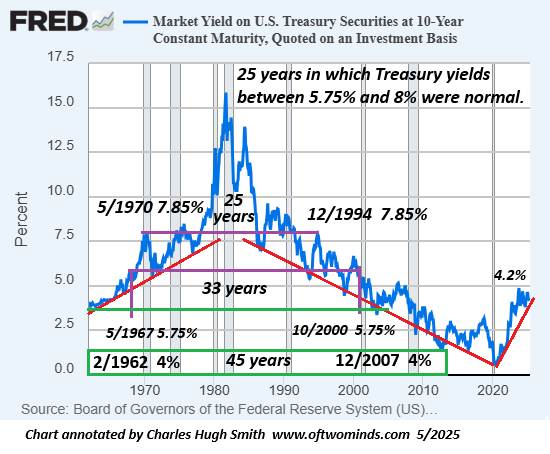
In other words, the business cycle, the Kondratieff credit cycle, the Debt Super-Cycle, etc. are defined not by the calendar but by their internal dynamics and measurable qualities. Credit/debt, for example, builds up in a wave of speculative excess that then crashes.
As Fischer observed, waves of human history share characteristics with ocean waves, which can accrete energy and become giant rogue waves that cannot be predicted even as they can be foreseen as recurring phenomena.
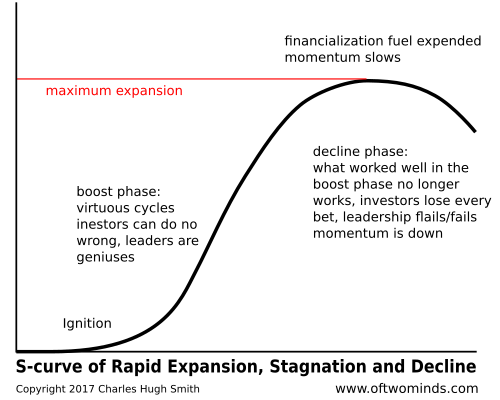
Both waves and cycles tend to follow the dynamics of S-curves in which a trend takes off in a boost phase, matures into a peak and then decays or reverses.
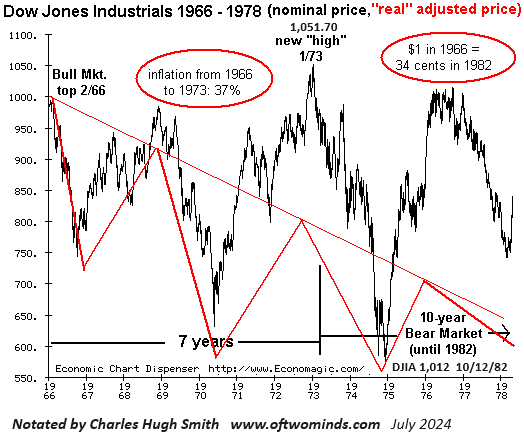
Perhaps the closest analogous period was the 1970s, an era characterized by external energy shocks that raised the cost of energy to a higher plateau, unleashing inflationary pressures throughout the economy, and stagnant productivity. These two dynamics generate stagflation, which when exacerbated by an institutional tropism to "run the economy hot," embeds self-reinforcing inflationary expectations that push enterprises and households into risk-off frugality or insolvency.
The net result of these dynamics was a massive erosion of the purchasing power of wages and currency. As this chart shows, everyone who held on to their stock portfolio from 1966, when the Dow Jones Industrial Average (DJIA) topped 1,000 for the first time, until 1982 when it finally rose above 1,000 and continued higher, might have cheered the restoration of their stock portfolio's value, but adjusted for inflation, their wealth had shrunk by 2/3rds as every dollar of their portfolio had fallen to 34 cents by 1982.
When understood as a wave, the current Everything Bubble is not sustainable. Energy, commodities, currencies, inflation, credit, interest rates, risk, "growth" and every other aspect of the socio-economic system will be in flux, and cycles and waves offer us a useful context / orientation as things become, um, dynamic.
The confluence of cycles, waves and conditions of the present may well be unique, and historical analogies may be misleading while instilling us with false confidence in our projections. Every analogy from the decline of the Western Roman Empire to the 1640s to the 1970s to the 2008-09 Global Financial Crisis may illuminate human psychology, but offer little in the way of predictive value in the decade ahead.
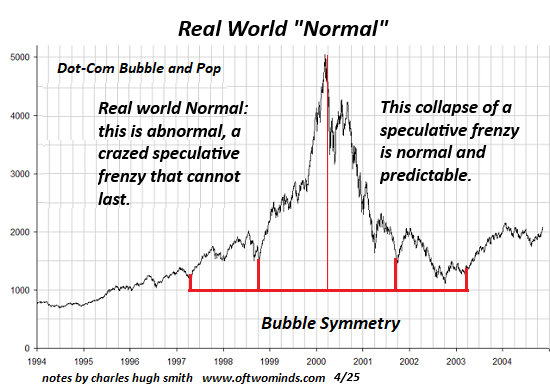
This bubble is hyper-normalized, a gigantic wave that's cresting and about to crash.
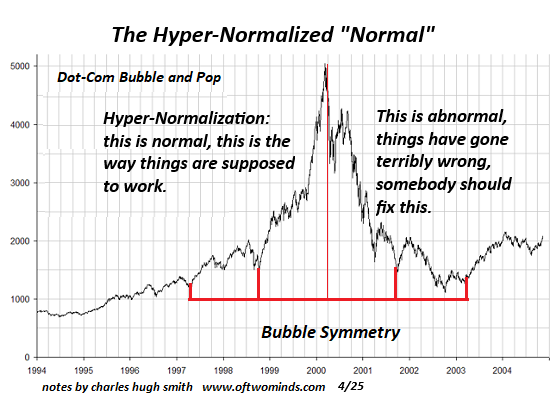
A few fortunate surfers will get the ride of a lifetime, the rest of us will experience wipeout. How bad it gets will depend partly on luck and partly on how well we've prepared ourselves for events we don't control. As this unprecedented wave breaks, the only thing we can control is our response.
New podcast: Current Waves and Cycles: Energy, Commodities, Inflation (38 min)
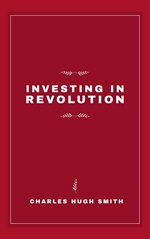
My new book Investing In Revolution is available at a 10% discount ($18 for the paperback, $24 for the hardcover and $8.95 for the ebook edition).
Introduction (free)
Check out my updated Books and Films.
Become
a $3/month patron of my work via patreon.com
Subscribe to my Substack for free
NOTE: Contributions/subscriptions are acknowledged in the order received. Your name and email
remain confidential and will not be given to any other individual, company or agency.
|
Thank you, Roger H. ($70), for your magnificently generous subscription
to this site -- I am greatly honored by your steadfast support and readership.
|
|
Thank you, Jim O. ($7/month), for your marvelously generous subscription
to this site -- I am greatly honored by your support and readership.
|
|
Thank you, Dolly C. ($7/month) for your superbly generous subscription
to this site -- I am greatly honored by your support and readership.
|
|
Thank you, Tierney P. ($7/month) for your splendidly generous subscription
to this site -- I am greatly honored by your support and readership.
|