The asymmetric scaling of credit has inflated The Everything Bubble that will burst with devastating
consequences for the real economy.
When credit scales faster than it can be absorbed by productive investments, the resulting credit-asset bubbles break the economy. This is the result of asymmetric scaling: credit (i.e. debt, money borrowed into existence) can be created in virtually limitless billions with a few keystrokes, while productive investments scale only incrementally.
The Federal Reserve added over $3 trillion to its balance sheet after the 2008-09 Global Financial Meltdown. That didn't automatically create $3+ trillion in productive uses for this tsunami of credit-money. Private banks also create money with keystrokes: when a lender originates a mortgage, that credit-money is created out of thin air. This is "the way the world works" because this new credit-money is based on the collateral of whatever property is being mortgaged.
This system has a pernicious circularity: as trillions of new credit slosh through the financial system, the wealthiest few with the highest net worth and credit ratings can borrow at lower rates of interest than the bottom 90%. They snap up houses for investment, outbidding those seeking a family home. Due to the vast scale of credit available, the higher bids push housing higher and higher, providing more collateral for more borrowing.
This is how credit-asset bubbles arise. Building a new enterprise is time-consuming and risky. It's much easier to buy an existing asset such as a house, commercial building, stock or corporate bond. As long as the asset appreciates at a rate higher than the interest being paid, it's wise to borrow more and buy more assets.
What happens when cheap credit chases existing assets is those assets appreciate due to the asymmetry of credit and the stock of existing assets: credit expands by the trillions of dollars, while the number of new assets being created lags far behind, as real-world buildings and enterprises can't be magic-wanded into existence with keystrokes.
This is how asymmetric scaling of credit and productive assets generates self-reinforcing bubbles: since credit is abundant, the assets being bid up appreciate in value, making it profitable to borrow even more and bid assets up even higher.
But since relatively little of this flood of credit is actually being invested in productive uses, the net result is a credit-asset bubble that reaches extremes and then collapses, destroying the phantom wealth created by excessive credit.
The fantasy here is that creating credit in vast quantities will automatically expand investing in productive assets. This is not what happens, because of the asymmetric scaling of credit, risk and return: it's far easier to borrow money and buy an existing asset that's appreciating / generating income than engage in building new housing or build a new enterprise that actually succeeds in generating sufficient revenues to make a profit.
Borrowing and buying assets is easy, building something productive is hard: that's asymmetric scaling in action. This is why private equity is snapping up veterinary clinics, specialty manufacturers and similar assets and then jacking prices to the moon once a quasi-monopoly has been established.
Once again we see the pernicious consequences of the asymmetric scaling of credit vs. real-world assets: private equity can borrow cheaply and at scale far beyond what households can borrow, and so they have the means to make owners of assets "an offer you can't refuse."
The owners of real-world enterprises are often struggling to pay bills, obtain insurance, retain employees, etc., and so when private equity comes with millions in untapped credit and makes an offer, few can afford to turn it down.
Private equity isn't interested in starting new enterprises, they're interested in establishing localized monopolies because these are so profitable and low-risk. Cheap (for the wealthy) abundant credit is what enables this pernicious cycle of more credit driving asset valuations out of reach of the bottom 90% and the assembly of quasi-monopolies that are rentier extraction machines that stripmine households to the benefit of those closest to the credit-spigot: corporations, private equity, billionaires, etc.
Burned by Billionaires: How Concentrated Wealth and Power Are Ruining Our Lives and Planet (new book by Chuck Collins)
Since it's tax preparation time, consider the tax break used by the wealthiest few to evade taxes. Rather than sell the assets they've accumulated with cheap credit, they borrow whatever sums are needed to pay their living expenses. Interest paid is a write-off, and since they don't pay themselves wages or sell any assets, there is no earned income or capital gains: no income, no income tax, and no Social Security-Medicare taxes, either.
The Federal Reserve created this asymmetric scaling credit monster to goose the wealth effect: the richer we feel, the more we borrow and spend. But that's not all that happens: the wealthiest few borrow more to buy up existing assets, pushing them out of reach of the bottom 90% and enabling monopolies that extract wealth not by creating better products at lower prices but by jacking up prices for products and services of lower value.
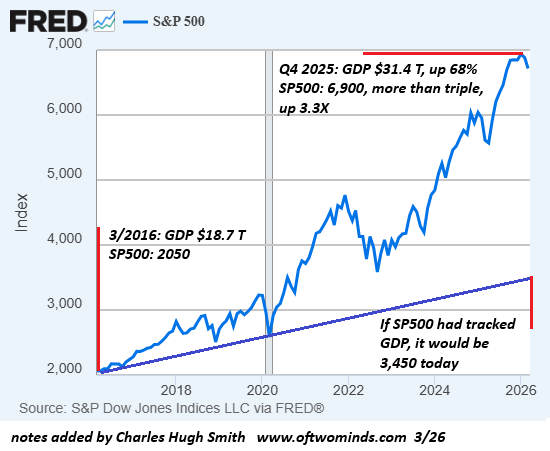
Here is a chart of the S&P 500 stock market index (SPX). Absent the injection of trillions in credit and the resulting credit-asset bubble, stocks would be expected to track the economy, i.e. GDP. If stocks had tracked GDP growth, the SPX would be roughly half its current lofty level: 3.450 rather than 6,800.
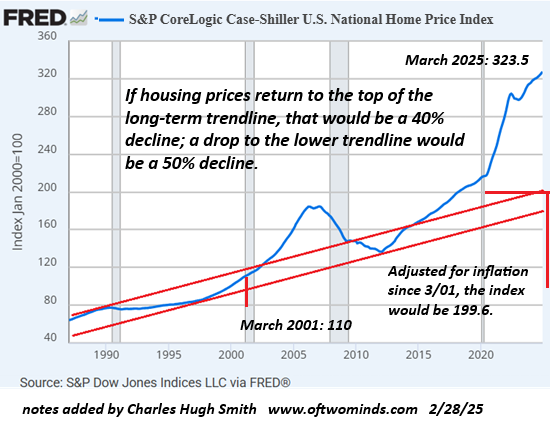
If housing had tracked inflation, it would be at valuations 40% lower than current valuations.
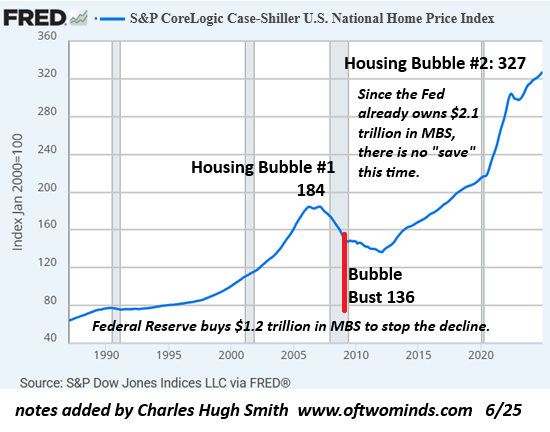
The Federal Reserve reversed the decline of valuations in Housing Bubble #1 by socializing the mortgage market, buying up $1+ trillion in mortgage backed securities (MBS). The Fed now owns over $2 trillion in MBS, so when Housing Bubble #2 (2020-2026) bursts, they won't be able to ride to the rescue. The asymmetries of scale will succumb to gravity.
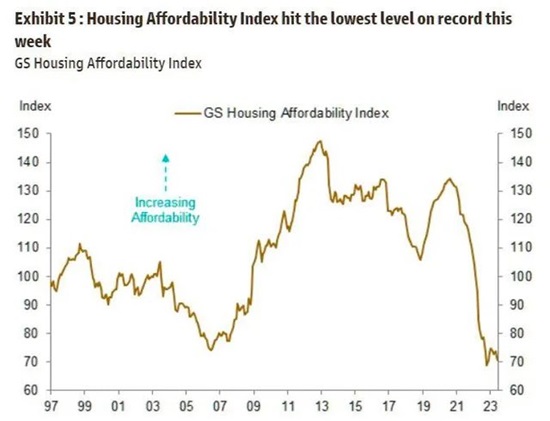
A funny thing happens on the way to the wealth effect: the already-rich get much richer, and everyone else is left behind in The Stockyard of Unaffordability. here is a chart of housing unaffordability.
The asymmetric scaling of credit has inflated The Everything Bubble that will burst with devastating
consequences for the real economy. What scales even faster than credit is risk-off fear.
Where does all this leave the rest of us? Two things to consider:
It's harder for bad things to happen when you have no debt.
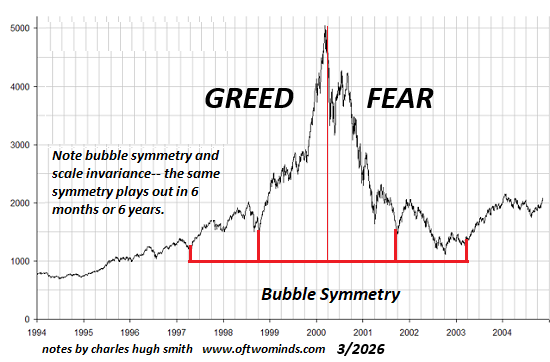
Greed is a wonderful motivator but fear works much faster.
New podcast: Current Waves and Cycles: Energy, Commodities, Inflation (38 min)
My new book Investing In Revolution is available at a 10% discount ($18 for the paperback, $24 for the hardcover and $8.95 for the ebook edition).
Introduction (free)
Check out my updated Books and Films.
Become
a $3/month patron of my work via patreon.com
Subscribe to my Substack for free
NOTE: Contributions/subscriptions are acknowledged in the order received. Your name and email
remain confidential and will not be given to any other individual, company or agency.
|
Thank you, William M. L. ($70), for your magnificently generous subscription
to this site -- I am greatly honored by your support and readership.
|
|
Thank you, JK ($32.40), for your marvelously generous subscription
to this site -- I am greatly honored by your support and readership.
|
|
Thank you, Steven G. ($7/month) for your superbly generous subscription
to this site -- I am greatly honored by your support and readership.
|
|
Thank you, Sunshine ($7/month) for your splendidly generous subscription
to this site -- I am greatly honored by your support and readership.
|