

Five Dynamics That Make Sense of an Increasingly Chaotic World
These dynamics and the incentives they generate lead to systemic crisis and collapse.
As I noted in
What Once Explained Everything Now Explains Nothing, the simplicity of either-or ideologies appeal to us. Identifying with an ideology is like having a favorite sports team: yea for our team! Our team good, other team bad.
The roots of this simplistic either-or are obvious: our tribe good, other tribe bad. The problems with this simplistic loyalty arise when we attempt to explain complex real-world dynamics with the comic-book simplicities of ideology, which extend from politics to culture to finance.
Rather than explain everything, they add a layer of mud rather than illuminate. The emotions of tribal / ideological identity and loyalty bypass our rational processes in favor of fight-or-flight limbic responses. Needless to say, these hormonal floods of emotions are the equivalent of smashing a rock on a machine to "problem-solve" what's broken in the device.
Fortunately, we have conceptual tools that bypass this smash-it-with-a-rock approach to making sense of a complex, increasingly chaotic world. These tools show up in all my work, stretching back 20 years.
1. The problem-solving power of self-organization. Humans are social animals because the ability to cooperate with others opens vast vistas of problem-solving power via self-organization: we self-organize to pursue mutual / shared interests in ways that benefit us all. This is the core function of tribes, i.e. self-organizing social structures in which our self-interest is advanced by advancing our mutual interests.
Both markets and society are self-organizing structures that arise to benefit individual self-interests by benefiting shared interests. In other words, both capitalist and socialist structures arise to serve shared interests. They are not either-or, they're both manifestations of the same dynamic. This is why the ideological either-or is such a misleading false choice.
Markets only function to everyone's benefit within a high-trust society. If there is no social structure that serves everyone's shared interests by limiting predation and exploitation, then you end up with the extractive "market forces" of totalitarianism, i.e. rackets, in which the few impoverish and immiserate the many to the exclusive benefit of the small cadre of insiders.
As I have taken pains to explain, private-sector totalitarianism is the "market" manifestation of totalitarianism, a privately owned version of political totalitarianism. The core dynamic is the same: the system exploits and immiserates the many to benefit the few.
When private equity snaps up the only manufacturers of fire engines and then jacks up prices without adding any value, this impoverishes and immiserates the many who must collectively pay more money for no added value to enrich the few who own / control the racket. There is no functional difference between a totalitarian state structure that enriches party insiders at the expense of the many and "markets" in which private equity enriches insiders at the expense of the many.
This leads to the second dynamic:
2. Diffusion and Concentration. Control--i.e. power--self-organizes around the dynamics of Diffusion and Concentration. Consider the power of a monopoly that can raise prices for all customers, customers who have no alternative because the monopoly controls the "market" / political structure. The gains of the price increases (value is unchanged but the cost rises) are concentrated in the hands of the monopoly's managers and owners while the impoverishment and immiseration is diffused across a vast spectrum of customers / taxpayers.
The incentives to raise prices is extremely high for insiders, as they will reap enormous personal gains. The incentives to resist a relatively small increase in price among the millions of customers / taxpayers is low, because life is already demanding, and what's the potential gain of fighting a losing battle against a powerful opponent over a small sum of money? The cost in time and effort is far more significant than the relatively modest financial benefit of winning the battle.
Diffusion and Concentration establish incentives which then organize the system. Consider a local government which sells bonds for a project that benefits only a small sector of the populace. The costs of this borrowing from future income to pay for benefits the few will enjoy today is spread not just over the entire current populace but over future taxpayers who weren't old enough to vote on the decisions they will pay for.
3. Benefits, Risks, Costs and Incentives. Those seeking to reduce their private risks and increase their private gains seek to concentrate the gains generated by control structures and distribute the risks and costs to others. Pull the strings that diffuse the costs and risks over a large populace and gather the gains into the hands of the insiders that manage the control structure, typically some form of monopoly, either public or private, or a fusion of public-private rackets.
So corporations that engage in blatantly illegal skimming and scamming face low risks--managers or owners are never imprisoned, and the fines paid when caught are modest compared to the profits skimmed--while the gains are extremely enticing. This diffusion of risk and concentration of potential gains establishes perverse incentives to increase extractive, exploitive, well-hidden rackets that impoverish and immiserate the many, but in doses small enough to avoid triggering push-back.
In a system that concentrates gains and diffuses risk, the "rational actor" seeks to maximize rackets that distribute impoverishment and immiseration to the many in small doses over time that attract little attention and are not significant enough to trigger an emotionally potent resistance. This leads to:
4. The Ratchet Effect. Costs ratchet up, value ratchets down, but in increments too small to change the risk-reward equation and over time so the pain of this impoverishment and immiseration is normalized as the populace herded into the corral habituates to the decay of value and the rise in costs.
So the parking ticket that once cost $15 is now $60, but exactly how does the individual citizen push back against the monopoly powers of the city government? Yes, the citizen can file a complaint with their representative, but the odds that this will lead to reduced parking fines is zero. The same is true should the citizen attend a public meeting and get 30 seconds to speak at the end of a long meeting when everyone just wants to go home.
Bureaucracies optimize The Ratchet Effect by their very nature. Regulators and administrators must "do something" to justify the high costs of their employment and benefits, and so they "serve the public" by incrementally adding to regulatory thickets that over time strip out self-organizing functionality and replace it with control structures that are impervious to reform.
Reformers seeking to reduce bureaucratic regulations and costs run into Diffusion and Concentration. Those whose jobs are threatened by cost-cutting are extremely motivated to spend every waking second resisting any cost-cutting, while those who stand to benefit--the citizens paying fines or business license fees--will only see a modest reduction in costs, too small to motivate them to self-organize in support of the reforms / cost cutting.
So these control structures, public and private, run on automatic, concentrating benefits in the hands of insiders and owners and distributing the risks and costs to the diffused many. The result is institutional sclerosis, and self-reinforcing resistance to any adaptation that benefits the many at the expense of the few insiders / managers / owners.

5. Semi-chaotic tests of the system's stability. Benoit Mandelbrot's book The (Mis)Behaviour of Markets: A Fractal View of Risk, Ruin and Reward explains how self-organizing structures such as markets--and by extension, all of life, which is also self-organizing--are prone to unpredictable cascades that operate outside the "normal, predictable" rules we've identified as "the way things work."
In terms of selective pressures and adaptation, these unpredictable crises test the system's adaptability and stability. In this way, they are essential to maintaining the adaptive "muscles" and coherence of the system which boil down to the dynamics of self-organization--precisely what all the control structures running on automatic have stripped out in the "rational actor" incentives to optimize concentrating gains and diffusing costs and risks.
These dynamics led to a rising wedge of asymmetric distributions of power, control, wealth and income that strip out self-organizing adaptation and the system's ability to survive unpredictable but inevitable crises. These dynamics and the incentives they generate lead to systemic crisis and collapse.

The only structures capable of re-organizing the post-collapse world are islands of coherence that managed to retain self-organizing capacities that escaped the control and predation of "rational actors" maximizing self-interest at the expense of the system's adaptive capacity and stability.
As noted above, these dynamics inform all my work. You can review all my books here.
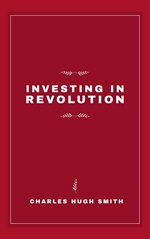
My book Investing In Revolution is available at a 10% discount ($18 for the paperback, $24 for the hardcover and $8.95 for the ebook edition).
Introduction (free)
Become
a $3/month patron of my work via patreon.com
Subscribe to my Substack for free
NOTE: Contributions/subscriptions are acknowledged in the order received. Your name and email remain confidential and will not be given to any other individual, company or agency.
|
Thank you, Rick C. ($7/month), for your marvelously generous subscription to this site -- I am greatly honored by your support and readership. |
Thank you, Paul C. ($200), for your beyond-outrageously generous subscription to this site -- I am greatly honored by your steadfast support and readership. |
|