






We Don't Need the World, We Only Need Money
The idea that modifying or replacing currency will solve problems of corrupted values, perverse incentives, destabilizing asymmetries of wealth and power and the civilizational psychosis of "growth of consumption and profits at any cost" is illusory.
An old friend summarized the mindset of much of the developed world wryly and succinctly: "We don't need the world, we only need money." In other words, we don't actually need real-world sources of life's essentials that are within our control or a functional biosphere because since we can buy everything we could possibly want or need with money. So, money is all we need.
We don't care where the stuff we want/need comes from because it will always come from somewhere and be available in whatever quantity and quality we desire, as somebody somewhere will keep our stores and fuel tanks fully stocked and our electrical grid powered 24/7.
This disconnect between the complex mechanics of real-world manufacturing, processing and transport--a world of physical materials reconfigured by productive work--is understandable in a consumer economy of transactions of money where all the work, all the materials and all the consequences are invisible to the consumer plugging in an appliance, fueling their car and buying an item off the shelf.
An economy that favors assets and financial speculation as the means to acquiring wealth is also disconnected from the role of productive work in this invisible world of production and supply chains.
These disconnects from the real world and productive work have created a make-believe mindset in which doing something with money is all we need to do to get rich and preserve our wealth. I call this make-believe world civilizational psychosis, a mindset detached from reality for it mischaracterizes the relationships of the material world, productive work and currency / money.
This make-believe world in which money is all that matters is not a sustainable society or economy.
In this make-believe world, shape-shifting money is the solution to all problems. Common sense and history both support the conclusion that a financial system that must borrow from the future and pay interest on that rising debt to fund the present is not sustainable and will be replaced with some other arrangement one way or another.
All the solutions being bandied about are money-based: stablecoins, gold-backed currencies, etc. The idea behind all of these proposals is that changing money will fix whatever's broken in a system that has lost touch with its material foundations and productive work.
This mindset explains the conventional conviction that all one has to do to live extremely well is navigate the coming collapse of the current money system (i.e. fiat currencies and credit) and emerge from the other side of the wormhole with wealth intact in some other form.
This mindset makes three implicit assumptions:
1. The real world will continue functioning perfectly despite the collapse of the current money system, ensuring fuel tanks are full, the electricity is on 24/7 and all the retail shelves are full of all the good things.
2. The majority who did not successfully navigate the collapse of the current money system and are now impoverished will passively accept their serfdom to the New Nobility who successfully emerged with wealth intact--or greatly increased (see #3).
3. Since the new form of money will be scarce--and this is the source of its value as a replacement currency--those who own it will accrue virtually all the "value" embedded in "money:" all those who held the old currency that's now worthless will have zero "money:" those who own the new form of money will own all the scarcity value of the new currency.
If history is any guide, the distribution of those who manage to convert all their "old" wealth into "new" wealth is highly asymmetric, as the vast majority lack the means to manage the conversion on a scale where the resulting wealth is consequential. In other words, the rich tend to manage the conversion and everyone else doesn't. So the rich get richer and everyone else is wiped out.
This has a corollary: since those who manage the conversion will emerge on the other side of the wormhole with wealth, "money" is no longer bound to work/labor: the wealthy have no need to generate value via work, they merely provide demand via spending their wealth.
None of these assumptions strike me as realistic, practical or desirable.
Let's examine what happens to supply chains when fiat currencies (the current form of money) crash in purchasing power (i.e. hyper-inflation or loss of trust in the currency) and the replacement currency is a gold-backed currency.
Those favoring gold-or-commodity backed currencies tend to forget that scale is a primary characteristic of "money" used in global transactions. If the gold-backed currency (or cryptocurrency) in circulation can only fund 10% of the current global volume of currency transactions--around $9 to $10 trillion dollars a day--and 90% of the new currency is locked in domestic accounts and unavailable for global transactions--then this new currency can only grease 1% of the current demand for global currency trading.
The global supply chain system crashes because there is not enough currency outside the issuing entity to grease the immense daily trade in currency for trade, debt, speculation, hedging, etc.
The whole point of a currency backed by a limited commodity is that it can't expand 10-fold overnight because that would reduce the purchasing power of the currency by the same factor.
In other words, a replacement currency must provide the same scale of not only currency in circulation but the same scale of liquidity available for global settlements of trade, debt, speculation and hedging--currently trillions of dollars per day. Anything less and the entire global trade / credit network freezes up.
Consider what happens to enterprises in supply chains who continued accepting now-worthless "old" currency. They're now bankrupt, so whatever chains they were links in are now broken. Those enterprises that prudently held off accepting any orders until the situation settled down have nothing in the pipeline, so whatever chains they were part of are also broken.
Those who decide to only accept some scarce monetary substitute are sitting on their hands, as they've been outbid by more desperate dealers / traders.
In summary, if the current "money" dissolves, global supply chains immediately dissolve, too, and expecting a relatively limited volume of replacement currency with a tiny float to ramp up 10-fold while retaining its scarcity value is delusional, as the entire point of scarcity value as the basis of a currency is destroyed if the issuance jumps up 10-fold to handle global trade needs while the quantity of the underlying commodity remains unchanged.
The real world breaks down immediately, and nobody will restock the shelves that are now bare, or refill the fuel tanks that are now empty, or restart the grid.
As for #2, the impoverished and those hanging onto "middle class status" by a thread had hope in the old system because the shelves were still full. Now that the old money has dissolved and the shelves are empty, they're not just impoverished, they have lost hope and are now angry. They are unlikely to view those who emerge from the wormhole wealthy favorably. They will likely view this as the penultimate form of unfairness and inequality and take action they reckon is appropriate, rebalancing the inequality by expropriation.
Telling them that they will now be able to turn their labor into real wealth down the road as serfs in a neofeudal arrangement is unlikely to persuade them that the New Nobility deserves its wealth and dominance.
As for the connection between the material world, productive work and money, there is no sustainable economy or society possible until these bonds are restored. The road to wealth must run through being productive in the material world rather than speculation. This has been lost in the current speculative mania and the associated civilizational psychosis that we "don't need the world, only need money" and the best way to acquire that money is speculating in assets and money. (I discuss the connections of money and work in my book Money and Work Unchained.)
In summary: the idea that modifying or replacing currency / money will solve problems of corrupted values, perverse incentives, destabilizing asymmetries of wealth and power and the civilizational psychosis of "growth of consumption and profits at any cost" is illusory. We would be wise to ponder changing far more about how we live than our monetary system, which is a manifestation of corrupted values, perverse incentives, destabilizing asymmetries and civilizational psychosis rather than their source.
Reorganizing the monetary system to serve a sustainable social order is certainly part of the overall set of solutions, but that alone is not enough to fix what's broken at deeper levels than what we use as money.
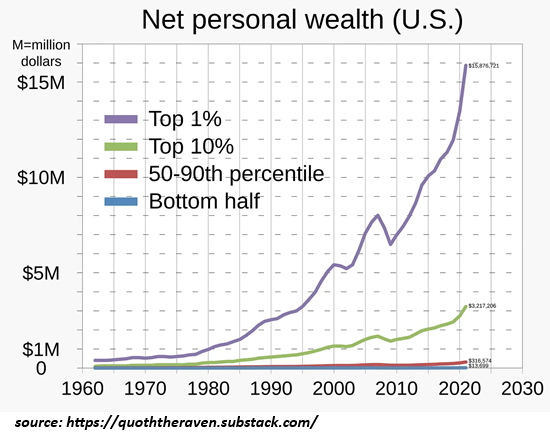
Charts of interest: wealth of the top 0.1%:
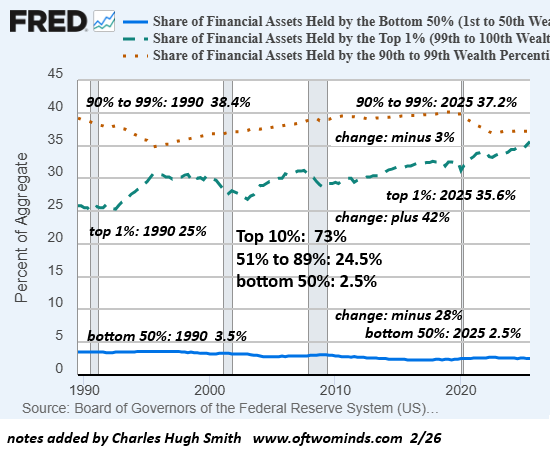
Percentage of financial assets held by the top 1%--up 42% since 1990: financial assets held by the bottom 50%, down 28%.
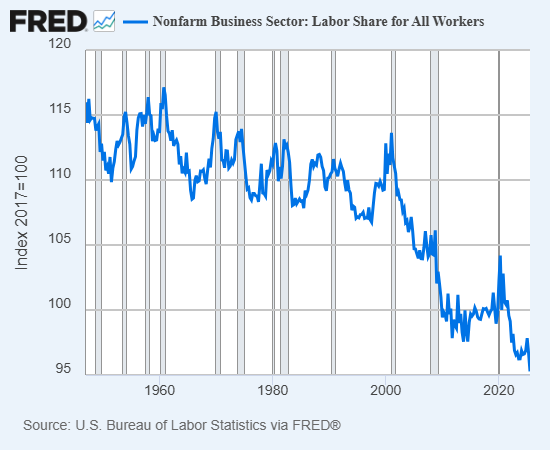
Labor's share of the economy: all-time lows:
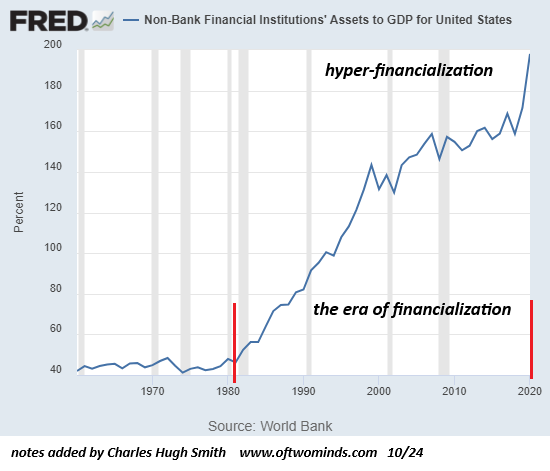
Non-bank assets: hyper-financialization:
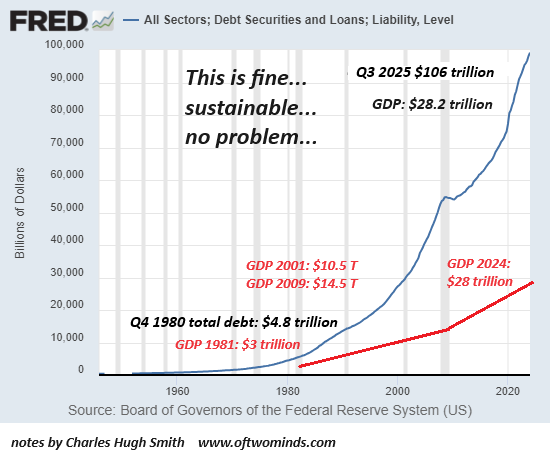
TCMDO: total credit:
My book Investing In Revolution is available at a 10% discount ($18 for the paperback, $24 for the hardcover and $8.95 for the ebook edition).
Introduction (free)
Become
a $3/month patron of my work via patreon.com
Subscribe to my Substack for free
NOTE: Contributions/subscriptions are acknowledged in the order received. Your name and email remain confidential and will not be given to any other individual, company or agency.
|
Thank you, David M. ($75), for your marvelously generous subscription to this site -- I am greatly honored by your support and readership. |
Thank you, Julie W. ($3/month), for your wondrously generous subscription to this site -- I am greatly honored by your support and readership. |
|