Thursday, April 02, 2015

The Inevitable Failure of Mechanistic Monetary Policy

Our current faith in central banks' ability to "make the economy all better, all the time" is horrendously misplaced.


We are living in the Cargo Cult Era of Central Bankers. The era began in earnest on December 5, 1996, when Federal Reserve chairman Alan Greenspan cautiously wondered aloud if the stock market was exhibiting "irrational exuberance."

The stock market promptly tanked. In this era, the utterances of central bankers exert more influence over markets than fundamentals.

This simplistic faith in the Cargo Cult magic of central banks is based on the absurd notion that two levers--interest rates and buying debt--can control and guide an immensely complex economy. Central bankers are well-versed in arcane incantations such as Operation Twist and aggregate demand, but if we strip away the mumbo-jumbo we find only two levers: interest rates and the purchase of debt.

Documentary film maker Adam Curtis explored the inherent limits of mechanistic monetary models in Episode 3 of his 6-part series, Pandora's Box (1992).

The wizards of monetary policy make the implicit assumption that monetary policy is the most important factor in an economy's expansion or contraction. But an economy is far more than interest rates, inflation and the purchase of bonds and other assets.

An economy is also the education or mis-education of the next generation of workers, the creative destruction wrought by technologies, the cultural appetite for risk and what I call the infrastructure of opportunity--the complex mix of attributes that either encourage social mobility or preclude it.

Two analogies will help us understand the absurdly simplistic myth of central bank magic. One is the forest fire analogy I discussed in The Yellowstone Analogy and The Crisis of Neoliberal Capitalism (May 18, 2009).

In essence, central banks no longer allow the "fires" of debt writedowns and credit contraction (i.e. recession) to burn away the dead wood that piles up after rapid expansion/good times/ leverage. As a result, the dead wood piles up higher and higher every season, until a chance spark (the infamous Black Swan) ignites the dry tinder and the subsequent conflagration burns down the entire forest.

The second analog is health-related.A fellow in very poor health goes to the clinic for a blood pressure test. He is overweight, dangerously unfit, smokes a pack a day and self-medicates himself with daily overdoses of alcohol. As a result of his disastrously poor health, is blood pressure is through the roof.

In our analogy, the stock market is the blood pressure reading. Markets (stocks, bonds, commodities, real estate, debt, risk, etc.) reflect the realities "discovered" by the interplay of buyers, sellers and information such as profits, debt levels, sales, etc.

Rather than address the underlying causes of the patient's poor health, the doctor (central bank) gives the guy two powerful drugs to slam down his blood pressure reading. This is the equivalent of central banks juicing markets with quantitative easing and zero-interest rates (ZIRP).

Is the guy healthier as a result of the massive injections of drugs? At least temporarily, his chances of dying are reduced by the drop in blood pressure. But over the longer term, this doctoring of one reading of health (i.e. the stock market) is not going to reverse the intensely negative consequences of poor diet, zero fitness, smoking and over-consumption of alcohol.

Our current faith in central banks' ability to "make the economy all better, all the time" is horrendously misplaced. Mechanistic monetary models are fine for manipulating a simplistic measure of economic health, but they are completely inadequate to the task of restoring fundamental health to a very sick patient teetering on the abyss.

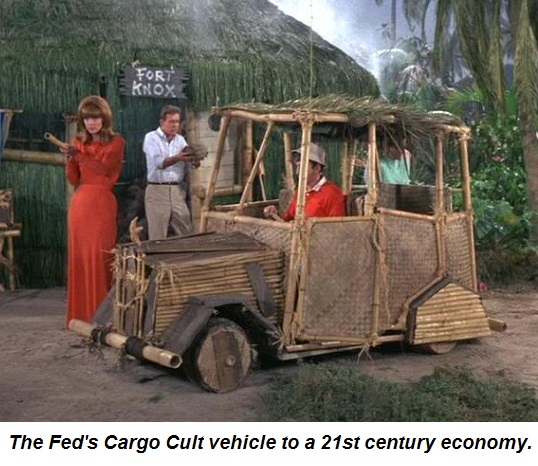
Bonus analogy: here's the Fed's Cargo Cult vehicle to a 21st century economy:


Get a Job, Build a Real Career and Defy a Bewildering Economy(Kindle, $9.95)(print, $20)
go to Kindle edition
Are you like me? Ever since my first summer job decades ago, I've been chasing financial security. Not win-the-lottery, Bill Gates riches (although it would be nice!), but simply a feeling of financial control. I want my financial worries to if not disappear at least be manageable and comprehensible.

And like most of you, the way I've moved toward my goal has always hinged not just on having a job but a career.

You don't have to be a financial blogger to know that "having a job" and "having a career" do not mean the same thing today as they did when I first started swinging a hammer for a paycheck.

Even the basic concept "getting a job" has changed so radically that jobs--getting and keeping them, and the perceived lack of them--is the number one financial topic among friends, family and for that matter, complete strangers.

So I sat down and wrote this book: Get a Job, Build a Real Career and Defy a Bewildering Economy.

It details everything I've verified about employment and the economy, and lays out an action plan to get you employed.

I am proud of this book. It is the culmination of both my practical work experiences and my financial analysis, and it is a useful, practical, and clarifying read.

Test drive the first section and see for yourself.     Kindle, $9.95     print, $20

"I want to thank you for creating your book Get a Job, Build a Real Career and Defy a Bewildering Economy. It is rare to find a person with a mind like yours, who can take a holistic systems view of things without being captured by specific perspectives or agendas. Your contribution to humanity is much appreciated."
Laura Y.

Gordon Long and I discuss The New Nature of Work: Jobs, Occupations & Careers(25 minutes, YouTube) 


NOTE: Contributions/subscriptions are acknowledged in the order received. Your name and email remain confidential and will not be given to any other individual, company or agency.

Thank you, Michael K. ($5/month), for your splendidly generous subscription to this site-- I am greatly honored by your support and readership.

Read more...

The U.S. Economy Slows to Stall Speed

This long-term weakening of the economy is the direct result of financialization and the Federal Reserve's policy of propping up impaired debt with more debt and constantly bringing demand forward with zero interest rates.

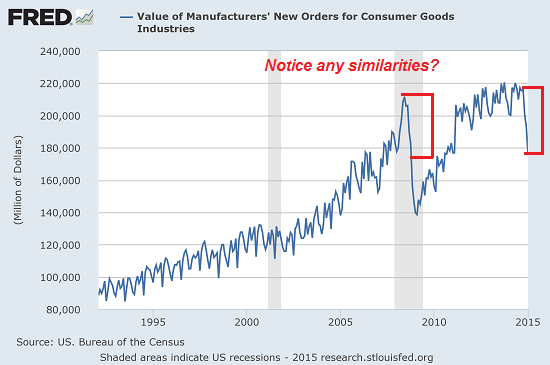
The U.S. economy is slowing to stall speed--the point when gravity overcomes the lift provided by central bank free money. This deceleration is evident in a number of indicators such as gross domestic product (GDP), which is now at 0% according to the Federal Reserve Bank of Atlanta's GDPNow model.

New orders for consumer goods has fallen off a cliff, eerily repeating the freefall of the Great Recession in 2008:


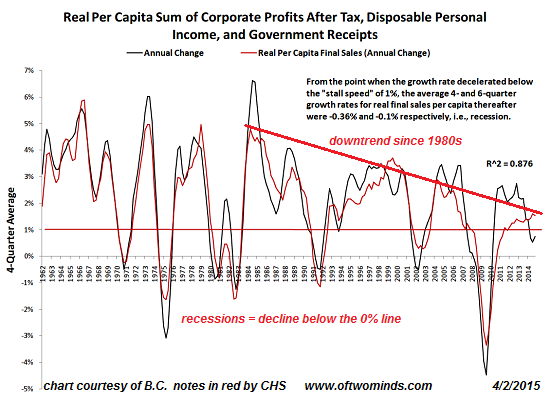
Longtime correspondent B.C. shared two more insightful charts of the economy's deceleration to stall speed. Rather than depict one or two indicators, B.C.'s charts are relational, meaning that data is added together or displayed as ratios.

The first chart shows per capita corporate profits + disposable personal income + government receipts and real final sales. As B.C. notes on the chart: "From the point when the growth rate decelerated below the 'stall speed' of 1% , the average 4- and 6-quarter growth rates for real final sales per capita thereafter were -0.36% and -0.1% respectively, i.e. recession."

I added two notes to the chart: growth rates in both series have been deteriorating since the early 1980s, when financialization began substituting leverage and debt for real growth in the real economy.

Every dip below the zero line aligns with a recession. Once the lines dip below the 1% stall speed line, a negative growth rate follows.


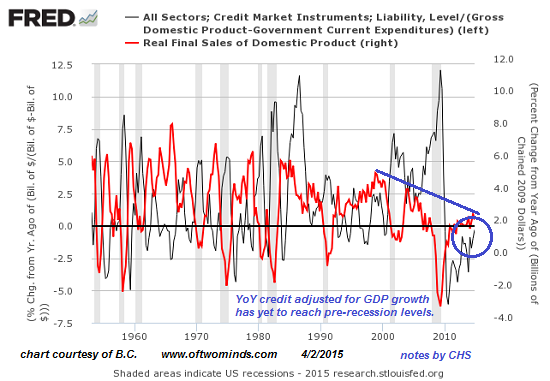
The second chart displays the credit market in a ratio with GDP (minus government expenditures, leaving only the private-sector economy) and real final sales ("real" meaning adjusted for inflation).

Adjusted for GDP growth, the credit market growth has yet to reach pre-Great Recession levels. This reflects debt saturation--adding debt no longer generates much expansion in the economy.

The growth rate of real final sales have been declining since the early 1980s, with each peak and each trough being lower than the previous peaks and troughs. The growth rate in the current recovery has barely edged over the stall speed of 0% and is now rolling over.


B.C. added this commentary on the two charts: The primary inference is that the real, after-tax income component of real GDP decelerated to "stall speed" and then a recessionary rate in Q3-Q4 '14.

With the increase in the US$, net exports will be a drag, even with the collapse in oil imports as a result of the shale oil boom/bubble. That leaves . . . an expansion of the fiscal deficit, all else equal, to prevent recession, or a contraction of nominal GDP with the marked deceleration of CPI and the GDP deflator.

Because we don't have net savings, the Fed will have to resume printing bank reserves for Too Big to Exist (TBTE) banks to resume buying federal bond issuances ("monetization") at some point later this year.

This long-term weakening of the economy is the direct result of financialization and the Federal Reserve's policy of propping up impaired debt with more debt and constantly bringing demand forward with zero interest rates. 


Get a Job, Build a Real Career and Defy a Bewildering Economy(Kindle, $9.95)(print, $20)
go to Kindle edition
Are you like me? Ever since my first summer job decades ago, I've been chasing financial security. Not win-the-lottery, Bill Gates riches (although it would be nice!), but simply a feeling of financial control. I want my financial worries to if not disappear at least be manageable and comprehensible.

And like most of you, the way I've moved toward my goal has always hinged not just on having a job but a career.

You don't have to be a financial blogger to know that "having a job" and "having a career" do not mean the same thing today as they did when I first started swinging a hammer for a paycheck.

Even the basic concept "getting a job" has changed so radically that jobs--getting and keeping them, and the perceived lack of them--is the number one financial topic among friends, family and for that matter, complete strangers.

So I sat down and wrote this book: Get a Job, Build a Real Career and Defy a Bewildering Economy.

It details everything I've verified about employment and the economy, and lays out an action plan to get you employed.

I am proud of this book. It is the culmination of both my practical work experiences and my financial analysis, and it is a useful, practical, and clarifying read.

Test drive the first section and see for yourself.     Kindle, $9.95     print, $20

"I want to thank you for creating your book Get a Job, Build a Real Career and Defy a Bewildering Economy. It is rare to find a person with a mind like yours, who can take a holistic systems view of things without being captured by specific perspectives or agendas. Your contribution to humanity is much appreciated."
Laura Y.

Gordon Long and I discuss The New Nature of Work: Jobs, Occupations & Careers(25 minutes, YouTube) 


NOTE: Contributions/subscriptions are acknowledged in the order received. Your name and email remain confidential and will not be given to any other individual, company or agency.


 Thank you, Melissa C. ($5/month), for your fabulously generous subscription to this site-- I am greatly honored by your support and readership.

Read more...

Wednesday, April 01, 2015

A Shocking Admission: "The Federal Reserve is a Criminal Conspiracy"

A spokesperson assured the assembled media that the Fed Board was "deeply concerned" about the American people, inflation, and the unemployment rate, but he was heckled off the stage.


In an extraordinary admission, the Board of Governors of the Federal Reserve conceded that the Federal Reserve is "at heart a criminal conspiracy of bankers."The Board followed up this revelation with a breezy confession that the Fed "doesn't really give a rat's rear-end about the American people, and we're tired of having to claim we do."

The Fed's role was global, the Board explained; the American people played no part whatsoever in Fed policy or decisions. "Honestly, why would anyone think we waste a moment's thought on the American people?" one commented. "We're here to maintain the power and wealth of the banking sector on a global scale. We have zero interest in John Q. Citizen's travails or his income. Our only interest in Mr. Citizen is that he continue to keep his mouth shut and not make waves."

The unprecedented display of bare-knuckled honesty was in evidence throughout the meeting. Asked if the Fed was confident that its policies were appropriate for the nation, one board member snapped, "We don't really think about the nation, but yes, we are 99% confident that our policies are appropriate and correct. In fact, let's dispense with the false modesty: we're 100% confident we are correct."

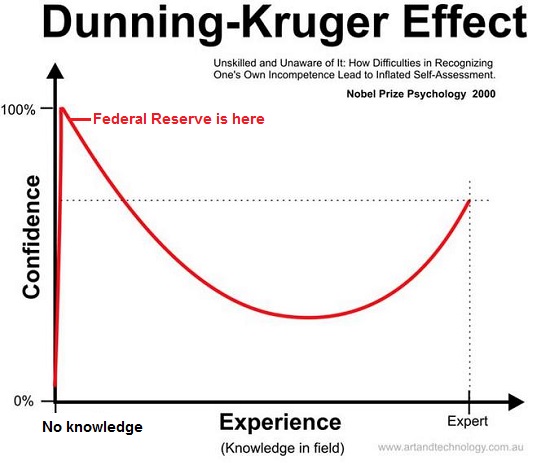
When a reporter asked if the Board was familiar with the Dunning–Kruger effect, a Board member snapped, "We don't concern ourselves with rare neurological diseases, or whatever that is. We govern the markets and the global economy."


The Dunning–Kruger effect is a cognitive bias wherein unskilled individuals suffer from illusory superiority, mistakenly assessing their ability to be much higher than is accurate.

"If you’re incompetent, you can’t know you’re incompetent. […] the skills you need to produce a right answer are exactly the skills you need to recognize what a right answer is." David Dunning

Rumors quickly spread that the Fed's water supply had been spiked with Ibogaine, which could explain the extraordinary public outburst of truthfulness. As handlers moved in to escort the Board members to their private chambers, some of the Board responded testily. One was heard to mutter, "Keep your grubby little paws off me, peon!"

A spokesperson assured the assembled media that the Fed Board was "deeply concerned" about the American people, inflation, and the unemployment rate, but he was heckled off the stage.

This is our annual April Fool's Day entry. 


Get a Job, Build a Real Career and Defy a Bewildering Economy(Kindle, $9.95)(print, $20)
go to Kindle edition
Are you like me? Ever since my first summer job decades ago, I've been chasing financial security. Not win-the-lottery, Bill Gates riches (although it would be nice!), but simply a feeling of financial control. I want my financial worries to if not disappear at least be manageable and comprehensible.  

And like most of you, the way I've moved toward my goal has always hinged not just on having a job but a career.

You don't have to be a financial blogger to know that "having a job" and "having a career" do not mean the same thing today as they did when I first started swinging a hammer for a paycheck.

Even the basic concept "getting a job" has changed so radically that jobs--getting and keeping them, and the perceived lack of them--is the number one financial topic among friends, family and for that matter, complete strangers.

So I sat down and wrote this book: Get a Job, Build a Real Career and Defy a Bewildering Economy.

It details everything I've verified about employment and the economy, and lays out an action plan to get you employed.

I am proud of this book. It is the culmination of both my practical work experiences and my financial analysis, and it is a useful, practical, and clarifying read.

Test drive the first section and see for yourself.     Kindle, $9.95     print, $20

"I want to thank you for creating your book Get a Job, Build a Real Career and Defy a Bewildering Economy. It is rare to find a person with a mind like yours, who can take a holistic systems view of things without being captured by specific perspectives or agendas. Your contribution to humanity is much appreciated."
Laura Y.

Gordon Long and I discuss The New Nature of Work: Jobs, Occupations & Careers(25 minutes, YouTube) 


NOTE: Contributions/subscriptions are acknowledged in the order received. Your name and email remain confidential and will not be given to any other individual, company or agency.


 Thank you, Scott B. ($5/month), for your wondrously generous subscription to this site-- I am greatly honored by your support and readership.

Read more...

Monday, March 30, 2015

The Fed Has Failed the Nation, in One Chart

There is only one way to end the financial tyranny of the Federal Reserve--abolish it, and put an end to the predatory pathologies of its policies.


The Federal Reserve has failed not just the nation and the U.S. economy, but more importantly, the American people that it supposedly serves. It has also failed the world, by showing other central banks that they can reward private banks and the top .01% with absolute impunity.


The supposed goal of the Fed's zero-interest rate policy (ZIRP) and quantitative easing (QE) was to make borrowing easier for both corporations and consumers, the idea being companies would borrow to invest in new productive capacity and consumers would buy the new goods and services being produced with cheap credit.

The secondary publicly stated goal was to spark a rally in stocks, bonds and real estate that would spark a wealth effect: as households saw their net worth rise, they would feel wealthier and thus more likely to buy goods and services they didn't need on credit.

The real reason for ZIRP and QE was to rebuild the balance sheets and profits of banks on the backs of savers who have earned near-zero thanks to the Fed's manipulation of markets. But setting aside the obvious success of the Fed's real goals--enriching the banks and the super-wealthy who have access to near-zero interest credit--let's see what corporations did with the Fed's nearly-free money.

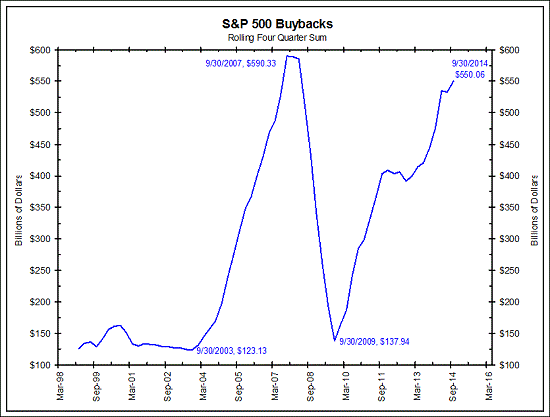
Did they invest in new productive capacity? No, they bought back their own stocks--trillions of dollars worth, to boost stock prices and managerial bonuses. Note what happened when the last stock buyback binge faded: stocks crashed.


The Fed's free money for financiers enriched the top layer of corporate management and the top 1% who own most of the nation's equities. You can read the details here: Factset Buyback Quarterly.


Chart source: Jim Bianco, Bianco Research, LLC, November 2014

The other group of financiers with access to the Fed's free money for financiers has been private equity. So did the private equity multi-millionaires borrow the Fed's largesse to build new plant and hire new employees? Did they invest the borrowed billions in productive startups?

No--they used the money to buy existing companies and bleed them dry. The Glory Days of Private Equity Are Over (Via Mark G.):

Private equity has been holding back the economy. When you buy out a drugstore chain or car-rental company and load it with debt, you aren’t investing in the productivity of the economy. More often, by cutting back on new products and services, you are removing productivity from the economy. While generating wealth for endowments and pension funds, private equity can destroy wealth in the economy—my guess is 0.5%-1% lower gross domestic product in an already subpar recovery.

There you have it: the Fed has lowered productivity and GDP and stripmined savers, widows and orphans to further enrich the obscenely wealthy. Recall this from my entry last week, Will Cash Always Be Trash, Or Will It One Day Be King?

Between 2009 and 2012, the first years of the economic recovery, the top 1% saw their incomes climb 31.4% — or, 95% of the total gain — while the bottom 99% saw growth of 0.4%.

There is only one way to end the financial tyranny of the Federal Reserve--abolish it, and put an end to the predatory pathologies of its policies. 


Get a Job, Build a Real Career and Defy a Bewildering Economy(Kindle, $9.95)(print, $20)
go to Kindle edition
Are you like me? Ever since my first summer job decades ago, I've been chasing financial security. Not win-the-lottery, Bill Gates riches (although it would be nice!), but simply a feeling of financial control. I want my financial worries to if not disappear at least be manageable and comprehensible.  

And like most of you, the way I've moved toward my goal has always hinged not just on having a job but a career.

You don't have to be a financial blogger to know that "having a job" and "having a career" do not mean the same thing today as they did when I first started swinging a hammer for a paycheck.

Even the basic concept "getting a job" has changed so radically that jobs--getting and keeping them, and the perceived lack of them--is the number one financial topic among friends, family and for that matter, complete strangers.

So I sat down and wrote this book: Get a Job, Build a Real Career and Defy a Bewildering Economy.

It details everything I've verified about employment and the economy, and lays out an action plan to get you employed.

I am proud of this book. It is the culmination of both my practical work experiences and my financial analysis, and it is a useful, practical, and clarifying read.

Test drive the first section and see for yourself.     Kindle, $9.95     print, $20

"I want to thank you for creating your book Get a Job, Build a Real Career and Defy a Bewildering Economy. It is rare to find a person with a mind like yours, who can take a holistic systems view of things without being captured by specific perspectives or agendas. Your contribution to humanity is much appreciated."
Laura Y.

Gordon Long and I discuss The New Nature of Work: Jobs, Occupations & Careers(25 minutes, YouTube) 


NOTE: Contributions/subscriptions are acknowledged in the order received. Your name and email remain confidential and will not be given to any other individual, company or agency.


Thank you, Luther A. ($10/month), for your outrageously generous subscription to this site-- I am greatly honored by your support and readership.

Read more...

Sunday, March 29, 2015

How Many Slots Are Open in the Upper Middle Class? Not As Many As You Might Think

Not only are there not that many slots in the upper middle class, the number of open slots is considerably lower.


If America is the Land of Opportunity, why are so many parents worried that their princeling/princess might not get into the "right" pre-school, i.e. the first rung on the ladder to the Ivy League-issued "ticket to the upper middle class"? The obsessive focus on getting your kids into the "right" pre-school, kindergarten and prep school to grease the path to the Ivy League suggests there aren't as many slots open as we're led to believe.

Let's set aside the endless debate over what qualifies a household to be "middle class." Most people define themselves as middle class, with little regard for their income. Let's cut to the chase and ask: how many young people aspire to joining this ill-defined middle class? Does this mean a rising standard of living and security? Not any more.

If you want those things, you must aspire to join the upper middle class.

So the more fruitful question is: what qualifies as upper-middle class?Here's a handy line in the sand: Stanford University covers the tuition for all incoming undergraduates whose household income is less than $125,000.

According to the U.S. Census Bureau data (here displayed on Wikipedia), $125,000 is right about the 85% line--only the top 15% households make $125,000 and up annually:Household income in the United States.

For context, median household income in the U.S. is around $52,000 annually.

A few years ago, I calculated What Does It Take To Be Middle Class? (December 5, 2013) and came up with an absolute minimum of $111,000 for two self-employed wage earners, as this includes the cost of healthcare insurance and the employer's share of Social Security and Medicare taxes. This was bare-bones.

Since employees of the government or Corporate America receive healthcare and retirement benefits (matching contributions to employee 401K plans, etc.), these can be subtracted from the $111,000. But this didn't allow for vacations or any of the finer things in life, so if we are talking about a truly comfortable household income, around $105,000 for state/corporate employed people sounds right and $125,000 for self-employed people is more or less the minimum required.

(Obviously, money goes further in the Midwest and not very far on the Left and Right coasts.)

Stanford's cutoff of $125,000 isn't as outlandish as it might seem at first glance.See where your household income fits in the spectrum with this online tool: What Is Your U.S. Income Percentile Ranking? (This confirms that an income of $125,000 puts the household in the top 15%.)
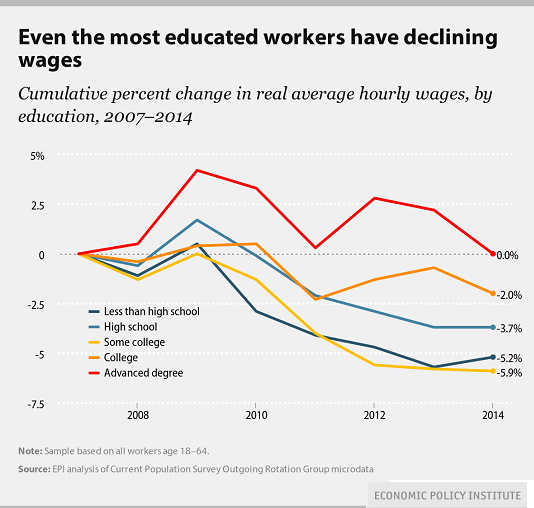
Meanwhile, wages for every category of worker, from the highly educated to the high school graduate, have been declining:


How many slots are there in this upper middle class? A household income of $190,000 is in the top 5% nationally. According to the Social Security Administration data for 2013 (the latest data available), Wage Statistics for 2013, individuals who earn $125,000 or more are in the top 5% of all earners. Two such workers would earn $250,00 together. The 2.8 million households with incomes of $250,000 or more are in the top 2.5%. If we define the top few percent as upper middle class, then who qualifies as wealthy? Only the top 1%?

I think it is reasonable to define the 10% of households earning between $125,000 (top 15%) and $190,000 (top 5%) as upper middle class. This is around 12 million households, out of a total of 121 million households.

Most of those jobs are already held by people with years of experience and abundant social and human capital. Yes, there are plenty of wastrels living off trust funds and free-riders doing as little as possible in their guaranteed government jobs, but by and large the people earning these incomes are working hard and will do whatever it takes to maintain their current incomes for the sake of their kids and their own security.

This explains the frantic drive to be one of the 2,100 students accepted by Stanford out of 42,000 applicants. These low admission numbers reflect the admission realities in the upper crust of Ivy league universities, both public and private.

The assumption is the few open slots in the upper middle class (or dare we hope, the 1%) will disproportionately go to those who have the credentials that signal they have the social breeding and brains to fit the corporate culture and they're willing to work hard and make their bosses lots of money.

Meanwhile, the top 5% of households in San Francisco earn a whopping $423,000 annually. (brookings.edu)

This is enough to put those households in the top 1% of California residents, roughly $433,000 annually: 10 States Where You Need The Most Money to Be In the 1 Percent

If you're curious what jobs those living in top 1% households have, check out this chart: Explore the occupations and industries of the nation's wealthiest households (NY Times).

4,575 writers (out of 92,000 nationally) are in top 1% households. Where do I sign up? Another 10,134 writers in "other industries" (out of 465,000 people claiming this employment category) are also in top 1% households. 15,000 retail clerks also live in top 1% households.

Perhaps the trick is not to make a lot of money writing or selling accessories, but to marry a top-level attorney, doctor, business owner, dot-com millionaire, lobbyist or trust funder?

(You can look up what qualifies as a 1% household income in this link, which has a chart of all 50 states and Washington D.C.)

Not only are there not that many slots in the upper middle class, the number of open slots is considerably lower. No wonder so many parents are desperate for an insider's pathway for their offspring. 


Get a Job, Build a Real Career and Defy a Bewildering Economy(Kindle, $9.95)(print, $20)
go to Kindle editionAre you like me? Ever since my first summer job decades ago, I've been chasing financial security. Not win-the-lottery, Bill Gates riches (although it would be nice!), but simply a feeling of financial control. I want my financial worries to if not disappear at least be manageable and comprehensible.  And like most of you, the way I've moved toward my goal has always hinged not just on having a job but a career.

You don't have to be a financial blogger to know that "having a job" and "having a career" do not mean the same thing today as they did when I first started swinging a hammer for a paycheck.

Even the basic concept "getting a job" has changed so radically that jobs--getting and keeping them, and the perceived lack of them--is the number one financial topic among friends, family and for that matter, complete strangers.

So I sat down and wrote this book: Get a Job, Build a Real Career and Defy a Bewildering Economy.

It details everything I've verified about employment and the economy, and lays out an action plan to get you employed.

I am proud of this book. It is the culmination of both my practical work experiences and my financial analysis, and it is a useful, practical, and clarifying read.

Test drive the first section and see for yourself.     Kindle, $9.95     print, $20

"I want to thank you for creating your book Get a Job, Build a Real Career and Defy a Bewildering Economy. It is rare to find a person with a mind like yours, who can take a holistic systems view of things without being captured by specific perspectives or agendas. Your contribution to humanity is much appreciated."
Laura Y.

Gordon Long and I discuss The New Nature of Work: Jobs, Occupations & Careers(25 minutes, YouTube) 


NOTE: Contributions/subscriptions are acknowledged in the order received. Your name and email remain confidential and will not be given to any other individual, company or agency.

Thank you, Elston Exhaust ($100), for your outrageously contribution to this site-- I am greatly honored by your steadfast support and readership.

Read more...

Terms of Service

All content on this blog is provided by Trewe LLC for informational purposes only. The owner of this blog makes no representations as to the accuracy or completeness of any information on this site or found by following any link on this site. The owner will not be liable for any errors or omissions in this information nor for the availability of this information. The owner will not be liable for any losses, injuries, or damages from the display or use of this information. These terms and conditions of use are subject to change at anytime and without notice.

RE: European Union AI Act, and Our Use of Generative AI Tools and Agents Policy

All text on this site is composed by Charles Hugh Smith or by a credited guest-author. No Generative AI Tools are used in the composition / writing of any text or graphic content created by Charles Hugh Smith. This site deploys no AI agents or generative AI tools. This site is not responsible for the disclosures, use or non-use of AI agents or generative AI tools in advertisements displayed by Investing Channel or other ad placement services.

Audio files generated by text-to-audio transcription tools are identified as such.

Our Privacy Policy:

Correspondents' email is strictly confidential. This site does not collect digital data from visitors or distribute cookies. Advertisements served by third-party advertising networks such as Investing Channel may use cookies or collect information from visitors for the purpose of Interest-Based Advertising; if you wish to opt out of Interest-Based Advertising, please go to Opt out of interest-based advertising (The Network Advertising Initiative) If you have other privacy concerns relating to advertisements, please contact advertisers directly.

PRIVACY NOTICE FOR EEA INDIVIDUALS

This section covers disclosures on the General Data Protection Regulation (GDPR) for users residing within EEA only. GDPR replaces the existing Directive 95/46/ec, and aims at harmonizing data protection laws in the EU that are fit for purpose in the digital age. The primary objective of the GDPR is to give citizens back control of their personal data. Please follow the link below to access InvestingChannel's General Data Protection Notice.
https://stg.media.investingchannel.com/gdpr-notice/

Notice of Compliance with The California Consumer Protection Act

This site does not collect digital data from visitors or distribute cookies. Advertisements served by a third-party advertising network (Investing Channel) may use cookies or collect information from visitors for the purpose of Interest-Based Advertising. If you do not want any personal information that may be collected by third-party advertising to be sold, please follow the instructions on this page: Do Not Sell My Personal Information.

Regarding Cookies:

This site does not collect digital data from visitors or distribute cookies. Advertisements served by third-party advertising networks such as Investing Channel may use cookies or collect information from visitors for the purpose of Interest-Based Advertising; if you wish to opt out of Interest-Based Advertising, please go to Opt out of interest-based advertising (The Network Advertising Initiative) If you have other privacy concerns relating to advertisements, please contact advertisers directly.

Our Commission Policy:

Though I earn a small commission on Amazon.com books and gift certificates and gold (BullionVault) purchased via links on my site, I receive no fees or compensation for any other non-advertising links or content posted on my site.

Copyright Notice:

All original images (Drawings and Photographs), text (essays, books and works of fiction), audio and video recordings, musical compositions, graphic design, graphic design elements and HTML coding on this site are the copyrighted work of Charles Hugh Smith unless otherwise credited or noted. They are published as information for the private use of site visitors, and any reproduction or redistribution of this content or coding in any media in any format or distribution channel (text, audio, video/film, web) without the written permission of the copyright holder is strictly prohibited. All rights in all media reserved globally.

  © Blogger templates Newspaper III by Ourblogtemplates.com 2008

Back to TOP