



Monday, January 07, 2019

2019: Fragmented, Unevenly Distributed, Asymmetric, Opaque

Add up Fragmented, Unevenly Distributed, Asymmetric and Opaque and you get a world spinning out of centralized control.
Here are the key dynamics of 2019: fragmented, unevenly distributed, asymmetric, opaque. Want to know what's happening with inflation, deflation, recession, populism, etc.?
It depends on what you own, when you own it, where you own it and its relative scarcity and stability--assuming you have trustworthy information on its scarcity and stability.
By ownership I mean all forms of capital: cash, tools, skills, social capital, trust in institutions, etc. Whatever forms of capital you own, the returns on that capital and its relative stability depend on the specifics of context and timing.
Will there be deflation or inflation? The right question is: Will there be deflation or inflation in my household?. In a rapidly fragmenting economy and society characterized by opacity, asymmetric information and unevenly distributed results, generalizations are intrinsically misleading / false. The only possible answers arise in a carefully limited context: my household, my neighborhood, my industry, my company, etc.
Here's an example I've mentioned in the past: healthcare costs. If you're one of the lucky households with heavily subsidized healthcare costs (for example, a government employee with limited deductibles, low per-visit costs and modest co-pays), your healthcare inflation is likely negligible.
But if your household doesn't qualify for subsidies and has to pay market rates, you're very likely to suffer double-digit healthcare inflation.
2019 is the year that central banks and states lose control of the narratives, the economy and the social contract, all of which are dynamic complex systems which excel in producing banquets of unintended consequences.
Control of the narrative requires harvesting "the right data" and spinning an interpretation that supports the status quo. How can anyone outside the central state / organs of propaganda know if the "raw data" has been massaged into the "right data"? The process is opaque, invisible to outsiders, and insiders are threatened with ruin should they make what is purposefully opaque visible to all.
The very desperation of the Powers That Be to label every skeptical inquiry or counter interpretation "fake news" speaks volumes: people understand the information is asymmetric: we're only told what supports the status quo. The loss of trust in "official news" is the only possible rational response to opacity and asymmetry.
Economic fragmentation is a core dynamic: established industries are marginalized by global finance and commoditization (see Commoditization = Deflation 1/4/19) while tech newcomers dominate stock markets and generate unevenly distributed returns for insiders and owners. Winners and losers are fragmented as well; whether you're a winner or loser depends on the specifics of your context: what you own, when you own it, where you own it and its relative scarcity and stability.
Then there's the rising social fragmentation as people seek tribal connections to counter their growing sense of insecurity and instability. Add up Fragmented, Unevenly Distributed, Asymmetric and Opaque and you get a world spinning out of centralized control. No wonder The Powers That Be are trying so hard not to reveal their growing sense of desperation.

My book Money and Work Unchained is now $6.95 for the Kindle ebook and $15 for the print edition. Read the first section for free in PDF format.


If you found value in this content, please join me in seeking solutions by becoming a $1/month patron of my work via patreon.com.

NOTE: Contributions/subscriptions are acknowledged in the order received. Your name and email remain confidential and will not be given to any other individual, company or agency.
Thank you, Charles W. ($100), for your outrageously generous contribution to this site -- I am greatly honored by your support and readership.
 
Thank you, Sudheer B. ($25), for your marvelously generous contribution to this site -- I am greatly honored by your support and readership.

Read more...

Sunday, January 06, 2019

Could Stocks Rally Even as Parts of the Economy Are Recessionary?

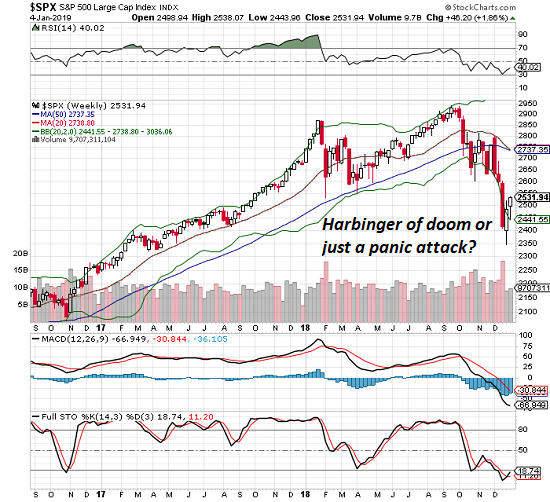
It's not yet clear that the stock market swoon is predictive or merely a panic attack triggered by a loss of meds.
We contrarians can't help it: when the herd is bullish, we start looking for a reversal. When the herd turns bearish, we also start looking for a reversal.
So now that the herd is skittishly bearish, anticipating a recession, contrarians start wondering if a most hated rally is in the offing, one that would leave most punters off the bus.
The primary theme for 2019 in my view is everything accepted by the mainstream is not as it seems. Everything presented as monolithic and straightforward is fragmented, asymmetric and complex.
Take "recession." The standard definition of recession is two consecutive quarters of negative GDP. But is this metric useful in such a fragmented, complex economy? What we're seeing develop is certain sectors are already in recession, others are sliding while others are doing OK.
So the question of stocks rising or falling partly depends on which parts of the economy are most heavily weighted in the stock market. If the sectors most heavily represented by listed stocks are doing OK, then other chunks of the economy can be in freefall and stocks could still rise.
There's also the psychological state of market participants. Was the 20% decline in the 4th quarter a much-delayed reaction to impending recession or was it a panic attack caused by the Federal Reserve withdrawing some of its largesse, i.e. lowering the Fed Put?
It it turns out to be more panic-attack than rational response, a relief rally might be expected.
Then there's the usual bag of tricks to consider. When stocks slide, analysts quickly drop revenue and profit estimates, setting up the potential for "positive surprises" so beloved by Bulls. It's an old game, lowering estimates enough so even weak earnings will appear to be "beat estimates."
The panic-attack topics may have been overblown. Trade war with China? Given exports' modest percentage of the US economy and the modest percentage of exports going to China, how big a deal is it if we scrape off the punditry's panic disorder? The US economy is simply not as dependent on exports as China or Germany.
The panic-disorder pundits are also expecting disaster from the US dollar. If it strengthens, everything falls apart, and if it weakens, well, everything still falls apart.
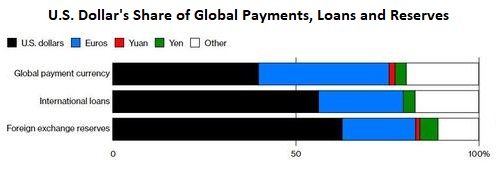
In a more measured view, if the USD weakens, that's positive for US exports and it takes pressure off USD-denominated debtors, which by the way include Chinese companies to the tune of $2 trillion, and trillions more owed by emerging market debtors. Making it easier for these debtors to service their USD-denominated debt would be a definitive plus for global stability and would not damage the dominance of the USD. (see chart below)
If the USD strengthens, then the US becomes even more attractive to non-US capital, a definite plus.
But wait, autos and housing are crashing. This is supposed to doom the entire economy to raging recession, but look at the market capitalization of auto and housing stocks. The two sectors don't even equal one tech giant. They've already been priced for a recession without end.
Then there's profits. Profits need to tank to trigger a fundamental revaluation of stock prices. Sure, many stocks were priced to perfection; now, after a 20% decline (more, in many cases), not so much.
As I've been saying for years, ours is a neofeudal system, not by accident or as a result of a few bad players, but as a result of its very design. Having stipulated that exploitation and rising inequality are built into the system, the net result is tremendous profitability for those who've rigged quasi-monopolies and cartels to protect their revenues and margins.
What is going to kill the fat profits of quasi-monopolies and cartels? Rising energy? Please note the 35% decline in oil prices. Soaring wages? The pundits are cheering a miserly 3% wage gain, without noting that's an average number, meaning the usual suspects pulled down big increases while the bottom 80% got the scraps. In any event, a 3% increase isn't going to snuff cartel profits. Since cartels and monopolies keep raising their prices and reducing the quantity and quality of their goods and services, they can handle the 3% increase in compensation costs.
How about healthcare costs? Everyone knows Sickcare is a train wreck of ever-higher costs for diminishing returns, and Corporate America has struggled to find ways to limit the predation of everyone's least favorite cartel (though national defense and higher education are close runner-ups).
But not much has changed in Sickcare; it's broken, but unlikely to trigger a recession.
The economy could use a market-clearing recession, but it's not yet clear that the stock market swoon is predictive or merely a panic attack triggered by a loss of meds (i.e. the Fed Put).
My book Money and Work Unchained is now $6.95 for the Kindle ebook and $15 for the print edition. Read the first section for free in PDF format.


If you found value in this content, please join me in seeking solutions by becoming a $1/month patron of my work via patreon.com.

NOTE: Contributions/subscriptions are acknowledged in the order received. Your name and email remain confidential and will not be given to any other individual, company or agency.
Thank you, Michael R. ($100), for your outrageously generous contribution to this site -- I am greatly honored by your steadfast support and readership.
 
Thank you, Duane S. ($25), for your most generous contribution to this site -- I am greatly honored by your steadfast support and readership.

Read more...

Saturday, January 05, 2019

What Do the CIA, Soros Foundation and the Kremlin Have in Common?

None of them provides financial support to Of Two Minds.
It's probably not much of a surprise that once again Of Two Minds failed to secure funding from the CIA, the Soros Foundation, the Russians or indeed any heavyweight at all. The site’s sole sponsor, the Kroika Cookie and Biscuit Company, Ltd., is unfortunately a fictitious invention of mine . . .
Well, one look at my website will tell you it’s not quite up to corporate sponsorship standards. I can’t tell you much about my brand, except that it’s not approved by the Powers That Be, and it’s skeptical of whatever is currently accepted by the mainstream media as obvious.
Examining things from a fresh perspective is the bread and butter of this site, and the output, if I can use such a grandiosely techie term, are solutions, for both individuals and households and the global systems we inhabit.
Presenting this unique content has resulted in a unique situation: my only sponsor is you.
A surprise for many is that websites such as Of Two Minds need money to exist. I know this is a shocking revelation--isn’t everything not paywalled free on the Internet?
So - how can you support Of Two Minds? There are a number of ways. One costs you nothing but a moment of time: when you find some essay of interest on the site, send it along to your circle of friends and contacts. Helping the site expand its readership is invaluable.
Another is to buy one or more of my books, ebooks or audio books, 21 and counting, all of which are eminently suitable as paperweights and levelers of imbalanced furniture. (Buy a thin one and a thicker one to make sure you have the right dimension on hand for that wobbly table leg.)
If you prefer to avoid the Amazon behemoth, you can order a book directly from me, with the caveat that I’m a lot slower to fulfill orders than Amazon. (Cost is list price of the book plus $5 postage in the US, $10 to Canada.)
A third way to support the site is to become a patron via Patreon or a subscriber/donor via PayPal (see sidebar for buttons), or send money via the US Postal Service to P.O. Box 4727, Berkeley CA 94704. Patrons at the $1 per month level get four special reports a year, plus discounts on my new books that may well offset the entire annual cost of $12 if you buy a few books.
Patrons, subscribers and donors at $5/month or $50 annually get the weekly Musings Reports, chockablock with insightful essays and useful bits of knowledge--any one of which might easily be worth the entire donation, if it helps you modify your life / understanding in a practical, advantageous way.
Many readers pick the $10/month option, for reasons known only to themselves. I am grateful for their magnificent generosity.
As I often note, value flows to what’s scarce . . . so your tangible demonstration that Of Two Minds has value for you inspires me to continue our pursuit of a better understanding of the world.
You asked how you can support Of Two Minds, and here’s the menu. Thank you, thank you, thank you for your willingness to support my work.
My book Money and Work Unchained is now $6.95 for the Kindle ebook and $15 for the print edition. Read the first section for free in PDF format.


If you found value in this content, please join me in seeking solutions by becoming a $1/month patron of my work via patreon.com.

NOTE: Contributions/subscriptions are acknowledged in the order received. Your name and email remain confidential and will not be given to any other individual, company or agency.
Thank you, Wojciech N. ($50), for your massively generous pledge to this site -- I am greatly honored by your steadfast support and readership.
 
Thank you, Eugene R. J. ($5/month), for your monstrously generous up-pledge to this site -- I am greatly honored by your steadfast support and readership.

Read more...

Friday, January 04, 2019

Commoditization = Deflation

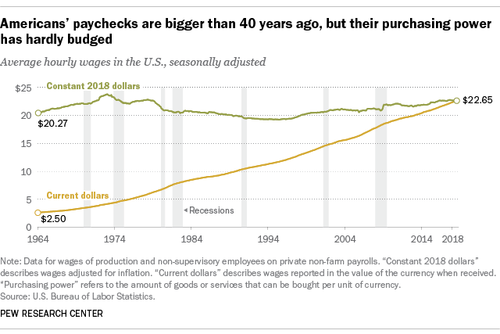
The other deflationary pressure is the stagnation of wages for the bottom 90%.
Apple's slumping sales growth in China re-energized discussions on the commoditization of smart phones: the basic idea is that once devices, services, goods, platforms, etc. are interchangeable and can be produced/generated anywhere, they are effectively commodities and their value declines accordingly.
In the case of Apple's iPhone, many observers see diminishing returns on the latest model's features as the price point (around $1,000) now exceeds what many customers are willing to pay for the status of owning an Apple product and the declining differentiation of the iPhone when compared to other smart phones available at a fraction of the iPhone's price.
Commoditization doesn't just affect the top tier of the food chain; it affects the entire food chain. The commodity $400 smart phone has diminishing returns over the commodity $200 smart phone, and the $200 smart phone has diminishing returns over the commodity $100 smart phone.
Commoditization ravages price and profitability. Once the production facility is paid for by the first run, the cost basis of future production drops, enabling the producer to reap profits even as price plummets.
This is why perfectly good tablets cost $35 wholesale in some Asian markets.
Commoditization doesn't just affect tech devices: passive index funds have commoditized investing. Why pay a hedge fund's steep fees when a passive index fund may beat the net return (i.e. after fees) of the hedge fund?
No wonder hedge funds are closing left and right; investing is being commoditized by passive funds, funds managed by software, etc.
Commoditization is inherently deflationary as prices and profits are pushed down along the entire food chain.
As Marx explained in the 19th century, the only way to preserve pricing power and profits is to eliminate competition by establishing a monopoly or cartel. And indeed, the sectors which continue to jack up prices and rake in outsized profits are cartels: healthcare, national defense, pharmaceuticals, higher education, etc.
Companies such as Microsoft, Google and Facebook have established quasi-monopolies via the network effect, buying up potential competitors, etc.
While globalization has fueled the commoditization of goods such as phones and services such as tech support, commoditization can also be homegrown.Consider how tax software has reduced the demand for tax preparation services, or how the cost of digitally distributing content such as films is near-zero.
Labor has also been commoditized, and this is one reason why wages have stagnated. If someone somewhere else (in another state, in another country, etc.) can produce the same output for less total compensation, then that pushes employers to move production to lower costs.
Direct delivery of goods and services to the consumer is also commoditized: do you really care whether your package is delivered by the US Postal Service, UPS, FedEX, or a gig-economy Amazon driver? No.
This is why Gordon Long and I were discussing the retail apocalypse years ago:Looming U.S. Retail Implosion (December 4, 2013).
The scarcity value and pricing power of brands, retail outlets, malls, etc. are all plummeting for structural reasons.
The other deflationary pressure is the stagnation of wages for the bottom 90%: consumers might desire the status of a new iPhone but be unable to justify the expense or the financial sacrifices that are required to make such a discretionary purchase.
If we consider the digitization powering the 4th Industrial Revolution and the rising political demands for renewed anti-trust scrutiny of monopolistic behemoths, it's not difficult to discern a continuation of the deflationary trends of commoditization and stagnant wages.
My book Money and Work Unchained is now $6.95 for the Kindle ebook and $15 for the print edition. Read the first section for free in PDF format.


If you found value in this content, please join me in seeking solutions by becoming a $1/month patron of my work via patreon.com.

NOTE: Contributions/subscriptions are acknowledged in the order received. Your name and email remain confidential and will not be given to any other individual, company or agency.
Thank you, Wojciech N. ($50), for your massively generous pledge to this site -- I am greatly honored by your steadfast support and readership.
 
Thank you, Eugene R. J. ($5/month), for your monstrously generous up-pledge to this site -- I am greatly honored by your steadfast support and readership.

Read more...

Wednesday, January 02, 2019

The Crisis of 2025

This is the predictable path because it's the only one that's politically expedient and doesn't cause much financial pain until it's too late to stave off collapse.
While many fear a war between the nuclear powers or the breakdown of civil order, I tend to think the Crisis of 2023-26 is more likely to be financial in nature.
War and civil breakdown are certainly common enough in history, global/nuclear war has been avoided in recent history, largely because wars are typically launched by those who reckon they can win the war. Launching a nuclear strike against a nation with the ability to launch a counterstrike (from submarines, for example, and missiles that survived the first strike) guarantees the destruction of whatever concentrations of population and assets the attacker may have.
The breakdown of civil order has not occurred in developed-world nations for quite some time, as central states can marshal military forces to restore order and issue / borrow money to buy the compliance of the restive populace.
Financial crises, in contrast, remain a constant feature of the modern era, and developed-world nations are perhaps even more vulnerable to financial disorder than developing nations.
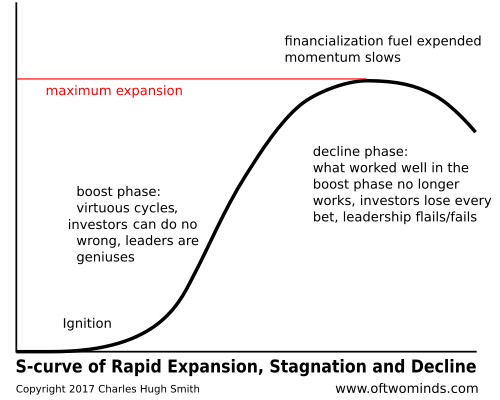
As I've often noted, systems tend to follow an S-Curve of rapid expansion followed by slower growth during maturity and culminating in stagnation, decline or collapse.
Successful economies generate a double-bind once they reach the stagnation-decline phase: the populace (and capital) both expect strong permanent growth as a birthright, and they see the previous boost-phase and maturity phase as evidence that the economy "should" continue delivering outsized returns on capital and widespread prosperity essentially forever.
They are willing to accept a temporary slowdown/decline as part of the process of prosperity, but their patience quickly runs out if outsized returns and general prosperity aren't forthcoming.
The stagnation phase has many causes: a reduction in resources or depletion of soil/water resources; a sustained shortage of energy or a sharp rise in the cost of energy; stagnating productivity, and the rise of parasitic elites, insiders who feather their nests at the expense of the many.
All of these factors act as friction in the system, and eventually the system is unable to sustain the parasitic elites, high returns on capital and general prosperity.
Any political elite that delivers the bad news that prosperity is over risks being overthrown or voted out of office, and so the ruling elites seek to extend high returns on capital and general prosperity by any means available.
Since they are the parasitic elites, eliminating that source of friction is off the table. Restoring depleted soil/water/energy resources is not possible, and wresting control of others' resources to exploit is problematic: using force might trigger a wider war, so buying others'resources is the safer answer.
Modern states create new currency by either digital "printing" or borrowing the money into existence. There is little political resistance to creating new money to buy others' resources, generate high returns on capital and deliver direct transfers of cash to the populace via "make work" employment, social welfare, Universal Basic Income, etc.
You see the double-bind: the ruling class must deliver outsized returns on capital and general prosperity, and the only way they can do so is to create new money rather than new wealth, something that is beyond their power.
Depending on the wealth and productivity of the existing economy, the world may accept this new money as having value for a time. But as the need for more currency increases, ruling elites start to "print" or borrow new currency in excess of what the economy actually generates in income and value.
Eventually the world catches on to the stealth devaluation of the money, and trust in the value of the currency drops, slowly at first and then precipitously.
In developed economies, the ruling elites protect their own incomes and power, and those of capital, as the owners of capital are part of the ruling elite. The net result of this is rising income/wealth inequality as the few increase their share at the expense of the many. (Thomas Piketty characterized this process as a higher rate of return on capital than on labor.)
The political "solution" to stagnation and inequality is QE for the People:increased infrastructure and social welfare spending, benefits that are now costly being subsidized by the state (healthcare, higher education) and Universal Basic Income.
Proponents rarely (if ever) question the bloated cost structure of these protected industries, which benefit entrenched elites (i.e. parasitic elites) at the expense of the overall economy.
Proponents of QE for the People have convinced themselves that essentially unlimited sums of new money can be created and distributed without generating inflation, since all the newly created trillions will be boosting "aggregate demand," i.e. more consumer demand for more of everything, including resources that are depleted/scarce.
This belief that creating and distributing trillions in new money isn't inflationary is necessary to suppress the common-sense view that inflation is inevitable once money-creation (and broad distribution of the new money) kicks into high gear.
Since the ruling elites have no other choice, they will embrace QE for the People and generate new money with abandon.
I am guessing the political movement demanding QE for the People will come to power by 2021. The money creation will begin in earnest and a few years later, inflation will start rising, much to the surprise of proponents of QE for the People.
At that point the proponents and the ruling elites will be trapped: they won't be able to withdraw all the benefits ("free money") of QE for the People, nor can they reverse runaway inflation without drastically reducing the creation of currency.
Various politically expedient policies will be tried--wealth taxes, the issuance of a new currency, perhaps even a state cryptocurrency--but none of these can reverse the underlying dynamic.
The currency devalues and then collapses, along with the "wealth" that it represented.
This is the predictable path because it's the only one that's politically expedient and doesn't cause much financial pain until it's too late to stave off collapse.
This essay was drawn from Musings Report 52. The Musings Reports are sent weekly to patrons and subscribers ($50/year or $5/month).


My new book Pathfinding our Destiny: Preventing the Final Fall of Our Democratic Republic is discounted ($5.95 ebook, $10.95 print): Read the first section for free in PDF format.


My new mystery The Adventures of the Consulting Philosopher: The Disappearance of Drake is a ridiculously affordable $1.29 (Kindle) or $8.95 (print); read the first chapters for free (PDF)
My book Money and Work Unchained is now $6.95 for the Kindle ebook and $15 for the print edition. Read the first section for free in PDF format.


If you found value in this content, please join me in seeking solutions by becoming a $1/month patron of my work via patreon.com.

NOTE: Contributions/subscriptions are acknowledged in the order received. Your name and email remain confidential and will not be given to any other individual, company or agency.
Thank you, Cada Dia Cheese ($50), for your brilliantly generous contribution to this site -- I am greatly honored by your support and readership.
 
Thank you, Michael R. ($5/month), for your monstrously generous pledge to this site -- I am greatly honored by your support and readership.

Read more...

Terms of Service

All content on this blog is provided by Trewe LLC for informational purposes only. The owner of this blog makes no representations as to the accuracy or completeness of any information on this site or found by following any link on this site. The owner will not be liable for any errors or omissions in this information nor for the availability of this information. The owner will not be liable for any losses, injuries, or damages from the display or use of this information. These terms and conditions of use are subject to change at anytime and without notice.


Our Privacy Policy:


Correspondents' email is strictly confidential. This site does not collect digital data from visitors or distribute cookies. Advertisements served by a third-party advertising network (Investing Channel) may use cookies or collect information from visitors for the purpose of Interest-Based Advertising; if you wish to opt out of Interest-Based Advertising, please go to Opt out of interest-based advertising (The Network Advertising Initiative). If you have other privacy concerns relating to advertisements, please contact advertisers directly. Websites and blog links on the site's blog roll are posted at my discretion.


PRIVACY NOTICE FOR EEA INDIVIDUALS


This section covers disclosures on the General Data Protection Regulation (GDPR) for users residing within EEA only. GDPR replaces the existing Directive 95/46/ec, and aims at harmonizing data protection laws in the EU that are fit for purpose in the digital age. The primary objective of the GDPR is to give citizens back control of their personal data. Please follow the link below to access InvestingChannel’s General Data Protection Notice. https://stg.media.investingchannel.com/gdpr-notice/


Notice of Compliance with The California Consumer Protection Act
This site does not collect digital data from visitors or distribute cookies. Advertisements served by a third-party advertising network (Investing Channel) may use cookies or collect information from visitors for the purpose of Interest-Based Advertising. If you do not want any personal information that may be collected by third-party advertising to be sold, please follow the instructions on this page: Limit the Use of My Sensitive Personal Information.


Regarding Cookies:


This site does not collect digital data from visitors or distribute cookies. Advertisements served by third-party advertising networks such as Investing Channel may use cookies or collect information from visitors for the purpose of Interest-Based Advertising; if you wish to opt out of Interest-Based Advertising, please go to Opt out of interest-based advertising (The Network Advertising Initiative) If you have other privacy concerns relating to advertisements, please contact advertisers directly.


Our Commission Policy:

As an Amazon Associate I earn from qualifying purchases. I also earn a commission on purchases of precious metals via BullionVault. I receive no fees or compensation for any other non-advertising links or content posted on my site.

  © Blogger templates Newspaper III by Ourblogtemplates.com 2008

Back to TOP