Sunday, March 22, 2015

Who Left the Crash Window Open?

Can stocks keep hitting new highs even as sales and profits fall?


Given that we live in a world where a modest 3% decline in the stock market triggers panicky demands for more quantitative easing (QE 4), few observers expect much a correction, regardless of the souring fundamentals such as sales and profits.

A correspondent notified me of a Puetz "crash" window (based on the analysis of Stephen J. Puetz) opening in late March-early April. (Since I am not a subscriber to Puetz's work, I can't confirm this.) As I understand it, while these windows do not predict a crash/sharp correction, such moves tend to occur in these windows, which are based on cycles and events such as eclipses.

So I decided to look for any evidence that a sharp correction might be in the offing.

One classic precursor of corrections is weakening market leaders and narrowing of breadth/liquidity/volume. When leaders who pulled the index higher roll over, the index is usually not far behind.

Consider the chart of Apple, (AAPL), long the engine that has been pulling the indices higher for years. Apple's chart is looking weak:


Another classic precursor of a decline is high levels of complacency, which is reflected in a low VIX or volatility index. When fear has been vanquished, the VIX declines to the 10-12 range. These levels reliably indicate market tops.

Interestingly, the VIX has been tracing out a descending wedge, a pattern that is usually bullish. (The VIX soars when stocks fall sharply and fear comes alive.)


The signs of a global slowdown are so plentiful that even the most ardent bulls should start feeling caution. Yet the central-bank-driven stock markets in the UK and Germany are hitting new highs, and the S&P 500 (SPX) in the US is within a few points of its all-time high.

But the S&P 500 is acting rather tired. Despite the declining VIX, the SPX has only managed a tepid 30-point gain in the past three months--months that are typically among the best in the calendar year for strong equity gains. This is characteristic not of a robust Bull trend but of a topping process--a process that typically takes several months to manifest.


Can stocks keep hitting new highs even as sales and profits fall? History suggests we've reached Peak Central Banking--the faith that central bank easing can push markets higher forever, regardless of fundamentals, has reached near-euphoric levels. Few fear a decline or an increase in volatility.

So it's all smooth sailing even as the global economy slides into recession? That is a disconnect from reality that beggars belief.

Perhaps the VIX will soon awaken from its slumbers, reflecting a "surprise" plummet in stocks. 


Get a Job, Build a Real Career and Defy a Bewildering Economy(Kindle, $9.95)(print, $20)
go to Kindle edition
Are you like me? Ever since my first summer job decades ago, I've been chasing financial security. Not win-the-lottery, Bill Gates riches (although it would be nice!), but simply a feeling of financial control. I want my financial worries to if not disappear at least be manageable and comprehensible.  And like most of you, the way I've moved toward my goal has always hinged not just on having a job but a career.
You don't have to be a financial blogger to know that "having a job" and "having a career" do not mean the same thing today as they did when I first started swinging a hammer for a paycheck.

Even the basic concept "getting a job" has changed so radically that jobs--getting and keeping them, and the perceived lack of them--is the number one financial topic among friends, family and for that matter, complete strangers.

So I sat down and wrote this book: Get a Job, Build a Real Career and Defy a Bewildering Economy.

It details everything I've verified about employment and the economy, and lays out an action plan to get you employed.

I am proud of this book. It is the culmination of both my practical work experiences and my financial analysis, and it is a useful, practical, and clarifying read.

Test drive the first section and see for yourself.     Kindle, $9.95     print, $20

"I want to thank you for creating your book Get a Job, Build a Real Career and Defy a Bewildering Economy. It is rare to find a person with a mind like yours, who can take a holistic systems view of things without being captured by specific perspectives or agendas. Your contribution to humanity is much appreciated."
Laura Y.

Gordon Long and I discuss The New Nature of Work: Jobs, Occupations & Careers(25 minutes, YouTube) 


NOTE: Contributions/subscriptions are acknowledged in the order received. Your name and email remain confidential and will not be given to any other individual, company or agency.

Thank you, Kaz M. ($10), for your much-appreciated generous contribution to this site-- I am greatly honored by your support and readership.


Read more...
Saturday, March 21, 2015

The Web: Destroyer or Savior of Culture, Pay and Employment?

The cost of creating and distributing content has fallen to near-zero, and that is not going away.


Last month I explored the contentious question, Is the Web Destroying the Cultural Economy? In my recent video discussion with analyst Gordon T. Long, we expanded this question to pay (earned income) and jobs, i.e. is the Web eroding pay and jobs?

I also discussed these issues with Mike Swanson of Wall Street Window in a podcast Is The Web Destroying the Cultural Economy? An historian by training, Mike is well-placed to put these issues in a larger context.

There are several key dynamics at work. One is the democratization of expression and journalism unleashed by the Web has eroded the industrial meritocracy of gatekeepers and vertically integrated content-media corporations: music labels, publishers, newspapers, etc.

The web has enabled virtually anyone with Internet access to create a nearly-free global distribution network--what I have termed 800 Million Channels of Me(February 21, 2011). This blog is obviously one of those millions of globally distributed channels.

Critics of this democratization feel that this has unleashed an avalanche of mediocrity that is judged on "likes" and pages views--a process in which talent is "lost in a sea of garbage."

The other side of the debate sees the demise of the gatekeepers, who could enforce their own view of what was valuable culturally and economically, as freeing all those who could never get past the gatekeepers. This explosion of creativity and expression is an unalloyed good thing.

It does create a new problem and a new need--some way to curate the flood of new content, as no one digital consumer can possibly listen to, read or watch more than a tiny sliver of the content being produced.

This curation and editorial selection is an intermediary layer between the creator of content and the end user--a layer that replaces the old industrial-meritocracy with a free-floating, self-organizing group of intermediaries who add value by sorting through a larger slice of the web's gargantuan output of content.

But few deny that this flood of free content--music, books, articles, videos, etc.--has drastically reduced the income paid to content creators. Take the porn industry, for example, a once-profitable distribution system for adult content. Now that virtually anyone can bare all and create adult content, the cost of adult content has plummeted to near-zero.

The music industry has certainly exploded in terms of free content, but the income of the entire industry has fallen roughly in half, from $14 billion to $7 billion. The subscription model that is gaining market share--Spotify, Netflix, etc.--offers end users nearly unlimited content for a modest flat monthly fee.

It's difficult for content creators to make much money in this model unless they have millions of end users downloading content.

Some musicians say that Spotify has enabled them to earn a living performing live by introducing their music to a large audience; others are less enthusiastic about the consequences of earning a few dollars from 1 million downloads (for instance, those who don't constantly tour).

Does culture benefit or suffer when the judgment of cultural value is universalized? There is no one answer, as those who see the flood of self-expression as the death of the cultural economy have some solid points: if only a handful of people can make a middle-class living creating content that is widely recognized as being valuable in some fashion, then where does that leave the culture?

Those who see the process of the wheat being sorted from the chaff by the users themselves see new opportunities for creators who were once marginalized to earn a living from a core group of fans and supporters. Musicians with such a core base can earn a living from a much smaller audience than in the old days of mass marketing of a few select bands. Writers like myself can earn more per book sold because we control all the rights and income.

One thing we know for sure: the cost of creating and distributing content has fallen to near-zero, and that is not going away. This impacts more than just content and culture, as Gordon and I discuss in What Do these Trends Suggest? (32:42 video; Macro-Analytics, with Gordon T. Long)


Get a Job, Build a Real Career and Defy a Bewildering Economy(Kindle, $9.95)(print, $20)
go to Kindle edition
Are you like me? Ever since my first summer job decades ago, I've been chasing financial security. Not win-the-lottery, Bill Gates riches (although it would be nice!), but simply a feeling of financial control. I want my financial worries to if not disappear at least be manageable and comprehensible.  

And like most of you, the way I've moved toward my goal has always hinged not just on having a job but a career.

You don't have to be a financial blogger to know that "having a job" and "having a career" do not mean the same thing today as they did when I first started swinging a hammer for a paycheck.

Even the basic concept "getting a job" has changed so radically that jobs--getting and keeping them, and the perceived lack of them--is the number one financial topic among friends, family and for that matter, complete strangers.

So I sat down and wrote this book: Get a Job, Build a Real Career and Defy a Bewildering Economy.

It details everything I've verified about employment and the economy, and lays out an action plan to get you employed.

I am proud of this book. It is the culmination of both my practical work experiences and my financial analysis, and it is a useful, practical, and clarifying read.

Test drive the first section and see for yourself.     Kindle, $9.95     print, $20

"I want to thank you for creating your book Get a Job, Build a Real Career and Defy a Bewildering Economy. It is rare to find a person with a mind like yours, who can take a holistic systems view of things without being captured by specific perspectives or agendas. Your contribution to humanity is much appreciated."
Laura Y.

Gordon Long and I discuss The New Nature of Work: Jobs, Occupations & Careers(25 minutes, YouTube) 


NOTE: Contributions/subscriptions are acknowledged in the order received. Your name and email remain confidential and will not be given to any other individual, company or agency.

Thank you, William S. ($100), for your outrageously generous contribution to this site-- I am greatly honored by your steadfast support and readership.

Read more...
Thursday, March 19, 2015

Income, Education and Inequality in the "Recovery": Prepare to be Surprised

Note to the higher education industry: issuing diplomas doesn't magically create new jobs in the real world.


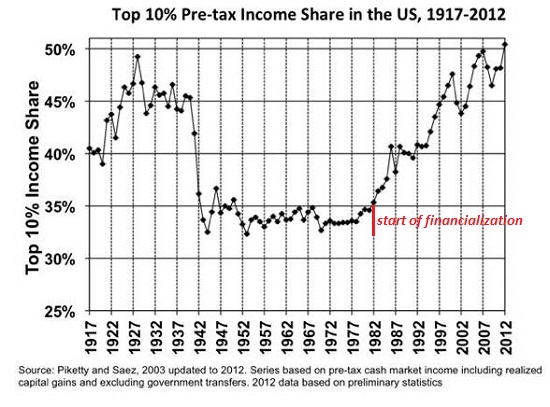
By virtually any standard, wealth inequality has soared to historic levels in the six years of "recovery" since the Great Recession of 2008-09. Economist Emmanuel Saez, who has long collaborated with Thomas Piketty, described the recent extremes of wealth inequality in a recent paper Striking it Richer: The Evolution of Top Incomes in the United States, which provides an in-depth look at the widening gulf between the top 1% and the bottom 90% from 2009 to 2012.

Here is a chart of the top 10% share of income, based on their research (the note in red marking the beginning of financialization in 1982 is my own):

As author David Cay Johnston noted in an insightful review of Piketty's book Capital in the Twenty-First Century, Trickle-Up economics: "The top 1 percent of Americans raked in 95 cents out of every dollar of increased income from 2009, when the Great Recession officially ended, through 2012. Almost a third of the entire national increase went to just 16,000 households, the top 1 percent of the top 1 percent, Piketty and Saez’s analysis of IRS data shows."

We would naturally expect those with the highest incomes to have fared best in the past six years and those at the bottom to have fared the worst financially--but this not entirely true.Most income analyses, it turns out, do not factor in government-funded social welfare transfers, tax credits and entitlements. Once these sources of income are added, the bottom 90% saw no decline in income at all from 2007 to 2011, while the top 1% suffered a 27% decline and the top 5% took a 7% hit.


"Pretax income for the middle class and poor dropped substantially from 2007 to 2011 – about 10 percent for most groups. Yet including taxes and transfers, incomes fared better: Average income for the bottom fifth of earners rose 2.6 percent, to $24,100, and the average for the middle fifth fell only 2 percent, to $59,000. Such stagnation is hardly good news, but it’s a lot better than a large decline."

Taxes on higher-income households have risen on several fronts: a new tax on high-earners to fund ObamaCare, for example, and a higher tax bracket for the highest-income households.

Social welfare transfers and tax credits/cuts did what they were supposed to do--cushion the blow of recession for lower-income households and transfer more of the tax burden to higher income households. Yes, there are endless debates around the issues of taxes: for example, if most of the benefits of the Bush-era tax cuts flowed to the top income earners, then recent tax increases for the top income bracket are clawbacks rather than new taxes.

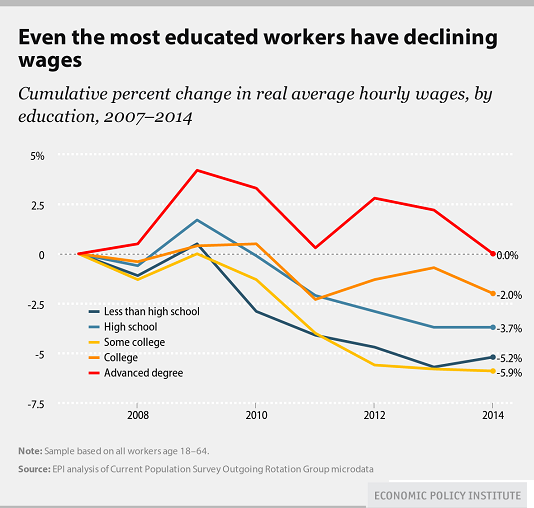
But setting aside the many debates on tax policies and sources of income inequality, another surprising data point has emerged: Even the Most Educated Workers Have Declining Wages (Economic Policy Institute)


The chart accompanying the article clearly shows less educated workers suffered larger wage declines than their more educated peers. The year-over-year data shows something else: "Some commentators are under the false impression that wage inequality is a simple consequence of employers’ demand for increased skills and education—often thought to be driven by advances in technology. But new data from 2014 shows that even college educated workers and workers with advanced degrees are not in demand enough to see their wages rise."

In other words, wages are declining even in fields where advanced degrees are supposed to inoculate the highly educated from declines in earnings. This is not entirely surprising to anyone who has first-hand knowledge of the tremendous glut in workers with advanced degrees, but it does drive a stake in the heart of the argument that the solution to income inequality is more education.

ironically, all that minting another 5 million Masters degrees, MBAs, law degrees and PhDs will do is increase the oversupply of highly educated workers and thereby exacerbate the decline in wages paid to these workers.

As I often note, issuing diplomas doesn't magically create new jobs in the real world. 


Get a Job, Build a Real Career and Defy a Bewildering Economy(Kindle, $9.95)(print, $20)
go to Kindle editionAre you like me? Ever since my first summer job decades ago, I've been chasing financial security. Not win-the-lottery, Bill Gates riches (although it would be nice!), but simply a feeling of financial control. I want my financial worries to if not disappear at least be manageable and comprehensible. 


 And like most of you, the way I've moved toward my goal has always hinged not just on having a job but a career.

You don't have to be a financial blogger to know that "having a job" and "having a career" do not mean the same thing today as they did when I first started swinging a hammer for a paycheck.

Even the basic concept "getting a job" has changed so radically that jobs--getting and keeping them, and the perceived lack of them--is the number one financial topic among friends, family and for that matter, complete strangers.

So I sat down and wrote this book: Get a Job, Build a Real Career and Defy a Bewildering Economy.

It details everything I've verified about employment and the economy, and lays out an action plan to get you employed.

I am proud of this book. It is the culmination of both my practical work experiences and my financial analysis, and it is a useful, practical, and clarifying read.

Test drive the first section and see for yourself.     Kindle, $9.95     print, $20

"I want to thank you for creating your book Get a Job, Build a Real Career and Defy a Bewildering Economy. It is rare to find a person with a mind like yours, who can take a holistic systems view of things without being captured by specific perspectives or agendas. Your contribution to humanity is much appreciated."
Laura Y.

Gordon Long and I discuss The New Nature of Work: Jobs, Occupations & Careers(25 minutes, YouTube) 


NOTE: Contributions/subscriptions are acknowledged in the order received. Your name and email remain confidential and will not be given to any other individual, company or agency.

Thank you, Michael S. ($50), for your monumentally generous contribution to this site-- I am greatly honored by your steadfast support and readership.

Read more...
Wednesday, March 18, 2015

The Unraveling Is Gathering Speed

Debt saturation and debt fatigue = diminishing returns on central bank tricks.


Does anyone else have the feeling that things are not just unraveling, but that the unraveling is gathering speed?

Though quantifying this perception is more interpretative than statistical, I think we can look at the ongoing debt crisis in Greece as an example of this acceleration of events.

The Greek debt crisis began in 2011 and reached a peak in 2012. The crisis was quelled by new Eurozone/IMF loans to Greece, and European Central Bank chief Mario Draghi’s famous “whatever it takes speech” in late July, 2012.

The Greek debt crisis quickly went from “boil” to “simmer,” where it stayed for almost two-and-a-half years. But no one with any knowledge of the gravity and precariousness of the situation expects the latest “extend and pretend” deal to patch everything together for another two years.  Current deals are more likely to last a matter of months, not years.

We can discern the same diminishing returns in Federal Reserve/central bank interventions, as the initial rounds of quantitative easing pushed stock and bond markets higher for years at a time, while the following interventions generated lower returns.

What factors are reducing the positive effects of intervention and causing increased volatility? Let’s start with the engine behind every central bank/state intervention and every “save” of the status quo: debt.

Debt Brings Forward Consumption & Income


Debt has one primary dynamic: borrowing money to consume something in the present brings forward consumption and income.  Economists describe trading future income for consumption today as bringing consumption forward. And since debt must be repaid with interest, bringing consumption forward also brings income forward.

Let’s say we want to buy a vehicle with cash, and it will take five years to save up the lump-sum purchase cost.  We forego current consumption to save for future consumption.

If we get a 100% auto loan now, we get the use of the vehicle (present-day consumption) and in exchange, we sacrifice some of our income over the next five years to pay back the auto loan. We brought consumption forward, and in essence took future income and brought it forward to pay for the consumption we’re enjoying today.

We can best understand the eventual consequence of this dynamic with a simplified household example. Let’s say a household has $2,000 a month in net income, i.e. after taxes, healthcare insurance deductions, etc., and rent (or mortgage payments), basic groceries and utilities consume $1,000 of this net income. That leaves the household with $1,000 in disposable income.

At the risk of boring finance-savvy readers, let’s briefly cover the difference between net income and disposable income. Net income can be earned (wages, salaries, net income from a sole proprietor enterprise, etc.) or unearned (dividends, interest income, rents, etc.) Net income can only rise by making more money or reducing taxes. There are limits to our control of these factors. In a stagnant economy, it’s tough to find better-paying jobs and harder to demand higher wages from employers.  Since governments’ expenditures are rising, taxes are also going up; it’s difficult for most wage-earners to cut their total tax load by much.

Disposable income is more within our control, as it is fundamentally a series of trade-offs between current consumption and future income/savings: if we choose to consume now, we have less income to save for future consumption or investments.  If we sacrifice consumption today, we have more money in the future for consumption or investing. If we borrow money to consume today, we’ll have less future income because a slice of our future income must be devoted to pay down the debt we took on to consume today.

If our household borrows money to buy a vehicle and the payment is $500 per month, the household’s disposable income drops from $1,000 to $500. If the household takes on other debt (credit cards, student loans, etc.) with payments of $500 per month, the household’s disposable income is zero: there is no money left to dine out, go to movies, pay for lessons, etc.

In effect, all of the future income for years to come has been spent.

The Only Trick To Expand Debt: Lower Interest Rates


There are only two ways to support additional debt: either increase net income, or lower the rate of interest on new and existing loans to free up disposable income.  Suppose our household refinances its auto loan to a much lower rate of interest and transfers its credit card debt to a lower-interest rate card.  Huzzah, each monthly payment drops by $100, and the household has $200 of disposable income to spend on current consumption or on more loans. Let’s say the household chooses to buy new furniture on credit with the windfall. This new consumption brought forward pushes the monthly debt payments back up to $1,000.

This additional debt-based consumption profits two critical players in the economy: the state (i.e. all levels of government) and the financial sector. The state benefits from the higher taxes generated by the sales, and the financial sector profits from transaction fees and the interest earned on the new loans.

The household’s consumption and debt rose as a result of lower interest rates, but there is a limit on this dynamic: lenders have to charge enough interest to service the loan, reap a profit and compensate shareholders for the risk of default. 

If lenders fail to properly assess the risk of default. They will be unprepared to absorb the losses incurred as marginal borrowers default en masse. This places the lender’s own solvency at risk.

Using this trick to enable further expansion of debt thus creates a systemic risk that borrowers will over-borrow and lenders will not have sufficient reserves to absorb the inevitable losses as marginal borrowers default and other borrowers suffer declines in disposable income that trigger further defaults.

In other words, the trick of lowering interest rates yields diminishing returns: the more debt that is enabled,  the thinner the margins of safety and thus the greater the systemic risks rise in direct correlation with rising debt loads.

The Trick To Increase Consumption: Punish Savers


While lowering interest rates increases disposable income and enables an expansion of debt, it also generates a disincentive for households to forego current consumption by saving disposable income rather than spending it.  Near-zero interest rates actively punish savers by reducing the interest income earned on low-risk savings accounts and certificates of deposit (CDs) to near-zero. Savers are pushed into either investing in high-risk markets that benefit the financial sector or by spending rather than saving—a choice that benefits the state, as more spending generates taxes for the state.

The Global Expansion Of Debt Has Increased Systemic Risks


These are the basic dynamics of the entire global economy: interest rates have been pushed to near-zero to punish savers and encourage expansion of debt-based consumption. But this inevitably leads to a reduction in disposable income and current consumption, as debt brings forward both consumption and income.

Once the borrowers have maxed out their borrowing power, there is no more expansion of debt or additional debt-based consumption.  This is known as debt saturation: flooding the financial sector with more credit no longer boosts borrowing or brings consumption forward.

Those who brought their consumption forward can no longer add to present consumption, as their future income is already spoken for.

That’s where the global economy finds itself today.


This vast expansion of debt on the backs of marginal borrowers and the expansion of risky investments has greatly increased the systemic risk of losses from defaults arising from over-extended borrowers.

No wonder every attempt to further expand debt-based consumption is yielding diminishing returns: net income is stagnant virtually everywhere in the bottom 95% of the populace, and further declines in interest rates are increasingly marginal as rates are near-zero everywhere that isn’t suffering a collapse in its currency.

The diminishing returns manifest in three ways: the gains from each round of central-bank tricks are declining, the periods of stability following the latest “save” are shrinking and the amplitude of each episode of debt crisis is expanding. 

That the unraveling is speeding up is not just perception—it’s reality.

In Part 2: The Coming Age Of Confiscation, we’ll look at the threat of the other fundamental driver of rising instability: the broken-logic TINA (there is no alternative) mind trap our global leaders are mired in. As the trajectory of the status quo worsens for all the reasons discussed above, government will become increasingly heavy-handed in appropriating the remaining wealth in order to keep things stumbling on just a little bit longer -- justifying its actions by claiming it "has no other choice".

Click here to read Part 2 of this report (free executive summary, enrollment required for full access)
This essay was first published on peakprosperity.com, where I am a contributing writer. 


Get a Job, Build a Real Career and Defy a Bewildering Economy(Kindle, $9.95)(print, $20)
go to Kindle edition
Are you like me? Ever since my first summer job decades ago, I've been chasing financial security. Not win-the-lottery, Bill Gates riches (although it would be nice!), but simply a feeling of financial control. I want my financial worries to if not disappear at least be manageable and comprehensible.  

And like most of you, the way I've moved toward my goal has always hinged not just on having a job but a career.

You don't have to be a financial blogger to know that "having a job" and "having a career" do not mean the same thing today as they did when I first started swinging a hammer for a paycheck.

Even the basic concept "getting a job" has changed so radically that jobs--getting and keeping them, and the perceived lack of them--is the number one financial topic among friends, family and for that matter, complete strangers.

So I sat down and wrote this book: Get a Job, Build a Real Career and Defy a Bewildering Economy.

It details everything I've verified about employment and the economy, and lays out an action plan to get you employed.

I am proud of this book. It is the culmination of both my practical work experiences and my financial analysis, and it is a useful, practical, and clarifying read.

Test drive the first section and see for yourself.     Kindle, $9.95     print, $20

"I want to thank you for creating your book Get a Job, Build a Real Career and Defy a Bewildering Economy. It is rare to find a person with a mind like yours, who can take a holistic systems view of things without being captured by specific perspectives or agendas. Your contribution to humanity is much appreciated."
Laura Y.

Gordon Long and I discuss The New Nature of Work: Jobs, Occupations & Careers(25 minutes, YouTube) 


NOTE: Contributions/subscriptions are acknowledged in the order received. Your name and email remain confidential and will not be given to any other individual, company or agency.

Thank you, Craig H. ($100), for your outrageously generous contribution to this site-- I am greatly honored by your steadfast support and readership.

Read more...
Tuesday, March 17, 2015

Dollar Demand = Global Economy Has Skidded Over the Cliff

Borrowing in USD was risk-on; buying USD is risk-off.


There is a lively debate about the global demand for U.S. dollars:


Correspondent Mark G. went through the BIS report and offered these insightful comments:

"Unless you enjoy multivariate regression analysis I suggest skimming the BIS working paper. Major points I got were:

1. Almost all of the dollar denominated debt and bond growth since 2009 was generated by the global shadow banking system. Banks per se were smaller players in issuing this debt, and US-based banks (i.e. the ones in reach of Federal Reserve life preservers) were minor. Sovereign wealth funds are large players in this. When we think of huge sovereign wealth funds held by major hydrocarbon exporters then the pucker factor rises.

One implied result of the BIS paper is that it will be extremely difficult or impossible for Federal Reserve emergency liquidity operations to stem a panic, even if the Fed is inclined to do so. AEP in the Telegraph article stated this more directly. The real problem is that modern bailout operations have large fiscal components as well as monetary components. Looking at the Bundestag's chronic heartburn with Greece and the EFSF is educational. Alternatively, consider how well proposals for a larger TARP type program aimed primarily at foreign entities would be received by the US Congress. And especially in 2016.

2. A major revelation was that $1 trillion of the dollarized lending went into Chinese companies. However the authors claim most of this lending was through Chinese banks.

3. "Emerging Markets" again account for 1/2 of the total offshore dollarized loans and bonds. This is $4.5 trillion and mainly centered in Brazil, Russia, India, China, etc.

4. From page 20:

"Fourth, since the crisis, the Federal Reserve's compression of term premia via its bond buying has led to a surge in US dollar borrowing through bond markets. Time-varying regressions and VARanalysis also indicate that inflows into bond mutual funds played a significant role in transmitting monetary ease, giving evidence of the portfolio rebalancing channel of the Federal Reserve large-scale bond purchases. In particular, given the low expected returns of holding US Treasury bonds (in relation to expected short-term rates), investors have sought out and found dollar bond issuers outside the US, many rated BBB and thus offering a welcome credit spread."

These dollarized bond funds were the "conservative" play for those players unwilling to also assume exchange rate risk.

"BBB..." This is already the S&P/Fitch ground floor of "investment grade." And that was the rating assigned to these foreign issuers during a time of free money and bubble expansion. We already know the bulk of bond mutual fund buyers are institutions. And many are required to flush any paper that falls below investment grade. And being 'smart money' they will have tried to hedge their risks against such a 'Credit Event' with credit default swaps (CDS).

We also know that CDS contracts typically require the CDS writer to begin posting progressively higher amounts of cash collateral as the credit outlook darkens for the underlying instrument. For instance, even if S&P/Fitch merely change the outlook from 'positive' to 'neutral' the required posted collateral percentage rises. And again from neutral to negative and so forth.

In the case of dollar loans and bonds the collateral needs to be in dollars. Therefore even if the CDS writer manages to borrow Euros with wet ink they still have to exchange these for dollars. See USD/Euro FX trend for the result."


Thank you, Mark, for the detailed analysis. Here are my initial thoughts:

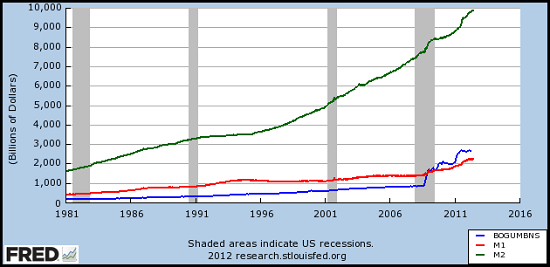
1. Currencies respond to supply and demand like any other commodity. As such, it's instructive to to look at the supply of U.S. dollars and see how it's changed since 2008:money supply (Wikipedia)


2. However you measure money supply, the supply of dollars hasn't risen by much: MZM Money Stock has risen $2 trillion since 2010, Adjusted Monetary Base rose from $1 trillion to $3 trillion, and M2 Money Stock from around $8 trillion to around $10 trillion.

To put that roughly $2 trillion increase in money supply in context:

The GDP of the U.S. is about $17 trillion.

Global GDP is around $72 trillion.

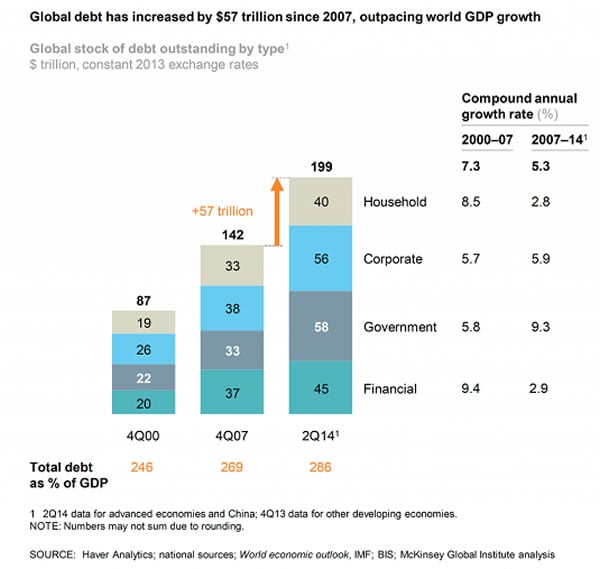
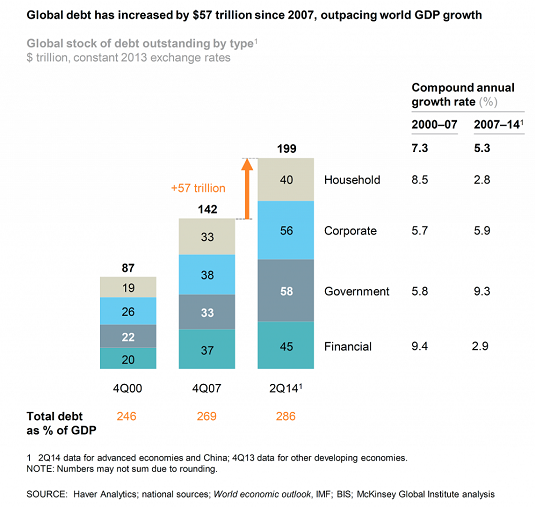
Global debt rose $57 trillion from 2007 to 2014:


3. If there is demand for $9 trillion USD, that dwarfs the increase in US money supply. It also dwarfs the expansion in the Federal Reserve's balance sheet, roughly $3.5 trillion since 2008.

4. Borrowing in U.S. dollars was the easy, profitable trade as long as the dollar was declining. Traders being traders, everybody jumped into the easy, profitable trade with all four feet. Now that the dollar has reversed, everyone who is holding debt in dollars is losing money every time the USD ticks higher.

5. Much of the shadow banking system is opaque, and assumptions made about the outstanding debt in USD are likely to be not just wrong but grossly under-estimated. See #2 above.

If you wanted a trade that was guaranteed to blow up, you couldn't do much better than "dollar bond issuers outside the US, many rated BBB." As Mark noted, once this gunwales-at-sea-level debt gets downgraded a notch, institutional owners will be obligated to sell, regardless of any other conditions. Selling will beget selling.

6. U.S. Treasuries are essentially the only super-liquid safe haven offering a yield above 1%. And what do you need to buy Treasuries? U.S. dollars. The point here is the demand for USD is not limited to those scrambling for USD to pay off dollar-denominated debt--it's a global consequence of the global economy skidding off the cliff into recession.

Borrowing in USD was risk-on; buying USD is risk-off. As the real global economy slips into recession, risk-on trades in USD-denominated debt are blowing up and those seeking risk-off liquidity and safe yields are scrambling for USD-denominated assets.

It's important to recall that buyers of U.S. Treasuries are getting not just the 2+% yield-- they're getting the capital appreciation from the USD rising against their home currency. Depending on the home currency, those who dumped their home currency and bought USD last summer have gained 17% to 25%, even if they received 0% yield.

Add all this up and we have to conclude that, in terms of demand for USD--you ain't seen nuthin' yet. 


Get a Job, Build a Real Career and Defy a Bewildering Economy(Kindle, $9.95)(print, $20)
go to Kindle editionAre you like me? Ever since my first summer job decades ago, I've been chasing financial security. Not win-the-lottery, Bill Gates riches (although it would be nice!), but simply a feeling of financial control. I want my financial worries to if not disappear at least be manageable and comprehensible.  And like most of you, the way I've moved toward my goal has always hinged not just on having a job but a career.

You don't have to be a financial blogger to know that "having a job" and "having a career" do not mean the same thing today as they did when I first started swinging a hammer for a paycheck.

Even the basic concept "getting a job" has changed so radically that jobs--getting and keeping them, and the perceived lack of them--is the number one financial topic among friends, family and for that matter, complete strangers.

So I sat down and wrote this book: Get a Job, Build a Real Career and Defy a Bewildering Economy.

It details everything I've verified about employment and the economy, and lays out an action plan to get you employed.

I am proud of this book. It is the culmination of both my practical work experiences and my financial analysis, and it is a useful, practical, and clarifying read.

Test drive the first section and see for yourself.     Kindle, $9.95     print, $20

"I want to thank you for creating your book Get a Job, Build a Real Career and Defy a Bewildering Economy. It is rare to find a person with a mind like yours, who can take a holistic systems view of things without being captured by specific perspectives or agendas. Your contribution to humanity is much appreciated."
Laura Y.

Gordon Long and I discuss The New Nature of Work: Jobs, Occupations & Careers(25 minutes, YouTube) 


NOTE: Contributions/subscriptions are acknowledged in the order received. Your name and email remain confidential and will not be given to any other individual, company or agency.


Thank you, John D. ($100), for your outrageously generous contribution to this site-- I am greatly honored by your steadfast support and readership.

Read more...
Terms of Service

All content on this blog is provided by Trewe LLC for informational purposes only. The owner of this blog makes no representations as to the accuracy or completeness of any information on this site or found by following any link on this site. The owner will not be liable for any errors or omissions in this information nor for the availability of this information. The owner will not be liable for any losses, injuries, or damages from the display or use of this information. These terms and conditions of use are subject to change at anytime and without notice.

RE: European Union AI Act, and Our Use of Generative AI Tools and Agents Policy

All text on this site is composed by Charles Hugh Smith or by a credited guest-author. No Generative AI Tools are used in the composition / writing of any text or graphic content created by Charles Hugh Smith. This site deploys no AI agents or generative AI tools. This site is not responsible for the disclosures, use or non-use of AI agents or generative AI tools in advertisements displayed by Investing Channel or other ad placement services.

Audio files generated by text-to-audio transcription tools are identified as such.

Our Privacy Policy:

Correspondents' email is strictly confidential. This site does not collect digital data from visitors or distribute cookies. Advertisements served by third-party advertising networks such as Investing Channel may use cookies or collect information from visitors for the purpose of Interest-Based Advertising; if you wish to opt out of Interest-Based Advertising, please go to Opt out of interest-based advertising (The Network Advertising Initiative) If you have other privacy concerns relating to advertisements, please contact advertisers directly.

PRIVACY NOTICE FOR EEA INDIVIDUALS

This section covers disclosures on the General Data Protection Regulation (GDPR) for users residing within EEA only. GDPR replaces the existing Directive 95/46/ec, and aims at harmonizing data protection laws in the EU that are fit for purpose in the digital age. The primary objective of the GDPR is to give citizens back control of their personal data. Please follow the link below to access InvestingChannel's General Data Protection Notice.
https://stg.media.investingchannel.com/gdpr-notice/

Notice of Compliance with The California Consumer Protection Act

This site does not collect digital data from visitors or distribute cookies. Advertisements served by a third-party advertising network (Investing Channel) may use cookies or collect information from visitors for the purpose of Interest-Based Advertising. If you do not want any personal information that may be collected by third-party advertising to be sold, please follow the instructions on this page: Do Not Sell My Personal Information.

Regarding Cookies:

This site does not collect digital data from visitors or distribute cookies. Advertisements served by third-party advertising networks such as Investing Channel may use cookies or collect information from visitors for the purpose of Interest-Based Advertising; if you wish to opt out of Interest-Based Advertising, please go to Opt out of interest-based advertising (The Network Advertising Initiative) If you have other privacy concerns relating to advertisements, please contact advertisers directly.

Our Commission Policy:

Though I earn a small commission on Amazon.com books and gift certificates and gold (BullionVault) purchased via links on my site, I receive no fees or compensation for any other non-advertising links or content posted on my site.

Copyright Notice:

All original images (Drawings and Photographs), text (essays, books and works of fiction), audio and video recordings, musical compositions, graphic design, graphic design elements and HTML coding on this site are the copyrighted work of Charles Hugh Smith unless otherwise credited or noted. They are published as information for the private use of site visitors, and any reproduction or redistribution of this content or coding in any media in any format or distribution channel (text, audio, video/film, web) without the written permission of the copyright holder is strictly prohibited. All rights in all media reserved globally.

  © Blogger templates Newspaper III by Ourblogtemplates.com 2008

Back to TOP