
Saturday, June 22, 2019

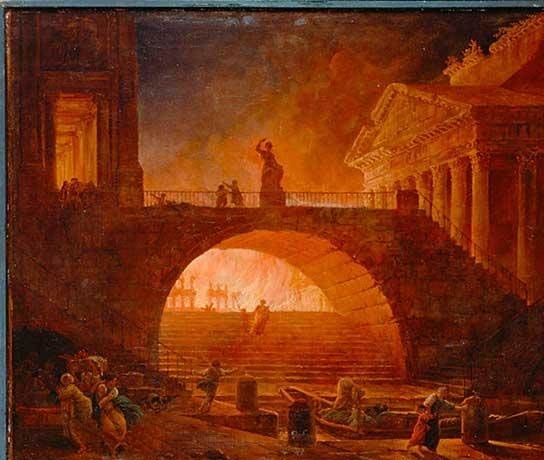
The Lessons of Rome: Our Neofeudal Oligarchy

Our society has a legal structure of self-rule and ownership of capital, but in reality it is a Neofeudal Oligarchy.
The Inheritance of Rome: Illuminating the Dark Ages 400-1000 is not an easy, breezy read; its length and detail are daunting.
The effort is well worth it, as the book helps us understand how the power structures of societies change over time in ways that may be largely invisible to those living through the changes.
The Inheritance of Rome focuses on the lasting influence of Rome's centralized social and political structures even as centralized economic power and trade routes dissolved.
This legacy of centralized power and loyalty to a central authority manifested 324 years after the end of the Western Roman Empire circa 476 A.D. in Charlemagne, who united much of western Europe as the head of the Holy Roman Empire. (Recall that the Eastern Roman (Byzantine) Empire endured another 1,000 years until 1453 A.D.)
But thereafter, the social and political strands tying far-flung villages and fiefdoms to a central authority frayed and were replaced by a decentralized feudalism in which peasants were largely stripped of the right to own land and became the chattel of independent nobles.
In this disintegrative phase, the central authority invested in the monarchy of kings and queens was weak to non-existent.
In the long sweep of history, it took several hundred years beyond 1000 A.D. for central authority to re-assert itself in the form of monarchy, and several hundred additional years for the rights of commoners to be established.
Indeed, it can be argued that it was not until the 1600s and 1700s--and only in the northern European strongholds of commoners' rights, The Netherlands and England--that the rights of ownership and political influence enjoyed by commoners in the Roman Empire were matched.
It can even be argued that the rights of Roman citizenship granted to every resident of the late Empire were only matched in the 19th and 20th centuries.
The rights of commoners were slowly chipped away by civil authorities and transferred to the feudal nobility. As the book explains, these rights included limited self-rule within village councils and ownership of land. These rights were extinguished by feudalism.
The connections between these civil society/legal freedoms (of self-rule and ownership of land/capital), the Protestant Reformation and the birth of modern Capitalism are explained by historian Fernand Braudel's masterful 3-volume history Civilization and Capitalism, 15th-18th Century, a series I have long recommended:
The self-reinforcing dynamics of religious, civil and economic freedoms are key to understanding the transition from feudalism/monarchy to the world systems of today, in which some form of self-rule or political influence and economic freedom are expected of every civil authority.
Let's fast-forward to today and ask what relevance these histories have in the present era.
There are two points worth discussing. One is the acceleration of change; what took 300 years now takes 30, or perhaps less.
The second is the slow erosion of commoners' self-rule and ownership of meaningful, productive capital.
This gradual, almost imperceptible erosion is what I call neofeudalism, a process of transferring political and economic power from commoners to a new Financial Aristocracy/Nobility.
If we examine the "wealth" of the middle class/working class (however you define them, the defining characteristic of both is the reliance on labor for income, as opposed to living off the income earned by capital), we find the primary capital asset is the family home, which as I have explained many times, is unproductive--in essence, a form of consumption rather than a source of income.
Ultimately, all pensions, public and private, are controlled by central authorities, even though "ownership" is nominally held by commoners. (Ask middle class Venezuelans what their pensions are worth once central authorities debauch the nation's currency.)
In a globalized, financialized economy, the only capital worth owning is mobile capital, capital that can be shifted by a keystroke to avoid devaluation or earn a a higher return.
Housing and pensions are "stranded capital," forms of capital that are not mobile unless they are liquidated before crises or expropriations occur.
I am also struck by the ever-rising barriers to starting or even operating small businesses, a core form of capital, as enterprises generate income and (potentially) capital gains.
The capital and managerial expertise required to launch and grow a legal enterprise is extraordinarily high, which is at least partly why a nation of self-employed farmers, shopkeepers, artisans and traders is now a nation of employees of government and large corporations.
What sort of capital can be acquired by the average commoner now? Enough to match the wealth and political power of financial Nobility? This is the source of our fascination with tech millionaires and billionaires: a few commoners have leveraged technology to join the Nobility.
As for political influence: a recent study found that voters had very little power in the U.S., which is effectively an oligarchy: Testing Theories of American Politics: Elites, Interest Groups, and Average Citizens.
Summary: "The U.S. government does not represent the interests of the majority of the country's citizens, but is instead ruled by those of the rich and powerful, a new study from Princeton and Northwestern universities has concluded."
Neofeudalism is not a re-run of feudalism. It's a new and improved, state-corporate version of indentured servitude. The process of devolving from central political power to feudalism required the erosion of peasants' rights to own productive assets, which in an agrarian economy meant ownership of land.
Ownership of land was replaced with various obligations to the local feudal lord or monastery-- free labor for time periods ranging from a few days to months; a share of one's grain harvest, and so on.
The other key dynamic of feudalism was the removal of the peasantry from the public sphere. In the pre-feudal era (for example, the reign of Charlemagne), peasants could still attend public councils and make their voices heard, and there was a rough system of justice in which peasants could petition authorities for redress.
From the capitalist perspective, feudalism restricted serfs' access to cash markets where they could sell their labor or harvests. The key feature of capitalism isn't just markets-- it's unrestricted ownership of productive assets--land, tools, workshops, and the social capital of skills, networks, trading associations, guilds, etc.
Our system is Neofeudal because the non-elites have no real voice in the public sphere, and ownership of productive capital is indirectly suppressed by the state-corporate duopoly.
Our society has a legal structure of self-rule and ownership of capital, but in reality it is a Neofeudal Oligarchy.
I discuss these dynamics in greater depth in my three compact books:
My book Money and Work Unchained is now $6.95 for the Kindle ebook and $15 for the print edition. Read the first section for free in PDF format.


If you found value in this content, please join me in seeking solutions by becoming a $1/month patron of my work via patreon.com. New benefit for subscribers/patrons: a monthly Q&A where I respond to your questions/topics.

NOTE: Contributions/subscriptions are acknowledged in the order received. Your name and email remain confidential and will not be given to any other individual, company or agency.
 
Thank you, Judith S. ($5/month), for your superbly generous pledge to this site-- I am greatly honored by your support and readership.
 

Read more...

Thursday, June 20, 2019

The Fed's Casino Is Giving Away Free Gambling Chips (But Only to the Super-Rich)

The rest of us eat our losses, either all at once or in bitter bites as we trudge through the financial wasteland left after bubbles burst.
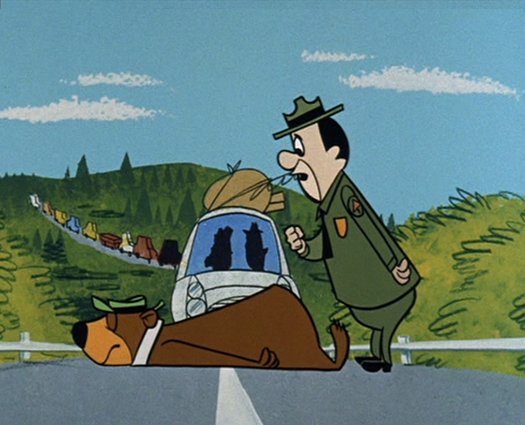
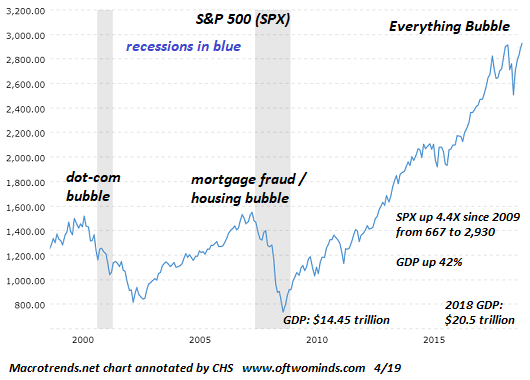
The news that the Federal Reserve Casino is giving away free gambling chips triggered a frenzied rush that trampled the bears, including poor Yogi:
There's just one catch to the giveaway: you have to be rich, and if you want more than a token free gambling chip, you need to be super-rich. Then you get a pile of free chips.
If you're not rich--none for you, debt-serf! If you're already super-rich, the Federal Reserve Casino has plenty of free gambling chips for you, which you are free to "invest" (heh) in just about any asset, since they're all going higher: gold, silver, bitcoin, stocks, bonds, bat guano, quatloos and of course shorting volatility, since volatility dies when the gambling chips are free.
If you're not rich, you're only allowed to gamble with cash you've saved from hard-earned income. And since your income has been stagnant for years or decades when adjusted for real-world inflation, that means you'll never have the leverage the super-rich have to acquire assets and watch them loft ever higher as the Federal Reserve Casino continues issuing free gambling chips to financiers, global corporations, banks and the super-wealthy.
The non-rich are allowed to borrow--but only at high rates of interest for worthless college degrees, rapidly depreciating pick-up trucks, groceries, $5 coffee beverages, etc.
When all is said and done, what's left from all this borrowing by the non-rich is the interest due the super-wealthy, who just so happen to own all the debt.
The only Federal Reserve Casino table open to the non-rich is housing, but with prices at bubble highs, it's a risky bet. Although you won't find any corporate media coverage of this, if you poke around the legal notices in newspapers (yes, the dead-tree variety), you'll find a steady trickle of mortgage foreclosures, as all the losers from the casino's housing roulette wheel are foreclosed by entities such as Deutsche Bank National Trust Company as Trustee for Morgan Stanley ABS Capital I, Inc. Trust and Deutsche Bank National Trust Company as Indenture Trustee for New Century Home Equity Loan Trust 2004-2.
Many of these defaulted mortgages date from the last housing bubble a decade ago. The lenders and mortgage-backed securities pools (legally, trusts managed by entities such as the Deutsche Bank National Trust Company) have kept these bad loans (non-performing loans, in the polite language of financial ruin) on the books, often under purposefully misleading guises to mask the enormity of the losses that are yet to be taken.
The bagholders of the defaulted mortgages are slowly liquidating the thousands of foreclosed homes under the radar now that absurd valuations are once again the norm. Since many of the foreclosed homes have not been maintained, they don't fetch much on the auction block.
The main point here is that there are losers even when the Federal Reserve is giving away free gambling chips. Since the stock market is the key signaling device that every gambler is a winner (so keep buying!), everyone reading the headlines and listening to to the daily reports of stocks rising to new highs is lulled into a very hazardous complacency: only the super-rich get bailed out when their bets go bad.
The rest of us eat our losses, either all at once or in bitter bites as we trudge through the financial wasteland left after bubbles burst.
My book Money and Work Unchained is now $6.95 for the Kindle ebook and $15 for the print edition. Read the first section for free in PDF format.


If you found value in this content, please join me in seeking solutions by becoming a $1/month patron of my work via patreon.com. New benefit for subscribers/patrons: a monthly Q&A where I respond to your questions/topics.

NOTE: Contributions/subscriptions are acknowledged in the order received. Your name and email remain confidential and will not be given to any other individual, company or agency.
 
Thank you, Brian M. ($10), for your most generous contribution to this site-- I am greatly honored by your support and readership.
 

Read more...

Wednesday, June 19, 2019

Dear Central Bankers: Prepare to be Swept Away in the Next Wave of Populism

The political moment when the "losers" connect their discontent and decline with central bankers is approaching.
The Ruling Elites' Chattering Classes still haven't absorbed the key lesson of the 2016 U.S. presidential election: the percentage of the populace that's becoming wealthier and more financially secure in the bloated, corrupt, self-serving Imperial status quo is declining and the percentage of the populace that's increasingly insecure and financially precarious is increasing, and candidates that mouth the usual platitudes in support of the bloated, corrupt, self-serving Imperial status quo lose to those who speak of the failing status quo as a travesty of a mockery of a sham, i.e. a "populist" speaking truth to power.
Donald Trump steered clear of the status quo's favored platitudes and embraced a bit of populist cant, and so to those who understand that the majority of Americans have been abandoned by America's hubris-soaked, self-serving managerial / ruling elites, his victory was not entirely surprising.
Just as we've reached Peak hubris-soaked, self-serving managerial / ruling Elites, we've also reached Peak Central Bank Cargo Cult: from now on the majority that's been abandoned by the managerial / ruling elites will become increasingly aware that the unprecedented asymmetries of wealth and power that have undermined American social and economic life can be traced directly back to the central bank, the Federal Reserve, which has become the all-powerful Cargo Cult of the global economy.
The same awareness of central bankers' responsibility for soaring wealth-income inequality and the decline of social mobility is spreading in other nations as well.
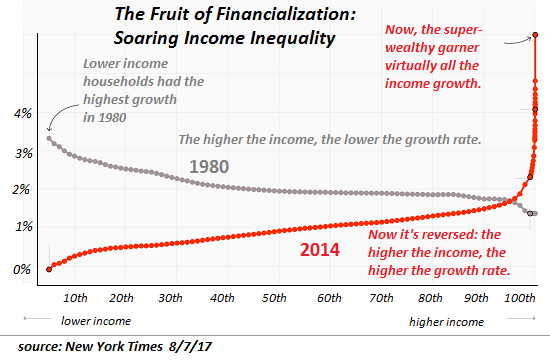
Longtime readers are probably tired of the chart below, depicting the incredible expansion of wealth in the already super-wealthy and the stagnation in the prospects of the bottom 95%. But let's shake off the boiled-frog syndrome and check the temperature of the political water we're immersed in: It's getting hotter--a lot hotter.
The ideological rhetoric of the next wave of populism matters less than its intensity. It's not just possible but increasingly likely that the next populist wave will assume many of the populist positions of the Left, positions which the "progressive" status quo is desperately attempting to co-opt and water down.
The core reality that powers populism Left and Right is the economy no longer works as advertised for the bottom 80%, and by many measures, the bottom 95%. The "conservative" camp generally holds that the "problem" is markets have been throttled by heavy-handed government regulations while "progressives" see private-sector wealth / power as as the problem and "taxing the rich" and redistributing the wealth as the solution.
What neither status quo camp dares mention is the domination of central bankers and the "winners" of their dominance, financiers, global corporations and state-enforced monopolies / cartels. (The losers are of course the rest of us: tax donkeys, debt-serfs, wage slaves, the restive crowd demanding more bread and circuses, etc.)
The political moment when the "losers" connect their discontent and decline with central bankers is approaching. Perhaps the wires will arc in 2020, or maybe it will be 2025; but whatever the timing turns out to be, the all-powerful Cargo Cult of the central bankers will be swept away in a global political convulsion unlike any in memory.
If you harbor any doubts about the demise of the Central Bank Cargo Cult, reflect a bit longer on the meaning of this chart:
My book Money and Work Unchained is now $6.95 for the Kindle ebook and $15 for the print edition. Read the first section for free in PDF format.


If you found value in this content, please join me in seeking solutions by becoming a $1/month patron of my work via patreon.com. New benefit for subscribers/patrons: a monthly Q&A where I respond to your questions/topics.

NOTE: Contributions/subscriptions are acknowledged in the order received. Your name and email remain confidential and will not be given to any other individual, company or agency.
 
Thank you, Zachary H. ($50), for your massively generous contribution to this site-- I am greatly honored by your support and readership.
 

Read more...

Tuesday, June 18, 2019

America's Managerial Elite Has Failed, But We Can't Get Rid of Them

The system is broken, and the managerial elite will keep it broken because it serves their interests to keep it broken.
America's managerial elite came to do good and stayed to do well--at the expense of everyone beneath them. Now that they've entrenched themselves at the top of the status quo, there's no way to dislodge them, even as their failure to address what's broken, much less actually fix what's broken, insures systemic breakdown.
In government, the managerial elite is known as The Deep State: those who remain in power regardless of who's in elected office. In local government, managerial elites often shift positions, moving from elected office to a plum position in the bureaucracy where they can draw a big paycheck out of sight until they retire.
In Corporate America, managerial elites also move around, leaving sinking ships (that they may well have helped sink) as needed, and moving to think tanks or academia if their failures start multiplying.
Changing elected officials does nothing to dislodge our managerial elite overlords. The new mayor, governor or president comes and goes, and all the major institutions--education, higher education, healthcare, national defense, critical infrastructure--continue down the same path of enriching entrenched insiders while the institution fails its core missions.
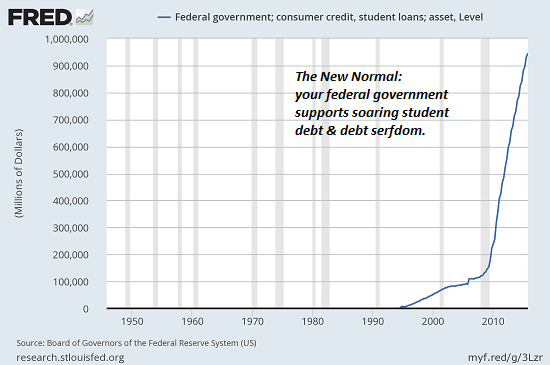
If you think this chart of soaring student loan debt is a sign of "success," you are 1) delusional 2) protected from the dire consequences of this failure 3) getting your paycheck from this failed system. That in a nutshell is the state of the nation: those who are protected from the consequences of failure are loyal to the Establishment, as are the millions drawing a paycheck from systems they know are irredeemable failures.
Let's review the central institutions of the nation:
1. Healthcare: a failed system doomed to bankrupt the nation.
2. Defense: a failed system of cartels and Pentagon fiefdoms that have saddled the nation with enormously costly failed weapons systems like the F-35 and the LCS.
3. Higher Education: a bloated, failed system that is bankrupting an entire generation while mis-educating them for productive roles in the emerging economy. (I cover this in depth in The Nearly Free University and the Emerging Economy and Get a Job, Build a Real Career and Defy a Bewildering Economy.)
4. Foreign policy: Iraq: a disaster. Afghanistan: a disaster. Libya: a disaster. Syria: a disaster. Need I go on?
5. Political governance: a corrupt system of self-serving elites, lobbyists, pay-to-play, corporate puppet-masters, and sociopaths who see themselves as above the law.
In Why Our Status Quo Failed and Is Beyond Reform, I explain why the only possible output of these systems is failure.
The sole output of America's managerial elite is self-serving hubris.
In an open market, failed leadership has consequences. Customers vanish and the enterprise goes bankrupt, or shareholders and employees rally to fire the failed leadership.
In our state-cartel system, failed leadership only tightens its grip on the nation's throat. The Deep State can't be fired, nor does it ever stand for election. The two political parties are interchangeable, as are the politicos who race from fund-raiser to fund-raiser.
It's tempting to blame the individuals who inhale the wealth and power of our failed system, but it's the system, not the individuals, though a more corrupt, craven, self-serving lot cannot easily be assembled.
Centralized hierarchies concentrate power at the top of the pyramid. That power is a magnet for everyone who seeks to wield power and enrich themselves in the process.
In the financial system, this concentration of power is visible in the chart below: the super-rich have become immensely richer in the past few decades of central banks' vast expansion of credit and financialization.
As systems become more complex, the need for a professional class to manage the overwhelming complexity grows. This class excels at appearing to manage complexity while ignoring the larger dynamics driving the system over the cliff.
And so we have endless meetings of highly paid people over trivial issues while the entire system careens toward meltdown. "Stakeholders" multiply in endless profusion, dooming every project to a glacial process that increases the sums paid to manage the glacial process and pushes the final cost to the moon.
The self-serving managerial elite always has one answer for every problem: give us more money. If the budget expands by 10% and nothing actually changes for the better, then the "solution" is a 25% increase in funding.
Budgets expand by leaps and bounds, but none of the systemic problems are ever resolved.
It's not hard to figure out why: look at the system's incentives. If systems were radically simplified and made more efficient, the need for an ever-expanding class of permanent managers would diminish. And so the solution is always more fodder for the managerial elite: more complexity, more meetings, more accumulation of power, more managers and always, more money.
Thus it is no surprise that the calls for "free" college and "Medicare for All" are rising: the managerial elite that has bankrupted higher education and healthcare while enriching themselves desperately needs to be bailed out, lest the systems they've steered toward the fiscal cliff deservedly go broke.
In a similar set of incentives, few weapons systems ever come in under budget when the Pentagon can always come up with another $10 or $20 billion for cost over-runs.
The system is broken, and the managerial elite will keep it broken because it serves their interests to keep it broken. Unfortunately we'll all suffer when the managerial elite is no longer able to stave off the dire fiscal consequences of their self-serving leadership.


Pathfinding our Destiny: Preventing the Final Fall of Our Democratic Republic ($6.95 ebook, $12 print, $13.08 audiobook): Read the first section for free in PDF format.


My new mystery The Adventures of the Consulting Philosopher: The Disappearance of Drake is a ridiculously affordable $1.29 (Kindle) or $8.95 (print); read the first chapters for free (PDF)
My book Money and Work Unchained is now $6.95 for the Kindle ebook and $15 for the print edition. Read the first section for free in PDF format.


If you found value in this content, please join me in seeking solutions by becoming a $1/month patron of my work via patreon.com. New benefit for subscribers/patrons: a monthly Q&A where I respond to your questions/topics.

NOTE: Contributions/subscriptions are acknowledged in the order received. Your name and email remain confidential and will not be given to any other individual, company or agency.
 
Thank you, Donald C. ($50), for your magnificently generous contribution to this site-- I am greatly honored by your steadfast support and readership.
 

Read more...

Sunday, June 16, 2019

How Much of Your "Wealth" Is Hostage to Bubbles and Impossible Promises?

All asset "wealth" in credit-asset bubble dependent economies is contingent and ephemeral.
A funny thing happens to "wealth" in a bubble economy: it only remains "wealth" if the owner sells at the top of the bubble and invests the proceeds in an asset which isn't losing purchasing power.
Transferring "wealth" to another asset bubble that is also deflating doesn't preserve the "wealth" from evaporation.
All the ironclad promises made in bubble economies ultimately depend on credit-asset bubbles never popping--but sadly, all credit-asset bubbles pop. So all the promises--which are of course politically impossible to revoke--will be broken as all the credit-asset bubbles that created the "wealth" that was to be redistributed--pensions, retirement benefits, etc.--deflate.
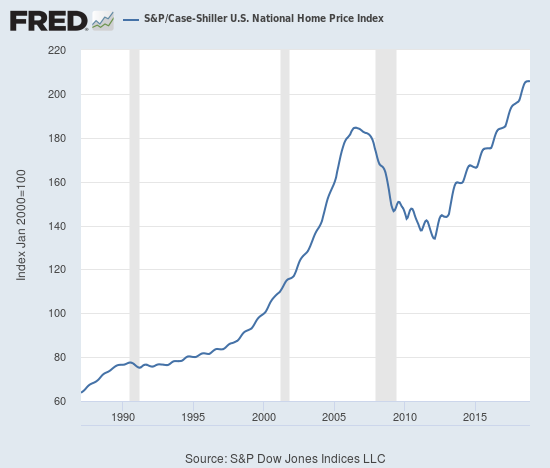
Consider the Case-Shiller housing index chart below. Housing is an asset that has reached the apex of a second bubble. (Stocks are reaching the apex of a third bubble.)
It is widely viewed as "impossible" for the housing market to lose 50% to 75% of its value. It is equally widely viewed as "impossible" for the stock market to lose 50% to 75% of its value.
Yet all credit-asset bubbles pop and lose 50% to 75% of their value--or even more. What's "impossible" isn't the bubbles popping--what's impossible is for bubbles to inflate forever and never pop.
Yet this impossibility is the foundation of all pensions and other promises: the pensions are only payable if all the credit-asset bubbles keep on expanding and never pop. They're also equally dependent on marginal borrowers never defaulting, marginal companies never going belly-up, and marginal speculations never going bust.
But this is precisely what marginal borrowers, companies and speculative ventures do--they blow up and default, delivering neutron-bomb like losses to the lenders: the physical assets remain, but the the "wealth" has been utterly destroyed.
Meanwhile, back at the government ranch, the vast majority of tax revenues are also dependent on credit-asset bubbles never popping. Most of the capital gains taxes reaped in bubbles dry up and blow away, high-earners who pay most of the income taxes lose their jobs or bonuses, and absurdly overvalued real estate that generated outlandish property taxes loses half its value, slashing property tax valuations.
Two retracement levels beckon on the Case-Shiller Home Price Index: a retrace to the previous Bubble #1 lows--a roughly 33% decline--or a full retrace back to pre-Bubble #1 levels, about a 60% drop from current levels.
In bubblicious regions that have seen decaying bungalows on postage-stamp lots rise 10-fold from $100,000 to $1 million, an 80% drop would be expected if history is any guide. This will be quite a shock to buyers who assumed that their home "wealth" would double from $1 million to $2 million.
All asset "wealth" in credit-asset bubble dependent economies is contingent and ephemeral. "Sure things" become less sure when credit bubbles pop and self-reinforcing defaults topple an ever widening circle of dominoes.
How much of your "wealth" is tied up in bubbles and impossible-to-keep promises? Only those who sell at the top before the herd panics and move their "wealth" into the few assets that are maintaining or gaining their purchasing power will still have their "wealth" after the conflagration turns credit-bubble "wealth"into ashes.


Pathfinding our Destiny: Preventing the Final Fall of Our Democratic Republic ($6.95 ebook, $12 print, $13.08 audiobook): Read the first section for free in PDF format.


My new mystery The Adventures of the Consulting Philosopher: The Disappearance of Drake is a ridiculously affordable $1.29 (Kindle) or $8.95 (print); read the first chapters for free (PDF)
My book Money and Work Unchained is now $6.95 for the Kindle ebook and $15 for the print edition. Read the first section for free in PDF format.


If you found value in this content, please join me in seeking solutions by becoming a $1/month patron of my work via patreon.com. New benefit for subscribers/patrons: a monthly Q&A where I respond to your questions/topics.

NOTE: Contributions/subscriptions are acknowledged in the order received. Your name and email remain confidential and will not be given to any other individual, company or agency.
 
Thank you, Creedon M. ($20), for your most generous contribution to this site-- I am greatly honored by your support and readership.
 

Read more...

Terms of Service

All content on this blog is provided by Trewe LLC for informational purposes only. The owner of this blog makes no representations as to the accuracy or completeness of any information on this site or found by following any link on this site. The owner will not be liable for any errors or omissions in this information nor for the availability of this information. The owner will not be liable for any losses, injuries, or damages from the display or use of this information. These terms and conditions of use are subject to change at anytime and without notice.

RE: European Union AI Act, and Our Use of Generative AI Tools and Agents Policy

All text on this site is composed by Charles Hugh Smith or by a credited guest-author. No Generative AI Tools are used in the composition / writing of any text or graphic content created by Charles Hugh Smith. This site deploys no AI agents or generative AI tools. This site is not responsible for the disclosures, use or non-use of AI agents or generative AI tools in advertisements displayed by Investing Channel or other ad placement services.

Audio files generated by text-to-audio transcription tools are identified as such.

Our Privacy Policy:

Correspondents' email is strictly confidential. This site does not collect digital data from visitors or distribute cookies. Advertisements served by third-party advertising networks such as Investing Channel may use cookies or collect information from visitors for the purpose of Interest-Based Advertising; if you wish to opt out of Interest-Based Advertising, please go to Opt out of interest-based advertising (The Network Advertising Initiative) If you have other privacy concerns relating to advertisements, please contact advertisers directly.

PRIVACY NOTICE FOR EEA INDIVIDUALS

This section covers disclosures on the General Data Protection Regulation (GDPR) for users residing within EEA only. GDPR replaces the existing Directive 95/46/ec, and aims at harmonizing data protection laws in the EU that are fit for purpose in the digital age. The primary objective of the GDPR is to give citizens back control of their personal data. Please follow the link below to access InvestingChannel's General Data Protection Notice.
https://stg.media.investingchannel.com/gdpr-notice/

Notice of Compliance with The California Consumer Protection Act

This site does not collect digital data from visitors or distribute cookies. Advertisements served by a third-party advertising network (Investing Channel) may use cookies or collect information from visitors for the purpose of Interest-Based Advertising. If you do not want any personal information that may be collected by third-party advertising to be sold, please follow the instructions on this page: Do Not Sell My Personal Information.

Regarding Cookies:

This site does not collect digital data from visitors or distribute cookies. Advertisements served by third-party advertising networks such as Investing Channel may use cookies or collect information from visitors for the purpose of Interest-Based Advertising; if you wish to opt out of Interest-Based Advertising, please go to Opt out of interest-based advertising (The Network Advertising Initiative) If you have other privacy concerns relating to advertisements, please contact advertisers directly.

Our Commission Policy:

Though I earn a small commission on Amazon.com books and gift certificates and gold (BullionVault) purchased via links on my site, I receive no fees or compensation for any other non-advertising links or content posted on my site.

Copyright Notice:

All original images (Drawings and Photographs), text (essays, books and works of fiction), audio and video recordings, musical compositions, graphic design, graphic design elements and HTML coding on this site are the copyrighted work of Charles Hugh Smith unless otherwise credited or noted. They are published as information for the private use of site visitors, and any reproduction or redistribution of this content or coding in any media in any format or distribution channel (text, audio, video/film, web) without the written permission of the copyright holder is strictly prohibited. All rights in all media reserved globally.

  © Blogger templates Newspaper III by Ourblogtemplates.com 2008

Back to TOP