





Choose One: Housing Is Shelter, or Housing Is Just Another Asset in a Bubble Economy
Those seeking housing as shelter cannot compete with wealthy households and entities seeking places to park credit-generated capital for income and/or appreciation.
This will get massive pushback because it's true: either Housing Is Shelter, or Housing Is Just Another Asset in a Bubble Economy--it can't be both. This reality gets pushback because the conversion of housing from shelter into just another asset bubbling higher in a bubble-dependent economy has been so profitable for those inflating the bubble.
The basic pushback goes like this: housing has always been an investment, nothing has changed. This is classic misdirection. This is like saying "stock market options have always been a way to hedge positions" to justify the transition from hedging to extremes of gambling, i.e. zero-day expiration options (ODTE).
Whenever I suggest that housing is being hoarded by the wealthy and corporations as a low-risk asset to park credit-generated capital, I get pushback: no, I'm told, the percentage of housing that's empty most or all of the year owned by the wealthy and corporations is tiny, as is the percentage of housing owned as short-term vacation rentals (STVRs).
The problem with these claims is they're based on completely fraudulent / inaccurate statistics. There is no regulatory system that audits whether owners who obtained "owner occupied" mortgages actually live in the dwelling, or whether owners (especially those hidden behind LLCs and other cloaking mechanisms) are "owner occupants" as claimed.
Owner-Occupancy Fraud and Mortgage Performance (Philadelphia Federal Reserve) Occupancy fraud has been suggested as a contributor to the housing bubble. We show it was pervasive and remains present.
In other words, even the most cursory audits find significant percentages of "owner occupied" housing is vacant most or all of the time or is an unregistered short-term vacation rental. Anecdotally, many upper-middle class households own not just vacation / second homes in rural locales but "investment" homes that are empty or they use occasionally in urban areas, which due to high demand / valuations are hoarded because selling them in a bubble economy means the sellers will be unable to buy back into the market in the future.
The "monetize your empty room" AirBnB idea that began the short-term vacation rental market has transmogrified into a monster consuming the housing market in resort locales. Surveys have found that 15% or more of all available housing in resort locales is now absentee-owner short-term vacation rentals, and two-thirds of condominium buyers are out-of-state.
STVRs Have Destroyed America's Resort Towns
Some argue this doesn't matter because resort housing tends to be in rural regions with few jobs. It matters to local residents who are priced out. But "investment" housing isn't limited to resorts; there are an unknown but consequential number of vacant / STVR "investment" housing units in urban areas with jobs and strong demand for permanent housing.
Cities with rent control such as San Francisco and New York have renters who keep their low-cost flat vacant while living abroad. Since the rent-controlled apartment cannot be replaced once it's surrendered, it makes sense to hoard the rental for future or occasional use. Again, there is no system of auditing who actually lives in a dwelling as a permanent resident, as this is viewed in the US as an invasion of privacy.
(In Japan, local authorities keep close tabs on who is actually living in every dwelling as a matter of course. When we stayed in a friend's temporarily vacant flat for a few days, officials came to the door to check on who we were.)
The monetary policies of suppressing interest rates and expanding credit have favored the wealthy who have the income to support additional mortgages and the need to park their expanding capital somewhere. Housing is attractive because it's less volatile than the stock market and offers higher appreciation in a bubble economy than bonds.
Those seeking housing as shelter cannot compete with wealthy households and entities seeking places to park credit-generated capital for income and/or appreciation. In a bubble-dependent economy, there's no need to go through all the trouble of renting an empty dwelling, as the appreciation alone makes the investment worthwhile. Renting out an "investment" incurs risks and costs that are best avoided--unless the property generates a hefty profit as a remotely managed unregistered short-term vacation rental.
Once again, the pushback is pushback against inconvenient truths that threaten the ownership class that has reaped gains from housing as an asset class in a bubble economy. It's now evident that large corporate owners of thousands of rental units have used predatory pricing--oops, I mean dynamic pricing--to jack up rents in markets they are dominant players in; once the price point is set higher, small landlords push up their rents to the new "market price."
In a non-bubble economy, credit is scarce and expensive, and so asset bubbles can't be inflated as credit inflates. As credit inflates, the pool of money sloshing around seeking a low-risk home for safety and appreciation expands, and this pool sloshes into housing, driving home prices and rents out of reach of those whose income is wages, not wages plus capital-generated income.
Bubbles in housing generate artificial scarcity, scarcity not in the total number of dwellings but in the number of dwellings available and within reach for those seeking shelter, i.e. whatever is left after wealthy households and corporations with access to credit snap up housing as a low-risk place to park capital that offers tax benefits and appreciation.
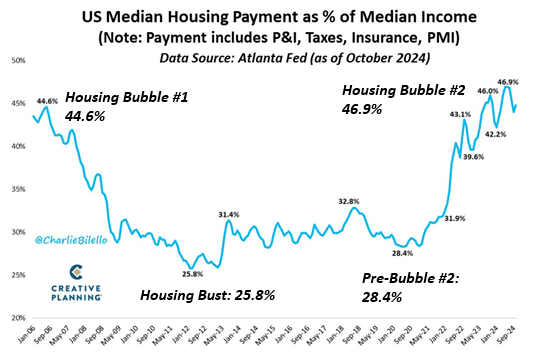
Housing affordability has reached historic lows.
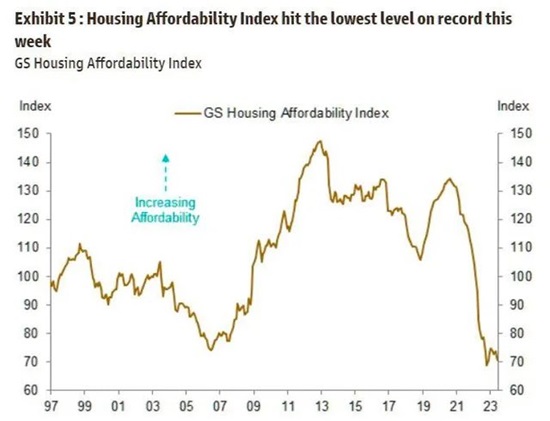
Housing payments have reached historic highs.
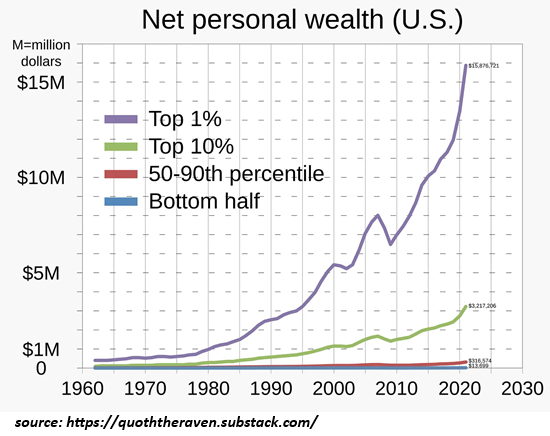
The wealthiest 10% have used their income and credit to bid up assets which bubble higher in bubble-dependent economies.
So here's the truth: we can choose housing as shelter or housing as an asset in a bubble economy, but we can't choose both. Housing as an asset in a bubble economy pushes housing out of reach of those seeking shelter.
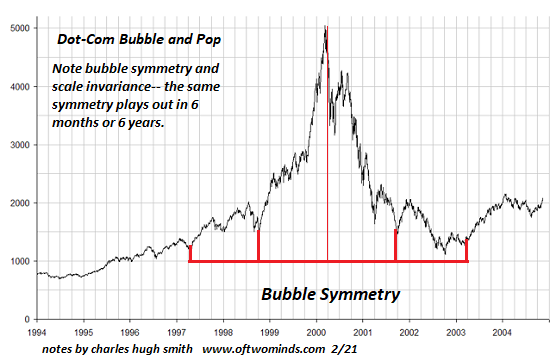
And of course there's pushback against the truth that ours is a bubble-dependent economy. For a definitive answer, let's see how well the economy is doing after all the credit-asset-speculative bubbles pop and decline back to their starting point.
My book Investing In Revolution is available at a 10% discount ($18 for the paperback, $24 for the hardcover and $8.95 for the ebook edition).
Introduction (free)
Become
a $3/month patron of my work via patreon.com
Subscribe to my Substack for free
NOTE: Contributions/subscriptions are acknowledged in the order received. Your name and email remain confidential and will not be given to any other individual, company or agency.
|
Thank you, Wade P. ($70), for your marvelously generous subscription to this site -- I am greatly honored by your support and readership. |
Thank you, Richard C. ($7/month), for your wondrously generous subscription to this site -- I am greatly honored by your support and readership. |
|