

The Joys and Tragedies of Naivete
Our naivete is being exploited so ruthlessly and with such abandon that the golden age of the Big Con is consuming itself.
Naivete is interesting because it's so easily confused with confidence, native optimism, youthful enthusiasm, and a host of delusions, including mistaking idealized fantasies and fairy tales as templates for the real world. In a culture that prides itself on not being a chump, to be called naive is an accusation: don't be naive means don't be an easily conned chump.
In contrast, being confident, optimistic and filled with youthful enthusiasm are praised as the core of American Practicality, Idealism and Vigor, i.e. the can-do spirit. That naivete lends itself to youthful enthusiasm, sunny optimism and can-do confidence is rarely remarked upon.
So what is naivete other than credulity? It's a willingness to trust leaders, institutions and mythologies without running them through common-sensically skeptical filters, and a belief that everything will work out just fine regardless of what happens if we just keep working hard and working smart.
The difference between a willingness to trust leaders, institutions and mythologies, sunny optimism and youthful enthusiasm and naively mistaking self-serving fantasies and fairy tales for the real world is, well, there isn't any. Believing that an unending stream of patently transparent self-serving fairy tales accurately reflect "the real world" is the pinnacle of naivete, and that describes the entire American society, culture and economy: this is the golden age of the Big Con.
Which brings us to Herman Melville's under-appreciated classic, The Confidence-Man.
Why read a book from 1857 which flopped so badly as commercial literature that Melville stopped writing and ended his career as a customs official? Because this book masterfully explores the entire nature of trust, confidence and cons. Though the setting is a riverboat on the Mississippi River just before the U.S. exploded into Civil War, its insights cross cultural boundaries.
This is not an easy book to read for several reasons. First, it is undoubtedly one of the first "post-modern" novels which breaks from traditional narrative storytelling. ( Another example: Dostoevsky's Notes From the Underground.) The Confidence-Man is a collection of 45 conversations between various people on the riverboat--beggars, absurdly dressed frontiersmen, sickly misers, shysters, patent medicine hucksters, veterans (of the Mexican-American War) and the "hero" in the latter part of the book, the Cosmopolitan.
In typical Melville fashion, you also get asides--directly to the reader, in several cases, as if Melville felt the need to address issues of fiction outside the actual form of his novel. The lack of structure, action and conclusion make this a post-modern type book, but if you read each conversation as a separate story, then it starts to make more sense.
For what ties the book together is not a story but a theme: the nature of trust and confidence. In a very sly way, Melville shows how a variety of cons are worked, as the absolutely distrustful are slowly but surely convinced to do exactly what they vowed not to do: buy the "herbal" patent medicine, buy shares in a bogus stock venture, or donate cash to a suspect "charity."
In other chapters, it seems like the con artist is either stopped in his tracks or is conned himself. Since the book is mostly conversations, we are left to our own conclusions; there is no authorial voice wrapping up each chapter with a neatly stated ending. This elliptical structure conveys the ambiguous nature of trust; we don't want to be taken, but confidence is also necessary for any business to be transacted. To trust no one is to be entirely isolated.
Melville also raises the question: is it always a bad thing to be conned? The sickly man seems to be improved by his purchase of the worthless herbal remedy, and the donor conned out of his cash for the bogus charity also seems to feel better about himself and life. The ornery frontiersman who's been conned by lazy helpers softens up enough to trust the smooth-talking employment agency owner. Is that a terrible thing, to trust despite a history of being burned?
The ambiguous nature of the bonds of trust is also explored. We think the Cosmopolitan is a con-man, but when he convinces a fellow passenger to part with a heavy sum, he returns it, just to prove a point. Is that a continuance of the con, or is he actually trustworthy?
The book is also an exploration of a peculiarly American task: sorting out who to trust in a multicultural non-traditional society of highly diverse and highly mobile citizens. In a traditional society, things operate in rote ways; young people follow in their parents' traditional roles, money is made and lent according to unchanging standards, and faith/tradition guides transactions such as marriage and business along well-worn pathways.
But in America, none of this structure is available. Even in Melville's day, America was a polyglot culture on the move; you had to decide who to trust based on their dress, manner and speech/pitch. The con, of course, works on precisely this necessity to rely on one's senses and rationality rather than a traditional network of trusted people and methods. So the con man dresses well and has a good story, and an answer for every doubt.

Our naivete is being exploited so ruthlessly and with such abandon that the golden age of the Big Con is consuming itself. Delusions are now the norm, as if our unhinged optimism that everything will turn out just fine as long as we believe in Technology and Finance, for that will be enough to stem the tsunami of consequences building up beneath the surface euphoria of stocks and AI making us all wealthy beyond measure.
These are the joys of naivete. The tragedies are still over the horizon, a gathering storm we are unprepared for.
NEW PODCAST:
We Don't Have Capitalism Anymore--We Have Privatized Totalitarianism (60 minutes)(host Daniel H.)
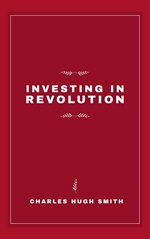
My book Investing In Revolution is available at a 10% discount ($18 for the paperback, $24 for the hardcover and $8.95 for the ebook edition).
Introduction (free)
Become
a $3/month patron of my work via patreon.com
Subscribe to my Substack for free
NOTE: Contributions/subscriptions are acknowledged in the order received. Your name and email remain confidential and will not be given to any other individual, company or agency.
|
Thank you, Joe S. ($70), for your superbly generous subscription to this site -- I am greatly honored by your support and readership. |
Thank you, Randy J. ($70), for your marvelously generous subscription to this site -- I am greatly honored by your support and readership. |
|
|
Thank you, Nick H. ($7/month), for your massively generous subscription to this site -- I am greatly honored by your support and readership. |
Thank you, Jeff M. ($7/month), for your splendidly generous subscription to this site -- I am greatly honored by your support and readership. |