





Tuesday, September 22, 2015

Financial Independence via Self-Employment: How Do We Do It?

Financial independence via self-employemnt is still possible, and there are a number of pathways to that goal.
The conventional financial industry touts gaining financial independence by playing Wall Street's game: working a conventional job for decades to accumulate a chunk of money in retirement funds that Wall Street wizards magically squeeze for hefty annual returns in a zero-yield world--in a completely risk-free manner that keeps your nest egg intact, of course.
This annual yield on the large sum squirreled away over the decades then (supposedly) enables a spacious retirement home on the golf course, luxury cruises, etc. (Uh, right. Unless stocks and bonds crater, Wall Street's hedges crumble and the global economy slides into recession--y'know, everything that's happening now.)
(And never mind many households can't possibly save enough to accumulate a big nest egg due to stagnating wages and soaring costs of big-ticket expenses like healthcare and college.)
The other pathway to high-income retirement is to manage your career to earn multiple government pensions: in areas with large Department of Defense (DoD) installations, (military and civilian), this often means 20 years in military or civil-service that comes with a pension and healthcare benefits, followed by a second career in another government agency that secures another pension and maybe Social Security, too: this is the classic Triple-Dipper retirement plan.
A similar pathway is to have two workers in the household each retire with a government pension and Social Security, so the household income includes four secure pensions.
The third avenue to financial independence is not so much about retirement--it's about financial independence during your career/working life as well as retirement. The ideal retirement scenario for the self-employed is simply a reduction in the work you don't much like and a continuation of the work you enjoy until the end of your life.
My credo is: Focus not on retiring comfortably, but on working comfortably.
Self-employment is a core mythology of the American Dream--working for yourself as the ideal form of work. Self-employment's place in the pantheon of American ideals did not prepare me for startling reality that a mere 5% of the workforce (about 7.4 million out of 145 million) earn a middle class living as self-employed (i.e. sole proprietors or partnerships/S-corporations with no employees).
I laid out the statistics in Endangered Species: The Self-Employed Middle Class. According to the source, there are roughly 6 million small businesses with employees. While running a small business with employees is certainly working for yourself, the requirements in terms of management, experience and capital are far more daunting than sole proprietorship, which is why I'm focusing only on the 7.4 million sole proprietors who make $50,000 or more annually.
This picture isn't entirely complete, however; unearned income, for example, from rental properties or family trusts, is not recorded as self-employed income (Schedule C); rental income is reported on Schedule E, and these earnings are not subject to self-employment payroll taxes (15.3%, as the self-employed pay both the employee and the employer portions of the payroll taxes).
So someone who owns rental properties could be financially independent and not be officially considered self-employed, even though they actively manage their properties.
There are a number of other interesting statistics in the IRS spreadsheet Table 1.4, All Returns: Adjusted Gross Income, Exemptions, Deductions, and Tax Items for tax year 2012 that help us understand how the self-employed earn their income.
This data tells us how many people are earning middle-class incomes from rental properties, royalties and earned income.
The IRS reports that 18.7 million taxpayers paid self-employment taxes, and 7.4 million of them earned $50,000 or more annually.
8,214 of these self-employed raked in $10 million or more annually. (I presume this includes athletes, film stars, etc.)
4.8 million people reported positive rental income, of which 2.95 million reported earning $50,000 or more in rental income annually.
1.25 million taxpayers reported earning $50,000 or more in royalties annually. (7,585 reported earning $10 million or more in royalties--subtracting Steven King and a few musicians, who else earns these princely sums? I suspect most are patent royalties.)
As I noted before, only 2.4 million earners deducted healthcare insurance payments. This suggests that many of the self-employed are in households where someone is getting healthcare coverage for the household from their employer. Alternatively, millions of self-employed don't have any healthcare insurance. This seems unlikely.
For this reason, I consider this the most accurate guide to the truly self-employed earning a middle-class income: 2.4 million people out of a work force of 145 million.
So what does all this say about self-employment? I think we can draw a few conclusions:
1. Establishing a profession is one tried-and-true way to be self-employed. Obtaining the diploma and license does not guarantee an income, of course, as competition can be plentiful in certain professions and regions.
2. Owning rental properties is a path to financial independence that works for almost 3 million people/households.
3. Owning the rights to creative content or patents that generate royalties is a ticket to financial independence for 1.25 million people.
4. There are many other sole proprietorships (about 3 million based on the IRS data) that manage to net $50,000 or more annually. Presumably some qualify as Mobile Creatives who cobble together several income streams to generate enough to live independently.
5. Over 10 million people are earning meaningful sums from small (less than $50K/yr) enterprises, rentals and royalties. These don't generate $50,000 a year, but they still make an important contribution to financial independence, income and capital/wealth.
6. Businesses that eventually earn $50,000 or more typically start small, so many of the people currently earning less than $10K/year could over time increase their income or add another modest income stream.
Financial independence via self-employemnt is still possible, and there are a number of pathways to that goal. The path I consider the most flexible and thus the most attainable by non-professionals is the Mobile Creative idea of generating multiple income streams, preferably from sources that are not all tied to the same industry so that a downturn in one sector won't wipe out the entire household income.
The Mobile Creative credo is simple: trust your network, not the corporation or the state.
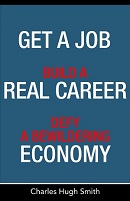
I cover Mobile Creatives, the Emerging Economy, the eight essential skills and avenues to an autonomous career in my book Get a Job, Build a Real Career and Defy a Bewildering Economy.


NOTE: Contributions/subscriptions are acknowledged in the order received. Your name and email remain confidential and will not be given to any other individual, company or agency.
Thank you, Steve K. ($50), for your fabulously generous contribution to this site -- I am greatly honored by your support and readership.
Thank you, Kisco Enterprises ($5/month), for your superbly generous subscription to this site -- I am greatly honored by your support and readership.

Read more...

Monday, September 21, 2015

The New Shackle of Serfdom: Clinging to Healthcare Insurance

The shackles of this new serfdom are invisible, but no less destructive for being invisible.
One of the more remarkable characteristics of American life is our passive acceptance of systems that are so obviously completely insane. Yes, I refer to our healthcare system, a.k.a. sickcare because in America sickness is profitable and health is not, and healthcare profiteering that would be the envy of pirates and warlords everywhere is the norm.
What warlord wouldn't jump on the opportunity to jack up the cost of a medication from $13.50 a tablet to $750 overnight, or as the article highlights, jack up the cost of an off-patent med from $1 a pill to $750 a pill in a few years?
This piratical pillaging is not an outlier--it's the norm in America's parasitic pharmaceutical industry:
Cycloserine, a drug used to treat dangerous multidrug-resistant tuberculosis, was just increased in price to $10,800 for 30 pills from $500 after its acquisition by Rodelis Therapeutics.
Imagine getting to jack your weekly wage from $500/week to $10,800/week while issuing a laughably lame excuse.
These profiteering prices are not the shackle of serfdom, at least not directly; few pay these prices in cash--insurers pay. And when prices rise, insurers jack their rates up accordingly (plus a bit to cover their costly political lobbying and the profit margins expected of quasi-monopolies).
Healthcare insurance is the new shackle of serfdom: Americans are forced to cling to whatever coverage they have, lest they lose coverage and risk bankruptcy.
Low-income Americans theoretically don't have to worry, as their medical care is covered by Medicaid. (They only need to find doctors and clinics that accept Medicaid. Good luck with that....)
Retired Americans only have to scrape up the few hundred bucks for Medicare Parts A, B, C, D, and of course E through Z (shall we talk about insane levels of complexity in the system? Perhaps another time...).
Modern capitalism has one necessary dynamic: the mobility of labor and capital.Financial capital is entirely mobile now; a click of a mouse button is all that's needed to send capital almost anywhere.
What happens to labor mobility when no one dares quit because that would mean losing their medicare coverage? Yes, I can already hear the obvious: the new employer will provide the same coverage.
Oh really? What if the new employer is the worker himself? What if the new employer is too under-funded to afford America's insanely costly healthcare?
And please don't offer ObamaCare as the "solution": in high-cost regions such as the left and right coast, any household with a moderately middle-class income doesn't qualify for ObamaCare subsidies.
Please explain the wisdom of shackling employers to employees' medical insurance, and employees to these employers. You can't, because there is no wisdom in this insanity. The system is not the result of planning or coherence--it's simply the result of a jumbled series of historical accidents.
Yet this is the system we cling to. Why? 1) We have no choice or 2) it's so insanely profitable for those at the top of the heap. Are these good reasons?
Is shackling our workforce to their current employer simply to avoid the risk of not having insurance and not qualifying for subsidies good for the economy? No.
This system makes no sense whatsoever.
There are only one way out of this insanity: break the shackles from employer to employees'  healthcare insurance and from employees to employer.
There are only two ways to break these shackles:
1. Offer everyone universal healthcare coverage via a government agency
2. Go back to a cash-only system. The "Impossible" Healthcare Solution: Go Back to Cash (July 29, 2009)
Guess how many pills the pirate would sell for $750 each if insurers were eliminated and cash payments by patients were the only form of payment: yup, near-zero. The parasitic pirate would either have to drop the price back to $13.50 (or better yet, $1) or go broke and have to sell the rights, or be accosted by those who'd lost loved ones to his rapacious greed.
The shackles of this new serfdom are invisible, but no less destructive for being invisible.

NOTE: Contributions/subscriptions are acknowledged in the order received. Your name and email remain confidential and will not be given to any other individual, company or agency.

Thank you, Jeffrey S. ($10), for your most generous contribution to this site -- I am greatly honored by your support and readership.
Thank you, Patriot Tours Inc. ($5/month), for your splendidly generous subscription to this site -- I am greatly honored by your support and readership.

Read more...

Sunday, September 20, 2015

Why Has Labor's Share of GDP Declined for 40 Years?

This long-term erosion of earned income and household finances does not enable "growth" that is based on rising spending and borrowing.
Why Has Labor's Share of Gross Domestic Product (GDP) been declining for 40 Years? The question cuts right to the heart of the core socio-economic issues of our era: the decline of secure work and the explosive rise of wealth and income inequality.

(chart courtesy of mdbriefing.com)
Over time, economic trends typically reflect macro conditions such as productivity, cost of energy, percentage of the adult population in the work force, etc.
For example: when oil shoots up in price, recessions follow. This is an obvious and well-supported correlation: when households have to spend more income on fuel, they have less to spend on other stuff, and that decline in spending pushes the economy into recession.
But labor's declining share of GDP hasn't reversed course as macro conditions change; labor's share keeps dropping, with brief periods of gains that quickly melt back to the downward-sloping trend line.
Other than the brief 5-year dot-com boom of 1995-2000, labor's share of GDP has dropped for four decades, through recessions and booms alike.
Why does this matter? If wages and salaries--earned income--is a steadily decreasing share of the entire economy, this means household earned income is eroding even when the economy is expanding.
And this is precisely what we see now: household income actually declined 8.5% since 2000 when adjusted for inflation.
How can households pay rising taxes, borrow more money and spend more to support a consumer economy on an income that's shrinking even when the economy is expanding?
Answer: they can't. "Something's gotta give": they can't pay higher taxes, borrow more money (and incur more monthly payments) and spend more on goods and services when their incomes are stagnating. It simply isn't possible.
Interestingly, labor's share of GDP only rose in the brief periods when labor was in strong demand:
1. in the late 1960s "guns and butter" era of Vietnam era military spending and new social-welfare programs
2. in the dot-com era, when building out the Internet created tens of thousands of high-paying jobs
3. in the housing booms of the late 1970s, the late 1980s and the subprime bubble of 2006-2008
In each of these housing-booms, the spike up was muted and short-lived.
The decline in labor's share of GDP in the stagflationary 1970s makes sense--in a long recession-prone environment, businesses will hire fewer people and suppress wage increases.
But what about the booming 1980s, when financialization, housing and the first wave of personal computing all took off? Why would wages/salaries' share of a booming GDP drop so precipitously?
The early 1990s, a time of post-Cold War/post-USSR good feelings, was generally prosperous, as the spike in oil prices from the First Gulf War was short-lived.
That was followed by the once-in-a-century dot-com bubble, which seemed to break the down-trend in labor's share of GDP.
But the dot-com bust phase wiped out all the gains and then some. The subprime housing boom triggered a short-lived, relatively muted rally that reversed as wages/salaries' share of GDP plummeted to new lows in the 2009 recession.
So what factors have persisted through all these changing trends? Two possibilities are:
1. technology that boosts productivity (and thus profits if wages are kept in line) has been steadily becoming cheaper and more powerful.
2. an enduring surplus of low-productivity, low-profitability labor.
As every clock-cycle in CPUs (central processing units) and every byte of memory became cheaper, replacing human labor with automation became increasingly affordable.
As the working-age population expanded (for two reasons--the Baby Boom and women entering the workforce en masse), a surplus of low-productivity labor developed beneath the surface of apparently prosperous eras.
In recessionary eras, job cuts slashed labor's share of GDP but when the economy came back, many of the low-skill, low productivity jobs did not: they'd been automated to lower costs.
These trends kicked into high gear when globalization (i.e. offshore competition and global supply chains) gutted U.S. industries in the 1970s (competition from Japan and South Korea) and again in the 1990s-2000s as competition from China and other emerging economies pressured U.S. corporate costs and profits.
If these factors continue to play out--and I see no reason they won't--we can expect labor's share of GDP to continue its slide as human labor is automated in a highly globalized economy.
This long-term erosion of earned income and household finances does not enable "growth" that is based on rising spending and borrowing. If these are no longer possible, the status quo has no Plan B.
This essay is excerpted from Musings Report 32. The Musings Reports are emailed weekly to subscribers ($5/month) and major contributors ($50+/annually).

NOTE: Contributions/subscriptions are acknowledged in the order received. Your name and email remain confidential and will not be given to any other individual, company or agency.
Thank you, Brandon M. ($10), for your most generous contribution to this site -- I am greatly honored by your support and readership.
Thank you, Rebecca H. ($5/month), for your fabulously generous subscription to this site -- I am greatly honored by your support and readership.

Read more...

Friday, September 18, 2015

Life's Most Important Dramas Are Being Disrupted

This erosion of opportunities to complete life's stages and core dramas is gradual, and rarely recognized, much less addressed.
The idea that human life subdivides rather naturally into stages is based on our natural progression from childhood into adulthood and eventual (if we're lucky) old age.
Confucian thought views life as a developmental process with seven stages, each roughly corresponding to a decade: childhood, young adulthood (16-30), age of independence (30-39), age of mental independence (40-49), age of spiritual maturity (50-59), age of acceptance (60-69), and age of unification (70 - end of life).
Each stage has various tasks, goals and duties, which establish the foundation for the next stage.
Each stage is centered on a core human drama: for the teenager, establishing an identity and life that is independent of parents; for the young adult, finding a mate and establishing a career; for the middle-aged, navigating the challenges of raising children and establishing some measure of financial security; for those in late middle-age, helping offspring reach independent adulthood and caring for aging parents; early old age, seeking fulfillment now that life's primary duties have been accomplished and managing one's health; and old age, the passage of accepting mortality and the loss of vitality.
The End of Secure Work and the diminishing returns of financialization are disrupting these core human dramas and frustrating those who are unable to proceed to the next stage of life:
1. Teenagers are being pressured to focus their lives on achieving a conventional financial success (see "Training for Discontent" in From Left Field) that is becoming harder to achieve.
2. Young adults without secure full-time careers cannot afford marriage or children, so they extend the self-absorption of late adolescence into middle age.
3. The middle-aged are finding financial security elusive or out of reach as they struggle to fund their young adult children, aging parents and their own retirement.
4. Increasing longevity is pressuring the late-middle-aged's stage of fulfillment, as elderly parents may require care even as their children reach their own retirement (65-70).
The financial pressures generated by the demise of financialization and the End of Secure Work are not just disrupting each stage; they are upending essential financial balances between the young, the middle-aged and the old.
The elderly, protected by generous social welfare benefits paid by current taxpayers, also benefit from the soaring value of assets such as real estate and stocks. Meanwhile, financialization's asset bubbles have pushed housing beyond the reach of most young people.
Downsizing, lay-offs, low-paying replacement work and poor decisions to buy houses near the peak of the prior bubble have left many of the middle-aged with high fixed costs and a stagnant or increasingly insecure income.
The stresses of trying to make enough money to afford what was once assumed to be a birthright--a "middle class" lifestyle--is taking a heavy toll on the mental and physical health of the middle-aged, leaving many of them too tired for any fulfilling activities and easy prey for destructive self-medication.
This erosion of opportunities to complete life's stages and core dramas is gradual, and rarely recognized, much less addressed. We are constantly bombarded with messages to innovate, keep up, be fulfilled, etc.--essentially impossible demands for those with multiple generational and/or business duties.
The most productive response to these financial disruptions is to focus not on what's scarce and fraught with intense competition (the top 5% slots of conventional financial security) but on what's still abundant, which is opportunities outside conventional hierarchies, ways of reducing fixed costs and life-skills that are entrepreneurial, adaptive and fulfilling.
When I talk about the Mobile Creative class, I'm not talking about a finance-centric definition of success or a path to join the top 5% in Corporate America and the government. The herd is chasing those dwindling slots, too, guaranteeing frustration and failure for the 95% who won't secure one of those slots.
What we're really discussing is a way of living that places a premium on independent thinking, maintaining very low fixed costs, establishing a healthy honesty with oneself and one's associates and customers, the ability to make realistic assessments of oneself, one's successes, failures and errors, and a focus on challenges, opportunities, risks, adaptability, flexibility and experimentation, all with a goal of building one's own human, social and physical capital--the foundations not just of well-being but of any meaningful measure of independent, real wealth.
This essay is excerpted from Musings Report 20. The Musings Reports are emailed weekly to subscribers ($5/month) and major contributors ($50+/annually).

NOTE: Contributions/subscriptions are acknowledged in the order received. Your name and email remain confidential and will not be given to any other individual, company or agency.
Thank you, Patrick Y. ($50), for your monstrously generous contribution to this site -- I am greatly honored by your support and readership.
Thank you, James J. ($5/month), for your fabulously generous subscription to this site -- I am greatly honored by your support and readership.

Read more...

Thursday, September 17, 2015

As the "Prosperity" Tide Recedes, the Ugly Reality of Wealth Inequality Is Exposed

This chart of median household income illustrates why so many of us feel poorer--we are poorer in terms of the purchasing power of our income.
A rising tide raises all boats, from rowboats to yachts--this is the narrative of "prosperity."
A rising tide is also the political cover for rising inequality: if the guy in the rowboat makes $100 more a month, he feels like he's participating in the prosperity.
Meanwhile, the guy in the speedboat is making $1,000 more a month and the guy in the yacht is making $1 million more a month.
But this doesn't bother the guy in the rowboat, for two reasons:
1. He thinks of himself as a guy who is currently in a rowboat on his way to buying a speedboat
2. Studies have found that our sense of wealth and "falling behind" is not defined by our actual increases in income or wealth, but by how we're doing relative to our peer group. If everyone else in rowboats is making $200 more a month in the rising tide of prosperity, the guy making only $100 more feels like he's falling behind--even if his absolute income and wealth is rising.
Conversely, if his peers are all suffering declines in income while his income is holding steady, he feels like he's doing pretty well for himself, even though his income is stagnant.
The fact that the wealthy are gaining far more in "prosperity" in both absolute and relative terms doesn't bother him as long as he's doing as well or better as his peers and feels he has a chance to eventually move up from a rowboat to a speedboat.
But when the tide of "prosperity" (i.e. the fake prosperity of financialization and phony statistics) recedes, the ugly realities of massive wealth/income inequality are exposed for all to see. The guy in the rowboat starts wondering if he can ever move up to a speedboat, and then he starts noticing the guy with the yacht just moved up to a much grander yacht while the paint is flaking off his rowboat.
Let's look at some charts for context.
Wealth/income inequality is significantly higher in the U.S. than in other developed nations.
This chart shows the number of people earning each bracket of income. Half of all households in the U.S. earn less than $53,000 annually, and 75% earn less than $85,000. (These numbers are from 2010; 2012/2013 numbers are slightly higher.)
You can identify your own relative status with this interactive link: What Percent Are You?
This chart of mean (average) household income shows the income of each segment to scale.
This chart of median household income illustrates why so many of us feel poorer-- we are poorer in terms of the purchasing power of our income.
The acceptance of the multitude in rowboats for the few buying new yachts wears thin when the many sense their declining mobility and purchasing power.The illusion that the tide of "prosperity" is lifting all boats is dissipating into a mist that no longer offers cover to obscenely wealthy politicos disclaiming the ugly reality of rising wealth/income inequality.
The question for the chattering classes is this: will the bread and circuses of sports, random shootings, Trump and the rest of the churn in the media arena be enough to distract those stuck in leaky rowboats from the political fund-raising parties on the grandiose yachts?

NOTE: Contributions/subscriptions are acknowledged in the order received. Your name and email remain confidential and will not be given to any other individual, company or agency.
Thank you, Bryan M. ($50), for your splendidly generous contribution to this site -- I am greatly honored by your support and readership.
Thank you, Jeffrey S. ($5/month), for your most generous subscription to this site -- I am greatly honored by your support and readership.

Read more...

Terms of Service

All content on this blog is provided by Trewe LLC for informational purposes only. The owner of this blog makes no representations as to the accuracy or completeness of any information on this site or found by following any link on this site. The owner will not be liable for any errors or omissions in this information nor for the availability of this information. The owner will not be liable for any losses, injuries, or damages from the display or use of this information. These terms and conditions of use are subject to change at anytime and without notice.

RE: European Union AI Act, and Our Use of Generative AI Tools and Agents Policy

All text on this site is composed by Charles Hugh Smith or by a credited guest-author. No Generative AI Tools are used in the composition / writing of any text or graphic content created by Charles Hugh Smith. This site deploys no AI agents or generative AI tools. This site is not responsible for the disclosures, use or non-use of AI agents or generative AI tools in advertisements displayed by Investing Channel or other ad placement services.

Audio files generated by text-to-audio transcription tools are identified as such.

Our Privacy Policy:

Correspondents' email is strictly confidential. This site does not collect digital data from visitors or distribute cookies. Advertisements served by third-party advertising networks such as Investing Channel may use cookies or collect information from visitors for the purpose of Interest-Based Advertising; if you wish to opt out of Interest-Based Advertising, please go to Opt out of interest-based advertising (The Network Advertising Initiative) If you have other privacy concerns relating to advertisements, please contact advertisers directly.

PRIVACY NOTICE FOR EEA INDIVIDUALS

This section covers disclosures on the General Data Protection Regulation (GDPR) for users residing within EEA only. GDPR replaces the existing Directive 95/46/ec, and aims at harmonizing data protection laws in the EU that are fit for purpose in the digital age. The primary objective of the GDPR is to give citizens back control of their personal data. Please follow the link below to access InvestingChannel's General Data Protection Notice.
https://stg.media.investingchannel.com/gdpr-notice/

Notice of Compliance with The California Consumer Protection Act

This site does not collect digital data from visitors or distribute cookies. Advertisements served by a third-party advertising network (Investing Channel) may use cookies or collect information from visitors for the purpose of Interest-Based Advertising. If you do not want any personal information that may be collected by third-party advertising to be sold, please follow the instructions on this page: Do Not Sell My Personal Information.

Regarding Cookies:

This site does not collect digital data from visitors or distribute cookies. Advertisements served by third-party advertising networks such as Investing Channel may use cookies or collect information from visitors for the purpose of Interest-Based Advertising; if you wish to opt out of Interest-Based Advertising, please go to Opt out of interest-based advertising (The Network Advertising Initiative) If you have other privacy concerns relating to advertisements, please contact advertisers directly.

Our Commission Policy:

Though I earn a small commission on Amazon.com books and gift certificates and gold (BullionVault) purchased via links on my site, I receive no fees or compensation for any other non-advertising links or content posted on my site.

Copyright Notice:

All original images (Drawings and Photographs), text (essays, books and works of fiction), audio and video recordings, musical compositions, graphic design, graphic design elements and HTML coding on this site are the copyrighted work of Charles Hugh Smith unless otherwise credited or noted. They are published as information for the private use of site visitors, and any reproduction or redistribution of this content or coding in any media in any format or distribution channel (text, audio, video/film, web) without the written permission of the copyright holder is strictly prohibited. All rights in all media reserved globally.

  © Blogger templates Newspaper III by Ourblogtemplates.com 2008

Back to TOP