
Monday, December 14, 2020

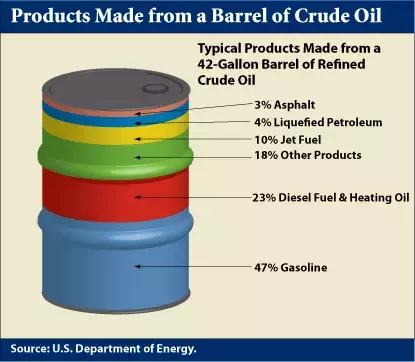
One Little Problem with the "All-Electric" Auto Fleet: What Do We Do with all the "Waste" Gasoline?

Regardless of what happens with vaccines and Covid-19, debt and energy--inextricably bound as debt funds consumption-- will destabilize the global economy in a self-reinforcing feedback.
Back in the early days of the oil industry (1880s and 1890s), the product that the industry could sell at a profit was kerosene for lighting and heating. Since there was no automobile industry yet, gasoline was a waste product that was dumped into streams.

Why couldn't the refiners produce only kerosene? Why did they end up with "worthless" gasoline?

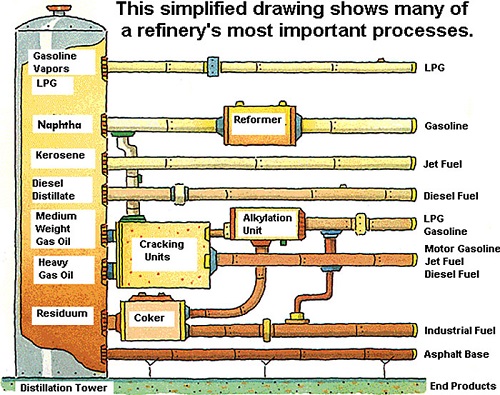
The answer is a barrel of oil produces a variety of products. While there is some "wiggle room" to produce more diesel and less gasoline, etc., it isn't possible to turn a barrel of oil into only one product.

John D. Rockefeller became very wealthy by cornering much of the oil market in the 19th century. But he didn't become fabulously wealthy until the 20th century, when the rise of automobiles created a market for all the "waste" gasoline.

Rockefeller became super-wealthy when all the products of each barrel of oil could be sold at a premium rather than just a portion of the products.

This reality has been forgotten: the price that can be fetched for a barrel of oil depends on the demand for all the products, not just a few of the products.

Those demanding an all-electric auto-truck fleet as a "green" alternative will re-create the dilemma of what to do with the "waste" gasoline. The world will still want fuel for all those container ships bringing all the goodies of a consumerist society, all those cruise ships visiting ports of call, jet fuel for all those exotic vacations enabled by 550 mile-per-hour aircraft, and oil-based lubricants, plastics and petro-chemicals, and so oil will still be pumped and refined, and almost half of it will be gasoline.

We can either use it or throw it away but we can't magically turn a barrel of oil into only one product.

This is a topic worthy of your understanding, so grab a vat of your favorite beverage and turn off all distractions.

Longtime readers know I've focused on energy-oil markets for 15 years. Despite ups and downs in price, the oil market has been remarkably stable.

This stability is about to transition to chronic instability: wild swings in price, shortages, and social chaos in both producing and consumer nations.

Let's start with the most basic dynamics in the cost of producing oil, refining it and selling the products at a profit.

1. As a general rule, a barrel of oil (42 gallons, 196 liters) yields a range of heavier and lighter products.

The price the producers can charge for each product--gasoline, diesel fuel, heating oil, jet fuel, propane, etc.-- depends on demand for each product.

If the price for one product falls drastically, the oil producer can't increase the price of some other product to compensate for the loss of income unless demand for the other products will support higher prices.

Consider the huge decline in demand for jet fuel as a result of global air travel dropping in the pandemic. Oil producers can't just raise the price of gasoline to compensate for the drop in the price of jet fuel.

If gasoline demand continues declining (due to fewer commutes, etc.) then producers can't charge more for diesel to make up the drop in the price of gasoline.

In other words, there has to be strong demand for all the products in a barrel of oil for producers to get enough money to extract, refine and transport the products globally.

Unlike the old days when producers could afford to throw away some petroleum products because their costs of extraction and refining were so low, now producers need more than $45/barrel just to break even.

This is what I'm calling Oil Paradox #1: if demand for any of the primary products is weak, producers can't afford to continue extracting and refining oil, even if there is strong demand for some products.

2. Transportation is the primary use of oil: 68% of all petroleum products are consumed by transport, 26% by industrial and 6% residential/commercial. (These are U.S. statistics, but the global demand is roughly the same.)

If demand for gasoline, diesel and jet fuel remains weak, the value of each barrel of oil will remain below break-even, even if the industrial need for some products (lubricants, etc.) is strong because these industrial products are essential to the world's industrial economy.

3. Much of the consumption of the past 20 years was funded by debt, which is now $277 trillion globally and accelerating. Humanity has borrowed and spent trillions on consumption, and what remains is the interest due on the debt.

This interest constrains future borrowing. The "solution" to interest is inflation, which devalues the interest due. But it also devalues the purchasing power of the currencies being inflated, and so everyone's money buys fewer goods and services.

This is the Debt-Inflation Paradox: the more interest you owe, the greater your need to inflate away the burden of interest. But inflation destroys the purchasing power of money, impoverishing everyone who needs the money to live.

There is no way out of this paradox: either the global economy defaults on its debts, destroying trillions in phantom wealth, or its currencies lose value, impoverishing everyone.

Since so much consumption is funded by debt, any reduction in borrowing, no matter how modest, will destroy demand for petroleum, triggering the Oil Paradox (producers can't charge enough to justify pumping and refining oil).

4. The pandemic has accelerated consumption trends that reduce demand for fuels. Remote work is here to stay, regardless of what you may read. Corporations can no longer afford to staff centralized offices in costly cities. Making everyone commute to offices is no longer financially viable.

Corporate travel is also no longer financially viable. As profit margins fall, the luxury of jetting to physical meetings is no longer justifiable except for senior management-- a few dozen people, not hundreds or thousands.

Tourism thrived in an economy of easy, low-cost credit and secure incomes. Lenders can no longer afford to lend to those with poor credit--notice how credit card limits have been drastically reduced--and incomes are no longer secure.

If the pandemic were the only issue, it would be possible to see a return to 2019-level consumption. But unsustainable debt loads will only get more unsustainable, so much of the consumption that was funded by debt will go away and not come back: the interest on all the existing debt remains to be paid, one way or another.

This decline in consumption has lowered the price of oil far below break-even for most producers. As the article below explains, there are two break-even prices for petroleum: one to get it out of the ground, refine it and deliver it to market, and the second for the social costs the oil pays for.

This is the famous Oil Curse: nations with oil reserves end up depending on selling oil for virtually all their revenues because it doesn't make sense to invest in less reliable, less profitable sectors.

As a result, Saudi Arabia can pump the oil for $45/barrel, but it needs a price of $85/barrel to pay all the social welfare costs it has promised its people.

If you glance at the charts in this article, you'll see the full break-even price of oil for OPEC nations is extremely high.

Breakeven crude oil prices are one metric of the economic constraints facing OPEC+ members

This generates Oil Paradox #2: low demand/low prices for oil may be financially viable in terms of extracting the oil, but the societies that depend on vast oil revenues will unravel if oil prices stay low, and that will disrupt production.

Roughly half of U.S. petroleum production is from tight shale and other unconventional oil sources. Many of these wells are no longer profitable and will be shut down once the producers' credit lines dry up. (This is already happening, triggering mass bankruptcies in the fracking industry).

The oil producing nations are basically surviving on $40/barrel oil by borrowing against future revenues. This is a dangerous game because if oil prices remain low their credit lines will eventually be withdrawn.

The oil producers need supply to fall drastically enough to raise prices back to the $80/barrel or higher level. But nobody can afford to cut their own production enough to reduce global supply enough to matter.

This introduces Oil Paradox #3: should petroleum producers succeed to slashing supply so oil goes to $85/barrel, the higher cost will push the fragile consuming nations into recession or depression, which will slash demand even more, which will require even deeper production cuts to maintain prices.

If we put all these paradoxes together, we see that oil markets are now intrinsically unstable and cannot return to stability because the mix of high break-even prices, declining demand and the end of debt-funded consumption cannot be resolved: high prices crush demand, low prices crush producers, and debt is crushing both consumers and producers.

Much hope is being placed on so-called renewable energy, most of which is not renewable but replaceable, as I've learned from Nate Hagens. A forest is renewable, a solar panel or windmill must be replaced every 20 years at enormous expense.

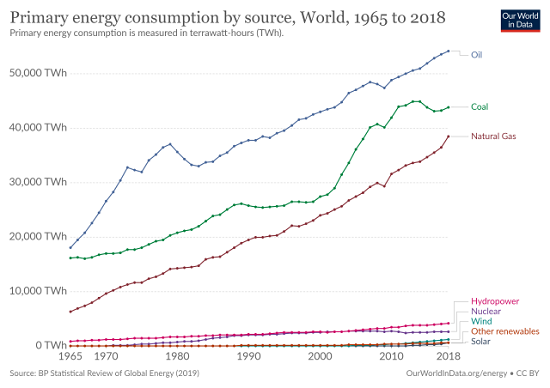
Right now all alternative energy sources--wind, solar, etc.-- generate no more than 4% of global energy consumption. (see chart below) Despite hundreds of billions of dollars invested, all the alternative energy sources are a tiny fraction of global consumption, and their supposed fantastic rates of growth is revealed on this chart as inconsequential: all this new energy doesn't replace a single drop of oil, it simply fuels additional consumption.

It will take a monumental investment and many years to get this to 10%. The reality is the vast majority of the global economy still depends entirely on petroleum for transport and industrial essentials such as lubricants.

How (Not) to Run a Modern Society on Solar and Wind Power Alone

Petroleum is now an unstable system and for all the reasons outlined above it cannot be restored to stability: just as time is a one-way arrow, so is the loss of stability.

What can we expect? Unstable systems are prone to wild swings to extremes and unpredictable collapses. So we may see collapses in the price of oil as we saw in March, and then rapid ascents in price above $100/barrel, which then crash once demand declines.

This unpredictability complicates projections and generates uncertainty. This is the final paradox (#4): the unpredictability of oil markets is itself a destabilizing force. Decisions on future production and consumption cannot be long-term, and this constrains investment in future production.

Regardless of what happens with vaccines and Covid-19, debt and energy--inextricably bound as debt funds consumption-- will destabilize the global economy in a self-reinforcing feedback.


If you found value in this content, please join me in seeking solutions by becoming a $1/month patron of my work via patreon.com.

My new book is available! A Hacker's Teleology: Sharing the Wealth of Our Shrinking Planet 20% and 15% discounts (Kindle $7, print $17, audiobook now available $17.46)

Read excerpts of the book for free (PDF).

The Story Behind the Book and the Introduction.


Recent Podcasts:

Parallels of the Great Fire of Rome 64 AD to Today (with host Richard Bonugli) (31:40)

AxisOfEasy Salon #34: Reclaiming Capital and Agency


My COVID-19 Pandemic Posts


My recent books:

A Hacker's Teleology: Sharing the Wealth of Our Shrinking Planet (Kindle $8.95, print $20, audiobook $17.46) Read the first section for free (PDF).

Will You Be Richer or Poorer?: Profit, Power, and AI in a Traumatized World
(Kindle $5, print $10, audiobook) Read the first section for free (PDF).

Pathfinding our Destiny: Preventing the Final Fall of Our Democratic Republic ($5 (Kindle), $10 (print), ( audiobook): Read the first section for free (PDF).

The Adventures of the Consulting Philosopher: The Disappearance of Drake $1.29 (Kindle), $8.95 (print); read the first chapters for free (PDF)

Money and Work Unchained $6.95 (Kindle), $15 (print) Read the first section for free (PDF).


Become a $1/month patron of my work via patreon.com.


NOTE: Contributions/subscriptions are acknowledged in the order received. Your name and email remain confidential and will not be given to any other individual, company or agency.

Thank you, Dan T. ($50), for your marvelously generous contribution to this site -- I am greatly honored by your steadfast support and readership.


Thank you, William K. ($25), for your superbly generous contribution to this site -- I am greatly honored by your support and readership.

Read more...

Sunday, December 13, 2020

New Audiobook, New Song, Renewed Focus

There is no way a status quo that is completely dependent on the permanent expansion of these interlocking extremes, asymmetries and imbalances can unwind them all and retain its myriad parasitic elites.

Thanks to my friend and colleague Mark Jeftovic, the audiobook of A Hacker's Teleology: Sharing the Wealth of Our Shrinking Planet is now available. Hands-free grokking is now accessible.

A new song also burst forth from the ether: I Can't Hear What You Say. This is my take on polarization and the tone-deafness of those claiming to be charge of things. (lyrics below) My friend and mentor CC did all the heavy lifting: the guitar, drums and bass tracks, while all I had to do was the vocals and a few guitar fills. All nine of our collaborations are posted here.

Two friends also released books long in the making. Robert Gellner just published his first novel Titan's Landing at the ripe old age of 15, a highly imaginative entry in the superhero science fiction genre (Kindle).

Marvin Motsenbocker just published Take Back The Power!: Sustainable Energy and Freedom are Within Your Grasp, a how-to guide to assembling and installing small-scale direct-current photovoltaic systems that save all the money and energy wasted on converting DC current to alternating current (AC). His experience in delivering and installing a prototype system in Africa is an eye-opener to just how adaptable and revolutionary this could be in both developed-world and developing-world settings. (Kindle and paperback)

Last but not least, I want to mention my renewed focus for 2021. The consensus is that the global economy is already well on its way to reflating all the bubbles of 2019, and that vaccinating the entire human populace is more or less a done deal that can be front-run.

In my view, both of these consensus assumptions are pure delusion because eradicating Covid won't resolve any of the mounting extremes, asymmetries and imbalances in global finance and governance that have been gathering momentum for the past 20 years.

There is no way a status quo that is completely dependent on the permanent expansion of these interlocking extremes, asymmetries and imbalances can unwind them all and retain its myriad parasitic elites.

In other words, solutions--individual and systemic--can only arise outside the walls of the status quo. That will be my focus in 2021, which I anticipate will be the main course after the snacks served in 2020 at the global banquet of consequences.

So bring a cushion for your Seats in the Coliseum and your appetite for surprises to The U.S.S.A.'s Banquet of Consequences.

Drum roll, please: here are the lyrics to our new song:

I see your lips move
But nothing makes sense
Why are you shouting
At me like I'm dense

I can't hear what you say, hear what you say, yeah

The more that you talk
The less we all heal
The world you describe
Is strangely unreal

I can't hear what you say, hear what you say, yeah
The lives of the many
Serve only the few
You say that's natural
You haven't a clue

I can't hear what you say, hear what you say, yeah

The voices you've drowned out
Are finally heard
Those you've denied
Will have the last word


If you found value in this content, please join me in seeking solutions by becoming a $1/month patron of my work via patreon.com.

My new book is available! A Hacker's Teleology: Sharing the Wealth of Our Shrinking Planet 20% and 15% discounts (Kindle $7, print $17, audiobook now available $17.46)

Read excerpts of the book for free (PDF).

The Story Behind the Book and the Introduction.


Recent Podcasts:

Parallels of the Great Fire of Rome 64 AD to Today (with host Richard Bonugli) (31:40)

AxisOfEasy Salon #34: Reclaiming Capital and Agency


My COVID-19 Pandemic Posts


My recent books:

A Hacker's Teleology: Sharing the Wealth of Our Shrinking Planet (Kindle $8.95, print $20, audiobook $17.46) Read the first section for free (PDF).

Will You Be Richer or Poorer?: Profit, Power, and AI in a Traumatized World
(Kindle $5, print $10, audiobook) Read the first section for free (PDF).

Pathfinding our Destiny: Preventing the Final Fall of Our Democratic Republic ($5 (Kindle), $10 (print), ( audiobook): Read the first section for free (PDF).

The Adventures of the Consulting Philosopher: The Disappearance of Drake $1.29 (Kindle), $8.95 (print); read the first chapters for free (PDF)

Money and Work Unchained $6.95 (Kindle), $15 (print) Read the first section for free (PDF).


Become a $1/month patron of my work via patreon.com.


NOTE: Contributions/subscriptions are acknowledged in the order received. Your name and email remain confidential and will not be given to any other individual, company or agency.

Thank you, Byron K. ($10/month), for your outrageously generous pledge to this site -- I am greatly honored by your support and readership.


Thank you, Sunil K. ($5/month), for your superbly generous pledge to this site -- I am greatly honored by your support and readership.

Read more...

Friday, December 11, 2020

Dreaming of a Christmas Without Stuff Nobody Wants or Needs

Freeing ourselves of unwanted/unneeded gift-giving is not just heresy in a debt-funded consumerist economy--it is tantamount to treason.

Did you see the new "gotta-have" coffee-pod flavors this Christmas? Crayfish, Spanish Moss, Pumpkin Spicy Radish and Jungle Rot. Yowza, it doesn't get any better than this....

Future archeologists will marvel not just at the enormous quantity of stuff left by our late-oil-boom frenzy of consumption but by the peculiar concentrations of never-used stuff in closets, basements and strange (possibly religious in nature) immense structures comprised of endless rows of small rooms crammed to the ceiling with stuff without any apparent utility or value.

When can we finally admit that Christmas gift-giving no longer serves any purpose other than the purchase of vast quantities of stuff nobody wants or needs? Generations ago, before everyone could buy whatever they wanted on credit, Christmas was the one time when some portion of the savings that had been painfully accumulated by sacrifice would be doled out for small gifts, typically a consumable treat, modest toys for children or a necessity.

Compare that tradition with today's frantic frenzy to find something new that recipients don't need or want and retailers' equally frantic search for new markets: your gerbil doesn't have a plush new bed? Shame on you! Imagine its anguish when everyone else is surrounded by piles of shredded wrapping paper and your poor pet didn't get a single present... where's your Christmas spirit (and credit card)?.

The most appreciated gift you can give is a suggestion to end the obligation to exchange gifts. To state the honest truth--we don't want or need anything else, and don't have space for anything else, thank you--is a gift few are willing to risk saying, but everyone heaves a sigh of relief when one brave person asks to be relieved of the burden of buying another mountain of stuff nobody wants or needs.

There is a long tradition of consumable homemade gifts--Christmas cookies, fruitcake, etc.--that awaits rediscovery.

Freeing ourselves of unwanted/unneeded gift-giving is not just heresy in a debt-funded consumerist economy--it is tantamount to treason. (The lines from an old Errol Flynn movie come to mind: "You speak treason!" "Fluently.") But why should an honest appraisal qualify as both heresy and treason?

The honest truth is hearts don't leap with joy at receiving another unwanted, unneeded thing; hearts sink at the task of moving the gift into some corner of the already-stuffed closet or donating it. What was the point of all this costly frenzy again? To keep a debt-dependent consumer economy from imploding? Is that what Christmas has become?

What's scarce isn't more stuff. What's scarce is time, reflection and the generosity of spirit. We're so busy loading the conveyor belt of unwanted, unneeded stuff in and out of our homes that we have no time to actually spend on what is valuable.

But here, try this new coffee-pod flavor, miso-kumquat-kimchee, I got you the bulk quantity at Costco, you're gonna love it.


If you found value in this content, please join me in seeking solutions by becoming a $1/month patron of my work via patreon.com.

My new book is available! A Hacker's Teleology: Sharing the Wealth of Our Shrinking Planet 20% and 15% discounts (Kindle $7, print $17, audiobook now available $17.46)

Read excerpts of the book for free (PDF).

The Story Behind the Book and the Introduction.


Recent Podcasts:

Charles Hugh Smith on Parallels of the Great Fire of Rome 64 AD to Today (with host Richard Bonugli) (31:40)

AxisOfEasy Salon #33: Ethereum 2.0 could be the scaffolding for the Network States (1:03) with Jesse H. and Mark J.


My COVID-19 Pandemic Posts


My recent books:

A Hacker's Teleology: Sharing the Wealth of Our Shrinking Planet (Kindle $8.95, print $20, audiobook $17.46) Read the first section for free (PDF).

Will You Be Richer or Poorer?: Profit, Power, and AI in a Traumatized World
(Kindle $5, print $10, audiobook) Read the first section for free (PDF).

Pathfinding our Destiny: Preventing the Final Fall of Our Democratic Republic ($5 (Kindle), $10 (print), ( audiobook): Read the first section for free (PDF).

The Adventures of the Consulting Philosopher: The Disappearance of Drake $1.29 (Kindle), $8.95 (print); read the first chapters for free (PDF)

Money and Work Unchained $6.95 (Kindle), $15 (print) Read the first section for free (PDF).


Become a $1/month patron of my work via patreon.com.


NOTE: Contributions/subscriptions are acknowledged in the order received. Your name and email remain confidential and will not be given to any other individual, company or agency.

Thank you, Gary R. ($5/month), for your marvelously generous pledge to this site -- I am greatly honored by your support and readership.


Thank you, David L. ($5/month), for your superbly generous pledge to this site -- I am greatly honored by your support and readership.

Read more...

Thursday, December 10, 2020

Cycles, Systems and Seats in the Coliseum

The idea that debt, leverage, speculation, greed, exploitation and parasitic elites can expand exponentially forever is magical thinking.

Contrary to first impressions, I am not a doom-and-gloomer; I'm a systems-cycles-er, meaning I'm interested in where systems and cycles are heading.

Cycles work because we're still running Wetware 1.0 which entered beta testing around 200,000 years ago and was released, bugs and all, around 50,000 years ago. Since the processes and inputs haven't changed, neither do the outputs.

Nature is a mix of dynamic, semi-chaotic systems (fractals, etc.) and cyclical patterns which tend to operate within predictable parameters. Why should human nature and human constructs (societies, economies and political realms) be any different?

So longterm success breeds complacency, hubris, economic and intellectual sclerosis, draining political infighting and the overproduction of parasitic elites, to use Peter Turchin's apt description. Consumption of resources expands to soak up every last bit of what's available and then the supply of goodies plummets for a multitude of completely natural and predictable reasons (sunspot/solar activity, El Nino, etc.) and a host of unpredictable but equally natural semi-chaotic extremes (100-year droughts, floods, etc.).

Wetware 1.0's go-to solutions to all such difficulties are rather limited:

1. Ramp up magical thinking. If a couple of human sacrifices ensured good harvests in the good old days, let's slaughter a couple hundred now--and if that doesn't work, then...

2. Do more of what's failed spectacularly and slaughter a couple thousand fellow humans, because darn it, maybe everything will turn around if we just kill another couple dozen.

This requires ignoring the novelty of the current challenges and clinging to what worked so well in the past even as whatever worked in the past can't possibly work now because circumstances are fundamentally different.

3. Seek scapegoats. It's those darn witches. Burn a bunch of them and our troubles will magically disappear.

4. Go take what we need from some other tribe. What's our oil doing under their sand?

5. Consolidate power and wealth in the hands of elites whose failures exacerbated the crisis. Because the obvious solution (to the elites with cushy offices around the palaces and temples) to repeated failures of a leadership that only excels in one thing, squandering rapidly depleting resources on infighting and self-aggrandizement, is to give us all the remaining wealth and power. Hey, this makes perfect sense once you understand #2 above.

6. Demand sacrifices of the many to protect the privileges of the few. The Empire needs some warm bodies to fend off the Barbarians, because it would be a real shame if the Barbarians reached our palatial estates and disrupted the flow of wine and festivities. No worries when you come back on your shield; the bureaucracy will give you a decent burial and your spouse and kids can join the multitude of half-starved beggars waiting for the dwindling distributions of bread and circuses. But never mind that, did you hear about the upcoming games in the Coliseum? Good seats are going fast.

7. Eat your seed corn to keep the party going awhile longer. Not every human group had the luxury of borrowing "money" to keep the fast-unraveling party going awhile longer, so they consumed their seed corn and drained the last of their reserves--which is the same thing as borrowing "money" from a future with diminishing resources and productivity.

8. Maintain supreme confidence that "it will all work out fine because it's always worked out fine" without any sacrifice required of "those who count." What's forgotten is that the luxe greatness that is now teetering on the precipice of ruin was won by the sacrifices of the elites far exceeding the sacrifices of the many.

Back in the day, joining the elite and maintaining one's position required constant sacrifices on behalf of the common good, and strict adherence to public virtue. Now that's all forgotten, and all that remains are elites possessed by the demons of shameless greed and self-interest.

The idea that debt, leverage, speculation, greed, exploitation and parasitic elites can expand exponentially forever is magical thinking. Yet that is precisely what America and the rest of the global economic order insists is true and will always be true, forever and ever.

By all means, reject those horrid, awful doom-and-gloomers who look at systems and cycles. Everything will be fine as long as you secure seats for the next games at the Coliseum--they should be spectacular--but not in the way you expect.


If you found value in this content, please join me in seeking solutions by becoming a $1/month patron of my work via patreon.com.

My new book is available! A Hacker's Teleology: Sharing the Wealth of Our Shrinking Planet 20% and 15% discounts (Kindle $7, print $17, audiobook now available $17.46)

Read excerpts of the book for free (PDF).

The Story Behind the Book and the Introduction.


Recent Podcasts:

Charles Hugh Smith on Parallels of the Great Fire of Rome 64 AD to Today (with host Richard Bonugli) (31:40)

AxisOfEasy Salon #33: Ethereum 2.0 could be the scaffolding for the Network States (1:03) with Jesse H. and Mark J.


My COVID-19 Pandemic Posts


My recent books:

A Hacker's Teleology: Sharing the Wealth of Our Shrinking Planet (Kindle $8.95, print $20, audiobook $17.46) Read the first section for free (PDF).

Will You Be Richer or Poorer?: Profit, Power, and AI in a Traumatized World
(Kindle $5, print $10, audiobook) Read the first section for free (PDF).

Pathfinding our Destiny: Preventing the Final Fall of Our Democratic Republic ($5 (Kindle), $10 (print), ( audiobook): Read the first section for free (PDF).

The Adventures of the Consulting Philosopher: The Disappearance of Drake $1.29 (Kindle), $8.95 (print); read the first chapters for free (PDF)

Money and Work Unchained $6.95 (Kindle), $15 (print) Read the first section for free (PDF).


Become a $1/month patron of my work via patreon.com.


NOTE: Contributions/subscriptions are acknowledged in the order received. Your name and email remain confidential and will not be given to any other individual, company or agency.

Thank you, Peter A. ($5/month), for your marvelously generous subscription to this site -- I am greatly honored by your support and readership.


Thank you, Michael T. ($25), for your superbly generous contribution to this site -- I am greatly honored by your support and readership.

Read more...

Tuesday, December 08, 2020

Welcome to the U.S.S.A.'s Banquet of Consequences

The incontestable incompetence of the USSA's monopolies, institutions and agencies is about to take center stage in 2021.

When I mention that the U.S.A. feels increasingly like the U.S.S.R., a surprising number of people tell me they feel the same way. Welcome to the U.S.S.A.: United Simulacra States of America where everything is an absurdly transparent simulation with little connection to reality and dissent is crushed by an everpresent, ubiquitous narrative police state enforced by the union of Big Tech social media, search and other monopolies and the Savior State: do what we tell you and you'll get a piece of our endlessly spewed trillions.

My colleague Mark Jeftovic recommended an insightful book on the unraveling of the USSR, Everything Was Forever, Until It Was No More: The Last Soviet Generation.

It's an academic book so there are the required servings of jargon and references to suitably opaque academic tropes, but beneath the conceptual clutter lies a profound analysis of how humans adapt to and navigate a system that has lost all authenticity and survives entirely on the ceaseless marketing of artifice: in other words, the USA today.

Of particular interest are the book's personal accounts of dutiful Party members going through the motions of obedience as a means of enjoying their private friendships and lives. Joining the Party's machinery was a way to meet friends who you recruited for your committee work. Everyone went through the motions but nobody actually believed any of it: you did homework while "listening" to the endless canned speeches, you went out for coffee while telling the Party functionary that you were on Party business, and you worked on parades and activities that were a bit of fun despite the dreary official purpose which everyone ignored.

Despite the enormous effort put into placing propaganda everywhere, nobody actually saw any of it: it was all background noise. When it changed, nobody noticed.

"Regular" party members avoided the True Believers and the Dissenters as both could get you in trouble--and who wanted trouble? It wasn't worth it. And so a carefully cloaked language of phrases and signs emerged to separate the safe "regular" members from the dangerous True Believers and Dissenters.

Documentarian Adam Curtis called this artifice as reality hyper-normalization, a concept also referred to as super-normalization: "normal life" is stripped of authenticity in favor of a simulacrum "normal" that supports those at the top of the status quo. This "new normal" reaches extremes of artifice, hence hyper-normalization.

As long as everyone thinks there are no alternatives to this hyper-normalized simulacrum, this artificial construct appears to be immutable--everything is forever.

But once the power structure admits, however minimally, that it no longer has the answers to the decay of the social-economic order, then the entire artificial construct collapses in a heap. This is the sociology of collapse: people accept a facade of artifice and propaganda without actually believing any of it, though they do have a limbic loyalty to the founding ideals of the State.

The ideologues (True Believers) are avoided as dangerous brown-nosers, and the Dissenters are avoided because it's not worth being sent to digital Siberia (shadow-banned, deleted, marginalized) just to publicly call attention to the abject failure of status quo institutions and organs of propaganda.

What's real is denial, repression of dissent, group-think, virtue-signaling and a profound loss of competence. What's hyper-normalized artifice is all the media spew about how great everything is going to be once we print and squander another couple trillion dollars to prop up the zombie corporations, institutions and government agencies until the magical vaccine time machine returns us to the glorious debt-dependent overconsumption of 2019.

The USSA has not yet admitted that the decay of its socio-economic order is unstoppable, and so the internal gulag has yet to be breached. But artifice is not a substitute for reality, and what's unsustainable (hyper-normalized artifice) unravels very quickly once the first thread is pulled.

The USSR took 20 years to unravel, but 19 years of the decay were hidden by an increasingly disconnected-from-reality simulacra of "success" and competence: the USSR lost the race to the moon in 1969 and 20 years later two decades of decay led to collapse.

The USSA responded to the dot-com crash of 2000 with artifice and propaganda, an absurdly transparent simulacra of "success" and competence. Twenty years of decay has brought us to the precipice of collapse, and the internal gulag of TINA--there is no alternative-- is fraying.

The incontestable incompetence of the USSA's monopolies, institutions and agencies is about to take center stage in 2021. The sociology of collapse will be followed by a not-be-missed banquet of consequences.


If you found value in this content, please join me in seeking solutions by becoming a $1/month patron of my work via patreon.com.

My new book is available! A Hacker's Teleology: Sharing the Wealth of Our Shrinking Planet 20% and 15% discounts (Kindle $7, print $17)

Read excerpts of the book for free (PDF).

The Story Behind the Book and the Introduction.


Recent Podcasts:

Charles Hugh Smith on Parallels of the Great Fire of Rome 64 AD to Today (with host Richard Bonugli) (31:40)

AxisOfEasy Salon #33: Ethereum 2.0 could be the scaffolding for the Network States (1:03) with Jesse H. and Mark J.


My COVID-19 Pandemic Posts


My recent books:

A Hacker's Teleology: Sharing the Wealth of Our Shrinking Planet (Kindle $8.95, print $20, audiobook coming soon) Read the first section for free (PDF).

Will You Be Richer or Poorer?: Profit, Power, and AI in a Traumatized World
(Kindle $5, print $10, audiobook) Read the first section for free (PDF).

Pathfinding our Destiny: Preventing the Final Fall of Our Democratic Republic ($5 (Kindle), $10 (print), ( audiobook): Read the first section for free (PDF).

The Adventures of the Consulting Philosopher: The Disappearance of Drake $1.29 (Kindle), $8.95 (print); read the first chapters for free (PDF)

Money and Work Unchained $6.95 (Kindle), $15 (print) Read the first section for free (PDF).


Become a $1/month patron of my work via patreon.com.


NOTE: Contributions/subscriptions are acknowledged in the order received. Your name and email remain confidential and will not be given to any other individual, company or agency.

Thank you, John C. ($50), for your marvelously generous contribution to this site -- I am greatly honored by your steadfast support and readership.


Thank you, Brian M. ($20), for your superbly generous contribution to this site -- I am greatly honored by your steadfast support and readership.

Read more...

Terms of Service

All content on this blog is provided by Trewe LLC for informational purposes only. The owner of this blog makes no representations as to the accuracy or completeness of any information on this site or found by following any link on this site. The owner will not be liable for any errors or omissions in this information nor for the availability of this information. The owner will not be liable for any losses, injuries, or damages from the display or use of this information. These terms and conditions of use are subject to change at anytime and without notice.

RE: European Union AI Act, and Our Use of Generative AI Tools and Agents Policy

All text on this site is composed by Charles Hugh Smith or by a credited guest-author. No Generative AI Tools are used in the composition / writing of any text or graphic content created by Charles Hugh Smith. This site deploys no AI agents or generative AI tools. This site is not responsible for the disclosures, use or non-use of AI agents or generative AI tools in advertisements displayed by Investing Channel or other ad placement services.

Audio files generated by text-to-audio transcription tools are identified as such.

Our Privacy Policy:

Correspondents' email is strictly confidential. This site does not collect digital data from visitors or distribute cookies. Advertisements served by third-party advertising networks such as Investing Channel may use cookies or collect information from visitors for the purpose of Interest-Based Advertising; if you wish to opt out of Interest-Based Advertising, please go to Opt out of interest-based advertising (The Network Advertising Initiative) If you have other privacy concerns relating to advertisements, please contact advertisers directly.

PRIVACY NOTICE FOR EEA INDIVIDUALS

This section covers disclosures on the General Data Protection Regulation (GDPR) for users residing within EEA only. GDPR replaces the existing Directive 95/46/ec, and aims at harmonizing data protection laws in the EU that are fit for purpose in the digital age. The primary objective of the GDPR is to give citizens back control of their personal data. Please follow the link below to access InvestingChannel's General Data Protection Notice.
https://stg.media.investingchannel.com/gdpr-notice/

Notice of Compliance with The California Consumer Protection Act

This site does not collect digital data from visitors or distribute cookies. Advertisements served by a third-party advertising network (Investing Channel) may use cookies or collect information from visitors for the purpose of Interest-Based Advertising. If you do not want any personal information that may be collected by third-party advertising to be sold, please follow the instructions on this page: Do Not Sell My Personal Information.

Regarding Cookies:

This site does not collect digital data from visitors or distribute cookies. Advertisements served by third-party advertising networks such as Investing Channel may use cookies or collect information from visitors for the purpose of Interest-Based Advertising; if you wish to opt out of Interest-Based Advertising, please go to Opt out of interest-based advertising (The Network Advertising Initiative) If you have other privacy concerns relating to advertisements, please contact advertisers directly.

Our Commission Policy:

Though I earn a small commission on Amazon.com books and gift certificates and gold (BullionVault) purchased via links on my site, I receive no fees or compensation for any other non-advertising links or content posted on my site.

Copyright Notice:

All original images (Drawings and Photographs), text (essays, books and works of fiction), audio and video recordings, musical compositions, graphic design, graphic design elements and HTML coding on this site are the copyrighted work of Charles Hugh Smith unless otherwise credited or noted. They are published as information for the private use of site visitors, and any reproduction or redistribution of this content or coding in any media in any format or distribution channel (text, audio, video/film, web) without the written permission of the copyright holder is strictly prohibited. All rights in all media reserved globally.

  © Blogger templates Newspaper III by Ourblogtemplates.com 2008

Back to TOP