
Thursday, February 03, 2022

The Bear Awakens

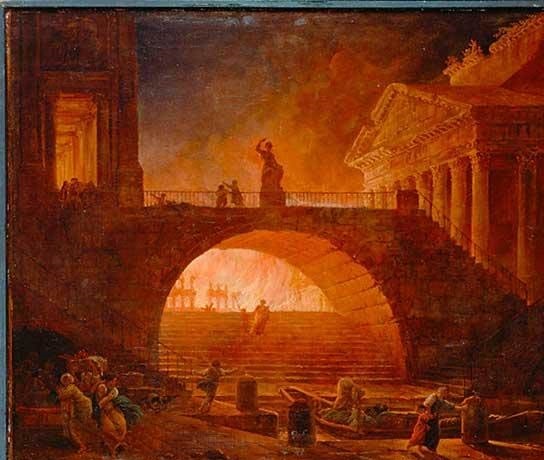
The bear has awakened, and it will not be limited to the stock market.

The bear awakens from a long, uneasy slumber and the everything bubble is in trouble.

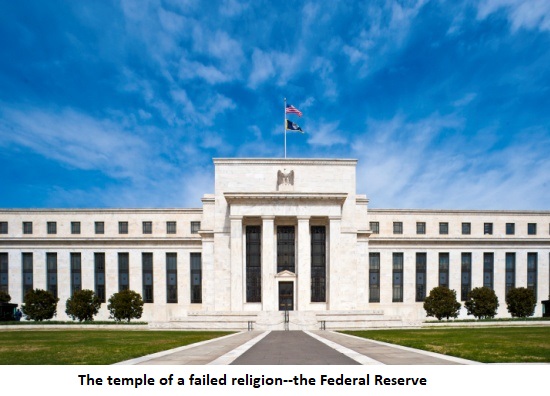
I'm not going to make the bear case with charts or price-earnings ratios or sentiment readings or anything remotely financial. My bear case is a crisis of belief as faith in the religion of the Federal Reserve dissolves and the dumbfounded believers realize the Fed is a failed religion.

To understand the religion of the Fed, consider the Federal Reserve policies and actions that the market views as bullish:

-- Fed lowers interest rates: bullish.

-- Fed raises interest rates: bullish.

-- Fed eases: bullish.

-- Fed tightens: bullish.

-- Fed holds steady: bullish.

-- Fed changes course: bullish.

-- Fed issues guidance: bullish.

-- Fed is silent: bullish.

-- Fed sneezes: bullish.

-- Fed coughs: bullish.

-- Fed caught insider trading: bullish.

-- Fed increases wealth inequality to the point it unravels society: bullish.

You get the idea: merely by occupying the temple of the Fed faith, the Eccles Building, the Fed is bullish because the Fed has the supernatural power to rescind the business / credit cycle and keep the economy and asset wealth expanding forever and ever.

The Fed could reveal that all policy was decided by Ouija board sessions and the stock market would leap: whatever the Fed does is bullish by default. Any policy error can quickly be reversed and so any decline in assets can also be reversed. The occasional heretic can be banished and the true believers will again be rewarded for their faith in the One True Financial Religion.

As in the story of the stranger mistaken for a god by the tribe until a thorn prick draws blood, revealing the stranger's all-too-human mortality, the Fed's over-reach has consequences which are now drawing blood. Shakespeare's lines are apropos:

By the pricking of my thumbs
Something wicked this way comes.


Just as Macbeth is deceived by promises of invincibility by the witches, so too the Fed has been deceived by promises of godlike powers over finance and the economy. But just as Macbeth's machinations triggered civil war and turmoil, the Fed's over-reach has set a banquet of consequences that few are prepared to keep down, much less savor.

Attempting to banish the business / credit cycle--i.e. endless, recession-free expansion--has tightly coiled a financial spring to produce maximum damage when it finally unleashes its compressed power. In the political-social realm, the Fed's vast expansion of the already-wealthy's extremes of wealth has fatally destabilized the nation's democracy and social contract.

The Fed's supposedly godlike powers cannot resolve supply-chain scarcities or labor shortages. The Fed can create currency out of thin air and sluice it into assets owned by the top 0.1%, but it can't reshore manufacturing and materials supply chains or create experienced welders, pipefitters, crane operators, etc. out of thin air.

What happens when a religion with such fervent believers is revealed as an empty promise of limitless power, a failed religion? The faithful are dazed, distraught, confused and lost, and then the anger arises. How could the false gods have failed us so completely? Where are those who led us so astray?

The bear has awakened, and it will not be limited to the stock market. As the temple of a false faith tumbles, the wrath of the deceived and betrayed will be great indeed.

By the pricking of my thumbs
Something wicked this way comes.


My new book is now available at a 20% discount this month: Global Crisis, National Renewal: A (Revolutionary) Grand Strategy for the United States (Kindle $8.95, print $20)

If you found value in this content, please join me in seeking solutions by becoming a $1/month patron of my work via patreon.com.


Recent Videos/Podcasts:

Charles Hugh Smith on Why Many are Resigning From Their Jobs (35 minutes, with Richard Bonugli)


My recent books:

Global Crisis, National Renewal: A (Revolutionary) Grand Strategy for the United States (Kindle $9.95, print $25) Read Chapter One for free (PDF).

A Hacker's Teleology: Sharing the Wealth of Our Shrinking Planet (Kindle $8.95, print $20, audiobook $17.46) Read the first section for free (PDF).

Will You Be Richer or Poorer?: Profit, Power, and AI in a Traumatized World
(Kindle $5, print $10, audiobook) Read the first section for free (PDF).

Pathfinding our Destiny: Preventing the Final Fall of Our Democratic Republic ($5 Kindle, $10 print, ( audiobook): Read the first section for free (PDF).

The Adventures of the Consulting Philosopher: The Disappearance of Drake $1.29 Kindle, $8.95 print); read the first chapters for free (PDF)

Money and Work Unchained $6.95 Kindle, $15 print)
Read the first section for free


Become a $1/month patron of my work via patreon.com.


NOTE: Contributions/subscriptions are acknowledged in the order received. Your name and email remain confidential and will not be given to any other individual, company or agency.

Thank you, Thomas G. ($50), for your marvelously generous contribution to this site -- I am greatly honored by your steadfast support and readership.


Thank you, Bryan K. ($5/month), for your superbly generous pledge to this site -- I am greatly honored by your support and readership.


Thank you, Jim S. ($54), for your magnificently generous contribution to this site -- I am greatly honored by your support and readership.


Thank you, S.C. ($10/month), for your monumentally generous pledge to this site -- I am greatly honored by your support and readership.

Read more...

Tuesday, February 01, 2022

Can a Nation Prosper as its Institutions Fail?

We are in effect so busy arranging the beach umbrellas per our instructions that we don't notice the approaching tsunami.

Economists focus on what can be easily measured: sales, profits, prices, tax revenues, etc. Since the decay and failure of institutions isn't easily quantified, this decay doesn't register in the realm of economics. Since it isn't measured, it doesn't exist.

But institutional decay and failure is all too real, and it begs the question: how can a society and economy thrive if its core institutions fail? The short answer is they cannot thrive, as institutions are the foundations of the social and economic orders.

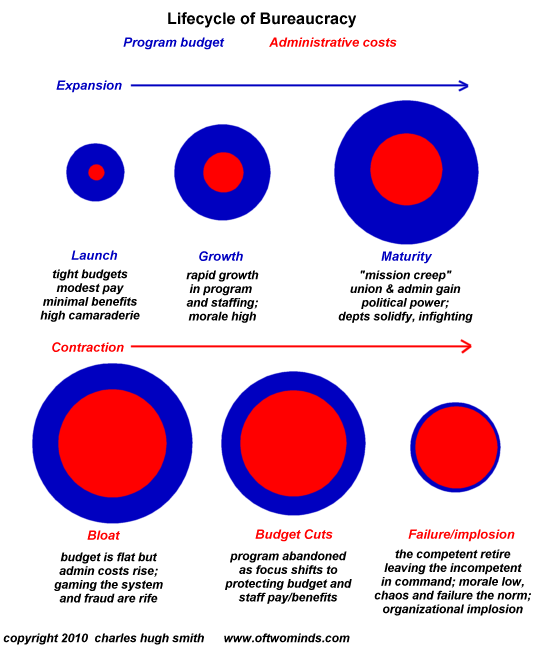
As I explain in my new book, Global Crisis, National Renewal, the conventional view has a naive faith that "great leaders" can reverse institutional rot. This faith overlooks the systemic sources of institutional decay and failure which are outlined in the graphic below, The Lifecycle of Bureaucracy, a.k.a. institutions.

Leaders are constrained by the nature of centralized organizations and the incentive structure that slowly shifts from rewarding efforts to further the institution's core mission to self-service and protecting an ossified, failing institution from outside scrutiny and reform.

As Samo Burja explains in his insightful essay, Why Civilizations Collapse, those inside institutions are by design so compartmentalized that few (if any) even recognize the institution is failing. As long as everything is glued together in each little compartment, no one grasps the entire institution has lost its way. And since no one recognizes it, no one attempts to save it.

Institutions end up advancing caretaker managers who excel at the political game of rising to the top of a sprawling institution. When the decay (or budget cuts) finally trigger a crisis, the institution has been stripped of visionaries with a bold grasp of what's needed to restore the focus on the core mission and institute new incentives. The bold leaders quit in disgust or were sent to bureaucratic Siberia as potential threats to the status quo.

The problem is institutions fail by the very nature of their centralized design. The organization is centralized so directives flow down the chain of command, and every branch is compartmentalized to limit the power of each department and employee to disrupt the orderly flow of top-down directives.

Within this compartmentalized, top-down structure, the incentives are to follow procedures rather than get results. The rewards go to those who dutifully follow procedures rather than to those who raise the alarm about the loss of transparency, effectiveness and focus on fulfilling the mission.

The path of least resistance is to protect the existing structure and add more compartments, i.e. "mission creep." Rather than focus on the dissipation of resources and the decline of the core mission, leaders add "feel good" missions and PR promotions of phony reforms and initiatives that bleed more resources from the core mission.

Consider the institution of democracy, which has been corrupted into an invitation-only auction of state favors and rentier skims. Democracies have another fatal flaw: politicians win re-election by promising virtually everyone something for nothing: more benefits and entitlements and lower taxes. The gap between higher costs and declining revenues will be filled by government borrowing.

All this additional borrowing will supposedly be paid by the magic of "growth", which will expand tax revenues at a rate that exceeds the cost of borrowing.

But demographics, resource depletion and the diminishing returns of a consumer economy fueled by rapidly expanding public and private debt have sapped "growth" in fundamental ways. Ironically, borrowing and spending more to spur "growth" only hastens the diminishing returns of increasing debt to fund consumption today.

Democracies are thus optimized for rapid "growth" and are ill-suited to transition to DeGrowth, i.e. less of everything for the vast majority of the citizenry as resources become scarce and debt eats the economy alive. (DeGrowth could work to everyone's benefit, which is the point of Global Crisis, National Renewal.)

Central banking is another failing institution. When faced with fiscal crises, central states/banks inevitably succumb to the temptation to print/borrow currency in whatever sums are needed to fill the shortfall of the moment, i.e. political expediency. This profligate creation of currency seems to be magic at first; everyone accepts the "new money" at the current value. But eventually gravity takes hold and the currency's purchasing power declines, as the real economy (the production of goods and services) grows at rates far below the expansion of credit and currency.

Even the greatest empires in human history have been unable to resist the "easy" solution of devaluing currency as the means of fulfilling all the promises that were made in more prosperous times.

The progression of centralized power slowly but surely replaces the self-organizing, resilient, decentralized structures of civil society with tightly bound hierarchical centralized structures that are increasingly ineffective, increasingly costly and increasingly fragile, i.e. increasingly prone to failure or collapse.

The irony of institutional decay and failure is everyone inside is so busy following procedures that nobody notices the decay until the whole worm-eaten structure collapses. Look no farther than financialized asset bubbles, healthcare and education for examples of institutions in run-to-failure decline.

We are in effect so busy arranging the beach umbrellas per our instructions that we don't notice the approaching tsunami. Can a nation prosper as its institutions decay and collapse? Only in the fantasies and magical thinking of the delusional.


My new book is now available at a 20% discount this month: Global Crisis, National Renewal: A (Revolutionary) Grand Strategy for the United States (Kindle $8.95, print $20)

If you found value in this content, please join me in seeking solutions by becoming a $1/month patron of my work via patreon.com.


Recent Videos/Podcasts:

Charles Hugh Smith on Why Many are Resigning From Their Jobs (35 minutes, with Richard Bonugli)


My recent books:

Global Crisis, National Renewal: A (Revolutionary) Grand Strategy for the United States (Kindle $9.95, print $25) Read Chapter One for free (PDF).

A Hacker's Teleology: Sharing the Wealth of Our Shrinking Planet (Kindle $8.95, print $20, audiobook $17.46) Read the first section for free (PDF).

Will You Be Richer or Poorer?: Profit, Power, and AI in a Traumatized World
(Kindle $5, print $10, audiobook) Read the first section for free (PDF).

Pathfinding our Destiny: Preventing the Final Fall of Our Democratic Republic ($5 Kindle, $10 print, ( audiobook): Read the first section for free (PDF).

The Adventures of the Consulting Philosopher: The Disappearance of Drake $1.29 Kindle, $8.95 print); read the first chapters for free (PDF)

Money and Work Unchained $6.95 Kindle, $15 print)
Read the first section for free


Become a $1/month patron of my work via patreon.com.


NOTE: Contributions/subscriptions are acknowledged in the order received. Your name and email remain confidential and will not be given to any other individual, company or agency.

Thank you, Jamie D. ($5/month), for your marvelously generous pledge to this site -- I am greatly honored by your support and readership.


Thank you, Stephen C. ($5/month), for your superbly generous pledge to this site -- I am greatly honored by your support and readership.


Thank you, David T. ($10), for your most generous contribution to this site -- I am greatly honored by your support and readership.


Thank you, Michael L. ($3), for your much-appreciated generous contribution to this site -- I am greatly honored by your support and readership.

Read more...

Friday, January 28, 2022

No Wonder the Market Is Skittish

The equity, real estate and bond markets all rode the coattails of the Fed's ZIRP and easy-money liqudiity tsunami for the past 13 years. As those subside, what's left to drive assets higher?

No wonder the market is skittish:

1. Every time the Federal Reserve began to taper quantitative easing / open spigot of liquidity over the past decade, reduce its balance sheet or raise rates from near-zero, the market plummeted ("taper tantrum") and the Fed stopped tightening and returned to easy-money expansion.

2. Now the Fed is boxed in by inflation--it can't continue the bubblicious easy-money policies, nor does it have any room left to lower rates due to its pinning interest rates to near-zero for years.

3. So market participants (a.k.a. punters) are nervously wondering: can the U.S. economy and the Fed's asset bubbles survive higher rates and the spigot of liquidity being turned off?

4. The market is also wondering if the economy can survive the pricking of the "everything" asset bubbles in stocks, bonds, real estate, etc. as interest rates rise and liquidity is withdrawn. What's left of "growth" once the top 10% no longer see their wealth expand every month like clockwork?

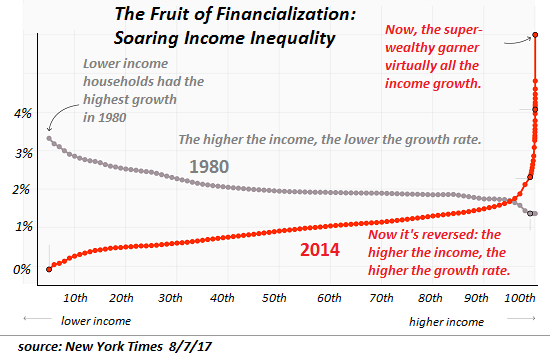
5. The unprecedented expansion of asset valuations driven by expansions of credit and liquidity (i.e. low-cost credit chasing scarce assets) has greatly increased the wealth of the top 10% (especially the wealth of the top 0.1% and top 1%). Since the top 10% collect about half of all income and account for roughly half of all consumer spending, the "wealth effect" generated by ever-rising asset valuations has underpinned "growth" in both asset purchases and consumption.

If assets actually decline in value and the wealth effect reverses (i.e. punters feel poorer), then what will drive expansion of capital and spending going forward?

6. The Federal Reserve and U.S. Treasury have institutionalized moral hazard, the disconnect of risk and consequence, for America's financial elite: rather than force those who gambled and lost to absorb the losses in 2008-09, the Fed and Treasury bailed out the too big to fail, too big to jail financial elite, establishing an unspoken policy of encouraging the wealthiest individuals and enterprises to borrow and gamble freely, knowing they could keep any winnings (and pay low or no taxes on the gains) and transfer any losses to the Fed and/or taxpayers.

7. This institutionalization of moral hazard combined with zero interest rate policy (ZIRP) and an open spigot of liquidity has driven wealth and income inequality to extremes that are economically, politically and socially destabilizing. Insider trading in the Fed and Congress has finally leached out into the public sphere, and the cozy enrichment of the already super-wealthy has now reached extremes that invite destabilizing blowback.

8. As noted here recently, inflation is now embedded due to structural, cyclical changes in supply chains and the labor market: rather than importing deflation, global supply chains now import inflation (higher costs) and scarcities. After being stripmined of $50 trillion over the past 45 years, labor has finally gained some leverage to claw back a bit of the purchasing power that has been surrendered to corporations and finance over the past two generations.

9. Inflation spirals out of control if the cost of credit (interest rates) don't rise to reward capital with inflation-adjusted income: if inflation is 6% annually, a bond paying 1% loses 5%. This is not sustainable, for it distorts the pricing of risk.

10. As rates rise, lower-risk bonds become more attractive than risky stocks, and capital leaves stocks for income-producing securities. Rising rates are historically bad for stocks, so what will keep stock markets lofting higher if rates rise, liquidity is reduced and capital exists risky stocks?

11. The stock market is overvalued by traditional measures of value, and any mean reversion will lower the market significantly. So what's left to push risk assets higher? The only answers with any substance are: A) rising profits due to companies having pricing power in an inflationary environment and workers getting more purchasing power so they can afford to pay higher prices and B) massive inflows of global capital due to perceptions of lower risk and higher returns in U.S. dollar denominated assets. If neither transpires, there's no real support for stocks to continue lofting ever higher.

12. The equity, real estate and bond markets all rode the coattails of the Fed's ZIRP and easy-money liquidity tsunami for the past 13 years. As those subside, what's left to drive assets higher? It's an open question, and so skittishness is rational and prudent.

In summary: by rewarding financialization and the largest concentrations of capital at the expense of labor, small business and productivity, the Federal Reserve and federal / state governments have made the economy and society precariously dependent on asset bubbles, corruption (pay to play politics) and financial trickery. The only real foundation for growth is to widen the distribution of gains in productivity, shift the gains from capital to labor and reward small-scale investment in productivity gains rather than funnel all the gains into asset bubbles and financialized casinos that enrich the top 0.1% at the expense of the nation and its people.


My new book is now available at a 20% discount this month: Global Crisis, National Renewal: A (Revolutionary) Grand Strategy for the United States (Kindle $8.95, print $20)

If you found value in this content, please join me in seeking solutions by becoming a $1/month patron of my work via patreon.com.


Recent Videos/Podcasts:

Charles Hugh Smith on Why Many are Resigning From Their Jobs (35 minutes, with Richard Bonugli)


My recent books:

Global Crisis, National Renewal: A (Revolutionary) Grand Strategy for the United States (Kindle $9.95, print $25) Read Chapter One for free (PDF).

A Hacker's Teleology: Sharing the Wealth of Our Shrinking Planet (Kindle $8.95, print $20, audiobook $17.46) Read the first section for free (PDF).

Will You Be Richer or Poorer?: Profit, Power, and AI in a Traumatized World
(Kindle $5, print $10, audiobook) Read the first section for free (PDF).

Pathfinding our Destiny: Preventing the Final Fall of Our Democratic Republic ($5 Kindle, $10 print, ( audiobook): Read the first section for free (PDF).

The Adventures of the Consulting Philosopher: The Disappearance of Drake $1.29 Kindle, $8.95 print); read the first chapters for free (PDF)

Money and Work Unchained $6.95 Kindle, $15 print)
Read the first section for free


Become a $1/month patron of my work via patreon.com.


NOTE: Contributions/subscriptions are acknowledged in the order received. Your name and email remain confidential and will not be given to any other individual, company or agency.

Thank you, Betty W. ($100), for your outrageously generous contribution to this site -- I am greatly honored by your steadfast support and readership.


Thank you, Robert J. ($108), for your outrageously generous contribution to this site -- I am greatly honored by your steadfast support and readership.


Thank you, Michael W. ($12), for your most generous contribution to this site -- I am greatly honored by your support and readership.


Thank you, Stephen B. ($15), for your much-appreciated generous contribution to this site -- I am greatly honored by your support and readership.

Read more...

Wednesday, January 26, 2022

Inflation Winners and Losers

The clear winners in inflation are those who require little from global supply chains, the frugal, and those who own their own labor, skills and enterprises.

As the case for systemic inflation builds, the question arises: who wins and who loses in an up-cycle of inflation? The general view is that inflation is bad for almost everyone, but this ignores the big winners in an inflationary cycle.

As I've explained here and in my new book Global Crisis, National Renewal, the two primary dynamics globally are 1) scarcity of essentials and 2) extremes of wealth/power inequality.

Scarcities drive prices higher simply as a result of supply-demand. Conventional economics holds that there are always cheaper substitutes for everything and hence there can never be scarcities enduring long enough to drive inflation: if steak gets costly, then consumers can buy cheaper chicken, etc.

But the conventional view overlooks essentials for which there is no substitute. Salt water may be cheap but it's no substitute for fresh water. There are no scalable substitutes for oil and natural gas. There are no scalable substitutes for hydrocarbon-derived fertilizers or plastics. As energy becomes more expensive due to the mass depletion of the cheap-to-extract resources, the costs of everything from fertilizer to plastics to steel to jet fuel rise.

This price pressure generates a number of effect. Rising costs embed a self-reinforcing feedback as prices are pushed higher in expectation of higher costs ahead, and these price increases generate the very inflation that sparked the pre-emptive price increase.

Second, increasing costs either reduce profits or force price increases. Neither is ideal, as higher prices tend to lower sales which then lowers profits.

Third, prices rise easily but drop only stubbornly, so sharp increases in prices aren't reversed as cost pressures ease: enterprises and workers quickly become accustomed to the higher prices and pay and are extremely resistant to cutting either prices or pay.

As I've outlined here before, extremes of wealth-power inequality are systemically destabilizing. Extremes generate reversals as the pendulum reaches its maximum and then reverses direction and gathers momentum to the opposite extreme. In terms of wealth-power inequality, the pendulum is finally swinging back toward higher wages for labor and higher taxes for the super-wealthy, and increasing regulation on exploitive monopolies.

In other words, there is more driving systemic inflation than just "transitory" supply-demand issues. Speaking of supposedly "transitory" cost increases that are actually systemic, global supply chains that were deflationary (i.e. pushing prices lower) for 40 years are now inflationary (i.e. pushing prices higher) as costs rise sharply in exporting economies that are now facing much higher labor and energy costs, and also finally bearing the long-delayed costs of environmental damage caused by rampant industrialization.

As noted here in The Real Revolution Is Underway But Nobody Recognizes It, labor has been stripmined for 45 years, and now the worm has turned. As much as corporate employers and governments would love outright indentured servitude where they could force everyone to work for low pay in abusive circumstances, people are still free to figure out how to simplify their lives, cut expenses and work less.

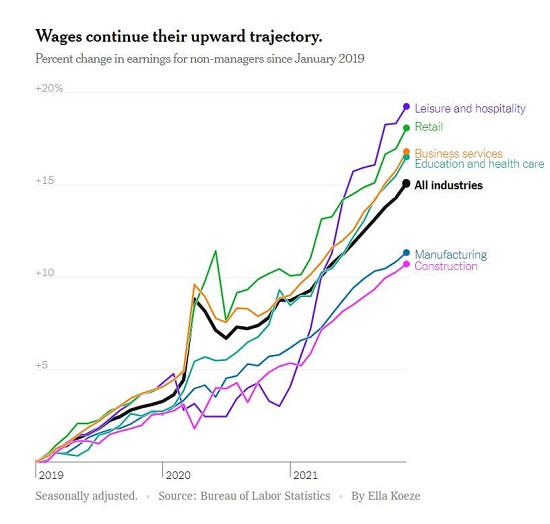
Scarcities of labor are enabling sharp increases in pay, especially in services. Anecdotally, I'm hearing accounts of service workers such as therapists, plumbers, accountants, architects, etc. raising their hourly rates by 20% overnight. In my own little sliver of the economy (writing / editing content), hourly rates are up as much as 30% for experienced independents.

So let's highlight a few winners and losers in a self-reinforcing inflationary spiral.

Asset inflation driven by zero interest rates and a tsunami of central bank liquidity will lose steam as rates rise and the liquidity spigots are turned off. As mortgage rates rise, already overvalued homes will become even less affordable as the number of buyers who can afford much higher monthly payments recedes toward zero.

Local governments dependent on skyrocketing real estate valuations driving higher property taxes will be losers.

Bonds paying 1% interest are losers once rates click up to 2% or 3%.

Stocks are a mixed bag, as the relatively few companies with unlimited pricing power may benefit from inflation, but the majority will be pressured by higher labor, materials, shipping and energy costs, plus higher taxes and fees as the claw-back from capital gathers momentum.

Consumers are losers as costs soar, but service workers with pricing power are winners. The Federal Reserve can print $1 trillion in an instant but it can't print experienced welders, plumbers, electricians, accountants, therapists, etc., and very little of this labor can be replaced by low-level (i.e. affordable) automation / robotics.

Farmers who have been decimated by decades of low-cost imports might gain some pricing power as adverse weather, higher shipping costs and other factors increase the cost of imported agricultural commodities. Corporations with quasi-monopolies on essential industrial minerals/metals such as magnesium, nickel, etc. will have pricing power due to scarcity and the wide moat around their businesses: it isn't cheap to set up competing mines and acquire rights to the minerals.

As a general rule, keep an eye on inelastic demand and supply. Elastic demand refers to demand which can ebb and flow with costs--the classic substitution mentioned earlier in which costly beef is replaced by cheaper chicken. Elastic supply is ranchers responding to much higher beef prices by increasing their herds.

There is always some elasticity in demand and supply as conservation, new efficiencies, recessions, etc. can stretch or shrink supplies and demand. But demand for essentials such as fertilizer, energy and food can only drop so much, and supply can only increase by so much.

The clear winners in inflation are those who require little from global supply chains, the frugal, and those who own their own labor, skills and enterprises in sectors with relatively inelastic supply and demand. The losers are those who are entirely dependent on global supply chains for essentials, wastrels who squander resources, food, labor and money and those gambling on the quick return to zero-interest largesse and endless trillions in liquidity.


My new book is now available at a 20% discount this month: Global Crisis, National Renewal: A (Revolutionary) Grand Strategy for the United States (Kindle $8.95, print $20)

If you found value in this content, please join me in seeking solutions by becoming a $1/month patron of my work via patreon.com.


Recent Videos/Podcasts:

Charles Hugh Smith: Move Out Of The Unraveling City BEFORE Economic Collapse (1:02 hr)


My recent books:

Global Crisis, National Renewal: A (Revolutionary) Grand Strategy for the United States (Kindle $9.95, print $25) Read Chapter One for free (PDF).

A Hacker's Teleology: Sharing the Wealth of Our Shrinking Planet (Kindle $8.95, print $20, audiobook $17.46) Read the first section for free (PDF).

Will You Be Richer or Poorer?: Profit, Power, and AI in a Traumatized World
(Kindle $5, print $10, audiobook) Read the first section for free (PDF).

Pathfinding our Destiny: Preventing the Final Fall of Our Democratic Republic ($5 Kindle, $10 print, ( audiobook): Read the first section for free (PDF).

The Adventures of the Consulting Philosopher: The Disappearance of Drake $1.29 Kindle, $8.95 print); read the first chapters for free (PDF)

Money and Work Unchained $6.95 Kindle, $15 print)
Read the first section for free


Become a $1/month patron of my work via patreon.com.


NOTE: Contributions/subscriptions are acknowledged in the order received. Your name and email remain confidential and will not be given to any other individual, company or agency.

Thank you, Christopher L. ($200), for your beyond-outrageously generous contribution to this site -- I am greatly honored by your steadfast support and readership.


Thank you, C. Steven P. ($100), for your outrageously generous contribution to this site -- I am greatly honored by your support and readership.


Thank you, Paul L. ($200), for your beyond-outrageously generous contribution to this site -- I am greatly honored by your support and readership.


Thank you, Bob O. ($200), for your beyond-outrageously generous contribution to this site -- I am greatly honored by your support and readership.

Read more...

Monday, January 24, 2022

Why Bear Markets Are Tough

The number of traders who beat the indices soundly over both Bull and Bear markets are very few in number.

The Bear's broken clock is finally right. Those clock hands stuck at midnight--well, it's finally midnight.

Bear markets are tough, not just for Bulls but for Bears, too. Bear markets are treacherous because they are famously punctuated with rip-your-face-off rallies (RYFOR) that shred Bears' lavish profits and handsomely reward buy-the-dip Bulls.

Then the markets suddenly roll over to new lows and the anguished cries of margin-call-impaled Bulls rises eerily from the depths. Newly enriched Bears--the few who weren't thrown off the Bear Bus by the repeated RYFORs--rejoice, only to be ejected from the Happy Seat by the next rip-your-face-off counter-rally.

Those playing both sides are wrung out by the churn, and while a few make fortunes, the majority are whipsawed off the Bear Bus and the Bull Bus by the volatility and the soul-crushing anxiety of being wrong yet again.

Bear markets excel at sucking in Bulls at the peaks and Bears at the lows. When the move you've been praying for finally manifests, the temptation to go all in and reap the gains for being right is irresistible.

Right when greed triumphs, the market reverses and fear rushes in to crush the euphoria. Bears may know they're right over the long term, but it's dishearteningly difficult to stay the course as profits vanish in rallies and the really big crash that mints fortunes remains maddenly elusive.

Bulls see every support level and bit of good news as the much-anticipated turning point where the bad news and the decline finally end. But the turning point is just as elusive as the penultimate capitulation crash. Everyone wants a clear signal that the Bear market is over and the moment to buy, buy, buy is finally at hand.

But Bear markets aren't quite so generous. The Bear is generous with false signals, false bottoms and false rallies, and remarkably stingy with the-real-deal, this-is-it capitulations.

All the confidence gained in long market melt-ups where buy-the-dip paid off 100% of the time is slowly eroded by Bear markets. Buy the dip works for a few hours or a few days, but only the nimble reap the gains. Those playing with leverage find the gains from 10 successful trades are erased by one trade that got away.

The Bear loves to toy with hope--hope for a turning point, for vindication, for capitulation and for life-changing profits. The Bear market loves teasing not just the vulnerable roller-coaster-riding emotional traders but also the pros and even the algo-trading machines.

The teeming hordes who beat the indices in the Bull market are reduced to a handful of stragglers in the waning days of a Bear Market. Napoleon's decimated, starving remnants of a once-great army hobbling out of Russia come to mind.

The number of traders who beat the indices soundly over both Bull and Bear markets are very few in number. Bull markets are easy, Bear markets are hard. They require an entirely different experiential skillset than buy-the-dip Bull markets.

Looking back with the luxury of hindsight, Bear markets look like Paradise for the active trader: look how much moola could have been reaped by buying low and selliing high, again and again and again.

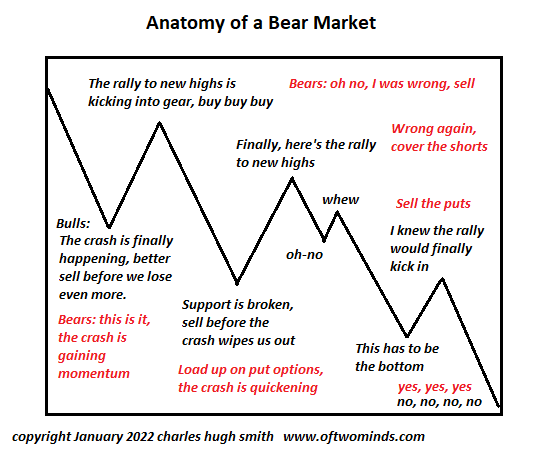
Easier said than done, as my chart of the Anatomy of a Bear Market illustrates. What's easy is being whipsawed and thrown off the bus.

That grizzled old wreck of a trader who mumbles incoherently about the 70s, 1987, 2002 and 2008? Listen to the ramblings, and ponder the runes and wanderings of the shattered mind. Therein lie the secrets to emerging not as a shell-shocked survivor but as the rare victor.


My new book is now available at a 20% discount this month: Global Crisis, National Renewal: A (Revolutionary) Grand Strategy for the United States (Kindle $8.95, print $20)

If you found value in this content, please join me in seeking solutions by becoming a $1/month patron of my work via patreon.com.


Recent Videos/Podcasts:

Charles Hugh Smith: Move Out Of The Unraveling City BEFORE Economic Collapse (1:02 hr)


My recent books:

Global Crisis, National Renewal: A (Revolutionary) Grand Strategy for the United States (Kindle $9.95, print $25) Read Chapter One for free (PDF).

A Hacker's Teleology: Sharing the Wealth of Our Shrinking Planet (Kindle $8.95, print $20, audiobook $17.46) Read the first section for free (PDF).

Will You Be Richer or Poorer?: Profit, Power, and AI in a Traumatized World
(Kindle $5, print $10, audiobook) Read the first section for free (PDF).

Pathfinding our Destiny: Preventing the Final Fall of Our Democratic Republic ($5 Kindle, $10 print, ( audiobook): Read the first section for free (PDF).

The Adventures of the Consulting Philosopher: The Disappearance of Drake $1.29 Kindle, $8.95 print); read the first chapters for free (PDF)

Money and Work Unchained $6.95 Kindle, $15 print)
Read the first section for free


Become a $1/month patron of my work via patreon.com.


NOTE: Contributions/subscriptions are acknowledged in the order received. Your name and email remain confidential and will not be given to any other individual, company or agency.

Thank you, Gerard H. ($50), for your marvelously generous contribution to this site -- I am greatly honored by your support and readership.


Thank you, John M. ($5/month), for your most-excellently generous pledge to this site -- I am greatly honored by your support and readership.


Thank you, Robert S. ($5/month), for your superbly generous pledge to this site -- I am greatly honored by your support and readership.


Thank you, Emily J.-R. ($5/month), for your supremely generous pledge to this site -- I am greatly honored by your support and readership.

Read more...

Terms of Service

All content on this blog is provided by Trewe LLC for informational purposes only. The owner of this blog makes no representations as to the accuracy or completeness of any information on this site or found by following any link on this site. The owner will not be liable for any errors or omissions in this information nor for the availability of this information. The owner will not be liable for any losses, injuries, or damages from the display or use of this information. These terms and conditions of use are subject to change at anytime and without notice.

RE: European Union AI Act, and Our Use of Generative AI Tools and Agents Policy

All text on this site is composed by Charles Hugh Smith or by a credited guest-author. No Generative AI Tools are used in the composition / writing of any text or graphic content created by Charles Hugh Smith. This site deploys no AI agents or generative AI tools. This site is not responsible for the disclosures, use or non-use of AI agents or generative AI tools in advertisements displayed by Investing Channel or other ad placement services.

Audio files generated by text-to-audio transcription tools are identified as such.

Our Privacy Policy:

Correspondents' email is strictly confidential. This site does not collect digital data from visitors or distribute cookies. Advertisements served by third-party advertising networks such as Investing Channel may use cookies or collect information from visitors for the purpose of Interest-Based Advertising; if you wish to opt out of Interest-Based Advertising, please go to Opt out of interest-based advertising (The Network Advertising Initiative) If you have other privacy concerns relating to advertisements, please contact advertisers directly.

PRIVACY NOTICE FOR EEA INDIVIDUALS

This section covers disclosures on the General Data Protection Regulation (GDPR) for users residing within EEA only. GDPR replaces the existing Directive 95/46/ec, and aims at harmonizing data protection laws in the EU that are fit for purpose in the digital age. The primary objective of the GDPR is to give citizens back control of their personal data. Please follow the link below to access InvestingChannel's General Data Protection Notice.
https://stg.media.investingchannel.com/gdpr-notice/

Notice of Compliance with The California Consumer Protection Act

This site does not collect digital data from visitors or distribute cookies. Advertisements served by a third-party advertising network (Investing Channel) may use cookies or collect information from visitors for the purpose of Interest-Based Advertising. If you do not want any personal information that may be collected by third-party advertising to be sold, please follow the instructions on this page: Do Not Sell My Personal Information.

Regarding Cookies:

This site does not collect digital data from visitors or distribute cookies. Advertisements served by third-party advertising networks such as Investing Channel may use cookies or collect information from visitors for the purpose of Interest-Based Advertising; if you wish to opt out of Interest-Based Advertising, please go to Opt out of interest-based advertising (The Network Advertising Initiative) If you have other privacy concerns relating to advertisements, please contact advertisers directly.

Our Commission Policy:

Though I earn a small commission on Amazon.com books and gift certificates and gold (BullionVault) purchased via links on my site, I receive no fees or compensation for any other non-advertising links or content posted on my site.

Copyright Notice:

All original images (Drawings and Photographs), text (essays, books and works of fiction), audio and video recordings, musical compositions, graphic design, graphic design elements and HTML coding on this site are the copyrighted work of Charles Hugh Smith unless otherwise credited or noted. They are published as information for the private use of site visitors, and any reproduction or redistribution of this content or coding in any media in any format or distribution channel (text, audio, video/film, web) without the written permission of the copyright holder is strictly prohibited. All rights in all media reserved globally.

  © Blogger templates Newspaper III by Ourblogtemplates.com 2008

Back to TOP