


Wednesday, November 17, 2010

Wall Street's "Recovery" Leaves Main Street Mugged in the Gutter

Rising costs and taxes and declining income have mugged Main Street while Wall Street revels in the Fed-engineered "recovery"--in the stock market.


The Fed would have us believe that the stock market is the leading indicator of the economy: if stocks are rising, then that is strong evidence the economy is improving.


This is the bogus "wealth effect" I have taken pains to discredit:


Why the Fed's 'Trickle-Down Economics' Is Failing


Are the Fed's Honchos Simpletons, Or Are They Just Taking Orders? (Nov. 1, 2010)


Fraud and Complicity Are Now the Lifeblood of the Status Quo (Nov. 12, 2010)


Fed's QE2 Misadventure Costs U.S. Households $4.6 trillion (Nov. 10, 2010)


Main Street didn't buy "the stock market is rising, so you must be richer" either, for the simple reason that Main Street's wallet is now much thinner. Even as the S&P 500 has soared 80% from its March 2009 lows, 70% of Americans don't believe the recession is over.


That must really hurt the apparatchiks in the Ministry of Propaganda and the Fed. Here they go to all this trouble to orchestrate a bogus stock market rally and Mainstream Media propaganda campaign hyping "the recovery," and Main Street America refused to buy it. How irksome.


It seems Main Street's grasp on reality is firmer than that of either the Fed or its partner, Wall Street.


Let's consider income.


The stock market rally off the March 2009 lows was by some measures the sharpest such advance in the past 100 years. Yet as stocks went on a tear, household income actually declined. According to the Census Bureau, the median household income fell 0.7% to $49,777 in 2009, down 4.2% since pre-recession 2007.
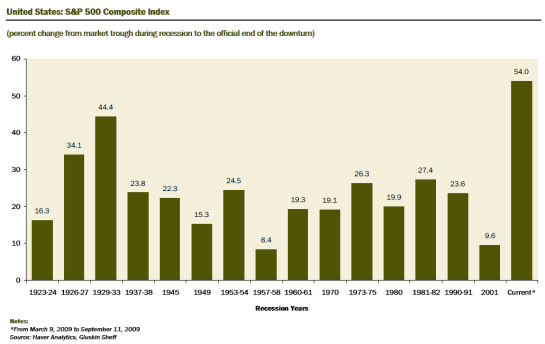

The Federal Reserve's stated policy objective is to boost the stock market to trigger a "wealth effect" which will then lead consumers to open their wallets.


As noted here before, the Fed failed to notice that only the top 10% of households hold enough stocks to see much benefit from a rising market. Household income actually fell, despite the huge run-up in stocks.


In other words, a rising stock market did not increase household incomes. The Fed is gambling on an effect with no evidence to support it.


How about jobs?


While the Bureau of Labor Statistics reported that the economy added 151,000 jobs in October, Mish's analysis finds that 330,000 jobs were lost according to the household survey, and even the BLS's 151,000 was mostly "seasonal adjustment" fiction.


The BLS also reported "discouraged workers" increased by 411,000 and the labor participate rate fell again. Why does that matter? If there are 20 workers participating in the economy, and 10 are unemployed, then the unemployment rate is 50%. If nine of those unemployed drop out ("discouraged workers") and stop looking for work, then the unemployment rate magically drops to 9%: there are ten employed workers and only one unemployed.


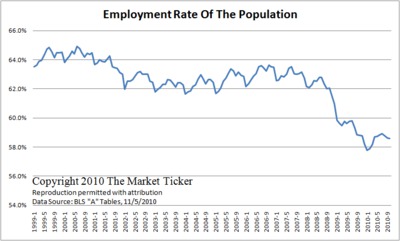
In other words, the unemployment rate can fall not because there are actually more people getting jobs but because there are fewer people looking, i.e. in the labor pool. Here is a chart, courtesy of Karl Denninger and Market Ticker, which depicts the declining participation rate.


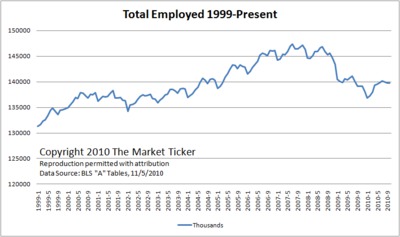
The total number of employed has bounced off a low but has flat-lined. If the "persons employed part time for economic reasons" (a BLS category) and those "marginally attached" (jobless but not counted by the BLS as unemployed because they had not searched for work in the 4 weeks preceding the survey), then the under-employment/unemployment rate jumps to over 17%.


This helps explain why the recovery appears so tepid to 2/3 of Americans: in terms of employment, it very clearly is tepid. This chart compares the current employment improvements with those of previous recessions. It is painfully obvious that the job market is still declining, not recovering.
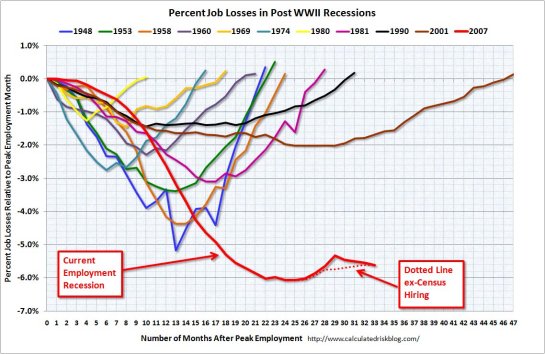


Unlike in previous recessions, the number of unemployed who have been jobless for 26 weeks or longer has skyrocketed, suggesting there is a structural dearth of jobs being created in the economy.


As the next chart illustrates, the primary reason the recession was not deeper is the Federal government and embarked on an unprecedented borrow-and-spend binge. The Federal deficit (that is, the increase in the national debt) was $1.6 trillion for fiscal year 2010, about the same size as the 2009 deficit.
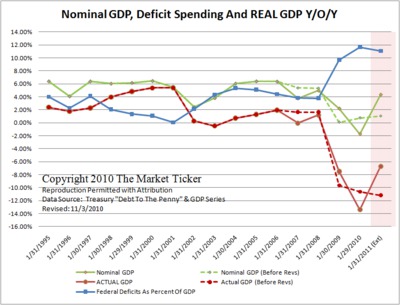


So the Federal Government borrowed and spent roughly 11% of the nation's entire GDP. Economists who believe that the government should "spend our way out of recession" (the Keynesians) have been unable to explain why borrowing and spending a staggering $3.2 trillion in two years has done little beyond maintaining the status quo.


But the money is borrowed, and future taxpayers will see their incomes diverted to pay the interest on all that additional debt.


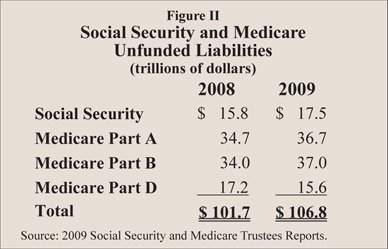
Even worse, the long-term liabilities being heaped on future taxpayers are growing by trillions every year. By some accounts, the unfunded liabilities for Social Security and Medicare alone (leaving aside all other government spending) is a mind-boggling $106 trillion.


Wall Street may be cheering this level of government borrowing and spending, but Main Street recognizes it is unhealthy and doomed to end badly for the American public.


How about the rising costs of essentials?


Though the official rate of inflation is a miniscule 1.1%, Main Street Americans sense this isn't accurate when it comes to food and other essentials. As many observers have noted, containers and package sizes are shrinking, meaning the consumer is getting less for their money. This sort of "hidden inflation" (also called "value deflation") is not picked up by the official statistics.


The Commodity Research Bureau index of commodities, the CRB, is a widely recognized measure of commodity prices. The CRB has shot up 28% since the Federal Reserve announced its QE2 quantitative easing program. While Wall Street is beside itself with joy over QE2, Main Street looks down the road and sees huge prices increases ahead in food, energy and other essentials.
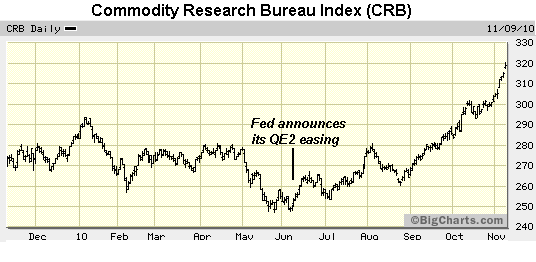

QE2 has certainly benefited Wall Street, but it has delivered Main Street a sucker punch of sharply higher prices in agricultural and energy commodities.


Meanwhile, taxes and fees have taken off and are climbing steeply.


Many observers find state and local tax revenues to be a more reliable measure of economic activity than GDP or unemployment statistics. After all, we only pay taxes out of real income and actual sales.


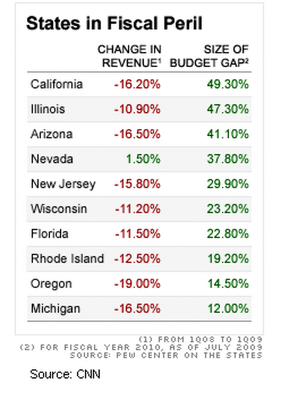
While state and local taxes have edged up 2.2% in the last quarter (April to June), indicating modest improvement in the real economy, the numbers are still considerably lower than in 2008 before the financial crisis in October 2008 triggered the recession.


According to the U.S. Census Bureau, total state and local taxes have slumped $38 billioncompared to the second quarter of 2008--roughly 16%. Individual income taxes plummeted by almost 20% (from $99 billion to $71 billion), corporate taxes fell by 18% and sales taxes are off about 5%.


Reflecting the state local governments' raising of tax rates and fees, vehicle taxes actually rose 5%. Despite the significant declines in property values, property taxes actually rose 14.7% from 2008 as municipalities jacked up tax rates.


With tax revenues based on incomes and consumption still way down from pre-recession totals, and the only increases in revenues coming from sharply higher tax rates and fees, Main Street has been mugged and tossed in the gutter while Wall Street chortles its way to billion-dollar bonuses and the Fed's economists count the number of fictitious angels employed on the head of a pin.


If you would like to post a comment where others can read it, please go toDailyJava.net, (registering only takes a moment), select Of Two Minds-Charles Smith, and then go to The daily topic. To see other readers recent comments, go to New Posts.


Order Survival+: Structuring Prosperity for Yourself and the Nation and/or Survival+ The Primer from your local bookseller or from amazon.com or in ebook and Kindle formats.A 20% discount is available from the publisher.


Of Two Minds is now available via Kindle: Of Two Minds blog-Kindle


Thank you, Denise S. ($20), for your awesomely generous second contribution to this site-- I am greatly honored by your support and readership. Thank you, John P. ($20), for your extremely generous contribution to this site-- I am honored by your support and readership.


Read more...

Tuesday, November 16, 2010

Commercial Real Estate (CRE): The Slow-Mo Cliff-Dive Gathers Speed

Commercial real estate is in a structural cliff-dive, currently in slow-motion but soon to gather momentum.


With all the hub-bub about the foreclosure crisis in residential real estate, commercial real estate (CRE) has fallen off the radar screen of crises. Don't worry, it's still careening off the cliff; the fall is just in slow motion.


No need for a fancy report to see the signs of decay in CRE. Signs of the ongoing CRE meltdown are everywhere--empty storefronts, mall shops and vacant office complexes abound.


The causes are all too familiar: lending standards went out the window, banks loaned too much, buyers paid too much, lousy deals were avidly securitized, cash flow projections entered Fantasyland and unhealthy speculation fed widespread fraud.


Since boom-and-bust cycles of overbuilding and retrenchment are endemic to commercial real estate, it's tempting to view this as just another post-expansion trough. Since prices have already slipped a staggering 40% from the 2006 peak, those calling this the bottom of the current cycle have some history on their side.


But beneath what appears to be a standard-issue retrenchment--a glut of inventory to work through, lenders avoiding risk instead of embracing it, and so on--structural changes in the U.S. economy are changing the CRE landscape for good--and not in a positive direction.


A long-term structural decline in CRE is not just a real estate industry concern. With some $1.7 trillion in CRE loans needing to be refinanced in the next few years, a continuing decline in CRE values could push the still-fragile banking system into a new crisis and the economy back into recession as early as next year.


The extremes reached in the boom were certainly epic: investors paid $800,000 per resort hotel room and over $500 per square foot for Class A office space, numbers which no terrestrial cash flow could possibly justify. Retail centers sprouted alongside every new exurb subdivision.


By this logic, an unprecedented boom requires an equally unprecedented bust to work through the excesses in price, debt and risk. So far so good, but there is an anecdotal body of evidence which suggests that profound systemic changes are taking place in the U.S. economy which will structurally reduce the demand for commercial real estate--not for a few years, but permanently.


1. A significant portion of CRE growth was the result of the snake eating its own tail: as the FIRE economy (finance, insurance, real estate) expanded in the credit-bubble environment of low interest rates, high leverage, plentiful liquidity and increased risk appetite, then the real estate, financing and construction industries' need for space exploded.


The go-go years also fed a boom in the business-travel hospitality sector, and homeowners flush with the "wealth effect" extracted some $5 trillion in home equity, fueling a prodigious increase in resorts and related high-end retail space.


The net result was a CRE industry which needed the rarified air of an ever-expanding credit bubble to sustain itself--the very pinnacle of unsustainability. Now that the credit bubble excesses are gone, then the industry has no foreseeable foundation for future growth.


2. Out of necessity, the U.S. consumer is retrenching for the long haul. With the home equity cash machine broken, credit tightening, unemployment topping 10% and their wealth reduced by some $11 trillion in the past two years, consumers of all ages are changing their credit-dependent lifestyles.


The 60-million strong Baby Boomer generation is facing the sobering prospects of a much-reduced retirement, or no retirement at all, and the only strategy with any guarantee of success is reducing spending and stashing away as much savings as possible.


This trend change is reflected in falling consumer credit--a change of trend roughly equivalent to the Earth's gravitational field reversing polarity--and plummeting sales tax receipts.


The consequences for the retail sector, and by extension, retail real estate, are dire. If this is not just a garden-variety retrenchment but a real sea change, then retail may be overbuilt for a generation--or if online shopping continues to take market share--permanently.


The old model of 5-year leases is already under pressure. The hot new trend in retail is "pop-up shops" that unload excess inventory for a few weeks and then close. Desperate landlords are accepting the crumbs of a few weeks' rent where they once demanded a multi-year lease. And it isn't just a low-end seasonal phenomenon: The Gap and Toys R Us are successfully using the pop-up model.


Similiar trends are visible in the resort/leisure sector. Constrained consumers are no longer willing or able to plunk down $250 or more a night for an upscale resort room, and once room rates drop below a certain threshold then highly leveraged hotels are no longer financially viable.


3. The built-in problem for all CRE is that as rents/occupancy/room rates decline, cash flow falls even faster. Just because occupancy is down doesn't mean property taxes, mortgages or maintenance costs drop accordingly. Thus the upscale Four Seasons Hualalai hotel on the Big Island of Hawaii saw its annual cash flow fall from $20.6 million in 2007 to $7.9 million in 2009--a massive 62% haircut that was almost double the 35% hit in occupancy rates.


With so many properties leveraged to the hilt, a decline in cash flow sets off a wicked positive feedback loop: plummeting cash flows trigger a wave of forfeitures, foreclosures and bankruptcies which add to a glut of distressed space will only further depress valuations and rents which lead to more foreclosures, and so on. If this were a typical recession, then all this excess property would eventually be absorbed by new enterprises. But if the bubble era of ever-rising consumer credit and spending is over, then that scenario is called into question.


4. The unprecedented access to low-interest credit and leverage fueled a real estate expansion into increasingly marginal locales--distant exurban "new towns" far from jobs and tourist "destinations" without proven drawing power. As consumer credit and spending recede (recall consumer spending is 2/3 of the entire U.S. GDP) then large numbers of properties will be left high and dry with little prospect for salvation. Whatever recovery does occur will begin with proven properties, and there is no guarantee the recovery will ever reach distant marginal properties.


5. The wave of creative destruction unleashed by the Internet has yet to envelop commercial office space--but it's already reached the front steps. Just as online retail has decimated retail sectors such as bookstores, the Web is busy revolutionizing white-collar work, the mainstay of office towers and business parks.


Real work can now be done offsite/remotely at a home office, café, or anywhere but a cubicle at headquarters, and the cost advantages of this flexibility will not be going away. Yes, there are still powerful reasons to meet in person, but there are equally powerful reasons to permanently downsize travel and office costs.


Structural changes in the economy are increasing self-employment and contract labor and shrinking the scale of new enterprises. Millions of well-educated American workers already work at home, and since the average U.S. house has grown in size over the past 50 years, free-lancers and self-employed professionals have plenty of space rent-free.


High-growth companies which once hired hundreds of employees and rented entire floors are increasingly offer highly automated products and services. New-tech juggernaut Twitter recently leased more space in San Francisco as it was expanding its staff to maybe as high as--gasp!--200 employees. Will Twitter be filling that empty office tower near you? No, because its "service" is largely automated software.


6. Global wage arbitrage, a.k.a. offshoring, continues eroding the need for domestic office space. The rising costs of doing business in the U.S. (healthcare goes up 6% a year, rain or shine) drives enterprises to minimize permanent staff--and just as importantly, permanent office space. Back-office staff is moved overseas and "creative" staff is either free-lance (contract) labor or mobile/home office/flex hours workers.


7. Corporate profits depend on slashing costs. With revenues stagnant and/or precariously dependent on foreign exchange arbitrage, the only way to reliably maintain profits is to slash and burn fixed costs--like office leases, utility bills, etc. Now that head counts have been cut, then empty office space which cannot be sublet is the next target to be eliminated as old leases roll over.


These trends reinforce one another. Add them together and you get a downward arc fast gathering momentum.


Order Survival+: Structuring Prosperity for Yourself and the Nation and/orSurvival+ The Primer from your local bookseller or from amazon.com or inebook and Kindle formats. A 20% discount is available from the publisher.


Of Two Minds is now available via Kindle: Of Two Minds blog-Kindle


Thank you, Oleh K. ($10), for your very generous contribution to this site-- I am honored by your support and readership. Thank you, Paul J. ($12), for your most generous contribution to this site-- I am honored by your support and readership.


Read more...

Monday, November 15, 2010

The Status Quo's Fundamental Paradigms Are Broken

The paradigms which undergird the global status quo are broken; doing more of the same (the current strategy) will not fix them.


Reading the Mainstream Media, you almost forget that the Status Quo's fundamental paradigms are completely broken. The Status Quo's essential paradigms are as follows:


1. "Growth" is the essential lifeblood of the global economy.


2. "Growth" means higher GDP and economic activity. Thus new luxury condos and Starbucks cafes on the coast of Peru boost Peru's GDP, and thus Peru is experiencing "growth" which is not just intrinsically "good" but essential.


3. "Growth" requires consuming more resources.


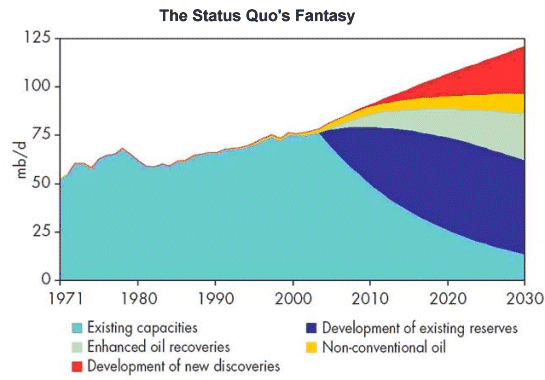
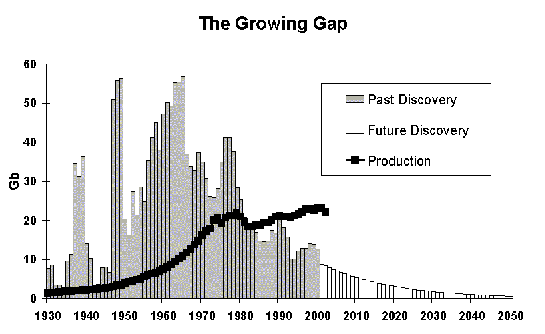
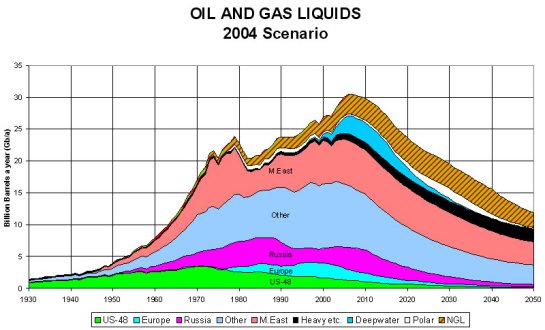
4. There will always be more resources into the foreseeable future. For instance, here is the Status Quo's depiction of fossil fuels supplies:


5. The transition from fossil fuels to alternatives will be slow and seamless because there is still plenty of cheap oil and gas.


6. The dominant paradigms of the global economy are the State Corporation (China) and the Corporate State (U.S.A.). Both are permanent because they are highly efficient.


7. Restrictions on trade and capital flows are "bad." They cause depressions.


8. The nation-state is a durable social structure which will never be seriously threatened with dissolution.


9. As long as the global "pie" of wealth keeps expanding, everyone can grow wealthier together.


10. Low interest rates and expansion of money supply and credit are the three essential financial fuels for "growth."


I think a strong case can be made that each of these paradigms is either already broken or in danger of breaking. Studies have shown that when presented with factual evidence that their core beliefs are wrong, humans respond by clinging even more tightly to their fallacious beliefs.


I think that is precisely the reaction of the global Status Quo.


Here is a typical presentation of the Status Quo's faith in the "China Story" that China's growth can and will continue unimpeded for decades to come:


The Game Changer (China).


Elizabeth C. Economy is a well-informed, insightful analyst. Yet she presumes that China can grow like a tree to the sky and that its consumption of oil and other resources can likewise double every few years forever.


There is not one word in this long essay which even hints at the possibility that constraints in the real world might hinder China's vast ambitions and appetites for "the good life" of middle-class consumption for its 1.2 billion citizens.


Though China runs a good PR game about building a "green economy," we should note that its energy consumption equaled the U.S. this year and its production of vehicles far surpassed the U.S. this year.


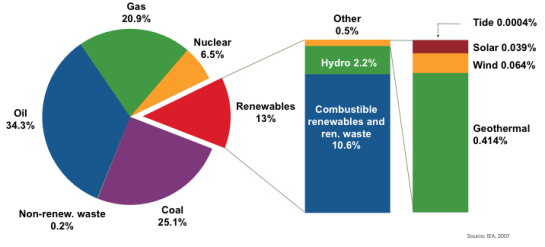
Like every other industrialized nation, China's alternative energy sector supplies at best a sliver of the nation's energy. This is a global chart from the IEA which includes nations like Brazil which have vast biofuel industries using sugar cane.


While subsidizing state-owned plants to manufacture solar panels is certainly a forward-thinking strategy, in the meantime building tens of millions of vehicles every year which require gasoline is pursuing an entirely different set of "growth" and dependency priorities.


Even in the U.S., electricity consumption has risen 25% since 1990, outstripping population growth.


Let's look at some facts before we buy into the paradigm that China (or any other nation) can grow to the sky.


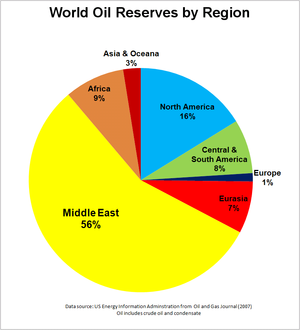
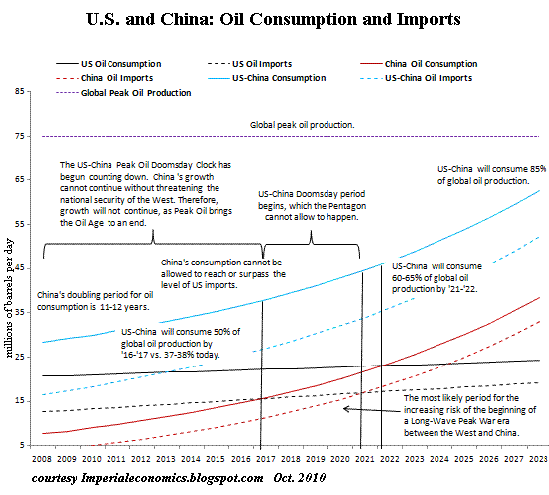
I was accused of saber-rattling after I pointed out in The Great Game: Geopolitics and Oil(October 19, 2010) that the U.S. has a "hard power" presence in the heart of the Mideast while China has a presence in Sudan and other African nations. Let's look at which presence controls more oil:


Now let's look at the reality rather than the fantasy of future oil production:


That sets up an inevitable grab for the resources needed for "growth." The timeframes on this chart are of course approximations; no one knows exactly when oil demand will rise above maximum oil production, but the status quo paradigm that China can double its consumption of oil every few years is clearly wrong.


China is culturally predisposed to feeling that the last few hundred years of weakness was an anomaly and that China is once again the center of the world. (The Chinese character for "center" has been read as "middle," i.e. the Middle Kingdom, but this misses the crucial self-awareness of China as the center of the world).


The future course of China's rising confidence in its heft can be seen everywhere: in its hardening claims for islands in the South China Sea, in its plans to divert rivers originating on the Tibetan plain away from other nations to benefit its own consumption, and in its recent export restrictions of rare industrial metals.


Anyone believing China will remain content with making solar panels while its supplies of essential resources dwindle is misreading China's larger plans.


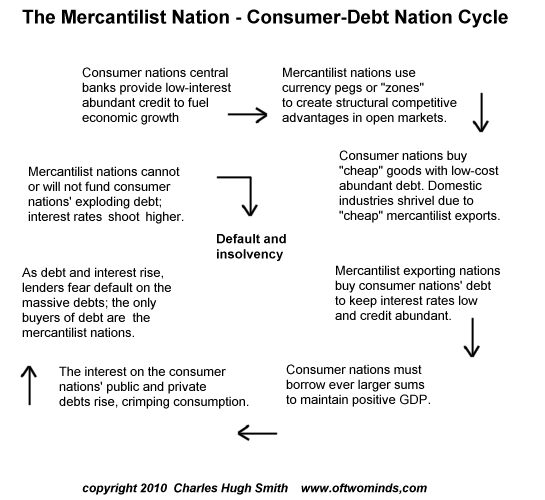
Another paradigm which is already broken is the trade-capital flow fantasy of mercantilist nations funding consumer nation's consumption. China's dissatisfaction with the end-game of this dynamic is already apparent, and a similar breakdown is occurring in Europe as the mercantilist machine that is Germany must bail out one consumer nation after another.


That dynamic is already doomed, and incantations to the contrary are simply beliefs which are unsupported by fact.


The other core paradigm of the Status Quo is a massive Central State--what I call The Savior State in the Survival+ critique.


In the U.S., personal income is around $9 trillion, and the Federal budget is around $3.6 trillion and state/local governments and agencies consume about $1.5 trillion. So government is about 36% of the nation's GDP.


Recently, the Federal government has been borrowing $1.5 trillion a year to maintain the status quo (representing about 11% of GDP). While the Status Quo presents a happy PR picture of an economy rebuilding its decaying infrastructure, the reality is the Federal borrowing is merely propping up personal income. "Transfers" are funds delivered by the government to individuals:


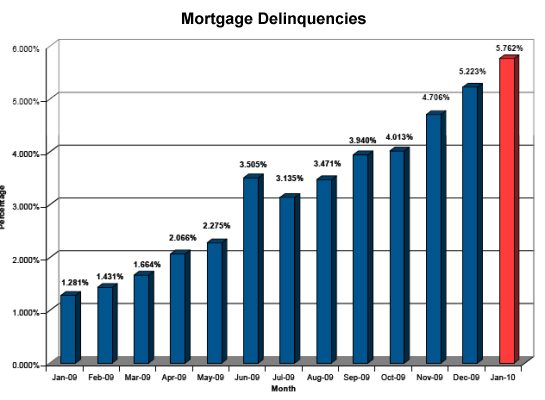
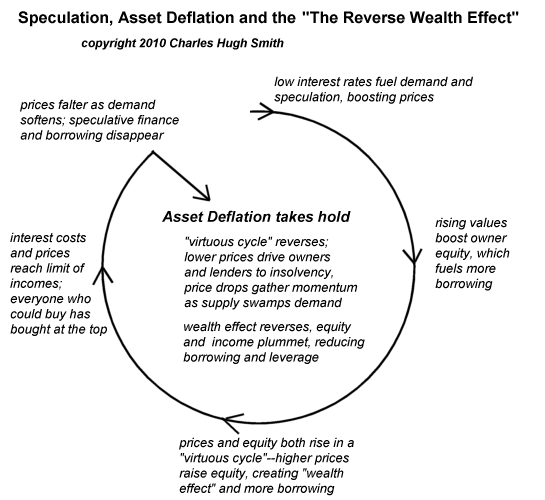
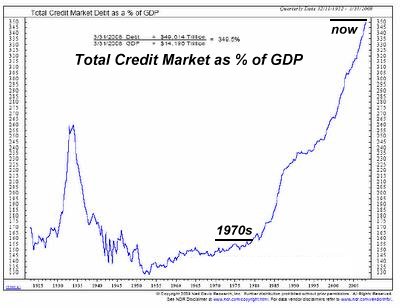
Lastly, the entire fantasy that exponentially rising debt/credit can fuel an asset bubble that then fuels a "virtuous cycle" of rising net worth and more borrowing and spending is also irrevocably broken. Let's start with the trajectory of mortgage delinquencies:


Any questions about the trend here?


As asset bubbles pop, the "wealth effect" reverses:


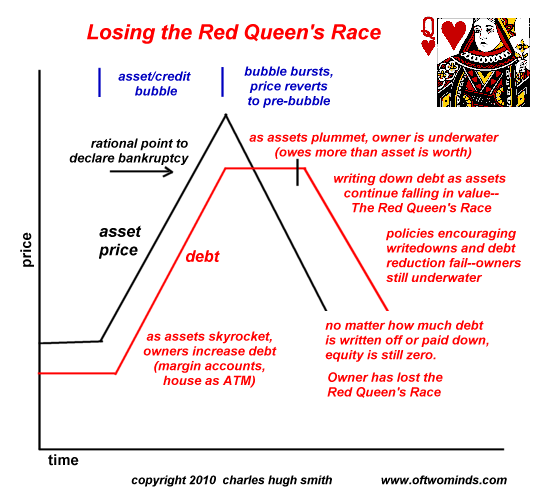
No matter how much uncollectible debt is written down, assets are falling faster: the debtor, the bank and the debtor nation all lose "The Red Queen's Race":


Ultimately, the implosion of the Savior State's finances mean the paradigm of a vast Central State is also threatened. We can understand this another way by considering the Central State as an energy consumer. As long as the Central State provides more benefits that it consumes, then the organism it lives off of (the economy) will support it.


But when the benefits dwindle and the carrying costs of the Central State continue rising, than at some point the economy can long longer support the consumption costs of the Central State.


At that point the Central State collapses or shrinks down to a sustainable size.


Anyone who believes the Savior State will endure without any adjustment in the coming decade is simply ignoring the facts and hardening their faulty beliefs. That refusal to learn from facts is not a successful survival strategy.


I don't have "all the answers" or a crystal ball, but it seems clear that "more of the same" is not a sustainable option. New applications of technology and new social/economic models (both localized and international) will have to be developed, tested and adapted which require less energy and resources.


If you would like to post a comment where others can read it, please go toDailyJava.net, (registering only takes a moment), select Of Two Minds-Charles Smith, and then go to The daily topic. To see other readers recent comments, go to New Posts.


Order Survival+: Structuring Prosperity for Yourself and the Nation and/or Survival+ The Primer from your local bookseller or from amazon.com or in ebook and Kindle formats.A 20% discount is available from the publisher.


Of Two Minds is now available via Kindle: Of Two Minds blog-Kindle


Thank you, Auntiegrav ($20), for your much-appreciated generous contribution to this site-- I am greatly honored by your support and readership. Thank you, Mike M. ($50), for your exceptionally generous contribution to this site-- I am greatly honored by your support and readership.


Read more...

Saturday, November 13, 2010

In Honor of Windows 7

Luckily for us users, Windows 7 retains all the classic error messages of legacy Windows.


My wife's cheap HP PC gave up the ghost last week after 5.5 years of service, and so I was introduced to the wonders of Windows 7 since we replaced the old cheap HP with a new cheap HP PC. (We also have an old Mac, the most recent in a line that stretches back to the first Mac in 1984, which cost $2,600 and booted the OS off a 400K "stiffy" floppy disk.)


(Tech aside #2: since I am lazy/overwhelmed 99% of the time, I back up our data remotely via the Carbonite service. It worked; all data was restored in about 15-16 hours.)


As luck would have it, Windows 7 retains all the wonderful error messages we Windows users have come to know and love. Enjoy....


NOTE 1: a severe cold, technical issues (see above) and the after-effects of oral surgery put me behind this week. Thank you to everyone who emailed me, and please don't take it as a slight if you have not yet received a reply. I read every email and will be responding as time/energy permits.


NOTE 2: I finished building my short positions in the stock market on Friday.


If you would like to post a comment where others can read it, please go toDailyJava.net, (registering only takes a moment), select Of Two Minds-Charles Smith, and then go to The daily topic. To see other readers recent comments, go to New Posts.


Order Survival+: Structuring Prosperity for Yourself and the Nation and/or Survival+ The Primer from your local bookseller or from amazon.com or in ebook and Kindle formats.A 20% discount is available from the publisher.


Of Two Minds is now available via Kindle: Of Two Minds blog-Kindle


Thank you, Tyler Z. ($10), for your most-welcome generous contribution to this site-- I am honored by your support and readership. Thank you, Barney S. ($5), for your ongoing splendid generosity to this site-- I am greatly honored by your support and readership.


Read more...

Friday, November 12, 2010

Fraud and Complicity Are Now the Lifeblood of the Status Quo (Banality of Financial Evil, Part 2)

The status quo would collapse were systemic fraud and complicity banished. Rather than the acts of evil conspirators, they have become the foundation of the U.S. economy and financial system.


Though fraud and complicity are presented in the mainstream media as isolated conspiracies outside the status quo, the truth is that the status quo is now entirely dependent on fraud and complicity for its very survival. Every level of the status quo would immediately implode were fraud and complicity suddenly withdrawn from the system.


How is this true? let me count the ways.


1. The mortgage market. As I reported recently in this Daily Finance story, the private market for mortgage-backed securities is dead. Now that we all understand the entire mortgage is not just riddled with fraud and misrepresentation of risk, but it is entirely dependent on fraud and misrepresentation of risk to function, no one is willing to touch any of this debt--except if it is guaranteed by the Federal government (and thus by its taxpayers).


Now that the systemic fraud and misrepresentation of risk have been exposed, the $10 trillion mortgage market has ceased to function except as a dumping ground where private players can dump 100% of their losses on the taxpayers (profits were privatized, losses are socialized).


2. Foreclosures and our Banana Republic system of "law". There are two sets of laws (and two sets of books) in status quo America: one set of laws for "too big to fail" banks and Wall Street, and one for the rest of us peons.


Courts Helping Banks Screw Over Homeowners.


3. Housing and commercial real estate (CRE). Does anyone seriously think housing is recovering from organic demand? Does anyone seriously think housing wouldn't fall off a cliff if the Central State withdrew its collusive propping-up of the real estate market?


As I reported in These Numbers Paint a Bleak Picture for Housing, there is essentially no evidence that housing is recovering due to "organic" (that is, non-State-manipulated) supply and demand.


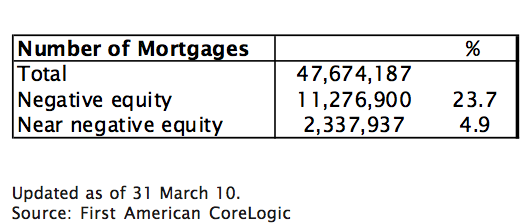
Rather, Home Prices Fall in Nearly Half of U.S. Metro Areas and the percentage of underwater homeowners rises.


4. Wall Street. Perhaps no finer example of a system totally dependent on fraud and misrepresentation of risk exists than Wall Street. To pluck but a few from dozens of recent examples:


J.P. Morgan, BofA Report Perfect Trading Quarters.


Proprietary Trading Goes Under Cover: Michael Lewis.


Want to get away with murder? Become a bank.


SIGTARP Report: Treasury Hid AIG Losses.


5. The stock market. As I outlined in Dependency, The Fed and the Market (November 8, 2010), the stock market would roll over and crater without constant intervention and manipulation by the Federal Reserve and other Power Elite/Central State agencies.


Astute reader Russ R. and Zero Hedge pointed me to this interview with Jeremy Granthamin which he rightly identifies the Fed's goal as controlling the economy rather than the money supply, and the Fed's only avenue for this manipulation is the "wealth effect" which it believes is triggered by a rising stock market.


But as I laid out in Are the Fed's Honchos Simpletons, Or Are They Just Taking Orders?(November 1, 2010), the "wealth effect" and its discredited cousin, the "trickle-down" theory, are both doomed to fail.


The stock market gained over 50% in 2009, adding trillions of dollars in "wealth effect," yet the median household income fell 0.7% to $49,777 in 2009. So much for the "wealth effect" from rising stocks having any positive effect on actual household incomes.


In essence, the Fed is counting on an illusion of temporary wealth to ignite a firestorm of new borrowing and spending. Unfortunately for the Fed, 90% of American households don't own enough financial assets to feel even the illusion of newfound wealth, and those that do have been burned twice this decade when all that "wealth" in stocks vanishes (NASDAQ down almost 80% in 2000-02, S&P 500 down 45% from October 2008 to March 2009).


6. Corporate accounting. With pro-forma earnings, off-balance sheet assets, derivatives booked as "mark to fantasy," much of Corporate America's accounting is dependent on fraud and misrepresentation of risk to plump up the all-important quarterly earnings.


I have written extensively on this recently:


U.S. Financial Markets: The Well Has Been Poisoned (Anger of the Honest Part II)(October 23, 2010)


The Loss of Trust and the Great Unraveling To Come (October 18, 2010)


The Normalization of Sociopathology in America (October 16, 2010)


The Rot Within: Our Culture of Financial Fraud and the Anger of the Honest (October 15, 2010)


7. Politics. I addressed this recently in two entries:


Concentrated Wealth and the Purchase of Political Power: Democracy's Death Spiral (October 29, 2010)


The Stealth Coup D'Etat: U.S.A. 2008-2010 (October 28, 2010)


8. The entire status quo, from worker bees to Power Elites and the Political Class.


The Banality of (Financial) Evil (November 9, 2010)


The Strain of Being Evil

(The present) state is marked by the rise of the pygmy leader, the sovereign as dolt, the CEO as figurehead that knows little, who has no real need of knowing. It is in this gimlet-eyed tone that Hegel should be read when he says that "no reference to particularity of character" is necessary in the leader of an advanced state or in this case, large bank in an advanced money economy. Hegel continues:

"In a completed organization we have to do with nothing but the extreme of formal decision, and that for this office is needed only a man who says 'Yes,' and so puts the dot upon the 'i.' The pinnacle of state must be such that the private character of its occupant shall be of no significance."


What is known in the literature as "moral hazard" creates an ecology that results in moral lassitude rather than evil. Thus our bankers are no robber barons, no blood suckers, but rather "dot the i" dolts, and at their best, their very best, they are performers who pantomime what a leader should look like in order to "dot the i" or appear to.

I think that sums up the foreclosure crisis, the banks, the courts, the regulatory agencies, Wall Street, the Fed, the Treasury, and the rest of the Political Class.


When a system becomes dependent on fraud and misrepresentation of risk for "business as usual," then all that is required of the complicit is to "dot the i's" and fill out the report, court order, balance sheet, act of Congress, etc., just like everyone else does.


Thus does the banality of (financial) evil come to full flower.


If you would like to post a comment where others can read it, please go toDailyJava.net, (registering only takes a moment), select Of Two Minds-Charles Smith, and then go to The daily topic. To see other readers recent comments, go to New Posts.


Order Survival+: Structuring Prosperity for Yourself and the Nation and/or Survival+ The Primer from your local bookseller or from amazon.com or in ebook and Kindle formats.A 20% discount is available from the publisher.


Of Two Minds is now available via Kindle: Of Two Minds blog-Kindle


Thank you, Kevin W. ($25), for your exceptionally generous contribution to this site-- I am honored by your support and readership. Thank you, Robert K. ($20), for your splendidly generous donation to this site-- I am honored by your support and readership.


Read more...

Terms of Service

All content on this blog is provided by Trewe LLC for informational purposes only. The owner of this blog makes no representations as to the accuracy or completeness of any information on this site or found by following any link on this site. The owner will not be liable for any errors or omissions in this information nor for the availability of this information. The owner will not be liable for any losses, injuries, or damages from the display or use of this information. These terms and conditions of use are subject to change at anytime and without notice.

RE: European Union AI Act, and Our Use of Generative AI Tools and Agents Policy

All text on this site is composed by Charles Hugh Smith or by a credited guest-author. No Generative AI Tools are used in the composition / writing of any text or graphics/charts created by Charles Hugh Smith. This site deploys no AI agents . This site is not responsible for the disclosures, use or non-use of AI agents or generative AI tools in advertisements displayed by Investing Channel or other ad placement services.

Audio files (such as the KDP-generated audiobooks of my novels) generated by text-to-audio transcription tools are identified as such. The MP4 videos accompanying my original songs and the illustrations in my graphic novels are generated by AI tools. The story, scenes, characters and all descriptions and dialog of the graphic novels are composed solely by me..

Our Privacy Policy:

Correspondents' email is strictly confidential. This site does not collect digital data from visitors or distribute cookies. Advertisements served by third-party advertising networks such as Investing Channel may use cookies or collect information from visitors for the purpose of Interest-Based Advertising; if you wish to opt out of Interest-Based Advertising, please go to Opt out of interest-based advertising (The Network Advertising Initiative) If you have other privacy concerns relating to advertisements, please contact advertisers directly.

PRIVACY NOTICE FOR EEA INDIVIDUALS

This section covers disclosures on the General Data Protection Regulation (GDPR) for users residing within EEA only. GDPR replaces the existing Directive 95/46/ec, and aims at harmonizing data protection laws in the EU that are fit for purpose in the digital age. The primary objective of the GDPR is to give citizens back control of their personal data. Please follow the link below to access InvestingChannel's General Data Protection Notice.
https://stg.media.investingchannel.com/gdpr-notice/

Notice of Compliance with The California Consumer Protection Act

This site does not collect digital data from visitors or distribute cookies. Advertisements served by a third-party advertising network (Investing Channel) may use cookies or collect information from visitors for the purpose of Interest-Based Advertising. If you do not want any personal information that may be collected by third-party advertising to be sold, please follow the instructions on this page: Do Not Sell My Personal Information.

Regarding Cookies:

This site does not collect digital data from visitors or distribute cookies. Advertisements served by third-party advertising networks such as Investing Channel may use cookies or collect information from visitors for the purpose of Interest-Based Advertising; if you wish to opt out of Interest-Based Advertising, please go to Opt out of interest-based advertising (The Network Advertising Initiative) If you have other privacy concerns relating to advertisements, please contact advertisers directly.

Our Commission Policy:

Though I earn a small commission on Amazon.com books and gift certificates and gold (BullionVault) purchased via links on my site, I receive no fees or compensation for any other non-advertising links or content posted on my site.

Copyright Notice:

All original images (Drawings and Photographs), text (essays, books and works of fiction), audio and video recordings, musical compositions, graphic design, graphic design elements and HTML coding on this site are the copyrighted work of Charles Hugh Smith unless otherwise credited or noted. They are published as information for the private use of site visitors, and any reproduction or redistribution of this content or coding in any media in any format or distribution channel (text, audio, video/film, web) without the written permission of the copyright holder is strictly prohibited. All rights in all media reserved globally.

  © Blogger templates Newspaper III by Ourblogtemplates.com 2008

Back to TOP