Thursday, February 19, 2015

How Many More “Saves” Are Left in the Central Bank Bazookas?

All central banks have succeeded in doing is pushing the systemic risk into an arena they do not control.


The master narrative of the global economy shifted six years ago from “China will push global growth for decades to come” to “the central banks can push global growth for decades to come.”

Time after time we’ve witnessed enfeebled global markets jolted out of terminal declines by central bank pronouncements and new money-printing policies. Never mind that the European Central Bank’s (ECB) Mario Draghi had no concrete proposals in hand when he announced the ECB would “do whatever it takes” to save the European Union from the financial consequences of its reckless abandonment of risk management; the mere announcement was enough to trigger a massive reversal in global markets.

The major central banks have tag-teamed one rally in global stock and bond markets after another: the U.S. Federal Reserve goosed markets in 2008, 2009, 2010, 2011, 2012 and 2013, only ending its various quantitative easing (QE) money-emitting programs in late 2014.

The ECB saved the day with Draghi’s “whatever it takes” PR gambit and more recently with its own QE money-printing program.

The Bank of Japan (BOJ) injected monetary amphetamines into global markets with Abenomics, a last-ditch effort by the BoJ and the government of Japan to crush the value of the Japanese yen and import inflation.

The People’s Bank of China (China’s central bank) has kept the credit spigot open wide for years, unleashing one of the greatest credit expansions in recent history.

China’s central bank balance sheet has doubled since 2009, but the star attraction in China’s debt bubble is bank credit. Compare China’s bank credit with that of the U.S.. Measured in dollars, the U.S. GDP is $17 trillion and China’s GDP is $10 trillion; measured in purchasing power parity (PPP), the two economies are roughly the same size.


The remarkable success of grandiose pronouncements, money-printing programs and serial expansions of credit raises a key question: how many more “saves” can the central bank bazookas fire that will have the desired effects of maintaining perceptions of central bank omnipotence and pushing global markets ever higher?

The Dow Jones Global Index (DJW) offers a snapshot of global markets. Since the last big central bank “save” in 2012, the index has lofted ever higher, staying comfortably above the 50-week moving average (MA).


But this era of central bank-induced euphoria appears to have ended in mid-2014; since then, price and key indicators have trended down. Recently, price has slipped beneath the 50-week MA and is struggling to overcome this line that was once support and is now resistance.

Though central banks have continued their ceaseless public-relations campaigns and kept various credit and money spigots wide open, this chart strongly suggests the central bank bazookas are losing their effectiveness. Iin other words, the returns on both PR and money/credit issuance are diminishing rapidly.

These diminishing returns may result at least partially from the end of the Federal Reserve’s massive monetary/credit expansion, which is reflected by the Fed’s balance sheet (courtesy of Davefairtex/mdbriefing.com):
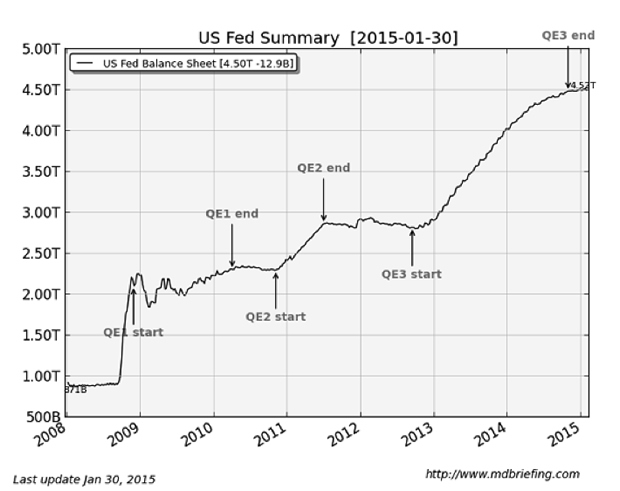
After quintupling from $871 billion in 2008 to $4.5 trillion, the balance sheet has leveled off as the Fed ended its QE program.

Other central banks have kept their money-printing/credit spigots wide open, but it's looking like the Fed’s decision to end large-scale money-issuance of U.S. dollars into the global economy cannot be replaced with euros, yen and renminbi (a.k.a. yuan).

Saved by Cheaper Energy?


The astonishing collapse in oil prices has provided an unexpected (by most analysts) tailwind to the world’s manufacturing/consuming economies, even as it has dealt a crushing hammer-blow to oil-producing/exporting economies.

While there are obvious pluses and minuses to the cost of oil falling in half (when priced in U.S. dollars), the fact is that the major manufacturing/consuming nations have far larger economies than the oil producing/exporting nations (the one exception being the U.S., which is both a major producer and major importer of oil). So the advantages of lower oil prices for manufacturing, transportation and end consumers on a global basis outweighs the damage to the energy sector globally, which is roughly 5% to 10% of global GDP, depending on the current prices of energy:
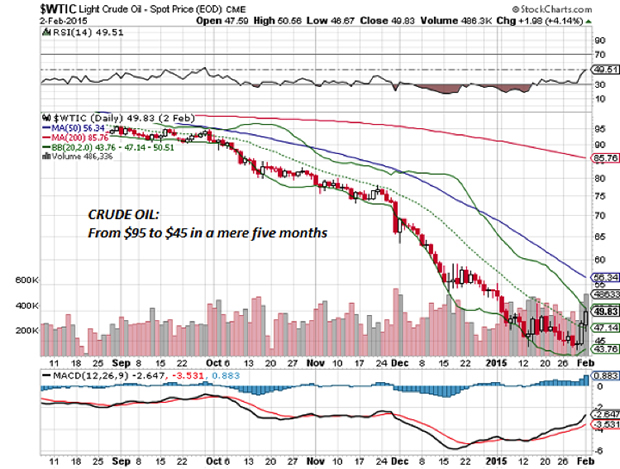

Though many mainstream media sources are claiming oil will decline to $30 or even lower, and stay there for years, others are skeptical of this “cheap oil forever” projection based on the rising cost of extracting oil globally. Since the majority of the cheap-to-extract oil has already been pumped, what’s left costs more to extract when measured in energy (energy returned on energy invested—EROEI) or money.

Since oil is priced on the margin, relatively modest changes in supply and demand can move prices far more than many expect.  The recent uptick visible in this chart suggests those expecting oil to drop to $30/barrel and stay there indefinitely might well be as wrong as those who thought oil would hover around a permanently high plateau around $90 - $100 last summer.

While the tailwind of lower energy costs has been welcomed in most of the world, the economics of oil do not lend much support to the expectation of $30/barrel oil lasting indefinitely. Lower prices will eventually cause producers to shut-in wells, rapidly reducing supply, while rising consumption in oil-exporting nations will continue to reduce the quantity of oil available for export.

In other words, it’s not just the quantity of oil that’s being produced globally that counts—it’s the quantity that’s available for export that really matters.

The tailwinds of lower energy prices might be as ephemeral as the tailwinds of hot air (PR pronouncements of the “whatever it takes” variety) issued by central banks.

The Destabilizing Rise of the U.S. Dollar


Just as the collapse in oil prices was not controllable by central bank jawboning or emissions of money/credit, it appears the strengthening of the U.S. dollar—a move that has destabilized emerging market economies and currencies—is not entirely in the control of central banks:
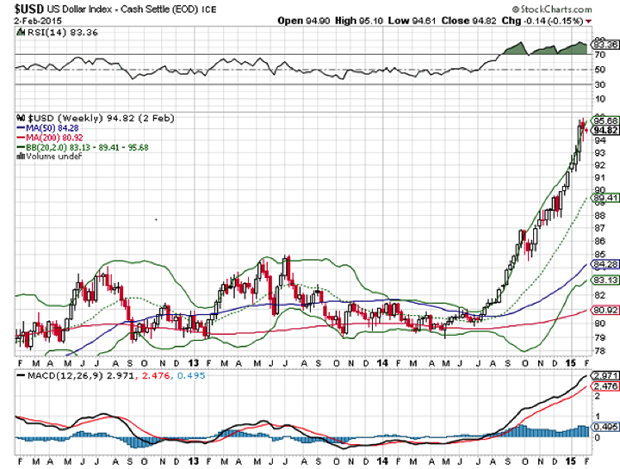

I have covered the dynamics of this destabilization in several prior articles over the past several months, including The Dollar May Remain Strong For Longer Than We Think and The Consequences Of A Strengthening US Dollar.

In essence, carry trades (i.e. borrowing in one currency and investing the proceeds in another currency) that were profitable when the dollar was weakening have reversed, turning into losing trades.

The more the dollar rises, the greater the losses in these carry trades, and the greater the incentive for those still in the trade to sell emerging market assets and currencies.

The flood of dollars unleashed by the Fed’s QE programs washed over the entire globe, encouraging people in emerging markets to take loans denominated in dollars. Now those loans are increasingly burdensome, as it takes ever-larger sums of local currency to service the dollar-denominated debts.
In response to these massive outflows of capital, emerging nations must raise interest rates to offer incentives for capital to stay put, which then causes the cost of new loans (and doing business in general) to quickly rise to painful levels.

As the currencies suffering outflows decline against the dollar, imports become more expensive and exports lose value when traded for dollars. It’s a triple-whammy for emerging nations: their borrowing costs are soaring, the capital leaving to pay off dollar-denominate debt leaves them starved for investment capital, and their imports rise in cost as their exports earn less.

As I have often noted, the failure to address the structural problems that caused the Global Financial Meltdown of 2008-2009 effectively transferred systemic risk to the enormous foreign-exchange (FX) market, which is connected to virtually everything in the global economy.

This is one key reason for the diminishing returns of central bank policies: all central banks have succeeded in doing is pushing the systemic risk into an arena they do not control.

In Part 2: What Will Happen Next For The US Dollar we explore just how far the destabilizing effects of currently in play in the currency markets -- currency wars, Triffin's Paradox, increased FX volatility -- are likely to threaten the global economy. It's very important to appreciate how the consequences of such global destabilization are not as controllable as relatively stable stagnation we have become used to over the past several decades.

In short, buckle up.

Click here to access Part 2 of this report (free executive summary; enrollment required for full access)

This essay was first published on peakprosperity.com where I am a contributing writer.


Get a Job, Build a Real Career and Defy a Bewildering Economy (Kindle, $9.95)(print, $20)
go to Kindle edition
Are you like me? Ever since my first summer job decades ago, I've been chasing financial security. Not win-the-lottery, Bill Gates riches (although it would be nice!), but simply a feeling of financial control. I want my financial worries to if not disappear at least be manageable and comprehensible.  And like most of you, the way I've moved toward my goal has always hinged not just on having a job but a career.

You don't have to be a financial blogger to know that "having a job" and "having a career" do not mean the same thing today as they did when I first started swinging a hammer for a paycheck.

Even the basic concept "getting a job" has changed so radically that jobs--getting and keeping them, and the perceived lack of them--is the number one financial topic among friends, family and for that matter, complete strangers.

So I sat down and wrote this book: Get a Job, Build a Real Career and Defy a Bewildering Economy.

It details everything I've verified about employment and the economy, and lays out an action plan to get you employed.

I am proud of this book. It is the culmination of both my practical work experiences and my financial analysis, and it is a useful, practical, and clarifying read.

Test drive the first section and see for yourself.     Kindle, $9.95     print, $20

"I want to thank you for creating your book Get a Job, Build a Real Career and Defy a Bewildering Economy. It is rare to find a person with a mind like yours, who can take a holistic systems view of things without being captured by specific perspectives or agendas. Your contribution to humanity is much appreciated."
Laura Y.

Gordon Long and I discuss The New Nature of Work: Jobs, Occupations & Careers (25 minutes, YouTube) 


NOTE: Contributions/subscriptions are acknowledged in the order received. Your name and email remain confidential and will not be given to any other individual, company or agency.


Thank you, Paul L. ($250), for your outrageously generous contribution to this site-- I am greatly honored by your steadfast support and readership.


Read more...

Wednesday, February 18, 2015

Greece and the Endgame of the Neocolonial Model of Exploitation

With the bankruptcy of Greece now undeniable, we've finally reached the endgame of the Neocolonial-Financialization Model.


We all know how old-fashioned colonialism worked: the imperial power takes physical control of previously independent lands and declares its ownership of the region as a newly minted colony.

What's the benefit of controlling colonies?In the traditional colonial model, there are two primary benefits: 

1. The imperial power (the core) extracts valuable commodities and low-cost labor from its colony (the periphery) 

2. The imperial power sells its own high-margin manufactured goods to the captured-market of its colony.

This buy low, sell high dynamic is the heart of colonialism, which can be understood as one example of the The Core-Periphery Model (June 11, 2013).

The book Sweetness and Power: The Place of Sugar in Modern History is an excellent history of how this model worked for Great Britain.

The tensions this model generated in the colonial elites of America are brought to life in Tobacco Culture: The Mentality of the Great Tidewater Planters on the Eve of Revolution.

This traditional model of colonialism was forcibly dismantled in the 1940s-1960s. Former colonies established their political independence, a process that diminished the wealth and global reach of former colonial powers.

In response, global financial powers sought financial control rather than political control. This is one dynamic of what I call the Neocolonial-Financialization Model (May 24, 2012), which substitutes the economic power of financialization (debt, leverage and speculation) for the raw power of political conquest and control.

The main strategy of financialization is: extend cheap credit to those with limited access to capital. Those with limited access to capital will swallow the bait of cheap credit whole, and willingly agree to penalties, high interest rates, etc.

Then, when the credit expansion reaches levels that cannot be supported, the lenders demand collateral and/or favorable trade and financial concessions.

These tactics have been well-documented in books such as The Shock Doctrine: The Rise of Disaster Capitalism and Confessions of an Economic Hit Man.

But the economic pillaging of former colonies has limits, and as a consequence the global financial powers developed the Neocolonial Model, which turns these same techniques on one's home region.

Thus Greece and other capital-poor European nations were recognized as the periphery that could be exploited by the core, and the euro was the ideal tool to financialize the economies of nations which could never have generated credit/housing bubbles without the wide-open spigots of cheap credit flooding their economies.

In Neocolonialism, the forces of financialization are used to indenture the local Elites and populace to the financial core: the peripheral "colonials" borrow money to buy the finished goods manufactured in the core economies, enriching the Imperial Elites with A) the profits made selling goods to the debtors B) interest on credit extended to the peripheral colonies to buy the core economies' goods and "live large", and C) the transactional skim of financializing peripheral assets such as real estate and State debt.

In essence, the core banks of the EU colonized the peripheral nations via the financializing euro, which enabled a massive expansion of debt and consumption in the periphery. The banks and exporters of the core extracted enormous profits from this expansion of debt and consumption.

Now that the financialization scheme of the euro has run its course, the periphery's neocolonial standing is starkly revealed: the assets and income of the periphery are flowing to the core as interest on the private and sovereign debts that are owed to the core's central bank and its money-center private banks.

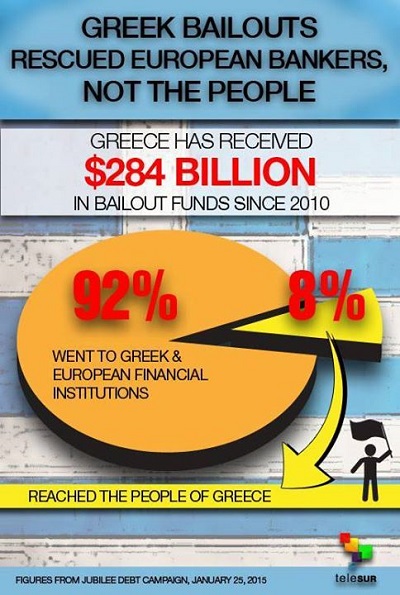
Note how little of the Greek "bailout" actually went to the citizenry of Greece and how much was interest paid to the financial powers.


This is not just the perfection of neocolonialism but of neofeudalism as well. The peripheral nations of the EU are effectively neocolonial debtors of the core, and the taxpayers of the core nations are now feudal serfs whose labor is devoted to making good on any loans to the periphery that go bad.

Neocolonialism benefits both the core's financial Aristocracy and national oligarchies/ kleptocracies. This is ably demonstrated in the recent essay Misrule of the Few: How the Oligarchs Ruined Greece.

With the bankruptcy of Greece now undeniable, we've finally reached the endgame of the Neocolonial-Financialization Model. There are no more markets to exploit with financialization, and the fact that the mountains of debt are unpayable can no longer be masked.

At this point, the financial Aristocracy has an unsolvable dilemma: writing off defaulted debt also writes off assets and income streams, for every debt is somebody else's asset and income stream. When all those phantom assets are recognized as worthless, the system implodes. 


Get a Job, Build a Real Career and Defy a Bewildering Economy (Kindle, $9.95)(print, $20)
go to Kindle edition
Are you like me? Ever since my first summer job decades ago, I've been chasing financial security. Not win-the-lottery, Bill Gates riches (although it would be nice!), but simply a feeling of financial control. I want my financial worries to if not disappear at least be manageable and comprehensible.  And like most of you, the way I've moved toward my goal has always hinged not just on having a job but a career.
You don't have to be a financial blogger to know that "having a job" and "having a career" do not mean the same thing today as they did when I first started swinging a hammer for a paycheck.

Even the basic concept "getting a job" has changed so radically that jobs--getting and keeping them, and the perceived lack of them--is the number one financial topic among friends, family and for that matter, complete strangers.

So I sat down and wrote this book: Get a Job, Build a Real Career and Defy a Bewildering Economy.

It details everything I've verified about employment and the economy, and lays out an action plan to get you employed.

I am proud of this book. It is the culmination of both my practical work experiences and my financial analysis, and it is a useful, practical, and clarifying read.

Test drive the first section and see for yourself.     Kindle, $9.95     print, $20

"I want to thank you for creating your book Get a Job, Build a Real Career and Defy a Bewildering Economy. It is rare to find a person with a mind like yours, who can take a holistic systems view of things without being captured by specific perspectives or agendas. Your contribution to humanity is much appreciated."
Laura Y.

Gordon Long and I discuss The New Nature of Work: Jobs, Occupations & Careers (25 minutes, YouTube) 


NOTE: Contributions/subscriptions are acknowledged in the order received. Your name and email remain confidential and will not be given to any other individual, company or agency.

Thank you, Mae W. ($20), for your splendidly generous contribution to this site-- I am greatly honored by your support and readership.

Read more...

Tuesday, February 17, 2015

The Catastrophic Costs of Extend-and-Pretend Are About to Crush Europe

Like a star which has expanded and now cannot maintain its grand state, Europe's extend-and-pretend economy is now poised to experience a supernova implosion.


The costs of ill-conceived policies are always paid by someone--usually those with the least political power. In ill-conceived wars, the costs are paid by the soldiers on the ground and their families, and the civilians who suffer collateral damage.

The costs of ill-conceived financial policies end up being paid by taxpayers, savers, borrowers and those who lose their jobs in the inevitable bust. Those who conjured up the disastrous policies slink away to plush villas or defend their stubborn addiction to failed ideologies in the media (see Keynesian Cargo Cult and Paul Krugman).

The most ill-conceived financial policy of all is extend-and-pretend: extend-and-pretend means if a debtor is bankrupt, then extend him more loans to maintain the illusion of solvency.

Here's how extend-and-pretend works in the real world:

-- If a homebuyer has defaulted, give him new loans, or shift his loan off the books into zombie mortgage status.

-- If a student defaults on student loans, shift the loans into forbearance, i.e. mask the default by putting the defaulted debt into zombie mode.

-- If a bank is insolvent, give it unlimited access to unlimited lines of central bank credit and lower interest rates to zero so the bank doesn't have to pay interest on deposits.

-- If a nation is bankrupt, extend it new loans.

The official reason for extend-and-pretend is the belief that time will heal all-- that given enough time, all problems solve themselves via some sort of pixie dust. In essence, this faith that time will heal all is a delusional state of magical thinking, for extending and pretending only enables the kleptocrats and the elites benefiting from the failed Status Quo to continue holding power.

As painful as it would have been, Greece should have been refused loans in 2010 and 2011, and been ejected from the euro. The situation was visibly hopeless to everyone then, and extend-and-pretend was never going to solve the structural imbalances in the Greek economy that had been furthered or enabled by the euro and easy credit.

What did Europe buy with its $245 billion bailouts of Greece? Nothing. The $245 billion-- equal to the entire GDP of Greece--squeezed the citizens of Greece while leaving the kleptocracy in charge--the worst possible outcome.

If policymakers had rejected extend-and-pretend and grasped the nettle in 2010/2011, Greece would be through the painful period of adjustment to its own currency. Deprived of the euro gravy train, its ruling kleptocracy would have collapsed or been ejected by the people as a failed regime.

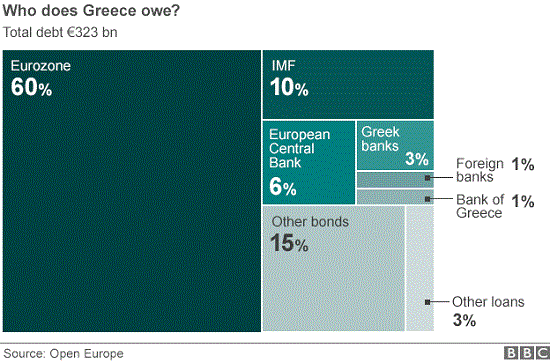
Thanks to extend-and-pretend bailouts, the pain of adjusting to reality is now being dumped not just on the people of Greece but on the people of every nation in the EU. Frequent contributor Mark G. explains why: most of the debt owed by Greece doesn't just vanish when Greece defaults--it must be paid by the other EU nations that guaranteed the debt.


Here's Mark's explanation:
The issue is not whether Greece's European Financial Stability Facility (EFSF) backed debts will be repaid. The question is who will repay them.  European Financial Stability Facility (Wikipedia) 
The structure of the EFSF and related packages means that if Greece will not/can not pay then every single guarantor country has to come up with fiscal appropriations to backstop any deficiency left by Greece in a default. This means going back to their national parliaments in most if not all cases for fiscal appropriations to do this. At this point what the Germans demonize as The Transfer Union will emerge stripped of all camouflage in all its hideousness. 
This is going to be politically explosive in itself for every one of these Eurozone governments. Nor is this confined to so-called "creditor" states, except in the sense that every non-defaulting state will be a creditor. 
So-called debtors and crisis states like Italy, Spain, Portugal and Ireland are all liable in large varying amounts as well as Finland, Holland, France and Germany. The first four, generally classed as being 'debt crisis' states themselves, are liable for a total of 240 billion euros as their end of the EFSF. Since Greece accounts for about 1/3 of the EFSF this works out to 80 billion euros for four weakened sates already experiencing their own Austerity. 
I cannot imagine that at this moment any of these cabinet politicians could tolerate a second budgetary line item that decodes as Additional New Money & Guarantees For Greece Under Tsipras/Varoufakis/Syriza. 
Greece can indeed initiate that process. And having done so, no one will have any further tolerance for Greece at the table. Their leverage begins and ends with default. 
The seeds of disaster were planted when Greece was first admitted to the ECB and euro under false pretenses.
Extending imprudently massive loans to marginal borrowers always plants the seeds of disaster, and extending and pretending turns a potentially containable disaster into an uncontainable financial calamity. Yet this is the game plan of policymakers everywhere, from Europe to the U.S. to China--extend enormous loans to marginal borrowers and then mask the inevitable defaults with extend-and-pretend policies that vastly increase the size of the debt.

By the time extend-and-pretend finally reaches its maximum limits, the resulting implosion is so large that the shock waves topple regimes, banks, currencies and entire nations.

Like a star which has expanded and now cannot maintain its grand state, Europe's extend-and-pretend economy is now poised to experience a supernova implosion.


Get a Job, Build a Real Career and Defy a Bewildering Economy(Kindle, $9.95)(print, $20)
go to Kindle edition
Are you like me? Ever since my first summer job decades ago, I've been chasing financial security. Not win-the-lottery, Bill Gates riches (although it would be nice!), but simply a feeling of financial control. I want my financial worries to if not disappear at least be manageable and comprehensible.  And like most of you, the way I've moved toward my goal has always hinged not just on having a job but a career.

You don't have to be a financial blogger to know that "having a job" and "having a career" do not mean the same thing today as they did when I first started swinging a hammer for a paycheck.

Even the basic concept "getting a job" has changed so radically that jobs--getting and keeping them, and the perceived lack of them--is the number one financial topic among friends, family and for that matter, complete strangers.

So I sat down and wrote this book: Get a Job, Build a Real Career and Defy a Bewildering Economy.

It details everything I've verified about employment and the economy, and lays out an action plan to get you employed.

I am proud of this book. It is the culmination of both my practical work experiences and my financial analysis, and it is a useful, practical, and clarifying read.

Test drive the first section and see for yourself.     Kindle, $9.95     print, $20

"I want to thank you for creating your book Get a Job, Build a Real Career and Defy a Bewildering Economy. It is rare to find a person with a mind like yours, who can take a holistic systems view of things without being captured by specific perspectives or agendas. Your contribution to humanity is much appreciated."
Laura Y.

Gordon Long and I discuss The New Nature of Work: Jobs, Occupations & Careers(25 minutes, YouTube) 


NOTE: Contributions/subscriptions are acknowledged in the order received. Your name and email remain confidential and will not be given to any other individual, company or agency.


Thank you, Tim B. ($100), for your outrageously generous contribution to this site-- I am greatly honored by your support and readership.

Read more...

Monday, February 16, 2015

Failed Discipline, Failed Reforms and Grexit: Why the Euro Failed

There is no substitute for the discipline of a market that cannot be manipulated by political elites.


It's not that difficult to understand why the euro is doomed to fail. Given its structure, there is no other possible outcome but failure. Greece's exit (Grexit) will simply be the first manifestation of the inevitable structural failure of the euro.

To understand why this is so, we have to start with two forms of discipline: the market and the state. The market disciplines its participants by discovering the price of not just goods and services but of currencies and the potential risks generated by fiscal and trade imbalances.

When nations issue their own sovereign currencies, the global foreign exchange (FX) market enforces an iron discipline on all participants. If a nation prints excessive quantities of its currency without boosting its production of goods and services by an equivalent amount, the FX market punishes this nation by devaluing its currency.

The market provides unwelcome feedback to the imbalances of interest rates, credit and currency: imports become prohibitive, nobody wants to buy the nation's bonds unless the interest rate compensates for the higher risk, and so on.

The political and financial leadership of the nation would eliminate this feedback if they could. Unfortunately for the domestic leadership, the FX market is too big to manipulate for long. Domestic governments and central banks can try all sorts of fancy footwork (pegging their currency to stronger currencies, etc.) but in the end, the market will sniff out the fundamental imbalance between the rigged price of the nation's currency and its market value.

The domestic political and financial leadership/Elites are powerless to stop or evade the discipline of the FX market. They can complain and protest and claim an international conspiracy brought down their financial fantasies, but the reality is the market is made up of many participants, all of whom want to make money, not lose it by accepting a bunch of political BS as the actual truth.

The other form of structural discipline is imposed by the state (government in all its forms, including central banks). A typical example is the state legislature imposes a cap on state borrowing, i.e. the state is not allowed to borrow more than 3% of expenses annually.

We all know what happens to these kinds of state-imposed discipline: they are ignored, bypassed, watered down or gutted. Why is this so? The reason is that all political systems, regardless of their ideology, are influenced by powerful elites and vested interests.

When some political cap stands in the way of enriching or protecting a politically powerful elite or vested interest, the cap is quickly reduced to a PR play.

This is the fundamental flaw in state fiscal discipline: it is always a political construct and thus contingent on what benefits powerful elites and constituencies.

The disciplinary foundation of the euro is wholly political. In agreeing to join a monetary union of one currency, the EU nations eliminated the market's ability to provide feedback on the imbalances building up in their economies.

In effect, they replaced the discipline of a market that cannot be manipulated for a political discipline that can be manipulated as a matter of course.

Canny domestic politicos are well-versed in ways to hide fiscal and credit imbalances. Masking financial realities is their bread and butter.

So what happens when you impose a super-state (the EU) on the member nations? the super-state becomes the cozy home for canny politicos who play the same old hide-and-seek financial games on a larger stage.

The official response to this intrinsic lack of discipline is for the central banks to print money and issue more credit. Does issuing more money and credit provide any fiscal discipline? Of course not--it does the opposite, freeing the canny politicos (yes, the ones supposedly in charge of imposing discipline on the system) to escape any consequences from their fraud and profligacy.

The idea that the political leadership of a state or super-state could impose a discipline equivalent to that imposed by a market was always a fantasy. As a result, the idea that political discipline could impose painful and difficult reforms on politically powerful elites and vested interests was also a fantasy.

This is why Greece has no choice but to exit the euro. The politicos in the EU will "do whatever it takes" to extend the fantasy their discipline is equal to the discipline of the FX market, but everyone knows it's all PR and lies.

There is no substitute for the discipline of a market that cannot be manipulated by political elites, and as a result there can be no real reforms until the euro is dissolved and the FX market forces the true cost of systemic imbalances on the domestic participants who created and maintained the imbalances.

Reform cannot be triggered by borrowing more money--it can only be triggered by defaulting on existing debts that cannot be paid. Bailouts are never about enabling reform--they're about preserving the Status Quo Elites' and vested interests' share of the swag. 


Get a Job, Build a Real Career and Defy a Bewildering Economy (Kindle, $9.95)(print, $20)
go to Kindle edition
Are you like me? Ever since my first summer job decades ago, I've been chasing financial security. Not win-the-lottery, Bill Gates riches (although it would be nice!), but simply a feeling of financial control. I want my financial worries to if not disappear at least be manageable and comprehensible.And like most of you, the way I've moved toward my goal has always hinged not just on having a job but a career.

You don't have to be a financial blogger to know that "having a job" and "having a career" do not mean the same thing today as they did when I first started swinging a hammer for a paycheck.

Even the basic concept "getting a job" has changed so radically that jobs--getting and keeping them, and the perceived lack of them--is the number one financial topic among friends, family and for that matter, complete strangers.

So I sat down and wrote this book: Get a Job, Build a Real Career and Defy a Bewildering Economy.

It details everything I've verified about employment and the economy, and lays out an action plan to get you employed.

I am proud of this book. It is the culmination of both my practical work experiences and my financial analysis, and it is a useful, practical, and clarifying read.

Test drive the first section and see for yourself.     Kindle, $9.95     print, $20

"I want to thank you for creating your book Get a Job, Build a Real Career and Defy a Bewildering Economy. It is rare to find a person with a mind like yours, who can take a holistic systems view of things without being captured by specific perspectives or agendas. Your contribution to humanity is much appreciated."
Laura Y.

Gordon Long and I discuss The New Nature of Work: Jobs, Occupations & Careers (25 minutes, YouTube) 


NOTE: Contributions/subscriptions are acknowledged in the order received. Your name and email remain confidential and will not be given to any other individual, company or agency.

Thank you, Deserno N. ($5/month), for your remarkably generous subscription to this site-- I am greatly honored by your support and readership.

Read more...

Sunday, February 15, 2015

Greece and Euroland's Crumbling McMansion of Debt

All the gimmicks lenders press on borrowers to maintain the artifice that the loan is being serviced are financial frauds.


Sometimes the best way to summarize a complex situation is with an analogy. The Greek debt crisis, for example, is very much like the subprime mortgage crisis of 2007-08.

As you might recall, service workers earning $25,000 annually got $500,000 mortgages to buy McMansions in subprime's go-go days. The applicant fudged a bit here and there on income and creditworthiness, and lenders reaping huge profits from originating and selling mortgages were delighted to ignore prudent underwriting standards and stamp "low-risk" on the mortgage because it was quickly sold to credulous investors.

The bank made its money in transaction and origination fees, and passed the risk of default on to investors who accepted the fraud that the loan was low-risk.

The loan was fundamentally imprudent and risky because the borrower was not qualified for a loan of such magnitude. But since the risk was distributed to others, the banks ignored the 100% probability of eventual default and skimmed the profits upfront.

Greece was the subprime borrower, and its membership in the euro gave the banks permission to enter the credit rating of Germany on Greece's loan application. Though anyone with the slightest knowledge of Greece's economy knew it did not qualify for loans of such magnitude, lenders were happy to offer the loans at interest rates close to those of Greece's northern neighbors, and then sell them as low-risk sovereign debt investments.

In effect, the banks were free-riding the magical-thinking belief that membership in the euro transformed risky borrowers into creditworthy borrowers.

It's as if the $25,000/year worker wrote in a rich cousin's sterling credit score on his mortgage application. The lender and applicant conspired to fudge the numbers to lower the apparent risk of the loan. In the case of Greece, Greece and the lenders each fudged the numbers; there was no real penalty for doing so, and the rewards for doing so were substantial.

Marginal borrowers eventually default, and sure enough, both the subprime borrower and Greece soon defaulted. Life isn't perfect; people lose their jobs, get divorced, have medical emergencies, etc., and recessions lower GDP and national income.

Prudent lenders make allowances for these risks. But lenders who make big money originating loans and offloading them to others have no incentive to be prudent; rather, they have every incentive to make as many loans as they can, as quickly as they can, to maximize their profits.

Faced with massive writedowns, the lender has two choices: it can loan the defaulting borrower more money, with the explicit guarantee that the borrower will use the money to pay interest on the original mortgage. The total loan amount goes up, but the loan stays on the books at full value.

Or the lender can roll the mortgage into a lower-interest loan, effectively entering partial forbearance: the promised return on the mortgage plummets, but as long as the borrower makes small monthly payments, the loan stays on the books at full value.

Both of these strategies have been deployed in Japan for decades to keep impaired debts on the books at full value.

The last choice is to turn the mortgage into a zombie loan: the loan is neither written off nor listed as being in default: it enters a zombie state, not in good standing but not in default, either. The mortgage can stay in this netherworld for years, as the lender waits for the market to rise enough that the house can be sold without the lender absorbing a huge loss on the mortgage.

Unfortunately for buyers of sovereign debt, there is no house that can be sold to pay down the debt. Lenders can demand the debtor-nation sell off its assets to make good on the loans, but there is little recourse should the debtor-nation refuse.

When the borrower can barely make the monthly payment, he becomes a zombie. The loan principal barely budges, and so the future is unending penury. The borrower can cut expenses--bike to work, only eat beans and rice, only buy thrift-store clothing, etc.,--but this austerity doesn't change anything: he still can't afford the loan.

This is why austerity is a fake solution: no matter what the guy earning $25,000 a year does, he will never be able to pay down the $500,000 mortgage.

Meanwhile, the poorly constructed McMansion is falling apart. The loan didn't boost the borrower's productivity, or create a new income stream; the borrowed money was squandered on something that did nothing for the borrower that something much, much cheaper could have done just as effectively.

What did Greece get for its $300+ billion in debt? Did it transform the lives of all citizens for the better, fix all its dysfunctional systems, and build an economy for the 21st century? No; the borrowed money simply masked the dysfunctional systems and allowed the Status Quo kleptocracy to reap fortunes.

Greece's lenders want to keep the imprudently issued loans on the books at full value.They followed the strategy of loaning Greece more money, but only to make the interest payments. Now there is fevered talk of some version of partial forbearance: rolling the debt into new loans, perhaps writing off a chunk of the debt, etc.

None of this changes the fundamental fact that Greece was unqualified to borrow that much money. No matter what the guy earning $25,000 a year does, he will never be able to service the $500,000 debt in a way that frees him from zombie servitude to the lender.

So the hapless subprime borrower with the crumbling McMansion and Greece both have the same choice: decades of zombie servitude to pay for the crumbling structure, or default and move on with their lives.

All the gimmicks lenders press on borrowers to maintain the artifice that the loan is being serviced are financial frauds. They are simply new frauds piled on the initial fraud of issuing a visibly imprudent loan. The borrower was not creditworthy and the lender should never have offered him loans of that magnitude and at that low interest rate. The losses belong to the lenders, period. 


Get a Job, Build a Real Career and Defy a Bewildering Economy (Kindle, $9.95)(print, $20)
go to Kindle edition
Are you like me? Ever since my first summer job decades ago, I've been chasing financial security. Not win-the-lottery, Bill Gates riches (although it would be nice!), but simply a feeling of financial control. I want my financial worries to if not disappear at least be manageable and comprehensible.  And like most of you, the way I've moved toward my goal has always hinged not just on having a job but a career.

You don't have to be a financial blogger to know that "having a job" and "having a career" do not mean the same thing today as they did when I first started swinging a hammer for a paycheck.

Even the basic concept "getting a job" has changed so radically that jobs--getting and keeping them, and the perceived lack of them--is the number one financial topic among friends, family and for that matter, complete strangers.

So I sat down and wrote this book: Get a Job, Build a Real Career and Defy a Bewildering Economy.

It details everything I've verified about employment and the economy, and lays out an action plan to get you employed.

I am proud of this book. It is the culmination of both my practical work experiences and my financial analysis, and it is a useful, practical, and clarifying read.

Test drive the first section and see for yourself.     Kindle, $9.95     print, $20

"I want to thank you for creating your book Get a Job, Build a Real Career and Defy a Bewildering Economy. It is rare to find a person with a mind like yours, who can take a holistic systems view of things without being captured by specific perspectives or agendas. Your contribution to humanity is much appreciated."
Laura Y.

Gordon Long and I discuss The New Nature of Work: Jobs, Occupations & Careers (25 minutes, YouTube) 


NOTE: Contributions/subscriptions are acknowledged in the order received. Your name and email remain confidential and will not be given to any other individual, company or agency.

Thank you, Susannah W. ($200), for your outrageously generous contribution to this site-- I am greatly honored by your steadfast support and readership.

Read more...

Terms of Service

All content on this blog is provided by Trewe LLC for informational purposes only. The owner of this blog makes no representations as to the accuracy or completeness of any information on this site or found by following any link on this site. The owner will not be liable for any errors or omissions in this information nor for the availability of this information. The owner will not be liable for any losses, injuries, or damages from the display or use of this information. These terms and conditions of use are subject to change at anytime and without notice.

RE: European Union AI Act, and Our Use of Generative AI Tools and Agents Policy

All text on this site is composed by Charles Hugh Smith or by a credited guest-author. No Generative AI Tools are used in the composition / writing of any text or graphics/charts created by Charles Hugh Smith. This site deploys no AI agents . This site is not responsible for the disclosures, use or non-use of AI agents or generative AI tools in advertisements displayed by Investing Channel or other ad placement services.

Audio files (such as the KDP-generated audiobooks of my novels) generated by text-to-audio transcription tools are identified as such. The MP4 videos accompanying my original songs and the illustrations in my graphic novels are generated by AI tools. The story, scenes, characters and all descriptions and dialog of the graphic novels are composed solely by me..

Our Privacy Policy:

Correspondents' email is strictly confidential. This site does not collect digital data from visitors or distribute cookies. Advertisements served by third-party advertising networks such as Investing Channel may use cookies or collect information from visitors for the purpose of Interest-Based Advertising; if you wish to opt out of Interest-Based Advertising, please go to Opt out of interest-based advertising (The Network Advertising Initiative) If you have other privacy concerns relating to advertisements, please contact advertisers directly.

PRIVACY NOTICE FOR EEA INDIVIDUALS

This section covers disclosures on the General Data Protection Regulation (GDPR) for users residing within EEA only. GDPR replaces the existing Directive 95/46/ec, and aims at harmonizing data protection laws in the EU that are fit for purpose in the digital age. The primary objective of the GDPR is to give citizens back control of their personal data. Please follow the link below to access InvestingChannel's General Data Protection Notice.
https://stg.media.investingchannel.com/gdpr-notice/

Notice of Compliance with The California Consumer Protection Act

This site does not collect digital data from visitors or distribute cookies. Advertisements served by a third-party advertising network (Investing Channel) may use cookies or collect information from visitors for the purpose of Interest-Based Advertising. If you do not want any personal information that may be collected by third-party advertising to be sold, please follow the instructions on this page: Do Not Sell My Personal Information.

Regarding Cookies:

This site does not collect digital data from visitors or distribute cookies. Advertisements served by third-party advertising networks such as Investing Channel may use cookies or collect information from visitors for the purpose of Interest-Based Advertising; if you wish to opt out of Interest-Based Advertising, please go to Opt out of interest-based advertising (The Network Advertising Initiative) If you have other privacy concerns relating to advertisements, please contact advertisers directly.

Our Commission Policy:

Though I earn a small commission on Amazon.com books and gift certificates and gold (BullionVault) purchased via links on my site, I receive no fees or compensation for any other non-advertising links or content posted on my site.

Copyright Notice:

All original images (Drawings and Photographs), text (essays, books and works of fiction), audio and video recordings, musical compositions, graphic design, graphic design elements and HTML coding on this site are the copyrighted work of Charles Hugh Smith unless otherwise credited or noted. They are published as information for the private use of site visitors, and any reproduction or redistribution of this content or coding in any media in any format or distribution channel (text, audio, video/film, web) without the written permission of the copyright holder is strictly prohibited. All rights in all media reserved globally.

  © Blogger templates Newspaper III by Ourblogtemplates.com 2008

Back to TOP