




Wednesday, January 20, 2016

Central Banks Are Out of Tricks

Once the power to manage expectations has been lost, the central bank bag of tricks is empty.
No one knows precisely how and when the global unraveling will impact their corner of the planet, but we do know one thing with absolute certainty: central banks are out of tricks.
Like all good conjurers, the major central banks will claim that their magical powers to inflate asset valuations and inspire the animal spirits of risk, borrowing and spending are unimpaired, but this time the audience knows the truth: their magic is threadbare and their trick-bag is empty.
Obfuscation and doublespeak are primary components of central bank magic.The magic is largely semantic: if the Federal Reserve claims it can restore the economy and the stock market with reverse repos and other financial legerdemain, the corporate media is always ready to repeat this dubious claim until it is accepted as self-evident.
The central bank magic is fundamentally a mind-trick of managing expectations. If the Fed (or other central bank) announces a quantitative easing or market-goosing program, punters buy assets anticipating the success of the bank's program, effectively creating the very push higher the bank intended.
This rise draws in other traders, and the program is declared a success as the market generates a self-reinforcing logic: the market's response is evidence the central bank's program is a success, which then inspires more risk-on buying and further market gains.
Once a central bank program fails to generate a self-reinforcing rally, the mind-trick's power is broken. Once expectations of a sustained rally are crushed by the failure of the rally to achieve virtuous-cycle lift-off, the magic no longer works: once traders take a wait and see stance rather than rush to place panic-buy orders, the initial rally soon fizzles, and the expectations of effortless gain are replaced by gnawing fear of more losses.
Once expectations revert to caution, the central banks lose their power to move markets with pronouncements. Unfortunately for believers in the omnipotence of central banks, monetary legerdemain has little power over the real economy. Once the power to manage expectations has been lost, the central bank bag of tricks is empty.
My new book is in the top 10 of Amazon's Kindle ebooks > Business & Money > International Economics: A Radically Beneficial World: Automation, Technology and Creating Jobs for All. The Kindle edition is $8.95 and the print edition is currently discounted to $20.82.
Admin note: I will be busy with family commitments this month. As a result, blog posts will be sporadic and email responses will be near-zero. Thank you for your understanding.

NOTE: Contributions/subscriptions are acknowledged in the order received. Your name and email remain confidential and will not be given to any other individual, company or agency.
Thank you, Mike G. ($100), for yet another outrageously generous contribution to this site -- I am greatly honored by your steadfast support and readership.
Thank you, Kenneth C. ($100), yet another outrageously generous subscription to this site -- I am greatly honored by your sup

Read more...

Another Reason Why the Middle Class and the Velocity of Money Are in Terminal Decline

This has three extremely negative consequences.
In response to a recent post on the structural decline in the velocity of money, correspondent Mike Fasano described a key dynamic in both the decline of money velocity and the middle class.
"There is another reason for falling velocity. People like me who have saved all their lives realize that they their savings (no matter how much) will never throw off enough money to allow retirement, unless I live off principal. This is especially so since one can reasonably expect social security to phased out, indexed out or dropped altogether. Accordingly, I realize that when I get to the point when I can no longer work, I'll be living off capital and not interest. This is an incentive to keep working and not to spend."
Thank you, Mike, for highlighting the devastating long-term impact of the Federal Reserve's zero-interest rate policy (ZIRP): with the real (i.e. adjusted for inflation) return on savings near zero (or even negative, for those who have to pay soaring rents, healthcare insurance premiums, college tuition, etc.), those saving for retirement are losing the Red Queen's Race: no matter how much they save, the income will be too paltry to support retirement.
This has three extremely negative consequences. Those seeking a return above zero are forced to put their savings at risk in boom-and-bust markets that tend to reward only those who get into the bubble expansion early and exit early.
These boom-and-bust markets tend to savage the assets of the middle class when they blow up, but do little to rebuild these assets in the bubble expansion phase, as prudent investors who were burned in the previous bubble bust shun risk assets.
The second negative consequence is the structural pressure on spending as those saving for retirement must sacrifice current spending to pile up capital to spend during retirement. No wonder the velocity of money is in free-fall--everyone hoping to retire on more than cat food has to set aside more of their earnings because they cannot count on any future earnings on capital.
The third consequence is the destruction of middle class retirement. When a $500,000 nestegg earns a miserable $15,000 a year (3% annual yield), saving enough to generate a middle class income in retirement is beyond the reach of what's left of the middle class.
My new book is in the top 10 of Amazon's Kindle ebooks > Business & Money > International Economics: A Radically Beneficial World: Automation, Technology and Creating Jobs for All. The Kindle edition is $8.95 and the print edition is currently discounted to $20.82.
Admin note: I will be busy with family commitments this month. As a result, blog posts will be sporadic and email responses will be near-zero. Thank you for your understanding.

NOTE: Contributions/subscriptions are acknowledged in the order received. Your name and email remain confidential and will not be given to any other individual, company or agency.
Thank you, Mike G. ($100), for yet another outrageously generous contribution to this site -- I am greatly honored by your steadfast support and readership.
Thank you, Kenneth C. ($100), yet another outrageously generous subscription to this site -- I am greatly honored by your support and readership.

Read more...

Monday, January 18, 2016

The Coming Era of Financial Triage

Virtually every major program of every major nation-state is financially unsustainable going forward.
Though triage is typically used in a medical setting, we are entering an era when financial triage will increasingly be necessary on a household, enterprise and national level.
The term triage may have originated during the Napoleonic Wars from the work of Dominique Jean Larrey. The term was used further during World War I by French doctors treating the battlefield wounded at the aid stations behind the front. Those responsible for the removal of the wounded from a battlefield or their care afterwards would divide the victims into three categories:
Those who are likely to live, regardless of what care they receive
Those who are likely to die, regardless of what care they receive
Those for whom immediate care might make a positive difference in outcome.
financial triage is the process of sorting financial expenses/ programs that are unsustainable and cannot be "reformed", those that cannot be saved except with systemic reforms, and those that will survive if simply scaled back.
On the household level, financial triage becomes necessary when one of the primary wage earners lose their jobs and cannot find a replacement position.
First to go are non-essentials such as cable TV subscriptions, eating out at restaurants, costly coffees from Starbucks, etc.
But scaling back these modest expenses may not restore the household's income to expenses balance. The major expenses of transportation, housing and healthcare may have to be sorted into what can be cut and what must be allowed to expire in order to save the household from insolvency and bankruptcy.
A mortgage that exceeds the remaining wage earner's income is an example of an expense that cannot be "reformed" away. Refinancing to a lower rate of interest may trim the monthly cost a bit, but the history of mortgage "reforms" suggests many if not most households that attempt to lower fundamentally unaffordable mortgage payments end up defaulting anyway.
Slashing major expenses is not cost-free. Trying to reduce healthcare insurance costs boils down to accepting high-deductible plans that end up costing as much as gold-plated plans once the full deductible is paid in cash.
Financial triage is intrinsically painful and wrenching. Corporations have much more practice in financial triage, as divisions or departments that aren't generating profits are sold, closed or slashed to save what can still be salvaged.
Nation-states typically have near-zero experience with financial triage.Programs are rarely ever shut down or slashed to the bone to save core functions; cuts are modest and as soon as the crisis passes, expenses soar as everyone who suffered minor cuts demands pay raises and benefits that restore whatever was trimmed.
Virtually every major program of every major nation-state is financially unsustainable going forward. Every major program is funded by wages and profits, both of which will be eviscerated in the global recession that is just starting.
Longer term, the demographics of a shrinking work force and the profit-destroying forces of automation render immensely costly social and military programs unsustainable. The idea that these trillion-dollar programs can be reformed/saved with minor cuts and policy tweaks is delusional; to save these programs, cuts must be deep and permanent--precisely what the status quo cannot accomplish because it is politically impossible to over-ride vested/ entrenched interests.
Unfortunately, this inability to save what could be saved with deep cuts/ reforms means programs that could have been saved will collapse, and politically acceptable half-measures of "reform" will end up dragging other programs that could have been saved to the financial morgue.
Admin note: I will be busy with family commitments this month. As a result, blog posts will be sporadic and email responses will be near-zero. Thank you for your understanding.

NOTE: Contributions/subscriptions are acknowledged in the order received. Your name and email remain confidential and will not be given to any other individual, company or agency.
Thank you, Mike G. ($100), for yet another outrageously generous contribution to this site -- I am greatly honored by your steadfast support and readership.
Thank you, Kenneth C. ($100), yet another outrageously generous subscription to this site -- I am greatly honored by your support and readership.

Read more...

Sunday, January 17, 2016

What's Eroding the Middle Class?

This erosion of a self-employed, independent middle class was an important pre-condition for the collapse of Rome and the French Revolution.
I have devoted many blog posts to the erosion of the middle class, for the specific reason that when the middle class--the layers of the economy between the Power Elites and landless laborers/state dependents--erodes away, the nation/empire is destabilized and descends into crisis.
A society without a functioning middle layer of economic and social activity is not stable, though repression can mask this for a time.
As historian Peter Turchin explained in his book War and Peace and War: The Rise and Fall of Empires, societies that lose the cohesion needed for concerted, collective action collapse, either by failing to meet an external threat or from internal conflicts.
Economies constructed of a supremely wealthy elite, a thin layer of independent artisans and small farmers, and a great mass of laborers with no assets has no shared sense of identity or purpose; those at the bottom have little in common with those at the top, and the thin middle that is scraping by has little affinity with either the elite above or the poverty-stricken below.
This erosion of a self-employed, independent middle class was an important pre-condition for the collapse of Rome and the French Revolution.
As I have outlined in some detail, the middle class in the U.S. is eroding: the lifestyle that was widely accessible to a broad swath of households in the 1960s is now only available to the top 10% below the wealthy (the top 5%). This includes not just possessions like a home or vehicle but productive assets that can be handed down to the next generation.
As it stands now, many households that consider themselves "middle class" have few if any productive assets, and even fewer will have any assets to pass on to the next generation as their retirement and other expenses may well consume much of whatever assets they currently own.
There are five primary drivers of this erosion in my view:
1. The shifting of pension and healthcare costs/risks from the state and employers to employees
2. The decline of scarcity value to labor in general and specifically in college degrees that were once the guaranteed ticket to middle class security
3. The inexorable rise in big-ticket costs: higher education, healthcare and housing. Even as wages stagnate, these costs continue rising. claiming an ever-larger share of household incomes, leaving less to save/invest.
4. The transition from an economy with stable returns to a financialized boom-and-bust economy that wipes out middle class wealth in the busts but doe not rebuild it in the booms.
5. The regulatory and administrative barriers to self-employment in a globalized economy.
There is zero evidence that any of these drivers is going to reverse, for the reason that they are reflections of deep forces that cannot be reversed: demographics, the exhaustion of financialization, the 3rd Industrial Revolution (i.e. the digital/automation revolution) and the loss of scarcity value in the foundations of the middle class: labor and financial capital.
Admin note: I will be busy with family commitments this month. As a result, blog posts will be sporadic and email responses will be near-zero. Thank you for your understanding.

NOTE: Contributions/subscriptions are acknowledged in the order received. Your name and email remain confidential and will not be given to any other individual, company or agency.
Thank you, Jeff G. ($60), for your fabulously generous contribution to this site -- I am greatly honored by your support and readership.
Thank you, Benjamin W. ($5/month), for your superbly generous subscription to this site -- I am greatly honored by your support and readership.

Read more...

Thursday, January 14, 2016

Could China's Housing Bubble Bring Down the Global Economy?

Who's going to buy the tens of millions of empty flats held as investments?
I've been writing a lot about China recently because it's becoming increasingly clear that China's economy is slowing and the authority's "fixes" are not turning it around. That means the engine that pulled the global economy out of the 2009 recession has stalled.
Many people see China's slowdown as the source of the next global recession, but few seem to realize the extreme vulnerability of China's vast housing market and the many knock-on consequences of that market grinding to a halt.
I've just completed a comprehensive review of China's housing market, and now realize it's much worse than the consensus understands.
The consensus view is: Sure, China's housing prices are falling modestly outside of Beijing and Shanghai, but since Chinese households buy homes with cash or large down payments, this decline won't trigger a banking crisis like America's housing bubble did in 2008.
The problem isn't a banking crisis; it's a loss of household wealth, the reversal of the wealth effect and the decimation of local government budgets and the construction sector.
China is uniquely dependent on housing and real estate development. This makes it uniquely vulnerable to any slowdown in construction and sales of new housing.
About 15% of China's GDP is housing-related. This is extraordinarily high. In the 2003-08 housing bubble, housing's share of U.S. GDP barely cracked 5%.
Of even greater concern, local governments in China depend on land development sales for roughly 2/3 of their revenues. (These are not fee simple sales of land, but the sale of leasehold rights, as all land in China is owned by the state.)
There is no substitute source of revenue waiting in the wings should land sales and housing development grind to a halt. Local governments will lose 2/3 of their operating revenues, and there is no other source they can tap to replace this lost revenue.
Since China authorized private ownership of housing in the late 1990s, homeowners in China have only experienced rising prices and thus rising household wealth--at least until very recently, when prices dipped as the government tightened lending standards and imposed some restrictions on the purchase of flats as investments.
Though it's difficult to quantify the "wealth effect" the rapid rise in housing valuations supported, it's widely acknowledged that upper-middle class household spending has increased as a direct result of housing's wealth effect.
Though few dare acknowledge it, prices in desirable first-tier cities urban cores are completely unaffordable to average households. Average flats in Beijing now cost 22X annual household income -- roughly six times the income-price ratio that is sustainable (3 or 4 X income = affordable cost of a house).
Far too many observers use housing prices and sales in Beijing and Shanghai--a mere 3.5% of China's population and housing stock--as the basis of entire nation's housing market. This is akin to judging America's housing market on prices and sales in Manhattan.
So while sales are soaring in Beijing, they're falling 26% in the 2nd, 3rd and 4th tier cities.
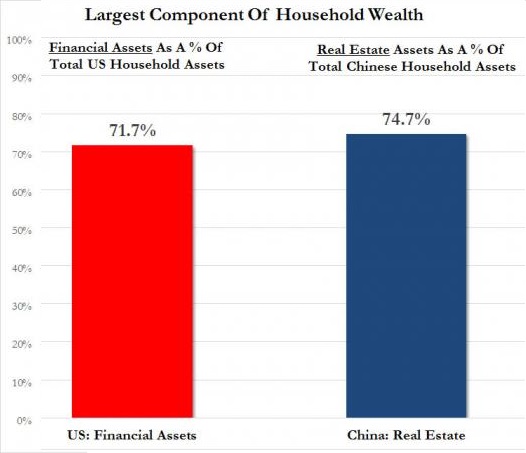
Though it is widely known that China's household wealth is concentrated in housing, the extent and consequences of this concentration are rarely discussed.
Much has been made of the $3+ trillion losses households have suffered as China's stock market bubble collapsed. But given the relatively insignificant role financial assets play in household wealth, these losses are modest compared to the far larger loss of household wealth that will occur as housing deflates from bubble heights.
Many people claim the estimated 65 million empty flats held as investments by the middle and upper classes in China will be sold to new buyers in due time. But these complacent analysts overlook the grim reality that the vast majority of urban workers make around $6,000 to $10,000 annually, and a $200,000 flat is permanently out of reach.
They also overlook the extreme concentration of wealth that goes into every purchase of a small flat by households that really can't afford the cost: the entire extended family's wealth is often poured into the flat, and money borrowed from friends and relatives or even loan sharks.
The other problem few Western analysts consider is the impaired nature of much of China's housing stock. Millions of units constructed in the early 2000s were hastily built and are now degraded. Newer buildings are not maintained, either, and there is a strong cultural preference for new homes, not existing units. (The government doesn't even keep track of resales/sales of existing homes; whatever minimal data is available comes from private brokerages).
In other words--who's going to buy the tens of millions of empty flats held as investments? What is the market value of flats nobody wants to buy or cannot afford to buy?
China has a demographic problem as well. The generation now entering the work force is much smaller than the generation that bought two or three flats for investment. There simply aren't enough wage earners entering the home-buying years to soak up this vast and growing inventory of empty homes.
China's stated intent is to move from a fixed-investment/export dependent economy to a consumer economy. But if we consider what happens when housing slows or even grinds to a halt, we realize the impact on incomes, wealth and consumption will be extraordinarily negative, not just for China but for every nation that sells China vehicles and other consumer goods.
Admin note: I will be busy with family commitments this month. As a result, blog posts will be sporadic and email responses will be near-zero. Thank you for your understanding.
My book on the emerging economy is now available as an audiobook: Get a Job, Build a Real Career and Defy a Bewildering Economy (Audible.com).
My new book is in the top 20 of Amazon's Kindle ebooks > Business & Money > International Economics: A Radically Beneficial World: Automation, Technology and Creating Jobs for All. The Kindle edition is $9.95 and the print edition is currently discounted to $20.82.

NOTE: Contributions/subscriptions are acknowledged in the order received. Your name and email remain confidential and will not be given to any other individual, company or agency.
Thank you, Marvin M. ($50), for yet another wondrously generous contribution to this site -- I am greatly honored by your steadfast support and readership.
Thank you, Ben G. ($75), for yet another superbly generous contribution to this site -- I am greatly honored by your support and readership.

Read more...

Terms of Service

All content on this blog is provided by Trewe LLC for informational purposes only. The owner of this blog makes no representations as to the accuracy or completeness of any information on this site or found by following any link on this site. The owner will not be liable for any errors or omissions in this information nor for the availability of this information. The owner will not be liable for any losses, injuries, or damages from the display or use of this information. These terms and conditions of use are subject to change at anytime and without notice.


Our Privacy Policy:


Correspondents' email is strictly confidential. This site does not collect digital data from visitors or distribute cookies. Advertisements served by a third-party advertising network (Investing Channel) may use cookies or collect information from visitors for the purpose of Interest-Based Advertising; if you wish to opt out of Interest-Based Advertising, please go to Opt out of interest-based advertising (The Network Advertising Initiative). If you have other privacy concerns relating to advertisements, please contact advertisers directly. Websites and blog links on the site's blog roll are posted at my discretion.


PRIVACY NOTICE FOR EEA INDIVIDUALS


This section covers disclosures on the General Data Protection Regulation (GDPR) for users residing within EEA only. GDPR replaces the existing Directive 95/46/ec, and aims at harmonizing data protection laws in the EU that are fit for purpose in the digital age. The primary objective of the GDPR is to give citizens back control of their personal data. Please follow the link below to access InvestingChannel’s General Data Protection Notice. https://stg.media.investingchannel.com/gdpr-notice/


Notice of Compliance with The California Consumer Protection Act
This site does not collect digital data from visitors or distribute cookies. Advertisements served by a third-party advertising network (Investing Channel) may use cookies or collect information from visitors for the purpose of Interest-Based Advertising. If you do not want any personal information that may be collected by third-party advertising to be sold, please follow the instructions on this page: Limit the Use of My Sensitive Personal Information.


Regarding Cookies:


This site does not collect digital data from visitors or distribute cookies. Advertisements served by third-party advertising networks such as Investing Channel may use cookies or collect information from visitors for the purpose of Interest-Based Advertising; if you wish to opt out of Interest-Based Advertising, please go to Opt out of interest-based advertising (The Network Advertising Initiative) If you have other privacy concerns relating to advertisements, please contact advertisers directly.


Our Commission Policy:

As an Amazon Associate I earn from qualifying purchases. I also earn a commission on purchases of precious metals via BullionVault. I receive no fees or compensation for any other non-advertising links or content posted on my site.

  © Blogger templates Newspaper III by Ourblogtemplates.com 2008

Back to TOP