



Thursday, December 22, 2016

Crisis of Meaning = Crisis of Work

People were poor by today's standards, so why do people remember the plantation life fondly? The answer is simple: community, purpose, sacrifice and meaning.
Allow me to connect two apparently unconnected dots. Dot #1: The last sugar plantation in Hawaii is closing down, ending more than a century of plantation life in the 50th state.
The research by economists Lawrence Katz of Harvard University and Alan Krueger at Princeton University shows that the proportion of workers throughout the U.S., during the Obama era, who were working in these kinds of temporary jobs, increased from 10.7% of the population to 15.8%. Krueger, a former chairman of the White House Council of Economic Advisers, was surprised by the finding. The disappearance of conventional full-time work, 9 a.m. to 5 p.m. work, has hit every demographic. “Workers seeking full-time, steady work have lost,” said Krueger.
While it's tempting to dismiss the plantation economy as corporate exploitation--a blatant reality in the early decades--once the I.L.W.U. represented the labor force, a more benign version emerged.
Indeed, what is striking is the nostalgia of the workers and residents for the orderly, secure life of the plantations. I attended high school in a classic plantation town in 1969-70, Lanai City, owned by Dole Pineapple, my summer employer.
Housing was cheap, work was plentiful and secure, and any married couple with plantation jobs could save enough to send their kids to college: my classmates are living proof of this.
The plantation town was not just a work place--it was a community. In the old days, bathrooms and showers were communal in sugar camps. You didn't just wave to your neighbor from your car--you shared the communal bath house.
People were poor by today's standards, so why do people remember the plantation life fondly?
The answer is simple: community, purpose, sacrifice and meaning. These are not independent dynamics--they are interwoven.
Work provided purpose and meaning, and the sacrifices made for the betterment of the next generation provides a second layer of meaning. The stable, secure community offered what every human seeks: shared purpose and friendship.
Compare this world with the insecure, isolated, atomized existence of the temporary worker in an economy that is changing fast in profound ways. Shared purpose--are you kidding? As Gustavo Tanaka observed in his essay There is something extraordinary happening in the world:
"No one can stand the (standard) employment model any longer.
We are reaching our limits. People working with big corporations can’t stand their jobs. The lack of purpose knocks on your door as if it came from inside you like a yell of despair.
People want out. They want to drop everything. Take a look on how many people are willing to risk entrepreneurship, people leaving on sabbaticals, people with work-related depression, people in burnout."
Community? People move constantly to either move up financially or to chase work. Stability is rare, ditto lasting friendship. Everything in the work world is contingent, ephemeral, and so is everything that once flowed from work: friendship, shared purpose, community.
The world of work has changed, and the rate of change is increasing. Despite the hopes of those who want to turn back the clock to the golden era of high-paying, low-skilled manufacturing jobs and an abundance of secure service-sector jobs,history doesn't have a reverse gear (tm).
The world of work is never going back to the "good old days" of 1955, 1965, 1985 or 1995.
Those hoping for history to reverse gears place their faith in these wishful-thinking fantasies:
1. That automation will create more jobs than it destroys because that's what happened in the 1st and 2nd Industrial Revolutions. The wishful thinkers expect the Digital / 4th Industrial Revolution to follow suite, but it won't: previous technological revolutions generated tens of millions of new low-skill jobs to replace the low-skill jobs that were lost to technology.
Millions of farm laborers moved to the factory floor in the 1st Industrial Revolution, and then millions of displaced factory workers moved to sales and clerk jobs in the 2nd Industrial Revolution.
Even white-collar jobs that supposedly required a college degree could be learned in a matter of hours, days or at most weeks, and little effort was required to stay current.
The Digital/4th Industrial Revolution is not creating tens of millions of low-skill jobs, and it never will. Even worse for the wishful thinking crowd, the 4th Digital Revolution is eating tech jobs along with the full spectrum of service-sector jobs.
Those expecting to replace low-skill service jobs with armies of coders will be disappointed, because coding is itself being automated.
The new jobs that are being created are few in number and highly demanding.Jobs are no longer strictly traditional boss-employee; the real growth is in peer-to-peer collaboration and what I term hybrid work performed by Mobile Creatives (see below), workers with highly developed technical/ creative/ social skillsets who are comfortable working with rapidly changing technologies, who enjoy constant learning and are highly adaptive.
The work that is being created in the Digital/4th Industrial Revolution is contingent and thus insecure. The only security that is attainable in fast-changing environments is the security offered by broad-based skillsets, adaptability, a voracious appetite for new learning and a keenly developed set of "soft skills": communication, collaboration, self-management, etc.
The problem is the number of these jobs is far smaller than the number of jobs that will be eaten by software, AI and robotics. the number of workers who can transition productively to this far more demanding and insecure work environment is also much smaller than the workforce displaced by software/robotics.
In short, we need a new system to provide work, purpose and meaning; wishful thinking isn't a solution.
2. The wishful thinkers want strong corporate profits to prop up their stock market and pension funds, but they don't want corporations to do what is necessary to reap strong profits, i.e. move production of commoditized goods, services and sales channels overseas and replace human labor with cheaper automation.
You can't have it both ways.
Wishful thinkers choose to ignore the reality that roughly half of all U.S. based global corporate sales and profits are reaped overseas. It makes zero financial sense to pay a U.S. worker $25/hour, and pay the insanely expensive costs of sickcare/"healthcare" in the U.S. when the work can be done closer to the actual markets for the goods and services at a fraction of the cost.
Memo to all the armchair wishful thinkers: if you want to compete globally with a high-cost U.S. work force and no automation, be my guest. Put your own money and time at risk and go make it happen. Go hire people at top dollar and provide full benefits, and then go out and make big profits in the global marketplace.
The armchair pundits and ivory tower academics would quickly lose their shirts and come back broke. That's why they wouldn't dare risk their own security, capital and time doing what they demand of others.
3. The wishful thinkers decry the lack of "good-paying" jobs yet they refuse to look at the reasons why employing people in the traditional boss/employee hierarchy no longer makes sense. The armchair pundits and ivory tower academics have never hired even one person with their own money. These protected privileged are living in a fantasy-world of academia, think tanks and foundations, where workers are paid with state money, grants, venture capital, etc.
As I have often noted here, Immanuel Wallerstein listed the systemic reasons why labor overhead costs will continue to rise even as wages stagnate. This means employers see total labor costs rising even if wages go nowhere: it gets more and more expensive to hire workers.
Then there's the staggering burden of liability in a litigious society, the costs of training and supervising ill-prepared employees and the hard-to-calculate costs of increasingly complex regulations.
4. Wishful thinkers claim we can solve the decline of the traditional work model with more education. This is also wishful thinking, as not only is the "factory model" of our higher education failing to produce workers with the requisite range of skills, the emphasis on higher education has produced an over-supply of people with college diplomas.
We need an entirely new model of education, one in which we accredit the student, not the institution, a model I describe in The Nearly Free University and the Emerging Economy: The Revolution in Higher Education.
An over-abundance of credentials pushes wages down, even for the highly educated. In the real world, even wages of the most highly educated are stagnating.
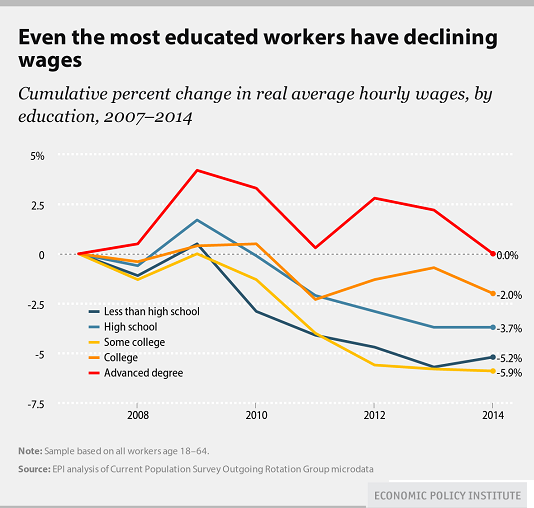
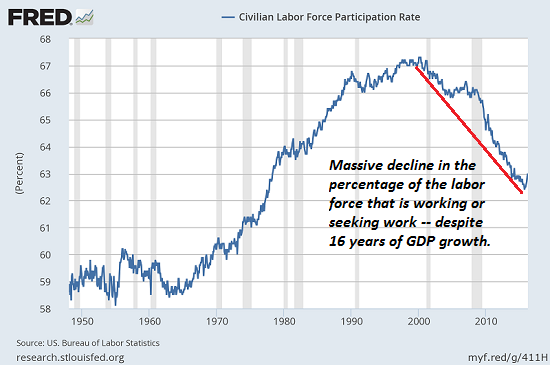
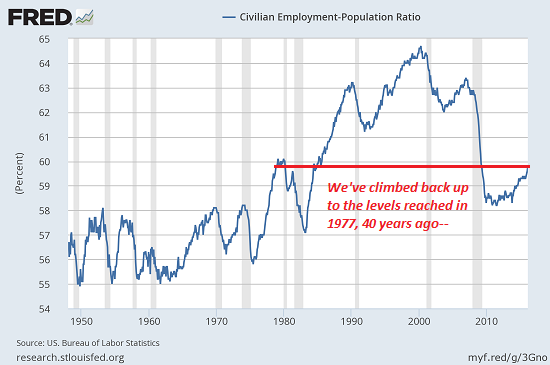
The structural changes in the world of work are visible in these charts:
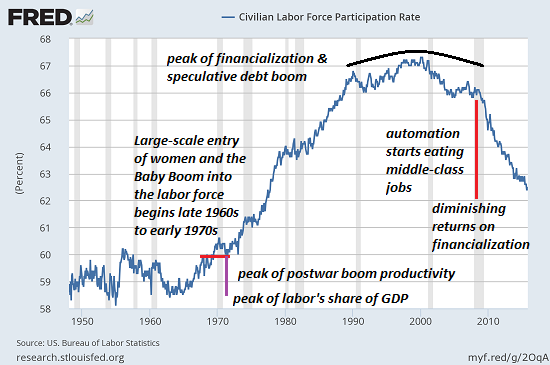
The civilian participation rate is plummeting, despite the "recovery:"
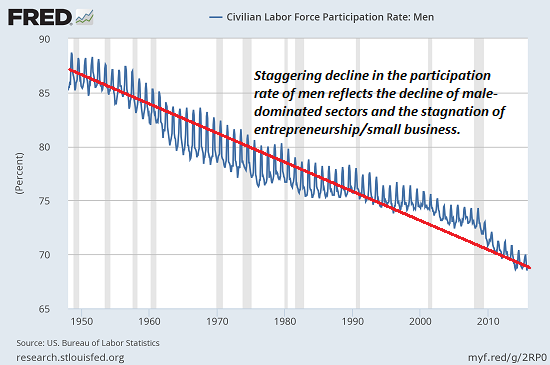
The civilian participation rate for men is in a multi-decade decline:
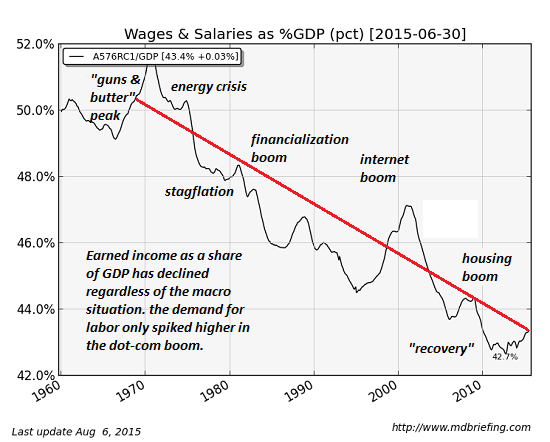
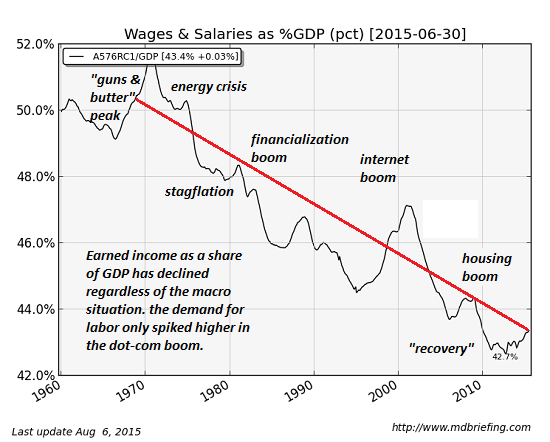
As a percentage of GDP, wages have been declining for decades.
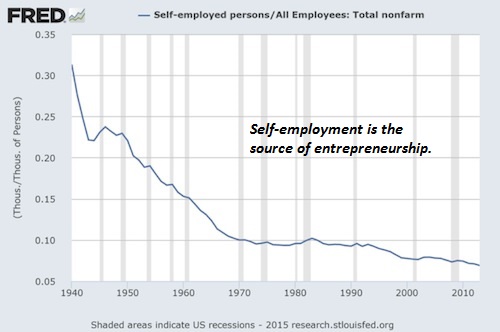
Self-employment is the wellspring of entrepreneurs and small business. As you can see, it has also been declining for decades.
It's time to get real. Wishful thinking is not a solution. We need a new system for creating paid work, shared purpose and meaning, and I propose a complete, practical alternative system in my book A Radically Beneficial World: Automation, Technology and Creating Jobs for All.
If you're seeking the source of the epidemics of ill-health, prescription drug addiction and other social ills, look to the absence of meaningful, purposeful work.
Of related interest:
Fixing The Way We Work (44:54 podcast with Chris Martenson)
Radical Changes in Jobs Market Now & in Future (47:37 podcast with Jason Burack)
Check out both of my new books, Inequality and the Collapse of Privilege ($3.95 Kindle, $8.95 print) and Why Our Status Quo Failed and Is Beyond Reform ($3.95 Kindle, $8.95 print). For more, please visit the OTM essentials website.

NOTE: Contributions/subscriptions are acknowledged in the order received. Your name and email remain confidential and will not be given to any other individual, company or agency.
Thank you, Jerry T. ($10/month), for your outrageously generous pledge to this site -- I am greatly honored by your support and readership.
Thank you, John O'B. ($5/month), for your splendidly generous pledge to this site -- I am greatly honored by your support and readership.

Read more...

Wednesday, December 21, 2016

Why the Massive Expansion of "Money" Hasn't Trickled Down to "The Rest of Us"

if you create and distribute money only in the apex of the wealth/power pyramid, it can only benefit the few rather than the many.
There are numerous debates about money: what it is, how we measure it, and so on. In recognition of these debates, I'm referring to "money" in quotes to designate that I'm using the Federal Reserve's measure of money stock (MZM).
Nowadays, "money" is often credit. We buy stuff not with currency/ cash, but with credit extended by lenders. The government pays for its programs with borrowed money as well, by selling sovereign bonds and spending the proceeds.
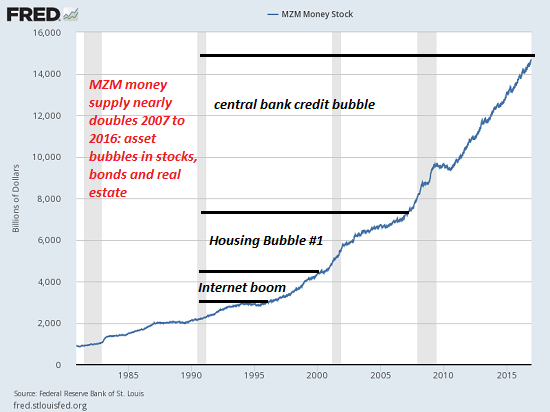
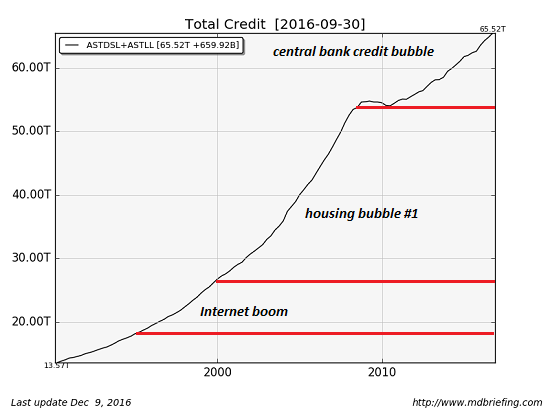
So to get a rough measure of the expansion of "money," we look at money stock and total credit.
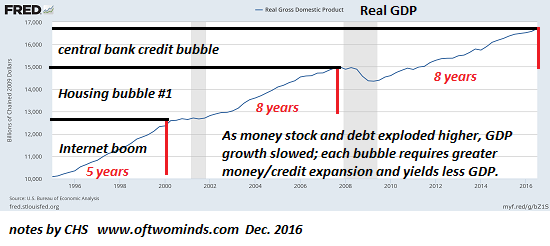
There's a third measure: GDP, or gross domestic product. As money and credit expanded, did GDP go up, too? By how much?
GDP is also a flawed measure of value and activity, but once again we'll use it as the conventional measure of economic "growth."
When we glance at money, credit and GDP, we are immediately struck by the disconnect between expansion of money/credit and GDP growth. A relatively modest expansion of money stock and credit was sufficient to fuel a powerful expansion of GDP during the 1995-2000 Internet boom.
The next expansion of GDP--Housing Bubble #1--required an enormous expansion of credit and about double the growth in money stock as the Internet boom.
The current "recovery"--what I term the central bank credit bubble--has required a monumental increase in money stock and a non-trivial expansion of credit.
This is the very definition of diminishing returns: Every expansion of GDP is weaker but requires vastly greater expansions of money stock and total credit.
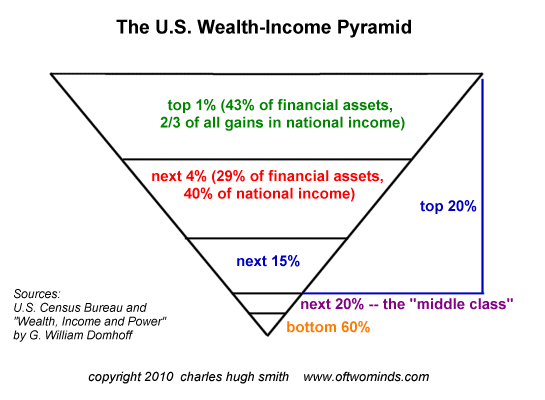
Longtime correspondent J. Numis identified a key dynamic that few others seem to have noticed: the money has been created in the top of the wealth pyramid of banks, financiers and corporations, and very little has "trickled down" to the bottom 95% in the form of higher wages or increased wealth. Here is J. Numis' comment:
"What we're going through is 'Cyberinflation' which bears no resemblance to hyperinflation, in that way too much ethereal money is out there--but only in the hands of a relative few--thus not debasing its overall value among the populace, in terms of making them believe. Kind of brilliant if you ask me, and a paradigm that nobody is looking for--as it didn't exist heretofore."
This expansion of "money" has inflated asset bubbles, because the wealthy few with access to the new money/ credit have the means to outbid everyone else for productive assets. Some of "the rest of us" have benefited indirectly, as those who own appreciable chunks of stocks, bonds and real estate in the hot areas have seen their net worth rise as the asset bubbles have inflated.
But the benefits of asset bubbles are concentrated in the top 5%, as most of these assets are owned by the top 5%. The next 15% benefits modestly, but the bottom 80% don't own enough assets to get any boost at all.
If anyone wonders why this monumental expansion of "money" hasn't sparked generalized wage inflation maybe one factor is that very little of this new money has trickled down to the bottom 95%.
This is why I contend that If We Don't Change the Way Money Is Created and Distributed, We Change Nothing (December 24, 2015). Every other reform is mere window-dressing.
In my book A Radically Beneficial World, I propose a way of creating and distributing money at the bottom of the pyramid to those who are creating value in their own communities, as opposed to only creating new money in the top of the pyramid and only distributing it to the obscenely wealthy.
No wonder so little "trickles down" to "the rest of us": if you create and distribute money only in the apex of the wealth/power pyramid, it can only benefit the few rather than the many.


Join me in seeking solutions by becoming a $1/month patron of my work via patreon.com.
Check out both of my new books, Inequality and the Collapse of Privilege ($3.95 Kindle, $8.95 print) and Why Our Status Quo Failed and Is Beyond Reform ($3.95 Kindle, $8.95 print). For more, please visit the OTM essentials website.

NOTE: Contributions/subscriptions are acknowledged in the order received. Your name and email remain confidential and will not be given to any other individual, company or agency.
Thank you, Amy W. ($5/month), for your superbly generous pledge to this site -- I am greatly honored by your support and readership.
Thank you, Vincent W. ($5/month), for your splendidly generous pledge to this site -- I am greatly honored by your support and readership.

Read more...

Tuesday, December 20, 2016

Will Tax Cuts and More Federal Borrowing/Spending Fix What's Broken?

Solutions abound, but not within our centralized state-cartel neofeudal system.
Not to rain on the new administration's parade, but one question needs to be asked of any new administration: will tax cuts and more federal borrowing/ spending fix what's broken in the U.S./global economy?
The short answer: if tax cuts and more federal borrowing/ spending were the cure for what ails the economy, we'd have reached Paradise long ago. Stripped of partisan politics and rah-rah, tax cuts and more federal borrowing/ spending--on infrastructure, education, defense, healthcare, you name it--have been the de facto status quo policies of both parties for the past 70 years.
Despite decades of these centralized, standard-issue Keynesian "fixes," the economy's structural ills are only getting worse. I outlined five of the most critical issues in What Have the "Experts" Gotten Right? In the Real Economy, They're 0 for 5(December 20, 2016).
Ultimately, two dynamics will dominate everything else: the paid work/earnings of non-elites and the transition from wasteful, debt-funded "growth" to a sustainable "Degrowth" economy.
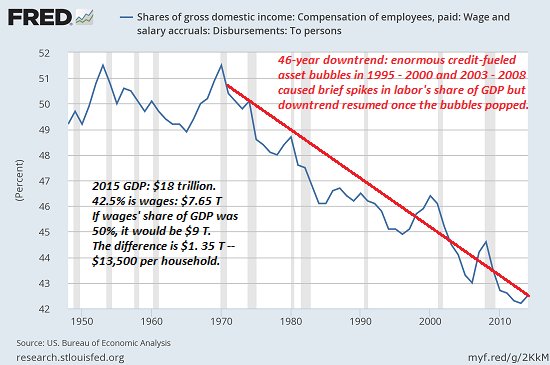
45 years of Keynesian "stimulus"--tax cuts and federal borrowing/ spending--haven't stemmed the decline of labor's share of the economy (GDP). As these charts reveal, if labor's share of the economy was still at 50% rather than 42%, households with earnings from work would be getting an astounding $1.35 trillion more per year.
This equates to an additional $10,800 per household, per year (there are roughly 125 million households in the U.S.) or about $100,000 per household per decade.
Would you be better off if your household had been paid an extra $100,000 in the 10 years since 2007? I am guessing the answer is "yes."
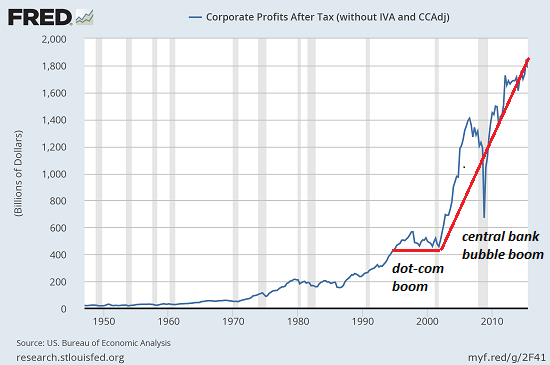
Is it mere coincidence that while labor's share of GDP declined by $1.35 trillion, corporate profits rose from $400 billion annually to $1.8 trillion? Garsh, do you reckon there's a connection?
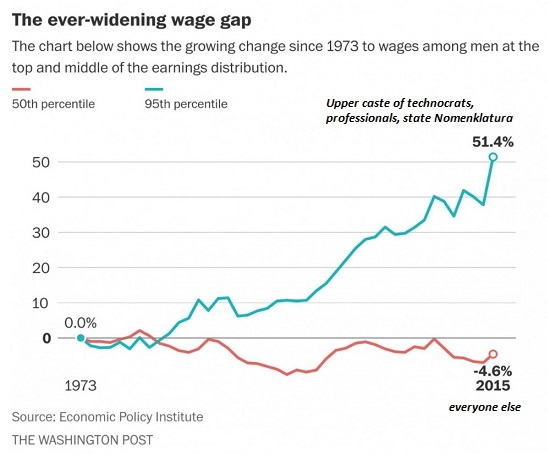
Another factor is the top 5%'s rising share of earnings. I call this the since I'm doing well, the economy is swell syndrome. The top 5% dominate the managerial class in the media, government, think tanks, foundations and corporate America, and from their perch high atop the centralized pyramid of wealth/power in America, things look just grand.
Things look considerably different from the bottom of the pyramid.
The Powers That Be have three basic fixes for every systemic ill:
1. Concentrate even more power and wealth in the central state
2. Borrow and blow a couple more trillion dollars
3. Guaranteed minimum income for the bottom 95%, which is a politically correct code phrase for:
We're tossing you on the trash heap of society, making sure you have just enough cash to get to the dollar store or Wal-Mart and enough to scrape by so you won't rise up against your "betters" who own all the wealth and income streams.
Sorry, but I think we can do better. In terms of aligning social-economic policy with the emerging economy, I think the real solutions are:
1. Decentralize / devolve power to regional metro areas, cities, towns, communities and neighborhoods. I explain how this works in my book Resistance, Revolution, Liberation: A Model for Positive Change.
I'm not alone in seeing this as the only solution that aligns with the emerging economy. Consider The Most Disruptive Transformation in History: How the clustering of knowledge lays bare the need to devolve power from the nation-state to the city.
2. Align our educational system with the emerging economy and reduce the cost of higher education by 90%. Yes, I know, it can't be done, blah blah blah, we need our buggy whip industry, we'll perish without it, Baumol's Disease, etc. etc. etc.
I explain how to revolutionize education in my book The Nearly Free University and the Emerging Economy.
3. Transform our sick, centralized culture of consumption to a vibrant healthy culture of productive entrepreneurism. As you have probably guessed, I lay out how to do this in my book Get a Job, Build a Real Career and Defy a Bewildering Economy.
4. Create capital and opportunity at the bottom of the pyramid where the 95% live rather than in the apex of the pyramid inhabited by the top .1%. I explain how this would work in my book A Radically Beneficial World: Automation, Technology and Creating Jobs for All.
5. Limit the power of privilege by creating multiple pathways from the low-opportunity disadvantaged class to the abundant-opportunity advantaged class. If you reckon I wrote a book on this, bingo: Inequality and the Collapse of Privilege.
If you suffer from since I'm doing well, the economy is swell syndrome, I suggest taking a look at Why Our Status Quo Failed and Is Beyond Reform.
Solutions abound, but not within our centralized state-cartel neofeudal system."You never change things by fighting the existing reality. To change something, build a new model that makes the existing model obsolete." R. Buckminster Fuller


Join me in seeking solutions by becoming a $1/month patron of my work via patreon.com.
Check out both of my new books, Inequality and the Collapse of Privilege ($3.95 Kindle, $8.95 print) and Why Our Status Quo Failed and Is Beyond Reform ($3.95 Kindle, $8.95 print). For more, please visit the OTM essentials website.

NOTE: Contributions/subscriptions are acknowledged in the order received. Your name and email remain confidential and will not be given to any other individual, company or agency.
Thank you, Frank S. ($50), for your magnificently generous contribution to this site -- I am greatly honored by your steadfast support and readership.
Thank you, Paul B. ($10/month), for your outrageously generous pledge to this site -- I am greatly honored by your support and readership.

Read more...

Monday, December 19, 2016

What Have the "Experts" Gotten Right? In the Real Economy, They're 0 for 5

If the "experts" were assessed on results, they'd all be fired.
The mainstream media continually hypes the authority of "experts," i.e. people with a stack of credentials from top institutions.
But does the mainstream media ever check on whether the "experts" got anything right? Let's compare the "experts" (conventional PhD economists) diagnoses and fixes with the results of their policies.
Let's stick to the big issues: inflation, productivity, near-zero interest rate policy (ZIRP), employment and "growth". If you get these wrong, you get the entire economy wrong.
If you can't get the big issues right, your "expertise" has failed: your "expertise" is not just worthless, it's counter-productive, because if common-sense policies had been put in place instead of the "experts'" fixes, we'd have made progress rather than digging a deeper hole.
1. Inflation. Conventional "experts" believe inflation has been near-zero for the past decade and will continue to be near-zero as far as the eye can see.
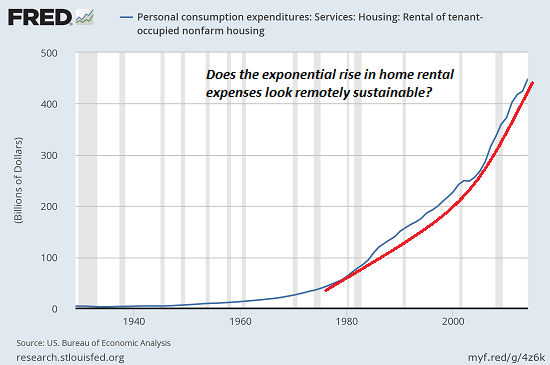
Did they get this right? No. Households exposed to healthcare, higher education and rental expenses have seen staggering increases in costs for the same (or diminished) services. In other words, the purchasing power of their earnings has plummeted.
If we measure these "Big Ticket" items, we find inflation rates of 100+% over the past decade. I laid this out in detail in The Burrito Index: Consumer Prices Have Soared 160% Since 2001
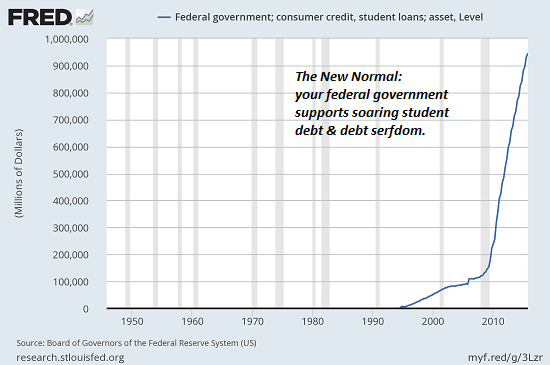
The "experts" solution to out-of-control costs is to borrow trillions of dollars-- in other words, the "fix" to out-of-control costs is out-of-control borrowing.
And remember: borrowing is nothing but consuming future earnings today, leaving less disposable income to spend in the future as interest payments eat the borrower alive.
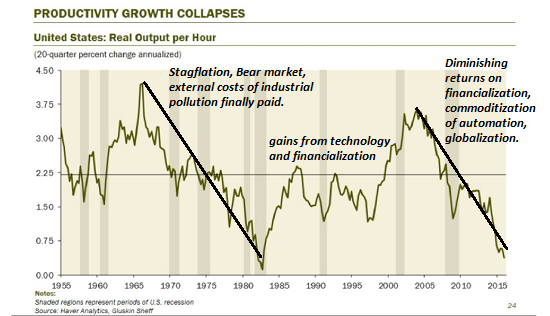
2. Productivity. The honest "experts" admit they are flummoxed by the steep decline in productivity, which is the only enduring source of higher wages and profits.
The "experts" are blind to the diminishing returns on financialization and globalization--the two engines of corporate profitability.
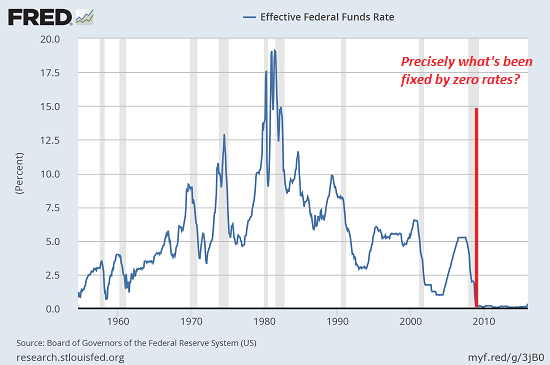
3. Zero interest rate policy (ZIRP). The "experts" at the Federal Reserve and elsewhere claimed that near-zero interest rates were the fix-all solution to low growth in GDP, employment, wages and business investment.
Precisely what's been fixed by ZIRP?
We know the answer to the other side of that question: What's been destroyed by ZIRP? Savers and pension funds. The hundreds of billions of dollars in interest income that once flowed to savers, pension funds, etc. have been diverted to banks and borrowers--except those paying 19% interest on credit cards.
The truth is ZIRP has been a gift to banks, lenders and corporations borrowing immense sums to buy back their own shares. There's no mystery why productivity has plummeted; the borrowed money went to boost stock options and financial games, not productive investments.
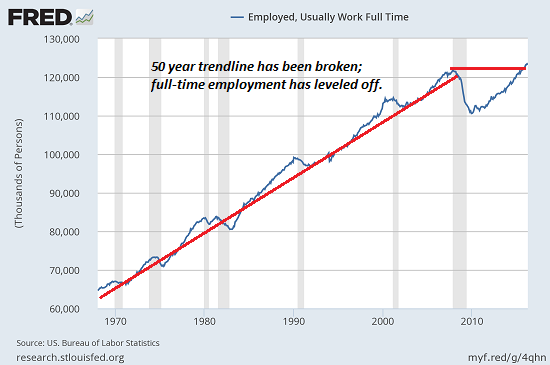
4. Employment. Statistical trickery cannot disguise the reality that meaningful employment (permanent, full-time) has weakened structurally, and the number of adults in the workforce with jobs has also weakened.
A handful of high-profile economists (Michael Spence et al.) have addressed the issue of automation, and concluded that "software eating the world" is weakening employment across the spectrum from high-skill to low-skill.
The conventional "experts" either ignore the issue, don't understand it, or cling to a cargo-cult-like belief that "technology always creates more jobs than it destroys," but with zero evidence to back up this faith-based assertion.
5. Growth. Few "experts" dare address stagnation and the Keynesian obsession with "growth" on a planet with declining resources (have you looked at fresh water recently? Central banks can't print it) and rising competition for what's left.
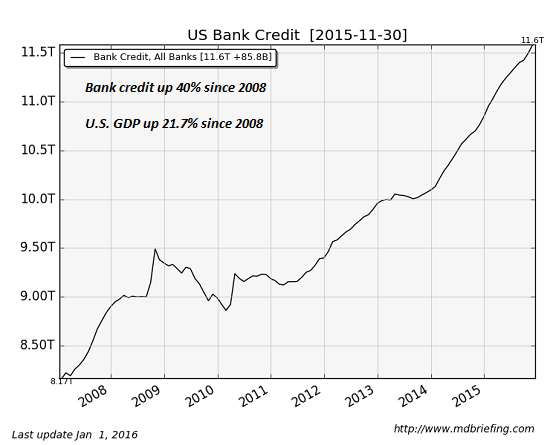
The "experts" reckoned that making borrowing cheaper would spur "growth"--but once again, they ignored the diminishing returns on cheap credit:
This chart is bank credit. Add in corporate, household and government debt, and you get a picture of massive increases in debt yielding pathetically low "growth" in GDP.
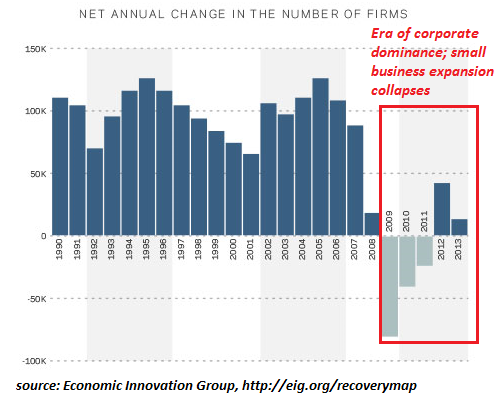
The "experts" are also flummoxed by the collapse of new business growth. How many conventional PhD economists have made a big-time academic or government career studying the stultifying consequence of over-regulation and regulatory capture by corporate cartels? How about the rise of local government junk fees and the crushing burdens of providing healthcare for employees?
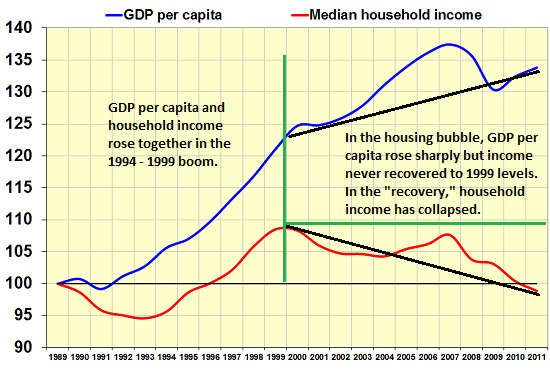
Whatever GDP growth did occur did not generate higher wages. Wages for the bottom 95% stagnated or declined when adjusted for inflation.
In the five dynamics that matter, the "experts" are 0 for 5. Malinvestment fueled by cheap credit, financialization, perverse incentives, over-regulation, the crushing pressure of soaring healthcare costs, the strangulation of small business-- these are not independent dynamics, they are causally linked.
If the "experts" were assessed on results, they'd all be fired. Eight years of failure and counterproductive consequences is enough to declare the "experts" are only "experts" in generating excuses and failed fixes to systemic ills.


Join me in seeking solutions by becoming a $1/month patron of my work via patreon.com.
Check out both of my new books, Inequality and the Collapse of Privilege ($3.95 Kindle, $8.95 print) and Why Our Status Quo Failed and Is Beyond Reform ($3.95 Kindle, $8.95 print). For more, please visit the OTM essentials website.

NOTE: Contributions/subscriptions are acknowledged in the order received. Your name and email remain confidential and will not be given to any other individual, company or agency.
Thank you, Mark H, ($25), for your magnificently generous contribution to this site -- I am greatly honored by your support and readership.
Thank you, Scott W. ($5/month), for your superbly generous pledge to this site -- I am greatly honored by your support and readership.

Read more...

Terms of Service

All content on this blog is provided by Trewe LLC for informational purposes only. The owner of this blog makes no representations as to the accuracy or completeness of any information on this site or found by following any link on this site. The owner will not be liable for any errors or omissions in this information nor for the availability of this information. The owner will not be liable for any losses, injuries, or damages from the display or use of this information. These terms and conditions of use are subject to change at anytime and without notice.


Our Privacy Policy:


Correspondents' email is strictly confidential. This site does not collect digital data from visitors or distribute cookies. Advertisements served by a third-party advertising network (Investing Channel) may use cookies or collect information from visitors for the purpose of Interest-Based Advertising; if you wish to opt out of Interest-Based Advertising, please go to Opt out of interest-based advertising (The Network Advertising Initiative). If you have other privacy concerns relating to advertisements, please contact advertisers directly. Websites and blog links on the site's blog roll are posted at my discretion.


PRIVACY NOTICE FOR EEA INDIVIDUALS


This section covers disclosures on the General Data Protection Regulation (GDPR) for users residing within EEA only. GDPR replaces the existing Directive 95/46/ec, and aims at harmonizing data protection laws in the EU that are fit for purpose in the digital age. The primary objective of the GDPR is to give citizens back control of their personal data. Please follow the link below to access InvestingChannel’s General Data Protection Notice. https://stg.media.investingchannel.com/gdpr-notice/


Notice of Compliance with The California Consumer Protection Act
This site does not collect digital data from visitors or distribute cookies. Advertisements served by a third-party advertising network (Investing Channel) may use cookies or collect information from visitors for the purpose of Interest-Based Advertising. If you do not want any personal information that may be collected by third-party advertising to be sold, please follow the instructions on this page: Limit the Use of My Sensitive Personal Information.


Regarding Cookies:


This site does not collect digital data from visitors or distribute cookies. Advertisements served by third-party advertising networks such as Investing Channel may use cookies or collect information from visitors for the purpose of Interest-Based Advertising; if you wish to opt out of Interest-Based Advertising, please go to Opt out of interest-based advertising (The Network Advertising Initiative) If you have other privacy concerns relating to advertisements, please contact advertisers directly.


Our Commission Policy:

As an Amazon Associate I earn from qualifying purchases. I also earn a commission on purchases of precious metals via BullionVault. I receive no fees or compensation for any other non-advertising links or content posted on my site.

  © Blogger templates Newspaper III by Ourblogtemplates.com 2008

Back to TOP