



Monday, February 15, 2021

Presidents Day: Carter's Prescient Farewell Address in 1981

Regardless of our opinions about President Carter and his legacy, his Farewell Address is worthy of our attention and study.

On Presidents Day 2021, I invite you to read/watch President Carter's Farewell Address from 40 years ago. As a Washington outsider, Carter was relentlessly mocked and undermined by the Establishment, as insiders' loathing of outsiders knows no bounds.

In a similar fashion, the loathing of the corrupt and self-absorbed for the faithful aspiring to better world despite our weaknesses and flaws also knows no bounds, and so the establishment insiders that run the nation had no use for Carter other than as a handy whipping post.

President Carter was not the only outsider president reviled by the Washington elites, of course; outsiders of both parties draw the fierce fire of a corrupt Establishment fearful of exposure.

Although many reckon it good sport to make fun of President Carter's initiatives (along with his grin, hair, accent, etc. etc. etc.), a strong case can be made that he was the first and only 21st century President the nation has elected. Every president since, regardless of party or ideology or canned speeches (Soaring Rhetoric (TM), has been embedded in a continuation of the 20th century economy, politics and Imperial Project.

Carter was the first and only president to address DeGrowth, though the word had yet to be coined: DeGrowth is the idea that resources would eventually become scarce and thus unaffordable, and rather then pursue the insane fantasy of eternal growth on a finite planet, a new arrangement that did more with less would be needed.

"There are real and growing dangers to our simple and our most precious possessions: the air we breathe, the water we drink, and the land which sustains us. The rapid depletion of irreplaceable minerals, the erosion of topsoil, the destruction of beauty, the blight of pollution, the demands of increasing billions of people, all combine to create problems which are easy to observe and predict, but difficult to resolve.

But there is no reason for despair. Acknowledging the physical realities of our planet does not mean a dismal future of endless sacrifice. In fact, acknowledging these realities is the first step in dealing with them. We can meet the resource problems of the world--water, food, minerals, farmlands, forests, overpopulation, pollution if we tackle them with courage and foresight."


President Carter was also prescient in his understanding that a nation's greatest strength is its social cohesion, a cohesion that America's unprecedented wealth/ income /power inequalities has undermined. Consider this excerpt from his Address:

"Our common vision of a free and just society is our greatest source of cohesion at home and strength abroad, greater even than the bounty of our material blessings."

President Carter recognized that civil rights / liberties are not just fatuous PR to be trotted out in Soaring Rhetoric (TM) lip-service; they are the foundation of our national identity:

"America did not invent human rights. In a very real sense, it's the other way around. Human rights invented America. Ours was the first nation in the history of the world to be founded explicitly on such an idea. Our social and political progress has been based on one fundamental principle: the value and importance of the individual. The fundamental force that unites us is not kinship or place of origin or religious preference. The love of liberty is the common blood that flows in our American veins.

We have no cause for self-righteousness or complacency, but we have every reason to persevere, both within our own country and beyond our borders."


President Carter recognized the fatal consequences of special interests dominating the political order, a danger that has now reached full flower in 2021:

"Today, as people have become ever more doubtful of the ability of the Government to deal with our problems, we are increasingly drawn to single-issue groups and special interest organizations to ensure that whatever else happens, our own personal views and our own private interests are protected. This is a disturbing factor in American political life. It tends to distort our purposes, because the national interest is not always the sum of all our single or special interests. We are all Americans together, and we must not forget that the common good is our common interest and our individual responsibility."

Regardless of our opinions about President Carter and his legacy, his Farewell Address is worthy of our attention and study:

President Carter's Farewell Address to the Nation (16:56)


If you found value in this content, please join me in seeking solutions by becoming a $1/month patron of my work via patreon.com.

My new book is available! A Hacker's Teleology: Sharing the Wealth of Our Shrinking Planet 20% and 15% discounts (Kindle $7, print $17, audiobook now available $17.46)

Read excerpts of the book for free (PDF).

The Story Behind the Book and the Introduction.


Recent Podcasts:

Jay Taylor and I discuss The Upcoming Revolt of the Middle Class
(22 min)

My COVID-19 Pandemic Posts


My recent books:

A Hacker's Teleology: Sharing the Wealth of Our Shrinking Planet (Kindle $8.95, print $20, audiobook $17.46) Read the first section for free (PDF).

Will You Be Richer or Poorer?: Profit, Power, and AI in a Traumatized World
(Kindle $5, print $10, audiobook) Read the first section for free (PDF).

Pathfinding our Destiny: Preventing the Final Fall of Our Democratic Republic ($5 (Kindle), $10 (print), ( audiobook): Read the first section for free (PDF).

The Adventures of the Consulting Philosopher: The Disappearance of Drake $1.29 (Kindle), $8.95 (print); read the first chapters for free (PDF)

Money and Work Unchained $6.95 (Kindle), $15 (print) Read the first section for free (PDF).


Become a $1/month patron of my work via patreon.com.


NOTE: Contributions/subscriptions are acknowledged in the order received. Your name and email remain confidential and will not be given to any other individual, company or agency.

Thank you, Pete S. ($5/month), for your gloriously generous pledge to this site -- I am greatly honored by your support and readership.


Thank you, Slavko S. ($5), for your most generous contribution to this site -- I am greatly honored by your support and readership.

Read more...

Thursday, February 11, 2021

Gains Are Unreal, Losses Are Real

Why would anyone sell when further gains are guaranteed? Because the gains are unreal but the losses are real.

When markets are soaring and your portfolio is rocketing higher, the gains seem unreal. Did I really make that much in one day, week, month? Wow! With the gains higher every time you look, it would be foolish to sell because look at the flood of media reports on "the Roaring 20s" that are predicted with such certitude that it's essentially guaranteed, the reflation that's lifting all boats globally, the Federal Reserve printing trillions to further inflate the market, and the millions of new traders scooping fantastic gains.

Why would anyone be idiotic enough to sell when the Bull Market is just getting started? Indeed. Sure, you sold to book those crazy gains in a couple of speculative frenzies, but you bought right back in to grab the next booster rocket higher.

There is only one thing more painful than watching the market continue higher after you sold: and that is holding on for the inevitable bounce and losing your entire profit.

There is only one thing more painful than holding on for the inevitable bounce and losing your entire profit: and that is continuing to hold because you're so sure the market will bounce big-time that you lose much or most of your capital.

There is only one thing more painful than being so sure the market will bounce big-time that you lose much or most of your capital: and that's refusing to accept your losses and hanging on until you've lost all your capital.

There is only one thing more painful than refusing to accept your losses and hanging on until you've lost all your capital: and that is realizing you still owe the government an enormous sum for the capital gains you reaped on the way up but no longer have the money to pay.

Why would anyone sell when further gains are guaranteed? Because the gains are unreal but the losses are real. Put another way: the gains aren't really yours until you sell and pocket them in cash. (Best to pay your estimated taxes the day after you book the gains, as a third of those gains aren't really yours, they belong to the government.)

Gains are unreal, losses are real.


If you found value in this content, please join me in seeking solutions by becoming a $1/month patron of my work via patreon.com.

My new book is available! A Hacker's Teleology: Sharing the Wealth of Our Shrinking Planet 20% and 15% discounts (Kindle $7, print $17, audiobook now available $17.46)

Read excerpts of the book for free (PDF).

The Story Behind the Book and the Introduction.


Recent Podcasts:

Jay Taylor and I discuss The Upcoming Revolt of the Middle Class
(22 min)

My COVID-19 Pandemic Posts


My recent books:

A Hacker's Teleology: Sharing the Wealth of Our Shrinking Planet (Kindle $8.95, print $20, audiobook $17.46) Read the first section for free (PDF).

Will You Be Richer or Poorer?: Profit, Power, and AI in a Traumatized World
(Kindle $5, print $10, audiobook) Read the first section for free (PDF).

Pathfinding our Destiny: Preventing the Final Fall of Our Democratic Republic ($5 (Kindle), $10 (print), ( audiobook): Read the first section for free (PDF).

The Adventures of the Consulting Philosopher: The Disappearance of Drake $1.29 (Kindle), $8.95 (print); read the first chapters for free (PDF)

Money and Work Unchained $6.95 (Kindle), $15 (print) Read the first section for free (PDF).


Become a $1/month patron of my work via patreon.com.


NOTE: Contributions/subscriptions are acknowledged in the order received. Your name and email remain confidential and will not be given to any other individual, company or agency.

Thank you, Mike ($5/month), for your gloriously generous pledge to this site -- I am greatly honored by your support and readership.


Thank you, Christopher G. ($5/month), for your superlatively generous pledge to this site -- I am greatly honored by your support and readership.

Read more...

Wednesday, February 10, 2021

What Collapsed the Middle Class?

The middle class has already collapsed, but thanks to debt and bubbles, this reality has been temporarily cloaked.

What collapsed the middle class? In many ways the answer echoes an Agatha Christie mystery: rather than there being one guilty party, a number of suspects participated in the collapse of the middle class.

Can we consolidate these dynamics into a few core causal factors? I've made the case in the pst few posts that yes, we can: many of these causes are part of a single dynamic, the decapitalization of the middle class and the decay of the ladder of social mobility which enabled tens of millions of workers to transform their wages into productive capital via saving and investment in their own human capital, their own enterprises and assets that earn income.

The Top 10% Is Doing Just Fine, The Middle Class Is Dying on the Vine (2/4/21)

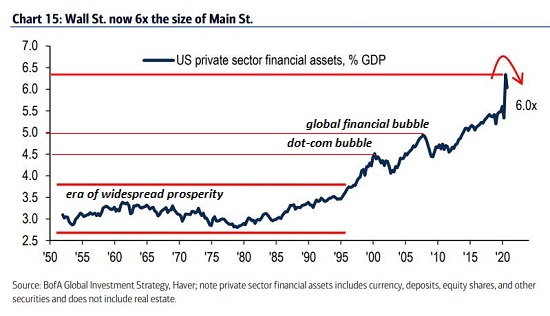
The second primary dynamic is the substitution of debt and speculation for earned income and productive capital. As the purchasing power of the bottom 90%'s wages declines, the status quo has substituted debt for income and speculation for investing in productive capital.

Debt and the Demise of the Middle Class (2/9/21)

This dynamic incentivizes debt, speculation and consumption rather than producing, savings and investments in human and productive capital. The source of this incentive structure is the maximization of corporate profits earned by banks loaning money to the middle class and by selling the middle class on superfluous consumption being the signifier of "success" rather than production being the signifier of "success".

In reality, what counts is agency (control of one's life, having a voice in governance) and ownership of productive capital. Becoming a debt-serf to buy more stuff and grab a few chips in the speculative casino sacrifices both agency and the acquisition of productive capital. But this sacrifice is oh-so profitable to the financier purveyors of debt and speculative gambles in the casino.

The third dynamic is globalization, and specifically the tyranny of global markets. Global banks and corporations are ideally placed to profit from the arbitrage of labor, environmental regulations, currencies, corruption (dear in some places, cheap in others) and the price of debt and risk.

Wage earners have no such leverage. In effect, all the risks of competition are eliminated for corporate monopolies and cartels while the risks are transferred to workers who face a global race to the bottom in wages, opportunity and income security.

The fourth dynamic is speculative bubbles put many assets out of reach of the bottom 90% who have only their wages and savings. The winners in speculative bubbles are those fortunate enough to have bought homes, bonds, rental properties, land, etc. decades ago when a house could be had for three times median income and bonds paid solid, above-inflation returns.

The bottom 90% attempting to find productive assets at affordable prices now are out of luck. Consider a 900 square foot home built in 1916 in the desirable San Francisco Bay Area community of Albany, CA. The house sold for $135,000 in 1996, 3.8 times the national median household income.

Then Housing Bubble #1 boosted the value to $542,000 in 2004, 12.2 times the national median household income. Housing Bubble #2 has pushed the value to slightly over $1 million, 14.5 times the national median household income. Only those inheriting wealth (or who chose wealthy parents), those earning over $250,000 annually or speculators who just scored big gains in bitcoin or GameStop could afford this very small, modest house.

That's what speculative bubbles do to the middle class: they leave them behind forever. Those who bought 25 years ago entered the top 10% in wealth due to the bubblicious increase in the value of their home. A few winners in the casino who sold at the top might have edged into the top 10%, but the vast majority of gamblers in the casino cannot compete with the insiders, manipulators and pros, so they lose ground. This is why the bottom 90% collect an insignificant 3% of all income from capital.

Jay Taylor and I discuss The Upcoming Revolt of the Middle Class (22 min)

These four primary dynamics manifest in the following ways. Each one helps generate a two-tier Neofeudal Economy of a Financial Aristocracy and its top 9.9% technocrat class who own virtually all the productive capital and the bottom 90%, a disenfranchized ALICE (assets limited, income constrained, employed) workforce.

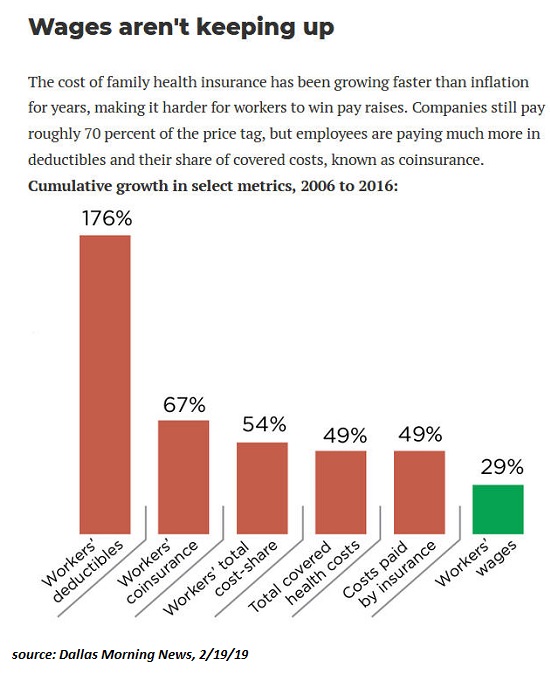
1. The shifting of pension and healthcare costs and risks from the state and employers to employees. (see chart below)

2. The decline of safe, secure high-yielding investments as central banks have driven savers into risky, crash-prone speculative assets such as stocks and junk bonds.

3. The decline of scarcity value in college diplomas that were once the ticket to middle class security. How Many Slots Are Open in the Upper Middle Class? Not As Many As You Might Think (March 30, 2015).

4. The inexorable rise in big-ticket costs: higher education, healthcare and housing. Even as wages stagnate, these costs continue rising, claiming an ever-larger share of household incomes, leaving less to save/invest.

5. The transition from a stable economy with predictable returns to a financialized boom-and-bust economy that wipes out middle class wealth in the inevitable busts but does not rebuild it in the booms.

6. The regulatory and administrative barriers to self-employment, forcing most of the workforce into wage-slavery and/or dependence on the state. Endangered Species: The Self-Employed Middle Class (May 2015).

7. The rising exposure of the U.S. workforce to highly educated, lower-cost competing workforces in a globalized economy.

8. The decline of labor's share of the U.S. economy: the slice of the pie distributed to earned income has been declining for decades.

9. The share of the earned-income slice going to the top 5% is rising.

10. The wealth of the middle class is tied up in the family home, a non-income producing asset prone to the wild swings of housing bubbles and busts. Stagnation Nation: Middle Class Wealth Is Locked Up in Housing and Retirement Funds (October 25, 2017).

The middle class has already collapsed, but thanks to debt and bubbles, this reality has been temporarily cloaked. All bubbles pop and all excessive debt ends in default. When these inevitably occur, the reality can no longer be hidden.


If you found value in this content, please join me in seeking solutions by becoming a $1/month patron of my work via patreon.com.

My new book is available! A Hacker's Teleology: Sharing the Wealth of Our Shrinking Planet 20% and 15% discounts (Kindle $7, print $17, audiobook now available $17.46)

Read excerpts of the book for free (PDF).

The Story Behind the Book and the Introduction.


Recent Podcasts:

Jay Taylor and I discuss The Upcoming Revolt of the Middle Class
(22 min)

My COVID-19 Pandemic Posts


My recent books:

A Hacker's Teleology: Sharing the Wealth of Our Shrinking Planet (Kindle $8.95, print $20, audiobook $17.46) Read the first section for free (PDF).

Will You Be Richer or Poorer?: Profit, Power, and AI in a Traumatized World
(Kindle $5, print $10, audiobook) Read the first section for free (PDF).

Pathfinding our Destiny: Preventing the Final Fall of Our Democratic Republic ($5 (Kindle), $10 (print), ( audiobook): Read the first section for free (PDF).

The Adventures of the Consulting Philosopher: The Disappearance of Drake $1.29 (Kindle), $8.95 (print); read the first chapters for free (PDF)

Money and Work Unchained $6.95 (Kindle), $15 (print) Read the first section for free (PDF).


Become a $1/month patron of my work via patreon.com.


NOTE: Contributions/subscriptions are acknowledged in the order received. Your name and email remain confidential and will not be given to any other individual, company or agency.

Thank you, Birgitta M. ($5/month), for your marvelously generous pledge to this site -- I am greatly honored by your support and readership.


Thank you, Edmund O.-S. ($5/month), for your massively generous pledge to this site -- I am greatly honored by your support and readership.

Read more...

Monday, February 08, 2021

Debt and the Demise of the Middle Class

Unfortunately for those at the top who've benefited immensely from speculative bubbles, speculative bubbles don't create a vibrant middle class--they push what's left of the middle class off a cliff.

What exactly is the Middle Class and what unique role does it serve in the economy? Given that the Middle Class is constantly invoked by politicos and economists, you'd think the status quo had a solid understanding of the Middle Class. Alas, it isn't that simple.

The conventional view defines the middle class by income, education or type of labor being performed. These are all superficial attributes and ignore what actually differentiates the working class from the middle class. Yes, the middle class tends to earn more, have higher educational credentials and perform white-collar labor rather than blue-collar labor.

But getting a higher education credential and increased pay doesn't automatically provide a middle class role in the economy, nor does performing white-collar work. None of these automatically moves the individual up the social mobility ladder from near-zero ownership of capital (working class) to meaningful ownership of productive capital (middle class).

As I explained in The Top 10% Is Doing Just Fine, The Middle Class Is Dying on the Vine, the middle class is fundamentally a means of transforming labor into capital via savings and investment. The traditional ladder of social mobility from the working class to the middle class is one of capitalizing work: time and savings are invested in higher education, in effect capitalizing future labor by increasing productivity.

In other words, what separates the working class from the middle class is the middle class is able to transform their labor into capital while the labor of the working class only funds consumption. The working class is defined not by credentials, type of labor or credentials but by limited access to the means to transform their labor into capital.

In the classical Marxist view, there is a bright line between labor and capital: the proletariats labor in the factories owned by the capitalist industrialists who depend on monopoly capital controlled by the commercial/investment banks.

The class of small business--tradecrafts, commerce, professionals, etc.--is merely a wedge between the dominant classes of labor and capital.

In this view, the exploitation of labor is the dominant force of capitalism. While labor is indeed exploited in many cases, the dynamic that this schema misses is the essential role of middle class credit/debt and consumption in generating profits for the big owners of capital. Low-wage workers benefit their employers but not the banks or those who profit from selling goods and services to higher-wage workers--the middle class.

Debt is immensely profitable, and so low-income workers are a limited pool of profitability. The financial services are expert at ripping off the working class with payday loans, check-cashing services, sky-high used auto loans, rapacious late fees and overdraft charges, but again, there is only so much blood that can be extracted from low-wage workers.

The higher, more secure wages of the middle class offer a bonanza of longer-term profits from debt taken on by the middle class: student loans to gain the credentials deemed necessary for middle class membership; auto loans, the larger the better for the aspirational consumption enabled by fatter paychecks, mortgages to buy homes, and consumer debt for all the consumption the middle class can afford: ski trips, cruises, fine dining, etc.

In other words, modern capitalism stagnates without a vibrant, creditworthy middle class that borrows and spends freely, for profits flow from high levels of debt and aspirational consumption that low-wage, insecure precariats cannot afford.

But here's the rub: most of the middle class debt stems from the aspiration to transform labor into capital via higher education (student debt) and home ownership (mortgages). As middle class wages lose purchasing power and incomes become more precarious (as employers offload healthcare and pension costs onto employees and shift workers from employees to gig-contract workers), the ability of the middle class to borrow and consume more falters.

Even worse, these time-honored avenues to ownership of productive capital are no longer reliable. Highed education credentials no longer guarantee stable, ample wages, and home ownership in a housing-bubble-addicted economy is less a means of saving and more a chip in the bubble-economy casino.

Debt serfdom awaits the aspirants to middle class ownership of productive capital. While debt payments are guaranteed, the rewards for taking on the debt are contingent and prone to sudden collapses in demand for credentials and assets purchased with debt.

Debt only works for the middle class if incomes and income security rise due to improving productivity and access to productive capital. Both productivity and access to productive capital are eroding, and so what made sense in past generations--borrowing for university educations and homes--are increasingly pathways to debt-serfdom.

The status quo "solution" to the decline of middle class ownership of income-producing capital is an economy that is now totally dependent on speculative bubbles. The idea here is as assets bubble ever higher, those in the middle class who own these assets will reap capital gains that will offset their declining purchasing power and income security.

Unfortunately, this "solution" has only enriched the top 10%, as the bottom 90% collect a near-zero 3% of all income from capital, which indicates that 1) the bottom 90%, which includes the middle class, own near-zero income-producing capital and 2) what capital they do own is either rapidly depreciating "stuff" (vehicles, appliances, etc.) that generates zero income or dead-money assets such as family homes that cost a fortune but produce no income and are no longer reliable investments, as the next bubble burst might evaporate the phantom homeowners equity generated by the serial housing bubbles.

As the middle class stagnates, so do the banks and producers of goods and services, and the lower-wage working class who labors in services and low-productivity producers. As the middle class awakens to the fact that the rungs of social mobility are broken, a systemic breakdown is predictable, a topic Jay Taylor and I discuss in the Upcoming Revolt of the Middle Class (22 min)

Unfortunately for those at the top who've benefited immensely from speculative bubbles, speculative bubbles don't create a vibrant middle class--they push what's left of the middle class off a cliff.


If you found value in this content, please join me in seeking solutions by becoming a $1/month patron of my work via patreon.com.

My new book is available! A Hacker's Teleology: Sharing the Wealth of Our Shrinking Planet 20% and 15% discounts (Kindle $7, print $17, audiobook now available $17.46)

Read excerpts of the book for free (PDF).

The Story Behind the Book and the Introduction.


Recent Podcasts:

Jay Taylor and I discuss The Upcoming Revolt of the Middle Class
(22 min)

My COVID-19 Pandemic Posts


My recent books:

A Hacker's Teleology: Sharing the Wealth of Our Shrinking Planet (Kindle $8.95, print $20, audiobook $17.46) Read the first section for free (PDF).

Will You Be Richer or Poorer?: Profit, Power, and AI in a Traumatized World
(Kindle $5, print $10, audiobook) Read the first section for free (PDF).

Pathfinding our Destiny: Preventing the Final Fall of Our Democratic Republic ($5 (Kindle), $10 (print), ( audiobook): Read the first section for free (PDF).

The Adventures of the Consulting Philosopher: The Disappearance of Drake $1.29 (Kindle), $8.95 (print); read the first chapters for free (PDF)

Money and Work Unchained $6.95 (Kindle), $15 (print) Read the first section for free (PDF).


Become a $1/month patron of my work via patreon.com.


NOTE: Contributions/subscriptions are acknowledged in the order received. Your name and email remain confidential and will not be given to any other individual, company or agency.

Thank you, Andre ($5/month), for your marvelously generous pledge to this site -- I am greatly honored by your support and readership.


Thank you, Littlefeat Fan ($5/month), for your massively generous pledge to this site -- I am greatly honored by your support and readership.

Read more...

Thursday, February 04, 2021

The Top 10% Is Doing Just Fine, The Middle Class Is Dying on the Vine

Please study these charts as a means of understanding the inevitability of economic stagnation and a revolt of the decapitalized middle class.

I've been covering the decline of America's middle class for over a decade with charts, data and commentary on the social depression that has accompanied the decline.

While there are many mutually reinforcing dynamics in this 45-year decline--demographics, global energy costs, financialization and globalization, to name a few-- one term describes the accelerating erosion of America's middle class: decapitalization.

To understand decapitalization, we need to start with the fundamentals of any economy between labor (wages) and capital and between investment and speculation. Although it's tempting to oversimplify and demonize one or the other of these basics (speculators bad! etc.), they each provide an essential role in a healthy economy, one which is in dynamic equilibrium, a state analogous to a healthy ecosystem with constantly changing interactions of numerous species, individuals and inputs (weather, etc.). This variability enables the order of fluctuations (to use Ilya Prigogine's profound phrase), a dynamic stability / equilibrium.

If labor's share of the economy drops too low, the workforce cannot consume enough to support their households and the economy as a whole. If capital can no longer earn an attractive return, investment dries up and production stagnates. If speculators are not allowed to take on risk, liquidity dries up and risk crushes investment. But if speculation becomes the foundation of the economy's "growth," then the inevitable collapse of speculative bubbles will crash the economy.

In modern social-capitalist systems, the core stabilizer of the system is the wage-earning middle class which provides the stable workforce driving production and the stable pool of consumers needed to borrow money and consume enough to soak up the production of goods and services at a profit to producers.

Without a stable, dominant middle class, capital has few opportunities to invest in productive capacity. Without a stable, dominant middle class, the economy stagnates and is prone to collapse as it is far from equilibrium.

The process of middle class decline is best explained as decapitalization because the middle class is fundamentally a means of transforming labor into capital via savings and investment. The traditional ladder of social mobility from the working class to the middle class is one of capitalizing work: time and savings are invested in higher education, in effect capitalizing future labor by increasing productivity.

Capital isn't limited to cash, land or tools; in an information economy, knowledge and skills are also capital, as is the social capital of social networking and relationships formed with mentors, suppliers, lenders, colleagues, investors, etc.

The second way to capitalize work is to save earnings and invest the savings in assets that produce income or gain value: a house, land, rental property, small business and income-producing financial assets such as bonds or dividend-paying stocks.

Thrift, investing, long-term planning and deferred consumption are all essential to capitalizing work by turning that labor into income-producing assets. As the household's ownership of these assets that yield unearned income rises, so does their income and wealth. These increase the financial security of the household and build a nestegg which can be passed down to the next generation, improving their security via inheritance of income-producing assets.

As long as productivity is increasing the value of their labor, the middle class can leverage future earnings into assets by borrowing money to invest in assets: to buy a house, a mortgage is borrowed against future earnings. As long as the mortgage is a fixed-interest loan and income can be expected to rise with productivity, then this is a win-win situation: capital earns a predictable, low-risk return from the mortgage and the middle class household has stake in a family home, an asset which acts as a savings mechanism as the mortgage slowly pays down the debt and increases the household's home equity--a form of savings.

The processes of decapitalization have upended this entire structure. In the systems context outlined above, our economy is out of balance and far from equilibrium and thus prone to collapse.

For the bottom 90%, which of course includes the middle class however you define it, it's increasingly difficult to capitalize labor into capital. There are a number of factors driving this decapitalization:

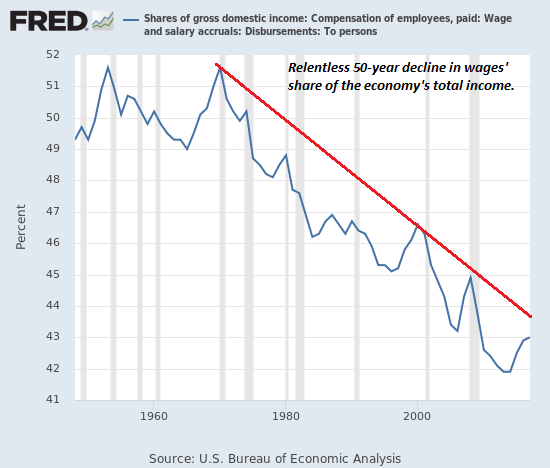
1. Wages' share of the national income has continued a five-decade downtrend. (See chart below) National income since 1973 has shifted from labor (wages) to capital and more specifically, to debt and speculative gaming of the system, a.k.a. financialization.

Total household income in the U.S. in 2018 was $17.6 trillion. The decline in wages' share of the national income from 1973 to 2018 is about 8.5%, which equals $1.5 trillion, the sum shifted from labor to capital every year. (See chart below)(source: https://www.statista.com/statistics/216756/us-personal-income/)

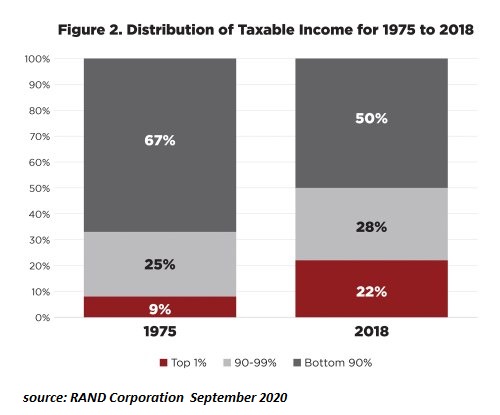
No, this is not a typo. As this RAND report documents, $50 trillion has been siphoned from labor (the lower 90% of the workforce) to the Financial Aristocracy and their technocrat lackeys (the top 10%) who own the vast majority of the capital (see charts below): Trends in Income From 1975 to 2018.

2. Within the workforce, wages have shifted to the top 10% who now earn 50% of all taxable income. (See RAND chart below) Financialization and globalization have decapitalized the skills of entire sectors of the workforce as automation and offshoring reduced the human capital of workers' skills and experience and the value of their social capital. When the entire industry is offshored, skills and professional relationships lose their market value.

In a fully globalized economy, every worker producing tradable goods/services is competing with the entire global workforce, a reality that reduces wages in high-cost developed nations such as the U.S.

Financialization has heavily rewarded workers with specialized gaming the financial system skills and devalued every other skill as only the skills of financialization are highly profitable in a globalized, financialized economy.

3. As the high-wage jobs and capital shifted to coastal urban centers, middle class owners of homes and capital elsewhere saw the value of their assets decline. If a home valued at $100,000 in the late 1990s is now worth $150,000, the owners lost ground even with "official" inflation. In terms of real-world purchasing power, their home actually lost significant value in the past 23 years.

Meanwhile, middle class owners who bought their home in a coastal hot-spot for $100,000 23 years ago are now enjoying home valuations close to $1 million. Homes, along with every other asset, have been shifted into a casino where almost everyone is sorted into winners and losers, less often by skill and more often by luck.

For those who were too young to buy in 1997, sorry--the opportunity to buy a home for three times average middle class income is gone. The lucky generation who bought in the late 1990s in booming coastal magnets for global capital joined the top 10% and their colleagues in less desirable regions lost ground.

4. As capital siphoned off income and appreciation from labor (human and social capital), the gains accruing to capital accelerated. Those who already owned income-producing assets reaped both income and asset appreciation gains as yields on savings collapsed to near-zero as the Federal Reserve and other central banks dropped yields to near-zero in 2009 and kept them low for the following 13 years.

This had two devastating effects on the middle class: hundreds of billions of dollars that once flowed to savers and money markets disappeared, swallowed by the banks as a direct (and intentional) effect of the Fed's ZIRP (zero-interest rate policy).

Since the Fed destroyed low-risk yields, anyone seeking any real yield (i.e. above inflation) would have to enter the casino and compete with hedge funds, insiders and the Financial Aristocracy. Very few middle class workers have the skills and experience to beat the pros in the casino, and so income and wealth accrued to those who already owned capital.

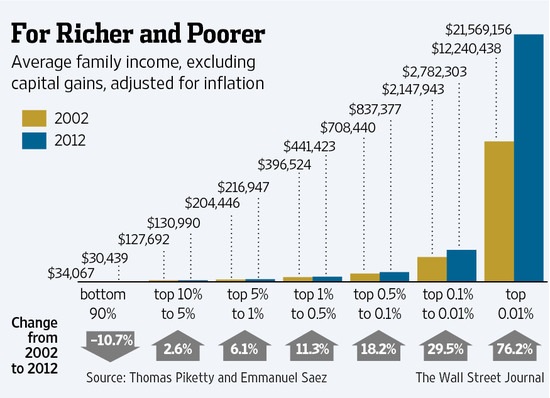
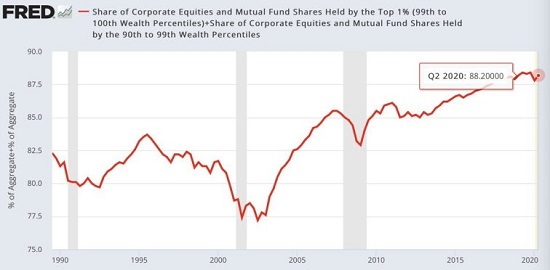
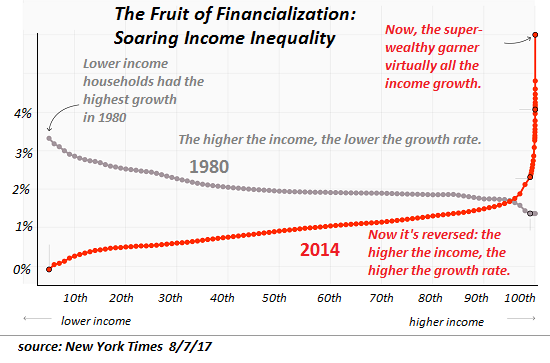
This is a key reason why the rich got richer and the poor got poorer. Those with capital accrued the majority of gains in income and wealth, leaving the bottom 90% in the dust.

A recent Foreign Affairs essay Monopoly Versus Democracy included these stunning statistics:

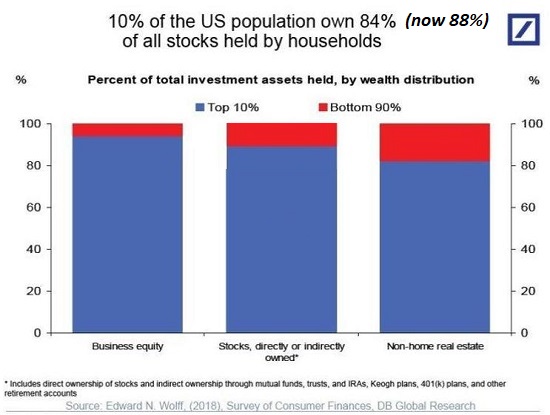
Ten percent of Americans now control 97 percent of all capital income in the country. Nearly half of the new income generated since the global financial crisis of 2008 has gone to the wealthiest one percent of U.S. citizens. The richest three Americans collectively have more wealth than the poorest 160 million Americans. (emphasis added.)

The 3% of income from capital collected by the bottom 90%--which includes the middle class-- is basically signal noise: the middle class collects inconsequential crumbs of income from capital.

Prior to the Fed's ZIRP and financialization of the economy, the middle class could both collect income from capital they owned and they could afford to acquire assets that yielded low-risk solid returns. Now they can do neither. Even worse, the puchasing power of their labor continues to decline, leaving them less able to save and buy assets.

This is why The Top 10% Is Doing Just Fine, The Middle Class Is Dying on the Vine. Please study these charts as a means of understanding the inevitability of economic stagnation and a revolt of the decapitalized middle class.


If you found value in this content, please join me in seeking solutions by becoming a $1/month patron of my work via patreon.com.

My new book is available! A Hacker's Teleology: Sharing the Wealth of Our Shrinking Planet 20% and 15% discounts (Kindle $7, print $17, audiobook now available $17.46)

Read excerpts of the book for free (PDF).

The Story Behind the Book and the Introduction.


Recent Podcasts:

AxisOfEasy Salon #36: Democratizing Stonk Market Manipulation (1:03 hrs)

The Roundtable Insight: Charles Hugh Smith on Is 2021 an Echo of 1641? (26 min)


My COVID-19 Pandemic Posts


My recent books:

A Hacker's Teleology: Sharing the Wealth of Our Shrinking Planet (Kindle $8.95, print $20, audiobook $17.46) Read the first section for free (PDF).

Will You Be Richer or Poorer?: Profit, Power, and AI in a Traumatized World
(Kindle $5, print $10, audiobook) Read the first section for free (PDF).

Pathfinding our Destiny: Preventing the Final Fall of Our Democratic Republic ($5 (Kindle), $10 (print), ( audiobook): Read the first section for free (PDF).

The Adventures of the Consulting Philosopher: The Disappearance of Drake $1.29 (Kindle), $8.95 (print); read the first chapters for free (PDF)

Money and Work Unchained $6.95 (Kindle), $15 (print) Read the first section for free (PDF).


Become a $1/month patron of my work via patreon.com.


NOTE: Contributions/subscriptions are acknowledged in the order received. Your name and email remain confidential and will not be given to any other individual, company or agency.

Thank you, James W. ($5/month), for your marvelously generous pledge to this site -- I am greatly honored by your support and readership.


Thank you, William H. ($50), for your massively generous contribution to this site -- I am greatly honored by your steadfast support and readership.

Read more...

Terms of Service

All content on this blog is provided by Trewe LLC for informational purposes only. The owner of this blog makes no representations as to the accuracy or completeness of any information on this site or found by following any link on this site. The owner will not be liable for any errors or omissions in this information nor for the availability of this information. The owner will not be liable for any losses, injuries, or damages from the display or use of this information. These terms and conditions of use are subject to change at anytime and without notice.

RE: European Union AI Act, and Our Use of Generative AI Tools and Agents Policy

All text on this site is composed by Charles Hugh Smith or by a credited guest-author. No Generative AI Tools are used in the composition / writing of any text or graphic content created by Charles Hugh Smith. This site deploys no AI agents or generative AI tools. This site is not responsible for the disclosures, use or non-use of AI agents or generative AI tools in advertisements displayed by Investing Channel or other ad placement services.

Audio files generated by text-to-audio transcription tools are identified as such.

Our Privacy Policy:

Correspondents' email is strictly confidential. This site does not collect digital data from visitors or distribute cookies. Advertisements served by third-party advertising networks such as Investing Channel may use cookies or collect information from visitors for the purpose of Interest-Based Advertising; if you wish to opt out of Interest-Based Advertising, please go to Opt out of interest-based advertising (The Network Advertising Initiative) If you have other privacy concerns relating to advertisements, please contact advertisers directly.

PRIVACY NOTICE FOR EEA INDIVIDUALS

This section covers disclosures on the General Data Protection Regulation (GDPR) for users residing within EEA only. GDPR replaces the existing Directive 95/46/ec, and aims at harmonizing data protection laws in the EU that are fit for purpose in the digital age. The primary objective of the GDPR is to give citizens back control of their personal data. Please follow the link below to access InvestingChannel's General Data Protection Notice.
https://stg.media.investingchannel.com/gdpr-notice/

Notice of Compliance with The California Consumer Protection Act

This site does not collect digital data from visitors or distribute cookies. Advertisements served by a third-party advertising network (Investing Channel) may use cookies or collect information from visitors for the purpose of Interest-Based Advertising. If you do not want any personal information that may be collected by third-party advertising to be sold, please follow the instructions on this page: Do Not Sell My Personal Information.

Regarding Cookies:

This site does not collect digital data from visitors or distribute cookies. Advertisements served by third-party advertising networks such as Investing Channel may use cookies or collect information from visitors for the purpose of Interest-Based Advertising; if you wish to opt out of Interest-Based Advertising, please go to Opt out of interest-based advertising (The Network Advertising Initiative) If you have other privacy concerns relating to advertisements, please contact advertisers directly.

Our Commission Policy:

Though I earn a small commission on Amazon.com books and gift certificates and gold (BullionVault) purchased via links on my site, I receive no fees or compensation for any other non-advertising links or content posted on my site.

Copyright Notice:

All original images (Drawings and Photographs), text (essays, books and works of fiction), audio and video recordings, musical compositions, graphic design, graphic design elements and HTML coding on this site are the copyrighted work of Charles Hugh Smith unless otherwise credited or noted. They are published as information for the private use of site visitors, and any reproduction or redistribution of this content or coding in any media in any format or distribution channel (text, audio, video/film, web) without the written permission of the copyright holder is strictly prohibited. All rights in all media reserved globally.

  © Blogger templates Newspaper III by Ourblogtemplates.com 2008

Back to TOP