

Wednesday, April 08, 2015

Rich Middle Class, Poor Middle Class

This great generational injustice is the direct consequence of central banks lowering interest rates to zero and inflating asset bubbles.


How can middle class households have similar incomes but some are asset-rich and others are asset-poor?
Spending and saving habits matter, of course; some households spend virtually all their net income while others "pay themselves first" and scrimp to do so.

But the really big differences in wealth are the result of what assets the household bought and when they were bought.

Those who bought assets at the top of bubbles may still be underwater once inflation is factored in; those who bought long before the Federal Reserve and other central banks inflated credit bubbles every few years have substantial equity even after the bubbles inevitably crash to Earth (revert to the mean).

For example, a household that bought $25,000 of 30-year Treasury bonds paying 12% in the early 1980s and reinvested the $3,000 annual interest (at much lower yields) ended up with over $100,000 by 2012.

Those who bought Apple stock shortly after Steve Jobs took the reins in 1997 did even better.

But few of us are blessed with the insight and courage to make big bets at just the right moment, and hold the bets for decades. Most of us buy homes when we scrape up the down payment, or upon getting married, having children, moving to a new locale, etc. Few of us have the years or willingness to attempt to time long real estate cycles.

Few of us acquire substantial amounts of stock in a corporation unless we work for the company and are granted stock options.

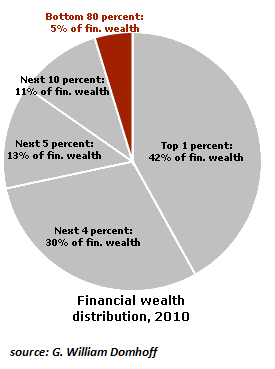
Thus it is no surprise that relatively few households below the top 5% hold substantial financial assets such as stocks and bonds.

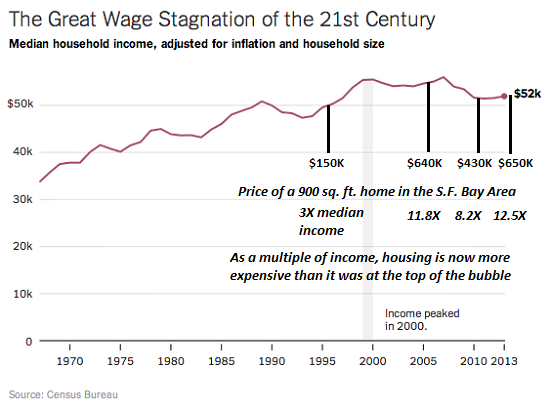
Stagnating wages for the lower 90% haven't made it any easier to save up capital to invest. As noted yesterday in Neofeudalism 101: Strip-Mining the Upper Middle Class, most of the income gains of the past 40 years have flowed to the very top of the income pyramid.

For all these reasons, the family home remains the foundation of most middle class households' wealth. Unfortunately, the Federal Reserve's policies have generated one credit bubble after another, destroying the old paradigm that buying a house was a reliable way to build equity.

As we can see in the chart of the Case-Shiller Index for the nation and the San Francisco Bay Area, those who bought in the bubble years have little to no equity despite their large monthly mortgage payments.

Buying a house in the bubble years was an unmitigated disaster in terms of building wealth. Only those who bought in the pre-bubble years of 1987 to 1998 built substantial equity--equity that didn't vanish even when the bubble popped.


Many households that bought modest homes in the early 1970s and held onto them now have $1 million+ in equity if they happened to live in highly desirable locales such as San Francisco, West Los Angeles, Honolulu, pricey boroughs in New York City, etc.

These households were not any different that the other 60% of households that owned homes. Their great fortune (pun intended) resulted from two unexpected bits of luck: buying before asset bubbles inflated, and buying property in areas that became extremely desirable to buyers on a global scale.

Based on multiples of inflation-adjusted income, housing in highly desirable areas is now more expensive than it was at the top of the 2007 bubble. Viewed from the metric of multiples of annual median income, housing in the San Francisco Bay Area has been unaffordable to all but very high-income households for the past 17 years.
Where does this leave us? With the unsettling reality that the generations that reached home-buying status in the 25-year era of 1973 - 1998 and happened to buy homes in locales that would one day become extremely desirable (and who didn't extract all their equity in the bubble years) are now Rich Middle Class Households.

Those who bought homes in the bubble years are Poor Middle Class Households with little or no asset wealth.

Is this just or fair? Of course not. This great generational injustice is the direct consequence of central banks lowering interest rates to zero and inflating asset bubbles in a corrosive (and vain) attempt to generate a wealth effect of households borrowing and blowing their newly created asset wealth.

In an economy that isn't whipsawed by central bank manipulation, the difference between middle class households' asset wealth is largely behavioral, not the random luck of coming of age before central banks began blowing destructive asset bubbles as a matter of policy. 


Get a Job, Build a Real Career and Defy a Bewildering Economy(Kindle, $9.95)(print, $20)
go to Kindle edition
Are you like me? Ever since my first summer job decades ago, I've been chasing financial security. Not win-the-lottery, Bill Gates riches (although it would be nice!), but simply a feeling of financial control. I want my financial worries to if not disappear at least be manageable and comprehensible.And like most of you, the way I've moved toward my goal has always hinged not just on having a job but a career.
You don't have to be a financial blogger to know that "having a job" and "having a career" do not mean the same thing today as they did when I first started swinging a hammer for a paycheck.
Even the basic concept "getting a job" has changed so radically that jobs--getting and keeping them, and the perceived lack of them--is the number one financial topic among friends, family and for that matter, complete strangers.
So I sat down and wrote this book: Get a Job, Build a Real Career and Defy a Bewildering Economy.
It details everything I've verified about employment and the economy, and lays out an action plan to get you employed.
I am proud of this book. It is the culmination of both my practical work experiences and my financial analysis, and it is a useful, practical, and clarifying read.
Test drive the first section and see for yourself.     Kindle, $9.95     print, $20
"I want to thank you for creating your book Get a Job, Build a Real Career and Defy a Bewildering Economy. It is rare to find a person with a mind like yours, who can take a holistic systems view of things without being captured by specific perspectives or agendas. Your contribution to humanity is much appreciated."
Laura Y.
Gordon Long and I discuss The New Nature of Work: Jobs, Occupations & Careers(25 minutes, YouTube) 


NOTE: Contributions/subscriptions are acknowledged in the order received. Your name and email remain confidential and will not be given to any other individual, company or agency.


 Thank you, Jan K. ($150), for your beyond-outrageously generous subscription to this site-- I am greatly honored by your steadfast support and readership.

Read more...

Tuesday, April 07, 2015

Neofeudalism 101: Strip-Mining the Upper Middle Class

This Neofeudal structure is unstable by its very nature.


I have often examined the Neofeudalist structure of the U.S. economic hierarchy, and the many social and financial fault lines running through this creaking structure. For example:


Bifurcation Nation (June 24, 2013)


Today I'd like to examine the neofeudal strip-mining of the class that pays most of the taxes. These taxes support the bottom 50% who pay the 7.65% payroll taxes and receive substantial income tax credits, and enables the super-wealthy to pay lower tax rates on their vast unearned income.

Let's take a quick glance at payroll and income taxes for context. Individual income taxes and Social Security/payroll taxes total $2.4 trillion.Corporate and other taxes add $600 billion, for a total of $3 trillion in Federal tax receipts.


Put together, people making under $40,000 a year get $81.1 billion from the income tax; that is, they get more refundable credits like the Earned Income Tax Credit than they pay in taxes. But that same group pays $121.5 billion in payroll taxes.

So people making under $40,000 a year--63.9% of all taxpayers, according to the Social Security Administration, paid a net of $40 billion out of the $2.4 trillion in payroll and income taxes. This is truly a drop in the bucket.

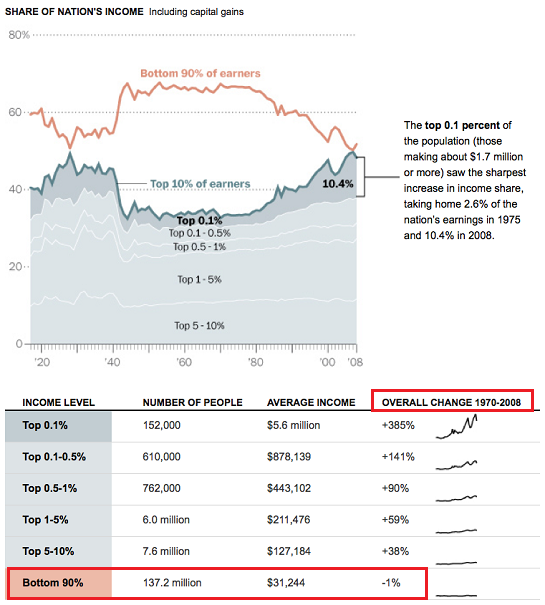
Meanwhile, the wealth of the top .01% has pulled away from the top 10% and even the top 1%:


A household income of around $150,000 a year qualifies as a top 10% income:
$145,000 to $149,999: 90.20%
$105,000 to $109,999: 81.09%
$190,000 to $194,999: 95.21%

Because the super-wealthy are in the top 10%, 5% and 1%, the average incomes of these groups are heavily skewed by the enormous incomes of the top 01%. As a result, it would be more accurate to remove the top .1% from the top 10%, 5% and 1%, but I haven't found any statistical charts that reflect this.

For their part, the top 10% (roughly 15 million taxpayers in a nation of 317 million people) pay the vast majority of income taxes: CBO:Top 40% Paid 106.2% of Income Taxes; Bottom 40% Paid -9.1%


The top 20% pay 93% of all federal income tax and 45% of all payroll taxes. The top 10% pay 77.4% of all federal income tax and 27% of all payroll taxes.

Most of the income gains have flowed to the very top of the income pyramid:


So what makes this structure Neofeudal? Simply this: the tax donkeys who pay most of the tax support the large class of modern-day serfs (working poor and state dependents) while their labor generates the great wealth enjoyed by the Financial Aristocracy.

The class of tax donkeys earns most of their income by their labor, and this income is exposed to both payroll taxes (up to $111,000 annually) and income taxes. Unless they are fortunate enough to be granted stock options in bubblicious tech companies, they do not own the capital needed to skim millions of dollars annually in unearned income like the Financial Aristocracy.

This Neofeudal structure is unstable by its very nature. For every person in the bottom 50% looking with resentment at someone earning $150,000, there's somebody like me (who doesn't earn $150K) paying $300 cash for a small tube of medication (that's long been off-patent) because I can't afford gold-plated health insurance but earn too much to get healthcare and all medications for free.

This class in the middle--making too much to qualify for federal subsidies, but not enough to afford healthcare, higher education, etc.--has its own fault lines, fractures I will discuss tomorrow. 


Get a Job, Build a Real Career and Defy a Bewildering Economy(Kindle, $9.95)(print, $20)
go to Kindle edition
Are you like me? Ever since my first summer job decades ago, I've been chasing financial security. Not win-the-lottery, Bill Gates riches (although it would be nice!), but simply a feeling of financial control. I want my financial worries to if not disappear at least be manageable and comprehensible.

And like most of you, the way I've moved toward my goal has always hinged not just on having a job but a career.

You don't have to be a financial blogger to know that "having a job" and "having a career" do not mean the same thing today as they did when I first started swinging a hammer for a paycheck.

Even the basic concept "getting a job" has changed so radically that jobs--getting and keeping them, and the perceived lack of them--is the number one financial topic among friends, family and for that matter, complete strangers.

So I sat down and wrote this book: Get a Job, Build a Real Career and Defy a Bewildering Economy.
It details everything I've verified about employment and the economy, and lays out an action plan to get you employed.
I am proud of this book. It is the culmination of both my practical work experiences and my financial analysis, and it is a useful, practical, and clarifying read.

Test drive the first section and see for yourself.     Kindle, $9.95     print, $20

"I want to thank you for creating your book Get a Job, Build a Real Career and Defy a Bewildering Economy. It is rare to find a person with a mind like yours, who can take a holistic systems view of things without being captured by specific perspectives or agendas. Your contribution to humanity is much appreciated."
Laura Y.

Gordon Long and I discuss The New Nature of Work: Jobs, Occupations & Careers(25 minutes, YouTube) 


NOTE: Contributions/subscriptions are acknowledged in the order received. Your name and email remain confidential and will not be given to any other individual, company or agency.

Thank you, Robert E. ($500), for your beyond-outrageously generous subscription to this site-- I am greatly honored by your steadfast support and readership.

Read more...

Monday, April 06, 2015

What Happens to Sales and Employment When Corporate Profits Fall?

Corporate profits are back at the levels reached in 1990, 1999 and 2008 that presaged recessions and a a sharp downturn in sales and employment.


It really isn't a surprise that corporate profits are falling: not only is the stronger U.S. dollar (USD) crushing the overseas profits of U.S. global corporations when reported in USD, but both the U.S. and global economies are slowing.

Since corporations have slashed every possible cost to the bone in the past six years, slowing economies lead to lower sales which lead to declining profits.

Head-count has been slashed, suppliers have been squeezed, high-interest loans have been refinanced, under-performing stores have been shuttered, high-cost properties have been sold--there really isn't much left for Corporate America to slash and burn to skim more profit.

So what happens to sales and employment when corporate profits start sliding? Longtime correspondent B.C. kindly shared a number of charts to answer this question, and I've selected two to discuss.

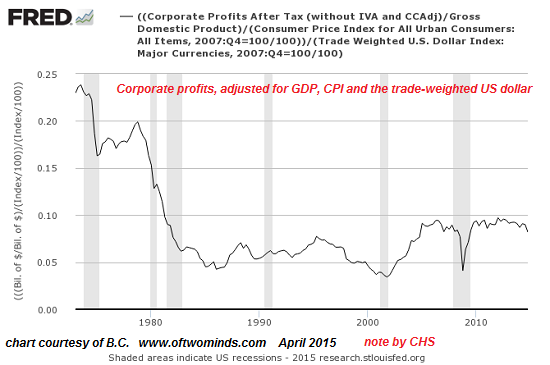
The first is corporate profits, adjusted for GDP, the Consumer Price Index (CPI) and the trade-weighted U.S. dollar. The problem with nominal profits, or indeed any financial data point, is that they can only be analyzed in the context of the factors that affect their purchasing power in the real world.

For example, nominal corporate profits might rise by 10% a year, a number that looks very positive in isolation. But if inflation is running at 15%, then those profits are actually lagging the general decline in purchasing power.
Profits earned in currencies that are weakening are another example of nominal numbers not telling the real story.

This is why I often post charts of financial data priced in oil or gold--real-world commodities that cannot be gamed like unemployment, profits and a host of other data that is deemed important.

This is the value of B.C.'s chart: this is corporate profits adjusted for the critical economic contexts of GDP, CPI and the trade-weighted USD.

Profits have rolled over, after topping out at 2007 levels:


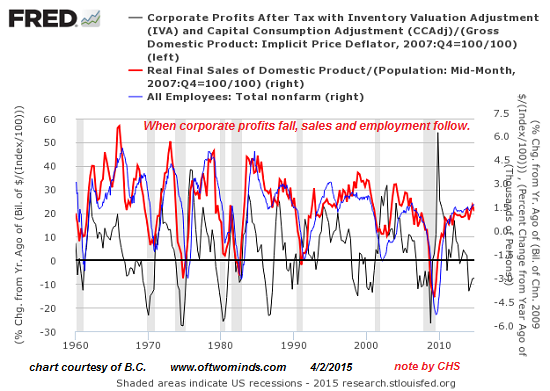
The second chart displays corporate profits, real final sales and employment. In this chart, corporate profits are adjusted for real GDP (i.e. adjusted for inflation). Note that profits lead sales and employment: when profits drop, sales and employment typically follow. This chart tracks year-over-year (YoY) changes:


Corporate profits are back at the levels reached in 1990, 1999 and 2008 that presaged recessions and a a sharp downturn in sales and employment. Profits adjusted for real GDP are noisy, but the recent drop in profits is clear.

If recent history is a reliable guide (and why wouldn't it be?), sales and employment have both topped and are about to fall sharply. At this point, it's wise to recall what the Federal Reserve cannot do:

1. It cannot force employers to hire more employees or pay them more.

2. It cannot force households or enterprises to borrow more money.

3. It cannot force households or enterprises to spend disposable income on non-essentials.

I suspect many households are like ours--tightening their belts and spending as little as possible in order to pay higher property taxes and federal and state income taxes.

Given the risks of a slowing economy, it's crazy to hire more employees or borrow more money unless the return on those investments is immediate, immensely profitable and recession-proof. Few investments meet those criteria. 


Get a Job, Build a Real Career and Defy a Bewildering Economy(Kindle, $9.95)(print, $20)
go to Kindle edition
Are you like me? Ever since my first summer job decades ago, I've been chasing financial security. Not win-the-lottery, Bill Gates riches (although it would be nice!), but simply a feeling of financial control. I want my financial worries to if not disappear at least be manageable and comprehensible.  

And like most of you, the way I've moved toward my goal has always hinged not just on having a job but a career.

You don't have to be a financial blogger to know that "having a job" and "having a career" do not mean the same thing today as they did when I first started swinging a hammer for a paycheck.

Even the basic concept "getting a job" has changed so radically that jobs--getting and keeping them, and the perceived lack of them--is the number one financial topic among friends, family and for that matter, complete strangers.

So I sat down and wrote this book: Get a Job, Build a Real Career and Defy a Bewildering Economy.

It details everything I've verified about employment and the economy, and lays out an action plan to get you employed.

I am proud of this book. It is the culmination of both my practical work experiences and my financial analysis, and it is a useful, practical, and clarifying read.

Test drive the first section and see for yourself.     Kindle, $9.95     print, $20

"I want to thank you for creating your book Get a Job, Build a Real Career and Defy a Bewildering Economy. It is rare to find a person with a mind like yours, who can take a holistic systems view of things without being captured by specific perspectives or agendas. Your contribution to humanity is much appreciated."
Laura Y.

Gordon Long and I discuss The New Nature of Work: Jobs, Occupations & Careers(25 minutes, YouTube) 


NOTE: Contributions/subscriptions are acknowledged in the order received. Your name and email remain confidential and will not be given to any other individual, company or agency.


 Thank you, James Y. ($5/month), for your superbly generous subscription to this site-- I am greatly honored by your support and readership.

Read more...

Sunday, April 05, 2015

Guaranteed Financial Security Is a Fantasy

Guarantees based on extracting higher taxes, borrowing trillions of dollars and creating trillions more out of thin air only guarantee eventual systemic implosion.


It is difficult for those living through tectonic social and economic shifts to recognize the passing of one era and the emergence of a new era. We are clearly in such a tectonic shift, yet it is slow enough and uneven enough that those who hope the old era will somehow endure despite the erosion of its foundations can find evidence to support their beliefs.

One such cherished belief is the faith that financial security can be guaranteed. This faith has two components:

1. The faith that risk can be identified and managed to the point it cannot disrupt the payment of promised pensions, benefits, yields, etc.

2. The faith that the system can pay what has been promised by one means or another.

If tax revenues are inadequate, taxes can always be raised. If tax revenues fail to rise, then the money needed to pay the promised pensions, benefits, etc. can be borrowed. If the money cannot be borrowed, then it can simply be created out of thin air by central banks or printed by government treasuries.

Before the advent of high finance, lowering risk could only be achieved by spreading the risk over a large populace. To lower the risk to individuals that their house would burn down in an accidental fire, insurance was sold to 1,000 homes. If one or two of the 1,000 homes burned down each year, the insurance could pay the claims and still build up reserves for future claims.

But if a conflagration burns down all 1,000 homes, the insurance is overwhelmed; the guaranteed coverage is rendered worthless.

The creation of a volunteer (or tax-supported) fire brigade will also lower the risk that an accidental fire could spread. But once again, such a brigade can only mitigate very limited fires; a second fire or a windstorm would exceed the capacity of the brigade to extinguish multiple fires.

The faith in guaranteed security is actually a faith that there will be no consequences from borrowing or printing enormous sums of money, and no possible risk to the system that cannot be anticipated and mitigated with some fancy financial footwork.

Is this faith reality-based? We know that borrowing immense sums of money does have consequences: interest must be paid out of future income, reducing the income that can be consumed or invested, and dependence on borrowed money creates moral hazard: rather than make difficult trade-offs, the borrower just borrows more money.

Creating money out of thin air is also not consequence-free. Fancy financial footwork can mask the consequences of creating money to pay promised pensions, benefits, etc., but eventually the reality that creating money does not create wealth intrudes on the fantasy that if tax revenues are insufficient, and borrowing has limits, then we can guarantee incomes, pensions, benefits, etc. by creating money out of thin air.

Those dependent on the promises made in the previous era will support any policy that "extends and pretends" the illusion that financial security can be guaranteed, regardless of seismic shifts in the natural and financial economies.

The irony of "extend and pretend" is these policies only push the system to extremes that guarantee systemic collapse. The more we avoid facing the intrinsic insecurities generated by tectonic shifts, the more we hasten the sudden implosion of old systems pushed beyond their limits.

Real security arises from the constant volatility, friction and insecurity of experimentation, adaptation and dissent. Guarantees based on extracting higher taxes, borrowing trillions of dollars and creating trillions more out of thin air only guarantee eventual systemic implosion.

Put another way: spreading the risk of a house fire amongst the 1,000 homeowners does not actually lessen the risk of a conflagration burning down the entire town. 


Get a Job, Build a Real Career and Defy a Bewildering Economy(Kindle, $9.95)(print, $20)
go to Kindle editionAre you like me? Ever since my first summer job decades ago, I've been chasing financial security. Not win-the-lottery, Bill Gates riches (although it would be nice!), but simply a feeling of financial control. I want my financial worries to if not disappear at least be manageable and comprehensible.  


And like most of you, the way I've moved toward my goal has always hinged not just on having a job but a career.

You don't have to be a financial blogger to know that "having a job" and "having a career" do not mean the same thing today as they did when I first started swinging a hammer for a paycheck.


Even the basic concept "getting a job" has changed so radically that jobs--getting and keeping them, and the perceived lack of them--is the number one financial topic among friends, family and for that matter, complete strangers.


So I sat down and wrote this book: Get a Job, Build a Real Career and Defy a Bewildering Economy.


It details everything I've verified about employment and the economy, and lays out an action plan to get you employed.


I am proud of this book. It is the culmination of both my practical work experiences and my financial analysis, and it is a useful, practical, and clarifying read.


Test drive the first section and see for yourself.     Kindle, $9.95     print, $20


"I want to thank you for creating your book Get a Job, Build a Real Career and Defy a Bewildering Economy. It is rare to find a person with a mind like yours, who can take a holistic systems view of things without being captured by specific perspectives or agendas. Your contribution to humanity is much appreciated."
Laura Y.


Gordon Long and I discuss The New Nature of Work: Jobs, Occupations & Careers(25 minutes, YouTube) 


NOTE: Contributions/subscriptions are acknowledged in the order received. Your name and email remain confidential and will not be given to any other individual, company or agency.

Thank you, Brian S. ($5/month), for your massively generous re-subscription to this site-- I am greatly honored by your steadfast support and readership.

Read more...

Who Would Jesus Shun?

Please glance at this painting and guess its era and the identity of the man.

It was painted in the early 1600s by Valentin de Boulogne, a French painter who spent most of his career in Rome and who was greatly influenced by Caravaggio's dramatic compositions and use of light.

The man is Jesus, and the painting depicts the critical moment of one of my favorite stories of the Bible, John 8:7 -- So when they continued asking him, he lifted up himself, and said unto them, "He that is without sin among you, let him first cast a stone at her."

The artist portrays Jesus as he "bent down and wrote with his finger on the ground." The scribes had brought an adulteress to Jesus as a test, or more correctly, as a trap, hoping his answer would enable them to bring some charge against him.

The artist presents Jesus as a human facing a difficult challenge; his expression is one of uncertainty and perhaps hesitation as he grasps the complex situation. I was immediately transfixed by this painting for reasons that transcend faith; one need not be a Christian or even a theist to understand how different this Jesus is from the thousands of other portrayals of Christ as a child or Savior. Here is first and foremost a human being, beset by human emotions.

The narrative and iconography of this painting were very different from the typical portrayals of Jesus, and they open up a wide range of potential responses and levels of understanding in the viewer.

Of particular interest is the artist's selection of the moment before Jesus rises and delivers his devastating takedown of the hypocritical moralists, the moment of extreme tension and precariousness. This is a very human moment we can all relate to on some level.

Imagine the scene as Jesus tells the adulteress, "Neither do I condemn you; go, and do not sin again." The mob has vanished, dispersed by the truth of Jesus' words.

The Church at various times emphasized or encouraged depictions of specific narratives and iconic moments in the Bible to shape the beliefs of those seeing the artworks, and those portrayals that strayed from the party line, so to speak, were kept private rather than displayed in chapels.

In the secular world, we must always be alert to just this sort of shaping of our belief structure by the careful reinforcement of carefully selected narratives and iconography.

Who would Jesus shun? Who would he refuse to serve? The answer is here: "He that is without sin among you, let him first cast a stone at her."

Those claiming the freedom to shun based on faith may have some religion, but it certainly isn't Christianity. 

Read more...

Terms of Service

All content on this blog is provided by Trewe LLC for informational purposes only. The owner of this blog makes no representations as to the accuracy or completeness of any information on this site or found by following any link on this site. The owner will not be liable for any errors or omissions in this information nor for the availability of this information. The owner will not be liable for any losses, injuries, or damages from the display or use of this information. These terms and conditions of use are subject to change at anytime and without notice.

RE: European Union AI Act, and Our Use of Generative AI Tools and Agents Policy

All text on this site is composed by Charles Hugh Smith or by a credited guest-author. No Generative AI Tools are used in the composition / writing of any text or graphic content created by Charles Hugh Smith. This site deploys no AI agents or generative AI tools. This site is not responsible for the disclosures, use or non-use of AI agents or generative AI tools in advertisements displayed by Investing Channel or other ad placement services.

Audio files generated by text-to-audio transcription tools are identified as such.

Our Privacy Policy:

Correspondents' email is strictly confidential. This site does not collect digital data from visitors or distribute cookies. Advertisements served by third-party advertising networks such as Investing Channel may use cookies or collect information from visitors for the purpose of Interest-Based Advertising; if you wish to opt out of Interest-Based Advertising, please go to Opt out of interest-based advertising (The Network Advertising Initiative) If you have other privacy concerns relating to advertisements, please contact advertisers directly.

PRIVACY NOTICE FOR EEA INDIVIDUALS

This section covers disclosures on the General Data Protection Regulation (GDPR) for users residing within EEA only. GDPR replaces the existing Directive 95/46/ec, and aims at harmonizing data protection laws in the EU that are fit for purpose in the digital age. The primary objective of the GDPR is to give citizens back control of their personal data. Please follow the link below to access InvestingChannel's General Data Protection Notice.
https://stg.media.investingchannel.com/gdpr-notice/

Notice of Compliance with The California Consumer Protection Act

This site does not collect digital data from visitors or distribute cookies. Advertisements served by a third-party advertising network (Investing Channel) may use cookies or collect information from visitors for the purpose of Interest-Based Advertising. If you do not want any personal information that may be collected by third-party advertising to be sold, please follow the instructions on this page: Do Not Sell My Personal Information.

Regarding Cookies:

This site does not collect digital data from visitors or distribute cookies. Advertisements served by third-party advertising networks such as Investing Channel may use cookies or collect information from visitors for the purpose of Interest-Based Advertising; if you wish to opt out of Interest-Based Advertising, please go to Opt out of interest-based advertising (The Network Advertising Initiative) If you have other privacy concerns relating to advertisements, please contact advertisers directly.

Our Commission Policy:

Though I earn a small commission on Amazon.com books and gift certificates and gold (BullionVault) purchased via links on my site, I receive no fees or compensation for any other non-advertising links or content posted on my site.

Copyright Notice:

All original images (Drawings and Photographs), text (essays, books and works of fiction), audio and video recordings, musical compositions, graphic design, graphic design elements and HTML coding on this site are the copyrighted work of Charles Hugh Smith unless otherwise credited or noted. They are published as information for the private use of site visitors, and any reproduction or redistribution of this content or coding in any media in any format or distribution channel (text, audio, video/film, web) without the written permission of the copyright holder is strictly prohibited. All rights in all media reserved globally.

  © Blogger templates Newspaper III by Ourblogtemplates.com 2008

Back to TOP