College grads, it may be time for different approach, not just in getting a job but in life.
If we scrape away the hype and the humbug, this is the corporate economy in a nutshell. Sorry about the bluntness, but alas, there's no way to sugarcoat calling Ultra-Processed Life what it really is.
We're all sheep to be sheared, living commodities. As consumers, the goal is to extract as much of our earnings and capital as possible by any means available, and do so as often as possible. As employees, the goal is to extract as much value as possible from our labor.
Yes, we're each unique. So are sheep. I could tell you about Bootsy the sheep, such a character, for individual sheep are unique, too. But that doesn't mean they're not commodities whose value and purpose in life is to be sheared to profit those doing the commodifying. We're all commodities, just like sheep.
Corporations have vast expertise in the psychological tricks of making it appear that the corporation really, really cares about you: yes, you, the consumer of their products and services (you're special!) and you, the employee / 1099-contract worker / gig worker--you're special!
Actually, we're not special. We're just commodities being processed to extract as much money / value as possible from each transaction or hour of labor, and an integral component in that extraction process is to mask the heartbreaking truth behind warm and fuzzy stories, signals and images--we really, really care about you, you're important. Yes, we are important, in the same way sheep are important because they're the source of profits.
The cold-steel truth is we're interchangeable. Ideally, we sign up for a high-interest credit card and charge our way into a high balance we can never pay off, but if we pass up that offer or default, we're replaced by another sheep in line to be sheared.
The individual who replaces us at work may not be as good as we were, but we remain replaceable. If the value of our work can be commoditized, that makes us more easily replaceable. And if the commoditized work can be automated, that's a slum dunk for the corporation, because the commodity AI agent / software process doesn't require stupidly expensive healthcare insurance, doesn't need training and won't sue us.
The work that can't be commoditized / automated requires experience, and if we don't have the necessary mix of experience to create value on Day One, we're a commodity of no interest.
Which brings us to college graduates sending out 90 resumes and being ghosted or rejected by the cloned HR (Human Resources) bots deployed by all 90 corporate employers to weed out everyone but those few with the requisite experience. Which in the case of recent collage graduates, is near-zero because they've been university students with minimal opportunities to gain high-value / intensive work experience.
Here's a real-world example of high-value / intensive work experience: I was speaking with a frontline healthcare tech and her first job was working alone on the night shift: no supervisor, no co-worker, just her and the patients. In these situations you learn fast or quit fast.
There are innumerable accounts online of the commoditization of applying for a job and the commoditization of rejecting applicants.
'I feel helpless': college graduates can't find entry-level roles in shrinking market amid rise of AI.
There's a Catch-22 here that everyone sees: you need a university degree, and so you have little high-value work experience, but we only hire people with a university diploma and 3 to 5 years of the exact type of experience we need so the employee starts generating value on Day One.
(The Catch-22 in the novel of the same name is the military service member who requests to be relieved of hazardous duty due to insanity is obviously sane, so their application is rejected.)
No corporation wants to waste the money and time to train a green employee with a university diploma of uncertain but likely low value. They want to poach a highly experienced employee from some other company that invested scarce resources in training the employee.
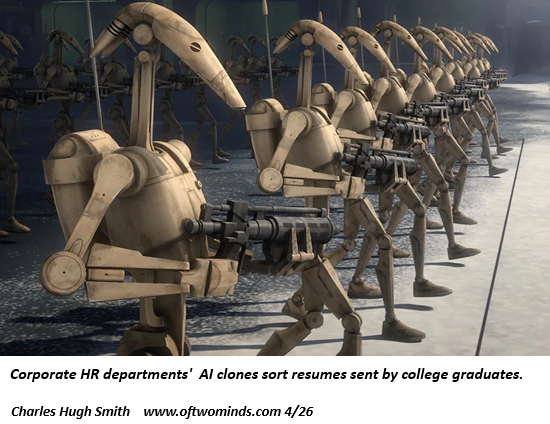
The analogy here is a Clone War: the recent grad incorrectly assumes getting a job offer is a numbers game, where volume / quantity will eventually generate "bingo"--a job offer in the grad's field of interest.
But HR has a digital army of clones programmed to find a reason to reject our application / resume, because that's the commoditized job of HR: process applications and resumes as quickly and cheaply as possible, which boils down to commoditizing the rejection process.
In the current zeitgeist of Ultra-Processed Life, the recent grad's response is to commoditize counter-strategies by using AI agents to tweak the resume so it gets through the clone army by guessing what triggers rejection and inserting some signal that evades the work experience requirement.
Battling commoditized clones with commoditized clones is a dead end. Fabricating work experience may be tempting but that will be revealed in the first interview, or the first week on the job.
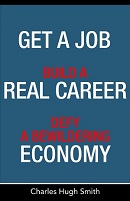
College graduates, it may be time for a completely different approach: don't fight in the clone war, realize you need experience and the way to get it is by de-commoditizing yourself and your job search by pursuing a path of what I describe in my book Get a Job, Build a Real Career and Defy a Bewildering Economy as accrediting yourself by doing real work and documenting it in ways that verify its value and your ownership of that value.
I wrote the book 12 years ago, but since I've been a student of AI since the mid-1980s, I anticipated what's happening today in the workplace and economy, and laid out a way out of the clone war's commoditization.
The way to avoid being ghosted by the clone war's commoditization is to forget about applying to corporations with HR clones and start looking for small to medium-sized businesses that don't have HR departments or AI clones--they have what Peter Drucker observed every enterprise has: expenses.
In many cases, they're not even aware they could use some help because they assume another employee is an expense they can't afford. These businesses are not in the business of commoditizing the extraction of money / value via transactions; their business includes transactions but their core value proposition is relationships, not faceless digital transactions.
It takes shoe-leather research to find businesses you might want to work for not necessarily because they're doing whatever your field of interest might be, but because of the integrity of the enterprise and the people working there.
Corporations have budgets for consultants and tech, but smaller enterprises are often struggling with legacy systems that they don't have the time or ability to replace or upgrade. They're often so overworked just keeping everything glued together they don't see ways that they could streamline processes or add value to existing sources of revenues without spending a fortune.
This is where, you, recent college grad, come in. The foundation of accredit yourself is to start thinking and acting like a self-employed entrepreneur. It's you against the world, and so you need to acquire the essential skills every self-employed person / entrepreneur needs to know via experience, not case studies.
Where you get those experiential skills matters less than acquiring them, for the point of these eight essential skills is they can be applied to every enterprise regardless of scale or sector or locale.
Learning how to think and act like a self-employed person must be learned by experience. While others can mentor you, no one can teach you how to do this, you must train yourself via focus, effort, willingness to experiment and fail, willingness to learn what you thought you knew but didn't really know, and desire for mastery.
The core trait of the self-employed person is figuring out what the customer is willing to spend money on and responding to that in a way that benefits the customer more than the other alternatives. In some cases, it's lower price; in others, it's providing a better product; in others, it's real customer service, not commoditized service being passed off as authentic customer service--in other words, a relationship not a transaction.
My own experience is the value lies not in fighting the commoditization war but in bypassing it completely, in effect obsoleting the entire corporate-HR commoditization. Find small businesses, try to meet the boss / owner, find out what they do, and if it's of interest, write them a letter or call them.
Don't say, "I want a job." Say "I'm interested in your business and work, I want to learn more, can I come by?" The self-employed entrepreneur you're nurturing within you will observe, ask questions, and if there is some small opportunity to help, offer to help without compensation, just because you find it interesting.
In many cases, the owner is overworked and has people demanding things, not offering to help. They may be reluctant to accept help, and if so, try to find some tiny task you can do for them that they'll accept. Then go to work on the real task, which is figuring out ways they could reduce expenses or increases revenues in ways that don't require a big budget or major effort.
In every case, you understand it's experimentation. Maybe ten owners blow you off. It's discouraging, but you anticipate this. Somebody will accept your authentic interest and sincere offer to help, just for the experience. Your value isn't necessarily a skill at this point, it's the willingness to help, to learn, to establish a sincere, authentic relationship with customers / clients.
Nobody will tell you this, so I'm telling you: those are all priceless and cannot be commoditized or automated. Every attempt to automate these is fake, nothing more than a synthetic, superficial simulation, just another debilitating, lifeless iteration of Ultra-Processed Life.
The value of your commoditized diploma is not what will get you hired. Learning how to create value with experiential skills and authentic relationships is what will get you a job offer. I get emails from people discouraged by the commoditization, the lifelessness of their current job, the many obstacles to changing careers. All these are real, and I've lived all the obstacles, not just more than once, but as a continuous process of adaptation and learning.
Although I titled my book Get a Job, it's not about getting something, it's about acquiring experiential skills and a mindset, an approach, an enthusiasm for learning by doing even when there is no money in it at first--or ever. Authentic skills, mastery via continual learning--these are what's scarce and valuable.
I don't want to veer too close to sappy homilies, but in my experience Emerson was right: Do the thing and you shall have the power.
Rumi was right, too: when it comes to mastery gained from experience, What you seek is seeking you. We all seek to become good at something, to establish authentic relationships, to become valuable to others. Our job is to find ways to do so that are authentic. No one can map the path for us, we must do it for ourselves.
Success has also been commoditized, so de-commoditize it. Must get rich, must check these boxes, blah blah blah. Guess what: nobody cares, because everything's that's commoditized is interchangeable.
What's worked for me through decades of failure is Churchill's dictum: Success consists of going from failure to failure without loss of enthusiasm. Spot-on, Winny.
MacArthur got it right: There is no security on this earth; there is only opportunity.
So did Aristotle: We are what we repeatedly do.
Painful but true, as John Paul Jones knew from experience: He who will not risk cannot win.
College grads, it may be time for different approach, not just in getting a job but in life.
My book Investing In Revolution is available at a 10% discount ($18 for the paperback, $24 for the hardcover and $8.95 for the ebook edition).
Introduction (free)
Check out my updated Books and Films.
Become
a $3/month patron of my work via patreon.com
Subscribe to my Substack for free
NOTE: Contributions/subscriptions are acknowledged in the order received. Your name and email
remain confidential and will not be given to any other individual, company or agency.
|
Thank you, John D. ($100), for your ourageously generous subscription
to this site -- I am greatly honored by your steadfast support and readership.
|
|
Thank you, David E. ($100), for your ourageously generous subscription
to this site -- I am greatly honored by your steadfast support and readership.
|
|
Thank you, Michael D. ($150) for your beyond-outrageously generous subscription
to this site -- I am greatly honored by your steadfast support and readership.
|
|
Thank you, Maury W. ($7/month) for your fantastically generous subscription
to this site -- I am greatly honored by your support and readership.
|