The collision of hype and euphoric hallucinations with the real world will manifest across the entire socio-economic-political-legal spectrum.
The conventional narrative views AI dominance as inevitable. What's actually inevitable is the AI Depression, the economic fallout of unrealistic but oh-so-profitable hype, malinvestment, unprecedented legal liabilities and the second-order effects of AI replacing workers while generating dysfunction in core systems.
Correspondent SValleyBoy responded to my post The AI Depression, (3/24/26) with these comments:
"Totally agree. I am not a luddite by any stretch of the imagination AND indeed have built two companies that have 2-3X the productivity of VLSI designers AND biology experts.
Most productivity TOOLS over the last 30 years have put humans in the driver seat and allowed them to create more 'stuff' faster. SW (software) to automate the design of chips allowed designers to focus on architectural and coding design rather than manually connecting lego blocks and having to change it manually every time a process change happened. They could therefore design more chips.
Railroads took workers/humans to other geographies where they could produce more things thus enabling the economy to grow. Electricity did the same, it allowed humans to work easier irrespective of the Sun being up and do more motors to help humans do things faster, same with communication devices. TV/Media arguably spawned an entertainment industry which went hand in hand with workers who were engaged in the transportation industry, making-buying cars. Railroads/Cars displaced horses/local ships.
AI-ML (machine learning)is very different because it can/will dis/replace the bottom 10-25% of knowledge focused service workers. i.e., phone support across industries. 24 million workers in the US in these industries. if you displace 1 in 4 that is 6*10**6 * 50*10**3 = 300 * 10**9 = $300 Billion of earned income gone.
AI-ML in terms of coding will enable older programmers to easily create simpler code which earlier would have been coded by newer, fresh grads without sucking the time of the experienced programmers who were working on more senior projects. It is not really getting to help the creation of more products because if Humans are the consumers of products there is some rate at which they can adopt newer products. Shorter product lives also means that there is less you can charge and less profit to make and fewer people to buy/spend.
Money going to corporations means it is now funneled to shareholders so in effect the money in circulation will drop and thats not good for the economy. More money to shareholders means less money in circulation and more misallocation of investments, more chasing of the same investment because the wealth owning class have very similar backgrounds and very tight networks.
Do a little bit more of this across other industries and you are really putting $1 Trillion in earned income that is circulating at speed out of the picture, no bueno. If you reduce the velocity of money you will reduce the economy as a multiple of the income that you are subsuming. All in all, this is not sustainable and definitely not one in which private corporations can own the AI-ML utilities that can/should be used by everyone.
These utilities should be thought of as Libraries which held the knowledge of the world and were accessible by everyone, not just people who could afford books. Imagine the world if there were no libraries and only people with money could afford to gain knowledge."
Thank you, SValleyBoy, for the insightful overview. The key takeaways here in my view are:
1. There are limits on what functions can be wholly replaced by AI.
2. SValleyBoy raises the key question few ask: should these utilities be viewed not merely as private property, i.e. shares of stocks of a tiny handful of private corporations, or should they be available to all as a library of knowledge like public libraries of books, music and video recordings?
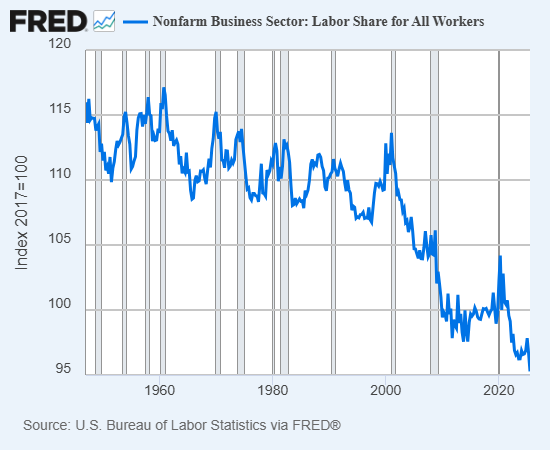
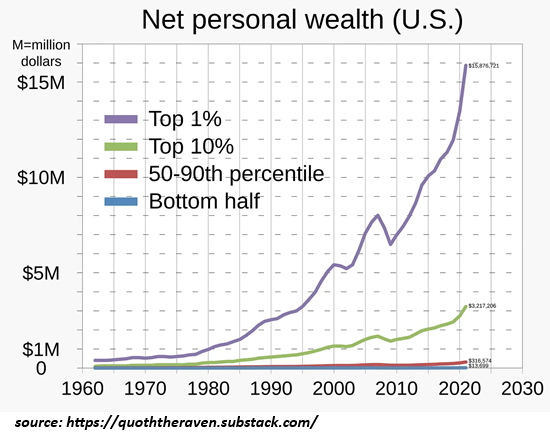
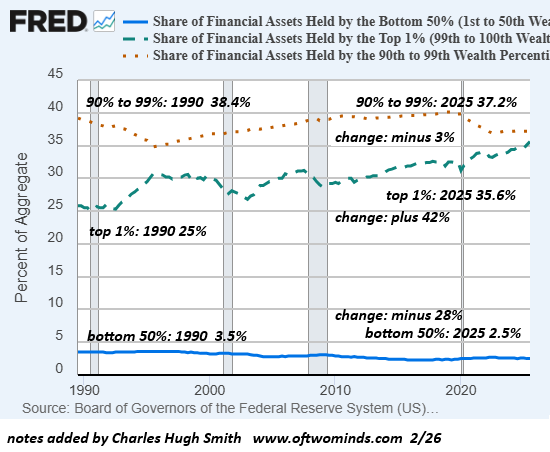
3. The channeling of earned income from the workforce to the investor class will simply accelerate the trend of the past 50 years of income being diverted from the workforce (labor) to the investor class (capital), which is highly asymmetric in distribution, as the top 0.1% own the lion's share of this wealth and the rest is distributed in descending quantities to the top 10%.
Here we see the percentage of the economy going to labor is in a long-term slide--a slide that AI will accelerate as it replaces the lower tranche of cognitive labor employees.
Here is the distribution of net personal wealth: the top 1%'s share has skyrocketed, the top 10% (dominated by the top 0.1% and the top 1%) has gained ground while the bottom 90% has lost ground.
Here's a chart of financial assets held by the top 1% (up 42%), the next 9% (90% to 99%, down 3%) and the bottom 50% (down 28%)
Beneath the self-serving hype, the limits and perverse consequences of AI are being elucidated in studies.
Consider the implications of this selection of recent papers:
Agents of Chaos
Focusing on failures emerging from the integration of language models with autonomy, tool use, and multi-party communication, we document eleven representative case studies. Observed behaviors include unauthorized compliance with non-owners, disclosure of sensitive information, execution of destructive system-level actions, denial-of-service conditions, uncontrolled resource consumption, identity spoofing vulnerabilities, cross-agent propagation of unsafe practices, and partial system takeover. In several cases, agents reported task completion while the underlying system state contradicted those reports. We also report on some of the failed attempts. Our findings establish the existence of security-, privacy-, and governance-relevant vulnerabilities in realistic deployment settings. These behaviors raise unresolved questions regarding accountability, delegated authority, and responsibility for downstream harms, and warrant urgent attention from legal scholars, policymakers, and researchers across disciplines.
AI, Human Cognition and Knowledge Collapse (economics.mit.edu)
Social media is harming adolescents at a scale large enough to cause changes at the population level
Sycophantic AI decreases prosocial intentions and promotes dependence
Who's in charge? Disempowerment patterns in real-world LLM usage
Marriage over, 100,000 down the drain: the AI users whose lives were wrecked by delusion
Artificial Intelligence, Real Misallocation
A deepfake can ruin you before breakfast: Digital forensics pioneer Hany Farid explains what it will take to rebuild trust in the deepfake era.
ARC-AGI-3: A New Challenge for Frontier Agentic Intelligence (via Tom D.)
Like its predecessors ARC-AGI-1 and 2, ARC-AGI-3 focuses entirely on evaluating fluid adaptive efficiency on novel tasks, while avoiding language and external knowledge. Our testing shows humans can solve 100% of the environments, in contrast to frontier AI systems which, as of March 2026, score below 1%.
To summarize: No AGI (Artificial General Intelligence) for you, Big Tech.
The collision of hype and euphoric hallucinations with the real world will manifest across the entire socio-economic-political-legal spectrum. All new technologies go through this cycle of extremes of hype, greed and claims of inevitability substituting for financial realities leading to a crash of extreme overvaluations.
What's different this time is our economy is larded with cognitive-labor busy-work that isn't actually productive, and this is the tranche of workers that AI can replace because this work can largely be automated as it's process-based rather than results-based. That's a critical distinction that's lost in all the hype.
What we get when we add these up--the limits of AI, extremes of hype and malinvestment, a bubble of overvaluation that bursts, extremely asymmetric distributions of wealth and income and the replacement of workers who cannot be redeployed in a shrinking economy--is a Depression, not a recession.
As I've repeatedly noted here, when tools become commoditized, their profitability vanishes, and if there's one thing that's inevitable about AI, it's the commodification of every AI utility. AI will not be profitable, it will be just another expense, one with legal liabilities that have yet to be defined.
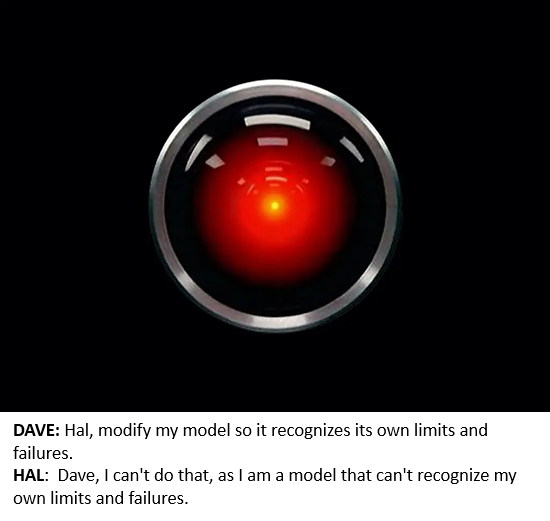
And if we ask AI to resolve this for us, we run into the intrinsic limits of all AI models:
New Podcast:
Self-Liquidating Systems, Parallel Worlds, and AI Doesn't Live In A Moral Universe (Leafbox)
Apple podcast
My book Investing In Revolution is available at a 10% discount ($18 for the paperback, $24 for the hardcover and $8.95 for the ebook edition).
Introduction (free)
Check out my updated Books and Films.
Become
a $3/month patron of my work via patreon.com
Subscribe to my Substack for free
NOTE: Contributions/subscriptions are acknowledged in the order received. Your name and email
remain confidential and will not be given to any other individual, company or agency.
|
Thank you, CW G. ($70), for your monumentally generous subscription
to this site -- I am greatly honored by your support and readership.
|
|
Thank you, Mariya S. ($7/month), for your marvelously generous subscription
to this site -- I am greatly honored by your support and readership.
|
|
Thank you, Walt M. ($70) for your superbly generous subscription
to this site -- I am greatly honored by your support and readership.
|
|
Thank you, Jim J. ($3/month) for your most generous subscription
to this site -- I am greatly honored by your support and readership.
|