Since the forces seeking to decentralize capital and power are distributed among numerous competing interest groups, the forces of centralization have the upper hand.
Today I conclude this week's exploration of narrative control as the core mechanism of social, political and economic control. In Narrative Control Made Easy: Us versus Them, I explained the core dynamic of creating binaries (us or them, all or nothing, "capitalism" or "communism," etc.) that force a false choice, an illusion of choice that directs the populace to grant control to whomever benefits from the false choice.
These mechanisms enable not just classic "divide and conquer"--prying apart populations into warring camps that see each other as the "enemy," enabling easy control of the entire distracted, misdirected populace--but the setting of contexts, agendas and priorities--establishing the limits of what's viewed as possible and positive in ways that benefit those holding centralized power.
So if "Progress" is defined as "what generates the highest profits for us," then the populace comes to believe that extractive monopolies actively degrading our quality of life while raising costs are not just all that is possible but this exploitive arrangement is also the best of all possible worlds, because Progress is inherently positive.
The sheep are delighted to be sheared because this is "progress."
In
Lessons from China's Cultural Revolution, I discussed how targeting a scapegoat segment of the population diverts the pent-up frustrations of expectations dashed away from those controlling the centralized system to an ill-defined set of class enemies, heretics, etc.--the label assigned to the scapegoats depends on the flavor of centralized power: theocracies will choose different labels than democracies-in-name, for example.
Which brings us to the struggle just ahead between the forces centralizing capital and power and those seeking to decentralize capital and power. In the broad sweep of history, we can discern these forces at work as those benefiting from centralizing power use narrative control to justify their consolidation of capital and power and those seeking to escape the tyranny of centralized control offer a competing narrative conducive to localized, more broadly distributed control.
These forces are visible in all forms of governance and power structures, from those based on religious faiths to monarchies to republics.
In the current era, the dominant narrative is Neoliberal Cornucopianism: if we just let the markets, wisely guided by an elite technocrat class, control not just the economy, but society, governance and the narrative, then we'll all enjoy super-abundance as the natural order of things.
In this self-serving narrative, centralizing capital and market power is a good thing because scaling up via centralization lowers costs and makes us all prosperous. This is of a course misdirection, i.e. a lie. When financial-market powers are centralized, the result is monopoly and cartels that then use their market power to degrade quality and quantity, raise prices and only allow products and services that maximize their private gains onto the market.
So we can no longer own software outright, it must be rented via subscription. There are no simplified, mostly analog, easily repairable, small, durable, affordable vehicles on the market because these are inherently unprofitable compared to complex, large, unrepairable, high-cost vehicles.
Since the forces seeking to decentralize capital and power are distributed among numerous competing interest groups, the forces of centralization have the upper hand until the second-order effects of their self-serving control brings the system to its knees. The struggle just ahead is the primary conflict between the forces seeking to further extend over-extended centralization and those seeking to distribute capital and power beyond the tiny self-selected elite that defines "progress" and "prosperity" as whatever increases their concentration of capital and power at the expense of non-elites.
The books of my
Revolution Trilogy describe this struggle in greater depth.
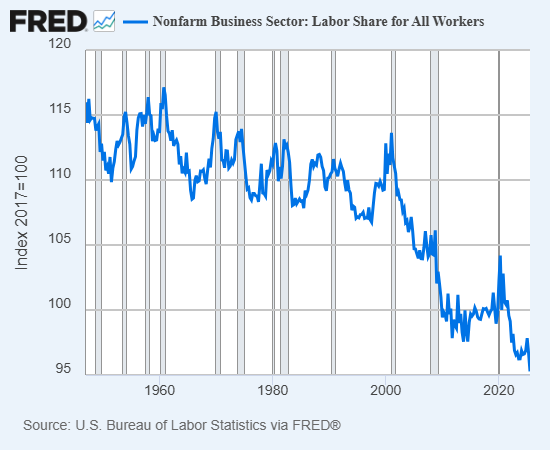
Monopolists are gleefully anticipating the further immiseration of the labor force as the means to increase their share of the economy's capital and gains:
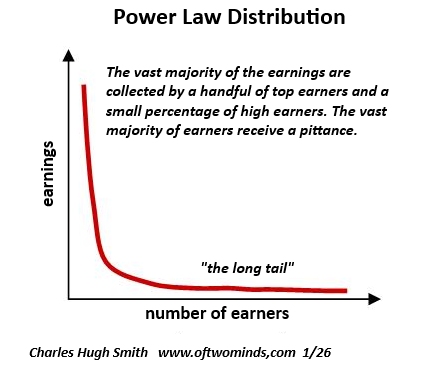
From the perspective of those holding centralized, concentrated power, this power-law distribution is not only ideal, it's the natural order of things:
As for the bottom 90%: when they can no longer afford bread, let them eat brioche.
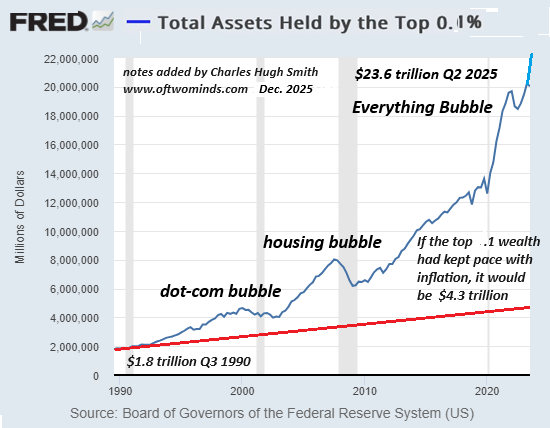
Wealth inequality in America just hit its widest gap in 3 decades: The wealthiest 1% held about $55 trillion in assets in the third quarter of 2025--roughly equal to the wealth held by the bottom 90% of Americans combined.
My new book Investing In Revolution is available at a 10% discount ($18 for the paperback, $24 for the hardcover and $8.95 for the ebook edition).
Introduction (free)
Check out my updated Books and Films.
Become
a $3/month patron of my work via patreon.com
Subscribe to my Substack for free
NOTE: Contributions/subscriptions are acknowledged in the order received. Your name and email
remain confidential and will not be given to any other individual, company or agency.
|
Thank you, Keith B. ($150), for your outrageously generous subscription
to this site -- I am greatly honored by your support and readership.
|
|
Thank you, Ben G. ($70), for your magnificently generous subscription
to this site -- I am greatly honored by your support and readership.
|
|
Thank you, Peter D. ($70) for your superbly generous subscription
to this site -- I am greatly honored by your support and readership.
|
|
Thank you, Dilver M. ($7/month) for your splendidly generous subscription
to this site -- I am greatly honored by your support and readership.
|