The net result of these perverse incentives is an Internet that is increasingly toxic and untrustworthy.
Perverse incentives are funny things. Even though we know they're harming us, we can't stop pursuing them because the refusal harms us, too, as we're excluded from the system.
Perverse incentives have come to dominate our lives, but slowly enough that we now accept this immiseration as "the way it is" / normal / inescapable. Let's start with the Internet, which dominates our lives in two ways: 1) as the infrastructure that enables the entire digital realm we depend on for the majority of our transactions and processes, and 2) the engrenages / gearing of our zeitgeist: how we communicate, gather information, learn and amuse / entertain ourselves.
One advantage of being active in the early days of the Internet is we experienced a completely different World Wide Web than those who have only experienced the current version dominated by perverse incentives.
In its initial incarnation, the Web was not ruled by algorithms extracting wealth by collecting and selling every bit of information from our activity online. To post content, you needed a domain name / DNS and a host for your website. Search engines (Google) tracked incoming and outgoing links between sites, and assigned a page rank based on the number and quality of the incoming links to your site.
Sites with large numbers of incoming links were given high page ranks, as the content was assumed to be valuable enough to attract other sites to link to it. These higher ranked sites were placed at the top of the list of search results.
This simple system was difficult to game. yes, you could set up 100 websites that linked to each other to give the appearance of many incoming links, but each of those links were worthless because they had no incoming links of high quality, i.e. links from sites with numerous incoming links.
Private communication was email, and you could post a comment on public forums / message boards. If your site had a comments section, you curated it yourself.
If you wanted to monetize your website, you could sell space for display adverts that weren't targeted to visitors; every visitor saw the same advert. Or you could sell a product or service, or offer a tip jar for those who wanted to support your content.
Search engines directed users to a ranked list of websites that were deemed most likely to be relevant to the search topic.
There were no platforms that collected visitors' information and sold it, monetized your content and then gave you a negligible slice of the revenues and ranked links by who paid them the most to "sponsor" the link. You kept any money made from adverts, sales or visitor contributions.
Compare this authentic, self-organizing system with the perverse incentives embedded in today's Web.
Since web traffic now flows primarily through a handful of Big Tech social media / search platforms that monetize both users and content creators, the only way to earn any money is to 1) do whatever it takes to goose your posts to go viral, i.e. click-bait that attracts thousands or millions of views, and 2) generate as much content as possible to "win" by quantity, not quality.
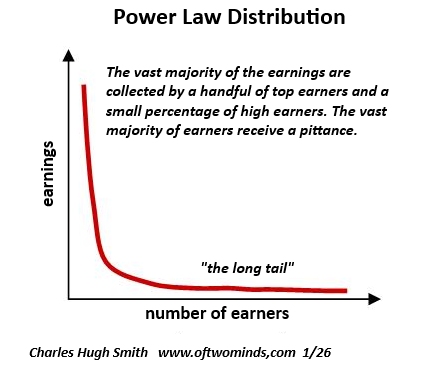
The meager revenue shares offered by Big Tech follow a power-law distribution: the vast majority of the earnings go to a handful of top earners and a small percentage of high earners (which I define as earning a sum that qualifies as a middle-class income) and the vast majority of content creators earn very little.
This distribution is visible on all the tech platforms: the few at the top make millions, a handful make $50,000 to $100,000 and the majority don't make enough to live on.
For example, musicians who manage to get 100,000 listens might make a few hundred dollars, while those who manage to get 3 million listens might make $10,000, unless they have a label, distributor and manager to split the income with, in which case their share might be $6,000 or less: one month of a lower-middle class income.
The Big Tech platforms have reached dominance via 1) the network effect, 2) buying up competitors before they could scale up to become threats, 3) intensifying the addictive draw of their content and "social rewards": clicks, likes, etc. and 4) aggregating all the functions that were once distributed over many sites into one integrated network state: search answers, marketplaces to sell stuff, sponsored ad placement, and so on.
The incentive is to increase profits by any means available, which means anything that hasn't been made illegal.
Since "use" requires "acceptance of community standards," the Big Tech platforms are privatized totalitarian network states which can ban or shadow-ban users without explanation or recourse, collect and sell data with few limits, and modify all this in black-box operations invisible to regulators and users.
Content that isn't posted on the platforms or paid "sponsored content" placement in effect disappears from view: search no longer directs queries to the site and their visibility to average users going only to platforms for content is zero.
The concentration of all search and content streams into a handful of platforms and the power-law distribution of the earnings generates perverse incentives to:
1. Generate as much content as possible (win by quantity not quality) which leads to AI slop becoming the norm, as AI tools tout their capacity to "create videos in minutes." This includes spam, phishing, etc., of course: increase income by sending millions of malicious emails, SMS, and bot-generated activity.
2. Seek to viralize content by making it click-bait (cute animals, heartwarming scenes, accidents averted at the last second, etc.) or extreme, designed to stimulate strong emotional reactions, or "edgy" which is getting more challenging as every outrage has already been commoditized by AI.
3. Attempt to game the platform's algorithms to gain some tiny advantage over the millions making almost nothing from all their content creation.
Content creators desperate to increase their share of the tiny slice distributed to creators are the hamsters spinning the quantity-slop wheels that make the web increasingly deranging as its authentic utility declines, wheels that spin out ever higher profits for the Big tech platforms. From their point of view, this arrangement is ideal for generating ever-expanding revenues and profits.
The net result of these perverse incentives is an Internet that is increasingly toxic and untrustworthy, as deepfakes proliferate, extremes of degradation and abuse are rewarded, and addictive behaviors are incentivized.
Future posts will explore other systemic perverse incentives.
My new book Investing In Revolution is available at a 10% discount ($18 for the paperback, $24 for the hardcover and $8.95 for the ebook edition).
Introduction (free)
Check out my updated Books and Films.
Become
a $3/month patron of my work via patreon.com
Subscribe to my Substack for free
NOTE: Contributions/subscriptions are acknowledged in the order received. Your name and email
remain confidential and will not be given to any other individual, company or agency.
|
Thank you, Camille ($108), for your monumentally generous subscription
to this site -- I am greatly honored by your support and readership.
|
|
Thank you, Rsonnenfeld ($7/month), for your magnificently generous subscription
to this site -- I am greatly honored by your support and readership.
|
|
Thank you, Mark M. ($70) for your superbly generous subscription
to this site -- I am greatly honored by your support and readership.
|
|
Thank you, Evan R. ($32) for your splendidly generous subscription
to this site -- I am greatly honored by your support and readership.
|