Nobody believes that "doing more of what's failed" will actually fail, because to date it's only made insiders rich.
Why Is Everything Such a Hot Mess? Let's summarize the consensus views.
1. Sociopaths are in charge. There are two options: A) the sociopaths gained power through official, legitimate means such as elections or royal bloodlines, or B) the real web of power is hidden from public view and operates behind the screen of official authority.
2. Alternatively, the system itself is sociopathic and so it doesn't matter who's in power, as the system elevates sociopaths to power by its very nature.
Yes, there are sociopaths and yes, there are conspiracies. Every corporate price-fixing scheme is a conspiracy that is consciously organized to benefit the few at the expense of the many and protect the conspirators from any negative consequences.
These are the defining traits of every conspiracy: pull hidden strings of power for private gain (more power, more wealth, etc.) and moat the conspirators from any consequences.
In this view, if we replaced the sociopaths who gained power and exposed the conspirators / hidden web of power to consequences, then we could restore legitimacy, stability and functionality to the system.
The alternate view is: since the system itself is sociopathic, the only way to restore legitimacy, stability and functionality is to change the system from the ground up: change the structure of power, oversight, incentives, the whole ball of wax.
In a conspiracy, those organizing the hidden web of power know it's wrong which is why they must hide it: exposure means ruin because the system still has the capacity to punish fraud, exploitation, abuse of power, etc. When the system itself is illegitimate and dysfunctional, then those rising up the ladder to positions of power don't see it as wrong; it's simply BAU--Business As Usual, the way things work and have always worked.
In this view, perverse incentives have been normalized and are accepted as status quo. So for example, addicting your customers to destructive products and services is an excellent business plan as it maximizes profits while directing the consequences onto the customers, not the corporate leaders who planned and executed the profit-maximizing strategy.
Since fraud and exploitation generate higher profits, any CEO that reverses this strategy will be fired for gross incompetence, as the means to increase profits don't matter, only increasing profits matters.
Maximizing fraud and exploitation maximizes personal enrichment. But in a sociopathic system, this isn't viewed as wrong, it's BAU--Business As Usual, as the system's explicit goal is the maximization of private gains by any means available.
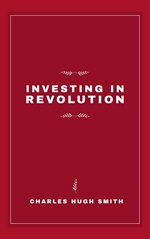
In my book Investing In Revolution, I trace how success and abundance generate sociopathic systems. The process isn't guided by sociopaths, it's human nature amplified by centralized, institutionalized power.
The psychology of what appears to participants as permanent abundance goes like this:
In the initial boost phase of the organization, success is not guaranteed. Success is contingent on the organization fulfilling its real-world purpose: transparent, competent governance, making products of enduring value and functionality, etc.
This requires feedback from the real world that hasn't been filtered, as filtered feedback generates false signals, and responding to false signals leads to failure.
The leadership of the organization understands this and accepts accountability, for the organization won't survive contact with the real world if leaders are not accountable for failures.
Feedback and accountability are transparent out of necessity.
This changes once the organization has institutionalized its success. The perception of those inside the organization changes: the organization is now viewed as so stable and successful that its existence is no longer contingent; it's guaranteed.
Insiders no longer have to concern themselves with feedback and accountability; the focus shifts to maximizing private gains. Since the organization is permanent and rich in resources, revenues and political protection/power, there's no need to invest in maintaining feedback or accountability, as the system basically runs itself via rules that govern the centralized hierarchy.
The organization selects those amenable to hierarchy and obeying rules. Those applying for positions self-select: those who chafe at hierarchy and rules quit.
Over time, this leads to leadership optimized for following rules and protecting the organization from consequences. Those with the capacity to adapt to sudden changes by reworking the entire organization on the fly have been weeded out by either self-selection or the optimization of business as usual, i.e. the artifices of filtering feedback, limiting accountability and defending the organization from negative consequences.
So when the time inevitably comes where radical re-organization is the sole path to survival, there's no organizational memory to tap and nobody in the organization with the ability to manage it. The leadership will simply increase the resources devoted to artifice--bogus statistics, happy-story narratives, fake reforms, and so on.
To serve these now-embedded goals of filtering feedback, limiting accountability and defending the organization from negative consequences, insiders modify the organization's rules of the game incrementally, eroding the authenticity of feedback and loosening accountability, as these modifications increase private gain and reduce exposure to consequences.
Once exposure to consequences has been eliminated, accountability is lost and the system loses the capacity to self-correct: feedback is edited/curated to maintain the appearance that the organization is fulfilling of its purpose admirably and the leadership is fully accountable, i.e. the leaders will experience negative consequences for the organization failing to fulfill its purpose.
This dismantling of feedback, accountability and consequence isn't a conspiracy or a takeover by sociopaths; it's all being done by perfectly average people who take their kids to soccer practice, etc., just like everyone else.
They don't see the erosion because it started long before they grasped the first rung in the ladder to authority. They're blind to the erosion of real feedback and accountability, and so they're blind to this erosion leading to the organization's failure to fulfill its purpose.
Since the organization rewards optimizing the tools of artifice--filtering feedback and moating the leadership from consequence--that's how to they use their power: increase the artifice because restoring authentic feedback and accountability threatens not just their personal self-enrichment but the legitimacy and stability of the entire organization.
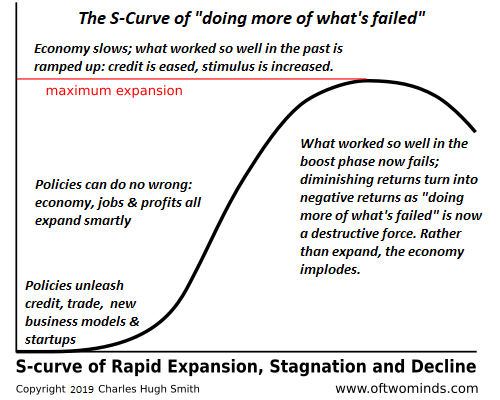
So they vigorously pursue doing more of what's failed until the consequences of the corrupted feedback and loss of accountability lead to Model Collapse: the entire model that generates the rules that guide the organization collapses in a heap.
That's how everything became such a hot mess. Nobody believes that doing more of what's failed will actually fail, because to date it's only made insiders rich.
Ultimately, this leads to a stark choice nobody accepts as inevitable: invest in Business As Usual or Invest In Revolution. Doing more of what's failed doesn't generate success, it simply accelerates the collision with consequences. But nobody inside the organization believes this, as doing more of what's failed has been wildly successful for their entire career.
It didn't have to be this way. Of course it did. The causal chain leaves no other option.
My new book Investing In Revolution is available at a 10% discount ($18 for the paperback, $24 for the hardcover and $8.95 for the ebook edition).
Introduction (free)
Check out my updated Books and Films.
Become
a $3/month patron of my work via patreon.com
Subscribe to my Substack for free
NOTE: Contributions/subscriptions are acknowledged in the order received. Your name and email
remain confidential and will not be given to any other individual, company or agency.
|
Thank you, Guy T. ($100), for your monumentally generous subscription
to this site -- I am greatly honored by your support and readership.
|
|
Thank you, James W. ($50), for your magnificently generous subscription
to this site -- I am greatly honored by your support and readership.
|
|
Thank you, John D. ($70) for your superbly generous subscription
to this site -- I am greatly honored by your support and readership.
|
|
Thank you, Debby ($70) for your splendidly generous subscription
to this site -- I am greatly honored by your support and readership.
|