Friday, January 23, 2026

The Epic Struggle Just Ahead

Since the forces seeking to decentralize capital and power are distributed among numerous competing interest groups, the forces of centralization have the upper hand.

Today I conclude this week's exploration of narrative control as the core mechanism of social, political and economic control. In Narrative Control Made Easy: Us versus Them, I explained the core dynamic of creating binaries (us or them, all or nothing, "capitalism" or "communism," etc.) that force a false choice, an illusion of choice that directs the populace to grant control to whomever benefits from the false choice.

These mechanisms enable not just classic "divide and conquer"--prying apart populations into warring camps that see each other as the "enemy," enabling easy control of the entire distracted, misdirected populace--but the setting of contexts, agendas and priorities--establishing the limits of what's viewed as possible and positive in ways that benefit those holding centralized power.

So if "Progress" is defined as "what generates the highest profits for us," then the populace comes to believe that extractive monopolies actively degrading our quality of life while raising costs are not just all that is possible but this exploitive arrangement is also the best of all possible worlds, because Progress is inherently positive.

The sheep are delighted to be sheared because this is "progress."

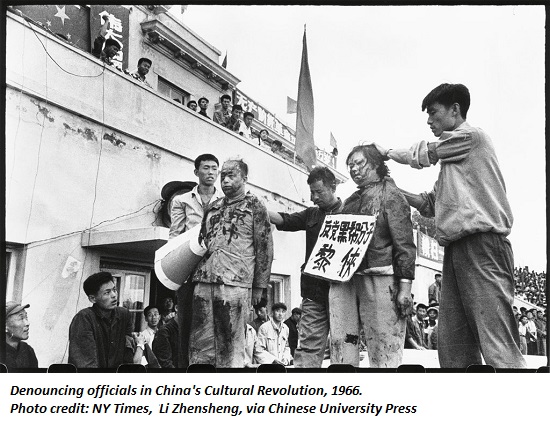
In Lessons from China's Cultural Revolution, I discussed how targeting a scapegoat segment of the population diverts the pent-up frustrations of expectations dashed away from those controlling the centralized system to an ill-defined set of class enemies, heretics, etc.--the label assigned to the scapegoats depends on the flavor of centralized power: theocracies will choose different labels than democracies-in-name, for example.

Which brings us to the struggle just ahead between the forces centralizing capital and power and those seeking to decentralize capital and power. In the broad sweep of history, we can discern these forces at work as those benefiting from centralizing power use narrative control to justify their consolidation of capital and power and those seeking to escape the tyranny of centralized control offer a competing narrative conducive to localized, more broadly distributed control.

These forces are visible in all forms of governance and power structures, from those based on religious faiths to monarchies to republics.

In the current era, the dominant narrative is Neoliberal Cornucopianism: if we just let the markets, wisely guided by an elite technocrat class, control not just the economy, but society, governance and the narrative, then we'll all enjoy super-abundance as the natural order of things.

In this self-serving narrative, centralizing capital and market power is a good thing because scaling up via centralization lowers costs and makes us all prosperous. This is of a course misdirection, i.e. a lie. When financial-market powers are centralized, the result is monopoly and cartels that then use their market power to degrade quality and quantity, raise prices and only allow products and services that maximize their private gains onto the market.

So we can no longer own software outright, it must be rented via subscription. There are no simplified, mostly analog, easily repairable, small, durable, affordable vehicles on the market because these are inherently unprofitable compared to complex, large, unrepairable, high-cost vehicles.

Since the forces seeking to decentralize capital and power are distributed among numerous competing interest groups, the forces of centralization have the upper hand until the second-order effects of their self-serving control brings the system to its knees. The struggle just ahead is the primary conflict between the forces seeking to further extend over-extended centralization and those seeking to distribute capital and power beyond the tiny self-selected elite that defines "progress" and "prosperity" as whatever increases their concentration of capital and power at the expense of non-elites.

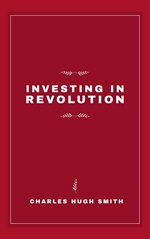
The books of my Revolution Trilogy describe this struggle in greater depth.

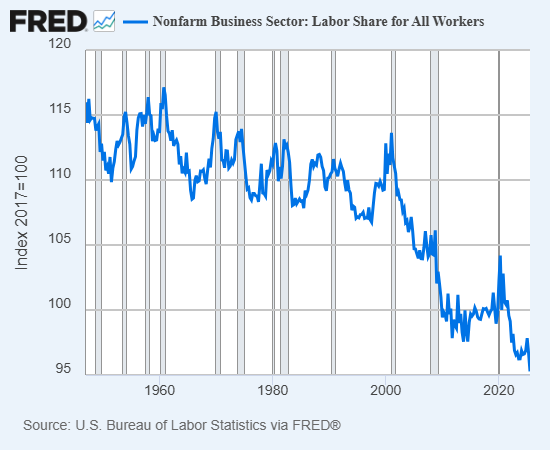
Monopolists are gleefully anticipating the further immiseration of the labor force as the means to increase their share of the economy's capital and gains:


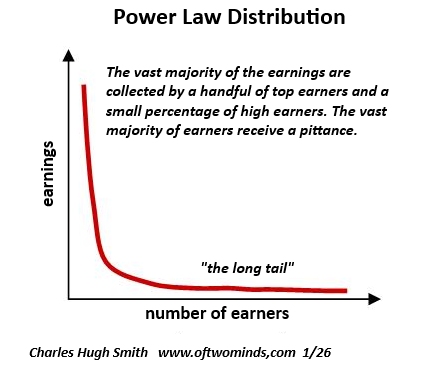
From the perspective of those holding centralized, concentrated power, this power-law distribution is not only ideal, it's the natural order of things:


As for the bottom 90%: when they can no longer afford bread, let them eat brioche.


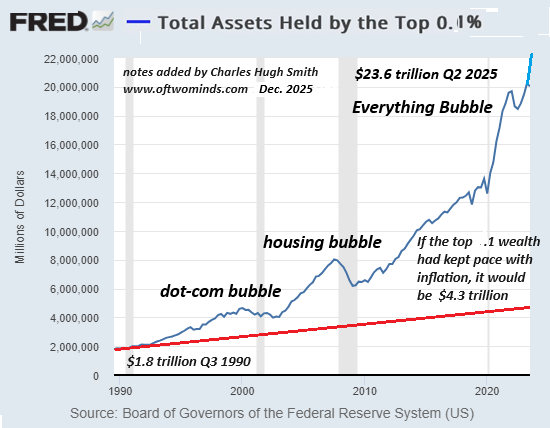
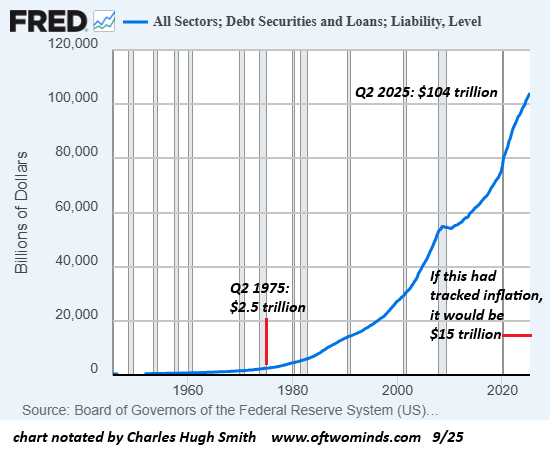
Wealth inequality in America just hit its widest gap in 3 decades: The wealthiest 1% held about $55 trillion in assets in the third quarter of 2025--roughly equal to the wealth held by the bottom 90% of Americans combined.


My new book Investing In Revolution is available at a 10% discount ($18 for the paperback, $24 for the hardcover and $8.95 for the ebook edition). Introduction (free)


Check out my updated Books and Films.

Become a $3/month patron of my work via patreon.com

Subscribe to my Substack for free


NOTE: Contributions/subscriptions are acknowledged in the order received. Your name and email remain confidential and will not be given to any other individual, company or agency.

Thank you, Keith B. ($150), for your outrageously generous subscription to this site -- I am greatly honored by your support and readership.


Thank you, Ben G. ($70), for your magnificently generous subscription to this site -- I am greatly honored by your support and readership.


Thank you, Peter D. ($70) for your superbly generous subscription to this site -- I am greatly honored by your support and readership.


Thank you, Dilver M. ($7/month) for your splendidly generous subscription to this site -- I am greatly honored by your support and readership.

Read more...

Wednesday, January 21, 2026

Lessons from China's Cultural Revolution

Just as nobody foresaw the Cultural Revolution, few if any foresee the emergence of the American equivalent.

China's Cultural Revolution (1966-1976) is interesting on multiple levels. The conventional narrative holds that it was the result of a power struggle between Mao and competing elements in the Chinese Communist Party (CCP), as Mao launched a chaotic cleansing of the Party's leadership that soon devolved into widespread disorder that consumed much and yielded little of lasting value.

My understanding of the Cultural Revolution comes not just from academic studies but from first-hand accounts from friends who lived through it. There are two stipulations in this account:

1. The Cultural Revolution remains politically sensitive, as it was clearly a catastrophe for China that reflects poorly on various sacrosanct figures and institutions. Discussions of what happened are not welcomed, and so even when those who lived through it are in the safety of their own home in the US, they tend to speak in hushed tones, for the topic is verboten.

2. As a general rule, Asian cultures do not relish badmouthing their nation or culture. Westerners will not be offered honest accounts unless they are longtime friends who have demonstrated their trustworthiness over many years. So "friends" who are actually only acquaintances are not going to speak openly.

The travails of senior officials are well-known. A recent book documents the experiences of Xi Jinping's father, a high-ranking CCP official who--along with his son--suffered greatly in the Cultural revolution: The Party's Interests Come First: The Life of Xi Zhongxun, Father of Xi Jinping details the difficulties faced by loyalists in surviving Mao's mercurial purges and precipitous humiliations of senior officials.

It doesn't take much armchair psychoanalyzing to discern the enormous impact the Cultural Revolution had on Xi Jinping's worldview, mindset, goals and priorities.

Equally obvious is how events quickly spiraled out of control, reaching extremes far beyond what was initially anticipated. The public's passive compliance to authority and narrative control was taken to be permanent. Passive compliance appears permanent but it is always contingent.

Firsthand accounts of regular people have typically received a lower profile. One friend's father was an officer in the People's Liberation Army (PLA) which we might have presumed was immune to the chaos. But PLA officers were demoted, put under house arrest and humiliated, while many of those associated with someone deemed an enemy of the people were sent down to the countryside even if they were innocent of wrongdoing.

Another friend's father was put under house arrest for years for the "crime" of having traveled to Soviet Bloc countries as an acrobat in a performing troupe.

In other words, the Cultural Revolution opened the door to denouncing, humiliating, torturing and even killing not actual "class enemies," but loyal Party members who were "guilty" of nothing more than performing their assigned duties. The Cultural Revolution gave permission to pursue personal vendettas and exact retribution on an unimaginably vast scale.

A friend born in 1967 at the height of the initial tumult was named "Love Mao" as a means of fitting in and inoculating the family from the sort of baseless denunciations that were not just permitted but encouraged as "revolutionary activity."

What few if any commentators mention is the unrecognized pent-up frustrations with a system that was launched with such promise and delivered less than what was promised. "Let a hundred flowers blossom, let a hundred schools of thought contend" turned into The Great Leap Forward, a disastrous policy that led to famine.

The unstated context of the Cultural Revolution was poverty. Another friend described how scarce and precious eggs were: her parents carefully divided the occasional egg into four pieces, one for each family member.

People did not have to be coerced to join the Red Guard's rampages; they relished the opportunity to be free of any cultural or political constraints. It's tempting to dismiss this as just another example of the madness of crowds, but this ignores the underlying dynamic of expectations not being met and the consequences of repression and never-ending power struggles and purges.

The first lesson of the Cultural Revolution is that if redress is unavailable, then retribution will become the default pathway. I discuss these dynamics in my new book Investing In Revolution in the context of their inevitability in the current era.

The second lesson of the Cultural Revolution is that allowing--much less encouraging--the unleashing of frustrations with the system on ill-defined "enemies of the people" who are innocent quickly spirals out of control. In the Cultural Revolution, the targets quickly expanded from those in authority positions in the Party to anyone deemed suspicious for any number of reasons: being educated, having traveled to other countries, being the offspring of the landlord class, being the offspring of a purged official (like Xi Jinping being abused because his father had fallen from grace), or simply being an object of envy.

This expanding circle soon included cultural relics of the past, and so irreplaceable Buddhist temples and other priceless artifacts were destroyed out of "revolutionary fervor."

The third lesson of the Cultural Revolution is that once these forces are released, it is impossible to put them back in the bottle. Those in power reckon that unleashing a flood tide of resentments and frustrations with the system on a selected group of scapegoats relieves the potential risk of the public revolting against the regime.

But this ignores the potential for the injustice and chaos to destabilize the regime, for the injustice and destruction don't just affect the scapegoats; they undermine the social, economic and political orders, too.


Just as nobody foresaw the Cultural Revolution, few if any foresee the emergence of the American equivalent. The consequences of expectations not being met build up despite repression and narrative control, and when the containment finally bursts, the dynamics are nonlinear--chaotic, unpredictable, uncontrollable.

Everything is forever until something unexpected breaks.


My new book Investing In Revolution is available at a 10% discount ($18 for the paperback, $24 for the hardcover and $8.95 for the ebook edition). Introduction (free)


Check out my updated Books and Films.

Become a $3/month patron of my work via patreon.com

Subscribe to my Substack for free


NOTE: Contributions/subscriptions are acknowledged in the order received. Your name and email remain confidential and will not be given to any other individual, company or agency.

Thank you, Richard H. ($70), for your monumentally generous subscription to this site -- I am greatly honored by your support and readership.


Thank you, NoHo ($70), for your magnificently generous subscription to this site -- I am greatly honored by your support and readership.


Thank you, Craig W. ($70) for your superbly generous subscription to this site -- I am greatly honored by your support and readership.


Thank you, JS ($7/month) for your splendidly generous subscription to this site -- I am greatly honored by your support and readership.

Read more...

Monday, January 19, 2026

Narrative Control Made Easy: Us versus Them

Those in charge of narrative control are suffering from the delusion that they're making sense. Everything is under control until it isn't.

The name of the game in controlling the populace is narrative control, the current term for setting the context, priorities and agenda so the populace complies without being aware they've been bamboozled into accepting a system that benefits the few at the expense of the many.

The easiest way to control the narrative is to establish the false choice of an either-or binary: Us versus Them. This is easy because it bypasses our rational mind by tapping our hard-wired instinct to divide humanity into members of our group and Outsiders / Strangers who are potential threats until proven otherwise.

As a general rule, our values, opinions and fealties stretch along a spectrum. We may have loyalties to values that are typically categorized as "conservative" or "liberal" and find no conflict between them.

To control the narrative, all nuance and variability must be crushed into an all-or-nothing litmus test: if you disagree with even one of the narrowly defined litmus test standards for inclusion in the "conservative" or "liberal" group--as defined by those seeking to control the populace by controlling the narrative--then you are cast out as "an X in name only."

The "other group" is vilified as servants of the Devil. Reading the diatribes mailed out to "loyalists" of the two political parties (seeking donations, of course--proving your loyalty is always about money) is a master class in parody that isn't recognized as parody: "they" are seeking to pollute our precious bodily fluids under the malefic cover of deceptively attractive PR.

That all Us and Them binaries are false choices must never be exposed lest the rational mind awaken to the manipulation of a completely fabricated either-or narrative. This fabrication is the foundation of wartime propaganda, of course, as there are no limits on what must be done to rid the Earth of the enemy of all that is good and just.

This works just as well in politics and culture wars: rally the troops by enforcing litmus-test inclusion standards that serve the purposes of those in charge of the narrative factory while providing an identity and the benefits of membership to those who declare their fealty to the litmus test checklist.

Skeptics are targeted as backward heretics. If you question the current definition of "Progress"--Progress is whatever makes me more money--then you're instantly tarred as a hopeless Luddite.

Once the consequences extend to money, income and security, fear kicks in. Standing up for sacred values is a good thing until it might cost us our jobs: when things get serious, we have to lie.

This enforcement of false-choice narratives pushes us into Ultra-Processed Life: everything is self-serving artifice, but pointing this out brings trouble, so we go along with the charade. There's no meaning in the narrative other than enforcing compliance to what's on the agenda of options, which are all false-choice binaries: would you choose to be a Good Person or a Bad Person? Hmm, that's not much of a choice, is it?

The irony here is that those controlling the narratives see our compliance as "winning," unaware that their control mechanisms have hollowed out the culture, politics and the economy, reducing everything to either-or binaries that are intrinsically false.


Falsities generate false signals, which lead to Model Collapse. Those in charge of narrative control are suffering from the delusion that they're making sense. Everything is under control until it isn't.


My new book Investing In Revolution is available at a 10% discount ($18 for the paperback, $24 for the hardcover and $8.95 for the ebook edition). Introduction (free)


Check out my updated Books and Films.

Become a $3/month patron of my work via patreon.com

Subscribe to my Substack for free


NOTE: Contributions/subscriptions are acknowledged in the order received. Your name and email remain confidential and will not be given to any other individual, company or agency.

Thank you, Glen ($70), for your monumentally generous subscription to this site -- I am greatly honored by your support and readership.


Thank you, Jane O. ($70), for your magnificently generous subscription to this site -- I am greatly honored by your support and readership.


Thank you, SDFlash2006 ($70) for your superbly generous subscription to this site -- I am greatly honored by your support and readership.


Thank you, Bear ($7/month) for your splendidly generous subscription to this site -- I am greatly honored by your support and readership.

Read more...

Monday, January 12, 2026

Why Is Everything Such a Hot Mess?

Nobody believes that "doing more of what's failed" will actually fail, because to date it's only made insiders rich.

Why Is Everything Such a Hot Mess? Let's summarize the consensus views.

1. Sociopaths are in charge. There are two options: A) the sociopaths gained power through official, legitimate means such as elections or royal bloodlines, or B) the real web of power is hidden from public view and operates behind the screen of official authority.

2. Alternatively, the system itself is sociopathic and so it doesn't matter who's in power, as the system elevates sociopaths to power by its very nature.

Yes, there are sociopaths and yes, there are conspiracies. Every corporate price-fixing scheme is a conspiracy that is consciously organized to benefit the few at the expense of the many and protect the conspirators from any negative consequences.

These are the defining traits of every conspiracy: pull hidden strings of power for private gain (more power, more wealth, etc.) and moat the conspirators from any consequences.

In this view, if we replaced the sociopaths who gained power and exposed the conspirators / hidden web of power to consequences, then we could restore legitimacy, stability and functionality to the system.

The alternate view is: since the system itself is sociopathic, the only way to restore legitimacy, stability and functionality is to change the system from the ground up: change the structure of power, oversight, incentives, the whole ball of wax.

In a conspiracy, those organizing the hidden web of power know it's wrong which is why they must hide it: exposure means ruin because the system still has the capacity to punish fraud, exploitation, abuse of power, etc. When the system itself is illegitimate and dysfunctional, then those rising up the ladder to positions of power don't see it as wrong; it's simply BAU--Business As Usual, the way things work and have always worked.

In this view, perverse incentives have been normalized and are accepted as status quo. So for example, addicting your customers to destructive products and services is an excellent business plan as it maximizes profits while directing the consequences onto the customers, not the corporate leaders who planned and executed the profit-maximizing strategy.

Since fraud and exploitation generate higher profits, any CEO that reverses this strategy will be fired for gross incompetence, as the means to increase profits don't matter, only increasing profits matters.

Maximizing fraud and exploitation maximizes personal enrichment. But in a sociopathic system, this isn't viewed as wrong, it's BAU--Business As Usual, as the system's explicit goal is the maximization of private gains by any means available.

In my book Investing In Revolution, I trace how success and abundance generate sociopathic systems. The process isn't guided by sociopaths, it's human nature amplified by centralized, institutionalized power.

The psychology of what appears to participants as permanent abundance goes like this:

In the initial boost phase of the organization, success is not guaranteed. Success is contingent on the organization fulfilling its real-world purpose: transparent, competent governance, making products of enduring value and functionality, etc.

This requires feedback from the real world that hasn't been filtered, as filtered feedback generates false signals, and responding to false signals leads to failure.

The leadership of the organization understands this and accepts accountability, for the organization won't survive contact with the real world if leaders are not accountable for failures.

Feedback and accountability are transparent out of necessity.

This changes once the organization has institutionalized its success. The perception of those inside the organization changes: the organization is now viewed as so stable and successful that its existence is no longer contingent; it's guaranteed.

Insiders no longer have to concern themselves with feedback and accountability; the focus shifts to maximizing private gains. Since the organization is permanent and rich in resources, revenues and political protection/power, there's no need to invest in maintaining feedback or accountability, as the system basically runs itself via rules that govern the centralized hierarchy.

The organization selects those amenable to hierarchy and obeying rules. Those applying for positions self-select: those who chafe at hierarchy and rules quit.

Over time, this leads to leadership optimized for following rules and protecting the organization from consequences. Those with the capacity to adapt to sudden changes by reworking the entire organization on the fly have been weeded out by either self-selection or the optimization of business as usual, i.e. the artifices of filtering feedback, limiting accountability and defending the organization from negative consequences.

So when the time inevitably comes where radical re-organization is the sole path to survival, there's no organizational memory to tap and nobody in the organization with the ability to manage it. The leadership will simply increase the resources devoted to artifice--bogus statistics, happy-story narratives, fake reforms, and so on.

To serve these now-embedded goals of filtering feedback, limiting accountability and defending the organization from negative consequences, insiders modify the organization's rules of the game incrementally, eroding the authenticity of feedback and loosening accountability, as these modifications increase private gain and reduce exposure to consequences.

Once exposure to consequences has been eliminated, accountability is lost and the system loses the capacity to self-correct: feedback is edited/curated to maintain the appearance that the organization is fulfilling of its purpose admirably and the leadership is fully accountable, i.e. the leaders will experience negative consequences for the organization failing to fulfill its purpose.

This dismantling of feedback, accountability and consequence isn't a conspiracy or a takeover by sociopaths; it's all being done by perfectly average people who take their kids to soccer practice, etc., just like everyone else.

They don't see the erosion because it started long before they grasped the first rung in the ladder to authority. They're blind to the erosion of real feedback and accountability, and so they're blind to this erosion leading to the organization's failure to fulfill its purpose.

Since the organization rewards optimizing the tools of artifice--filtering feedback and moating the leadership from consequence--that's how to they use their power: increase the artifice because restoring authentic feedback and accountability threatens not just their personal self-enrichment but the legitimacy and stability of the entire organization.

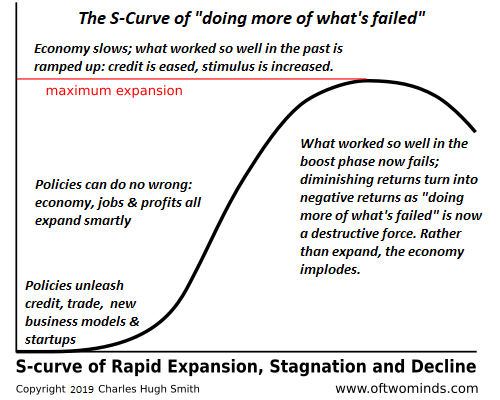
So they vigorously pursue doing more of what's failed until the consequences of the corrupted feedback and loss of accountability lead to Model Collapse: the entire model that generates the rules that guide the organization collapses in a heap.

That's how everything became such a hot mess. Nobody believes that doing more of what's failed will actually fail, because to date it's only made insiders rich.

Ultimately, this leads to a stark choice nobody accepts as inevitable: invest in Business As Usual or Invest In Revolution. Doing more of what's failed doesn't generate success, it simply accelerates the collision with consequences. But nobody inside the organization believes this, as doing more of what's failed has been wildly successful for their entire career.


It didn't have to be this way. Of course it did. The causal chain leaves no other option.


My new book Investing In Revolution is available at a 10% discount ($18 for the paperback, $24 for the hardcover and $8.95 for the ebook edition). Introduction (free)


Check out my updated Books and Films.

Become a $3/month patron of my work via patreon.com

Subscribe to my Substack for free


NOTE: Contributions/subscriptions are acknowledged in the order received. Your name and email remain confidential and will not be given to any other individual, company or agency.

Thank you, Guy T. ($100), for your monumentally generous subscription to this site -- I am greatly honored by your support and readership.


Thank you, James W. ($50), for your magnificently generous subscription to this site -- I am greatly honored by your support and readership.


Thank you, John D. ($70) for your superbly generous subscription to this site -- I am greatly honored by your support and readership.


Thank you, Debby ($70) for your splendidly generous subscription to this site -- I am greatly honored by your support and readership.

Read more...
Thursday, January 08, 2026

The Perverse Incentives Dominating Our Lives

The net result of these perverse incentives is an Internet that is increasingly toxic and untrustworthy.

Perverse incentives are funny things. Even though we know they're harming us, we can't stop pursuing them because the refusal harms us, too, as we're excluded from the system.

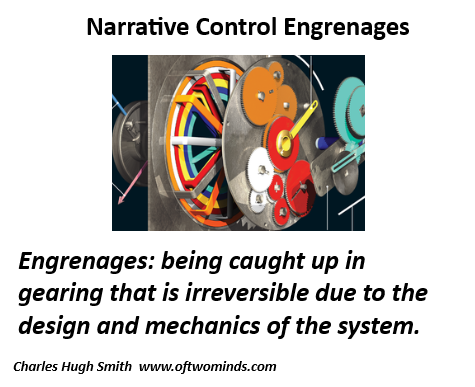
Perverse incentives have come to dominate our lives, but slowly enough that we now accept this immiseration as "the way it is" / normal / inescapable. Let's start with the Internet, which dominates our lives in two ways: 1) as the infrastructure that enables the entire digital realm we depend on for the majority of our transactions and processes, and 2) the engrenages / gearing of our zeitgeist: how we communicate, gather information, learn and amuse / entertain ourselves.

One advantage of being active in the early days of the Internet is we experienced a completely different World Wide Web than those who have only experienced the current version dominated by perverse incentives.

In its initial incarnation, the Web was not ruled by algorithms extracting wealth by collecting and selling every bit of information from our activity online. To post content, you needed a domain name / DNS and a host for your website. Search engines (Google) tracked incoming and outgoing links between sites, and assigned a page rank based on the number and quality of the incoming links to your site.

Sites with large numbers of incoming links were given high page ranks, as the content was assumed to be valuable enough to attract other sites to link to it. These higher ranked sites were placed at the top of the list of search results.

This simple system was difficult to game. yes, you could set up 100 websites that linked to each other to give the appearance of many incoming links, but each of those links were worthless because they had no incoming links of high quality, i.e. links from sites with numerous incoming links.

Private communication was email, and you could post a comment on public forums / message boards. If your site had a comments section, you curated it yourself.

If you wanted to monetize your website, you could sell space for display adverts that weren't targeted to visitors; every visitor saw the same advert. Or you could sell a product or service, or offer a tip jar for those who wanted to support your content.

Search engines directed users to a ranked list of websites that were deemed most likely to be relevant to the search topic.

There were no platforms that collected visitors' information and sold it, monetized your content and then gave you a negligible slice of the revenues and ranked links by who paid them the most to "sponsor" the link. You kept any money made from adverts, sales or visitor contributions.

Compare this authentic, self-organizing system with the perverse incentives embedded in today's Web. Since web traffic now flows primarily through a handful of Big Tech social media / search platforms that monetize both users and content creators, the only way to earn any money is to 1) do whatever it takes to goose your posts to go viral, i.e. click-bait that attracts thousands or millions of views, and 2) generate as much content as possible to "win" by quantity, not quality.

The meager revenue shares offered by Big Tech follow a power-law distribution: the vast majority of the earnings go to a handful of top earners and a small percentage of high earners (which I define as earning a sum that qualifies as a middle-class income) and the vast majority of content creators earn very little.

This distribution is visible on all the tech platforms: the few at the top make millions, a handful make $50,000 to $100,000 and the majority don't make enough to live on.

For example, musicians who manage to get 100,000 listens might make a few hundred dollars, while those who manage to get 3 million listens might make $10,000, unless they have a label, distributor and manager to split the income with, in which case their share might be $6,000 or less: one month of a lower-middle class income.


The Big Tech platforms have reached dominance via 1) the network effect, 2) buying up competitors before they could scale up to become threats, 3) intensifying the addictive draw of their content and "social rewards": clicks, likes, etc. and 4) aggregating all the functions that were once distributed over many sites into one integrated network state: search answers, marketplaces to sell stuff, sponsored ad placement, and so on.

The incentive is to increase profits by any means available, which means anything that hasn't been made illegal.

Since "use" requires "acceptance of community standards," the Big Tech platforms are privatized totalitarian network states which can ban or shadow-ban users without explanation or recourse, collect and sell data with few limits, and modify all this in black-box operations invisible to regulators and users.

Content that isn't posted on the platforms or paid "sponsored content" placement in effect disappears from view: search no longer directs queries to the site and their visibility to average users going only to platforms for content is zero.

The concentration of all search and content streams into a handful of platforms and the power-law distribution of the earnings generates perverse incentives to:

1. Generate as much content as possible (win by quantity not quality) which leads to AI slop becoming the norm, as AI tools tout their capacity to "create videos in minutes." This includes spam, phishing, etc., of course: increase income by sending millions of malicious emails, SMS, and bot-generated activity.

2. Seek to viralize content by making it click-bait (cute animals, heartwarming scenes, accidents averted at the last second, etc.) or extreme, designed to stimulate strong emotional reactions, or "edgy" which is getting more challenging as every outrage has already been commoditized by AI.

3. Attempt to game the platform's algorithms to gain some tiny advantage over the millions making almost nothing from all their content creation.

Content creators desperate to increase their share of the tiny slice distributed to creators are the hamsters spinning the quantity-slop wheels that make the web increasingly deranging as its authentic utility declines, wheels that spin out ever higher profits for the Big tech platforms. From their point of view, this arrangement is ideal for generating ever-expanding revenues and profits.

The net result of these perverse incentives is an Internet that is increasingly toxic and untrustworthy, as deepfakes proliferate, extremes of degradation and abuse are rewarded, and addictive behaviors are incentivized.

Future posts will explore other systemic perverse incentives.


My new book Investing In Revolution is available at a 10% discount ($18 for the paperback, $24 for the hardcover and $8.95 for the ebook edition). Introduction (free)


Check out my updated Books and Films.

Become a $3/month patron of my work via patreon.com

Subscribe to my Substack for free


NOTE: Contributions/subscriptions are acknowledged in the order received. Your name and email remain confidential and will not be given to any other individual, company or agency.

Thank you, Camille ($108), for your monumentally generous subscription to this site -- I am greatly honored by your support and readership.


Thank you, Rsonnenfeld ($7/month), for your magnificently generous subscription to this site -- I am greatly honored by your support and readership.


Thank you, Mark M. ($70) for your superbly generous subscription to this site -- I am greatly honored by your support and readership.


Thank you, Evan R. ($32) for your splendidly generous subscription to this site -- I am greatly honored by your support and readership.

Read more...

Tuesday, January 06, 2026

We Can Discern Cycles and Waves, But Not the Outcomes

Which brings us to the present and the cycles and waves that have yet to reach the concluding third act, where the dramatic climax leads to resolution.

We can discern cycles and waves in the past and posit them in the present, but not the outcomes. A great many phenomena follow cyclical patterns, from sunspots to Peter Turchin's 50-year cycle of human history, while others form waves.

Author David Hackett Fischer (The Great Wave: Price Revolutions and the Rhythm of History) described the difference between cycles and waves:

"Cyclical rhythms are fixed and regular. Their periods are highly predictable. Great waves are more variable and less predictable. They differ in duration, magnitude, velocity, and momentum. One great price wave lasted less than ninety years; another continued more than 180 years. The irregularities in individual price movements make them no more (or less) predictable than individual waves in the sea.

Even so, all great waves had important qualities in common. They all shared the same wave-structure. They tended to have the same sequence of development, the same pattern of price relatives, similar movements of wages, rent, interest rates; and the same dangerous volatility in later stages. All major price revolutions in modern history began in periods of prosperity. Each ended in shattering world crises and was followed by periods of recovery and comparative equilibrium."


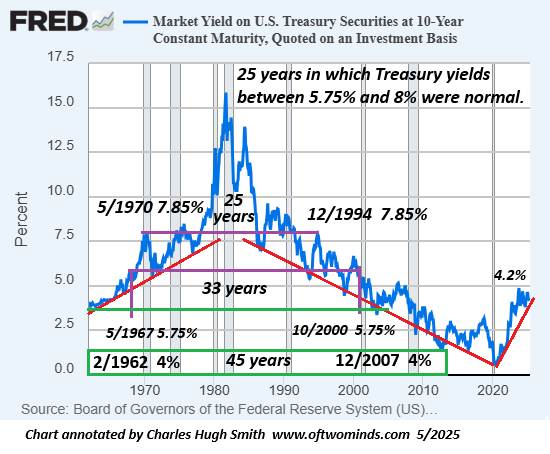
Examples of waves range from rogue waves in the sea to bond yields / interest rates which arise and decline over periods of time that vary too much to qualify as cycles but match the dynamics of waves described by Fischer. Bond yields have gone from peaks to troughs in less than 20 years to the recent span of about 40 years--at the outer duration boundary of previous interest rate/yield waves.


In other words, the cycles described by historian Peter Turchin (50 year cycles that can generate 100-year, 150-year and 200-year cycles), along with many other cycles--the business cycle, the Kondratieff credit cycle, the Debt Super-Cycle, etc.--are defined not solely by time but by their internal dynamics and measurable qualities. Waves and cycles share many of the same dynamics and are easily confused.

As Fischer observed, waves of human history share characteristics with ocean waves, which can accrete energy and become giant rogue waves that cannot be predicted even as they can be foreseen as recurring phenomena.

I posted a list of dynamics currently accreting in self-reinforcing feedback loops last January:

Catch-20: The 20 Dynamics That Will Shape the Next Decade (1/15/25).

Both waves and cycles tend to follow the dynamics of S-curves in which a trend takes off in a boost phase, matures into a peak and then decays or reverses.


What cannot be discerned are the consequences and outcomes. An economic cycle or wave might culminate in an excess-clearing recession that sets the stage for an ultimately positive rebalancing of risk and debt, or the outcome might be an excess-clearing Depression that lays waste to the entire status quo.

Two cycles have attracted much commentary over the past decade: The Fourth Turning posited by William Strauss and Neil Howe in their 1997 book The Fourth Turning: An American Prophecy (subtitled What the Cycles of History Tell Us About America's Next Rendezvous with Destiny) which laid out an 80-year cycle of four generational turnings (High, Awakening, Unraveling, Crisis) that culminate in a system-changing Fourth Turning.

This 80-year cycle aligns with the nation-changing crises of 1781 (the end of the Revolutionary War and the founding of the United States), 1861 (the start of the Civil War) and 1941 (America's entry into an existential global conflict, World War II). This cycle suggests a nation-changing crisis began around 2021.

Strauss and Howe took pains to note that the outcome of each crisis isn't pre-ordained to be positive. Complacency based on the idea that it will all turn out wonderfully due to the nation's destiny could be fatal.

Peter Turchin and his colleagues have mapped out a 50-year cycle based on data ranging from archeological to financial--or in the case of coin hoards buried in times of crisis, both archeological and financial. Turchin's prediction of a crisis beginning in 2020 drew skepticism which then flipped to recognition when the events of 2020 came to pass.

The previous era of crisis centered around 1970, a period that includes the latter half of the tumultuous 1960s (assassinations, the war in Vietnam) and the world-falling-apart early 1970s, which featured an energy crisis and deep recession, the reuniting of Vietnam by the North, crushing inflation, the resignation of a president who had won re-election by a landslide, a Constitutional crisis and an extended period of domestic terrorism that included hundreds of bombings and the kidnaping of heiress Patty Hearst--an era documented in the book Days of Rage: America's Radical Underground, the FBI, and the Forgotten Age of Revolutionary Violence.

Since I lived through this period, I observed the importance of context when defining the outcome. To those who had benefited from (and grown accustomed to those benefits) the postwar era of 1946 to 1963, the changes in culture and the zeitgeist were dismaying: crew-cuts and college sweaters gave way to long-hairs in hippie garb, music went from Guy Lombardo and Henry Mancini to psychedelic rock, those who chafed under the social and economic limitations of the previous era sought a wider range of opportunities, and the nation that was united by war in the 1940s was shattered by war in the 1960s.

To many in the older generations, this era inspired a desire to return to the good old days of relative stability and conformity to long-established norms. But to those chafing under the limits of social, political and economic hierarchies, this was a period of liberation.

Not all good, by any means, but also not all bad--depending on where you stood.

Which brings us to the present and the cycles and waves that have yet to reach their concluding third act, where the dramatic climax leads to resolution.

Will we get a controlled burn that sets the stage for regrowth, or a conflagration that burns down the entire status quo? Many reckon the present will extend seamlessly into the 2040s, while others see 2026 as the spark igniting a multi-year conflagration.

To the degree that everything from the Global Financial Meltdown in 2008-09 to the present has been artifice masking moral decay and the terminal rot of Anti-Progress, it seems unlikely that we'll be afforded the luxury of another decade to extend the second act of Ultra-Processed pretense and speculative extremes.

We can discern cycles and waves, and the arrival of Act Three, but not the outcomes, as the outcomes depend on our responses to forces in play that may well veer from linear and controllable to nonlinear and uncontrollable, at which point something different from what we planned and expected happens.

An observer on Triskelion is taking the nonlinear side of the what-happens-next bet: Provider One wagers five thousand quatloos that AI will destroy its own Thralls.


My new book Investing In Revolution is available at a 10% discount ($18 for the paperback, $24 for the hardcover and $8.95 for the ebook edition). Introduction (free)


Check out my updated Books and Films.

Become a $3/month patron of my work via patreon.com

Subscribe to my Substack for free


NOTE: Contributions/subscriptions are acknowledged in the order received. Your name and email remain confidential and will not be given to any other individual, company or agency.

Thank you, Lisa P. ($70), for your monumentally generous subscription to this site -- I am greatly honored by your support and readership.


Thank you, Rroland55 ($7/month), for your magnificently generous subscription to this site -- I am greatly honored by your support and readership.


Thank you, Christian L. ($7/month) for your superbly generous subscription to this site -- I am greatly honored by your support and readership.


Thank you, Luke K. ($7/month) for your splendidly generous subscription to this site -- I am greatly honored by your support and readership.

Read more...
Sunday, January 04, 2026

Channeling Napoleon and Chou En-Lai

Where things will stand in three years in unknown. A little humility might serve us well, for it is indeed too soon to tell about a great many things.

Recent events call two quotes to mind, one from Napoleon Bonaparte and one from Chou En-Lai.

Napoleon: "Do you know what amazes me more than anything else? The impotence of force to organize anything."

Chou En-Lai: "It's too soon to tell."

The current backdrop is one of simplistic declarations presented as certainties because these are rewarded by the algorithms. Remarkably, few of those confidently declaring their implicit expertise ever acknowledge the limits of their own knowledge and the limits of the Ultra-Processed "facts" presented by the various interests seeking to control the context, narrative and agenda.

I reckon it fair to say that Napoleon was well-placed to survey the limits of force. That he is reputed to have observed "There are only two powers in the world: the spirit and the sword. In the long run, the sword will always be conquered by the spirit" makes sense in the context of the limits of the sword and other manifestations of force.

The phrase in the long run brings us to Chou En-Lai's "It's too soon to tell." Chou En-Lai (Zhou Enlai) was the People's Republic of China's first foreign minister and Premier, the statesman / diplomat who guided foreign policy while surviving Mao's tumultuous purges.

In the usual telling, while meeting with American officials during President Nixon's February, 1972 visit to China, Zhou was asked (in some tellings by Henry Kissinger, in others by Nixon) what he thought of the French Revolution, which occurred some 180 years earlier in 1789-1793.

Zhou's reply--"It's too soon to tell"--is presented as evidence of China's long game perspective that reflects China's long history and sagacious avoidance of rash judgments.

The real story is different but equally insightful. According to the American diplomat who was present during the famous conversation, the question was posed in a general sense, and since the participants in France's May 1968 general strike had contextualized those events in the language of the French Revolution and the 1871 Commune, Zhou interpreted the question as referring to the May 1968 uprising--a mere three-plus years before.

"It is too soon to tell"--the real story China fact of the day.

This doesn't detract from Zhou's sagacity. Events that are initially characterized by simplistic pronouncements often turn out quite differently from the expectations of those elevating superficialities to grandiose certainties.

I first visited the Shanghai residence of Zhou Enlai in 2000 (photo below) when it was a lightly visited historical site that preserved much of the period's furniture and artifacts--including the battered suitcase Zhou had used on his overseas missions.

Numerous books--most recently, The Party's Interests Come First: The Life of Xi Zhongxun, Father of Xi Jinping--have documented the difficulties faced by loyalists such as Zhou in surviving Mao's mercurial purges and precipitous humiliations of senior officials in his inner circle.

Visiting Zhou's home in Shanghai's leafy French Concession humanizes a historical figure of the sort who who are all too easily turned into abstractions.


The same can be said of entire cultures and nations. What amazes me is the ease with which commentators implicitly claim sufficient expertise about a nation, region or geopolitical puzzle to make grand categorical statements about the situation without actually knowing any people who actually live in those places.

This profound ignorance of actual individuals' experience permeates the simplistic, catastrophically misguided tropes that pass for "policy" and "insight" in an era stripped of nuance and humility about the limits not just of force but of our own knowledge.

I'm amazed that pundits routinely claim sufficient knowledge to render judgments about complex cultures they know little or nothing about. In my experience, knowing a Syrian family, or families from Venezuela--and knowing full well that these individuals may not be representative of the entire culture or nation--offers an essential insight that abstractions and numbers cannot: these are real people being displaced, and real lives being upended or shattered.

Practically everyone is now an expert on China, it seems, yet few of those quick to make blanket statements actually have any Chinese friends who trust them enough to share their own experiences of the Cultural Revolution over a home-cooked meal.

This readiness to take abstractions as expertise should give us pause, because we've seen where this leads: arrogance masking abysmal ignorance and ideology replacing experiential knowledge with simplistic canards that can only generate errors of the most profound variety. Ideology of any stripe is no substitute for knowledge gained from long, careful study and personal experience.

A recent book traces out how supreme confidence in the abstractions of "management" and "statistical analysis" and in the powers of the sword led to the killing fields of Vietnam: McNamara at War: A New History.

We can discern the usual misplaced self-confidence and hubris of "the best and the brightest," of course, but we can also see the subversive weight of sunk costs, as withdrawing from a deployment of force that has already cost the nation credibility, treasure and lives is viewed as sending all the wrong messages of admitting error and weakness. And so the policy remains doing more of what's failed.

The fact that was always overlooked was the leadership's complete ignorance of Vietnam's complex history and culture. Safe and secure in a world of abstractions, it's easy to assume knowledge of abstractions is a satisfactory replacement for real knowledge. By the time this is revealed as catastrophically wrong, it's too late.

What's remarkable is how little humility about the limits of our knowledge is ever expressed by all those making simplistic, ideologically inspired blanket statements. There are uncertainties in what's being presented, and unknowns that are glossed over to project confidence and certainty.

Where things will stand in three years in unknown. A little humility might serve us well, for it is indeed too soon to tell about a great many things. A great many unexpected things can happen in three years.


My new book Investing In Revolution is available at a 10% discount ($18 for the paperback, $24 for the hardcover and $8.95 for the ebook edition). Introduction (free)


Check out my updated Books and Films.

Become a $3/month patron of my work via patreon.com

Subscribe to my Substack for free


NOTE: Contributions/subscriptions are acknowledged in the order received. Your name and email remain confidential and will not be given to any other individual, company or agency.

Thank you, Tim C. ($7/month), for your monumentally generous subscription to this site -- I am greatly honored by your support and readership.


Thank you, Jackson T. ($7/month), for your magnificently generous subscription to this site -- I am greatly honored by your support and readership.


Thank you, G.F. ($70) for your superbly generous subscription to this site -- I am greatly honored by your support and readership.


Thank you, Money designed for democracy ($70) for your splendidly generous subscription to this site -- I am greatly honored by your support and readership.

Read more...

Thursday, January 01, 2026

Pretense, Staging, Expediency: the "Solutions" That Implode the Whole Shebang

Slapdash quick fixes and policies share one characteristic: they eventually implode the whole shebang.

We all know how this works: the business is failing and the divorce papers have been filed, but the optics are ugly, so the couple waltzes in, all smiles and lovey-dovey, for who wants to explain how it all went wrong?

To paper over the inevitable reckoning, expediencies are deployed: money is borrowed but the loans are kept off the books, defaults are buried, the kids' college fund is raided, promises that can't be kept are made, and so on.

To maintain the illusion that all is well, everything is carefully staged. The failing business still churns out PR, the yard service keeps the front yard tidy, and the inability to pay the university tuition is explained away as a "gap year" as the eldest child seeks work experience to bolster their career opportunities, etc.

2026 is the year when all the "solutions" of Pretense, Staging and Expediency implode on every level: household, enterprise, local, state and national, for Pretense, Staging and Expediency are scale-invariant "solutions": cooking the books, staging and hiding debt works for the state and nation just as well as it does for the sole proprietor and bankrupt household.

The only difference is the depth of the deviousness. The larger the organization, the greater the resources available to throw into Pretense, Staging and Expediency. So banks extend a new loan to borrowers who defaulted so they can make minimal payments, an expediency that enables the bank to keep the non-performing loan on the books as an asset in good standing.

Conventional economists are paid truckloads of cash to conjure up gamed statistics and bogus projections that act as eye-catching facades hiding the rotting mansion awaiting collapse.

The problem is Pretense, Staging and Expediency are not actual solutions. Since there's no actual long-term plan to address the dire consequences of previous "solutions," Pretense and Staging are deployed along with increasingly destabilizing Expediencies to mask the unintended consequences of slapdash quick fixes.

Policies touted as "solutions" that lack any consideration of the consequences are in effect Expediencies, as the first-order effects of policies that affect the entire system are hard enough to anticipate, while the second-order effects (consequences generate their own set of consequences) only unfold over time and cannot be fully anticipated.

Semantic / narrative-control Pretense and Staging are popular but self-defeating, as calling the risk-choked Shadow Banking System "private credit" doesn't change the dominoes-falling house of cards nature of expediencies as they implode. (Thank you, correspondent Anthony A., for this example.)

Slapdash fixes / policies share one characteristic: they eventually implode the whole shebang when the failure of Pretense, Staging and Expediency to actually resolve structural problems becomes unavoidably obvious. Hope clings tenaciously to Pretense, Staging and Expediency, but when this faith in falsehoods and fakery finally expires, there's no outrunning the consequences.


We'll know things are serious when those in charge are reduced to relying on lies as their last-ditch cover story.

Alternatively, we'll know things are serious when the AI chatbot declares all this is a fringe conspiracy theory and then three questions later, it's recommending survivalist strategies of the fringe conspiracy theory variety.


Podcasts: Insane Financial Imbalances and a Social Revolution (36:34 min)

Ultra-Processed Life: Unhealthy, Addictive, Deranging, Artificial (36 min)

My new book Investing In Revolution is available at a 10% discount ($18 for the paperback, $24 for the hardcover and $8.95 for the ebook edition). Introduction (free)


Check out my updated Books and Films.

Become a $3/month patron of my work via patreon.com

Subscribe to my Substack for free


NOTE: Contributions/subscriptions are acknowledged in the order received. Your name and email remain confidential and will not be given to any other individual, company or agency.

Thank you, Michael ($70), for your monumentally generous subscription to this site -- I am greatly honored by your support and readership.


Thank you, Doug S. ($7/month), for your magnificently generous subscription to this site -- I am greatly honored by your support and readership.


Thank you, Chriwi3 ($7/month) for your superbly generous subscription to this site -- I am greatly honored by your support and readership.


Thank you, Miforest ($7/month) for your splendidly generous subscription to this site -- I am greatly honored by your support and readership.

Read more...
Terms of Service

All content on this blog is provided by Trewe LLC for informational purposes only. The owner of this blog makes no representations as to the accuracy or completeness of any information on this site or found by following any link on this site. The owner will not be liable for any errors or omissions in this information nor for the availability of this information. The owner will not be liable for any losses, injuries, or damages from the display or use of this information. These terms and conditions of use are subject to change at anytime and without notice.


Our Privacy Policy:


Correspondents' email is strictly confidential. This site does not collect digital data from visitors or distribute cookies. Advertisements served by a third-party advertising network (Investing Channel) may use cookies or collect information from visitors for the purpose of Interest-Based Advertising; if you wish to opt out of Interest-Based Advertising, please go to Opt out of interest-based advertising (The Network Advertising Initiative). If you have other privacy concerns relating to advertisements, please contact advertisers directly. Websites and blog links on the site's blog roll are posted at my discretion.


PRIVACY NOTICE FOR EEA INDIVIDUALS


This section covers disclosures on the General Data Protection Regulation (GDPR) for users residing within EEA only. GDPR replaces the existing Directive 95/46/ec, and aims at harmonizing data protection laws in the EU that are fit for purpose in the digital age. The primary objective of the GDPR is to give citizens back control of their personal data. Please follow the link below to access InvestingChannel’s General Data Protection Notice. https://stg.media.investingchannel.com/gdpr-notice/


Notice of Compliance with The California Consumer Protection Act
This site does not collect digital data from visitors or distribute cookies. Advertisements served by a third-party advertising network (Investing Channel) may use cookies or collect information from visitors for the purpose of Interest-Based Advertising. If you do not want any personal information that may be collected by third-party advertising to be sold, please follow the instructions on this page: Limit the Use of My Sensitive Personal Information.


Regarding Cookies:


This site does not collect digital data from visitors or distribute cookies. Advertisements served by third-party advertising networks such as Investing Channel may use cookies or collect information from visitors for the purpose of Interest-Based Advertising; if you wish to opt out of Interest-Based Advertising, please go to Opt out of interest-based advertising (The Network Advertising Initiative) If you have other privacy concerns relating to advertisements, please contact advertisers directly.


Our Commission Policy:

As an Amazon Associate I earn from qualifying purchases. I also earn a commission on purchases of precious metals via BullionVault. I receive no fees or compensation for any other non-advertising links or content posted on my site.

  © Blogger templates Newspaper III by Ourblogtemplates.com 2008

Back to TOP