Tuesday, November 11, 2025

Did the "Solution" Solve the Problem, Or Did It Just Make Somebody Rich?

Here's the real problem: there's no profit in a raw carrot and a walk around the block.

Here's our mythology in a nutshell: human needs are limited but human desires are unlimited, and the economy is fueled by smart people motivated by profit to fulfill our desires. Since desires and human ingenuity are both unlimited, the economy is unlimited.

This story is heartwarming but it's a fairy tale because it leaves out marketing and monopoly: marketing shapes desire to fit what's being sold, not the other way around, and monopoly eliminates choices that don't generate enormous profits for those who own the monopoly.

It isn't surprising that our economy is dominated by marketing and monopoly, because these are what generate the really big profits. The fairy tale features the canny innovator producing a better mousetrap but the real profits are made by eliminating competing mousetraps and forcing consumers to buy products and services that are highly profitable without being highly beneficial.

Which brings us to this question: does the "solution" actually solve the problem, or does it just make somebody a lot of money? Since the most important component of "wealth, abundance and prosperity" is our health, let's focus on health.

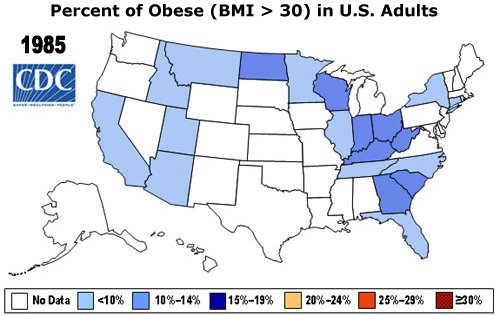
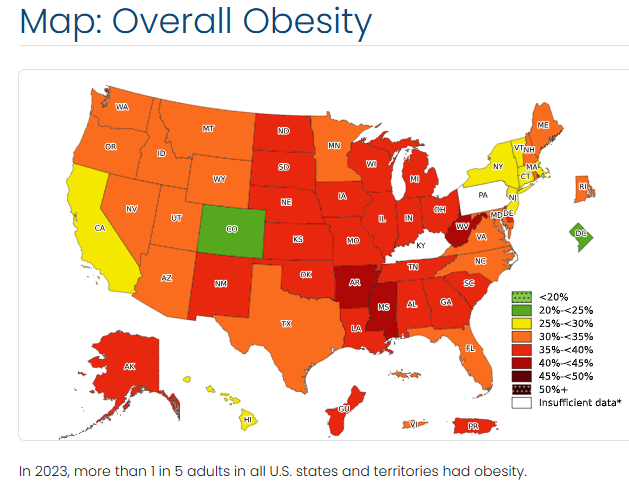
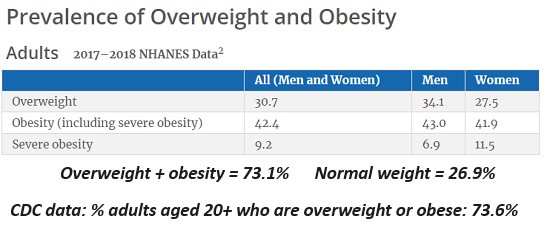
It's self-evident that being overweight/obese is a systemic risk to our overall health. It's also self-evident that this risk factor was relatively rare in the early 1960s and is now prevalent, with recent studies finding only 22% of the US adult populace normal or underweight and about 70% are obese.

Traditional calculations find about 75% of the adult populace is overweight/obese and 25% are normal weight.


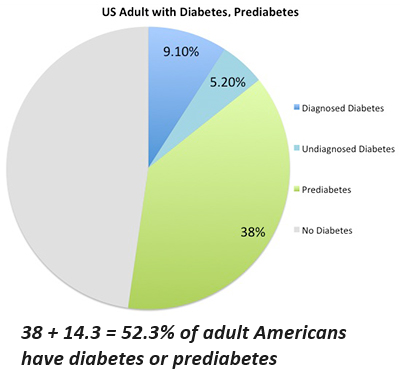
Over half the adult populace is either prediabetic or diabetic.


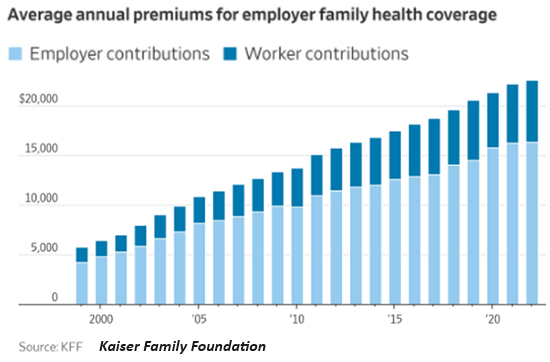
The solution being offered is expensive, highly profitable weight-loss drugs which have many side-effects. But is this really the best solution, or is it a "solution" to the "problem" of how to generate higher profits?

Isn't the obvious line of inquiry here to ask why we were healthier 60 years ago and seek to replicate those conditions? In other words, isn't the obvious solution to go back to what worked without costly, risky interventions?

By all accounts, we were more active and ate mostly real food 60 years ago. We were more active in everyday life; nobody was getting up at 5 am to go to the gym except a handful of professional body-builders or athletes.

Today, our collective diet is dominated by highly processed foods, sugary beverages, unhealthy snacks and fast food, all of which meet two criteria: 1. they are inherently unhealthy and 2) they are highly profitable.

In summary: "solutions" are no longer about actually solving problems: "solutions" are about defining the "problem" so that a highly profitable fake solution can be marketed by a cartel or monopoly.

Here's the real problem: there's no profit in a raw carrot and a walk around the block. "Solutions" must be profitable or they're not "solutions." That these fake "solutions" generate new unsolvable problems--well, you can't stop "Progress."


My new book Investing In Revolution is available at a 10% discount ($18 for the paperback, $24 for the hardcover and $8.95 for the ebook edition) through November. Introduction (free)


Check out my updated Books and Films.

Become a $3/month patron of my work via patreon.com

Subscribe to my Substack for free


NOTE: Contributions/subscriptions are acknowledged in the order received. Your name and email remain confidential and will not be given to any other individual, company or agency.

Thank you, Dennis P. ($70), for your magnificently generous subscription to this site -- I am greatly honored by your support and readership.


Thank you, David E. ($7/month), for your marvelously generous subscription to this site -- I am greatly honored by your support and readership.


Thank you, D.G. ($7/month), for your superbly generous subscription to this site -- I am greatly honored by your support and readership.


Thank you, Francis ($7/month), for your splendidly generous subscription to this site -- I am greatly honored by your support and readership.

Read more...

Thursday, November 06, 2025

The Risk of AI Isn't Skynet

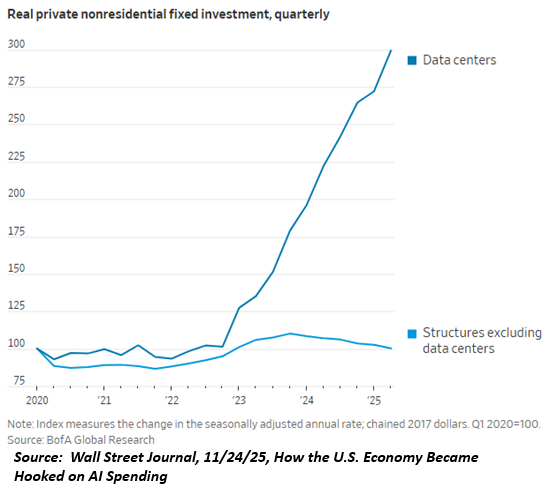
Just as a reminder of what's being gambled on "AI supremacy": it's not just financial capital, it's everything.

The risk that AI transitions from Servant to Master is dramatically appealing--Skynet!--but the real risks are in the mundane realms of the socio-economic order. As I explain in my new book Investing In Revolution, technological revolutions share the same dynamic: those profiting from the innovations push them pell-mell, without regard for future consequences, as the goal is to expand as quickly as possible to achieve market dominance.

This is entirely understandable, as pausing to assess potential pitfalls will effectively cede control to competitors.

Society--all of civilization that isn't reducible to financial data--bears the consequences, but over a timespan far longer than the initial expansion of the technology. In other words, the immediate rewards of the technological revolution go to the fast-moving innovators while the broader consequences--both the benefits and the downsides--impact the socio-cultural-political realms over a much longer time frame.

This creates a time-response lag, where society must absorb and assess the consequences years or even decades after the initial expansion of the technology. The organizational tool of innovators is the corporation, a financial structure with a single goal--expand revenues and profits by any means available--and a quasi-military command-control-communications (a.k.a. 3C) hierarchy.

This structure meshes perfectly with markets, which price everything in the moment: markets lack mechanisms to price future consequences; they only price production, transport, currencies, materials, marketing, inventory, etc. in the present.

In contrast, society is characterized by a multitude of interests and structures in various stages of advocacy. There is no one single goal or hierarchy, and the upsides and downsides of technological changes are typically distributed very unevenly.

Those positioned to reap the rewards gain ground, those positioned to bear the brunt of negative consequences lose ground. Each will then advocate for controls or let-it-run-wild accordingly.

The American ethos favors the let-it-run-wild and pick up the pieces later approach to technological revolutions. This serves the interests of the initial innovators and speculators, who can amass great fortunes in the initial speculative frenzy to get on board. This has played out in railroads, autos, radio, TV, the Internet, and so on.

Each revolution is characterized as creative destruction the buggy whip industry is wiped out, but a larger industry is created.

Here is where correlation is confused with causation: the fact that this cycle has played out in the recent past does not make it a Law of Nature, i.e. a predictable manifestation of causation.

Which brings us to AI. AI is different: it doesn't generate a need for more human labor as it expands, it replaces human labor. This is its implicit raison d'etre, reason to exist.

The rewards go to the initial innovators' corporations and speculators, and the consequences fall on a society ill-prepared to assess them, much less limit them.

AI is different in another way: it generates a compelling facsimile of human characteristics and interactions, facsimiles of thought and knowledge that we take as "real" because they're in "our language."

But as I explain in my book Ultra-Processed Life, these facsimiles are all processed in ways we cannot discern: everything is processed in black boxes following scripts and agendas that we can't see.

What's presented as an accurate representation is actually an ultra-processed distillation that leaves out everything that's unwieldy or unwelcome. We're told that what's the screen is real, but it's not; it's the equivalent of an orange-colored ultra-processed, sugary, salty, greasy goo being presented as a "healthy snack alternative" to a raw carrot.

What's being lost in substituting AI's ultra-processed facsimiles occurs beneath our perception. We don't notice what's been lost, and so we can no longer make a realistic assessment: that capacity has been lost.

AI is also accelerating the process of technological change, a process that's been accelerating for 60 years. Alvin Toffler's 1970 book Future Shock described the disorienting nature of technology-driven change, a theme updated by Douglas Rushkoff in his 2004 book, Present Shock.

Put these dynamics together and we reach this analogy: we're children playing with matches and gasoline in a drought-stricken forest of dry deadwood. Even as the formidable resources of big-tech corporations and the state rush to secure AI supremacy, we may have it backwards: those squandering resources to build out a state-corporate Skynet "to serve humanity" are speeding our self-destruction, while those societies that limit their exposure to AI's ultra-processed goo will emerge as the winners rather than the losers.

Just as a reminder of what's being gambled on AI supremacy: it's not just financial capital, it's everything.


My new book Investing In Revolution is available at a 10% discount ($18 for the paperback, $24 for the hardcover and $8.95 for the ebook edition) through November. Introduction (free)

New podcast: Anti-Progress, Reverse Leverage and the Hot-Potato Economy (45 min)


Check out my updated Books and Films.

Become a $3/month patron of my work via patreon.com

Subscribe to my Substack for free


My recent books:

Disclosure: As an Amazon Associate I earn from qualifying purchases originated via links to Amazon products on this site.


THE REVOLUTION TRILOGY:
Investing In Revolution     Ultra-Processed Life     The Mythology of Progress

Systemic Problems/Solutions

Investing In Revolution (2025) Introduction (free)

The Mythology of Progress (2024) Introduction (free)

Global Crisis, National Renewal (2021) Introduction (free)

Money and Work Unchained (2017) Introduction (free)

A Radically Beneficial World (2015) Introduction (free)

What You Can Do Yourself

Ultra-Processed Life (2025) Introduction (free)

Self-Reliance in the 21st Century (2022) Introduction (free)

When You Can't Go On: Burnout, Reckoning and Renewal (2022) Introduction (free)

Get a Job, Build a Real Career and Defy a Bewildering Economy (2014) Intro (free)

Novels

The Adventures of the Consulting Philosopher Intro (free)

The Secret Life of an Asian Heroine First chapters (free)


Become a $3/month patron of my work via patreon.com.

Subscribe to my Substack for free


NOTE: Contributions/subscriptions are acknowledged in the order received. Your name and email remain confidential and will not be given to any other individual, company or agency.

Thank you, Marty D. ($70), for your magnificently generous subscription to this site -- I am greatly honored by your support and readership.


Thank you, Friend of Pacepa ($70), for your marvelously generous subscription to this site -- I am greatly honored by your support and readership.


Thank you, Keith S. ($100), for your outrageously generous subscription to this site -- I am greatly honored by your support and readership.


Thank you, Lee S. ($7/month), for your splendidly generous subscription to this site -- I am greatly honored by your support and readership.

Read more...

Monday, November 03, 2025

The Inevitable Drift Down from "Can't Lose" Owning Stocks to "Can't Win"

Even if an AI program advises selling everything and walking away from the market for five years, how many of us would take this advice?

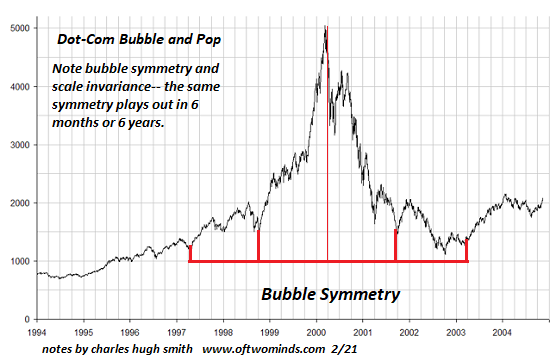
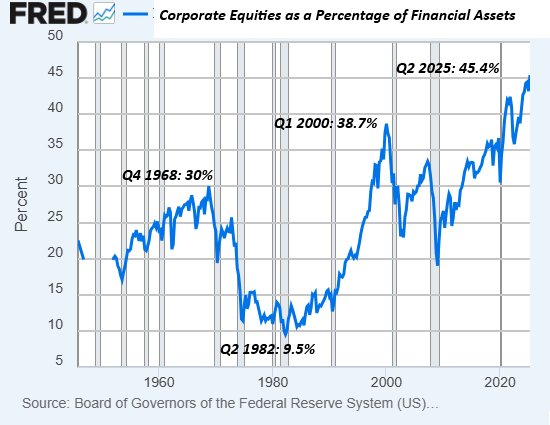
Only those who experienced the heady euphoria of the late 1990s dot-com bubble in tech stocks know what the shift from "can't lose" confidence to "can't win" surrender feels like. The chart below illustrates this emotional cycle of confidence rising and fading as bubbles inflate and deflate.

Though we like to tell ourselves we're rational investors, animal spirits are the driving force in euphoric bubbles where our beliefs direct our decisions: we come to believe that we're smarter than the cautious dummies, that the technological revolution underway has plenty more room to run, that policies supportive of stocks have been refined and institutionalized to the point they're rock-solid foundations, and so on.

Though the chart doesn't go back to the 1870s bust or the 1930s Great Depression, the cycle played out in those eras, too. The process of confidence fading is painfully long, as the rewards of "buying the dip" have been so generous and reliable that we naturally assume any decline will be brief.

When the recovery we anticipated rolls over and reaches new lows, we're sure the authorities will "do whatever it takes" to reinflate the markets, but authorities don't actually have god-like powers; their powers only appeared god-like because conditions favored their interventions.

Every new low hurts, but we're still confident that the market fundamentals are intact, authorities have plenty of policy bazookas they can launch, and the recommendations of Wall Street analysts to "buy the dip" are encouraging.

(Those trading in the 2000-2002 era recall Wall Street analysts touting dot-com stocks that had fallen from $80 to $40 as "strong buys," meanwhile the stock finally bottom at $4. Following the "buy" recommendation yielded a 90% loss.)

We attribute any run of bad luck to over-confidence rather than misjudgment of the entire market and economy: OK, we blew the last few trades, but we can get our mojo back.

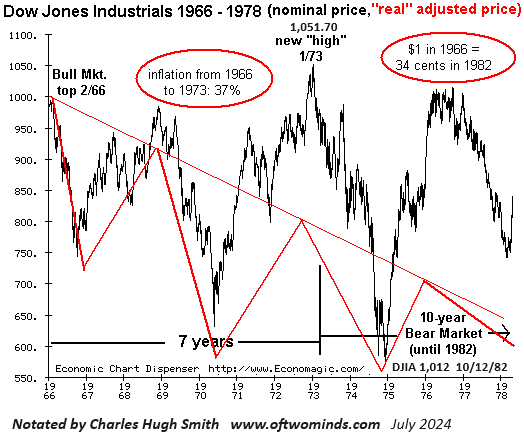
In the years this process takes to exhaust itself, inflation is eating away at nominal stock prices. As the third chart illustrates, when the Dow Jones Industrial Average (DJIA) finally returned to its 1966 peak above 1,000 in 1973, that didn't mean investors were made whole; inflation had consumed 37% of the value of their stock holdings. To be made whole, DJIA would have to reach 1,370, not 1,000.

The real losses were even bleaker the next time the DJIA again closed above 1,000 on October 12,1982. Investors who held their index portfolios from the peak in 1966 to 1982 lost two-thirds of the purchasing power of their investment. They would not be made whole until the DJIA rose well above 3,000.

The trend that pops out of this long-term chart is that each new peak of household assets invested in stocks is higher than the previous peak. What will the nominal valuation of stock indices be when the percentage of household assets invested in stocks falls from 45% to 15%? What will the purchasing power of the money invested be (i.e. adjusted for real-world inflation) at that point?


This is unknowable, but if history is any guide--and we have no other--then a 50% to 80% decline would be "normal." Consider this chart of the dot-com bubble and deflation: an 80% decline, exhibiting remarkable symmetry:


Inflation renders nominal stock index valuations meaningless:


The drift from "can't lose" to "can't win" is slow and painful. Our beliefs are stubborn, and we cling on to what worked in the past long after it stopped working. Even if an AI program advises selling everything and walking away from the market for five years, how many of us would take this advice? History says: very few.


My new book Investing In Revolution is available at a 10% discount ($18 for the paperback, $24 for the hardcover and $8.95 for the ebook edition) through November. Introduction (free)

New podcast: Anti-Progress, Reverse Leverage and the Hot-Potato Economy (45 min)


Check out my updated Books and Films.

Become a $3/month patron of my work via patreon.com

Subscribe to my Substack for free


My recent books:

Disclosure: As an Amazon Associate I earn from qualifying purchases originated via links to Amazon products on this site.


THE REVOLUTION TRILOGY:
Investing In Revolution     Ultra-Processed Life     The Mythology of Progress

Systemic Problems/Solutions

Investing In Revolution (2025) Introduction (free)

The Mythology of Progress (2024) Introduction (free)

Global Crisis, National Renewal (2021) Introduction (free)

Money and Work Unchained (2017) Introduction (free)

A Radically Beneficial World (2015) Introduction (free)

What You Can Do Yourself

Ultra-Processed Life (2025) Introduction (free)

Self-Reliance in the 21st Century (2022) Introduction (free)

When You Can't Go On: Burnout, Reckoning and Renewal (2022) Introduction (free)

Get a Job, Build a Real Career and Defy a Bewildering Economy (2014) Intro (free)

Novels

The Adventures of the Consulting Philosopher Intro (free)

The Secret Life of an Asian Heroine First chapters (free)


Become a $3/month patron of my work via patreon.com.

Subscribe to my Substack for free


NOTE: Contributions/subscriptions are acknowledged in the order received. Your name and email remain confidential and will not be given to any other individual, company or agency.

Thank you, Charles J. ($70), for your magnificently generous subscription to this site -- I am greatly honored by your support and readership.


Thank you, Pete W. ($7/month), for your marvelously generous subscription to this site -- I am greatly honored by your support and readership.


Thank you, Jeff P. ($70), for your superbly generous subscription to this site -- I am greatly honored by your support and readership.


Thank you, Donna B. ($7/month), for your splendidly generous subscription to this site -- I am greatly honored by your support and readership.

Read more...

Terms of Service

All content on this blog is provided by Trewe LLC for informational purposes only. The owner of this blog makes no representations as to the accuracy or completeness of any information on this site or found by following any link on this site. The owner will not be liable for any errors or omissions in this information nor for the availability of this information. The owner will not be liable for any losses, injuries, or damages from the display or use of this information. These terms and conditions of use are subject to change at anytime and without notice.


Our Privacy Policy:


Correspondents' email is strictly confidential. This site does not collect digital data from visitors or distribute cookies. Advertisements served by a third-party advertising network (Investing Channel) may use cookies or collect information from visitors for the purpose of Interest-Based Advertising; if you wish to opt out of Interest-Based Advertising, please go to Opt out of interest-based advertising (The Network Advertising Initiative). If you have other privacy concerns relating to advertisements, please contact advertisers directly. Websites and blog links on the site's blog roll are posted at my discretion.


PRIVACY NOTICE FOR EEA INDIVIDUALS


This section covers disclosures on the General Data Protection Regulation (GDPR) for users residing within EEA only. GDPR replaces the existing Directive 95/46/ec, and aims at harmonizing data protection laws in the EU that are fit for purpose in the digital age. The primary objective of the GDPR is to give citizens back control of their personal data. Please follow the link below to access InvestingChannel’s General Data Protection Notice. https://stg.media.investingchannel.com/gdpr-notice/


Notice of Compliance with The California Consumer Protection Act
This site does not collect digital data from visitors or distribute cookies. Advertisements served by a third-party advertising network (Investing Channel) may use cookies or collect information from visitors for the purpose of Interest-Based Advertising. If you do not want any personal information that may be collected by third-party advertising to be sold, please follow the instructions on this page: Limit the Use of My Sensitive Personal Information.


Regarding Cookies:


This site does not collect digital data from visitors or distribute cookies. Advertisements served by third-party advertising networks such as Investing Channel may use cookies or collect information from visitors for the purpose of Interest-Based Advertising; if you wish to opt out of Interest-Based Advertising, please go to Opt out of interest-based advertising (The Network Advertising Initiative) If you have other privacy concerns relating to advertisements, please contact advertisers directly.


Our Commission Policy:

As an Amazon Associate I earn from qualifying purchases. I also earn a commission on purchases of precious metals via BullionVault. I receive no fees or compensation for any other non-advertising links or content posted on my site.

  © Blogger templates Newspaper III by Ourblogtemplates.com 2008

Back to TOP