




Wednesday, May 20, 2026

When Unfairness Is Systemic, the Consequences Are Flight, Resistance, Revolt

Now that we've drained the aquifers of a stable society, the replacement form of "wealth" is a delusional credit-asset bubble that generates the illusion of "wealth."

Let's weave together two threads that look different: systemic unfairness and civilizational psychosis. As I often note, social species that organize themselves into hierarchies (i.e. primates, including humans) have an innate sensitivity to fairness, as this trait is essential to maintaining social stability, and therefore it has been selected as advantageous.

This sensitivity applies both to individual instances of unfairness / injustice and to systemic unfairness / injustice. If there is no redress when an individual is treated unfairly or abused, the social order is weakened. This is why early civilizations instituted legal codes and systems of redress as they expanded into nations / empires that needed bureaucracies to organize, manage and enforce the rules and responsibilities of every class.

If the mechanisms of redress have become empty shams, then the unfairness is systemic: it isn't just some individuals who have been treated unfairly--everyone is being exploited and treated differently from what the system claims is the operative set of values and rules.

When there's an external source of wealth to be exploited, the leadership has the luxury of becoming extractive and oppressive, because they have a source of wealth that's external to their own populace. Consider the progression from a society of systemic fairness to a society of systemic unfairness.

Consider a fledgling nation that was a society with high levels of social trust and cohesion generated by a dutiful leadership, social mobility and a system in which social pressures meant members of each social class had to respect the same set of social rules.

This structure is the essential foundation of a functional society and economy, for if the resident populace is immiserated by an unfair system, they respond by either fleeing the system (i.e. opting out or leaving), resisting the unfairness / exploitation or revolting against the status quo.

If the nation transitions into an expansionist empire, the leadership can jettison fairness / redress because it can extract wealth via conquest or exploiting new resources. The bureaucracy is co-opted / bought off via the spoils of conquest and corruption, and as the imperium expands, it has sufficient wealth to buy off the citizenry class with bread and circuses or equivalent largesse.

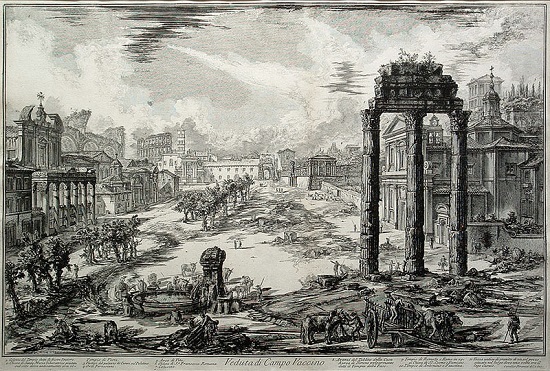
In other words, systemic unfairness--what we now call a rigged casino--is accepted as long as the key social classes feel they're getting ahead. The Roman state / empire is an example of these dynamics, but there are many others.

As long as there's enough external wealth flowing in to enable people to feel they're still getting ahead, social decay is tolerated as "the cost of progress." In other words, who needs fairness if I have a seat in the rigged casino?

But this structure is inherently unstable, both economically and socially. External sources of wealth / resources are eventually depleted, and the largesse diminishes asymmetrically: the wealthiest few at the top continue amassing fortunes, the bureaucrats are squeezed, and the lower classes are now being taxed to cover the decline of external wealth extraction.

The systemic unfairness that was tolerated is no longer tolerable once the majority are no longer getting ahead. This presents the leadership class reaping the lion's share of the wealth extraction with a problem: how to persuade the masses that 1) they're still getting ahead, even as they visibly lose ground, and 2) how to mask the systemic unfairness, i.e. the rigged casino that stripmines the many to benefit the few.

The leadership's "solution" is civilizational psychosis: the founding mythology of the state--so inspirational and lofty--is heavily promoted, even as this mythology (super-abundance, democracy, etc.) no longer maps the real world.

This widening divide generates civilizational psychosis as the masses are corralled into a state of denial that temporarily eases their anxiety at the recognition they're no longer getting ahead and the ladders of upward mobility have all crumbled.

This state of inspirational delusion enables denial to take a superficially plausible inspirational form: Rome is eternal, so we don't have to do anything but await an automatic return to greatness, AI will make us all rich, technological Progress is inevitable and automatically solves all our problems, and so on.

We fervently believe these delusions because the alternative is too painful to bear. The system is rotten to the core, it's all artifice masquerading as authenticity, and not only are we no longer getting ahead, there are no pathways left to get ahead other than gambling, selling our blood or delusional aspirations to become one of the tiny handful of newly minted Tech Bro millionaires.

There is an emotional progression that parallels the progression from a stable society of dynamic equilibrium to civilizational psychosis: denial breaks down into anger, a volatile state with uncertain outcomes, which eventually transitions to bargaining (please let the stock market go back up so I can exit without losses) which leads to depression (it's all lost) which once processed can move to acceptance (oh well, time to start over).

Both denial and civilizational psychosis are inherently unstable as they're self-liquidating. So denial will blossom into anger whether we "like" it or not.

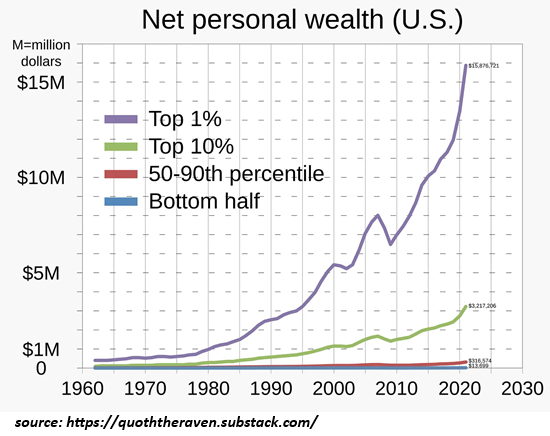
Now that we've drained the aquifers of a stable society, the replacement form of "wealth" is a catastrophically delusional credit-asset bubble that generates the illusion of "wealth." Since the top 10% managerial / entrepreneurial / professional class the leadership needs to run the empire own 90% of the bubbling assets, inflating a credit-asset bubble is a painless way of generating the illusion in this class that they're still getting ahead.

Until the bubble pops, of course, and all bubbles pop, even when we insist they're not bubbles.

Bubbles masquerading as "wealth" is a manifestation of civilizational psychosis
, and so these asset bubbles are equally unstable and self-liquidating: they implode not as a result of some external influence but as an inevitable consequence of their internal structure / nature.

Once the system's transition to a rigged casino becomes undeniable, denial cracks wide open and is replaced by anger. The responses to systemic unfairness are flight, resistance and revolt: dropping out, laying flat, let it rot, opting out, booing toadies worshiping the new gods of AI and eventually, manifestations of revolt as political, economic and social redress are suppressed as needless by a delusional leadership class that has embraced civilizational psychosis.

The price of believing their own PR will be higher than anyone thought possible.


My book Investing In Revolution is available at a 10% discount ($18 for the paperback, $24 for the hardcover and $8.95 for the ebook edition). Introduction (free)


Become a $3/month patron of my work via patreon.com

Subscribe to my Substack for free


NOTE: Contributions/subscriptions are acknowledged in the order received. Your name and email remain confidential and will not be given to any other individual, company or agency.

Thank you, JD ($70), for your marvelously generous subscription to this site -- I am greatly honored by your support and readership.


Thank you, Todd D. ($70), for your wondrously generous subscription to this site -- I am greatly honored by your support and readership.


Thank you, Steven K. ($7/month) for your splendidly generous subscription to this site -- I am greatly honored by your support and readership.


Thank you, Christopher P. ($70) for your enormously generous subscription to this site -- I am greatly honored by your support and readership.

Read more...

Tuesday, May 19, 2026

Inequality, AI and Digital Life Are Undermining Society

Trying to convince ourselves that this is "Progress" and therefore it will all work out just fine isn't the same as it actually working out just fine.

That society is on a terminal trajectory toward collapse is self-evident, as is our desire to evade acknowledging this distressing reality. I have curated four recent articles / essays to establish the baseline argument: inequality, AI and social media are undermining society in mutually reinforcing ways.

The dynamics are scale-invariant: they undermine the cognitive, emotional, financial and social stability of individuals, families, communities, the economy and ultimately society, which includes the economy--not the other way around, as we've been led to believe: society doesn't exist, the economy is everything. This claim is the ultimate source of the dynamics of system-societal collapse.

Let's go through four sources that lay out the dynamics of social collapse.

1. The collapse of identity, marriage, family, security and universally accessible positive economic-social roles.

Jaded with work and school, some young men are opting out. Meet the NEETs: not employed, in education or in training. (yahoo.com)

2. The globalization of inequality not just in wealth and income but in agency (control of one's life) and opportunity to marry, establish a family, own a home and secure a positive economic-social role. What's being globalized is anxiety, desperation and loneliness, not prosperity.

The Shared Feeling of Being Harvested by the Future. (nytimes.com)

I have spent years reporting and living in both the United States and China and wrote a book chronicling the history and evolution of the Chinese internet. Moving between the two countries, I've been struck by how they have come to mirror and resemble each other. There is a shared sense of precarity that lies beneath the envy and distrust: the technological future is taking shape at vertiginous speed yet its promise is not shared by all.

Researchers are courted with nine-figure salaries like N.B.A. stars, and roadside billboards call on residents to 'Supercharge your A.I.' and 'Stop Hiring Humans.' Tech workers have earnestly adopted China's infamous '996' work schedule: 9 a.m. to 9 p.m., six days a week. They are hustling hard and 'locking in' to ensure that they emerge as the rich and powerful victors of the A.I. gold rush. China's tech hubs are driven by a similar sense of urgency.

"It's a highly competitive environment right now," a Shenzhen software engineer told me. "I feel like if I stop, I'll be left behind." His anxiety is not new. Unstable work situations and economic insecurity long predate the current A.I. boom. But A.I. has supercharged those anxieties and made them much harder to contest.

A parallel set of memes has emerged to capture the sense of powerlessness. In the United States, the Silicon Valley tech elite identify as 'high agency,' while the rest of us are 'bots' condemned to the 'permanent underclass.'

"This is not 'embracing the future,'" one disillusioned user on RedNote described the OpenClaw craze. "It's 'being harvested by the future.'"

In China, ordinary workers describe themselves as shechu ('corporate cattle') and jiabangou ('overtime dogs.') These same workers have long used the viral term 'involution' to capture the feeling of being trapped in a cycle of meaningless competition. In both countries, those disaffected by A.I. identify with the gaming meme of the 'NPC' or 'non-player character.' They feel like the background role in someone else's video game, existing only to fill the world but not to shape it.


The knowledge workers of both countries feel the surveillance presence of the technology. Outside the office, both Chinese and Americans have become enamored with A.I. as a source of frictionless companionship and emotional validation, with companies now monetizing emotional intimacy at scale.

In China, one survey found that nearly half of young Chinese had used an A.I. chatbot to discuss their mental health. A.I. companions have emerged as a quick fix to a growing loneliness epidemic. This year, the app 'Are You Dead?' --which alerts a contact if a user fails to check-in -- has been wildly popular.

The people of both countries are turning toward the spiritual for solace and agency in a world accelerating out of their control. When the future loses its promise, the past becomes a refuge. Both societies have seen a surge of nostalgia, a longing for a time remembered as simpler and more stable.

Faced with such a system, the simplest response is to surrender: accept one's fate, sink into the apathy of inevitable decline and, in the words of Chinese netizens, 'let it rot.' It's easy to flee the friction of the real world for the comfort of our feeds and to confide in chatbots rather than friends.


3. The undermining of the family, which is the foundational structure of the human experience and social order. Stability is being replaced by desperation, anxiety, insecurity, disconnection and profound alienation.

Meet the Sad Wives of AI: Are you married to a man who's obsessed with AI? I'm so, so sorry.

There's a strange and under-discussed side effect of the AI boom: what it's doing to family dynamics. By which I mean: how it's potentially destroying family dynamics. I'm sure this applies to all kinds of families, gay or straight, rich or poor, with any AI-pilled members. The technology is coming, has come, for us all.

Often it goes like this: He works in AI, and she does everything and anything else. Other times, it's bleaker: He desperately wants to work in AI--or feels he must work in AI--and she wants him to do literally anything else. He's off in another world, a world of prompts and benchmarks and epiphanies, while she's firmly in this one.

Princess Diana famously said there were three people in her marriage. For the sad wives of AI, the third is a chatbot.

Neither of my friends' husbands actually makes money from AI. Not yet. There is this sense, I offered, among people in AI--and people adjacent to it, and people who are pretty sure it's coming for them--that this is their last chance. They've tried everything else, these men, from writing screenplays to investing in crypto. It's AI or bust. Their partners, meanwhile, have quietly taken on a second job: emotional support. Chief Existential Officer, uncompensated. No one asked us if we wanted the gig.

This is the question I ask everyone: Has any part of the AI boom made things better at home? Could it ever?


4. The hollowing out of social mobility and stability by financialization, turning everything into a market that can be rigged and exploited.

The Profitable Rot of the Middle (Noel Johnson)

Look around and you will see that the concept of ownership has radically changed. What we have now is licensing, a mere permission to use a thing or a service.

This is the matter of the profitable rot at the deepest level. The societal transformation from owners to tenants is the very center of the transition.

This propagates everywhere. It is the main principle of chokepoint capitalism.

The social contract is being broken down between generations. If the calculation shows the hardworking generation can't get a house, health security or an honorable retirement anymore, then their attitudes change.

Instead of going for the traditional achievements, they are saying 'nah' and quietly dropping out of the rat race. This is often misinterpreted by the media as 'quiet quitting' or lack of ambition. The truth is that it is neither.

It is a highly rational reaction to a rigged casino. Why play a game where the rules are entirely dictated by the house and the house has explicitly stated its goal is to empty your pockets?

We are witnessing a powerful psychological shift. The constant stress and worry characteristic of modern life are pretty much the awareness that a single medical emergency, job loss or rent hike will send you into complete ruin.

The safety net has been privatized, sold off and financialized and the latter has been offered to us at an unaffordable price.

Every pillar which used to provide stability to the middle class has been turned into an extraction vector.

So what really makes us, us? What defines the modern working class? They shared a common understanding that the cavalry will not come to rescue it.


Why does it matter so much?

Because a society that has no middle class is by definition fragile. It's a brittle construct incapable of withstanding systemic shocks. In the absence of social mobility avenues, the impoverishment of individuals is not the only thing that happens. The legitimacy of the very institutions erodes.

Whenever the distance between the rulers and the ruled gets too great and the social contract is voided by the elites at the top. History shows that the system does not end up simply incapable of resolving a state of permanent inequality.

The system breaks down completely."


Will inequality, AI and Digital Life collapse society? Yes.

I have curated a list of my own essays that address society's accelerating trajectory into collapse: How Things Break / Model Collapse that includes a summary.

I also have a curated list of my Essays on AI.

The real-world commons where people learned to socialize and gain their sea-legs as adults has been replaced by ultra-processed Digital Life: addictive digital technologies / phones / devices that don't just enable surveillance, tracking and algorithmic entertainment, they monetize and incentivize these sources of addiction, disconnect, alienation, loneliness and isolation. Social anxiety is a "market" that invites profitable exploitation.

The real-world commons and sources of stability that are the foundations of social stability are eroding right before our eyes. AI is not the answer, it is one of the drivers. There are no simplistic economic or political answers to the decay and collapse of society, for the root causes include every aspect of Ultra-Processed Life, from addictive digital scrolls to addictive junk food to a pervasive desperation and anxiety as the ground gives way beneath our feet.

Will buying (or more likely, leasing) a household robot fix what's broken, or is the fantasy that there is a profitable technological "solution" to everything the reason why everything of value is breaking down? This is the core dynamic of what I call Anti-Progress: a profitable technology sold as "Progress" that is actually the opposite of Progress, for what's broken can't be fixed by what broke it.

Avoidance, rationalization, denial--these coping mechanisms have very short half-lives. After denial comes Anger, and we're unprepared for anything other than artifice permanently propping up denial. But there is nothing permanent about artifice or denial, as both are self-liquidating by their very nature.

Trying to convince ourselves that this is "Progress" and therefore it will all work out just fine isn't the same as it actually working out just fine, and the difference between the two is about to be starkly revealed as denial is replaced by anger.

My trilogy maps this territory: the Mythology of Progress fails, the consequences of Ultra-Processed Life break through denial, and this acts as a catalyst:

The Mythology of Progress

Ultra-Processed Life

Investing In Revolution

Short video: Inequality, AI and Digital Life Are Undermining Society (1:57 min)


Read more...

Sunday, May 17, 2026

We've Optimized Fragility, Failure, Denial--and Rage

What happens when optimization is itself the point of failure?

In today's zeitgeist, everything must be optimized or we'll fail: our time, productivity, fitness, diet, supplements, career, income, wealth--everything must be constantly optimized lest we fall behind or fail.

The grand irony is optimization generates fragility which generates failure which generates denial which eventually generates rage. We've optimized global supply chains for efficiency and cost, rendering them exquisitely vulnerable to disruption and collapse. We've optimized the global economy for "growth" based on expanding consumption of energy and everything that depends on energy, which is everything.

To fund this endless expansion of consumption, everyone must borrow more money to buy more than their income allows. To enable this endless expansion of debt, money must be nearly free to borrow after adjusting for inflation.

The irony here is when money has no cost, it's squandered on excess consumption or speculation. The incentive to borrow and spend / invest wisely is that borrowing money has a high cost. Reduce the cost to boost borrowing / consumption / speculation and you create credit-asset bubbles and households, enterprises and governments one mis-step from insolvency.

Optimization raises expectations to lofty heights. The promise of optimization is endless--there's no limit to optimization, and so there's no limit to technology, profits, health, wealth and prosperity. If we keep optimizing, everything becomes possible. By tweaking technology and finance, we can endlessly expand consumption and wealth.

The mindset this generates is: follow the rules of optimization and you'll enjoy all the benefits of success. Optimize your career by borrowing a small fortune to obtain a university diploma, chase the Next Big Thing, optimize your engagement, visibility, and the buzzword du jour, and all the good things in life will be within reach.

The expectations are as fragile as the system they rely on. We've been taught that "our vote counts," that democracy means we have a say in collective decisions via representatives we elect. We've been taught we have agency--control of our destiny: work hard, work smart, optimize work flows and innovation, and anyone can be a startup founder who cashes out with millions of dollars--and the high agency that comes from high visibility.

Except all of this that's presented as stable, trustworthy, predictable and real is fragile, unstable and artificial--simulations of stability, trust and predictability. The belief that this vast system of mythologies, beliefs and "the real world" is as it's presented is civilizational psychosis, a self-reinforcing state of denial in which some new innovation / optimization will "solve" whatever problems arise.

So what's the optimized solution when optimization itself is the problem? What if a new product or profitable technology is not a solution but an extension of optimized fragility?

What's been optimized is centralization of power and control in the hands of the few because distributed capital, agency, power and control are inefficient. So we inhabit a world of overlapping monopolies and cartels, the marriage of state and private sector monopolies. In terms of optimizing profits, the optimized structure is monopoly. Nothing else comes close. So an economy of overlapping monopolies and shared-monopoly (i.e. cartels) is the perfection of a system optimized to maximize profits for the owners of the monopolies.

This is why it doesn't matter who you vote for, as the decisions are made to suit the interests of those at the top of the optimized concentrations of power pyramid. The masses are fed distractions, us-vs-them divisions, fake virtue-signaling policy-tweak "solutions," and a circus of entertainment.

As for optimizing security and a place in the sun--oops, you didn't optimize enough. You didn't optimize innovation enough, and let's face it, you didn't optimize optimization enough, so you failed. Maybe your AI chatbot can console you.

High expectations lead to dreams dashed which leads to denial crumbling on contact with the real world. And when denial crumbles and the scales fall from our eyes, and we see everything that was presented as authentic is actually artificial, a synthetic simulation designed to obscure the gearing of an increasingly fragile system, our sense of betrayal, the shattering of trust, the awareness that we've been lied to, conned, to benefit those doing the bamboozling, then we become angry.

We become angry because we're social beings who depend on trust and truth to function as a group that benefits its members and not just its leaders. When trust and truth have been replaced by artifices to serve the interests of leaders touting how the system benefits everyone, the group dynamics transition from positive to destructive. Nobody likes being conned, and there is a selective advantage to this trait.

Part of the con is to claim that we can collectively transit smoothly from denial to acceptance, skipping the messy, difficult stages of anger, bargaining and depression. (Kubler-Ross's progression of the five stages of grief: denial, anger, bargaining, depression, acceptance.) But this isn't how we're wired, and this progression cannot be optimized away.

So never mind you're selling your blood to make ends meet while a handful of others are about to reap fortunes in IPOs. Just accept this is your lot in life. Not all outcomes are equal, creative destruction, blah blah blah.

But what if optimization is the techno-speak cover story for a rigged casino? What if all the buzzwords --innovation, growth, super-abundance, and so on--are all techno-speak cover stories for the substitution of economic metrics for a life that's actually worth living?

We've been herded into a Mouse Utopia of metrics--financial metrics, systems, data, models--that leaves out the reality that we exist in a moral universe in which trust and truth matter more than GDP, stock markets, and the hollow, surreal realm of consumerist transactions.

In this universe, anger leads to redress or retribution. The current system is optimized to avoid redress by optimizing the substitution of artifice for authenticity. This optimization has reached such perfection that the status quo leaders, public and private, believe their mastery of this substitution will continue protecting them from public anger come what may. Just pull the levers, and the public will continue believing.


Our leaders have effectively optimized their belief in their own PR. There is no need for redress because the public will accept more of the same: distractions, us-vs-them divisions, fake virtue-signaling policy-tweak "solutions," and a circus of entertainment.

But this isn't how the transition from denial to anger works. Applying more of the same will only push anger into rage, where it becomes an emergent force with non-linear dynamics: unpredictable, uncontrollable.

In terms of optimized metrics and systems, rage is irrational. In the moral universe, it's perfectly rational. What happens when an unexpected asteroid shatters all the interconnected fragilities of hyper-optimized supply chains and finance?

We can rephrase this to: what happens when optimization is itself the point of failure? What happens when the optimization of substituting artifice for authenticity to mask the decay of trust and truth fails?

All this boils down to: what happens when redress is set aside as needless? That leaves retribution as the only outlet for all the energy being converted from denial to anger.

What seemed preposterous before the asteroid is later recognized as destiny.


NEW PODCAST: Dennis Tubbergen and I discuss the growing risks facing the U.S. and global economy. (32:45 min)


My book Investing In Revolution is available at a 10% discount ($18 for the paperback, $24 for the hardcover and $8.95 for the ebook edition). Introduction (free)


Become a $3/month patron of my work via patreon.com

Subscribe to my Substack for free


NOTE: Contributions/subscriptions are acknowledged in the order received. Your name and email remain confidential and will not be given to any other individual, company or agency.

Thank you, JD ($70), for your marvelously generous subscription to this site -- I am greatly honored by your support and readership.


Thank you, Todd D. ($70), for your wondrously generous subscription to this site -- I am greatly honored by your support and readership.


Thank you, Steven K. ($7/month) for your splendidly generous subscription to this site -- I am greatly honored by your support and readership.


Thank you, Christopher P. ($70) for your enormously generous subscription to this site -- I am greatly honored by your support and readership.

Read more...

Tuesday, May 12, 2026

Chaos Unleashed: When "Irrational" Makes Perfect Sense

Once fairness and honesty have been stripped out of a social order, social trust collapses. Once trust collapses, society disintegrates.

It's important to understand the dynamics of chaos before the certainties in our lives are swept away.

Over the past few months, I've been exploring the dynamics of delusion and breakdown:


1. our reliance on models to make sense of the world and what happens when those models no longer track reality;
2. the difficulties in adapting when our old model breaks down;
3. our growing reliance on complex systems and AI;
4. our frustration with broken systems that are impervious to reform;
5. how the status quo makes a show of reforming broken systems, substituting theatrics for substance;
6. the destabilizing consequences of extremely asymmetric distributions of wealth, power and income;
7. the erosion of our standard of living and quality of life as "progress" is replaced by Anti-Progress and an Ultra-Processed Life of transactions and synthetic facsimiles of authenticity;
8. how these forces have shaped two "fork in the road" narratives:
A. boundless prosperity for all generated by AI and technology
B. the breakdown of an imbalanced, inherently destabilizing socio-economic-political system of the powerful and the powerless defined by moral decay, the collapse of trust in institutions, widening extremes of inequality and the substitution of artifice for authenticity, a.k.a. everything is fake, to maintain the illusion that all is well.

These ideas inform my recent work:

One of Us Is Delusional, But Which One?

When Predictability Collapses, What's Scarce and Valuable Is Adaptability

AI, Money, Human Nature and the Problem with Problems

Why We're Helpless When Things Break Down

The Fork in the Road Ahead

Recession and Revolution: Our Experience Isn't a Model or System

What Would Be Truly Bullish? Actually Fixing What's Broken

There are two underlying material-world dynamics that tie all these themes together:

1. Growth / Progress--defined as higher energy consumption per capita that results in increased purchasing power of wages--is no longer robust enough to raise all boats. This reality is reflected in the declining purchasing power of wages, which is typically labeled "a rise in the cost of living" / inflation.

2. At the same time, the top 10% ownership / professional / managerial elite is taking a larger share of the pie due to a number of factors, including regulatory capture, political changes in tax laws that favor asset-owners, etc., and the explicit but unstated policy decision to give the stagnating economy the appearance of "growth" by inflating credit-asset bubbles that enrich those who already own assets at the expense of those who don't own enough to matter.

These boil down to the distribution of "pain" and "gain": who gets the pain and who gets the gain, and whether the pain and the gain are distributed across all socio-economic classes or are they asymmetrically distributed.

The "pain" of declining purchasing power of wages, living standards and quality of life (for example, health, financial security. etc.) is being distributed to the bottom 80% while the "gains" are distributed to the top 10% owners of capital. (A tiny percentage of the gains trickles down to the cohort between 80% and 90% who own enough capital to maintain a "middle class" lifestyle.)

As I have noted many times, humans are hardwired to be innately attentive to the three dynamics that give humanity's social skills such immense adaptive power:
1. fairness / unfairness (justice, injustice)
2. truth / honesty / authenticity
3. trust (but verify)

Once fairness and honesty have been stripped out of a social order, social trust collapses. Once trust collapses, society disintegrates.

I consider it self-evident that extreme asymmetries of distributing pain and gain cannot be justified as "fair" nor are they perceived to be "fair" by those absorbing the pain.

I also consider it self-evident that truth / honesty / authenticity have been replaced by theater, staged performances and the self-serving artifices of making a show of reforming broken systems.

That social trust is in steep decline cannot be plausibly denied.

This raises the question: how does this disintegration manifest?

Tim Morgan of Surplus Energy Economics (highly recommended reading) has provided an insightful context for understanding how social-economic-political disintegration follows a profoundly human and inherently "irrational" emotional progression.

As he explains, in our technocratic system, causal chains are invariably presented as mechanistic: technology changes this, monetary policy changes that, and so on. We understand "how things work" as linear, reductionist, left-hemisphere mechanical processes of inputs, processes and outputs.

But humans are not machines, and society is not a mechanism comprised solely of institutions and technocratic / financial processes.

Morgan offers the missing half of disintegrative dynamics: the emotional progression of grief famously described by Dr. Elisabeth Kubler-Ross in her 1969 book On Death and Dying, a process that in one way or another works through five emotional states: Denial, Anger, Bargaining, Depression, and Acceptance.

Morgan posits that we are collectively grieving the loss of growth without being fully aware that we're experiencing this dynamic because we're in the denial stage.

#323: They First Make Mad: Stress and Grief at the End of Growth (Tim Morgan of Surplus Energy Economics)

Kubler-Ross describes a system that is not linearly mechanical; it's a progression that often veers into emotional states that can be described as "irrational" even as they are completely rational to those experiencing them.

This is a system of emotional processes and truths that can't be understood with the conventional tools of systems dynamics or the social sciences, for the "irrationality" of each state is intrinsic to the progression.

Humans are not mechanisms, and neither is this emotional system. What appears "irrational" is not irrational; it's the way this system works to reconcile our inner life with existential life-changing events.

The status quo's survival strategy is to claim that the Anti-Progress of systemic decline in the standard of living / quality of life experienced by the bottom 80% is still "growth" and "Progress," but this model is veering so far from lived experience that it's increasingly delusional for those not being enriched by bubbles in stocks and housing.

Since we resist losing what we value and are accustomed to--a positive social identity, livelihood, security--the bottom 80% are experiencing the uneasy limbo that precedes a profound phase change that cannot be reversed.

In this temporary state of instability, they're clinging to denial that the era of "growth / Progress" that actually improved their living standards and quality of life has ended, even as the tightening vise of decline increasingly stresses their security, social mobility and belief in the model of permanent upward mobility and prosperity.

The pain generated by decline comes in forms that don't lend themselves to measurement: anxiety, precarity, etc., emotions that make denial a form of emotional solution. But this "solution" doesn't resolve the anxiety or precarity; it's only an emotional Band-Aid / coping mechanism.

Our hardwired awareness of unfairness, artifice and the collapse of trust can't be suppressed, and these chip away at denial. Eventually the denial breaks down, much like an avalanche: the scales fall from our eyes and we see everything we've denied as inescapably real.

On the other side of this phase change is anger.

Denial becomes increasingly delusional as declines that would have been shocking in previous eras of prosperity are now accepted with the passive shrug of the powerless. Selling one's blood for extra cash--once the sole domain of destitute junkies needing cash to feed their addiction--is now an accepted middle-class "gig" to earn extra cash to support a lifestyle that is slipping away:

The Middle-Class Suburbanites Who Sell Their Blood Plasma to Get By.

Another hallmark of middle-class security--the IRA/401K retirement fund--is being drained to pay for everyday expenses:

They Withdrew 401(k) Money Early, and They Have Some Regrets.

In an era of declining purchasing power of wages, the money being withdrawn is unlikely to be replaced.

This account by an anthropologist sheds light on the themes I'm describing:
"The America I move through today often feels alien to the one I thought I knew. Those who fall behind are seen not as constrained, but as having failed. The result is a pervasive, if often unspoken, alienation--one that erodes shared bonds and leaves people to navigate inequality on their own.

Most troubling is the way this environment feeds a politics of grievance. Anger and frustration are redirected toward scapegoats rather than toward the structures that concentrate wealth and power. Identity and culture become tools of division rather than sources of connection. In that context, authoritarianism finds its opening--not as a rupture, but as an extension of patterns already in place."


Since humans are social animals, private anger that is shared becomes public anger--a much more powerful, more volatile emergent property of the phase change from denial to anger.

In this context, we can understand the "wealth tax" in California and the tax on second homes worth in excess of $5 million in New York City as precursors of this phase change from denial to anger which fuels the desire to restore some balance by clawing back some of the gains of the super-wealthy.

This is an example of what I call redress in my book Investing In Revolution: the desire to rebalance extremes of inequality to restore some measure of trust in institutions and the system. Redress can also be fulfilled by restoring previously existing limits on concentrations of power that tilted the system to distribute the lion's share of gains to the few at the top.

Examples of the rules being changed to benefit the wealthy include stock buybacks (previously illegal), Citizens United and a long list of other regulatory changes designed to benefit those with the wealth to buy political influence.

If redress is thwarted or watered down to just another virtue-signaling performance of fake reform for show, the alternative manifestation of anger is retribution. When anger slides into rage as redress is thwarted, retribution has the potential to gain an emotional momentum few anticipate.

Absent systemic unfairness, deception and distrust, anger can proceed to bargaining without transitioning into rage: when bad things happen to us while others are unaffected, it feels unfair--but since it isn't intentional--no one sacrificed our interests to serve their own--we eventually find ways to accept that life is inherently unfair.

But when the system is built on unfairness, deception and distrust so the few can benefit at the expense of the many, anger heats up into rage when redress is denied. This rage seeks expression, and if it's shared by others, it quickly spreads into a volatile public movement.

Bargaining, depression, and acceptance are off the table until substantive redress is achieved or the rage burns itself out.

Chaos looks irrational due to its unpredictability and destructive potential. But when viewed as part of a hardwired emotional casual chain triggered by unfairness, deception and distrust, then not only are anger and demands for redress rational, so too is rage unleashing chaos when legitimate demands for redress are denied by those in power.

At this volatile juncture where the emergent properties of public rage take on a life of their own, the importance of shared beliefs and ideals becomes paramount: absent a narrative and model that inspires positive collective actions, the emergent properties of public rage manifest as uncontrollable chaos.

History offers several templates for what happens once the spark of public anger ignites a fast-spreading wildfire of rage and retribution. One is martial law, a military clampdown that erases public expression and replaces democratic institutions with authoritarian rule. This is the root of Napoleon's famous quip about quelling the mob with a "whiff of grapeshot," i.e. blasting the mob with cannons loaded with round bullets.

In other cases, an authoritarian or self-serving, corrupt neofeudal regime attempts to quell the disorder, but the force needed to suppress the public rage is beyond those being tasked to shoot down their family and friends to save the regime from the consequences of its exploitation and lies.

But the consequences of model collapse don't go away with force. All that force accomplishes is the suppression of public anger. What's needed to nurture a society that values, prioritizes and incentivizes fairness, authenticity and trust is a new model that inspires the disenfranchised with a coherent set of values and goals.

Ivan Illich described this in a way we can all understand:
"Neither revolution nor reformation can ultimately change a society, rather you must tell a new powerful tale, one so persuasive that it sweeps away the old myths and becomes the preferred story, one so inclusive that it gathers all the bits of our past and our present into a coherent whole, one that even shines some light into the future so that we can take the next step. If you want to change a society, then you have to tell an alternative story."

Developing this alternative story is the point of my work. The outlines are not complicated:

1. shift the goal from "growth" (The Waste Is Growth, Everything Is Disposable Landfill Economy) to a sustainably rewarding quality of life that isn't measured solely by material consumption but by the "prosperity" of positive social roles, upward mobility (chances to get ahead), agency (control of one's life) and a say in decisions affecting shared interests (for example, the quality of air / water and public institutions).

2. Limit centralization and the consolidation of financial, economic and political power in the hands of the few, who inevitably use this power to serve their interests at the expense of the many.

We can understand this alternative story as a secular Reformation, a necessary response to a incorrigibly corrupt status quo whose foundational story (infinite growth via what Tim Morgan succinctly describes as "infinite monetary stimulus and limitless technological possibility") is unsustainable and therefore delusional.

Absent a coherent, realistic, inspirational alternative story, once chaos is unleashed, there is no pathway to the restoration of fairness, authenticity and trust within a sustainable model that serves everyone's interests.

John Maynard Keynes famously stated that "markets can remain irrational longer than you can stay solvent." The same can be said of redress-denied, rage-fueled chaos: it too can remain irrational longer than we can imagine.


SHORT VIDEO: Unleashing Chaos: When "Irrational" Makes Perfect Sense (my narration, 1:48 min)


Contributions/subscriptions are acknowledged in the order received. Your name and email remain confidential and will not be given to any other individual, company or agency. All contributors are listed below in acknowledgement of my gratitude.

Thank you, Harvey D. ($200), for your beyond-outrageously generous subscription to this site -- I am greatly honored by your steadfast support and readership.


Thank you, Irving W. ($70), for your wondrously generous subscription to this site -- I am greatly honored by your support and readership.


Thank you, Melissa S. ($7/month) for your splendidly generous subscription to this site -- I am greatly honored by your support and readership.


Thank you, Paulsat ($70) for your enormously generous subscription to this site -- I am greatly honored by your support and readership.

Read more...

Monday, May 11, 2026

When US Treasuries Play a Reverse Card

Rather than being sold, Treasuries will be sought after for their safety, predictability and yield.

In the card game Uno, playing a Reverse card reverses the direction of the game. If the play moved to the right, it reverses direction and moves to the left.

The consensus view is the US dollar (USD) and US Treasuries are both weakening as global capital flows to other currencies and investments such as cryptocurrencies, commodities, precious metals, reshoring industries and of course AI.

It would surprise quite a few players if US Treasuries play a Reverse card and capital flows out of current darlings and into Treasuries. How is this even possible, given that the USD is on a terminal trajectory to zero due to out-of-control federal borrowing / debt?

Here's how the Reverse card scenario plays out. All the current investment darlings are based on two conditions that are currently locked away in the Denial Basement:

1. Virtually every asset class other than commercial real estate is in a gargantuan, unprecedented bubble that will track all the other bubbles in history by popping, surprising everyone who believes the extreme valuations are fully justified and therefore not a bubble.

2. The essentially limitless expansion of the money supply and public / private debt driving the global asset bubble has been normalized, i.e. accepted as "the way it is," a condition that is sustainable based on the self-serving fantasy that AI and technology are ushering in an era of super-abundance of everything we value: energy, resources, leisure and of course financial wealth.

Unbeknownst to those who believe that the Denial Basement is impenetrable, the Monster Id is currently melting the thick steel walls like they're butter. All bubbles pop for the same reason all extremes reverse: the pendulum--of excess, momentum, euphoria, greed, confidence, hubris--reaches a point of exhaustion and then gravity takes hold and the swing to the other extreme gathers momentum.

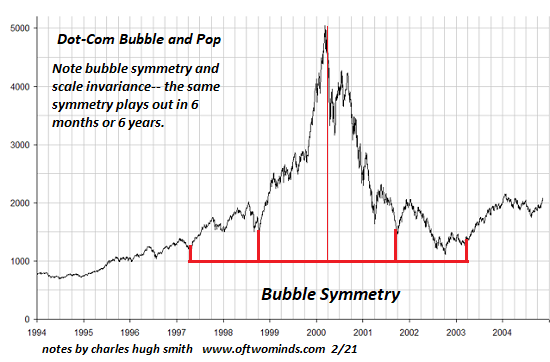
When asset bubbles pop, there's a symmetry to its collapse. The initial decline mirrors the last push to the peak. Since this final push higher is generally near-verticial, the drop is the reverse: a steep decline.

The smartest money missed profiting from the bubble peak due to prioritizing return of capital rather than return on capital. (Hence Buffett's $400 billion stash of cash.)

The smart money kept dancing as long as the music was playing, but once the music stopped, they noticed the bow of the Titanic was dipping lower into the icy waters of the North Atlantic. Those tasked with protecting the capital of the wealthy revert from greed (maximizing return on capital) to safety: return of capital.

The credulous money remains greedy, and continues to "buy the dip" until their capital is depleted. Due to this "buy the dip" buying, the collapse of the bubble back to its initial starting point is frequently interrupted by manic bear market rallies that inspire a fervent belief that "the bottom is in" so it's time to buy, buy, buy.

Alas, nature and markets are not always warm and fuzzy, and since the conditions that inflated the bubble are no longer controlling the game, the dynamics have changed, and "buy the dip" only works for short-term players.


Those tasked with protecting the capital of the wealthy seek two things: investments that guarantee a return of capital and some positive yield / return on capital. A handful of sovereign bond markets offer both.

Why only a handful? For these reasons:

1. Liquidity. Since there's several hundred trillion dollars sloshing around global asset markets, the ideal bond market is liquid enough that money managers can move tens of billions of dollars in and out without moving the bid and ask much.

2. Stable currency valuations set by the market, not the issuing state. There's one threat to the desired return of capital that money managers can't control: the valuation of the underlying currency. A 4% yield looks inviting, but if the issuing state suddenly devalues the currency by 10%, the positive gain reverses into a loss. So the ideal bond market is based on a liquid, transparent currency that can't be devalued by central state / central bank decree.

Any currency that's pegged to another currency, either formally or informally, is disqualified as the valuation is hostage to A) arbitrary decrees changing the peg and B) changes in the underlying currency. In summary: the currency underlying the bond market is the risk.

Superman looks invincible until the Kryptonite Monkey of currency devaluation jumps on his back.

3. A solid, transparent foundation comprised of A) the diversity and strength of the issuing nation's economy and B) the predictability / stability of the legal and financial systems governing the bond market.

As raising cash and escaping risk become paramount, the bubble popping spreads to all asset classes. Everything eventually gets sold to raise cash / pay down debt, including safe haven assets.

As capital gains reverse into losses, money managers accustomed to sneering at Treasury yields paying a pathetic 3% while assets were reaping 30% gains annually suddenly change priorities to earning any safe yield that comes with a guaranteed return of capital without any offsetting devaluation in the currency.

The one sovereign bond market that best meets these qualifications is the US Treasury market: liquid, transparent, valuation set by market force not state decrees, not pegged to any other currency, and predictable based on the diversity and adaptability of the US economy and the relative predictability of its legal and financial system.

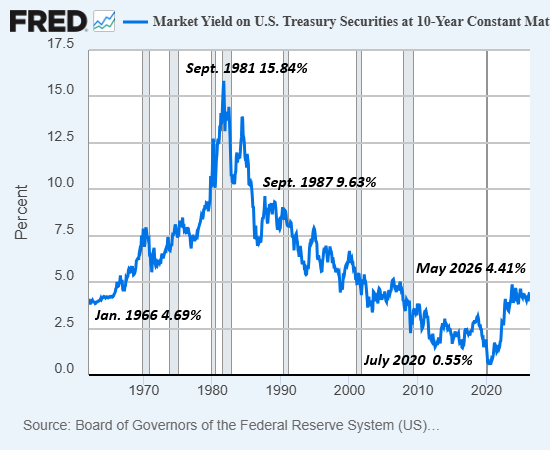
Rather than being sold, Treasuries will be sought after for their safety, predictability and yield. It's widely assumed that yields will drop toward zero in a recession, but this is recency bias not reality: in inflationary eras, yields rise even as capital exits the stock market. Consider this chart of the 10-year Treasury bond yield.


That's how US Treasuries play the Reverse card. While everyone's partying around the AI super-abundance punch bowl, the Monster Id is melting the last steel containment shield in the Denial Basement. Denial will turn to anger--this can't be happening--to bargaining--look, just make the market go back up once more so I can get out whole--to depression--it's gone, it's all gone--to acceptance. Oh well, time to start over.

There's a remarkable irony in this reversal: the profligate borrowing of the US Treasury looks unsustainable when Treasuries are being sold. But when asset bubbles pop and those reaping 30% gains annually have lost 30% of their entire capital, then even if a modest percentage of the hundreds of trillions left sloshing around the global economy seek the safety and predictable yield of Treasuries, that modest percentage will be more than enough to fund federal borrowing.

The total value of global assets cannot be measured with certainty, but estimates of liquid assets (cash and securities / cash equivalents) place the total around $450 trillion. US debt (the entire Treasuries market) is $31 trillion, about 7% of current global liquid assets.

This doesn't include real estate or fixed assets. (Please note estimates vary widely depending on what's being counted.)

All the Money in the World, And Who Has It (2022)

How Much Money Is in the World in 2026? Shocking Figures (Updated 2026-02-04)

Should the asset bubbles pop, total assets will fall significantly, but the sum of cash and cash equivalents will be extraordinarily large as fixed assets collapsing in value will be sold and converted to cash.

If 10% of all privately held wealth seeks the safety and yield of US Treasuries, that's a very large pool of capital trying to get a piece of a relatively limited asset class.

Some final points that must be made. Assets that looked safe as inflation hedges get sold because inflation in the cost of living doesn't necessarily translate to inflation of asset valuations. If demand craters, valuations fall. Once capital appreciation reverses to losses of capital, money managers will seek any safe yield and a return of capital over risking further downside.

Resources rise in value in global growth. But demand can drop far faster than supply, and so even limited resources can crash in price in a deep recession that crushes demand.

Individual investors can absorb losses in the hope that prices will soon return to nosebleed levels, but money managers don't have that luxury. The winning strategy in terms of saving their jobs is sell everything, put the capital in Treasuries earning some yield, and await the return of organic demand after the washout of all asset valuations reaches exhaustion.

Recency bias stretches back 17 years to 2009. Few believe a deflation of asset valuations is possible, or that yields could rise or that Treasuries will be in high demand while all the current darlings are being sold.

Money managers have a different risk calculus than individual investors / gamblers. And since they manage large sums, what they process through their OODA loop will influence markets. So it usually pays to put ourselves in their shoes. Losing our own money is one thing, losing other people's money is another.


My book Investing In Revolution is available at a 10% discount ($18 for the paperback, $24 for the hardcover and $8.95 for the ebook edition). Introduction (free)


Become a $3/month patron of my work via patreon.com

Subscribe to my Substack for free


NOTE: Contributions/subscriptions are acknowledged in the order received. Your name and email remain confidential and will not be given to any other individual, company or agency.

Thank you, Harvey D. ($200), for your beyond-outrageously generous subscription to this site -- I am greatly honored by your steadfast support and readership.


Thank you, Irving W. ($70), for your wondrously generous subscription to this site -- I am greatly honored by your support and readership.


Thank you, Melissa S. ($7/month) for your splendidly generous subscription to this site -- I am greatly honored by your support and readership.


Thank you, Paulsat ($70) for your enormously generous subscription to this site -- I am greatly honored by your support and readership.

Read more...

Wednesday, May 06, 2026

What Would Be Truly Bullish? Actually Fixing What's Broken

Refusing to recognize, much less actually fix, what's broken hurries our collective rendezvous with consequences.

We've come to an interesting juncture in history, interesting because while we're being assured that AI will solve all problems, including any it creates, back in the real world, AI is incapable of fixing what's broken because too many people are getting rich off the status quo, and since the status quo is the problem, those who own / control AI will use it to maintain the status quo, guaranteeing that what's broken spirals into irreversible breakdown.

Richard Bonugli and I discuss what's fatally broken in a new podcast on what it will take to become Bullish (32 min).

Let's start with what's "obvious": letting what's broken fester until it implodes the status quo is not bullish, and neither is substituting delusion and denial for a realistic appraisal of what's actually broken--the essential observe and orient steps in the OODA loop (observe, orient, decide, act).

I've often described the two dynamics that are broken that AI can't fix because those who own / control AI are using it to increase the asymmetrical distribution of wealth and income that are the source of breakdown. Consider healthcare. Everyone except the managers / owners / shareholders of healthcare / pharma cartels agrees healthcare is fundamentally broken and is bankrupting households, employers and the government / nation.

Those profiteering off the status quo healthcare system claim AI is going to reduce costs. They fail to mention this won't reduce the price, it will only serve to increase their profits. Cut costs by replacing human labor with AI tools, yea, we reap even higher profits. Nobody is claiming healthcare will magically become affordable because a truly affordable healthcare system wouldn't be as profitable because it wouldn't be as open to exploitation, fraud, profiteering, extraction and parasitic pricing.

In the same way, AI can't solve the other fatal dynamic--widening wealth and income asymmetry--because it's widening the asymmetry to new extremes. The owners of AI are reaping vast fortunes while stripmining resources to run their AI data centers and laying off wage earners. Rather than fixing what's broken in America, AI is accelerating the endgame of what's broken.

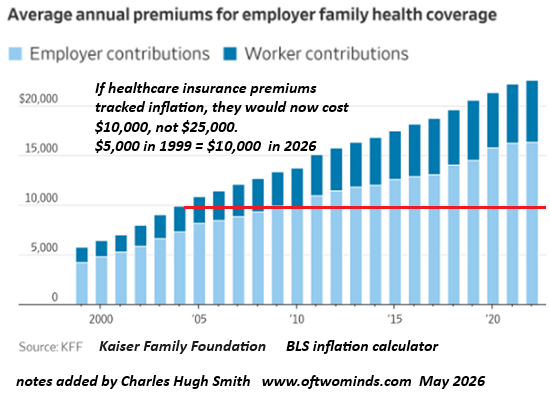
Let's run through why increasing numbers of online comments suggest burning the whole rotten healthcare system down and starting over. Healthcare insurance--which often turn out to be a profitable facsimile of actual insurance--has more than doubled beyond the official rate of inflation. If healthcare insurance had tracked inflation, it would cost $10,000 a year for family coverage in 2026. Instead, it costs $25,000+ annually.

Diagnosis: broken.


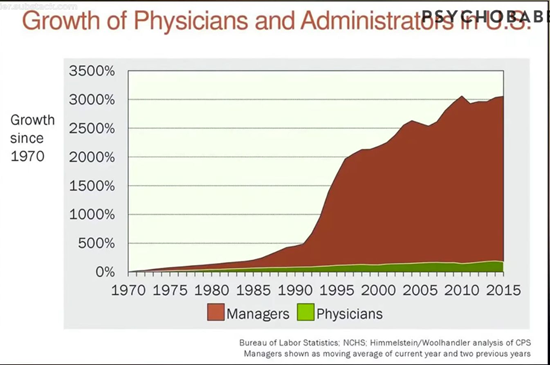
Regardless of how you toy with statistics, the reality is administrative costs / bloat / profiteering have soared. Diagnosis: broken.


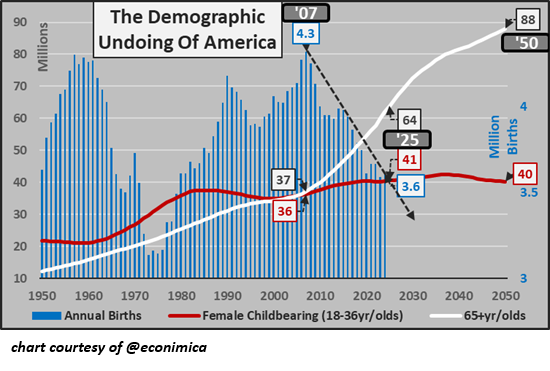
Meanwhile, back in reality, rapidly aging populations are far from their peak demand for healthcare services. Check out the white line on this chart (courtesy of @econimica) of those aged 65+. While births collapse and the workforce is pressured by AI and the soaring cost of living, millions of elderly retirees are being added to the Medicare beneficiary pool. Diagnosis: broken.


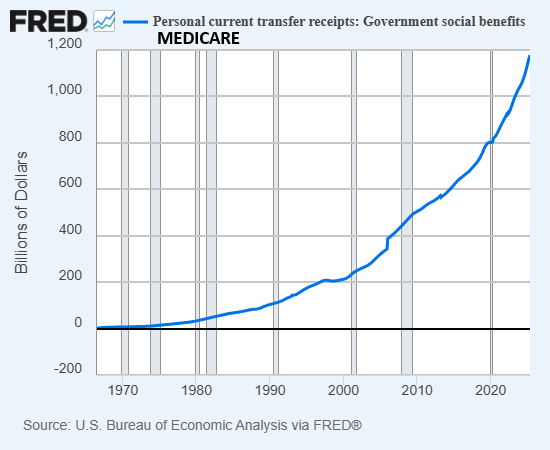
Here is the chart of Medicare costs: parabolic. It's nice we can borrow a few trillion every year, but can we borrow $5 trillion or more every year with no consequence? Diagnosis: broken.


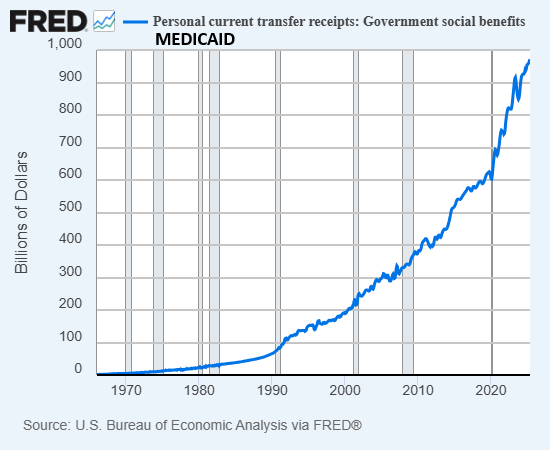
Here is the chart of Medicaid costs: parabolic. Diagnosis: broken.


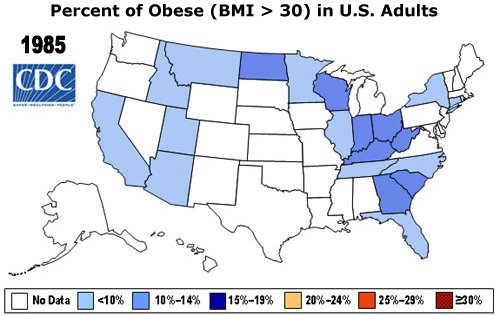
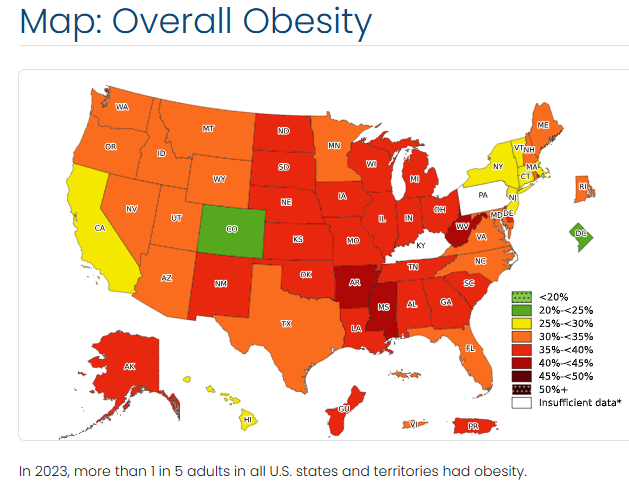
As for the health of the general populace: it's been declining for two generations as our diet has shifted from real food made at home to ultra-processed goo and fitness has bifurcated into a thin layer of extreme fitness and a majority of the populace burdened with the complex ill health of poor diets, poor fitness and metabolic disorders.

Weight of the populace in 1985:


Weight of the populace in 2023:


Yes, now we have GLP-1 drugs that reduce weight and the diseases related to weight, but these drugs have side effects in many patients and they must be taken for life. Once the patient stops taking them, the weight returns.

Drugs that must be taken for life are not a substitute for being healthy. Healthy = not needing any medications.

Diagnosis of the healthcare system: broken. Prognosis: bifurcation: the rich will get "the finest care in the world," and everyone else will be in a queue or denied care--basically the same result--or offered extraordinarily profitable meds and a spectrum of side effects.

What's broken is the entire financial-economic system that distributes the pain and the gain: the pain of sharply higher costs of living and increasing financial precarity is distributed to the bottom 80% while the gains are distributed to the top 10%, with a dribble going to the cohort between 81% and 90% who own enough capital to support their claim to being "middle class."

Note to America's elites: when only the top 15% just below the top 5% qualifies as "middle class," that's not a middle class. I know, you don't concern yourselves with such trivia: there are trillions of dollars to be reaped "solving problems" with AI.

The "problem" you can't solve with AI is AI only "solves" the "problem" you see, which is how to increase your wealth and income before the bottom 80% awaken from the 24/7-hyped delusion that credit-asset bubbles (AI!) raise all boats and will continue to do so forever and ever.


Real life has diverged from that delusion, and the radioactive power of AI to extend that delusion has a short half-life. Refusing to recognize, much less actually fix, what's broken hurries our collective rendezvous with consequences.

What would be bullish is actually fixing what's broken. Promoting self-serving illusory "solutions" that only widen the asymmetries stretching the socio-economic fabric to the breaking point is not bullish.

New podcast: what it will take to become Bullish (32 min).


My book Investing In Revolution is available at a 10% discount ($18 for the paperback, $24 for the hardcover and $8.95 for the ebook edition). Introduction (free)


Check out my updated Books and Films.

Become a $3/month patron of my work via patreon.com

Subscribe to my Substack for free


NOTE: Contributions/subscriptions are acknowledged in the order received. Your name and email remain confidential and will not be given to any other individual, company or agency.

Thank you, Lance D. ($70), for your wondrously generous subscription to this site -- I am greatly honored by your support and readership.


Thank you, Pradeep A. ($7/month), for your marvelously generous subscription to this site -- I am greatly honored by your support and readership.


Thank you, Paul ($7/month) for your splendidly generous subscription to this site -- I am greatly honored by your support and readership.


Thank you, Michael N. ($7/month) for your enormously generous subscription to this site -- I am greatly honored by your support and readership.

Read more...

Monday, May 04, 2026

Recession and Revolution: Our Experience Isn't a Model or System

The Chinese proverb "When you're thirsty, it's too late to dig a well" summarizes an experiential approach to the challenges many of us will encounter should recession and/or some form of revolution upend our lives.

I often write about experience and models and systems, but I realize I've never addressed the deep chasm between them. We experience life on multiple levels, reflecting the complex nature of life, our species' social and cognitive foundations, and the complex interactions of our senses, awareness, emotions, intuition and our ability to return to the past in memory and leap forward in time in anticipation.

I often refer to tacit knowledge gained through the accumulation of direct experience in the tactile, real world. Experiential knowledge / skills cannot be acquired by "book learning" or the purely intellectual processes of formalizing a model or system; this type of knowledge can only be acquired by doing, making mistakes, seeking to correct them, and pushing ourselves to expand our skills by pursuing tasks beyond the boundaries of what we already know how to do.

Author Michael Polanyi summarized the nature of tacit knowledge in seven words: "We know more than we can tell." We can't explain exactly how we came to "know how to fix this" or the steps we took to diagnose and solve the problem, as it's an intuitive right-hemisphere type of knowledge, not a linear, formalized left-hemisphere type of knowledge.

Both types are useful and work together without our awareness, until we're asked to explain something like "how did you learn to write?" This question can't be answered neatly because writing is thinking, and engages both our intuitive, tacit-knowledge capabilities and our linear analytic capabilities.

If we say "writing boils down to the rules of grammar and the definitions of words," this linear description misses the most important attributes of writing, which is the thinking that finds expression in what we call "voice," the writer's expression of their unique experiential knowledge / skills.

When AI tools "clean up" text, they homogenize / dilute the "voice" and the tacit knowledge that created it.

Improvisation is an example of what I'm describing. Learning to play a classic improvisation note for note is one thing--an advancement in skill--but that doesn't give the student the ability to improvise on their own. Learning to improvise as an expression of "voice" is far more demanding and experiential in nature--it cannot be formalized, for the formalization ("follow these rules to create an improvisation") isn't an authentic expression, it's just instantiating a formal program, an ultra-processed simulation of authentic improvisation.

Which brings us to recession and revolution: how we experience these socio-economic-political upheavals is different from how we understand them as formal models.

To those who lose their jobs or see their income drop precipitously, the experience of a deep recession is disorienting and distressing. Our world collapses around us, one piece at a time, and then altogether. We may feel trapped, and feel there's no way out. Our experience may not offer much guidance on how best to respond to financial stresses beyond our control.

The intellectualized explanation that capitalism generates prosperity by its very nature isn't helpful. Neither is looking at charts of interest rates and unemployment rates, or other abstract models that "explain" recession as the result of system dynamics: excesses of debt and speculation, rising inflation, and so on.

The disconcerting experience of navigating a decline or collapse in income and the dominoes that fall as a result cannot be "solved" by abstract models and systems. We can understand that our crisis is caused by larger forces, but that doesn't help us extricate ourselves from the downward financial and emotional spiral.

The same is true of experiencing revolution: technological, financial, political, social or cultural, or a mix of these revolutionary forces. In the present, we're each experiencing some exposure to the AI revolution, and there's no clear historical guide that can be formalized with any utility or accuracy for those experiencing the downsides of the revolution.

If deception, deceit, artifice and exploitation are the primary tools of those in power, human nature (Wetware 1.0) kicks in and demands some version of a truthful accounting of the parasitic elite pulling the levers in a Hall of Mirrors. This can manifest as formal processes--a truth commission or judicial proceedings--or as a tumultuous free-for-all of retribution and the settling of scores.

Formal models and systems help us understand the dynamics at work beneath the surface, but they're not guides to how we experience tumultuous disruptions in our own lives. Our experiences may be shared in part, but they are inherently as unique as our own life experiences.

From the start, my "job" here has been to explore and illuminate both worlds, the abstract realm of models, ideas and system dynamics, and the personal living-in-the-real-world experiences of navigating disruptive, non-linear eras. The abstract realm gives us a context in which we can locate our own experience, and illuminates dynamics that we can either avoid or slip-stream in our own responses.

But the experimentation, risk and potential ruin fall on us as individuals and households. These are not abstractions, these are often chaotic experiences with unpredictable outcomes.

No one individual can experience every variation of challenge and crisis, but many of us have experienced quite a few, from serious bodily injury to mental health crises to being broke to moving to a new place where you know no one to starting a business to changing careers to run-ins with authorities to situations where "doing the right thing" means sacrificing one's own interests--the list of potential challenges and crises arising in our own lives in tumultuous times is almost endless.

In the realm of experience, I promote self-reliance and formulating Plans A, B and C which can be summarized as setting a goal of acquiring tacit knowledge and skills and thinking through what options we have or can start creating before it's too late.

The Chinese proverb When you're thirsty, it's too late to dig a well summarizes an experiential approach to the challenges many of us will encounter should recession and/or some form of revolution upend our lives--and our Plan A.

Self-awareness is a critical component of tacit knowledge and skills. Being aware of the limits of our knowledge and experience--knowing what we don't know--and trusting our own intuition are both "skills" that can't be taught or learned by rote. It's the doing that teaches us what's most valuable--starting with humility and a willingness tp fail and persevere.


Video summary: I narrate key points (1:44 min): Navigating Recession and Revolution: Our Experience Isn't a Model or System


My book Investing In Revolution is available at a 10% discount ($18 for the paperback, $24 for the hardcover and $8.95 for the ebook edition). Introduction (free)


Check out my updated Books and Films.

Become a $3/month patron of my work via patreon.com

Subscribe to my Substack for free


NOTE: Contributions/subscriptions are acknowledged in the order received. Your name and email remain confidential and will not be given to any other individual, company or agency.

Thank you, Simons C. ($32.40), for your wondrously generous subscription to this site -- I am greatly honored by your support and readership.


Thank you, Ferrema S. ($7/month), for your marvelously generous subscription to this site -- I am greatly honored by your support and readership.


Thank you, Scott T. ($300) for your beyond-outrageously generous subscription to this site -- I am greatly honored by your support and readership.


Thank you, Don A. ($70) for your enormously generous subscription to this site -- I am greatly honored by your support and readership.

Read more...

Friday, May 01, 2026

Why We're Helpless When Things Break Down

Only then do we realize that by optimizing profit and efficiency, we've also optimized systemic failure.

In my essay AI, Money, Human Nature and the Problem with Problems, I refer to boundary conditions but didn't offer a thorough explanation of the role this concept plays in understanding not just how the world works but more importantly, how things break down.

Boundary conditions define what the system needs to function. The more complex the machine / system, the greater the number of conditions. For example, a car needs a source of power, fuel, tires, control mechanisms, seats, and so on--hundreds of components are required for the car to function optimally.

Some boundary conditions are narrow--there's little or no wiggle-room in what the system needs to function. Everything has to function perfectly or the system breaks down. We can call these tight systems as there's very little leeway in what they need to function.

In contrast, loose systems have boundary conditions with leeway: some components can fail or function poorly and the system will degrade--i.e. not operate optimally--but it will still function.

Consider a tire. A tire is a fairly loose system. If the optimal tire pressure is 32 pounds, the tire will still function if pressure falls to 28 or is overinflated to 34 pounds.

Now imagine a tire that fails if pressure exceeds 32.5 pounds or falls below 31.5 pounds. Those are unforgiving, tight boundary conditions with very little wiggle room. If tire pressure declines even slightly, it fails.

Which tire do you want--the one optimized for price/efficiency or the one with looser boundary conditions? Our entire way of life is dominated by systems optimized for price/efficiency, not survivability when the system veers outside its boundary conditions.

If a critical semiconductor chip fails in a modern vehicle, the vehicle breaks down and ceases to function. The chip controlled an essential subsystem, and once the chip failed, the subsystem failed, and the vehicle rolls to a stop: complete breakdown.

Certain characteristics of systems create tight boundary conditions that we don't see until they break down. During the pandemic in the early 2020s, the supply chain of some semiconductors broke down, and as a result the production of cars and trucks that needed those chips broke down.

Supply chains with single-source suppliers within long dependency chains (this part needs this part which needs this part) have exacting boundary conditions: since the supply chain depends on a single source for a critical part, if that supplier is disrupted, the entire chain breaks down.

Since the economy is optimized to maximize profit, it's maximized for efficiencies which demand tight boundary conditions and lengthy dependency chains: the system only works if every component works perfectly and every condition is met.

Centralization generates tight boundary conditions. Consider a mega-farm growing a single crop--a mono-crop that the region depends on. This centralized mega-system is optimized to maximize yield of a single crop via optimized subsystems: specific seeds, fertilizers, mechanized equipment, soil sensors, irrigation, harvesting and transport, and at the end, a market price for the crop that covers all the costs and yields a profit.

Financially, this is an optimized system. In the real world, it is a system prone to failure due to its tight boundary conditions. A pest or plague that evades the genetically modified seeds' defenses can wipe out the crop, a sudden bout of extreme weather at the wrong time can wipe out the harvest, and a drop in the market value of the crop can make it unprofitable to even harvest, so it's left to rot or plowed under.

Contrast this with a system of 100 independent, decentralized farms. Financially, this system is inefficient and not optimized to maximize profit, so it's anathema in a financial system that demands optimizing everything to optimize profits. Some of the farms will grow crops with low profit margins or non-optimal yields, and some will be inefficient due to raising a variety of crops instead of one financially optimized crop.

When the pest, plague or price collapse wipes out the mega-farm, the system of 100 farms growing a variety of crops continues to function, albeit at a reduced yield as some farms will suffer lower yields and incomes while many will be unaffected.

When a centralized system / mono-crop fails, everyone depending on that system / mono-crop starves. Once the system veered outside the boundary conditions, it broke down.

Here's a graphic illustrating tight and loose boundary conditions:


Analog - physical systems tend to be more forgiving than digital-dependent systems. When a bracket on a home appliance breaks, it's typically possible to substitute a non-optimized part to fix it. In other words, the manufacturer's bracket is nice to have but not essential, as some other piece of metal can be worked to serve the same function.

When the digital motherboard on the modern appliance fails, there is no replacement except that exact board. Some other mix of semiconductors and circuitry can't be substituted. The appliance--or vehicle, digital device, etc.--is now a brick. And if that one component is no longer available, the appliance is unrepairable.

In an old analog auto engine, if one of the four cylinders was no longer functioning optimally--the gasket was leaking, valves clogged, etc.--the engine would still function, albeit generating lower horsepower and dirtier exhaust.

The majority of systems we rely on for life's essentials--water, power, food, transport, banking, healthcare, etc.--are now digitally dependent systems with tight boundary conditions. They work perfectly until some critical component in a dependency chain fails, and then the entire system fails.

There are no replacements or substitutes for what failed, and so the entire system ceases to function. All the features of systems that optimize efficiency and profits tighten boundary conditions. Everything that widens boundary conditions--i.e. everything that increases survivability and flexibility--increases costs and reduces profits and optimization of efficiency: redundancy, warehousing of spare parts, constant training of personnel to deal with unlikely emergencies, etc.

The vulnerabilities of our optimized way of life are hidden until systems veer outside their boundary conditions and break down. We've witnessed many such breakdowns as every system is optimized for efficiency and profit by stripping out redundancies, second suppliers, spare parts, analog backups in favor of digital efficiencies, etc.

This is why we're surprised--and helpless--when they break down. We think they're robust because they work so well within their boundary conditions, but the narrowness of their boundary conditions makes them extremely sensitive to failures in critical components. This fragility is invisible until the system breaks down.

Only then do we realize that by optimizing profit and efficiency, we've also optimized systemic failure. Go ahead and hold control-alt-delete, but the system won't reboot or repair itself, for it's been optimized to break down.


My book Investing In Revolution is available at a 10% discount ($18 for the paperback, $24 for the hardcover and $8.95 for the ebook edition). Introduction (free)


Check out my updated Books and Films.

Become a $3/month patron of my work via patreon.com

Subscribe to my Substack for free


NOTE: Contributions/subscriptions are acknowledged in the order received. Your name and email remain confidential and will not be given to any other individual, company or agency.

Thank you, Simons C. ($32.40), for your wondrously generous subscription to this site -- I am greatly honored by your support and readership.


Thank you, Ferrema S. ($7/month), for your marvelously generous subscription to this site -- I am greatly honored by your support and readership.


Thank you, Scott T. ($300) for your beyond-outrageously generous subscription to this site -- I am greatly honored by your support and readership.


Thank you, Don A. ($70) for your enormously generous subscription to this site -- I am greatly honored by your support and readership.

Read more...

Terms of Service

All content on this blog is provided by Trewe LLC for informational purposes only. The owner of this blog makes no representations as to the accuracy or completeness of any information on this site or found by following any link on this site. The owner will not be liable for any errors or omissions in this information nor for the availability of this information. The owner will not be liable for any losses, injuries, or damages from the display or use of this information. These terms and conditions of use are subject to change at anytime and without notice.


Our Privacy Policy:


Correspondents' email is strictly confidential. This site does not collect digital data from visitors or distribute cookies. Advertisements served by a third-party advertising network (Investing Channel) may use cookies or collect information from visitors for the purpose of Interest-Based Advertising; if you wish to opt out of Interest-Based Advertising, please go to Opt out of interest-based advertising (The Network Advertising Initiative). If you have other privacy concerns relating to advertisements, please contact advertisers directly. Websites and blog links on the site's blog roll are posted at my discretion.


PRIVACY NOTICE FOR EEA INDIVIDUALS


This section covers disclosures on the General Data Protection Regulation (GDPR) for users residing within EEA only. GDPR replaces the existing Directive 95/46/ec, and aims at harmonizing data protection laws in the EU that are fit for purpose in the digital age. The primary objective of the GDPR is to give citizens back control of their personal data. Please follow the link below to access InvestingChannel’s General Data Protection Notice. https://stg.media.investingchannel.com/gdpr-notice/


Notice of Compliance with The California Consumer Protection Act
This site does not collect digital data from visitors or distribute cookies. Advertisements served by a third-party advertising network (Investing Channel) may use cookies or collect information from visitors for the purpose of Interest-Based Advertising. If you do not want any personal information that may be collected by third-party advertising to be sold, please follow the instructions on this page: Limit the Use of My Sensitive Personal Information.


Regarding Cookies:


This site does not collect digital data from visitors or distribute cookies. Advertisements served by third-party advertising networks such as Investing Channel may use cookies or collect information from visitors for the purpose of Interest-Based Advertising; if you wish to opt out of Interest-Based Advertising, please go to Opt out of interest-based advertising (The Network Advertising Initiative) If you have other privacy concerns relating to advertisements, please contact advertisers directly.


Our Commission Policy:

As an Amazon Associate I earn from qualifying purchases. I also earn a commission on purchases of precious metals via BullionVault. I receive no fees or compensation for any other non-advertising links or content posted on my site.

  © Blogger templates Newspaper III by Ourblogtemplates.com 2008

Back to TOP