That I don't have an analysis or insight to offer doesn't mean I don't care. It simply means there are limits on what we know, and what we do know suggests circumspection.
War seems to demand some response--opinion, analysis, insight--lest it seem that we're uncaring or detached from events so consequential. But if there is anything we can say with any certainty about war, it's that nobody outside the inner circle knows anything, and the inner circle's knowledge is partial, contingent, and prone to the interpretive distortions of group-think.
The other thing we can say with certainty is the primary task of those in charge of the war is perception management, to shape-shift the fog of war into narratives supported by images and statistics that lend an air of factual certainty to something that was as carefully curated as an advert campaign designed to persuade us to buy into whatever story of the war suits those in charge.
Since nobody has a truly comprehensive grasp of what's going on--and what passes for comprehension has been filtered, either purposefully for perception management, or by the biases born of previous experience--any opinion, analysis, or insight is a claim for some measure of certainty that dismisses the inherent contingencies of fast-moving events that depend to some irreducible degree on where one is standing.
War fighting, perception management, analysis and policy-making are professions that are fraught with biases, group-think, blind spots and all the unknowns, from the known-unknowns to the unknown-unknowns, and everything in between. One of the few certainties is that no one involved is anxious to publicly admit they made a mistake.
Another thing we can surmise with reasonable certainty is that few of those in charge of war have any high-quality understanding of the enemy. In a recent weekend post that referenced the Vietnam War, I discussed the consequences of the American leadership's profound ignorance of Vietnam's complex history, politics or culture, and their catastrophic belief that surveillance photos and statistical analyses were substitutes for actual knowledge.
Consider the experience of Admiral Isoroku Yamamoto of the Imperial Japanese Navy prior to World War II. He attended Harvard for two years, and served as a naval attache in Washington, D.C. for years. He traveled extensively in the U.S., taking special interest in the oil fields of Texas and the industrial infrastructure of Detroit.
This on-the-ground experience informed his hesitancy to engage in a long war of attrition with the U.S. and his view that a surprise attack that crippled American power in the Pacific was the best chance of securing a negotiated peace. But this proved to be a false reading of the American character, as the one thing a surprise attack took off the table was a negotiated peace.
It's remarkably easy to drift into an abstract, view-from-orbit take on war. First-hand accounts of war tend to bring us back to Earth. One of our elderly Japanese friends was drafted as a teen to work in an underground munitions factory late in World War II. High-born to a wealthy family, she was given a Naval rank and uniform at 16 years of age, supervising the old men and boys assembling artillery shells in tunnels bored deep into the mountain to escape American bombs.
I have a copy of my uncle's list of his 33 B-24 and B-17 missions over Germany and German-occupied territory in the 8th Air Force in World War II, all in 1944 and early 1945. Given the fierce flak and German fighters, serving on a bomber crew was to some degree often akin to a suicide mission, as losses were so high that by one estimate only 24% of crew members came through their 30 missions (later boosted to 35) alive and uninjured. Depending on the phase of the air campaign, estimates of casualties approach 50%. The 8th Air Force had more KIA (killed in action) casualties--26,000--than the entire U.S. Marine Corps, which endured horrendous casualties in its numerous island-hopping campaigns in the Pacific.
A friend of mine served as a Loach helicopter pilot in the peak years of the Vietnam War. The Loach (Hughes OH-6 Cayuse) was a Light Observation Helicopter crewed by a pilot and gunner. The missions demanded flying at low altitude and therefore being exposed to ground fire, including shoulder-launched weaponry. Once again, these were to some degree often akin to a suicide mission.
The casualty rate was so high that my friend said the old hands didn't even bother learning the names of the new pilots. My friend was shot down twice and had numerous near-misses with death.
We don't do 50% casualty rates any more, as war--along with everything else--has gone high-tech. This greases the slide to war as an abstraction to be discussed as bloodlessly as a chess game or the price of oil.
I don't have an analysis or insight to offer because I know nothing of any credible value. I suppose if one had access to the combined intel of Russia, China, the U.S., Israel, Turkey, Saudi Arabia and other regional interests, one might fashion a fairly coherent view of things on the ground. But even this would be contingent on events of the following day, and on the workings of people who are out of sight or lost in the inevitable summarizing of complex events.
The irony here is I don't have an analysis or insight to offer because I know too much--not about this particular war, but about war in general. I understand the casino's tables are taking bets on the price of oil, and other tables are taking bets on other eventualities, but given that people are risking their lives to do their duty, I'm not interested in the casino. It reminds me of the Star Trek episode The Gamesters of Triskelion where disembodied pulsing brains bet quatloos on life and death combat.
That I don't have an analysis or insight to offer doesn't mean I don't care. It simply means there are limits on what we know, and what we do know suggests circumspection.
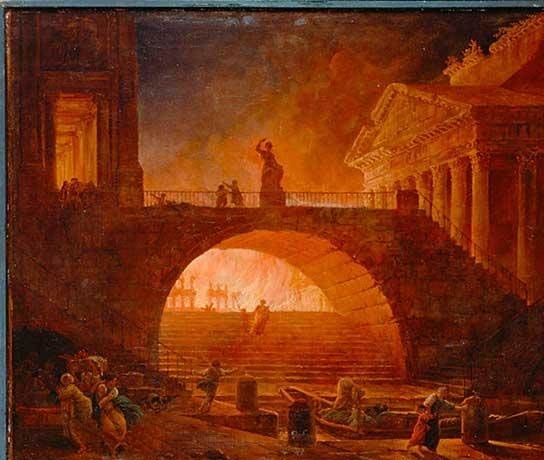
My new book Investing In Revolution is available at a 10% discount ($18 for the paperback, $24 for the hardcover and $8.95 for the ebook edition).
Introduction (free)
Check out my updated Books and Films.
Become
a $3/month patron of my work via patreon.com
Subscribe to my Substack for free
NOTE: Contributions/subscriptions are acknowledged in the order received. Your name and email
remain confidential and will not be given to any other individual, company or agency.
|
Thank you, Horus Cocu ($70), for your marvelously generous subscription
to this site -- I am greatly honored by your support and readership.
|
|
Thank you, Louis F. ($7/month), for your magnificently generous subscription
to this site -- I am greatly honored by your support and readership.
|
|
Thank you, David B. ($70) for your superbly generous subscription
to this site -- I am greatly honored by your support and readership.
|
|
Thank you, BF ($7/month) for your splendidly generous subscription
to this site -- I am greatly honored by your support and readership.
|