Wednesday, May 28, 2014

Our "Make It Look Good" Economy Has Failed

When rigged numbers are the basis of our success, we have failed.


The essence of the U.S. economy is make it look good: never mind quality or long-term consequences, just make it look good today, this week, this month, this quarter: make the pink slime look like meat, make the company look profitable, make the low-quality product look good enough to close the sale, make the unemployment rate low enough to justify re-electing the toadies currently in power, make the body count of bad guys look good, and on and on--just makes the numbers look good now, the future will take care of itself.

This is, of course, an attractive lie: the future is a direct consequence of present decisions and actions. It is remarkable how quickly we latch onto the notion that an endless parade of lies, manipulations and deceptions will magically produce a warm and fuzzy future of organic growth fostered by sound investments.

Alas, an economy that relies on an endless parade of lies, manipulations and deceptions has only one possible future: failure--abject, total, undeniable, devastating. Equally remarkable is the current conviction that absurd extremes in manipulation--the billions of dollars of corporate buybacks pushing stocks higher, the socialization of the U.S. mortgage market, where privately issued mortgages (unbacked by government guarantees) have virtually vanished, the ginned-up unemployment number (remove enough potential workers from the count and the unemployment rate is soon near-zero)--will magically lead to an economy that no longer needs extreme manipulations to sustain itself.

All these lies (if we are bold enough to call a lie a lie) and manipulations cannot possibly herald in an economy of honest reporting, market discovery of price and sound investments.

This is equivalent to doing nothing but eating junk food while playing martial-arts videogames for months on end and then expecting to beat Tony Jaa in a real-world sparring match. Only people who've lost touch with reality would think that getting fat and wheezy playing videogames while eating Happy Meals and Ho-Hos would create a future that required an entirely different set of decisions and disciplines.

America is completely out of touch with reality: gaming statistics and making credit free to financiers doesn't create jobs, any more than stuffing one's face with junk food and playing videogames prepares one to avoid getting beaten to a pulp in a real martial arts match.

The misguided individual who reckons that foisting make it look good cons will magically create productive investments soon discovers that cons, lies and manipulations are all one-way streets: a make it look good con has only one future: a bigger con, to cover up the disastrous consequences of the initial con.
The U.S. economy won't fail in the future: it has already failed. Just as the delusional coach-potato who stuffs himself with Happy Meals and Ho-Hos to prepare for a real-world sparring match failed at the first bite, so too have we failed with the first lie, the first gamed statistic, the first Federal Reserve manipulation, the first fudged "profit."

Liars often entertain the fantasy that the initial make it look good illusion can eventually be replaced with real numbers and real integrity: but that too is a lie, a lie the liar tells himself. A house of cards constructed of lies, manipulations, fudged numbers, ginned-up statistics and cleverly constructed deceptions cannot suddenly become a structure built on integrity, accountability and honest reporting of facts; it will always be fragile, for a single truth and a single unvarnished fact can bring down the entire contraption.

This is where our endless parade of lies, manipulations and deceptions has led us: to a future of more lies, manipulations and deceptions because untruth is a black hole; once our first manipulation pushes us past the event horizon, there is no way back to honesty, accountability and factual reporting.

Officially sanctioned lies, manipulations and deceptions erode trust in institutions and the bedrock belief that honesty, integrity, accountability, hard work and productive investments are the keys to advancement.

Once a people have been trained to swallow an endless parade of lies, manipulations and deceptions in order to get their share of the system's swag, they lose the ability to practice accountability, integrity and honesty. Their own complicity renders them incapable of trusting the system or anyone else playing the make it look good game.

Eventually they lose the ability to even recognize accountability, integrity and honesty, much less live them.

America's economy has already failed. It failed when our leaders turned to lies and manipulation to make it look good, and it failed when we bought the lies because it was so much less risky than demanding a factual accounting.

When rigged numbers are the basis of our success, we have failed.


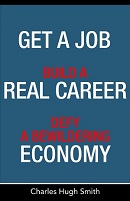
Want to give an enduringly practical graduation gift? Then give my new book Get a Job, Build a Real Career and Defy a Bewildering Economy, a mere $9.95 for the Kindle ebook edition and $17.76 for the print edition. 


Get a Job, Build a Real Career and Defy a Bewildering Economy(Kindle, $9.95)(print, $20)
go to Kindle editionAre you like me? Ever since my first summer job decades ago, I've been chasing financial security. Not win-the-lottery, Bill Gates riches (although it would be nice!), but simply a feeling of financial control. I want my financial worries to if not disappear at least be manageable and comprehensible.


And like most of you, the way I've moved toward my goal has always hinged not just on having a job but a career.

You don't have to be a financial blogger to know that "having a job" and "having a career" do not mean the same thing today as they did when I first started swinging a hammer for a paycheck.

Even the basic concept "getting a job" has changed so radically that jobs--getting and keeping them, and the perceived lack of them--is the number one financial topic among friends, family and for that matter, complete strangers.

So I sat down and wrote this book: Get a Job, Build a Real Career and Defy a Bewildering Economy.

It details everything I've verified about employment and the economy, and lays out an action plan to get you employed.

I am proud of this book. It is the culmination of both my practical work experiences and my financial analysis, and it is a useful, practical, and clarifying read.

Test drive the first section and see for yourself.     Kindle, $9.95     print, $20

"I want to thank you for creating your book Get a Job, Build a Real Career and Defy a Bewildering Economy. It is rare to find a person with a mind like yours, who can take a holistic systems view of things without being captured by specific perspectives or agendas. Your contribution to humanity is much appreciated."
Laura Y.


Thank you, John A. ($20), for your remarkably generous contribution to this site -- I am greatly honored by your support and readership.Thank you, Mark B. ($15), for your much-appreciated generous contribution to this site -- I am greatly honored by your support and readership.

Read more...

Why Are Food Prices so High? Because We're Eating Oil

Regardless of what we eat, we're actually eating oil.


Anyone who buys their own groceries (as opposed to having a full-time cook handle such mundane chores) knows that the cost of basic foods keeps rising, despite the official claims that inflation is essentially near-zero.

Common-sense causes include severe weather and droughts than reduce crop yields, rising demand from the increasingly wealthy global middle class and money printing, which devalues the purchasing power of income.

While these factors undoubtedly influence the cost of food, it turns out that food moves in virtual lockstep with the one master commodity in an industrialized global economy: oil. Courtesy of our friends at Market Daily Briefing, here is a chart of a basket of basic foodstuffs and Brent Crude Oil:

In other words, regardless of what we eat, we're actually eating oil. Not directly, of course, but indirectly, as the global production of tradable foods relies on mechanized farming, fertilizers derived from fossil fuel feedstocks, transport of the harvest to processing plants and from there, to final customers.

Even more indirectly, it took enormous quantities of fossil-fuel energy to construct the aircraft that fly delicacies halfway around the world, the ships that carry cacao beans and grain, the trucks that transport produce and the roads that enable fast, reliable delivery of perishables.

Though many observers see money-printing as the master narrative of the global economy, we don't see much correlation between the Fed's ballooning balance sheet and food/oil. If money-printing alone controlled oil (and thus food), prices of oil/food should have soared as the flood of QE3 (and other central bank orgies of credit-money creation) washed into the global economy from late 2012.

Instead, oil/food have traced out a wedge: prices have remained in a relatively narrow trading range during the orgy of money-printing.

While money creation is one influence on commodity prices, supply and demand matter, too; in that sense, money printing only matters if it pushes demand higher while constricting supply.

Other observers use gold as the "you can't print this" metric of price. In other words, rather than price grain in dollars, yuan, yen or euros, we calculate the cost of grain in ounces of gold.

The gold/food ratio is around the level it reached in 2009 after spiking in 2008.

This tells us food is cheap when priced in gold compared to 2002, but it's more expensive (priced in gold) than it was at gold's peak in 2012.

In effect, the influences of monetary inflation and supply/demand show up in food via the price of oil. Until we stop eating oil (10 calories of fossil fuels are consumed to put one calorie of food on the table), oil is the master commodity in the cost of food.


Jason Burack of Wall Street for Main Street and I discuss the changing nature of work, jobs and entrepreneurial skills: Charles Hugh Smith: Entrepreneur Skills A Must for Any Job (34 min, YouTube)


Want to give an enduringly practical graduation gift? Then give my new book Get a Job, Build a Real Career and Defy a Bewildering Economy, a mere $9.95 for the Kindle ebook edition and $17.76 for the print edition. 


Get a Job, Build a Real Career and Defy a Bewildering Economy(Kindle, $9.95)(print, $20)
go to Kindle editionAre you like me? Ever since my first summer job decades ago, I've been chasing financial security. Not win-the-lottery, Bill Gates riches (although it would be nice!), but simply a feeling of financial control. I want my financial worries to if not disappear at least be manageable and comprehensible.


And like most of you, the way I've moved toward my goal has always hinged not just on having a job but a career.

You don't have to be a financial blogger to know that "having a job" and "having a career" do not mean the same thing today as they did when I first started swinging a hammer for a paycheck.

Even the basic concept "getting a job" has changed so radically that jobs--getting and keeping them, and the perceived lack of them--is the number one financial topic among friends, family and for that matter, complete strangers.


So I sat down and wrote this book: Get a Job, Build a Real Career and Defy a Bewildering Economy.


It details everything I've verified about employment and the economy, and lays out an action plan to get you employed.

I am proud of this book. It is the culmination of both my practical work experiences and my financial analysis, and it is a useful, practical, and clarifying read.

Test drive the first section and see for yourself.     Kindle, $9.95     print, $20


"I want to thank you for creating your book Get a Job, Build a Real Career and Defy a Bewildering Economy. It is rare to find a person with a mind like yours, who can take a holistic systems view of things without being captured by specific perspectives or agendas. Your contribution to humanity is much appreciated."
Laura Y. 


Thank you, Walter S. ($200), for your outrageously generous contribution to this site -- I am greatly honored by your longstanding support and readership.Thank you, Marvin M ($60), for your wondrously generous contribution to this site -- I am greatly honored by your steadfast support and readership.

Read more...

Monday, May 26, 2014

The Housing "Recovery" in Four Charts

The unintended consequences of the Fed's unprecedented interventions will rip the heart and lungs out of the housing market

The housing "recovery" since 2010 can be summarized in four phrases: diminishing returns, unprecedented central state/bank intervention, unintended consequences, end-game. Three charts from our friends at Market Daily Briefing and one of the Case-Shiller Home Price Index tell the story.

Let's start with what we all know: declining mortgage rates, mortgage securitization, poorly regulated/unregulated no-document, no-down mortgages, easy credit policies of the Federal Reserve and massive Federal subsidies of housing and mortgages fueled an unprecedented housing bubble from 2001 to 2007.

The index of major housing markets rose from 80 to 227--a staggering 280% rise in a few years.
The housing bubble was a classic Ponzi Scheme. A recent article in Scientific American explains that Ponzi schemes do not require a fraud--all they require is the belief that another buyer will pay significantly more for an asset than we did: The Whole Economy Is Rife with Ponzi Schemes (subscription required; look for the June issue at your local library).

This bubble dynamic needs nothing more than a supply of greater fools willing to pay substantially more for assets that haven't changed qualitatively or quantitatively, and our expectation that the supply of greater fools is endless.

Alas, the number of people willing and able to borrow immense sums to buy more houses eventually falls below the number needed to sustain the bubble, and the bubble promptly implodes.

The Federal Reserve responded to the bubble collapse with unprecedented intervention to prop up housing values: the Fed dropped short-term interest rates to near-zero (i.e. ZIRP, zero-interest rate policy) and bought roughly $2 trillion of mortgage-backed securities in two waves. (That's about 20% of the entire U.S. mortgage market.)

In this chart, we see the original housing bubble and the echo bubble blown by the Fed's unprecedented interventions.


The home price index is now roughly 130% above its pre-bubble levels.

Not unsurprisingly, the housing market responded to the end of the Fed's first wave of mortgage buying by tanking. The Fed quickly launched a second monumental wave of mortgage purchases, and this corresponded to a renewed surge in housing prices.


A decline of just over 2% in mortgage rates helped push the housing bubble to insane heights. The Fed's unprecedented interventions pushed mortgage rates lower by almost 3% at the bottom, and housing prices rose by about 20%.

That's called diminishing returns: The Fed has pulled out all the stops in its support of housing (as have the Federal housing agencies such as FHA), yet housing managed only a weak 20% expansion on the back of this extraordinary, multi-trillion-dollar manipulation (oops, I mean intervention).


The Fed's policies of unlimited liquidity and zero-interest rates have generated an unintended consequence: the super-wealthy financiers closest to the Fed's money spigot can borrow money to buy housing at absurdly low rates, while regular home buyers have been largely frozen out of the market as a result of 1) bidding wars with all-cash investors desperate for yield in a zero-rate environment and 2) banks that have tightened lending standards as rates have plummeted and risk has finally been priced into the housing market.

(Recall that virtually the entire mortgage market is Federally backed/subsidized; in effect, the mortgage market in the U.S. has been fully socialized, with taxpayers on the hook for all the debt guaranteed by Federal agencies.)

The echo bubble is entirely driven by all-cash purchases by investors desperately seeking some sort of yield in a Fed-engineered low-yield economy via rental housing. Investors driven to extremes by the Fed's interevention are the greater fools, and the supply of these greater fools is finally diminishing. Once the pool of greater fools evaporates, the echo bubble will burst, just like the initial bubble burst.

Meanwhile, back in the real world where mortgages are serviced by earned income (wages and salaries), the ratio of mortgage debt to wages/salaries is still roughly double historical ratios. The debt/wages ratio rose in the go-go years of the dot-com stock market bubble, as rising wealth encouraged the belief that higher debt levels would be offset by rising income and stock market wealth.

But the current ratio is still 35% higher than the late 1990s.


Now we discern the end-game: the pool of greater fools is evaporating as prices reach nosebleed territory and newbie rental-housing investors discover houses and renters have all sorts of real-world issues that paper wealth doesn't have. In other words, that promised 6% net yield is not guaranteed, but is fraught with risks-- especially in a recession, where renters stop paying and the pool of renters able to pay sky-high rents dries up.

Since average wage earners are effectively frozen out of the market, that leaves current homeowners who are selling and "moving up". Oops: 20% of all homeowners are effectively underwater and cannot sell/buy another home. Housing debt still traps 10 million Americans.

The returns on the Fed's unprecedented interventions are diminishing, the pool of greater fools is shrinking, households are either underwater or frozen out of the market, and the economy is supposedly healthy.

So what happens when investors lose their appetite for housing? What happens when the economy slips into recession? What happens when the Fed's purchases of mortgages slacken or end?

The whole echo bubble is based on unsustainable extremes of interest rates, central-planning intervention and investor fantasies that the supply of greater fools will never decline. If history is any guide, rates will rise (albeit modestly), the economy's "recovery" will end in recession, the Fed's manipulation will cease having any positive returns while the unintended consequences of the Fed's unprecedented interventions will rip the heart and lungs out of the housing market.

Jason Burack of Wall Street for Main Street and I discuss the changing nature of work, jobs and entrepreneurial skills: Charles Hugh Smith: Entrepreneur Skills A Must for Any Job (34 min, YouTube)


Get a Job, Build a Real Career and Defy a Bewildering Economy(Kindle, $9.95)(print, $20)
go to Kindle edition
Are you like me? Ever since my first summer job decades ago, I've been chasing financial security. Not win-the-lottery, Bill Gates riches (although it would be nice!), but simply a feeling of financial control. I want my financial worries to if not disappear at least be manageable and comprehensible.


And like most of you, the way I've moved toward my goal has always hinged not just on having a job but a career.
You don't have to be a financial blogger to know that "having a job" and "having a career" do not mean the same thing today as they did when I first started swinging a hammer for a paycheck.

Even the basic concept "getting a job" has changed so radically that jobs--getting and keeping them, and the perceived lack of them--is the number one financial topic among friends, family and for that matter, complete strangers.

So I sat down and wrote this book: Get a Job, Build a Real Career and Defy a Bewildering Economy.

It details everything I've verified about employment and the economy, and lays out an action plan to get you employed.

I am proud of this book. It is the culmination of both my practical work experiences and my financial analysis, and it is a useful, practical, and clarifying read.

Test drive the first section and see for yourself.     Kindle, $9.95     print, $20

"I want to thank you for creating your book Get a Job, Build a Real Career and Defy a Bewildering Economy. It is rare to find a person with a mind like yours, who can take a holistic systems view of things without being captured by specific perspectives or agendas. Your contribution to humanity is much appreciated."
Laura Y. 


Thank you, Miles H. ($100), for your outrageously generous contribution to this site -- I am greatly honored by your longstanding support and readership.Thank you, Adam E. ($5/month), for your wondrously generous re-subscription to this site -- I am greatly honored by your steadfast support and readership.

Read more...

Sunday, May 25, 2014

Memorial Day 2014: Just Following Orders

Large-scale evil requires surrender of autonomy, coercion by a central authority and a willingness to follow orders.


There is evil, and then there's organized evil. This is a memorial outside the village where my brother lives in the south of France. It is a typical village, quite small, perhaps a few hundred residents. The memorial commemorates three young French civilians who were taken out and shot by Nazi soldiers, either for "crimes" of resistance or perhaps as a "lesson" to the restive civilian populace.

The German soldiers who pulled the triggers were of course "just following orders."

Evil must be resisted, corralled, vanquished. Interestingly, people don't need to be forced by a central authority to resist evil, though their efforts will prove more successful if they band together and submit to a competent authority of their own choosing. This is the basis of the "good war" or "just war."

But to be part of large-scale organized evil, people need to surrender their autonomy under threat, and be ordered by a central authority.

This is the origin of the Nuremberg Defense: I was only following lawful, Superior Orders when I murdered those French civilians. The soldiers who followed the orders would have been punished had they refused; coercion is always the backbone of central authority.

Hannah Arendt wrote about the Great Evil, Nazi Germany, and "The Final Solution" of death camps in Eichmann in Jerusalem: A Report on the Banality of Evil. The Nazi machine spewed plentiful opportunities to practice the banality of evil, and the death camps were simply one division of the daily grind of pressing one's palms on evil and passing it on to the next "good German."

The routine killing of civilians went on day after day; it was the "day job" of the occupying troops.

Those inside the central authority know, of course, but very few are telling, because the see-saw is just so imbalanced in a system which depends on lies and the distortion of truth to continue its domination.

Truth-tellers will lose their prestigious position, their generous salary and the acceptance of their peers, and perhaps their lives. In exchange for this sacrifice, the truth-teller receives only the glowing, ephemeral shards of his/her integrity: in the current zeitgeist, that literally has no value. The machine will grind on without them, impervious to the tiny pricks of truth; the machinery of propaganda, artifice, misdirection and misrepresentation is well-oiled and masterful in the reach and scope of its operation.

In this context, it is worth watching The Most Dangerous Man in America: Daniel Ellsberg and the Pentagon Papers. Daniel Ellsberg was only one of thousands of "good Americans" doing their job in a war machine built entirely on lies and propaganda. He was one of a handful of citizens out of those thousands, or tens of thousands, who was willing to trade his career for his integrity and conscience.

The Vietnam War was "sold" to the public as a "just and necessary war" that they had "chosen" via their elected representatives. But it was all lies, propaganda and coercion, crowned by the profound cowardice of an elected leadership unwilling to risk the loss of perquisites and power.

Ellsberg had given excerpts of The Pentagon Papers, the secret and oh-so-dangerous unvarnished truth about America's involvement in Vietnam, to various members of Congress; all but one did nothing. Only Rep. Pete McCloskey (R) thought the American people deserved the truth. (McCloskey is a decorated U.S. Marine Corps veteran of combat during the Korean War, recipient of the Navy Cross, the Silver Star, and two awards of the Purple Heart. He published Truth and Untruth - Political Deceit in America in 1972.)

Perhaps the American people would have chosen to sacrifice their youth and treasure on what it had concluded was a "just and necessary" in Vietnam, but it never got the chance to learn the truth which was the necessary foundation of any such decision.

That's how the banality of evil works. When truth becomes too dangerous to the Status Quo, it must be strangled every day, by tens of thousands of people, and its limp corpse hidden away.


Get a Job, Build a Real Career and Defy a Bewildering Economy(Kindle, $9.95)(print, $20)
go to Kindle edition
Are you like me? Ever since my first summer job decades ago, I've been chasing financial security. Not win-the-lottery, Bill Gates riches (although it would be nice!), but simply a feeling of financial control. I want my financial worries to if not disappear at least be manageable and comprehensible.


And like most of you, the way I've moved toward my goal has always hinged not just on having a job but a career.
You don't have to be a financial blogger to know that "having a job" and "having a career" do not mean the same thing today as they did when I first started swinging a hammer for a paycheck.

Even the basic concept "getting a job" has changed so radically that jobs--getting and keeping them, and the perceived lack of them--is the number one financial topic among friends, family and for that matter, complete strangers.

So I sat down and wrote this book: Get a Job, Build a Real Career and Defy a Bewildering Economy.

It details everything I've verified about employment and the economy, and lays out an action plan to get you employed.

I am proud of this book. It is the culmination of both my practical work experiences and my financial analysis, and it is a useful, practical, and clarifying read.

Test drive the first section and see for yourself.     Kindle, $9.95     print, $20

"I want to thank you for creating your book Get a Job, Build a Real Career and Defy a Bewildering Economy. It is rare to find a person with a mind like yours, who can take a holistic systems view of things without being captured by specific perspectives or agendas. Your contribution to humanity is much appreciated."
Laura Y. 


Thank you, Stephen J. ($100), for your outrageously generous contribution (via Dwolla) to this site -- I am greatly honored by your support and readership.Thank you, Brian C. ($10), for your much-appreciated generous contribution to this site -- I am greatly honored by your support and readership.

Read more...

Saturday, May 24, 2014

The Essential Role of Volatility, Stress and Dissent

The individual or system that never experiences dissent, volatility or stress is systemically unhealthy and increasingly prone to sudden "gosh, I didn't see this coming" collapse.


To say that volatility, stress, dissent are not just healthy, but essential for maintaining health sounds counter-intuitive. On an individual level, we try to avoid exertion, stress and crisis, and on a larger systemic level, our institutions devote enormous resources to minimizing systemic volatility and suppressing dissent.

In other words, the notion that stress and dissent are to be avoided is scale-invariant: it works the same for individuals, households, enterprises, economies, governments and empires.

What got me thinking about this was some recent research that suggests short bursts of physical exertion several times a day yields the equivalent positive results as 20+ minutes of strenuous workout in the gym.

Doing some strenuous exercise for 60 seconds a few times of day appears to trigger the same immune response and repair systems that longer duration exercise engenders.

Why does this matter? On a practical level, many of us have a hard time finding time to go to a gym every day. Those of us over 50 find that sustained vigorous exercise increases the odds of injury.

On a natural-selection level, the benefits arising from short bursts of strenuous exercise fits into our basic survival need to be ready to sprint, lift a heavy object, etc., that is, perform some brief exertion to escape danger or obtain the necessities of life.

In the hunter-gatherer world that shaped the human genome, calories are too scarce to squander on 20+ minutes a day of vigorous workout; the payoff simply isn't worth the costly expenditure of calories.

So the fact that three 60-second bursts of exertion are enough to maintain strength and endurance makes sense in a natural-selection analysis in which the minimum number of calories are consumed to maintain the optimum sustainable fitness for survival.

There is another form of survival fitness, of course, the ability to walk/jog for miles/kilometers a day, day after day. We clearly need both types of fitness to be resilient and healthy.

The key to the benefits of short bursts of exertion (fort example, 50 jumping jacks or 20 burpees, etc.) is that this stress signals the body to rebuild muscle tissue and activate multiple immune responses to the damage caused by the exertion.

In terms of systems, stress, volatility and dissent are essential because only these forces trigger systemic reform, repair and rebuilding.

Anecdotally, I've found that a regime of brief exertions maintain strength despite significant gaps in sustained exercise; missing a week or so (due to illness, travel, etc.) doesn't degrade one's core strength much, once a certain level of fitness is reached.

Exertion also stresses the heart-lung systems, in effect pushing all the major systems out of low-volatility steady-state default settings.

This aligns with what we've learned about how systems respond when feedback and information is limited or suppressed. This is one of the key insights of Nassim Taleb's work on black swans and risk. In manipulating systems to maintain a steady-state of financial stability, the Federal Reserve and the central state have doomed the entire system to collapse.

The same can be said of a political system that suppresses dissent, punishes whistleblowers and treats its entire citizenry as potential enemies of the state: the greater the suppression of dissent and transparency, the greater the certainty of eventual crisis and collapse.

In effect, the central state/bank insure the economy and society have lost the ability to respond positively to volatility and stress. Suppressing dissent and volatility guarantee systemic failure and collapse.

Taleb explained why in the June 2011 issue of Foreign Affairs“Complex systems that have artificially suppressed volatility become extremely fragile, while at the same time exhibiting no visible risks.”

As Taleb has explained, the very act of suppressing volatility and dissent renders systems extremely prone to large-scale disruptions that are viewed as low-probability events, the infamous “black swans.”

In terms of human health, the systemic fragility that arises from a low-exertion lifestyle is masked by steady-state normalcy that appears superficially low-risk. The fragility is only revealed when the individual does some strenuous work, and the brittle systems are unable to respond to the stress and fail (for instance, a heart attack).

Political economies in which dissent, volatility and the stress of financial panics have been suppressed or eliminated by manipulation (for example, allowing banks to mark their assets to fantasy rather than to the market value of the assets) become increasingly fragile, as the repair/reform responses triggered by stress, dissent and volatility have been systematically eliminated.

In a healthy economy, dissent and the volatility of market-clearing insolvency act just like bursts of exertion, stressing the system enough to trigger repairs/reforms. Stripped of these signals, the systems ossify and become too brittle to absorb the shock of dissent/volatility/stress when these forces break through centralized suppression.

Diseases such as diabetes seem to be fostered by a steady-state lifestyle of a corrosive diet and no strenuous exercise. Since no signals of repair/reform are triggered, the individual/household/enterprise/economy gets more brittle and prone to failure with every passing day, even as risks of collapse appear minimal on the surface.

(It is important to note that anyone who is out of shape cannot just jump into a routine of strenuous exercise. Resilience, flexibility, strength and endurance must be built up slowly over time. Check with a doctor who is familiar with your medical history before starting a fitness program.)

The individual or system that never experiences dissent, volatility or stress is systemically unhealthy and increasingly prone to sudden "gosh, I didn't see this coming" collapse. The individual who walks daily (i.e. aerobic exercise) is healthier than the couch potato, but the individual who routinely engages in short bouts of strenuous activity has the added benefits of triggering rebuilding/repair responses.

Political economies, government agencies, enterprises and communities are no different, as all systems respond the same way: either growing brittle and vulnerable by suppressing dissent and volatility or maintaining strength, resilience and adaptability by encouraging dissent and volatility.

Our centralized government and bank have spared no expense to ruthlessly suppress these essential forces of healthy systems at every turn. The cost of their gross incompetence has yet to be paid, but it will be paid, and in full, in the years ahead.

This essay was drawn from Musings Report 8. The Musings Reports are sent weekly to subscribers and major contributors.


Want to give an enduringly practical graduation gift? Then give my new book Get a Job, Build a Real Career and Defy a Bewildering Economy, a mere $9.95 for the Kindle ebook edition and $17.76 for the print edition. 


Get a Job, Build a Real Career and Defy a Bewildering Economy(Kindle, $9.95)(print, $20)
go to Kindle edition
Are you like me? Ever since my first summer job decades ago, I've been chasing financial security. Not win-the-lottery, Bill Gates riches (although it would be nice!), but simply a feeling of financial control. I want my financial worries to if not disappear at least be manageable and comprehensible.


And like most of you, the way I've moved toward my goal has always hinged not just on having a job but a career.
You don't have to be a financial blogger to know that "having a job" and "having a career" do not mean the same thing today as they did when I first started swinging a hammer for a paycheck.

Even the basic concept "getting a job" has changed so radically that jobs--getting and keeping them, and the perceived lack of them--is the number one financial topic among friends, family and for that matter, complete strangers.

So I sat down and wrote this book: Get a Job, Build a Real Career and Defy a Bewildering Economy.

It details everything I've verified about employment and the economy, and lays out an action plan to get you employed.
I am proud of this book. It is the culmination of both my practical work experiences and my financial analysis, and it is a useful, practical, and clarifying read.

Test drive the first section and see for yourself.     Kindle, $9.95     print, $20

"I want to thank you for creating your book Get a Job, Build a Real Career and Defy a Bewildering Economy. It is rare to find a person with a mind like yours, who can take a holistic systems view of things without being captured by specific perspectives or agendas. Your contribution to humanity is much appreciated."
Laura Y. 


Thank you, Herb S. ($150), for your outrageously generous contribution to this site -- I am greatly honored by your longstanding support and readership.Thank you, Timothy T. ($5), for your much-appreciated generous contribution to this site -- I am greatly honored by your support and readership.

Read more...

Terms of Service

All content on this blog is provided by Trewe LLC for informational purposes only. The owner of this blog makes no representations as to the accuracy or completeness of any information on this site or found by following any link on this site. The owner will not be liable for any errors or omissions in this information nor for the availability of this information. The owner will not be liable for any losses, injuries, or damages from the display or use of this information. These terms and conditions of use are subject to change at anytime and without notice.


Our Privacy Policy:


Correspondents' email is strictly confidential. This site does not collect digital data from visitors or distribute cookies. Advertisements served by a third-party advertising network (Investing Channel) may use cookies or collect information from visitors for the purpose of Interest-Based Advertising; if you wish to opt out of Interest-Based Advertising, please go to Opt out of interest-based advertising (The Network Advertising Initiative). If you have other privacy concerns relating to advertisements, please contact advertisers directly. Websites and blog links on the site's blog roll are posted at my discretion.


PRIVACY NOTICE FOR EEA INDIVIDUALS


This section covers disclosures on the General Data Protection Regulation (GDPR) for users residing within EEA only. GDPR replaces the existing Directive 95/46/ec, and aims at harmonizing data protection laws in the EU that are fit for purpose in the digital age. The primary objective of the GDPR is to give citizens back control of their personal data. Please follow the link below to access InvestingChannel’s General Data Protection Notice. https://stg.media.investingchannel.com/gdpr-notice/


Notice of Compliance with The California Consumer Protection Act
This site does not collect digital data from visitors or distribute cookies. Advertisements served by a third-party advertising network (Investing Channel) may use cookies or collect information from visitors for the purpose of Interest-Based Advertising. If you do not want any personal information that may be collected by third-party advertising to be sold, please follow the instructions on this page: Limit the Use of My Sensitive Personal Information.


Regarding Cookies:


This site does not collect digital data from visitors or distribute cookies. Advertisements served by third-party advertising networks such as Investing Channel may use cookies or collect information from visitors for the purpose of Interest-Based Advertising; if you wish to opt out of Interest-Based Advertising, please go to Opt out of interest-based advertising (The Network Advertising Initiative) If you have other privacy concerns relating to advertisements, please contact advertisers directly.


Our Commission Policy:

As an Amazon Associate I earn from qualifying purchases. I also earn a commission on purchases of precious metals via BullionVault. I receive no fees or compensation for any other non-advertising links or content posted on my site.

  © Blogger templates Newspaper III by Ourblogtemplates.com 2008

Back to TOP