


Tuesday, June 12, 2018

What's Wrong with the Economy: 9 Toxic Dynamics

These nine dynamics are mutually reinforcing.
Beneath the surface signals of an eternally rising stock market and expanding GDP, we all sense something is deeply, systemically wrong with the U.S. economy. These nine structural dynamics generate secondary dynamics, all of which are toxic to social mobility, sustainable prosperity, accountability and democracy:
1. The financialization of the economy, which transformed services, credit, risk and labor into commodities that could be traded globally. Financialization generates enormously asymmetric returns: those with access to low-cost credit, global markets and expertise in finance collect the lion's share of gains in income and wealth.
2. The technological transformation of the economy, which has placed a substantial scarcity premium on specific tech/managerial/communication skills and devalued ordinary labor and capital. As a result, the majority of gains in wealth and income flow to those with the scarce skills and forms of capital, leaving little for ordinary labor and capital.
3. The end of cheap fossil fuels. The fracking boom/bubble has obscured the long-term secular trend: the depletion of cheap-to-access and process oil. As many analysts have observed (Nate Hagens, Gail Tverberg, Richard Heinberg, Chris Martenson et al.), the global economy only grows if energy and credit are both cheap.
4. Globalization, which transformed the developing world into the environmental dumping ground of the wealthy nations and enabled the owners of capital to offshore waste and labor.
5. The destructive consequences of "growth at any cost" are piling up. "Growth" is the one constant of all existing political-economic systems, and none of the current Modes of Production (i.e. the structures that organize production, consumption, the economy and society) recognize that "growth" is not sustainable.
The first two dynamics drive three other dynamics that have hollowed out the productive economy:
6. The dominance of debt-funded speculation as the means of "getting ahead"as opposed to producing products and services of intrinsic value that serve the core needs of communities.
7. The economy's gains in income and wealth are concentrated in the very top of the wealth-power pyramid: the top 5%--entrepreneurs, professionals and technocrats, etc., and within this class, most of the gains go to the top 1/10th of 1% --the existing owners of wealth, and financiers/speculators with access to cheap credit.
The net result is the bottom 95% have few opportunities to "get ahead" outside of gambling in the asset bubbles du jour: the stock and housing market. While the average middle class household may be able to borrow enough to speculate in the housing bubble, two factors limit the odds of success for ordinary investors/gamblers:
A. The gains in housing are concentrated in specific markets; outside these hot markets, gains are modest.
B. Asset bubbles eventually pop, leaving those still owning the assets with losses. The risks are thus intrinsic and high. The average investor/gambler lacks the experience needed to recognize the bubble has stopped expanding and exit the market before ll the other speculators rush for the narrowing exit.
8. The devaluation of ordinary labor and capital means the bottom 60% of the economy that lacks the requisite skills with a scarcity premium in the Emerging Economy have lost easy access to the ladder of social mobility.
9. The concentration of wealth and power in the hands of the self-serving few corrupts the economy and democracy. The U.S. economy is dominated by insider and elite rackets, skims, scams and cartels/quasi-monopolies, all of which corrupt the economy by creating perverse incentives for exploitation and gaming the system to benefit the few at the expense of the many.
This corruption in service of maximizing private/personal gains at the expense of the system itself also corrupts the mechanisms of governance, which are now little more than cloaking devices that protect insiders and elites from scrutiny and consequences.
The 20% above the bottom 60% may appear to have some access to social/economic mobility, but this is largely an artifact of the bubble economy since 2009. Once the bubble deflates, the illusion of social mobility for the "middle class" between the bottom 60% and the upper 20% vanishes.
The "upper middle class" between the bottom 80% and the top 5% is being squeezed by the over-production of elites, i.e. the over-abundance of those with college degrees and the relative scarcity of secure jobs within the top 5%. As a result, credential inflation is rampant, with Masters Degrees replacing Bachelors Degrees as the default for a white-collar job, and PhDs replacing Masters diplomas as the new default for positions that lack security and upward mobility.
In other words, the number of people who qualify for and desire a slot in the elite class (top 5%) far exceeds the number of slots available. As Peter Turchin has explained, this competition generates social disorder at the top of economic heap as the top 20% fight over the few positions open in the top 5%. The disgruntled, frustrated losers far outnumber the relatively few winners.
These nine dynamics are mutually reinforcing, meaning that each dynamic strengthens one or more of the others, reinforcing each other so the sum of the nine is far more powerful than a mere addition might suggest.


My new book Money and Work Unchained is $9.95 for the Kindle ebook and $20 for the print edition.
Read the first section for free in PDF format.


If you found value in this content, please join me in seeking solutions by becoming a $1/month patron of my work via patreon.com.

NOTE: Contributions/subscriptions are acknowledged in the order received. Your name and email remain confidential and will not be given to any other individual, company or agency.

Thank you, Neil W. ($5/month), for your supremely generous pledge to this site -- I am greatly honored by your support and readership.
 
Thank you, Andrew M. ($5/month), for your splendidly generous pledge to this site -- I am greatly honored by your support and readership.

Read more...

Friday, June 08, 2018

The Politics of Pretense: The Status Quo Is the Problem, But It Can't Be Touched

Ultimately, all doomed ruling elites face the same problem: there isn't enough money to fund their take and fuel the vast machinery of power.
The politics of the U.S. boils down to one sustained pretense: politicians win votes by promising to fix problems that are the direct result of our bloated, corrupt, unsustainable Status Quo, yet they fund their campaigns by promising insiders and self-serving elites that they won't touch their Status Quo gravy trains, power and privilege.
This is of course the politics of collapse: by protecting the entrenched, self-serving elites at the top of the wealth-power pyramid, including the political class itself, the political class is condemning the Status Quo to systemic implosion.
The political class is the handmaiden of a Status Quo that is doing everything in its formidable power to fend off any change that threatens its privileged-insiders-plunder. In effect, the political class is doing what's it been paid (via tens of millions of dollars in campaign contributions) to do: protect the Status Quo by any and all means available.
Throughout history, the ruling Status Quo self-destructs by refusing to adapt to changing circumstances. The real world is not static, but those in power are so thoroughly soaked in hubris and the delusions of power that they focus not on painful adaptation but on maximizing and protecting their self-aggrandizement.
Ultimately, all doomed ruling elites face the same problem: there isn't enough money to fund their take and fuel the vast machinery of power. Their solution is always the same: rather than make painful sacrifices to reduce their skim, they "print money" by one means or another: reduce the silver content of coinage, issue paper money, issue "stimulus" via central banks, and so on.
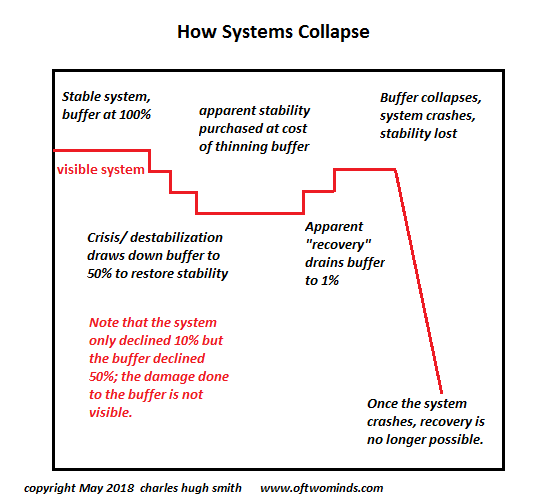
This self-serving mechanism hollows out and corrupts the economy, which consequently becomes increasingly fragile. The system's resilience (its buffers and ability to respond quickly and effectively to crises) erodes to near-zero, and one crisis or another that would have been handled in the past brings down the entire rotten edifice.
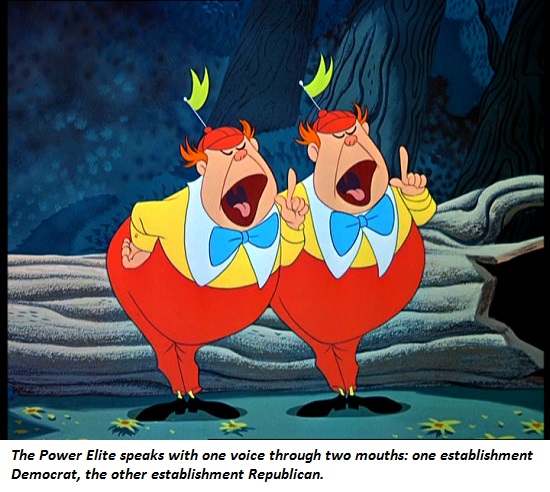
Here's the two-party system stripped to its essentials:
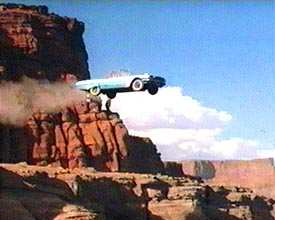
Here's our "leadership class" displaying their self-serving "leadership skills":
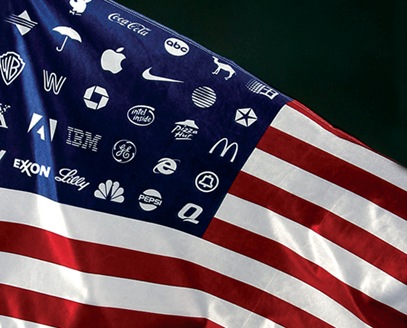
As the saying goes, follow the money:
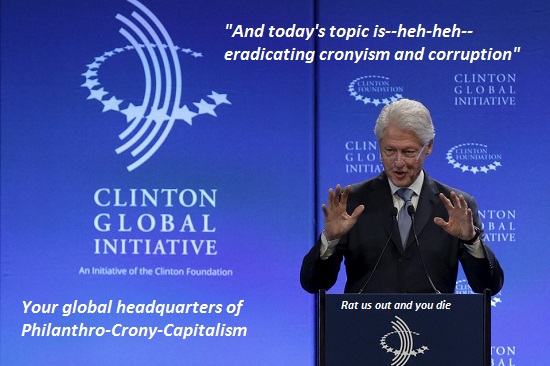
Philanthro-crony-capitalism is a favored pretense of self-serving elites: things can go south when the plunder reaches extremes, of course....
So keep this in mind when voting in this year's elections: you'll be promised "change" but real change is impossible because the real priority is preserving a self-serving, corrupt, bloated and unsustainable Status Quo by any means available.
You'll be told what you want to hear: the problems will all be fixed within the existing Status Quo. But the existing Status Quo is the source of the problems.Pretense feeds delusion which guarantees collapse.
As a reminder of how systems become fragile and collapse:


My new book Money and Work Unchained is $9.95 for the Kindle ebook and $20 for the print edition.
Read the first section for free in PDF format.


If you found value in this content, please join me in seeking solutions by becoming a $1/month patron of my work via patreon.com.

NOTE: Contributions/subscriptions are acknowledged in the order received. Your name and email remain confidential and will not be given to any other individual, company or agency.

Thank you, David M. ($5/month), for your supremely generous pledge to this site -- I am greatly honored by your support and readership.
 
Thank you, Carol A. J. ($5/month), for your splendidly generous pledge to this site -- I am greatly honored by your support and readership.

Read more...

Wednesday, June 06, 2018

The Three Crises That Will Synchronize a Global Meltdown by 2025

We're going to get a synchronized global dynamic, but it won't be "growth" and stability, it will be DeGrowth and instability.
To understand the synchronized global meltdown that is on tap for the 2021-2025 period, we must first stipulate the relationship of "money" to energy:"money" is nothing more than a claim on future energy. If there's no energy available to fuel the global economy, "money" will have little value.
The conventional economists assure us that energy is now a small part of the overall economy, so fluctuations in energy prices will have a limited effect on global prosperity. But what's left of global prosperity when energy is unable to meet current demand at any price that consumers can afford?
The current "economic understanding" of energy and "money" is an artifact of a unique period of cheap, abundant fossil fuels. It is an article of faith in economics that energy will always become cheaper and more abundant as the pixie-dust of technology is irreversible. By the time fossil fuels become scarce many decades hence, we'll all have cold-fusion generators, or micro-nuclear power plants or nearly free electricity from solar panels, and so on.
This is of course complete rubbish. To scale up any energy source to replace fossil fuels will require decades and tens of trillions of dollars in capital investment. In other words, energy development is a financial dynamic. Technology is only the first small piece of a much larger puzzle.
This becomes clear when we ponder the unwelcome reality that the fracking miracle has resulted in $250 billion in losses. You mean all those companies lost money exploiting the miracle technologies of fracking?
My point is profits are not guaranteed in any industry that requires trillions in new investment before it earns a positive return. The financial graveyard is littered with the carcasses of costly energy technologies that were supposed to "save industrial civilization" with some new clean source of essentially limitless energy.
Conventional economists also tend to overlook the impact of rising domestic consumption of oil exporting nations. A funny thing happens when domestic demand rises with population and prosperity; the exporting nation may pump the same quantity of oil, but there's no longer much left to export.
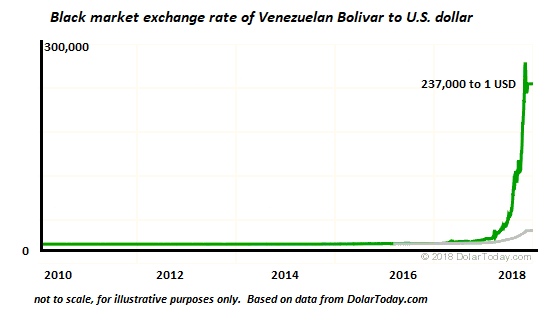
Then there's the fantasy that governments can't go broke because they can always print as much money as they need. Venezuela proves this is correct, right? Oops, sorry: Venezuela proved that this faith in the power of the central bank/government printing press is rubbish.
You can't print more oil. You can print more future claims on oil (i.e. "money"), but all that does is devalue the existing stock of "money." Print enough "money" and all your "money" loses its purchasing power.
Inflation has a peculiar feature: printing more "money" doesn't solve the decline in purchasing power of inflation, it accelerates the decline in purchasing power. The mainstream has grown accustomed to the fantasy that all financial difficulties can be solved by central banks creating more credit / "money." But when inflation in real-world essentials like energy kicks in, expanding the pool of "money" and credit won't solve the supply-demand imbalance--it will only devalue the purchasing power of all existing "money," impoverishing everyone holding "money."
The third crisis is governance: around the world, regardless of the ideology or form of governance, the quality and legitimacy of governance is crumbling. Ruling Elites are doing everything they can to keep the privileged-insiders-plundering status quo intact, but the Elites' policies are hollowing out their economies and weakening the buffers supporting increasingly fragile civil societies.
The financial, energy and governance buffers will all start collapsing in a global synchronized meltdown in the 2021 - 2025 period. Why synchronized? Because the global financial and energy markets are one system. Once the system's buffers collapse, everyone dependent on trade, global finance and energy will collapse in a domino effect that will start with the weakest periphery nations. No nation or empire will be immune, as all the major powers rely on "money" with phantom value and energy that can't be printed by central banks.
Here's my diagram of how buffers weaken beneath the phony facade of "endless prosperity":
Venezuela's "money" exemplifies the future of all "money,", including the euro, yen, yuan/RMB and the U.S. dollar. There is nothing inherently permanent or valuable in "money" printed by central banks or governments; they are nothing but fast-accumulating claims on a diminishing supply of future energy.
We're going to get a synchronized global dynamic, but it won't be "growth" and stability, it will be DeGrowth and instability. The harsh realities of energy, "money" and mis-governance will come home to roost, and all the fantasies that technology and central banks printing "money" will save us will dissolve into thin air.


My new book Money and Work Unchained is $9.95 for the Kindle ebook and $20 for the print edition.
Read the first section for free in PDF format.


If you found value in this content, please join me in seeking solutions by becoming a $1/month patron of my work via patreon.com.

NOTE: Contributions/subscriptions are acknowledged in the order received. Your name and email remain confidential and will not be given to any other individual, company or agency.

Thank you, Craig A. ($50), for your supremely generous contribution to this site -- I am greatly honored by your support and readership.
 
Thank you, Jim M. ($5/month), for your splendidly generous pledge to this site -- I am greatly honored by your support and readership.

Read more...

Sunday, June 03, 2018

Does Anyone Else See a Giant Bear Flag in the S&P 500?

We all know the game is rigged, but strange things occasionally upset the "easy money bet."
"Reality" is in the eye of the beholder, especially when it comes to technical analysis and economic tea leaves. It seems most stock market soothsayers are seeing a breakout of the downtrend that erupted in early February, and so the path to new all-time highs is clear.
Does anyone else see a giant bear flag pattern in the daily chart of the S&P 500? Maybe I'm the only one who sees a bearish signal instead of a bullish breakout.
What I see post-mini-crash is a bearish rising wedge which broke to the downside as rising wedges are wont to do.
What followed the rising wedge? A bear flag. As the name implies, Bear Flags are, well, bearish; they tend to break lower in a continuation of trend. The consensus of soothsayers seems to be that the trend is still bullish. I guess I'm the only one who sees lower highs since late January, something that doesn't strike me as evidence of a bullish trend, the definition of which is higher highs.
Having treaded water for the better part of the month, the Bollinger bands are now tightening, a condition that typically presages a major move up or down.
If the consensus is correct and the technical snapshot is 100% bullish (breakout, up-trend, etc.) then the next big move will be to the upside. Plummeting volatility (VIX) suggests the majority of punters are in the 100% bullish-signals camp.
If the tin-foil hat outlier (me) who sees a big fat bear flag is correct, the next big move will "surprise to the downside."
Meanwhile, a smaller camp of soothsayers expects a trendless chopfest, i.e. a continuation of May's up and down action within a tight trading range.
The roulette wheel is still spinning, so place your bets. We all know the game is rigged, but strange things occasionally upset the "easy money bet."


My new book Money and Work Unchained is $9.95 for the Kindle ebook and $20 for the print edition.
Read the first section for free in PDF format.


If you found value in this content, please join me in seeking solutions by becoming a $1/month patron of my work via patreon.com.

NOTE: Contributions/subscriptions are acknowledged in the order received. Your name and email remain confidential and will not be given to any other individual, company or agency.

Thank you, Blaise S. ($20), for your extremely generous contribution to this site -- I am greatly honored by your steadfast support and readership.
 
Thank you, Don B. ($60), for your splendidly generous contribution to this site -- I am greatly honored by your support and readership.

Read more...

Friday, June 01, 2018

The U.S. Economy In Two Words: Asymmetric Gains

The Status Quo is in trouble if the bottom 95% wake up to the asymmetric gains that are the only possible output of our hyper-financialized economy.
The core dynamic of the U.S. economy in this era is asymmetric gains: the gains in income, wealth and power are increasingly concentrated in the top slice of the economy and society, while the income, wealth and power of the majority stagnate or decline.
The Status Quo must paper over this widening gulf with threadbare narratives that no longer match reality: for example, we're an ownership society. We sure are: the vast majority of the nation's productive assets are owned by the top 5%.
The U.S. economy has changed, but the transformation is largely invisible to the average participant and conventional economist. The previous iteration of the economy expired in the 1970s, an era of stagflation (stagnant growth and rising inflation that eroded the purchasing power of most households), higher energy costs and increasing global competition, an era in which the "external costs" of industrial-scale pollution finally came home to roost and the early stages of digital technologies began impacting human labor.
Stocks and bonds were destroyed in the 1970s. Investing capital in industrial production no longer generated outsized profits.
The 1980s ushered in a New Economy based on financial magic: the outsized profits flowed to those with access to credit and the tools of financialization: buying assets with borrowed money, selling the assets off in the global marketplace and reaping enormous gains by producing no goods or services.
We now inhabit a hyper-financialized economy in which the only way to get ahead is to speculate. For the middle class, this means speculating in housing: if you hit the jackpot and your house soars in value, then leverage this new wealth into the cash needed to buy a second property--or extract the equity to fund a more luxe lifestyle.
Entrepreneurs seek to generate "value" only as a means of cashing out via an initial public offering or selling their company to a global corporation. The "value" sought now is the perception of value--the magic of future promise that boosts valuations into the millions, or better yet, billions.
How many entrepreneurs are looking forward to owning their company ten years hence? Very few, as "the long haul" has no value in a hyper-financialized economy. If you don't cash out in six months, your Big Idea might be worthless, leapfrogged by some other Big Idea.
In a hyper-financialized economy, hype is the most valuable skill. Those who can raise $100 million in capital for a fancy juicer win, as do those who sell the Big Idea to global corporations desperate not to miss out on the Next Big Thing.
In a hyper-financialized economy, future income is pulled into the present and monetized to benefit the top dogs. We borrow from the future to fund the inefficiencies of today. It's a great system, and the Status Quo has the answer to everything: the government can never go broke because all it has to do is print more money.
What a swell idea. Isn't that what Venezuela has done for the past decade?And how did that work for them? If you think that destroying the purchasing power of "money" is a winner, then by all means, go on believing that the government can never go broke because all it has to do is print more money.
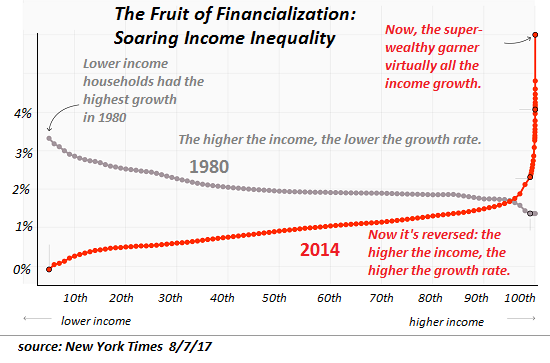
Here's my favorite chart of asymmetric gains. The vast majority of the gains reaped since the 2008-09 Global Financial Meltdown have flowed to the top .1%. This is not a bug, it is a feature of hyper-financialization. Indeed, it is the only possible output of the current system.
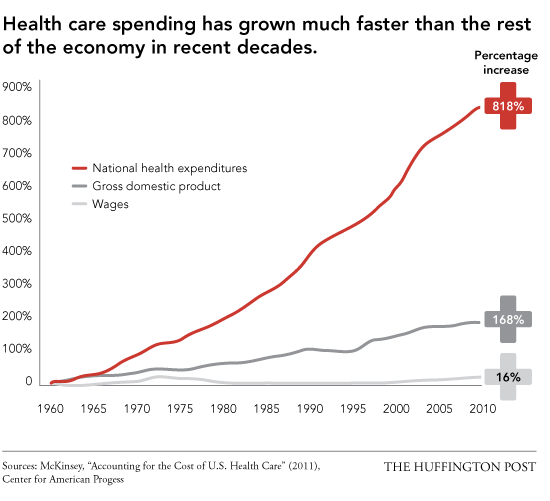
Meanwhile, the bottom 95% live in an economy where wages go nowhere and costs are soaring. The financial media cheers when wages (supposedly) rise by 2%, but nobody dares measure the impact of rising costs in services such as healthcare and higher education.
The Status Quo is in trouble if the bottom 95% wake up to the asymmetric gains that are the only possible output of our hyper-financialized economy.Hype and propaganda are the key tools of the present era, as these are required to disconnect perception from reality. How long the disconnect will last is anyone's guess, but when the two reconnect, all that is solid now will melt into thin air.


My new book Money and Work Unchained is $9.95 for the Kindle ebook and $20 for the print edition.
Read the first section for free in PDF format.


If you found value in this content, please join me in seeking solutions by becoming a $1/month patron of my work via patreon.com.

NOTE: Contributions/subscriptions are acknowledged in the order received. Your name and email remain confidential and will not be given to any other individual, company or agency.

Thank you, Mark and Christine C. ($25), for your extremely generous contribution to this site -- I am greatly honored by your support and readership.
Thank you, Kenneth A. ($50), for your splendidly generous contribution to this site -- I am greatly honored by your support and readership.

Read more...

Terms of Service

All content on this blog is provided by Trewe LLC for informational purposes only. The owner of this blog makes no representations as to the accuracy or completeness of any information on this site or found by following any link on this site. The owner will not be liable for any errors or omissions in this information nor for the availability of this information. The owner will not be liable for any losses, injuries, or damages from the display or use of this information. These terms and conditions of use are subject to change at anytime and without notice.

RE: European Union AI Act, and Our Use of Generative AI Tools and Agents Policy

All text on this site is composed by Charles Hugh Smith or by a credited guest-author. No Generative AI Tools are used in the composition / writing of any text or graphics/charts created by Charles Hugh Smith. This site deploys no AI agents . This site is not responsible for the disclosures, use or non-use of AI agents or generative AI tools in advertisements displayed by Investing Channel or other ad placement services.

Audio files (such as the KDP-generated audiobooks of my novels) generated by text-to-audio transcription tools are identified as such. The MP4 videos accompanying my original songs and the illustrations in my graphic novels are generated by AI tools. The story, scenes, characters and all descriptions and dialog of the graphic novels are composed solely by me..

Our Privacy Policy:

Correspondents' email is strictly confidential. This site does not collect digital data from visitors or distribute cookies. Advertisements served by third-party advertising networks such as Investing Channel may use cookies or collect information from visitors for the purpose of Interest-Based Advertising; if you wish to opt out of Interest-Based Advertising, please go to Opt out of interest-based advertising (The Network Advertising Initiative) If you have other privacy concerns relating to advertisements, please contact advertisers directly.

PRIVACY NOTICE FOR EEA INDIVIDUALS

This section covers disclosures on the General Data Protection Regulation (GDPR) for users residing within EEA only. GDPR replaces the existing Directive 95/46/ec, and aims at harmonizing data protection laws in the EU that are fit for purpose in the digital age. The primary objective of the GDPR is to give citizens back control of their personal data. Please follow the link below to access InvestingChannel's General Data Protection Notice.
https://stg.media.investingchannel.com/gdpr-notice/

Notice of Compliance with The California Consumer Protection Act

This site does not collect digital data from visitors or distribute cookies. Advertisements served by a third-party advertising network (Investing Channel) may use cookies or collect information from visitors for the purpose of Interest-Based Advertising. If you do not want any personal information that may be collected by third-party advertising to be sold, please follow the instructions on this page: Do Not Sell My Personal Information.

Regarding Cookies:

This site does not collect digital data from visitors or distribute cookies. Advertisements served by third-party advertising networks such as Investing Channel may use cookies or collect information from visitors for the purpose of Interest-Based Advertising; if you wish to opt out of Interest-Based Advertising, please go to Opt out of interest-based advertising (The Network Advertising Initiative) If you have other privacy concerns relating to advertisements, please contact advertisers directly.

Our Commission Policy:

Though I earn a small commission on Amazon.com books and gift certificates and gold (BullionVault) purchased via links on my site, I receive no fees or compensation for any other non-advertising links or content posted on my site.

Copyright Notice:

All original images (Drawings and Photographs), text (essays, books and works of fiction), audio and video recordings, musical compositions, graphic design, graphic design elements and HTML coding on this site are the copyrighted work of Charles Hugh Smith unless otherwise credited or noted. They are published as information for the private use of site visitors, and any reproduction or redistribution of this content or coding in any media in any format or distribution channel (text, audio, video/film, web) without the written permission of the copyright holder is strictly prohibited. All rights in all media reserved globally.

  © Blogger templates Newspaper III by Ourblogtemplates.com 2008

Back to TOP