





Monday, May 06, 2019

What Would It Take to Spark a Rural/Small-Town Revival?

There are many historical models in which the spending/investing of wealthy families drives the expansion of local economies.
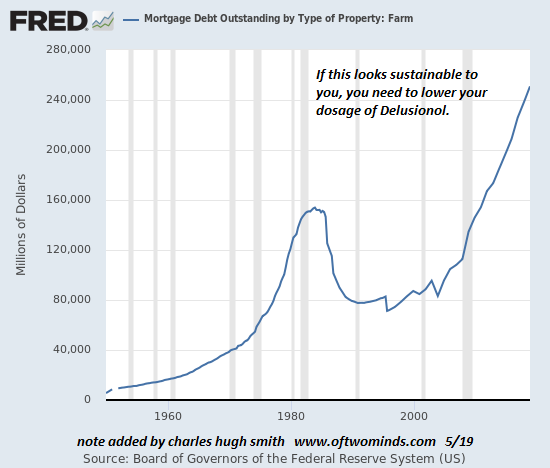
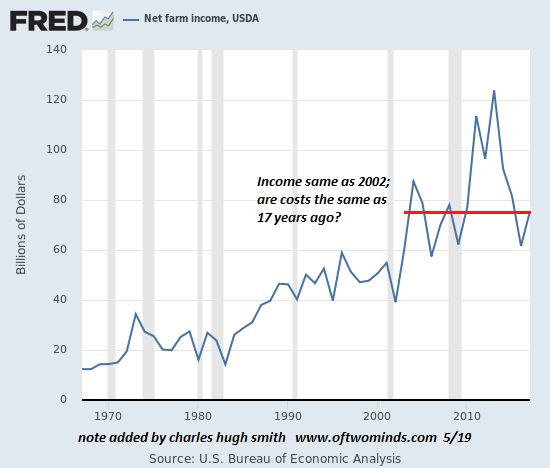
The increase in farm debt while farm income declines is putting unbearable financial pressure on American farmers, who must be differentiated from giant agri-business corporations. This is placing immense pressure on farmers, pressure which manifests in rising suicide rates.
If this isn't the nadir of rural America, it's certainly close.
This decline of financial viability and sharp rise in stress isn't limited to rural America. The decline of rural regions and small towns is a global phenomenon, and the causes are many but boil down to two primary dynamics:
1. Cities and megalopolises (aggregations of cities, suburbs and exurbs) attract capital, infrastructure, markets, talent and government spending, and these are the engines of job creation. People move to cities to find jobs and opportunities.
As an example, consider the San Francisco Bay Area megalopolis of roughly 7.6 million people in 9 counties and 101 cities. The region added over 400,000 new jobs since the 2008-09 Global Financial Crisis and over 1 million additional residents since the early 2000s.
In effect, the region absorbed an entire new city with 400,000 jobs and 1 million residents. Roads and public transport did not expand capacity, and housing construction lagged. As a result, traffic is horrific, homelessness endemic and housing costs are unaffordable to all but the favored few.
Rural / small town regions cannot match these employment opportunities and so people move, reluctantly or enthusiastically, to overcrowded, horrendously costly urban zones to find jobs.
2. Globalization has lowered the cost of agricultural commodities by exposing every locality to globally set prices (supply and demand) which are also distorted by currency fluctuations.
The relatively low cost of fuels has enabled produce from thousands of miles away to be shipped to supermarkets virtually everywhere.
These mega-trends have slashed farming incomes while costs have risen across the board. This squeeze as revenues decline and costs increase has driven even the most diligent and devoted farmers out of business or reduced them to hanging on by a thread.
What would it take reverse these trends?
1. The price of agricultural commodities and products would have to triple or quadruple, so that farming would become lucrative and attract capital and talent.
Imagine an economy where ambitious people wanted to get into agriculture rather than investment banking. It's a stretch to even imagine this, but if energy suddenly became much more expensive and crop failures globally became the norm due to fungi, plant viruses and pests that can no longer be controlled and adverse weather patterns, this could very rapidly change the price of ag products to the benefit of local producers.
Another potential dynamic is the decline of global trade due to geopolitical issues and domestic politics, i.e. the desire to reshore "strategic industries" such as food production regardless of the higher costs such a trend might cause.
The repudiation of finance as the engine of economic "growth" (or pillage, if we remove the gloves) and the prioritization of real-world production are also trends that could arise as the financial bubbles pop and cannot be reinflated with the usual central bank trickery.
2. Wealthy owners of capital tire of unlivable cities and move to small towns, bringing their capital and entrepreneurial drive with them.
There are many historical models in which the spending/investing of wealthy families drives the expansion of local economies. Colonial America and the Roman countryside are two examples of this dynamic.
When capital flows to small towns, jobs are created as the wealthy hire people to serve their needs. These new jobs create new markets for small businesses, and these new opportunities attract new capital.
Some owners of capital are passive owners, collecting rents from afar and spending this income in the local small-town economy. Others are restless entrepreneurial types who will fund new local businesses as a challenge or as an opportunity that's been ignored in the mad rush to sprawling unaffordable cities.
Both kinds of owners bring new spending and investment.
Wealth enables this class to bring its luxuries and desires with it, and so cultural activities favored by the wealthy get funding they never had before.
Wealthy types follow leaders just like everyone else, and once they hear of wealthy people extolling "the good life" in a small town, they investigate this option in a way they would never have done before.
Thus capital attracts capital, opens market opportunities, increases employment and starts attracting talent which is frustrated by the high costs and competition of the megalopolises.
Why would wealthy owners of capital move from places like Los Angeles, San Francisco, Seattle and New York City to small towns?
Any urban dweller in an overcrowded megalopolis can give you the answer: the traffic is unbearable, homeless is expanding, taxes and costs are skyrocketing and so on. The cultural benefits the city offers are increasingly outweighed by the friction, even for the wealthy.
What would cause the trickle of wealthy people leaving cities to swell into a mini-flood? A recession that guts tax revenues would cause cities and counties to raise taxes and fees, many aimed specifically at the rich, while reducing spending on the intractable problems of traffic, homelessness, public education, etc.
Most city dwellers cannot leave for lower cost climes because they need the higher income of city employment and they have a stake in the real estate market via a home they own and a mortgage to pay.
The wealthy, whose income is derived from capital rather than solely labor, have the financial freedom to leave the city but retain much of their income.
If both of these trends manifest, we might see those who can abandoning increasingly unlivable cities for lower cost, safer and more livable small towns.
The only other development that would restore urban-rural balance is the collapse of the entire neo-feudal (neoliberal) regime, including fiat currencies, central banking, financialization and financialized globalization.
In the near term, scarcities that drive agricultural prices higher and people fleeing unlivable, unaffordable cities are likelier possibilities.
My book Money and Work Unchained is now $6.95 for the Kindle ebook and $15 for the print edition. Read the first section for free in PDF format.

If you found value in this content, please join me in seeking solutions by becoming a $1/month patron of my work via patreon.com. New benefit for subscribers/patrons: a monthly Q&A where I respond to your questions/topics.

NOTE: Contributions/subscriptions are acknowledged in the order received. Your name and email remain confidential and will not be given to any other individual, company or agency.
 
Thank you,Jim H. ($5/month), for your splendidly generous pledge to this site-- I am greatly honored by your support and readership.
 

Read more...

Sunday, May 05, 2019

Good Riddance to a "Nothing-Burger" Trade Deal

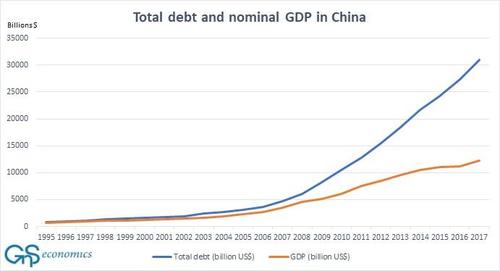
China has expanded its domestic debt to fund its growth, much of which qualifies as malinvestment, creating financial vulnerabilities its government is anxious to mask.
As I noted in Trade Deal Follies: The U.S. Has Embraced the World's Worst Negotiating Tactics (April 8, 2019), the trade deal was a Nothing-Burger for the U.S. Without any consequences for violating trade deals, China violates all trade deals, starting with the WTO. (As an example, China has never reported its state subsidies to Huawei to the WTO as required by that treaty.)
The only trade deal that wouldn't be a Nothing-Burger for the U.S. is one that explicitly gives the U.S. the sole power to decide if the deal has been violated and impose the consequences. Agreements without monitoring, enforcement and severe consequences are meaningless.
Developing nations are prone to cheating on trade agreements, and developed nations are prone to letting them cheat. It's a simple matter of incentives and self-interest. Developing nations do not have the resources to develop technologies from scratch, so they steal it by reverse engineering, theft of intellectual property (IP) and industrial espionage.
Developed nations are desperate for the new markets, cheap labor and resources of developing nations, so they overlook technology and IP theft as the "cost" of accessing the benefits of new markets, cheap labor and resources.
As a general rule, developing nations want capital to build out industry and markets for their goods (manufacturing) and commodities. Developed worlds are typically post-industrial for a variety of reasons, and what they want is open markets for their services (finance, insurance, entertainment, etc.).
Developing nations have tremendous incentives to limit the goods and services from developed nations, as these would provide too much competition for the domestic sectors they need to build for their export model of development and for domestic employment.
These tensions build as developing nations become wealthier and the inequalities of the trade and capital flows widen. When the developing nations reaches the point of competing in the global market with the developed nations, then the developed nations naturally demand that the playing field become level.
China is two economies: one developed and wealthy along the coast, the other rural and impoverished. China's domestic strategy is to shift capital from the coast to the impoverished interior to raise the standard of living of its 600 million rural residents.
By any historical measure, the wealthy coast is a developed nation, and so naturally the developed nations want to level the playing field: they want China to open its domestic markets to foreign capital without demanding technology transfers, open domestic markets to foreign services and stop China's officially sanctioned wholesale industrial espionage and theft of IP.
But the western interior of China is still a developing nation, and so by averaging the per capita GDP and income of its two halves, China can claim to be a developing world in terms of trade deal breaks while claiming superpower status for its developed half.
China can't have it both ways: if China can afford an army, navy, space program and power projection of a superpower, as well as a global currency, it can't claim any implicit "right" to trade deals with no enforcement or consequences, nor can it expect to get a free pass to brazenly flout every deal it signs.
China's leadership has gotten spoiled; it expects the world to cave in to its demands to developing-world trade breaks while it lays claim to superpower status.
China is rapidly expanding its military power and technologies, but it doesn't have deep, global capital markets or a currency that can become a reserve currency, for the reason I've explained here many times: to have a reserve currency, the issuing nation must run a permanent and substantial trade deficit to supply the world with enough of its currency to be useful.
Additionally, the issuing nation must "give away" some of its currency via grants and subsidies to supply nations which would otherwise have limited access to the currency. It must also have deep, liquid capital markets so foreign nations and entities can borrow the currency in size.
China has been accused of "debt diplomacy" because it forces all its Belt and Road partners to take loans. By forcing loans, China isn't emitting any of its currency; it's actually extracting interest payable in other currencies--the exact opposite of establishing a reserve currency.
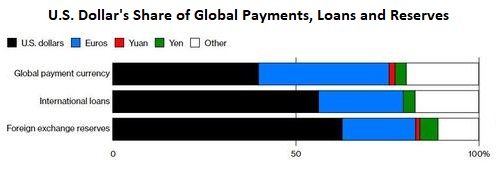
This reality is reflected in the near-zero role China's currency (RMB, a.k.a. yuan) plays in the global economy:
All of which is to say that China needs the world's markets and capital--especially U.S. dollars to service its vast USD-denominated debt. China isn't self-sufficient and so it doesn't have the leverage to demand much of its trading partners. Rather, China has expanded its domestic debt to fund its growth, much of which qualifies as malinvestment, creating financial vulnerabilities its government is anxious to mask.
As for the much-touted leverage of China's ownership of U.S. Treasuries, that's also a Nothing-Burger. China's stash of Treasuries has been around $1 trillion for many years. The Federal Reserve created $4 trillion out of thin air, and issued loans and guarantees of around $29 trillion in the Global Financial Meltdown. The Federal Reserve could buy China's entire stash with newly created currency and the market wouldn't even notice.
The Treasury market is so large and liquid, the Fed and its private-sector proxies could soak up China's $1 trillion without batting an eye.
Trade deals have to work for both parties. China has to accept that becoming a developed nation means the implicit free passes granted to developing nations are no longer available. It has to start following the agreements it signs, or it loses access to capital and goods markets it needs.


Pathfinding our Destiny: Preventing the Final Fall of Our Democratic Republic ($6.95 ebook, $12 print, $13.08 audiobook): Read the first section for free in PDF format.


My new mystery The Adventures of the Consulting Philosopher: The Disappearance of Drake is a ridiculously affordable $1.29 (Kindle) or $8.95 (print); read the first chapters for free (PDF)
My book Money and Work Unchained is now $6.95 for the Kindle ebook and $15 for the print edition. Read the first section for free in PDF format.


If you found value in this content, please join me in seeking solutions by becoming a $1/month patron of my work via patreon.com. New benefit for subscribers/patrons: a monthly Q&A where I respond to your questions/topics.

NOTE: Contributions/subscriptions are acknowledged in the order received. Your name and email remain confidential and will not be given to any other individual, company or agency.
 
Thank you, Pat ($5/month), for your marvelously generous pledge to this site-- I am greatly honored by your support and readership.
 

Read more...

Thursday, May 02, 2019

Income Inequality and the Decline of the Middle Class in Two Charts

Now look at the middle quintiles--the middle class: their income has gone nowhere in the past decade.
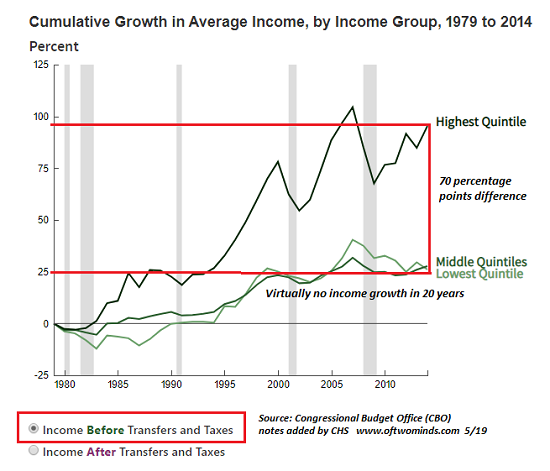
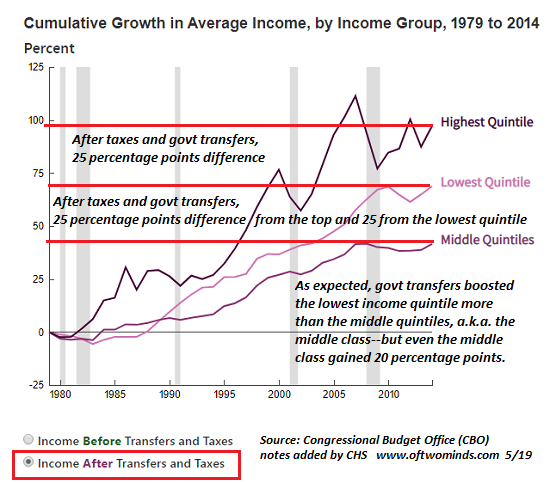
These two charts of average incomes of U.S. households by quintile (bottom 20%, middle 60% (20%+20%+20%) and top 20%) have both good news and bad news. (Charts are from the non-partisan Congressional Budget Office -- CBO).
These charts depict 1) household income before transfers (means-tested government benefits) and taxes, in other words, pre-tax earned income, income from capital gains and interest, unemployment insurance, etc., and 2) income after federal transfers and taxes.
This is a much more accurate view of household income, as this is what gets deposited in households' accounts.
The typical chart of average incomes doesn't include government transfers, so it under-reports the actual income of households receiving means-tested government benefits. (Note that the CBO methodology may not include all government transfers, as not all transfers are means-tested, i.e. based on income and other qualifying factors.)
The CBO reports periodically on the Distribution of Household Income and Federal Taxes, but it doesn't generate these charts every year. (Go to Congressional Budget Office reports and scroll down to Distribution of Household Income and Federal Taxes).
Here's the CBO's summary of what the charts depict:
Means-tested transfers and federal taxes cause household incomes to be more evenly distributed. Those transfers and taxes:
Increased income among households in the lowest quintile by $12,000 (or more than 60 percent), on average, to $31,000.
Decreased income among households in the highest quintile by $74,000 (or more than 25 percent), on average, to $207,000.
While the gap between $31,000 and $207,000 is the core issue in rising income inequality, taxes and means-tested programs do make a big difference:a 60% gain in household income is significant.
As for the top 20%, this income is heavily skewed by the top 0.1%, those earning millions or tens of millions of dollars annually. A more accurate look can be found here:Summary of the Latest Federal Income Tax Data, 2018 Update.
Note that the charts depict cumulative income growth as percentages, with zero being set in 1979.
Let's call this the good news: yes, income inequality is soaring, but America's progressive tax system (the wealthy pay higher rates) and government programs transfer income from the top households to the bottom households--pretty much in line with the political mandate of the majority of Americans.
The bad news is the middle class has received no real income gains in the past 20 years, and they don't qualify for many means-tested transfers. I've marked the charts up to highlight this.
In the income before transfers and taxes chart, the lowest and the middle quintiles are about where they were in 1999. Both gained ground in the 2005-08 housing bubble, but as with all bubbles, the effects only lasted as along as the bubble itself.
Since the top quintile's income accelerated away from the bottom 80% in the early 1990s, there is a 70 percentage point gap between the top 20% and the bottom 80%. I've addressed the reasons for soaring income-wealth inequality here many times, but the key takeaway is the enormous gains reaped by the top 20% during asset bubbles, which are the consequence of financialization and central bank-fueled speculation.
In the income after transfers and taxes chart, the gap between lowest and top quintiles drops from 70 to 25 percentage points: a big reduction. After transfers, the lowest quintile income has gained steadily since the late 1980s. If we eliminate the asset bubble peaks, the gap between the top and bottom quintiles hasn't grown that much.
Now look at the middle quintiles--the middle class: their income has gone nowhere in the past decade. Both the top and bottom quintiles have notched percentage gains in income while middle class income has stagnated.
And there you have it: financialization, central bank-fueled speculation and globalization greatly boosted the incomes of the top 20%, while government transfers have significantly increased the incomes of the bottom 20% of households.
The middle 60%, who did not benefit from the credit-fueled orgies of speculative bubbles (financialization) or globalization, and who do not qualify for many means tested transfers, have experienced near-zero income growth in the past decade of "recovery" and soaring asset bubbles.
We all know this from real-life experience in America: it pays to be either wealthy or low-income (especially if the household getting means-tested benefits also works in the black-market informal economy for cash). As for the middle 60%: you get nothing.


Pathfinding our Destiny: Preventing the Final Fall of Our Democratic Republic ($6.95 ebook, $12 print, $13.08 audiobook): Read the first section for free in PDF format.


My new mystery The Adventures of the Consulting Philosopher: The Disappearance of Drake is a ridiculously affordable $1.29 (Kindle) or $8.95 (print); read the first chapters for free (PDF)
My book Money and Work Unchained is now $6.95 for the Kindle ebook and $15 for the print edition. Read the first section for free in PDF format.


If you found value in this content, please join me in seeking solutions by becoming a $1/month patron of my work via patreon.com. New benefit for subscribers/patrons: a monthly Q&A where I respond to your questions/topics.

NOTE: Contributions/subscriptions are acknowledged in the order received. Your name and email remain confidential and will not be given to any other individual, company or agency.
 
Thank you, David L. ($5/month), for your marvelously generous pledge to this site-- I am greatly honored by your support and readership.
 

Read more...

Wednesday, May 01, 2019

The Accelerating Decay of the Middle Class

Ironically, their ample compensation allows them to avoid the poor-quality services they've designed for everyone below them.
If we define middle class by the security of household income and what that income can buy rather than by an income level, what do we conclude? We have little choice but to conclude the middle class is decaying, both in the percentage of the workforce that qualifies as "middle class" according to traditional standards and in the quality of life of those who do qualify.
There's a longstanding way to understand the middle class quality of life: it's supposed to be superior to the indignities of being poor. If you've been poor (and I've been down to my last $100), even for short periods, you know the indignities and frictions of being poor (and by poor I don't mean on welfare, I mean working poor, with unreliable incomes and low wages).
Being middle class meant being able to escape the hassles and indifferent services that await the poor. Fast-forward to today: what day-to-day tasks and interactions are easy and cost-free for the middle class? How many are nightmarish, complicated, frustrating, and costly?
Virtually all of them. Being "middle class" is no longer a buffer to the indignities and friction of a dysfunctional, costly status quo that only serves the wealthy with anything resembling what was once afforded the middle class.
No wonder what remains of the middle class is so anxious to qualify for "elite" airline miles programs and similar "special" service, because it approximates what every middle class person once expected as the norm.
In terms of the quality of life and of services, the bottom 95% is now poor. Can you really contest this, or is contesting a matter of hurt pride?
What qualifies as middle class? I've defined it by characteristics rather than income: starting with What Does It Take To Be Middle Class? (December 5, 2013), I've used 12 minimum standards of membership that were implicit characteristics of the conventional middle class a generation ago:
1. Meaningful healthcare insurance ($5,000 deductible plans don't qualify, and neither does government-provided low-income coverage such as Medicaid.)
2. Significant equity (25%-50%) in a home or other real estate
3. Income/expenses that enable the household to save at least 6% of its income
4. Significant retirement funds: 401Ks, IRAs, etc.
5. The ability to service all debt and expenses over the medium-term if one of the primary household wage-earners lose their job
6. Reliable vehicles for each wage-earner
7. If a household requires government assistance to maintain the family lifestyle, their Middle Class status is in doubt.
8. A percentage of non-paper, non-real estate hard assets such as family heirlooms, precious metals, tools, etc. that can be transferred to the next generation, i.e. generational wealth.
9. Ability to invest in offspring (education, extracurricular clubs/training, etc.) without going into debt to pay for the extracurricular activities.
10. Leisure time devoted to the maintenance of physical/spiritual/mental fitness.
11. Continual accumulation of human and social capital (new skills, networks of collaborators, markets for one's services, etc.)
12. Family ownership of income-producing assets such as savings bonds, etc.
To these core attributes we might add the host of services that are being cut back or eliminated en masse listed in yesterday's guest post, ‘Workarounds’ Galore: How Real Americans Deal with ‘Real’ Inflation: attending sporting events, regular haircuts, dry-cleaning, membership in service clubs and country clubs, and dozens of other once-standard benefits of middle class life.
The decay of this standard of living is not just quantitative, it's qualitative. The quality of life available to those with middle class incomes is decaying on two fronts: quantitatively, households can no longer afford services and activities, and what they can afford is of lower quality, both the goods and the services.
I touched on this in The Erosion of Everyday Life, but I only scratched the surface of the accelerating decay of the quality of services available to what remains of the middle class.
Do you get excellent service from automated Corporate America customer service? You must be joking if you answer "yes."
The point here is the quality has been stripped out of Corporate America's products and services to maximize quarterly profits. Whatever digital device that lasts more than a few years is obsoleted by some software "upgrade" that forces customers to buy a new device.
The quality of government services has also decayed, often to the point of dysfunction. Try getting a double-billing from a local government agency cleared up. Try getting the potholes on your local street that doubles as a bikeway (so the city can brag it's bicycle-friendly) filled in less than a few years. And so on.
People in customer service and public service are doing their best, but they're often hobbled by inefficient work rules, outdated equipment and software (or software that simply doesn't function properly), poor training, overzealous compliance, staffing shortages, maxed-out managers and other hindrances to quality service.
As for the security of household income--at least one wage earner has to work for the government or a government-funded industry such as education, healthcare or defense to have even minimum security. Private-sector security simply doesn't exist outside of the quasi-government sectors which are largely or completely funded by government.
Let's not forget the insecurity of traditional middle class assets such as the family home and pensions. The family home has plenty of equity at the top of the bubble du jour, not so much when the bubble pops. The 401K retirement fund exudes security at the top of the bubble, not so much after it crashes. The pension is only as good as the pension fund and its annual growth rate, both of which are contingent on forces beyond the reach of the pension managers.
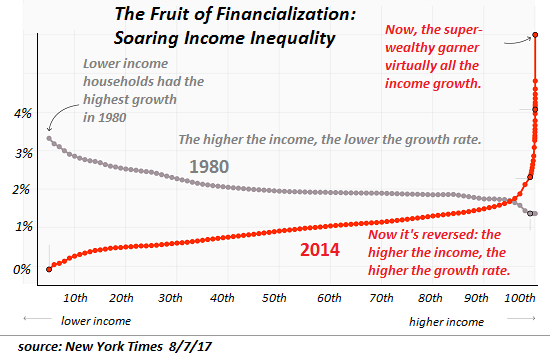
Yes, the super-wealthy have siphoned off most of the gains in income and wealth generated by financialization as shown on this chart. But that's only part of the picture, as that only impacts income and capital--it doesn't measure the decay of purchasing power and the quality of life available to everyone below the top of the wealth-power pyramid.
Many of the most richly compensated people in our economy are those who figure out ways to eliminate costs by degrading quality and service. Ironically, their ample compensation allows them to avoid the poor-quality services they've designed for everyone below them.
Of related interest:
My book Money and Work Unchained is now $6.95 for the Kindle ebook and $15 for the print edition. Read the first section for free in PDF format.


If you found value in this content, please join me in seeking solutions by becoming a $1/month patron of my work via patreon.com. New benefit for subscribers/patrons: a monthly Q&A where I respond to your questions/topics.

NOTE: Contributions/subscriptions are acknowledged in the order received. Your name and email remain confidential and will not be given to any other individual, company or agency.
 
Thank you, David L. ($5/month), for your marvelously generous pledge to this site-- I am greatly honored by your support and readership.
 

Read more...

Terms of Service

All content on this blog is provided by Trewe LLC for informational purposes only. The owner of this blog makes no representations as to the accuracy or completeness of any information on this site or found by following any link on this site. The owner will not be liable for any errors or omissions in this information nor for the availability of this information. The owner will not be liable for any losses, injuries, or damages from the display or use of this information. These terms and conditions of use are subject to change at anytime and without notice.

RE: European Union AI Act, and Our Use of Generative AI Tools and Agents Policy

All text on this site is composed by Charles Hugh Smith or by a credited guest-author. No Generative AI Tools are used in the composition / writing of any text or graphic content created by Charles Hugh Smith. This site deploys no AI agents or generative AI tools. This site is not responsible for the disclosures, use or non-use of AI agents or generative AI tools in advertisements displayed by Investing Channel or other ad placement services.

Audio files generated by text-to-audio transcription tools are identified as such.

Our Privacy Policy:

Correspondents' email is strictly confidential. This site does not collect digital data from visitors or distribute cookies. Advertisements served by third-party advertising networks such as Investing Channel may use cookies or collect information from visitors for the purpose of Interest-Based Advertising; if you wish to opt out of Interest-Based Advertising, please go to Opt out of interest-based advertising (The Network Advertising Initiative) If you have other privacy concerns relating to advertisements, please contact advertisers directly.

PRIVACY NOTICE FOR EEA INDIVIDUALS

This section covers disclosures on the General Data Protection Regulation (GDPR) for users residing within EEA only. GDPR replaces the existing Directive 95/46/ec, and aims at harmonizing data protection laws in the EU that are fit for purpose in the digital age. The primary objective of the GDPR is to give citizens back control of their personal data. Please follow the link below to access InvestingChannel's General Data Protection Notice.
https://stg.media.investingchannel.com/gdpr-notice/

Notice of Compliance with The California Consumer Protection Act

This site does not collect digital data from visitors or distribute cookies. Advertisements served by a third-party advertising network (Investing Channel) may use cookies or collect information from visitors for the purpose of Interest-Based Advertising. If you do not want any personal information that may be collected by third-party advertising to be sold, please follow the instructions on this page: Do Not Sell My Personal Information.

Regarding Cookies:

This site does not collect digital data from visitors or distribute cookies. Advertisements served by third-party advertising networks such as Investing Channel may use cookies or collect information from visitors for the purpose of Interest-Based Advertising; if you wish to opt out of Interest-Based Advertising, please go to Opt out of interest-based advertising (The Network Advertising Initiative) If you have other privacy concerns relating to advertisements, please contact advertisers directly.

Our Commission Policy:

Though I earn a small commission on Amazon.com books and gift certificates and gold (BullionVault) purchased via links on my site, I receive no fees or compensation for any other non-advertising links or content posted on my site.

Copyright Notice:

All original images (Drawings and Photographs), text (essays, books and works of fiction), audio and video recordings, musical compositions, graphic design, graphic design elements and HTML coding on this site are the copyrighted work of Charles Hugh Smith unless otherwise credited or noted. They are published as information for the private use of site visitors, and any reproduction or redistribution of this content or coding in any media in any format or distribution channel (text, audio, video/film, web) without the written permission of the copyright holder is strictly prohibited. All rights in all media reserved globally.

  © Blogger templates Newspaper III by Ourblogtemplates.com 2008

Back to TOP