
Tuesday, May 14, 2019

The Economy Has Fundamentally Changed in the 21st Century--and Not for the Better

The net result is we have an economy that's supposedly expanding smartly while our well-being and financial security are collapsing.
Gross Domestic Product (GDP) and other metrics of economic activity don't measure either broad-based prosperity or well-being. Elites skimming financialization profits by expanding corporate debt and issuing more loans to commoners while spending more on their lifestyles boosts GDP quite nicely while the security and well-being of the bottom 90% plummets.
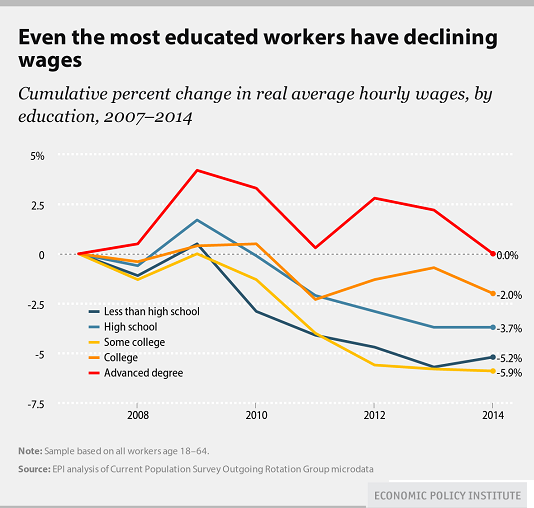
Under the hood of "recovery" and a higher GDP, life has gotten harder and more insecure for the bottom 90%. The key is not to look just at wages (trending up, we're assured) or inflation (near-zero, we're assured) but at aspects of daily life (lived experience) that cannot be captured by conventional economic / financial attempts at quantifying the economy.
How do we quantify the cost of the financial anxiety provoked by huge insurance deductibles or staggering healthcare bills? What matters isn't just whether the patient or their family has to declare bankruptcy because they can't afford the enormous co-pays: what matters is the debilitating stress caused by having to decide between risking an operation and bankrupting the family or foregoing the operation and hoping for a miracle.
Or how about the eventual cost of foregoing healthcare except in emergencies due to having to pay cash for any care due to the high deductibles?
Small stresses add up, leading to chronic stress and a host of debilitating consequences. Consider the daily commute to work, which has become longer and more stressful due to increasing congestion and the limits of public transport infrastructure that hasn't been improved or expanded in decades.
Why New York City Stopped Building Subways (via Mark G.) Unlike most other great cities, New York’s rapid transit system remains frozen in time: Commuters on their iPhones are standing in stations scarcely changed from nearly 80 years ago.
Then there's financial insecurity. Where is the measure of financial insecurity? How do we quantify the erosion of secure pensions and stable home prices? The average Social Security monthly benefit for 2019 is $1,462, which isn't enough to rent a studio in many urban areas, and tens of millions of lower-income retirees receive considerably less than this princely sum.
The family home remains the mainstay of middle-class wealth, but its value is now determined by credit bubbles and busts and the relative burdens of property taxes. In the pre-financialization / pre-neoliberal era, house prices tended to rise by a modest percentage over time, more or less the equivalent of a savings account drawing interest as the homeowner paid down the principal and accrued equity.
Now every homeowner has been transformed into a gambler who must time the market swings when buying or selling. One mistake can wipe out decades of paper gains. How do we quantify this erosion of the reliability and safety of homes' market valuations?
Everyone with their retirement savings in a 401K or IRA is also now a gambler whether they accept that reality or not. In a global economy of historically low yields on safe investments such as government bonds, households playing it safe are punished with near-zero or negative returns, while households that put all their money oin the stock market roulette game have been richly rewarded to date.
But the security of stock market gains is illusory: rather than reflect the fundamentals of the corporations, stock valuations reflect the Federal Reserve's decision to make the stock market the signifier of economic growth: if the market is rising, the economy is doing well.
Why did they do this? Manipulating stocks higher is easy: just push low-cost liquidity into the financial system and much of it will end up in stocks or corporate buybacks which boost shares valuations by reducing the number of shares outstanding.
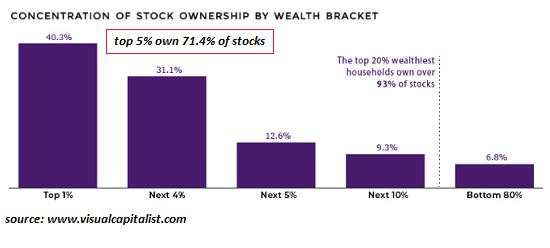
The other factor is the concentration of stock ownership in the politically powerful hands of elites. Should the market threaten to crash, wealthy donors and their lobbyists will let the regulators and politicos know they're not happy that their enormous wealth is at risk of dwindling.
Fed goosing and corporate buybacks are not solid foundations. All such manipulations eventually founder on the shoals of reality, and everyone who thought their retirement funds in stocks was as safe as a savings account will discover that risk can be masked but it can't be made to disappear.
The Neoliberal Project of making everything into a tradable market has dominated the 21st century economy. The concept is appealing: by making everything into a competitive market, prices will drop as efficiencies and innovations take hold, and financial markets will benefit as everything that's being commoditized can be packaged, marketed and sold globally.
So a designed-to-default subprime mortgage security can be sold to a pension fund in Norway as "low-risk," heh.
This happy story of the wunnerful benefits of turning everything into a tradable market is not what actually happened. What actually happened is that the new markets were quickly dominated by monopolies and cartels, and previously safe assets were financialized and securitized, in effect stripmining the unwary of their income and assets.
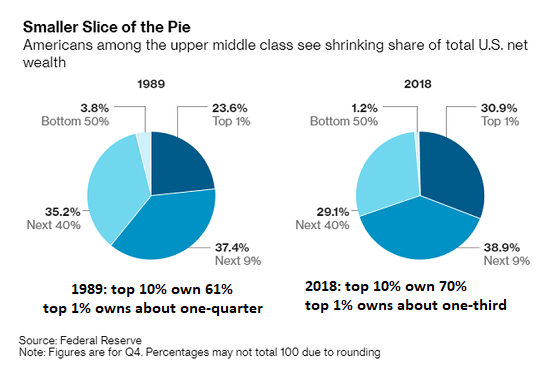
Neoliberal financialization and Fed goosing of risk assets are why the nation's wealth has become increasingly concentrated in the hands of financial elites.As you can see in the charts below, the gains reaped by the top 10% were concentrated in the top 1%, and the gains of the top 1% have been concentrated in the top .01%.
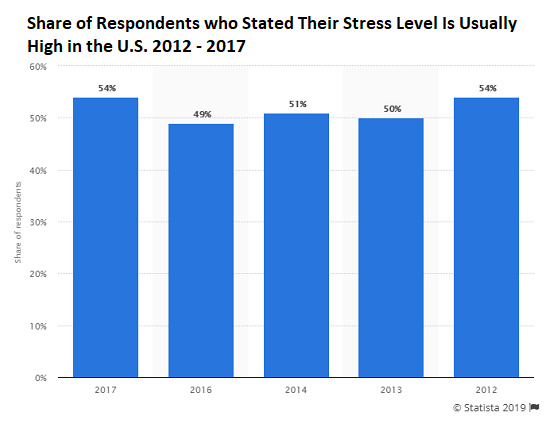
As I noted in Burnout Nation, the precarious nature of employment and rising workloads are reducing well-being across the board. Again, the tools to accurately quantify the internal states of security and well-being are not the equivalent of measuring GDP: much of the data comes from self-reporting, which is skewed by Americans' belief that everybody should be upbeat and positive, so we tend to report what others want to hear.
The net result is we have an economy that's supposedly expanding smartly while our well-being and financial security are collapsing. As I often note here: we optimize what we measure, and if we measure what doesn't really matter then we're optimizing the wrong things.


Pathfinding our Destiny: Preventing the Final Fall of Our Democratic Republic ($6.95 ebook, $12 print, $13.08 audiobook): Read the first section for free in PDF format.


My new mystery The Adventures of the Consulting Philosopher: The Disappearance of Drake is a ridiculously affordable $1.29 (Kindle) or $8.95 (print); read the first chapters for free (PDF)
My book Money and Work Unchained is now $6.95 for the Kindle ebook and $15 for the print edition. Read the first section for free in PDF format.


If you found value in this content, please join me in seeking solutions by becoming a $1/month patron of my work via patreon.com. New benefit for subscribers/patrons: a monthly Q&A where I respond to your questions/topics.

NOTE: Contributions/subscriptions are acknowledged in the order received. Your name and email remain confidential and will not be given to any other individual, company or agency.
 
Thank you, Richard P. ($50), for your marvelously generous contribution to this site-- I am greatly honored by your steadfast support and readership.
 

Read more...

Monday, May 13, 2019

Burnout Nation

The economic and financial stresses will exceed the workforce's carrying capacity in the next recession.
A number of recent surveys reflect a widespread sense of financial stress and symptoms of poor health in America's workers, particularly the younger generations. There's no real mystery as to the cause of this economic anxiety:
-- competition for secure, well-paid jobs that were once considered the birthright of the middle class is increasingly fierce;
-- the pay and predictability of the jobs that are available are low;
-- high-paying jobs are extraordinarily demanding, forcing workers to sacrifice everything else to keep the big-bucks position;
-- the much-lauded gig economy is tracking the Pareto Distribution, as 80% of the income accrues to the top 20%, and those trying to earn a lower-middle class income in the gig economy are working long hours to do so;
-- housing costs are unaffordable in hot job markets;
-- commutes to jobs from lower-cost areas are brutal;
-- student loan debt taken on to earn low-value diplomas is crushing.
These are just the highlights, not an exhaustive list of the common stresses experienced by American workers of all ages.
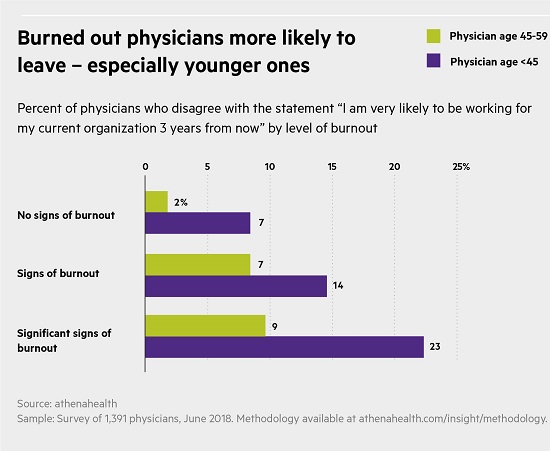
The inevitable result of these pressures over time is burnout, which anecdotally is reaching epidemic proportions in the U.S. and other nations.
While many of these stresses are unique to private-sector precariats in the gig economy or insecure positions in Corporate America, many public-sector workers in public safety and healthcare are also prone to burnout due to increasing workloads and understaffing.
While government agencies and Corporate America recognize the dangers to productivity posed by burnout, few agencies and companies are taking concrete actions to address the sources. Given that many of the sources are systemic, there is only so much agencies and companies can do; but what they can do may make the difference between workers free-falling into total burnout or being able to manage high levels of chronic stress.
But why should workers tolerate high levels of chronic stress? The alternative--quitting the source of the stress and finding a lower wage, lower pressure livelihood is an increasingly compelling alternative.
The status quo is purposefully blind to the systemic dangers of burnout because it depends on obedient workers producing wealth, paying taxes and taking on debt to buy more stuff. As I have noted recently, the most productive workers with digital / remote work skills have the most to gain by bailing out of the long commute / overwork / unaffordable housing rat race and establishing a lower-cost, lower stress life elsewhere.
Since the high-income workforce pays the lion's share of income and other taxes, a mass exodus of burned out high-productivity workers will cause shortfalls in tax revenues and in creditworthy buyers of overpriced housing in high-stress coastal urban regions.
Burnout isn't limited to highly paid workers; lower paid workers holding down multiple jobs are carrying enormous burdens of chronic stress.
The economic and financial stresses will exceed the workforce's carrying capacity in the next recession. In terms of chronic stress and economic insecurity, the recession of 2008-09 never ended for many workers; rather, the burdens have increased and the damage wrought by unrelenting stress is reaching the critical point of failure, where stress cascades into total burnout and the abandonment of jobs not by choice but by necessity.
Depression, fatigue, burnout and stress are all related, and the plethora of self-help columns aimed at relieving stress don't recognize the systemic burdens placed on workers: rather than tell overworked employees and small business owners they should meditate at 5 am before starting their commute, the entire system needs to be overhauled.
My book Money and Work Unchained is now $6.95 for the Kindle ebook and $15 for the print edition. Read the first section for free in PDF format.


If you found value in this content, please join me in seeking solutions by becoming a $1/month patron of my work via patreon.com. New benefit for subscribers/patrons: a monthly Q&A where I respond to your questions/topics.

NOTE: Contributions/subscriptions are acknowledged in the order received. Your name and email remain confidential and will not be given to any other individual, company or agency.
 
Thank you, Jess C. ($5/month), for your superbly generous pledge to this site-- I am greatly honored by your support and readership.
 

Read more...

Sunday, May 12, 2019

Is China's Belt & Road a Decade Too Late?

The world appears to be tiring of globalization and hegemons, and that trend may doom the Belt & Road to irrelevancy.
The conventional narrative holds that China's Belt & Road Initiative is cementing China's global superpower status. There's an alternative narrative, however: it's a decade too late. From this perspective, global trade has reached the top of the S-Curve and is in the stagnation phase, which will be followed by decline or collapse.
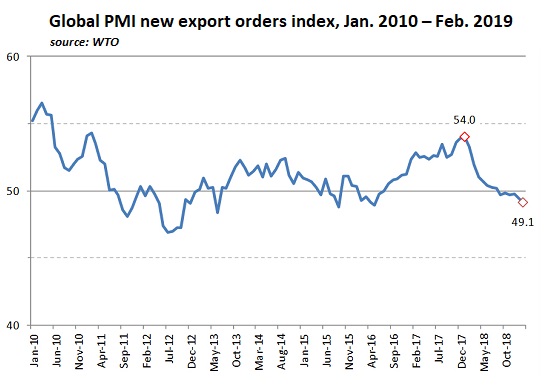
Why could global trade decline as a secular trend? The answer of the moment--trade wars-- is more a symptom than the disease itself, which is the benefits of globalization have declined and the negative consequences are becoming unavoidable.
Trade is never "free;" there are always losers to any trade, and if the benefits accrue to the few at the expense of the many, the gains no longer offset the losses. Resistance to globalization is rising, and national interests are gaining political ground.
Then there are the strategic considerations of trade. Do you really want your nation overly dependent on other nations for energy, food, semiconductors and capital?Food security makes little sense by itself; the spectrum of autarchy / self-sufficiency must also include energy, critical technologies and capital--human, institutional and financial.
Going forward, the last thing nations will want is increasing dependence on China--or any other hegemon.
China's debt diplomacy--pressuring "partners" to borrow immense sums from China, backed by collateral like harbors and ports--is already drawing resistance. If global trade has indeed topped out and shifted to secular decline, all the strategic reasons to limit dependency on other nations will start becoming more important than private-sector profits reaped by politically powerful corporations.
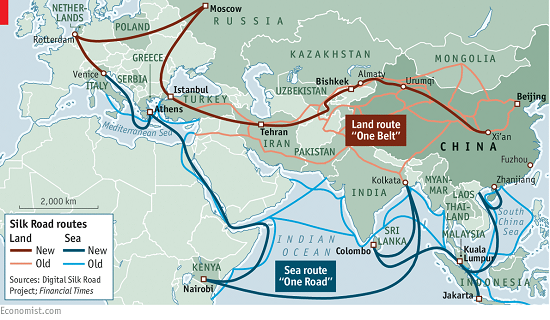
Then there's the asymmetric inefficiencies of diesel trucks versus sea transport. The "maritime road" in the one belt, one road (OBOR) scheme is nothing new; these routes through the Indian Ocean linking Africa, the Mideast, India and Asia have been followed for hundreds of years. China isn't bringing any new efficiencies to these longstanding sea routes.
As for moving goods by truck: it's up to five times more expensive in terms of fuel efficiency and ecological impacts than shipping by sea. Furthermore, unlike the sea, roads require constant maintenance: not only is trucking expensive, maintaining thousands of trucks and thousands of kilometers of roads is costly. These costs don't scale: every truck and every kilometer of road costs money to maintain.
So where are the economic advantages in trucking goods thousands of kilometers? Landlocked regions which depend on trucks already might see some benefit, but are those benefits significant enough to make the entire OBOR investment profitable?
Let's say diesel fuel costs rise going forward: what are the consequences?Depending on how much fuel costs rise, trade earns diminishing returns for all but the highest-value goods.
Then there's security. The world is becoming more dangerous as non-state entities gain disruptive technologies. Hundreds of kilometers of roads through trackless wastelands are essentially impossible to secure against primitive IEDs (improvised explosive devices), and more advanced threats make hundreds of kilometers of natural gas pipelines and other infrastructure through sparsely populated regions vulnerable.
If trade declines, fuel costs increase, security emerges as an issue and strategic concerns reduce the appeal of globalization and dependency on others, the Belt & Road becomes a bottomless boondoggle. Maybe a decade ago, when trade and globalization were on the upswing, the Belt & Road would have been an instant success.
But now, the tidal forces that supported globalization and dependency are reversing. In a decade hence, will China reign supreme as the global hegemon as a result of the Belt & Road, or will the entire Initiative be viewed as a colossal malinvestment that undermined China's attempt to wield soft power via debt diplomacy and trade-based dependency?
The world appears to be tiring of globalization and hegemons, and that trend may doom the Belt & Road to irrelevancy--or worse.
My book Money and Work Unchained is now $6.95 for the Kindle ebook and $15 for the print edition. Read the first section for free in PDF format.


If you found value in this content, please join me in seeking solutions by becoming a $1/month patron of my work via patreon.com. New benefit for subscribers/patrons: a monthly Q&A where I respond to your questions/topics.

NOTE: Contributions/subscriptions are acknowledged in the order received. Your name and email remain confidential and will not be given to any other individual, company or agency.
 
Thank you, Annisa S. ($10/month), for your outrageously generous pledge to this site-- I am greatly honored by your support and readership.
 

Read more...

Thursday, May 09, 2019

Unrealistically Great Expectations

Our expectations have continued ever higher even as the pie is shrinking..
Let's see if we can tie together four social dynamics: the elite college admissions scandal, the decline in social mobility, the rising sense of entitlement and the unrealistically 'great expectations' of many Americans.
As many have noted, the nation's financial and status rewards are increasingly flowing to the top 5%, what many call a winner-take-all or winner-take-most economy.
This is the primary source of widening wealth and income inequality: wealth and income are disproportionately accruing to the top slice of earners and owners of productive capital.
This concentration manifests in a broad-based decline in social mobility: it's getting harder and harder to break into the narrow band (top 5%) who collects the lion's share of the economy's gains.
Historian Peter Turchin has identified the increasing burden of parasitic elites as one core cause of social and economic collapse. In Turchin's reading, economies that can support a modest-sized class of parasitic elites buckle when the class of elites expecting a free pass to wealth and power expands faster than what the economy can support.
The same dynamic applies to productive elites: as I have often mentioned, graduating 1 millions STEM (science, technology, engineering, math) PhDs doesn't magically guarantee 1 million jobs will be created for the graduates.
Such a costly and specialized education was once scarce, but now it's relatively common, and this manifests in the tens of thousands of what I call academic ronin, i.e. PhDs without academic tenure or stable jobs in industry.
This glut is a global: I've known many people with PhDs from top universities in the developed world who have struggled to find a tenured professorship or a high-level research position anywhere in the world.
In other words, what was once a surefire ticket to status, security and superior pay is no longer surefire.
No wonder wealthy parents are so anxious to fast-track their non-superstar offspring by hook or by crook.
There is an even larger dynamic in play. As I explained here recently, the economic pie is shrinking, not just the pie of gains that can be distributed but the pie of opportunity.
Would parents and students be so anxious about their prospects if opportunities abounded for average students? The narrowing of opportunities to secure a stable career and livelihood is driving the frenzy to get into an elite university.
As everyone seeks an advantage, there's a vast expansion of people with advanced diplomas: what was once relatively scarce (and thus valuable) is no longer scarce and therefore no longer very valuable.
The soaring cost of the middle-class membership basics--home ownership, healthcare and access to college--has drastically reduced the number of households who can afford these basics.
Two generations ago, just about any frugal working-class household with two wage-earners could save up a down payment for a modest home and later, save enough to put their children through the local state college.
Now, even two relatively well-paid wage earners in Left and Right Coast urban areas cannot afford to buy a house or put their kids through college. They are lucky to afford the rent, never mind buying a house.
As the number of upper-middle class slots declines, expectations have risen.This manifests in two ways: a rising sense of entitlement, which broadly speaking is the belief that the material security of middle class life should be available without great sacrifice.
The second manifestation is is higher expectations of material life in general:not only should we all have access to healthcare, college and home ownership, we also "deserve" to eat out every day, own luxury brand items, take resort vacations, and so on.
In a recent pre-recording conversation with a podcast host, we were talking about the number of average workers who think very little (apparently) of buying a $15 breakfast and/or a $20 lunch for themselves every day, plus an expensive coffee or beverage. This contrasts with the "old school" expectations which reserved lunches in restaurants for executives with expense accounts or The Boss. Everyone else filled a thermos with coffee at home and packed a brown bag lunch (or kau-kau tin in Hawaii).
From this perspective, $25 a day is $125 a week or $6,250 annually (a 50-week year). That's $12,500 annually for a two wage-earner household. Five years of foregoing this luxury yields a nestegg of $62,500, a down payment for a $300,000 house, or the full cost of a four-year university education for two students who attend the local state university and who live at home.
(Sidebar note: a kind person gave us a $50 gift certificate to a popular casual-dining breakfast-lunch cafe. I reckoned we'd get a nice chunk of change after ordering two basic sandwiches and one beer. The $50 didn't cover the three items, much less the tip. I nearly fell out of my chair. Over $50 for two sandwiches and a beer? And yet the place is jammed with people young amd old, and I wondered: is everyone here earning $200,000+ annually, i.e. a top 5% income? If not, how can they afford such a costly luxury?)
As I noted earlier this month in the blog, the Federal Reserve's obsession with generating a "wealth effect" by inflating bubbles in stocks and housing have enriched owners of capital at the expense of the young.
But even if we set aside the perverse and destructive impact of this disastrous policy, the economy is changing in structural ways. Scarcity value is becoming, well, scarcer. Global competition has reduced the scarcity value of education, ordinary labor and capital, and so the gains flowing to these has declined accordingly.
Yet our expectations have continued ever higher even as the pie is shrinking.Common sense suggests realigning expectations with a realistic appraisal of what's possible and what sacrifices are necessary is a good first step.
My book Money and Work Unchained is now $6.95 for the Kindle ebook and $15 for the print edition. Read the first section for free in PDF format.


If you found value in this content, please join me in seeking solutions by becoming a $1/month patron of my work via patreon.com. New benefit for subscribers/patrons: a monthly Q&A where I respond to your questions/topics.

NOTE: Contributions/subscriptions are acknowledged in the order received. Your name and email remain confidential and will not be given to any other individual, company or agency.
 
Thank you, Annisa S. ($10/month), for your outrageously generous pledge to this site-- I am greatly honored by your support and readership.

Read more...

Wednesday, May 08, 2019

The Great Unraveling Begins: Distraction, Lies, Infighting, Betrayal

The good news is renewal becomes possible when the entire rotten status quo collapses in a putrid heap.
There are two basic pathways to systemic collapse: external shocks or internal decay. The two are not mutually exclusive, of course; it can be argued that the most common path is internal decay weakens the empire/state and an external shock pushes the rotted structure off the cliff.
As Dave of the X22 Report and I discuss in The World Is About To Change & It's Going To Be Glorious, we are in the early stages of terminal internal decay.There are a number of dynamics shared by decaying empires/states:
1. The ruling elites lose the moral imperative to sacrifice for the good of the empire/state. Instead they use the power of the state to further their own private interests and agendas.
2. The ruling elites start "fudging" reports (i.e. lies are presented as truths) and promoting narratives to mask their self-aggrandizement and the erosion of the nation/empire under their self-interested rule.
In other words, the elites know the public would resist their leadership if the truth were widely known, so the ruling elites devote tremendous resources to massaging the news to distract the public from reality and reflect positively on their self-serving leadership.
Since the weaknesses of the empire are being hidden, they cannot be addressed, and so rot that could have been fixed early becomes widespread and fatal.
3. Flush with the state's wealth and power, the ruling elite splinters into warring camps which squander the empire's remaining wealth on private battles over which camp will rule what appears solid and eternal--the empire.
4. As the elites battle it out, the nation/empire falls apart as the leadership's focus is on internecine conflicts over the spoils of the empire, rather than on preserving the foundations of the empire's wealth and security.
5. As the truth inevitably leaks out, the public grasps the enormity of the elites' betrayal of the nation and the public interest. Faith in the elites and the institutions they control plummets, and the Great Unraveling becomes unstoppable.
6. In a last-ditch effort to save their wealth and power, the elites distract the public with Bread and Circuses-- "free money" in various guises (Universal Basic Income, Modern Monetary Theory, etc.)--and the distracting Circus of political theater and a surfeit of entertainment.
Whether the elites or the public are aware of it or not, America is well down the path to terminal internal decay: Distraction, Lies, Infighting, Betrayal.
The good news is renewal becomes possible when the entire rotten status quo collapses in a putrid heap of broken promises, dysfunctional institutions, blatant lies, unpayable debts and cascading defaults.
My book Money and Work Unchained is now $6.95 for the Kindle ebook and $15 for the print edition. Read the first section for free in PDF format.


If you found value in this content, please join me in seeking solutions by becoming a $1/month patron of my work via patreon.com. New benefit for subscribers/patrons: a monthly Q&A where I respond to your questions/topics.

NOTE: Contributions/subscriptions are acknowledged in the order received. Your name and email remain confidential and will not be given to any other individual, company or agency.
 
Thank you, Annisa S. ($10/month), for your outrageously generous pledge to this site-- I am greatly honored by your support and readership.
 

Read more...

Terms of Service

All content on this blog is provided by Trewe LLC for informational purposes only. The owner of this blog makes no representations as to the accuracy or completeness of any information on this site or found by following any link on this site. The owner will not be liable for any errors or omissions in this information nor for the availability of this information. The owner will not be liable for any losses, injuries, or damages from the display or use of this information. These terms and conditions of use are subject to change at anytime and without notice.

RE: European Union AI Act, and Our Use of Generative AI Tools and Agents Policy

All text on this site is composed by Charles Hugh Smith or by a credited guest-author. No Generative AI Tools are used in the composition / writing of any text or graphic content created by Charles Hugh Smith. This site deploys no AI agents or generative AI tools. This site is not responsible for the disclosures, use or non-use of AI agents or generative AI tools in advertisements displayed by Investing Channel or other ad placement services.

Audio files generated by text-to-audio transcription tools are identified as such.

Our Privacy Policy:

Correspondents' email is strictly confidential. This site does not collect digital data from visitors or distribute cookies. Advertisements served by third-party advertising networks such as Investing Channel may use cookies or collect information from visitors for the purpose of Interest-Based Advertising; if you wish to opt out of Interest-Based Advertising, please go to Opt out of interest-based advertising (The Network Advertising Initiative) If you have other privacy concerns relating to advertisements, please contact advertisers directly.

PRIVACY NOTICE FOR EEA INDIVIDUALS

This section covers disclosures on the General Data Protection Regulation (GDPR) for users residing within EEA only. GDPR replaces the existing Directive 95/46/ec, and aims at harmonizing data protection laws in the EU that are fit for purpose in the digital age. The primary objective of the GDPR is to give citizens back control of their personal data. Please follow the link below to access InvestingChannel's General Data Protection Notice.
https://stg.media.investingchannel.com/gdpr-notice/

Notice of Compliance with The California Consumer Protection Act

This site does not collect digital data from visitors or distribute cookies. Advertisements served by a third-party advertising network (Investing Channel) may use cookies or collect information from visitors for the purpose of Interest-Based Advertising. If you do not want any personal information that may be collected by third-party advertising to be sold, please follow the instructions on this page: Do Not Sell My Personal Information.

Regarding Cookies:

This site does not collect digital data from visitors or distribute cookies. Advertisements served by third-party advertising networks such as Investing Channel may use cookies or collect information from visitors for the purpose of Interest-Based Advertising; if you wish to opt out of Interest-Based Advertising, please go to Opt out of interest-based advertising (The Network Advertising Initiative) If you have other privacy concerns relating to advertisements, please contact advertisers directly.

Our Commission Policy:

Though I earn a small commission on Amazon.com books and gift certificates and gold (BullionVault) purchased via links on my site, I receive no fees or compensation for any other non-advertising links or content posted on my site.

Copyright Notice:

All original images (Drawings and Photographs), text (essays, books and works of fiction), audio and video recordings, musical compositions, graphic design, graphic design elements and HTML coding on this site are the copyrighted work of Charles Hugh Smith unless otherwise credited or noted. They are published as information for the private use of site visitors, and any reproduction or redistribution of this content or coding in any media in any format or distribution channel (text, audio, video/film, web) without the written permission of the copyright holder is strictly prohibited. All rights in all media reserved globally.

  © Blogger templates Newspaper III by Ourblogtemplates.com 2008

Back to TOP