
Sunday, April 19, 2020

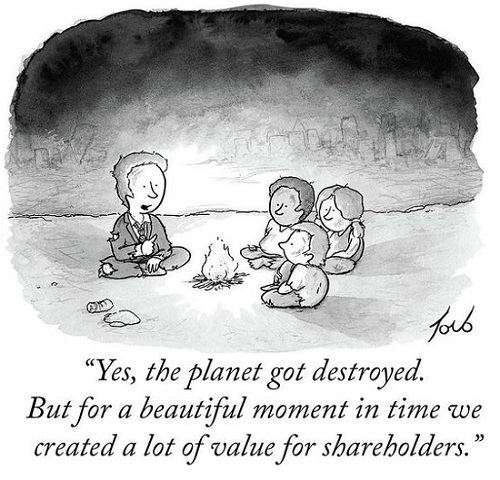
Here We Go Again: When Bubbles Pop, Only the First Sellers Avoid Destruction

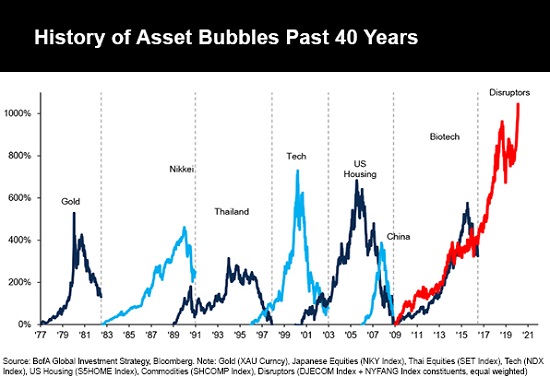
Bubbles always burst, and the confidence that "this isn't a bubble" and "the Fed has our back" are counter-indicators.
Here we go again: stocks have once again reached nosebleed valuations completely disconnected from reality--in other words a repeat of the speculative-frenzy bubble that reached its peak on February 19. Once again, stocks are sporting delusional GDP-to-valuation and P-E (price-earnings) ratios, all based (again) on the belief that nothing--certainly not revenues, profits, debt levels, etc.--matters; the only thing that matters is the Fed pimping stocks.
What might observant punters have learned from the February 19 bubble popping? For one thing, the complacent belief that every technician's target is guaranteed is suspect: at this writing, the vast majority of technical-analysis targets are much higher.
What's the basis for these higher targets? Nothing but the implicit quasi-religious faith in the Fed.
For another, the belief that the market will give every punter an ample opportunity to sell once those targets are reached is equally suspect. Wouldn't it be nice if every punter that sees a target for the 61.8% Fibonacci level, etc. can wait for that target and then cash out, as if nobody else (or ten thousand trading bots) aren't planning to sell at the same target?
One often overlooked characteristic of stock market bubbles is the extremely small exit for sellers trying to avoid becoming impoverished bagholders. Bubbles always present small exits because once sentiment turns, buyers vanish and so price goes over the waterfall and crashes on the rocks below (accompanied by the screams of all the punters who reckoned they'd exit at the top).
For an example, please review a chart of stock market action between March 1 and March 23.
But modern markets have characteristics which have further diminished the exit to a tiny pinhole. These include (but are not limited to):
1. The dominance of index funds. When shares of the index are sold, every constituent stock gets sold. This triggers cascades of selling that overwhelm "buy the dip" buying.
2. Computers do most of the trading, and the algorithms are set to follow trends with extreme ferocity. Once the trend is "sell," the program selling will self-reinforce the cascade.
3. Central banks have generated a mesmerizing moral-hazard propaganda field that implicitly suggests "we'll never stocks go down again, ever!" Yet the only way central banks can causally intervene is to buy stocks directly in size, i.e. in the trillions of dollars. (Recall U.S. stocks are around $30 trillion, global stock markets about $80 trillion. Yes, buying futures contracts through proxies works in stable markets, but not so much in panic cascades of selling.)
Beneath the illusory stability, modern markets are extremely illiquid, meaning that when the bubble pops and punters/money managers try to sell, there are no buyers at any price.
Liquidity in a crash depends on "buy the dip" bagholders. Once they've been destroyed, there are no more buyers at any price. The "buy the dip" crowd will be wiped out after the first spike higher fails, and then nobody will be left who's willing to catch the falling knife.
It's illuminating to go back to to former Federal Reserve chairman Alan Greenspan's 2014 belated bleatings in Foreign AffairsWhy I Didn't See the Crisis Coming. Greenspan presented one primary reason: the Fed's models failed to accurately account for "tail risk," (otherwise known as things that supposedly happen only rarely but when they do happen, they're a doozy), because guess what--they happen more often than statistical models predict.
"Tail risk" is a fancy way of saying that bagholders willing to buy the dip and be destroyed as the crash gathers momentum are too scarce to stop the waterfall of selling. That leaves everyone with a long position in stocks with a binary choice: either grasp the fleeting advantage of selling out in the first wave of selling--and by the way, there's no advantage unless every single share is sold--or become a hapless bagholder.
Bubbles always burst, and the confidence that "this isn't a bubble" and "the Fed has our back" are counter-indicators of just how crushing the pop will be: the greater the confidence/euphoria, the greater the crash.
Sober up, people. All bubbles pop, and the higher the extreme, the greater the crash. Only the first sellers will escape; everyone who hesitates or "buys the dip" will be crushed at the bottom of the waterfall.
If you want to sell your shares to bagholders, issue technical targets way above current levels and year-end targets at nonsensically lofty levels, then sell, sell, sell as the over-confident bagholders buy, buy, buy. ("But Mr. Pundit said the S&P 500 was gonna go higher, he promised!")
Who goes into the market planning to buy at technical levels where everybody else is selling? How many "dumb money bagholders" does everyone reckon will be anxious to buy their shares at the top of the craziest overvalued bubble ever?
Here we go again: only two months after "buy the dip" and "the Fed has our backs" failed, the pundits and money managers are falling over themselves to declare "the bottom is in," "there's now light at the end of the tunnel," and all the other reasons to complacently hold on and become a bagholder so the smart money can sell to you before the anointed TA targets are reached.
Money and Work Unchained $6.95 (Kindle), $15 (print) Read the first section for free (PDF).


If you found value in this content, please join me in seeking solutions by becoming a $1/month patron of my work via patreon.com.

NOTE: Contributions/subscriptions are acknowledged in the order received. Your name and email remain confidential and will not be given to any other individual, company or agency.
Thank you, Jesse R. ($5/month), for your superbly generous pledge to this site -- I am greatly honored by your support and readership.
 
Thank you, John L. ($5/month), for your splendidly generous pledge to this site -- I am greatly honored by your support and readership.

Read more...

Saturday, April 18, 2020

Between a Rock and a Hard Place: Pandemic and Growth

There is no way authorities can limit the coronavirus and restore global growth and debt expansion to December 2019 levels.
Authorities around the world are between a rock and a hard place: they need policies that both limit the spread of the coronavirus and allow their economies to "open for business." The two demands are inherently incompatible, and so neither one can be fulfilled.
The problem is the intrinsic natures of the virus and the global economy. This virus is highly contagious during its asymptomatic phase, which is long (5 to 20 days), and therefore impossible to control with the conventional tools of identifying people with symptoms and isolating them, and tracking their contacts with others.
While there is much we do not know for certainty about Covid-19, what's clear (and not well-reported) is that its lethality is not exactly like a normal flu. The number of otherwise healthy people under the age of 60 who die of a regular flu is near-zero. The number of otherwise healthy people under the age of 60 who die of Covid-19 is not large as a percentage of cases but it is worryingly above zero. A great many otherwise healthy people under the age of 60 have died of Covid-19.
Yes, the vast majority of those who die are elderly and suffering from chronic health issues, but the number of younger, healthier people who are dying makes this virus consequentially different from a typical flu.
Everyone looking at total deaths (currently much lower than the fatalities in a typical flu season) is missing the semi-random lethality of Covid-19 in younger, healthier people, or at least certain strains of the virus in certain conditions (air pollution, viral load, etc.) and in not yet fully understood sub-populations.
This uncertainty and semi-randomness means authorities cannot claim that Covid-19 is "no worse than a regular flu" because the number of 40-year old doctors, nurses, transit employees, etc. who die of regular flu is near-zero, but the number who are dying of Covid-19 is far above zero.
In a regular flu season, people with healthy immune systems have little fear of dying of the flu. But Covid-19 is killing enough otherwise healthy people that there cannot be absolute certainty that the risk of death is essentially zero. This is an enormous difference psychologically, a difference that is currently under-appreciated.
The global economy is much like a shark: it must keep moving forward in growth and debt expansion or it dies. This reality is poorly understood and therefore of paramount importance.
The difference is debt. A large percentage of global consumption is ultimately based on debt. Debt masks a variety of inefficiencies, but the drag of inefficiencies and unproductive profiteering is visible if we look at the rate of "growth" and the rate of "debt expansion."
In the past 12 years, debt has exploded higher globally just to maintain weak growth. Where $1 in new debt once increased GDP by 50 cents, now it boosts GDP by 5 cents--or by some measures, zero. It's taking more and more debt to keep the "growth" shark moving forward.
The problem is debt must be serviced: interest must be paid and principal paid down. Even at near-zero interest rates, the principal payments loom large.
Debt has a built-in opportunity cost. Once the borrower takes on more debt, a chunk of income must be allotted to paying the new debt. That income is no longer available to be saved or invested or spent on goods and services; it's tied up for the life of the loan.
Eventually, borrowers' income is completely consumed by debt service and paying essentials such as rent and food. There is no income left after essentials and debt service are paid.
So what happens when income falls? There is no longer enough income to pay all the expenses, and so what does the household or company do? It pays the essential bills and defaults on the debt, i.e. stops servicing the debt.
The lender can pursue legal action to collect the debt, but heavily indebted households and companies simply don't have the income or assets to pay the loan back. They declare bankruptcy and all their lenders must eat the loss.
This has far-reaching consequences. Lenders saddled with huge losses due to mass defaults are insolvent, and must conserve earnings to rebuild their capital requirements. To stem the flood of losses, they have to tighten lending standards and avoid making loans to over-indebted households and companies.
But reducing their lending to marginal borrowers greatly reduces their income, as marginal borrowers must pay higher interest rates, and so these are the most profitable loans lenders can make.
You see the feedback loop here: less lending, less profits, and lenders' losses pile up. The banking sector unravels.
As in 2008, we see central banks bailing out insolvent lenders, but as I explained in a recent blog post, bailouts are not the same as revenues. Bailing out lenders and over-indebted corporations doesn't magically create new creditworthy borrowers. Buy The Tumor, Sell the News (April 10, 2020)
Bailouts are short-term emergency measures, but they don't restore the foundations of sustainable debt: credit-worthy borrowers.
From the point of view of the potential borrower, why borrow more money to spend on a superfluous vacation if income is uncertain? Why buy a house if there's a chance it might decline in value by 20%? Wouldn't it be wiser to delay purchases funded by more debt? Of course it's wiser.
Let's add up the uncertainties:
1. Covid-19 is not as risk-free for healthy people as ordinary flu. Therefore there is an uncertainty that favors caution and prudence and risk avoidance.
2. From the point of view of potential borrowers, there is also uncertainty about future income and asset values, and so lowering risk makes sense. The easiest way to avoid risk is not take on new debts to fund discretionary purchases and save money to create a cushion against uncertainties.
3. From the point of view of lenders, there is uncertainty about the creditworthiness of borrowers, households and companies alike. The past is not a good guide to the future: households with sterling credit may default if a primary wage earner loses their job.
Charging marginal borrowers higher interest rates is no longer a low-risk strategy, as what good is a month or two of higher interest if the borrower defaults and the lender is stuck with an enormous loss?
These uncertainties cannot be dialed back to zero. To truly limit the spread and semi-random lethality of Covid-19, authorities will have to make extreme measures permanent--for example, mass testing of the populace on a scale never seen, plus identifying those at lower risk (those who have recovered, etc.) and those at higher risk (elderly people with multiple health issues) and imposing different rules of conduct on each group.
This article outlines the incredibly cumbersome requirements of such a program: Disease Control, Civil Liberties, and Mass Testing — Calibrating Restrictions during the Covid-19 Pandemic. (via Ron G.)
Economically, the global financial system will unravel if debt expansion ceases or reverses, and incomes decline or even become uncertain.
Recall that the absolute number of defaults does not have to rise by much to sink the system. Even if there are no additional defaults, once debt stops expanding, the system unravels, as it requires expanding debt to fund expanding consumption ("growth") and the continuing purchase of assets at bubble-top high valuations.
Once assets decline in market value, the system unravels, as bubble-top valued assets are the collateral holding up the world's mountain of debt. Once the collateral shrinks, the system becomes increasingly prone to a self-reinforcing collapse of lending and asset crashes, as sellers can't find any buyers and lenders can't find any creditworthy borrowers with solid collateral and income.
For an example, consider global tourism and travel, including business-related travel. This sector accounts for roughly 10% of global GDP ($9.25 trillion). Tourism worldwide - Statistics & Facts. In 1960, about 25 million people traveled internationally. In 2019, the number of international travelers was 1.4 billion. This is a 56-fold increase.
When I moved to Hawaii as a young teen in 1969, the state had just cracked the 1 million visitors per year line. In 2019, 10.4 million visitors came to Hawaii.
Tourism and even business travel are the epitome of discretionary spending. What happens to incomes, asset valuations, collateral and debt defaults if global tourism only recovers to 50% of 2019 levels?
That would reduce global GDP by 5%, but this drop will trigger financial consequences many multiples of 5%.
What happens to the pricey room rental rates that have become standard? What happens to the incomes of AirBnB hosts? How many will seek to sell their properties or default on their mortgages?
What happens to property values in cities dependent on tourism when a significant percentage of AirBnB owners try to sell their properties? Who will want to take the risk of buying a property which could lose much of its value going forward?
Another apt analogy for the global financial system is an airliner. Airliners are optimized for flying at high altitudes at speeds of between 500 and 575 miles per hour. This is their envelope of maximum fuel efficiency.
While an airliner is physically able to fly at 500 feet, its fuel efficiency will be greatly reduced. Just as airliners cannot fly above a maximum altitude (around 45,000 feet) or approach the speed of sound (Mach 1), they cannot reach their maximum range flying at 500 feet.
The airliner is optimized for a very narrow envelope, and once it leaves that envelope, bad things happen: its engines flame out, it runs out of fuel, etc.
The global economy is optimized for a vast, steady expansion of debt to fund an equally vast and steady increase in consumption. Once it slips out of this narrow envelope, it crashes.
Central banks and governments can mask this in the short-term by substituting bailouts for revenues, but bailouts are not sustainable replacements for revenues, incomes, profits and debt service. The global economy has already fallen out of its sustainable envelope, and the only questions are its rate of descent and how long the remaining fuel will last.
There is no way authorities can limit the coronavirus and restore global growth and debt expansion to December 2019 levels. This is not what people want to hear, but it's the reality we will have to deal with.
This essay was drawn from Musings Report 15. The Musings Reports are emailed weekly to subscribers and patrons. To subscribe or become a patron, please visit how to subscribe/become a patron.
Money and Work Unchained $6.95 (Kindle), $15 (print) Read the first section for free (PDF).


If you found value in this content, please join me in seeking solutions by becoming a $1/month patron of my work via patreon.com.

NOTE: Contributions/subscriptions are acknowledged in the order received. Your name and email remain confidential and will not be given to any other individual, company or agency.
Thank you, Paul C. ($5/month), for your superbly generous pledge to this site -- I am greatly honored by your support and readership.
 
Thank you, Brian F. ($5/month), for your splendidly generous pledge to this site -- I am greatly honored by your support and readership.

Read more...

Friday, April 17, 2020

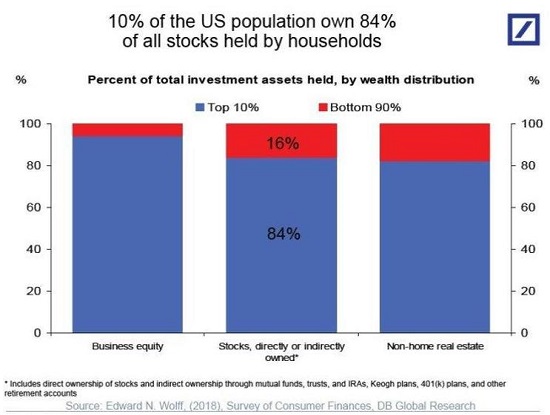
While the Top 10% and the Fed Cheer Stocks Rebounding, the Bottom 60% Lose their Livelihoods and Lives

If you have any doubt that the Fed and Wall Street will some day be dismantled, please re-read this "real life in America" list again.
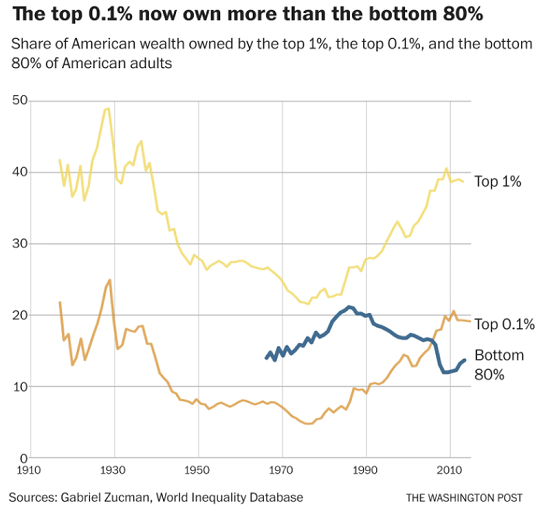
The pandemic is a stark, brutal spotlight on income/wealth inequality in America: while the top 10% who own the majority of the nation's wealth cheer the Federal Reserve's relentless pimping of the stock market, the bottom 60%--America's vast underclass of low-paid, marginalized, gig-economy, Amazon warehouse precarious proletariats (precariats)-- are losing their livelihoods and tragically, their lives as the pandemic ravages the ranks of those who cannot work at home and those whose health is impaired by the ceaseless struggle to survive in Unequal America.
The inequality isn't just in wealth and income; it's in what that wealth and income can buy-- stability, security and better health. While there are plenty of wealthy Americans in poor health, there's no getting past the reality that those with big incomes, 7-figure net worths and gold-plated healthcare insurance paid by their employer or family-owned enterprise can afford to be gym rats, hire personal trainers, get regular dental care, eat costly delicacies from Whole Foods (Whole Paycheck to precariats)--in other words, everything needed (including the financial security that enables a good night's sleep) to be slim and healthy.
America's vast Underclass is dying in the pandemic because their health is impaired by inequality.
As long as there are plenty of precariats earning less than $30,000 a year to walk their dog, empty Mom's bedpan, ship their order from an Amazon "fulfillment center," a.k.a. 21st century sweatshop, deliver their groceries from Whole Foods, drive their Uber ride, clean their McMansions, etc., the top 10% could care less about inequality in America.
Like the Fed, their focus is on the stock market, their free money machine: thanks to the Fed, your wealth doubles or triples without actually having to produce any value at all.
The excuse is the wealth effect: the Fed's pimping of the top 10%'s free money machine gives the top 10% the financial "animal spirits" confidence to buy, buy, buy services that create all those precariat jobs.
Here's a brief primer for all the top 10%ers who have no idea of what life is like for America's 60% Underclass:
1. Income is insecure as shift/hours per week/gigs are all uncertain.
2. When you are at your job, you're overloaded with work: the pressure never lets up.
3. You have long commutes, long hours.
4. There are insufficient rewards and recognition for your labors: low pay, no stock options, supervisors pressured to fire people, not praise them.
5. There's no trust or community at work; you're either competing for miserable pay in the gig economy, or you work with a constantly shifting mix of people. There's no trust or support.
6. Every day is an object lesson in unfairness: all you see are workers being treated unfairly while invisible bosses skim huge paychecks or millions/billions in stock options.
7. You cannot value or have pride in your work because the product/service is garbage, as defined and dictated by your overlords, who care only about maximizing profit by whatever means are available, i.e. lowering quality and hiding this from customers.
8. There are few avenues for advancement, unless you want to become a slave-driving crew chief for another lousy dollar or two an hour.
9. There's no way to get ahead, as your wobbly paycheck barely covers expenses, and any savings are wiped out by dental emergencies, car repairs, desperation-soaked loans to relatives, etc.
10. The constant overwork and all the anxieties of economic insecurity have undermined your health.
If you have any doubt that the Fed and Wall Street will some day be dismantled, please re-read this "real life in America" list as many times as needed to break through the obsession with the free money machine of a Fed-pimped euphoric stock market.
The pandemic might yet have a positive consequence if America's vast Underclass eventually decides that enough is enough.
Money and Work Unchained $6.95 (Kindle), $15 (print) Read the first section for free (PDF).


If you found value in this content, please join me in seeking solutions by becoming a $1/month patron of my work via patreon.com.

NOTE: Contributions/subscriptions are acknowledged in the order received. Your name and email remain confidential and will not be given to any other individual, company or agency.
Thank you, Greg M. ($5/month), for your superbly generous pledge to this site -- I am greatly honored by your steadfast support and readership.
 
Thank you, Edgeman ($5/month), for your splendidly generous pledge to this site -- I am greatly honored by your support and readership.

Read more...

Wednesday, April 15, 2020

Overcapacity / Oversupply Everywhere: Massive Deflation Ahead

The price of a great many assets will crash, out of proportion to the decline in demand.
Oil is the poster child of the forces driving massive deflation: overcapacity / oversupply and a collapse in demand. Overcapacity / oversupply and a collapse in demand are not limited to the crude oil market; rather, they are the dominant realities in the global economy.
Yes, there are shortages in a few high-demand areas such as PPE (personal protective equipment), but across the entire spectrum of global supply and demand, there is nothing but a vast sea of overcapacity / oversupply and a systemic decline in demand as far as the eye can see.
Here's a partial list of commodities that are in Overcapacity / oversupply:
1. Overvalued assets
2. Overpriced income streams (as income craters, so will the asset generating the income)
3. Labor: low-skill everywhere, high-skill in sectors experiencing systemic collapse in demand
4. AirBnB and other vacation rental properties
5. Overpriced flats, condos and houses
6. Overpriced rental apartments
7. Overpriced commercial office space
8. Overpriced retail space
9. Overpriced used vehicles
10. Overpriced collectibles
I think you get the idea.
Should China restart its export factories, then almost everything being manufactured will immediately be in oversupply, as the global export sector was plagued with mass overcapacity long before the Covid-19 pandemic crushed demand.
Incomes will crater as revenues and profits crash, small businesses close their doors, never to re-open, local governments tighten spending, and whatever competition still exists will relentlessly push the price of labor, goods and services lower.
Globalization has generated hyper-specialization in local and regional economies, stripping them of resilience. Fully exposed to the demand flows of a globalized class of consumers with surplus discretionary income, regions specialized in tourism, manufacturing, commodity mining, etc.
All these regions are now facing a structural collapse of global demand, and they have no diversified local economy to cushion the blow to jobs, incomes, profits and tax revenues.
Thousands of small business that could barely squeak through a 20% decline in revenues are facing a 50% or more decline as far as the eye can see. With costs such as rent, labor, fees, taxes and healthcare at nosebleed levels, an enormously consequential number of small businesses globally cannot survive more than a modest, brief drop in revenues, as their costs remain high even as their sales plummet: costs are sticky, profits slide quickly to zero and beyond.
What's scarce:
1. low-risk, high-yield assets
2. Low-cost hedges against the collapse of asset valuations
3. Investment income streams that survive the collapse of demand and asset valuations
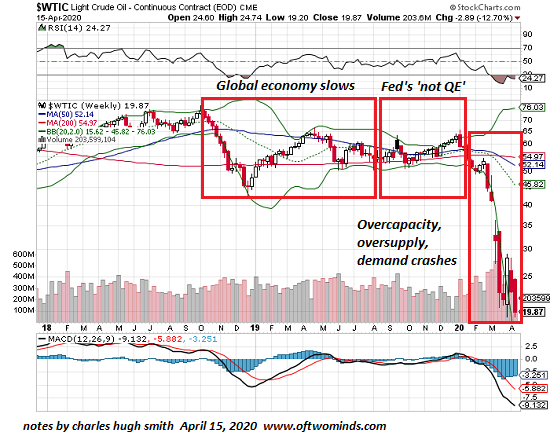
Here is a weekly chart of crude oil (WTIC). Note the weakening of price as the global economy slowed in 2018-2019, the modest rise as the Federal Reserve began "not QE" printing of currency in September 2019, and the complete collapse as oil producers jockeyed for control via crushing price wars/over-production and global demand plummeted.
This is the future of vast swaths of the global economy: labor, commodities, assets, goods and services, and the tax revenues that are skimmed from the private sector, will all crash as supply far exceeds demand.
The price of a great many assets will crash, out of proportion to the decline in demand. Only the global top 10% can afford to buy pricey vacation homes, for example, and as the top 10% own 90% of the assets that are melting away like ice cubes in Death Valley, when their ability and willingness to buy assets they can no longer afford vanishes, the market price of those assets can fall 90% or even to zero.
You'll know this moment has arrived when you see once-expensive sailboats and pleasure craft abandoned and drifting, as the owners can no longer afford the dock fees and can't sell the craft. To quote Jackson Browne: Don't think it won't happen just because it hasn't happened yet.
Money and Work Unchained $6.95 (Kindle), $15 (print) Read the first section for free (PDF).


If you found value in this content, please join me in seeking solutions by becoming a $1/month patron of my work via patreon.com.

NOTE: Contributions/subscriptions are acknowledged in the order received. Your name and email remain confidential and will not be given to any other individual, company or agency.
Thank you, Robert C. ($50), for your superbly generous contribution to this site -- I am greatly honored by your steadfast support and readership.
 
Thank you, Maxwell Q. ($5/month), for your most generous pledge to this site -- I am greatly honored by your support and readership.

Read more...

Terms of Service

All content on this blog is provided by Trewe LLC for informational purposes only. The owner of this blog makes no representations as to the accuracy or completeness of any information on this site or found by following any link on this site. The owner will not be liable for any errors or omissions in this information nor for the availability of this information. The owner will not be liable for any losses, injuries, or damages from the display or use of this information. These terms and conditions of use are subject to change at anytime and without notice.

RE: European Union AI Act, and Our Use of Generative AI Tools and Agents Policy

All text on this site is composed by Charles Hugh Smith or by a credited guest-author. No Generative AI Tools are used in the composition / writing of any text or graphic content created by Charles Hugh Smith. This site deploys no AI agents or generative AI tools. This site is not responsible for the disclosures, use or non-use of AI agents or generative AI tools in advertisements displayed by Investing Channel or other ad placement services.

Audio files generated by text-to-audio transcription tools are identified as such.

Our Privacy Policy:

Correspondents' email is strictly confidential. This site does not collect digital data from visitors or distribute cookies. Advertisements served by third-party advertising networks such as Investing Channel may use cookies or collect information from visitors for the purpose of Interest-Based Advertising; if you wish to opt out of Interest-Based Advertising, please go to Opt out of interest-based advertising (The Network Advertising Initiative) If you have other privacy concerns relating to advertisements, please contact advertisers directly.

PRIVACY NOTICE FOR EEA INDIVIDUALS

This section covers disclosures on the General Data Protection Regulation (GDPR) for users residing within EEA only. GDPR replaces the existing Directive 95/46/ec, and aims at harmonizing data protection laws in the EU that are fit for purpose in the digital age. The primary objective of the GDPR is to give citizens back control of their personal data. Please follow the link below to access InvestingChannel's General Data Protection Notice.
https://stg.media.investingchannel.com/gdpr-notice/

Notice of Compliance with The California Consumer Protection Act

This site does not collect digital data from visitors or distribute cookies. Advertisements served by a third-party advertising network (Investing Channel) may use cookies or collect information from visitors for the purpose of Interest-Based Advertising. If you do not want any personal information that may be collected by third-party advertising to be sold, please follow the instructions on this page: Do Not Sell My Personal Information.

Regarding Cookies:

This site does not collect digital data from visitors or distribute cookies. Advertisements served by third-party advertising networks such as Investing Channel may use cookies or collect information from visitors for the purpose of Interest-Based Advertising; if you wish to opt out of Interest-Based Advertising, please go to Opt out of interest-based advertising (The Network Advertising Initiative) If you have other privacy concerns relating to advertisements, please contact advertisers directly.

Our Commission Policy:

Though I earn a small commission on Amazon.com books and gift certificates and gold (BullionVault) purchased via links on my site, I receive no fees or compensation for any other non-advertising links or content posted on my site.

Copyright Notice:

All original images (Drawings and Photographs), text (essays, books and works of fiction), audio and video recordings, musical compositions, graphic design, graphic design elements and HTML coding on this site are the copyrighted work of Charles Hugh Smith unless otherwise credited or noted. They are published as information for the private use of site visitors, and any reproduction or redistribution of this content or coding in any media in any format or distribution channel (text, audio, video/film, web) without the written permission of the copyright holder is strictly prohibited. All rights in all media reserved globally.

  © Blogger templates Newspaper III by Ourblogtemplates.com 2008

Back to TOP