Wednesday, June 23, 2021

It Always Ends The Same Way: Crisis, Crash, Collapse

Risk has not been extinguished, it is expanding geometrically beneath the false stability of a monstrously manipulated market.

One of the most under-appreciated investment insights is courtesy of Mike Tyson: "Everybody has a plan until they get punched in the mouth." At this moment in history, the plan of most market participants is to place their full faith and trust in the status quo's ability to keep asset prices lofting ever higher, essentially forever.

In other words, the vast majority of punters are convinced they will never suffer the indignity of getting punched in the mouth by a market crash. What makes this confidence so interesting is massively distorted markets always end the same way: crisis, crash and collapse.

The core dynamic here is distorted markets provide false feedback and misleading information which then lead to participants making catastrophically misguided decisions. Investment decisions made on poor information will also be poor, leading participants to end up poor, to their very great surprise.

The surprise comes from the falsity of the feedback, as those who are distorting markets want punters to believe "the market" is functioning transparently. If you're manipulating the market, the last thing you want is for the unwary marks to discover that the market is generating false signals and misleading information on risk, as knowing the market is being distorted would alert them to the extraordinary risks intrinsic to heavily distorted markets.

The risks arise from the disconnect between the precariousness of the manipulated market and the extreme confidence punters have in its stability and predictability. The predictability comes not from transparent feedback and market signals but from the manipulation. This stability is entirely fabricated and therefore it lacks the dynamic stability of truly open markets.

Markets that are being distorted/manipulated to achieve a goal that is impossible in truly open markets--for example, markets that only loft higher with near-zero volatility--lull participants into a dangerous perception that because markets are so stable, risk has dissipated.

In actuality, risk is skyrocketing beneath the surface of the artificial stability because the market has been stripped of the mechanisms of dynamic stability. This artificial stability derived from sustained manipulation has the superficial appearance of low-risk markets, i.e., low levels of volatility, but this lack of volatility derives not from transparency but from behind-the-scenes suppression of volatility.

Another source of risk in distorted markets is the illusion of liquidity: in low-volume markets of suppressed volatility, participants are encouraged to believe that they can buy and sell whatever securities they want in whatever volumes they want without disturbing market pricing and liquidity. In other words, participants are led to believe that the market will always have a bid due to the near-infinite depth of liquidity: no matter how many billions of dollars of securities you want to sell, there will always be a bid for your shares.

In actual fact, the bid is paper-thin and it vanishes altogether once selling rises above very low levels. Heavily manipulated markets are exquisitely sensitive to selling because the entire point is to limit any urge to sell while encouraging the greed to increase gains by buying more.

The illusions of low risk, essentially guaranteed gains for those who increase their positions and near-infinite liquidity generate overwhelming incentives to borrow more and leverage it to the hilt to maximize gains. The blissfully delusional punter feels the decision to borrow the maximum available and leverage it to the maximum is entirely rational due to the "obvious" absence of risk, the "obvious" guaranteed gains offered by markets lofting ever higher like clockwork and the "obvious" abundance of liquidity, assuring the punter they can always sell their entire position at today's prices and lock in profits at any time.

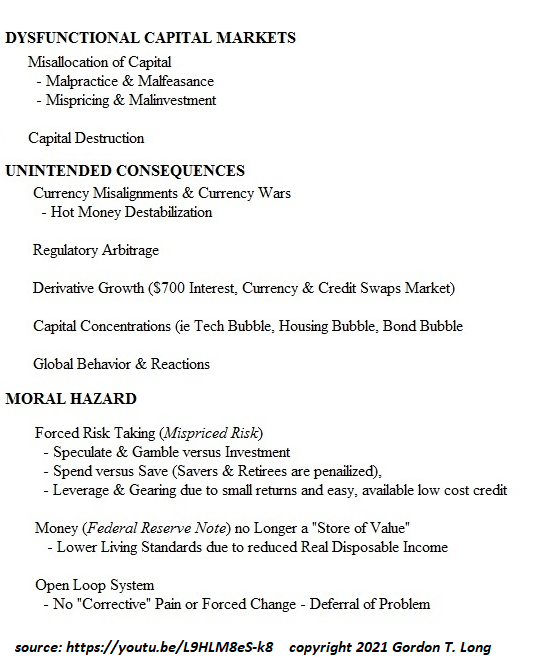
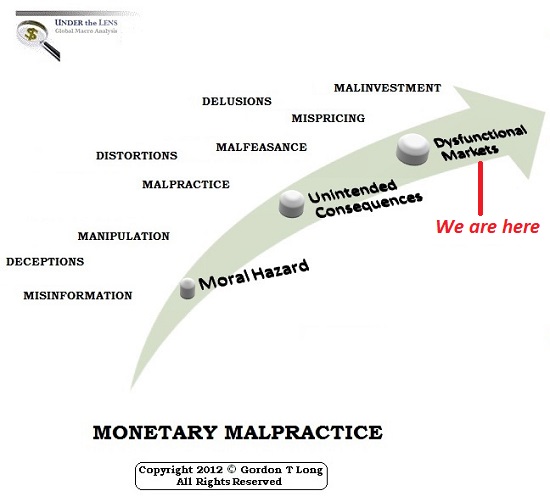
On top of all these grossly misleading distortions, punters have been encouraged to believe in the ultimate distortion: the Federal Reserve will never let markets decline again, ever. This is the perfection of moral hazard: risk has been disconnected from consequence.

In this perfection of moral hazard, punters consider it entirely rational to increase extremely risky speculative bets because the Federal Reserve will never let markets decline. Given the abundant evidence behind this assumption, it would be irrational not to ramp up crazy-risky speculative bets to the maximum because losses are now impossible thanks to the Fed's implicit promise to never let markets drop.

This is why distorted, manipulated markets always end the same way: first, in an unexpected emergence of risk, which was presumed to be banished; second, a market crash as the paper-thin bid disappears and prices flash-crash to levels that wipe out all those forced to sell by margin calls, and then the collapse of faith in the manipulators (the Fed), collapse of the collateral supporting trillions of dollars in highly leveraged debt and then the collapse of the entire delusion-based financial system.

Gordon Long and I illuminate the many layers of distortion, manipulation and moral hazard in our new video presentation, It Always Ends The Same Way (34:33). Amidst the ruins generated by well-meaning manipulation and distortion, the "well meaning" part will leave an extremely long-lasting bitter taste in all those who failed to differentiate between the false signals and distorted information of manipulated markets and the trustworthy transparency of signals arising in truly open markets.

In summary: risk has not been extinguished, it is expanding geometrically beneath the false stability of a monstrously manipulated market. As I often note here, risk cannot be extinguished, it can only be transferred. By distorting markets to create an illusion of low-risk stability, the Federal Reserve has transferred this fatal supernova of risk to the entire financial system.


If you found value in this content, please join me in seeking solutions by becoming a $1/month patron of my work via patreon.com.

My new book is available! A Hacker's Teleology: Sharing the Wealth of Our Shrinking Planet 20% and 15% discounts (Kindle $7, print $17, audiobook now available $17.46)

Read excerpts of the book for free (PDF).

The Story Behind the Book and the Introduction.


Recent Videos/Podcasts:

It Always Ends The Same Way (34:33) (with Gordon Long)

My COVID-19 Pandemic Posts


My recent books:

A Hacker's Teleology: Sharing the Wealth of Our Shrinking Planet (Kindle $8.95, print $20, audiobook $17.46) Read the first section for free (PDF).

Will You Be Richer or Poorer?: Profit, Power, and AI in a Traumatized World
(Kindle $5, print $10, audiobook) Read the first section for free (PDF).

Pathfinding our Destiny: Preventing the Final Fall of Our Democratic Republic ($5 (Kindle), $10 (print), ( audiobook): Read the first section for free (PDF).

The Adventures of the Consulting Philosopher: The Disappearance of Drake $1.29 (Kindle), $8.95 (print); read the first chapters for free (PDF)

Money and Work Unchained $6.95 (Kindle), $15 (print) Read the first section for free (PDF).


Become a $1/month patron of my work via patreon.com.


NOTE: Contributions/subscriptions are acknowledged in the order received. Your name and email remain confidential and will not be given to any other individual, company or agency.

Thank you, Joy U. ($5/month), for your exceedingly generous pledge to this site -- I am greatly honored by your support and readership.


Thank you, Jim S. ($10/month), for your outrageously generous pledge to this site -- I am greatly honored by your support and readership.

Read more...

Sunday, June 20, 2021

Front-Running the Crash

What if everyone in the market realizes it's now the moment to front-run the crash?

We have a fine-sounding word for running with the herd: momentum. When the herd is running, those who buy what the herd is buying and sell what the herd is selling are trading momentum, which sounds so much more professional and high-brow than the noisy, dusty image of large mammals (and their trading machines) mindlessly running with the herd.

We also have a fine-sounding phrase for anticipating where the herd is running: front-running. So when the herd is running into stocks, those who buy stocks just ahead of the herd are front-running the market.

When the Federal Reserve announces that's it's going to make billionaires even wealthier with some new financial spew, those betting that stocks will never go down because the Fed has our back are front-running the Fed.

There are two remarkable assumptions at the heart of momentum and front-running: The momentum herd and those front-running the herd base their behavior on the assumption that there will always be other rich people who will sell all the shares they want to buy at today's prices before the run-up to new highs.

Since only rich people own stocks, we know that those selling stocks are selling to other rich people and those buying stocks are buying from other rich people. So the assumption of those front-running the market is that there is a large enough sub-herd of rich people who for whatever reason aren't smart enough to front-run the herd, and who will foolishly sell their stocks just before they double in value.

The second assumption is that there will also be a large enough sub-herd of rich people who will buy all the shares they want to sell at the top, just before the bubble pops and the value of the newly purchased shares falls in half.

There are various ways to state this, but the bottom line is that momentum and front-running are only profitable if you sell at the top, just before the bubble bursts. You would be forgiven for anticipating that the same sub-herd front-running the herd and the Fed on the way up to the top of the bubble would be just as prescient and active in front-running the inevitable bursting of the bubble, but this is not how running with the herd works.

Short interest recently plumbed multi-year lows, indicating that very few are front-running the market crash.

Those trading momentum and front-running the herd/Fed are making a remarkable assumption, an assumption which is visible in a great volume of financial-media content: the stock market, we're told, will continue to make new highs like clockwork until some point in the third or fourth quarter, at which point there may well be a spot of bother, i.e., a crash.

The assumption is that all the rich people who own stocks will be so splendidly stupid that they will hold their shares until the crash and then sell them at prices far lower than they can fetch today. Put another way, the market participants who decide this is close enough to the top to liquidate their positions today and not wait around for the crash to wipe them out assume that that the herd of other rich people who will be delighted to buy their insanely overvalued shares at today's prices is large enough to absorb all their selling with no downward pressure on valuations.

In other words, the assumption being made is: I can wait until just before the crash to sell, because there will be boatloads of splendidly stupid rich people who will buy all the shares I want to sell at today's lofty prices--or higher, and this liquidation won't push valuations off a cliff.

As a general rule, people don't all become rich by being splendidly stupid, i.e., failing to anticipate what other rich people are about to do, and so this raises the question: what if everyone in the market realizes it's now the moment to front-run the crash?

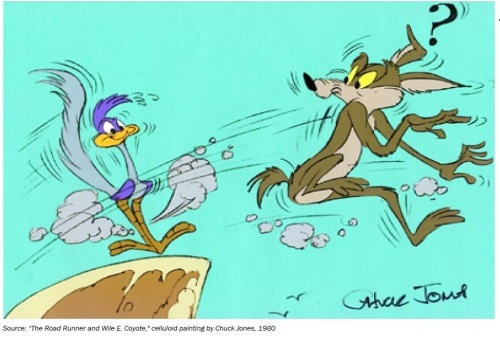
Perhaps Wile E. Coyote could offer some useful perspective on what happens next.


If you found value in this content, please join me in seeking solutions by becoming a $1/month patron of my work via patreon.com.

My new book is available! A Hacker's Teleology: Sharing the Wealth of Our Shrinking Planet 20% and 15% discounts (Kindle $7, print $17, audiobook now available $17.46)

Read excerpts of the book for free (PDF).

The Story Behind the Book and the Introduction.


Recent Videos/Podcasts:

It Always Ends The Same Way (34:33) (with Gordon Long)

My COVID-19 Pandemic Posts


My recent books:

A Hacker's Teleology: Sharing the Wealth of Our Shrinking Planet (Kindle $8.95, print $20, audiobook $17.46) Read the first section for free (PDF).

Will You Be Richer or Poorer?: Profit, Power, and AI in a Traumatized World
(Kindle $5, print $10, audiobook) Read the first section for free (PDF).

Pathfinding our Destiny: Preventing the Final Fall of Our Democratic Republic ($5 (Kindle), $10 (print), ( audiobook): Read the first section for free (PDF).

The Adventures of the Consulting Philosopher: The Disappearance of Drake $1.29 (Kindle), $8.95 (print); read the first chapters for free (PDF)

Money and Work Unchained $6.95 (Kindle), $15 (print) Read the first section for free (PDF).


Become a $1/month patron of my work via patreon.com.


NOTE: Contributions/subscriptions are acknowledged in the order received. Your name and email remain confidential and will not be given to any other individual, company or agency.

Thank you, Corey M. ($5/month), for your exceedingly generous pledge to this site -- I am greatly honored by your support and readership.


Thank you, Ross B. ($10/month), for your outrageously generous pledge to this site -- I am greatly honored by your support and readership.

Read more...

Friday, June 18, 2021

USA 2021: Capitalism for the Powerless, Crony-Socialism for the Powerful

The only dynamic that's even faintly "capitalist" about America's Crony-Socialism is the price of political corruption is still a "market."

The supposed "choice" between "capitalism" and "socialism" is a useful fabrication masking the worst of all possible worlds we inhabit: Capitalism for the powerless and Crony-Socialism for the powerful. Capitalism's primary dynamics are reserved solely for the powerless: market price of money, capital's exploitive potential, free-for-all competition and creative destruction.

The powerful, on the other hand, bask in the warm glow of socialism: The Federal Reserve protects them from the market cost of money--financiers and the super-wealthy get their money for virtually nothing from the Fed, in virtually unlimited quantities--and the Treasury, Congress and the Executive branch protect them from any losses: their gains are private, but their losses are transferred to the public. The Supreme Court ensures the super-rich maintain this cozy crony-socialism by ensuring they can buy political power via lobbying and campaign contributions--under the laughable excuse of free speech.

Cronies get the best political system money can buy and you--well, you get to carry a sign on the street corner, just before you're hauled off to jail for disturbing the peace (and you're banned by social media/search Big Tech, i.e. privatized totalitarianism, for good measure).

The Federal Reserve is America's financial Politburo: cronies get a free pass, the powerless get nothing. While the three billionaires who own more wealth than the bottom 165 million Americans can borrow unlimited sums for next to nothing thanks to the Fed (i.e. Crony-Socialist Politburo), the 165 million Americans pay exorbitant interest on payday loans, used car loans, student loans, credit cards and so on.

Capitalism (market sets price of money) for the powerless, Crony-Socialism (nearly free money) for the powerful--thanks to America's Crony-Socialist Politburo, the Fed. Consider the "free market" plight of America's working poor: earning low wages that are rapidly losing their purchasing power makes them a credit risk, i.e. prone to defaulting, so lenders (i.e. capital's exploitive potential) charge high interest rates on loans to the working poor.

Since they pay such high rates of interest and earn so little, they default on their debt at higher rates--just what the lenders expected, and what the lenders created by charging sky-high rates of interest: gee, you're having trouble paying 24% interest? Too bad you're poor. You see the point: low wages, poverty and exorbitant rates of interest are mutually reinforcing: a primary driver of defaults and poverty is paying sky-high rates of interest and all the late fees, bounced check fees, etc. that go with 24% interest rates.

The Crony-Socialists have a much different deal with the Fed and its crony-bankers: the super-wealthy arrange for the corporations they own shares in to borrow billions of dollars to fund stock buybacks (which in a less exploitive era were illegal market manipulation). The super-wealthy Crony-Socialist's personal wealth rises by $100 million thanks to the stock buybacks, and then the super-wealthy Crony-Socialist borrows $10 million for next to nothing against this newly conjured "wealth" (thanks, Fed!) to fund living large.

Crony-Socialist corporations pay no income tax thanks to loopholes and the Crony-Socialists who own the shares report $1 in salary and zero income because they borrowed their living expenses against their Fed-conjured wealth. Do you discern the difference between capitalism for the powerless and crony-socialism for the super-wealthy?

If you can't yet discern the difference, then ask yourself: can you borrow $1 billion from the Fed's cronies to buy back shares of your own company, and then borrow $10 million for near-zero rates of interest against the newly conjured "wealth"? You can't? Well, why not?

If you answer "I don't have enough collateral," you missed the key point here: thanks to America's Crony-Socialist Politburo (the Fed), the super-wealthy have no exposure to the market price of money. The Fed manipulates the cost of money to near-zero, and then funnels unlimited sums of this nearly-free money to corporations, financiers and the super-wealthy.

Collateral is unnecessary in Crony-Socialism; that's just a excuse given to the powerless. Crony-Socialists borrow $1 billion for next to nothing, buy Treasuries with the free money, put the Treasuries up as collateral (but wait, didn't they borrow the money? Never mind, it doesn't matter), originate some financial instruments (CDOs, etc.), post those as collateral, and then leverage up another bet on that fictitious collateral.

If the bets all go bad, the Crony-Socialist claims the whole fraud is now a systemic risk and so the losses are transferred to the public / taxpayers to "save the financial system from collapse." Isn't Crony-Socialism fantastic?

Just as the rich kid caught with smack gets a suspended sentence and probation while the powerless kid gets a tenner in the War on Drugs Gulag, the super-wealthy Crony-Socialists avoid all the consequences of their gambles and frauds. America's Crony-Socialist Politburo (the Fed) takes care of its cronies and the powerless bear the brunt of predatory exploitation that's passed off as "capitalism."

The only dynamic that's even faintly "capitalist" about America's Crony-Socialism is the price of political corruption is still a "market": what's the current price of protecting your monopoly or cartel from competition? It's moving up fast, so better get those bribes (oops, I mean campaign contributions for the 2022 election) in now before the price of corrupting "democracy" goes even higher.


If you found value in this content, please join me in seeking solutions by becoming a $1/month patron of my work via patreon.com.

My new book is available! A Hacker's Teleology: Sharing the Wealth of Our Shrinking Planet 20% and 15% discounts (Kindle $7, print $17, audiobook now available $17.46)

Read excerpts of the book for free (PDF).

The Story Behind the Book and the Introduction.


Recent Podcasts:

Charles Hugh Smith on the Era of Accelerating Expropriations (38 min) (FRA Roundtable Insight)

Covid Has Triggered The Next Great Financial Crisis (34:46)

My COVID-19 Pandemic Posts


My recent books:

A Hacker's Teleology: Sharing the Wealth of Our Shrinking Planet (Kindle $8.95, print $20, audiobook $17.46) Read the first section for free (PDF).

Will You Be Richer or Poorer?: Profit, Power, and AI in a Traumatized World
(Kindle $5, print $10, audiobook) Read the first section for free (PDF).

Pathfinding our Destiny: Preventing the Final Fall of Our Democratic Republic ($5 (Kindle), $10 (print), ( audiobook): Read the first section for free (PDF).

The Adventures of the Consulting Philosopher: The Disappearance of Drake $1.29 (Kindle), $8.95 (print); read the first chapters for free (PDF)

Money and Work Unchained $6.95 (Kindle), $15 (print) Read the first section for free (PDF).


Become a $1/month patron of my work via patreon.com.


NOTE: Contributions/subscriptions are acknowledged in the order received. Your name and email remain confidential and will not be given to any other individual, company or agency.

Thank you, Mike G. ($5/month), for your splendidly generous pledge to this site -- I am greatly honored by your support and readership.


Thank you, Richard C. ($54), for yet another marvelously generous contribution to this site -- I am greatly honored by your support and readership.

Read more...

Wednesday, June 16, 2021

Is Inflation "Transitory"? Here's Your Simple Test

Is inflation "transitory" in your household budget? Really? Where?

The Federal Reserve has been bleating that inflation is "transitory"--but what about the real world that we live in, as opposed to the abstract funhouse of rigged statistics? Here's a simple test to help you decide if inflation is "transitory" in the real world.

Let's start with some simple stipulations: price is price, there are no tricks like hedonics or substitution. Nobody cares if the truck stereo is better than it was 40 years ago, the price of the truck is the price we pay today, and that's all that matters.

(Funny, the funhouse statistical adjustments never consider that appliances that used to last 30 years now break down and are junked after 3 years--if we adjusted for that, the $500 washer would be tagged at $5,000 today because it has lost 90% of its durability over the past 30 years.)

Second, inflation must be weighted to "big ticket" nondiscretionary items. The funhouse statistical trickery counts a $10 drop in the price of a TV (which you buy every few years at best) as equal to a $100 rise in childcare, which you pay monthly. No, no, no: a 10% rise in rent, healthcare insurance and childcare is $400 a month or roughly $5,000 a year. A 10% decline in a TV you buy every three years is $50. Even a 50% drop in the price of a TV ($250) is $83 per year--absolutely trivial, absolutely meaningless compared to $5,000 in higher big-ticket expenses.

You can forego the new TV but not the rent, childcare or healthcare. That's the difference between "big ticket" nondiscretionary and discretionary (meals out, 3rd TV, etc.).

Third, we jettison the painfully obvious manipulation of "owners equivalent rent" for housing costs. Housing costs are the prices we pay for rent, owning a home and paying property taxes, insurance and maintenance costs to own the home. (Have you priced having a new roof put on your house by a licensed, reputable contractor? No? Well, it's become a lot more expensive than it was a few years ago. Where is that enormous price leap in "owners equivalent rent"? Just how stupid does the Fed reckon we are?)

OK, here's the test: let's say markets finally take a deflationary dive from overvalued heights. Housing, stocks and other risk assets fall 30%. Trillions of dollars in "wealth" (that didn't exist prior to the Everything Bubble inflating) has vanished, generating a reverse wealth effect as all the owners of these assets feel poorer and less inclined to borrow and spend. This is classically considered highly deflationary: demand drops, prices drop.

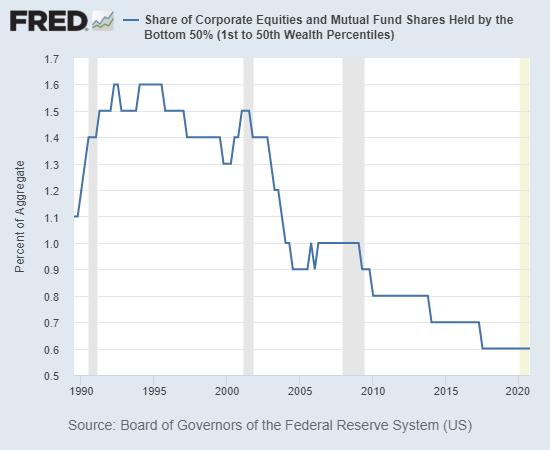
The three billionaires who own more assets than the bottom 50% of Americans (165 million Americans) will be crying, but how does life change for the 165 million Americans who own a vanishingly thin slice of these assets? Does their rent drop? No, for the reasons I explained in The Fed Is Wrong: Inflation Is Sticky: the big corporate landlords have to keep rents high to placate their lenders. (And let's not forget greed: the greedy never want to lower prices, preferring to cling to the Fed's fantasy of "transitory" trouble.)

Now let's ask about the higher-income 150 million Americans who own homes and pay property taxes, who pay healthcare insurance, college tuition and fees, childcare and elderly care. Even if there is a deflationary crash in stocks and housing, what are the odds the overall costs of owning and maintaining your home will drop significantly?

What are the odds that local government will let property taxes drop with valuations? Shall we be honest and say zero? If real estate valuations plummet, then property tax rates will rise to compensate. Or other "creative" fees will be imposed to make up the shortfall in tax revenues.

What about childcare? What are the odds that childcare costs will drop 30%? Shall we be honest and say zero? The costs paid by childcare providers only go up, and so those who don't charge enough (marginal providers) will close down, generating a shortage of supply that elevates prices.

What about elderly care? Will assisted living facilities suddenly drop 30% just because asset bubbles pop? No. The costs of assisted living march higher regardless of what asset valuations and interest rates do.

What about healthcare? Will all those costs drop 30% because assets declined? No. Everyone exposed to real-world pricing of healthcare will be paying more.

But what about the roofing contractor? Won't they charge 30% less? The biggest expenses for the contractor are workers compensation insurance, liability insurance, disability insurance, FICA (Social Security and Medicare) and healthcare insurance, and none of those will drop a single dollar even if stocks drop 30%.

Just as 85% of local government expenses are labor-related, most of the expenses of the roofing contractor are labor-related. The roofing materials dropping a few bucks might lower the cost by a few percentage points, but the material costs are based on the costs of the manufacturers, distributors, truckers, etc., and these are also based on labor-related expenses, taxes, insurance and healthcare--none of which will drop a dime, regardless of what asset prices do.

Economist Michael Spence elucidated the difference between tradable and untradable goods and services. If you want your washer repaired, that service in untradable, as shipping your broken washer to China for repair is not financially viable. As labor costs rise in China and other offshore economies, that raises costs even for tradable goods.

The majority of essential services are untradable and the costs are dependent on "big ticket" expenses which cannot go down without imploding the economy and government: taxes, insurance, healthcare, childcare, elderly care, etc. cannot drop 30% because they're based on labor costs, highly profitable systemic friction (Big Pharma, the Higher Education Cartel, Big Ag, healthcare and other quasi-monopolies) and the need for ever-higher tax revenues to provide services which the public demands.

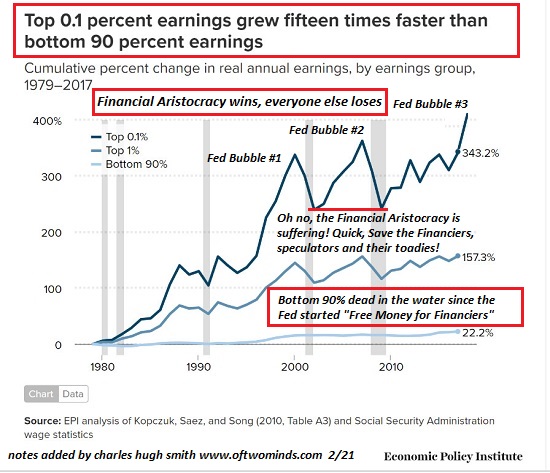
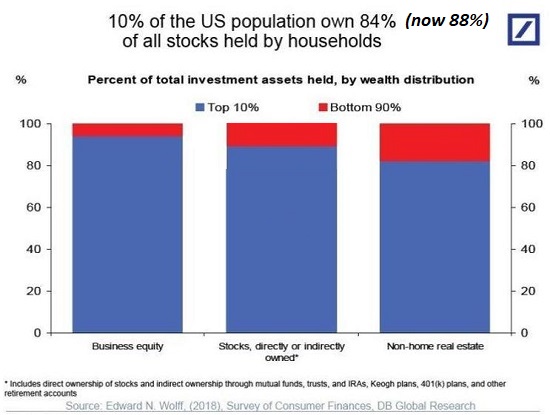
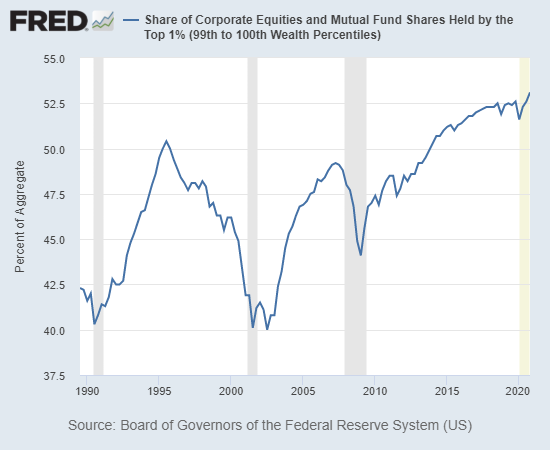
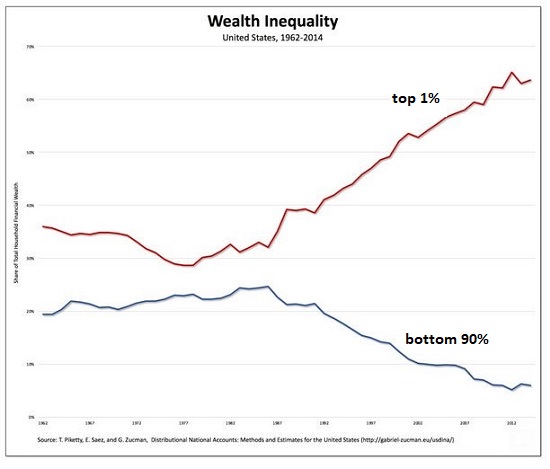
Let's also ponder the consequences of the extreme concentration of wealth and income in the top 5% of U.S. households. The top 10% own roughly 85% of all wealth, and the top 1% own more than half the financial wealth.

Any significant drop in financial assets will have almost no effect on the bottom 90% because they don't own enough of these assets to be consequential. So the deflationary effect of the reverse wealth effect will be concentrated in the discretionary spending of the top 10%: the luxury imported vehicles, the $100 per plate dinners (those $60 bottles of wine add up), the $500/day resort vacation, the $2,500/week AirBnB rental, etc.

The declines in the cost of these discretionary luxuries may well be noteworthy, but there are thresholds below which prices cannot drop. The high-end restaurant has equally high-end expenses, and so marginal providers will close, leaving only those few who can maintain profitability as demand for luxury dining craters.

The resort has high expenses as well, and once profitability has been lost, resorts will close just like other marginal providers. Supply shrinks along with demand, and the survivors keep prices high enough or they too will close.

So the essential "big ticket" costs will keep rising and the discretionary luxuries only the top 10% can afford will drop--but not by much as all those luxury providers have the same high fixed costs.

So to recap the test: what are the odds of these "big ticket" expenses dropping 30% if asset prices drop 30%?

Taxes: zero.

Healthcare: zero.

Childcare: zero.

Elderly care: zero.

Costs of doing business: zero.

As for housing: the mortgage doesn't drop if the market value of the house drops 30%, and any declines in insurance will be modest. The costs of maintenance won't drop much, either, and might actually increase as the supply of skilled workers declines. (Nothing is more expensive than the "cheap" repair that has to be redone correctly.)

Rents may drop in areas nobody wants to live anymore, but rents will rise in places people do want to live.

The larger point here is the long economic cycles have turned. The 40-year decline in interest rates has turned, whether we admit it or not. The 40-year decline in the prices of goods due to financialization (lower interest rates, higher speculative assets) and globalization has turned. The 40-year expansion of the workforce has turned. The 40-year decline of oil/fuel/resources prices has turned. The 40-year fantasy that we can depend on other nations for our essential resources and components is drawing to a close.

Untradable goods and services, cost thresholds, resource security, the end of financialization / globalization and declining interest rates matter. The fantasy that the top 10% can prop up the economy by borrowing and spending the phantom wealth of insanely overvalued asset bubbles is drawing to a close.

Is inflation "transitory" in your household budget? Really? Where?


If you found value in this content, please join me in seeking solutions by becoming a $1/month patron of my work via patreon.com.

My new book is available! A Hacker's Teleology: Sharing the Wealth of Our Shrinking Planet 20% and 15% discounts (Kindle $7, print $17, audiobook now available $17.46)

Read excerpts of the book for free (PDF).

The Story Behind the Book and the Introduction.


Recent Podcasts:

Charles Hugh Smith on the Era of Accelerating Expropriations (38 min) (FRA Roundtable Insight)

Covid Has Triggered The Next Great Financial Crisis (34:46)

My COVID-19 Pandemic Posts


My recent books:

A Hacker's Teleology: Sharing the Wealth of Our Shrinking Planet (Kindle $8.95, print $20, audiobook $17.46) Read the first section for free (PDF).

Will You Be Richer or Poorer?: Profit, Power, and AI in a Traumatized World
(Kindle $5, print $10, audiobook) Read the first section for free (PDF).

Pathfinding our Destiny: Preventing the Final Fall of Our Democratic Republic ($5 (Kindle), $10 (print), ( audiobook): Read the first section for free (PDF).

The Adventures of the Consulting Philosopher: The Disappearance of Drake $1.29 (Kindle), $8.95 (print); read the first chapters for free (PDF)

Money and Work Unchained $6.95 (Kindle), $15 (print) Read the first section for free (PDF).


Become a $1/month patron of my work via patreon.com.


NOTE: Contributions/subscriptions are acknowledged in the order received. Your name and email remain confidential and will not be given to any other individual, company or agency.

Thank you, Paul B. ($5/month), for your splendidly generous subscription to this site -- I am greatly honored by your support and readership.


Thank you, John B. ($54), for yet another marvelously generous contribution to this site -- I am greatly honored by your support and readership.

Read more...

Sunday, June 13, 2021

Seven Things Nobody Talks About that Will Eventually Matter--A Lot

Nobody seems to notice the 'diminishing returns' on Fed manipulation, oops, I mean 'intervention'.

Perhaps it shouldn't surprise us that everything that will eventually matter is ignored until it does matter--but by then it's too late. Here's a short list to start the discussion:

1. The Federal Reserve has transformed the American populace into a nation of dismayingly over-confident gamblers. I've been writing about moral hazard--the separation of risk from consequence--since 2011. Punters who are insulated from risk will have an insatiable appetite for risky bets, which is precisely what we see on a mass scale, as the confidence that the Fed will never let markets drop is 99.99% because the Fed has indeed reversed every decline, no matter how modest, month after month, year after year.

The Fed has perfected moral hazard: everyone from the money manager betting billions to the punters gambling their stimmy money is absolutely confident I can't lose because the Fed will always push the market higher. Hence the advice to never sell and keep increasing the size of one's bets because losing is transitory (heh).

2. The Fed's perfection of moral hazard radically incentivizes increasing debt and leverage to maximize one's bets because the bigger the bet, the bigger the payoff--the Fed guarantees it! Margin debt is at extremes, and many wildly successful stock and options punters have reaped fantastic gains by maxing out their Robinhood margin as their winnings increase.

Since the Fed guarantees that anyone holding until the Fed gooses markets higher will be a winner, maximizing leverage is completely rational: hedging is a foolish waste of money that could have been placed on a sure winner--any long bet.

Margin and shadow-banking leverage is through the roof, but nobody sees any risk from this extreme expansion of debt and leverage. Never mind that leverage unwinds faster than it builds...

3. As longtime technician Louise Yamada reminds us, volume is the weapon of the Bull. Yet volume is lower than the holiday season before New Years. The Bull is nowhere in sight if we look at volume, yet every new high is proof-positive that the Fed doesn't need no stinkin' volume-- markets will loft higher forever with or without volume. OK, if you say so...

4. Inflation is Kryptonite for markets, yet nobody feels any need to discount the possibility that inflation isn't "transitory". There are numerous reasons to doubt the Fed's bleatings, reasons I've laid out in The Fed Is Wrong: Inflation Is Sticky
The Sources of Rip-Your-Face-Off Inflation Few Dare Discuss
A Couple Things About Inflation.

5. Everyone seems to be assuming the calendar has been reset to September 2019 with absolutely nothing different, yet profound cultural changes have occured beneath the status quo's radar. I addressed a few of these cultural shifts in Post-Pandemic Metamorphosis: Never Going Back
The 'Take This Job and Shove It' Recession.

The incentives to opt-out--and the quiet time needed to realize this provided by the lockdown-- are weighing on the entire spectrum of the workforce from professionals to the working poor. But conventional pundits are blind to the consequences of 'Take This Job and Shove It'.

6. The insanity of leaving the nation dependent on foreign suppliers for essentials goes largely unremarked. Never mind the national security risks-- all that matters is Corporate America squeezing the last few dollars of profits out of the dead carcass of globalization.

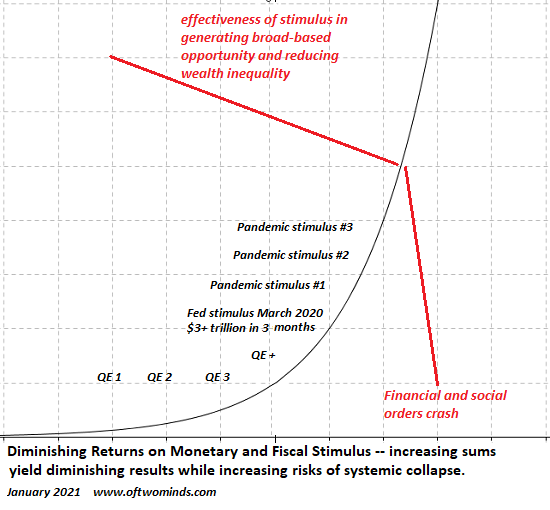
7. Nobody seems to notice the diminishing returns on Fed manipulation, oops, I mean intervention: what $1 trillion accomplished 12 years ago takes almost $4 trillion--and what about the next fireball of deleveraging / margin calls? What will that take to reverse? $8 trillion? $10 trillion? And all of that will be consequence-free, no matter how bloviated? If you say so....


If you found value in this content, please join me in seeking solutions by becoming a $1/month patron of my work via patreon.com.

My new book is available! A Hacker's Teleology: Sharing the Wealth of Our Shrinking Planet 20% and 15% discounts (Kindle $7, print $17, audiobook now available $17.46)

Read excerpts of the book for free (PDF).

The Story Behind the Book and the Introduction.


Recent Podcasts:

Charles Hugh Smith on the Era of Accelerating Expropriations (38 min) (FRA Roundtable Insight)

Covid Has Triggered The Next Great Financial Crisis (34:46)

My COVID-19 Pandemic Posts


My recent books:

A Hacker's Teleology: Sharing the Wealth of Our Shrinking Planet (Kindle $8.95, print $20, audiobook $17.46) Read the first section for free (PDF).

Will You Be Richer or Poorer?: Profit, Power, and AI in a Traumatized World
(Kindle $5, print $10, audiobook) Read the first section for free (PDF).

Pathfinding our Destiny: Preventing the Final Fall of Our Democratic Republic ($5 (Kindle), $10 (print), ( audiobook): Read the first section for free (PDF).

The Adventures of the Consulting Philosopher: The Disappearance of Drake $1.29 (Kindle), $8.95 (print); read the first chapters for free (PDF)

Money and Work Unchained $6.95 (Kindle), $15 (print) Read the first section for free (PDF).


Become a $1/month patron of my work via patreon.com.


NOTE: Contributions/subscriptions are acknowledged in the order received. Your name and email remain confidential and will not be given to any other individual, company or agency.

Thank you, Douglas R. Jr. ($5/month), for your splendidly generous subscription to this site -- I am greatly honored by your support and readership.


Thank you, Carl P. ($5/month), for for your marvelously generous subscription to this site -- I am greatly honored by your support and readership.

Read more...

Terms of Service

All content on this blog is provided by Trewe LLC for informational purposes only. The owner of this blog makes no representations as to the accuracy or completeness of any information on this site or found by following any link on this site. The owner will not be liable for any errors or omissions in this information nor for the availability of this information. The owner will not be liable for any losses, injuries, or damages from the display or use of this information. These terms and conditions of use are subject to change at anytime and without notice.

RE: European Union AI Act, and Our Use of Generative AI Tools and Agents Policy

All text on this site is composed by Charles Hugh Smith or by a credited guest-author. No Generative AI Tools are used in the composition / writing of any text or graphic content created by Charles Hugh Smith. This site deploys no AI agents or generative AI tools. This site is not responsible for the disclosures, use or non-use of AI agents or generative AI tools in advertisements displayed by Investing Channel or other ad placement services.

Audio files generated by text-to-audio transcription tools are identified as such.

Our Privacy Policy:

Correspondents' email is strictly confidential. This site does not collect digital data from visitors or distribute cookies. Advertisements served by third-party advertising networks such as Investing Channel may use cookies or collect information from visitors for the purpose of Interest-Based Advertising; if you wish to opt out of Interest-Based Advertising, please go to Opt out of interest-based advertising (The Network Advertising Initiative) If you have other privacy concerns relating to advertisements, please contact advertisers directly.

PRIVACY NOTICE FOR EEA INDIVIDUALS

This section covers disclosures on the General Data Protection Regulation (GDPR) for users residing within EEA only. GDPR replaces the existing Directive 95/46/ec, and aims at harmonizing data protection laws in the EU that are fit for purpose in the digital age. The primary objective of the GDPR is to give citizens back control of their personal data. Please follow the link below to access InvestingChannel's General Data Protection Notice.
https://stg.media.investingchannel.com/gdpr-notice/

Notice of Compliance with The California Consumer Protection Act

This site does not collect digital data from visitors or distribute cookies. Advertisements served by a third-party advertising network (Investing Channel) may use cookies or collect information from visitors for the purpose of Interest-Based Advertising. If you do not want any personal information that may be collected by third-party advertising to be sold, please follow the instructions on this page: Do Not Sell My Personal Information.

Regarding Cookies:

This site does not collect digital data from visitors or distribute cookies. Advertisements served by third-party advertising networks such as Investing Channel may use cookies or collect information from visitors for the purpose of Interest-Based Advertising; if you wish to opt out of Interest-Based Advertising, please go to Opt out of interest-based advertising (The Network Advertising Initiative) If you have other privacy concerns relating to advertisements, please contact advertisers directly.

Our Commission Policy:

Though I earn a small commission on Amazon.com books and gift certificates and gold (BullionVault) purchased via links on my site, I receive no fees or compensation for any other non-advertising links or content posted on my site.

Copyright Notice:

All original images (Drawings and Photographs), text (essays, books and works of fiction), audio and video recordings, musical compositions, graphic design, graphic design elements and HTML coding on this site are the copyrighted work of Charles Hugh Smith unless otherwise credited or noted. They are published as information for the private use of site visitors, and any reproduction or redistribution of this content or coding in any media in any format or distribution channel (text, audio, video/film, web) without the written permission of the copyright holder is strictly prohibited. All rights in all media reserved globally.

  © Blogger templates Newspaper III by Ourblogtemplates.com 2008

Back to TOP