




Tuesday, September 13, 2022

The Fourth Turn, Turn, Turn

The cycles of The Fourth Turning, Fischer and Turchin are all in alignment at this point in history..

The 1997 book The Fourth Turning: An American Prophecy proposed a cyclical pattern of four 20-year generations which culminate in a national crisis every 80 years. The book identifies these dates as Fourth Turnings: 1781 (Revolutionary War), 1861 (Civil War) and 1941 (global war). add 80 years and voila, 2021.

I use the term Fourth Turning generically to describe an existential crisis that decisively changes the course of national identity and history.

In other words, we don't have to accept the book's theory of generational dynamics to accept an 80-year cycle. There are other causal dynamics in play that also tend to cycle: the credit (Kondratieff) cycle, for example.

While each of the previous existential crises were resolved positively, positive outcomes are not guaranteed: dissolution and collapse are also potential outcomes.

David Hackett Fischer's book The Great Wave: Price Revolutions and the Rhythm of History proposes another cycle: humans expand their numbers and consumption until they've exploited and depleted all available resources.

As resources become scarce, societies and economies unravel as humans do not respond well to rising prices generated by scarcities.

The unraveling continues until consumption is realigned with the resources available. In the past this meant either a mass die-off that drastically reduced human numbers and consumption (for example, The Black Plague), a decline in fertility that slowly reduced population to fit resources, mass migration to locales with more resources or the discovery and exploitation of a new scalable energy source that enabled a new cycle of rising consumption.

The 14th century Black Death reduce Europe's population by roughly 40%, enabling depleted forests to regrow and depleted agricultural land to restore fertility.

Once the human population regained its numbers and consumption in the 17th century, wood was once again under pressure as the key source of energy, shipbuilding, housing, etc.

The development of steam power and the technologies of mining enabled the exploitation of coal, which soon replaced wood as the primary energy source.

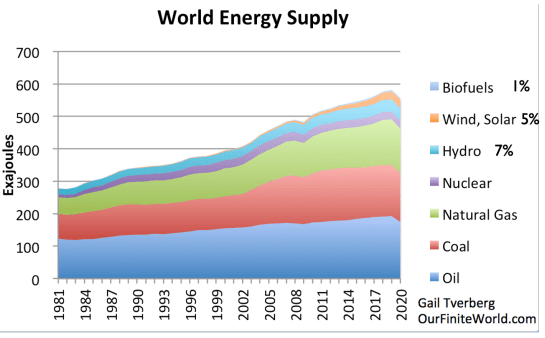
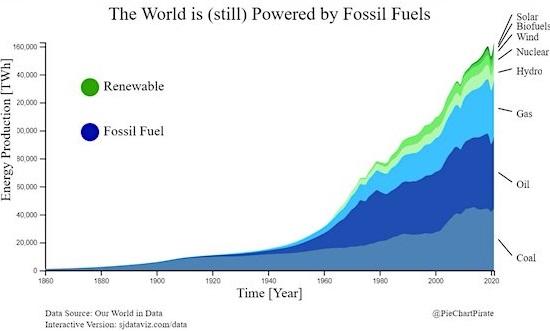
Oil and natural gas added to the energy humans could tap, followed (at a much more modest level) by nuclear power. Despite gargantuan investments, the recent push to develop solar and wind energy has yielded very modest results, as globally these sources provide about 5% of total energy consumption. (See chart below)

It's self-evident that despite breezy claims of endless expansion of consumption, the global human population has now exceeded the resources available for practical extraction. Energy, fresh water, wild fisheries and fertile soils have all been exploited and the easy/cheap-to-extract resources have been depleted.

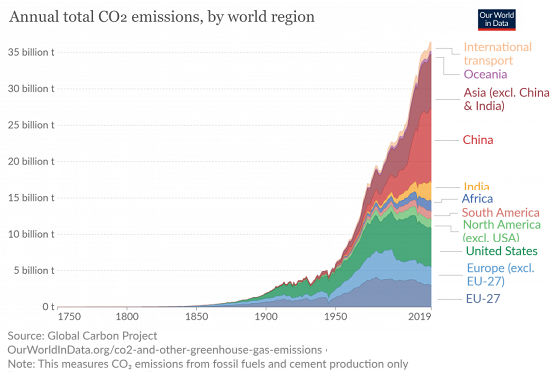
(The chart below of global CO2 emissions is a proxy for energy / resource consumption.)

So once again it's crunch-time: either we proactively reduce consumption to align with available resources, or Nature will do it for us via scarcities.

Peter Turchin proposed another socio-economic cycle of 50 years in his book Ages of Discord: in the integrative stage, people find reasons to cooperate. In the disintegrative stage at the end of the cycle, people no longer find much common ground or reasons to cooperate. Political, social and financial extremes proliferate, culminating in a rolling crisis.

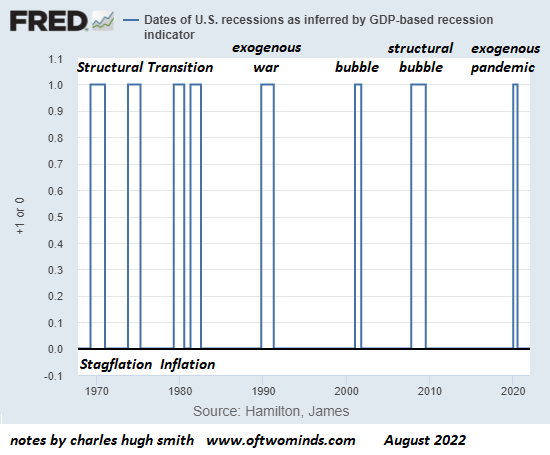
In Turchin's analysis, the previous 50-year age of discord began around 1970, and the current era of discord began in 2020. Those who lived through the domestic terrorism, urban decay, stagflation and political/social/legal crises of the 1970s recall how inter-related crises dominated the decade.

In my analysis, the last period of discord in the 1970s was "saved" by the supergiant oil fields discovered in the 60s coming online in the late 1970s and early 1980s. That oil enabled a 40-year boom which is now ending, with no new scalable source of energy available to replace oil, much less enable an expansion of consumption.

In other words, the cycles of The Fourth Turning, Fischer and Turchin are all in alignment at this point in history. We have proliferating political, social and financial extremes and a forced transition to lower consumption to align with declining energy.

Turn, turn, turn. Right when we need to cooperate on transforming a high-consumption, bubble-dependent "waste is growth" Landfill Economy to declining consumption / Degrowth, we're beset by discord and demographic pressures, as the promises made to the elderly back when it was expected that there would always be 5 workers per retiree cannot possibly be kept now that the worker-retiree ratio is 2-to-1 and there are no limits on healthcare spending for the elderly.

Humans are happy to expand their numbers and consumption and much less happy to consume less. They tend to start revolutions and wars in vain attempts to secure enough resources to maintain their profligate consumption and expansion.

Today's extremes of wealth and income inequality are optimized to spark political discord and revolts. The wealthiest 20% will be able to pay higher prices, but the bottom 40% will not. The middle 40% will find their disposable income, i.e. their income left over after paying for essentials, will drop to near-zero.

When 80% of the populace are crunched financially, revolutions and the overthrow of governments follow.

As I've outlined in previous posts, global inequalities are widening as the Core exploits its built-in advantages at the expense of the vulnerable Periphery.

Core nations will be much better able to maintain their consumption at the expense of the Periphery nations, which will experience sharp declines in purchasing power and consumption.

Previous Fourth Turnings have been resolved one way or another within 5 to 7 years. If this Turning began in 2020, we can expect resolution by 2025 - 2027.

As I explained in my book Global Crisis, National Renewal, those nations that embrace Degrowth will manage the transition, while those that cling to the endless-expansion, bubble-dependent Waste Is Growth model will fail.

This is why I keep talking about making Plans A, B and C to preserve optionality and reduce financial commitments and consumption now rather than passively await crises over which we will have little direct control.

As I've endeavored to explain, those anticipating decades of time to adjust are overlooking the systemic fragilities of the current global financial/supply systems. Tightly bound systems of interconnected dependency chains have been optimized to work perfectly in an era of expansion. They're not optimized to gradually adjust to contraction; they're optimized to break and trigger domino-like breakdowns in interconnected chains.

We don't control these macro-trends, we only control our response.


This essay was first published as a weekly Musings Report sent exclusively to subscribers and patrons at the $5/month ($54/year) and higher level. Thank you, patrons and subscribers, for supporting my work and free website.


Recent podcasts/videos:

Roundtable Insight: Charles Hugh Smith on the Insanity of Central Banks in Addressing Inflation (38 min.)


My new book is now available at a 10% discount this month: When You Can't Go On: Burnout, Reckoning and Renewal.

If you found value in this content, please join me in seeking solutions by becoming a $1/month patron of my work via patreon.com.


My recent books:

Global Crisis, National Renewal: A (Revolutionary) Grand Strategy for the United States (Kindle $9.95, print $24, audiobook) Read Chapter One for free (PDF).

A Hacker's Teleology: Sharing the Wealth of Our Shrinking Planet (Kindle $8.95, print $20, audiobook $17.46) Read the first section for free (PDF).

Will You Be Richer or Poorer?: Profit, Power, and AI in a Traumatized World
(Kindle $5, print $10, audiobook) Read the first section for free (PDF).

The Adventures of the Consulting Philosopher: The Disappearance of Drake $1.29 Kindle, $8.95 print); read the first chapters for free (PDF)

Money and Work Unchained $6.95 Kindle, $15 print)
Read the first section for free


Become a $1/month patron of my work via patreon.com.


NOTE: Contributions/subscriptions are acknowledged in the order received. Your name and email remain confidential and will not be given to any other individual, company or agency.

Thank you, Kenneth L. ($5/month), for your marvelously generous pledge to this site -- I am greatly honored by your support and readership.


Thank you, Jan A. ($100), for your outrageously generous contribution to this site -- I am greatly honored by your steadfast support and readership.

Read more...

Sunday, September 11, 2022

Why This Recession Is Different

All of these are structural dynamics that won't go away in a few months or years.

Let's explore what's different now compared to recessions of the past 60 years.

1. Deglobalization is inflationary. Offshoring production to low-cost countries imported deflation (product prices remained flat or declined) and boosted corporate profits.

Deglobalization will increase costs and pressure profits.

Just as cleaning up the environmental damage of rampant industrialization imposed costs on the U.S. economy in the 1970s that generated stagflation (inflation and stagnant growth), reshoring essential supply chains will impose costs, pushing prices higher.

Everything costs more in developed economies due to their high wages and social costs (pensions, healthcare, disability, etc.), high taxes, strict environmental standards and extensive regulations.

Consumers will pay more as supply chains are onshored / secured.

2. Energy will cost more. The price of oil and natural gas will fluctuate and could drop significantly as global demand drops, but in the long run the easy-to-access energy has been depleted and all energy will cost more.

Consumers will pay more regardless of where the goods and services come from

3. Capital will no longer have zero cost: interest rates may briefly return to near-zero but over time the cost of credit/borrowing will rise.

The 40+ year cycle of credit has bottomed and is reversing. As global risks rise, capital will demand a return.

Global risks are much higher than generally recognized. Each risk factor doesn't just add risk arithmetically: 1 + 1 + 1 = 3. Risk rises geometrically as each risk boosts the possibility of runaway feedback.

Climate change, scarcities, geopolitical tensions, capital flows--each reinforces the negative effects of the others. As risk rises, capital demands a higher return.

4. Definancialization will revalue assets. The hyper-financialization that fueled global growth for the past 40 years depended on the cost of credit falling: interest rates fell for 40 years, rewarding borrowers and buyers of bonds, which increased in value with each click down in interest rates.

These trends are reversing. Credit will cost more and every existing bond loses value with every click higher in interest rates / yields.

As profits from globalization dry up and credit costs rise, asset valuations based on cheap credit and rising profits will be repriced lower

Assets that benefit from scarcity, Deglobalization and Definancialization may increase in value.

But there are many other factors that play a part in revaluing assets:

-- generational selling as the elderly sell assets to fund their retirement

-- global capital flows as money flees insecure Periphery nations for the Core (North America)

-- heightened risk will revalue whatever is deemed safe and secure and what's viewed as risky / speculative

-- unprecedented inequality will drive clawbacks, wealth taxes and expropriations of wealth viewed as illegitimate or excessive.

Any one of these factors could upend conventional expectations of what each asset class will do in the future. All four interacting makes it impossible to predict any future valuation with any certainty.

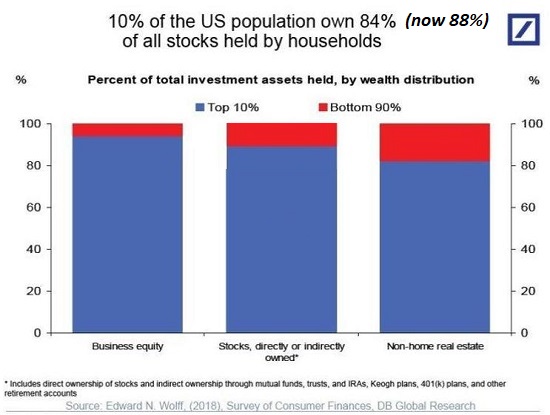
5. Wealth will take a hit, affecting the top 10% who own almost 90% of the wealth.

If history is any guide, all of the $400+ trillion in private wealth globally will not find a new home that preserves current valuations.

The losses will fall lightly on those who own few assets, i.e. the majority. The heavy losses will fall on those who own most of the assets--the top 5%.

This reverse wealth effect will reduce their ability to spend / consume, shrinking luxury / discretionary spending.

Demand for essentials will remain steady, demand for non-essentials will drop.

6. Labor scarcities will increase. Workforces in most nations are shrinking while the population of retirees' soars.

This undermines the entire social contract established in the postwar era (1950s and 1960s) which are all "pay as you go" programs that were designed for 4 or 5 workers supporting one retiree.

Now that the ratio has fallen to two workers (or less) to each retiree, the programs are unsustainable.

7. The unprecedented inequality of income and wealth has changed perceptions and values, changing societies in ways few recognize.

Young people with average jobs / income have no hope of affording a home, retirement or raising a family. So they've given up.

In China, it's called laying flat. In Japan, it has numerous manifestations, from Hikkomori (withdrawing from society) to arubaito (part-time work).

Since it's hopeless for average people to get all the good things with average effort, people give up and try to enjoy life without sacrificing themselves in the vain hope they'll somehow claw their way into the upper-middle class and be able to afford a family, house and retirement.

This is why pundits are complaining about lazy workers. Why aren't people working hard like they used to? because hard work is increasingly pointless. Just get by and enjoy life.

8. The pandemic changed perceptions of what's important. People gained new appreciation for the here and now and the futility of assuming the future is riskless and predictable.

Rather than sacrifice for an increasingly unstable, unpredictable future, people are pursuing what they want now.

For many younger people, this means ditching the dreams of wealth and conventional success for enjoying life in the here and now.

For those with incomes and assets, they're buying stuff they want now rather than putting it off. They're less concerned about debt. As long as they can swing the payments now, that's all that matters.

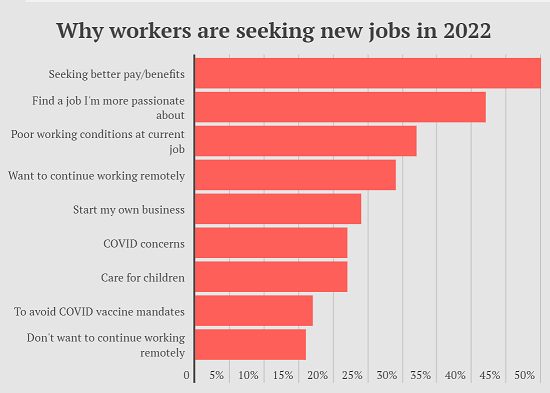
For others, work is optional. They found ways to get by without working. Now they may be lured back to work if the work is easy and they control their own schedule.

Employers are frustrated that they can't force employees to exclusively serve their needs.

As workers change what they consider important, this is forcing employers to pay attention to essential workers they took for granted.

9. Non-essential jobs will be slashed. Finding people to clean hotel rooms is hard, and so resorts are cutting services even as they jack up prices.

Enterprises can't cut maids, drivers, waiters, welders, etc., nor can these jobs be automated, despite the robotic fantasies of the intelligentsia.

Who they can cut are all the people spending their days in meetings.

10. Deglobalization will re-order mercantilist economies that have depended on exports for their bread and butter and consumer economies dependent on essentials imported from elsewhere.

Essentials (food, energy, technology) will increasingly be viewed (correctly) as national security priorities. Relying on other nations for essentials will be viewed (correctly) as increasing vulnerability and risk.

This will re-order all economies on a fundamental level. National security and trusted alliances will become higher priorities than increasing corporate profits.

All of these are structural dynamics that won't go away in a few months or years. They will transform the economy and society either positively (for those who embrace Degrowth) or negatively (those who cling to the bubble-dependent Waste Is Growth Landfill Economy).


Recent podcasts/videos:

Roundtable Insight: Charles Hugh Smith on the Insanity of Central Banks in Addressing Inflation (38 min.)


My new book is now available at a 10% discount this month: When You Can't Go On: Burnout, Reckoning and Renewal.

If you found value in this content, please join me in seeking solutions by becoming a $1/month patron of my work via patreon.com.


My recent books:

Global Crisis, National Renewal: A (Revolutionary) Grand Strategy for the United States (Kindle $9.95, print $24, audiobook) Read Chapter One for free (PDF).

A Hacker's Teleology: Sharing the Wealth of Our Shrinking Planet (Kindle $8.95, print $20, audiobook $17.46) Read the first section for free (PDF).

Will You Be Richer or Poorer?: Profit, Power, and AI in a Traumatized World
(Kindle $5, print $10, audiobook) Read the first section for free (PDF).

The Adventures of the Consulting Philosopher: The Disappearance of Drake $1.29 Kindle, $8.95 print); read the first chapters for free (PDF)

Money and Work Unchained $6.95 Kindle, $15 print)
Read the first section for free


Become a $1/month patron of my work via patreon.com.


NOTE: Contributions/subscriptions are acknowledged in the order received. Your name and email remain confidential and will not be given to any other individual, company or agency.

Thank you, Lisa V. ($5/month), for your marvelously generous pledge to this site -- I am greatly honored by your support and readership.


Thank you, Sebastian S. ($40), for your outstandingly generous contribution to this site -- I am greatly honored by your steadfast support and readership.

Read more...

Wednesday, September 07, 2022

The EU's Crisis Is Global: Neocolonialism, Hyper-Financialization and Hyper-Globalization Come Home to Roost

The EU's crisis isn't limited to energy. It is a manifestation of the global breakdown of Neocolonialism, Financialization and Globalization.

The European Union (EU) was seen as the culmination of a centuries-long process of integration that would finally put an end to the ceaseless conflicts that had led to disastrous wars in the 20th century that had knocked Europe from global preeminence.

Wary of the predations of the U.S. and rising Asian powers, European nations sought the economic and diplomatic strength of a confederation that would be greater than the sum of its parts, a union that would restore Europe's rightful place as a global power.

This worthy goal was undermined by the destructive dynamics of the past forty years: Neocolonialism, Financialization and Globalization.

These dynamics are unstable due to their internal contradictions. In classical colonialism, the Core dominates the Periphery with force, extracting economic value by exploiting the subject states' commodities and forcing the colonies to buy the valued-added finished goods produced by the colonial power's domestic economy.

This extractive model was at odds with the liberal worldview of the colonial powers which held self-rule and open markets as necessary to stable prosperity. The contradictions of classical colonialism led to its collapse as colonies broke free and the colonial powers were forced to navigate a more open global economy.

Beneath the glossy vibe of strength through unity, the EU institutionalized a Neocolonial Model in which some EU members are more equal than others, a divide that was starkly revealed in the debt crisis of 2011-2012.

I described the EU's version of the Neocolonial Model in 2012: The E.U., Neofeudalism and the Neocolonial-Financialization Model (May 24, 2012)

In Neocolonialism, the forces of financialization (debt and leverage controlled by State-approved banking cartels) are used to indenture the local Elites and populace to the banking center: the peripheral Neocolonials borrow money to buy the finished goods sold by the Core, doubly enriching the center with 1) interest and the transactional skim of financializing assets such as real estate, harbors, etc. and 2) the profits made selling goods to the debtors.

(China's Belt and Road Initiative (BRI) is another version of the Neocolonial Model in which credit and financialization indebt and disempower the Periphery nations to the benefit of the Neocolonial Power.)

In essence, the Core nations of the EU colonized the Periphery nations via the euro which enabled a massive expansion of debt and consumption in the Periphery. The banks and exporters of the Core extracted enormous profits from this expansion of debt-fueled consumption.

The Periphery's neocolonial status was starkly revealed by the debt crisis: the assets and income of the Periphery flowed to the Core as interest on the private and sovereign debts that are owed to the Core's commercial and central banks.

This was the perfection of Neocolonial Neofeudalism. The Periphery nations of the E.U. are effectively neocolonial debtors of the Core countries' banks, and the taxpayers of the Core nations are now feudal serfs whose labor is devoted to making good on any bank loans to the Periphery that go bad.

In effect, the importing Periphery nations were given the same expansive credit limits of their Mercantilist siblings. In a real-world analogy, it's as if someone prone to financing life's expenses with credit was handed a no-limit credit card with a low interest rate, backed by a guarantee from a credit-averse cousin.

Credit duly expanded oh-so profitably, but the contradictions eventually unravel the utopia: the Periphery borrowers soon borrow more than they can actually support, and the Core has to bail them out without actually writing off any of the debt, as writedowns would crush the profitability of the Core banks.

This is a colonialism based on the financialization of the smaller economies to the benefit of the Core's financial institutions and Mercantilist economies.

In the EU, the opportunities to exploit captive markets were even better than those found abroad, for the simple reason that the EU itself stood ready to guarantee there would be no messy expropriations or defaults by local authorities who decided to throw off the yokes of neocolonization.

The EU attempted to reconcile this intrinsically unstable private-capital/State arrangement-- profits are private but losses are public--by shoving the costs of the bad debt onto the backs of the Core's taxpayers (now indentured serfs).

The profits from the euro arbitrage and Neocolonial exploitation were private, but the costs are being borne by the taxpaying public of both Core and Periphery.

Globalization also has its own set of internal contradictions. Using financialization (credit and all the speculative schemes leverage enables) to boost mercantilist exports and consumerist imports was highly profitable, but both the exporters and importers are now exposed to the inherent vulnerabilities and fragilities of dependency on credit-fueled investment and consumption and the unstable private-capital/State arrangement--an arrangement that's coming apart everywhere from the EU to China.

The Neocolonial-Financialization Model has reached its limits globally. There are no more markets to exploit with financialization, the discretionary incomes of the debt-serfs have stagnated to the point they cannot take on any more debt and the reality that the speculative gains are phantom and the mountains of debt are unpayable can no longer be masked.

As I endeavored to explain in The Global Power Shift Isn't West to East--It's Not That Simple (June 24, 2022), currencies are the bedrock of financialization, and the internal contradictions of the global economy's credit-currency regime are finally unraveling the illusory stability of currency markets.

The EU's crisis isn't limited to energy. It is a manifestation of the global breakdown of Neocolonialism, Financialization and Globalization. No one will be unaffected as the internal contradictions destabilize a global economy that was presented as permanent.

What's the status quo fix? Cannibalization: The System Is Busy Cannibalizing Itself (August 31, 2022). Turning financialization and globalization into Hyper-Financialization and Hyper-Globalization didn't resolve the internal contradictions, it only accelerated their demise.


Recent podcasts/videos:

Roundtable Insight: Charles Hugh Smith on the Insanity of Central Banks in Addressing Inflation (38 min.)


My new book is now available at a 10% discount this month: When You Can't Go On: Burnout, Reckoning and Renewal.

If you found value in this content, please join me in seeking solutions by becoming a $1/month patron of my work via patreon.com.


My recent books:

Global Crisis, National Renewal: A (Revolutionary) Grand Strategy for the United States (Kindle $9.95, print $24, audiobook) Read Chapter One for free (PDF).

A Hacker's Teleology: Sharing the Wealth of Our Shrinking Planet (Kindle $8.95, print $20, audiobook $17.46) Read the first section for free (PDF).

Will You Be Richer or Poorer?: Profit, Power, and AI in a Traumatized World
(Kindle $5, print $10, audiobook) Read the first section for free (PDF).

The Adventures of the Consulting Philosopher: The Disappearance of Drake $1.29 Kindle, $8.95 print); read the first chapters for free (PDF)

Money and Work Unchained $6.95 Kindle, $15 print)
Read the first section for free


Become a $1/month patron of my work via patreon.com.


NOTE: Contributions/subscriptions are acknowledged in the order received. Your name and email remain confidential and will not be given to any other individual, company or agency.

Thank you, Eugene M. ($5/month), for your marvelously generous pledge to this site -- I am greatly honored by your support and readership.


Thank you, Thomas S. ($1/month), for your most generous pledge to this site -- I am greatly honored by your support and readership.

Read more...

Monday, September 05, 2022

Why Some Cities May No Longer Be Viable

Any city whose lifeblood ultimately depends on hyper-globalization and hyper-financialization will no longer be viable.

The human migration from the countryside to cities has been an enduring feature of civilization. Cities concentrate wealth, productivity and power, and so they're magnets to talent and capital, offering newcomers the greatest opportunities.

Cities are efficient, packing population, productivity and wealth creation into small areas. Slums and sweatshops are immensely profitable, and cramming people into centers of manufacturing is far more efficient than scattering people and production across a landscape.

Cities generally arose on coastal harbors, navigable rivers or the confluence of overland trade routes, as these hubs enabled profitable trade and transport of goods protected by defensible barriers.

In sum, cities offered unmatchable advantages over more widely distributed settlements, trade and production. Given their typically strategic location and regional dominance, they tend to become political, military and cultural centers as well as economic / financial heavyweights.

But the nature of cities has changed, and so has their viability as magnets for talent and capital. I recently discussed these shifts with longtime correspondent T.D., who succinctly summarized the economic foundations of New York City--a set of dynamics that applies in one way or another to virtually all major cities globally: cities are transport / value-added hubs.

"With the creation of the Erie Canal, New York became a major port and city, a place where cheap immigrant labor and the precursors to all sorts of products could be immediately brought together in a value-added manner for finishing into a manufactured product which was then cost effectively shipped onward."

These longstanding economic foundations began shifting in the 1970s. Slums and manufacturing were deemed undesirable for environmental and aesthetic reasons, and globalization began chipping away at manufacturing within costly urban zones as production was shipped to lower-cost regions.

The other core dynamic of the past 40 years, financialization, replaced value-added trade and goods with value-added financial instruments and services. As globalization and financialization transitioned to hyper-globalization and hyper-financialization, cities became magnets for real estate speculation, global capital seeking a safe place to park money, healthcare and higher education. status-enhancing conspicuous consumption and entertainment, i.e. the good life of diverse cultural attractions, neighborhoods, venues, cafes, bars and nightlife, all of which are the foundation of global tourism, now the primary industry in many cities.

The shift to finance funded both the speculation and the consumption. Cities morphed from centers of value-added manufacturing and trade to financial transactions and the origination of financial instruments, developments which enabled and expanded a series of ever-larger speculative bubbles.

Cities have always been more expensive than the countryside, but hyper-financialization has boosted urban costs to the point that only the top 10% or 20% can own their own home and afford all the good things the city has to offer without family wealth or speculative gains banked by playing hyper-financialization games.

One driver of higher costs is cities are magnets for graft, corruption, insider deals and quasi-monopolies, as the aggregation of money and power make the rewards of insider self-service irresistible. All of these forms of skimming add cost without adding any value to residents or enterprises.

Even worse, they erode competence and accountability, as the essence of insider self-service is the elimination of accountability so low-level corruption and incompetence cannot be reined in. Insiders have a free hand to exploit their access to the enormous flows of money and power that sluice through every major city.

As T.D. explained, large-scale industry is the only force with sufficient heft to demand competence and accountability of city governments. The current batch of what passes for "industry"--tourism, hospitals, universities, museums, etc.--can't threaten to leave, as their own existence depends on the city. None wield sufficient political power to clamp down on corruption and incompetence.

As the energy, water, waste and transport infrastructure decays to the point of breakdown, industry would have stepped in and demanded managerial competence to get it fixed because industry needed those systems to survive. The complaints of highly segmented service industries don't seem to wield the same power or urgency.

As for finance, it's already global, and it right-sizes its footprint to match the flows of capital sluicing through the city as well as its costs and amenities. If any of these factors goes the wrong way, finance will abandon the city in a New York Minute.

In effect, globalization and financialization have hollowed out the traditional economic foundations of cities in favor of services and entertainment which are dependent on the speculative gains of financialization. Should the flood of wealth being generated by ceaseless hyper-financialization reach its zenith and crash, cities will lose their source of wealth and income even as their managerial competence has been eroded by the very success of financialization in generating staggering flows of money.

Given an ever-expanding flood of money, competence and accountability can both be dispensed with. If the flow of money keeps expanding, simulacra of accountability and competence will do just fine.

But when the flood of money dries up, and the city needs administrative competence and accountability to adapt, these have decayed to the point nobody in power has any experience of anything but an ever-expanding flood of money.

In other words, the "efficiencies" of the city now depend on the permanent expansion of hyper-globalization and hyper-financialization, both of which are increasingly vulnerable to decay, downsizing or collapse.

Any city whose lifeblood ultimately depends on hyper-globalization and hyper-financialization will no longer be viable. Non-viability of the globalized, financialized urban model is currently considered "impossible." Let's check in around 2030 and make an accounting of the second-order effects of the demise of globalization and financialization. One such effect might be a reversal of the human migration as people leave no-longer-viable urban zones en masse.


Recent podcasts/videos:

Roundtable Insight: Charles Hugh Smith on the Insanity of Central Banks in Addressing Inflation (38 min.)


My new book is now available at a 10% discount this month: When You Can't Go On: Burnout, Reckoning and Renewal.

If you found value in this content, please join me in seeking solutions by becoming a $1/month patron of my work via patreon.com.


My recent books:

Global Crisis, National Renewal: A (Revolutionary) Grand Strategy for the United States (Kindle $9.95, print $24, audiobook) Read Chapter One for free (PDF).

A Hacker's Teleology: Sharing the Wealth of Our Shrinking Planet (Kindle $8.95, print $20, audiobook $17.46) Read the first section for free (PDF).

Will You Be Richer or Poorer?: Profit, Power, and AI in a Traumatized World
(Kindle $5, print $10, audiobook) Read the first section for free (PDF).

The Adventures of the Consulting Philosopher: The Disappearance of Drake $1.29 Kindle, $8.95 print); read the first chapters for free (PDF)

Money and Work Unchained $6.95 Kindle, $15 print)
Read the first section for free


Become a $1/month patron of my work via patreon.com.


NOTE: Contributions/subscriptions are acknowledged in the order received. Your name and email remain confidential and will not be given to any other individual, company or agency.

Thank you, Wayne F. ($158), for your outrageously generous contribution to this site -- I am greatly honored by your steadfast support and readership.


Thank you, Edward T. ($1/month), for your most generous subscription to this site -- I am greatly honored by your support and readership.

Read more...

Friday, September 02, 2022

The Global Energy Crunch

If we insist on doing the transition the hard, slow, costly way rather than the easy, fast, cheap way, it's going to be a needlessly arduous, soul-crushing slog.

Let's cover a few common-sense points and ask a few questions about the Global Energy Crunch. Let's start with the high-tech, super-costly solutions that many promote as the surefire source of abundant, affordable energy: thorium reactors, mini/modular-reactors, clean coal plants and fusion.

Every one of these may turn out to be a solution, but in the here and now they take many years to build and huge sums of money. Full-scale functioning examples of these technologies do not yet exist. Various prototypes are in development, but the timelines are long and uncertain.

For example, one modular nuclear reactor design recently gained approval, and the first prototype will hopefully be ready for testing in 2030. As for when we can expect the first full-scale modular nuclear reactor to start producing electricity, nobody knows. How many units can be manufactured per year is also unknown. Any practical guess is decades.

Nuclear reactors are costly to build, regardless of their fuel cycle. Cost and time over-runs are the norm. Five years becomes nine years and $1 billion becomes $3 billion. New technologies are especially prone to over-runs. There are about 440 functioning nuclear reactors on the planet and about 55 under construction in 19 countries. The existing reactors supply about 10% of global electricity--in other words, a fraction of total energy consumption.

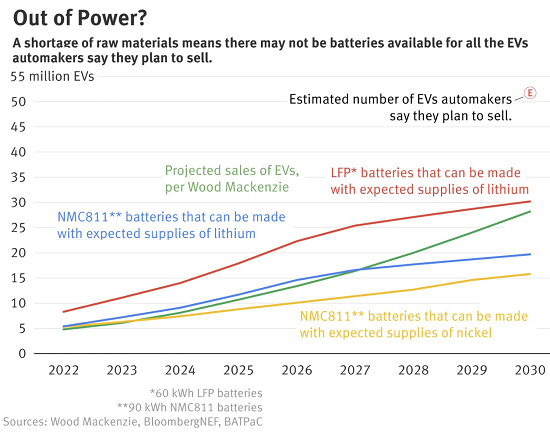
As for everyone's favorite solution, the so-called renewables of wind/solar--actually replaceables--we all know the problem: they're intermittent. So you need a second power generation system to fill the gaps when the sun goes down and the wind dies. As for batteries-- even mega-batteries only hold a tiny percentage of total energy consumption. And it's already clear that there aren't enough minerals to build hundreds of millions of high-tech batteries, which by the way, are also replaceable, i.e. must be replaced every decade or so. (See chart below.)

Common-sense suggests it is folly to shut down existing energy sources until a replacement system is up and running. Yet that seems to be official policy in many places. The idea that getting rid of undesirable energy sources will magically create desirable energy sources is delusional, yet that idea is apparently quite compelling.

Maintaining two energy generation systems--one intermittent and one for backup--is inherently more expensive than having one system. Whether the backup is battery or another energy source (or some of both), it doesn't matter: the cost is greater regardless of the type of backup.

The global energy crunch is real and has no easy, cheap, quick fix. That doesn't mean we're powerless (heh).

Let's ask a few questions of the planet's largest energy consumers: Europe, North America, China and Japan.

1. What percentage of habitable structures are well-insulated or super-insulated to minimize the need for heating / cooling?

2. What percentage of habitable structures have geothermal heat pumps (GHPs) that use the ambient temperature of the Earth to reduce energy consumption?

3. How many empty rooms / spaces in these regions are heated / cooled?

4. How many of the millions of vehicles that are stuck in traffic jams are single-occupant?

You see where this is leading: conservation is the fastest, lowest-cost, lowest-technology way to reduce energy consumption by reducing waste. Rather than invest in universal conservation and incentives to reduce wasteful behaviors (heating empty spaces 24/7, etc.), we've squandered decades and trillions of dollars, yuan, yen and euros on bridges to nowhere, wars of choice, speculative excess, virtue-signaling and the mindless consumption of the waste is growth Landfill Economy.

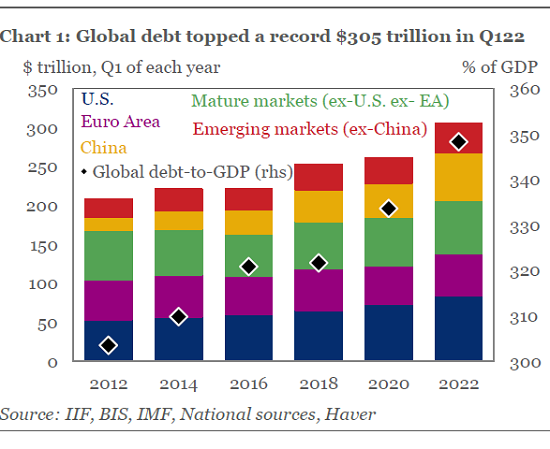
We've squandered trillions that were borrowed and now we have to pay interest on the wasted money.

Many solutions are solely behavioral and require no new infrastructure at all. For example, everyone driving themselves to the city center could stop at a bus stop or equivalent gathering place and pick up three other commuters. Tollways could be reprogrammed to reward vehicles with four passengers.

There are many such behavioral solutions that conserve energy on a mass scale. For some mysterious reason, we seem collectively enamored of high-tech solutions that demand decades and trillions of dollars rather than solutions that are within reach.

Waste is not growth. This is the central delusion of the modern economic mindset and the global economy. Eliminating glaringly obvious waste and using basic technologies (geothermal heat exchange, insulation) are the common-sense first steps to the goal of maintaining energy supplies at affordable levels.

The technologies to radically reduce waste have been around since the late 1970s / early 1980s. Rocky Mountain Institute (RMI) (Wikipedia):

By 1978, experimental physicist Amory Lovins had published many books, consulted widely, and was active in energy affairs in some fifteen countries as synthesist and lobbyist. Lovins is a main proponent of the soft energy path.

At RMI's headquarters the south-facing building complex is so energy-efficient that, even with local -40 °F (-40 °C) winter temperatures, the building interiors can maintain a comfortable temperature solely from the sunlight admitted plus the body heat of the people who work there. The environment can actually nurture semi-tropical and tropical indoor plants.


Rocky Mountain Institute (RMI)

If we insist on doing the transition the hard, slow, costly way rather than the easy, fast, cheap way, it's going to be a needlessly arduous, soul-crushing slog. Perhaps we need some uncommon sense since common sense appears to be so scarce.


Recent podcasts/videos:

Roundtable Insight: Charles Hugh Smith on the Insanity of Central Banks in Addressing Inflation (38 min.)


My new book is now available at a 10% discount this month: When You Can't Go On: Burnout, Reckoning and Renewal.

If you found value in this content, please join me in seeking solutions by becoming a $1/month patron of my work via patreon.com.


My recent books:

Global Crisis, National Renewal: A (Revolutionary) Grand Strategy for the United States (Kindle $9.95, print $24, audiobook) Read Chapter One for free (PDF).

A Hacker's Teleology: Sharing the Wealth of Our Shrinking Planet (Kindle $8.95, print $20, audiobook $17.46) Read the first section for free (PDF).

Will You Be Richer or Poorer?: Profit, Power, and AI in a Traumatized World
(Kindle $5, print $10, audiobook) Read the first section for free (PDF).

The Adventures of the Consulting Philosopher: The Disappearance of Drake $1.29 Kindle, $8.95 print); read the first chapters for free (PDF)

Money and Work Unchained $6.95 Kindle, $15 print)
Read the first section for free


Become a $1/month patron of my work via patreon.com.


NOTE: Contributions/subscriptions are acknowledged in the order received. Your name and email remain confidential and will not be given to any other individual, company or agency.

Thank you, Sam F. ($200), for your outrageously generous contribution to this site -- I am greatly honored by your steadfast support and readership.


Thank you, Eric V.H. ($5/month), for your splendidly generous subscription to this site -- I am greatly honored by your support and readership.

Read more...

Terms of Service

All content on this blog is provided by Trewe LLC for informational purposes only. The owner of this blog makes no representations as to the accuracy or completeness of any information on this site or found by following any link on this site. The owner will not be liable for any errors or omissions in this information nor for the availability of this information. The owner will not be liable for any losses, injuries, or damages from the display or use of this information. These terms and conditions of use are subject to change at anytime and without notice.

RE: European Union AI Act, and Our Use of Generative AI Tools and Agents Policy

All text on this site is composed by Charles Hugh Smith or by a credited guest-author. No Generative AI Tools are used in the composition / writing of any text or graphic content created by Charles Hugh Smith. This site deploys no AI agents or generative AI tools. This site is not responsible for the disclosures, use or non-use of AI agents or generative AI tools in advertisements displayed by Investing Channel or other ad placement services.

Audio files generated by text-to-audio transcription tools are identified as such.

Our Privacy Policy:

Correspondents' email is strictly confidential. This site does not collect digital data from visitors or distribute cookies. Advertisements served by third-party advertising networks such as Investing Channel may use cookies or collect information from visitors for the purpose of Interest-Based Advertising; if you wish to opt out of Interest-Based Advertising, please go to Opt out of interest-based advertising (The Network Advertising Initiative) If you have other privacy concerns relating to advertisements, please contact advertisers directly.

PRIVACY NOTICE FOR EEA INDIVIDUALS

This section covers disclosures on the General Data Protection Regulation (GDPR) for users residing within EEA only. GDPR replaces the existing Directive 95/46/ec, and aims at harmonizing data protection laws in the EU that are fit for purpose in the digital age. The primary objective of the GDPR is to give citizens back control of their personal data. Please follow the link below to access InvestingChannel's General Data Protection Notice.
https://stg.media.investingchannel.com/gdpr-notice/

Notice of Compliance with The California Consumer Protection Act

This site does not collect digital data from visitors or distribute cookies. Advertisements served by a third-party advertising network (Investing Channel) may use cookies or collect information from visitors for the purpose of Interest-Based Advertising. If you do not want any personal information that may be collected by third-party advertising to be sold, please follow the instructions on this page: Do Not Sell My Personal Information.

Regarding Cookies:

This site does not collect digital data from visitors or distribute cookies. Advertisements served by third-party advertising networks such as Investing Channel may use cookies or collect information from visitors for the purpose of Interest-Based Advertising; if you wish to opt out of Interest-Based Advertising, please go to Opt out of interest-based advertising (The Network Advertising Initiative) If you have other privacy concerns relating to advertisements, please contact advertisers directly.

Our Commission Policy:

Though I earn a small commission on Amazon.com books and gift certificates and gold (BullionVault) purchased via links on my site, I receive no fees or compensation for any other non-advertising links or content posted on my site.

Copyright Notice:

All original images (Drawings and Photographs), text (essays, books and works of fiction), audio and video recordings, musical compositions, graphic design, graphic design elements and HTML coding on this site are the copyrighted work of Charles Hugh Smith unless otherwise credited or noted. They are published as information for the private use of site visitors, and any reproduction or redistribution of this content or coding in any media in any format or distribution channel (text, audio, video/film, web) without the written permission of the copyright holder is strictly prohibited. All rights in all media reserved globally.

  © Blogger templates Newspaper III by Ourblogtemplates.com 2008

Back to TOP