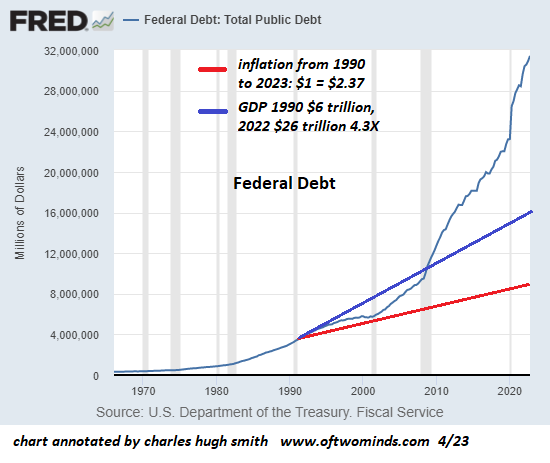
Monday, February 12, 2024

The "Phantom Legion" Problem

Everything is presented as rock-solid until it falls apart.

Of the many signs of systemic decay in the late Roman Empire, one of particular relevance to our era is the Phantom Legion, military units that on paper were at full strength--and paid accordingly--but which were in reality no longer there: the paymaster collected the silver wages and recorded the unit's roll of officers and soldiers, but it was all make-believe.

When the Empire's wealth seems limitless, graft, embezzlement and fraud all seem harmless to those skimming the wealth. Look, the Empire is forever, what harm is there in my little self-interested skim?

This rot starts at the top, of course, and then seeps into every nook and cranny of the system. When those at the top are getting fabulously wealthy on modest salaries while claiming to serve the public, the signal is clear: go ahead and maximize your own private gain at the expense of the public and the state. Civic virtue--the backbone of the Empire--decayed into self-interest, incompetence and indulgence.

The "Phantom Legion" Problem has another wrinkle: the legion is reported at full strength, but the actual number of soldiers is far lower than the reported number, and the competence of the officers is so low that the legion is incapable of performing its duties. In other words, the numbers don't reflect the actual utility-value of the legion as a combat unit: the soldiers may be ill-trained, ill-equipped and poorly fed, and the officers inexperienced, corrupt or just waiting for their term of duty to end.

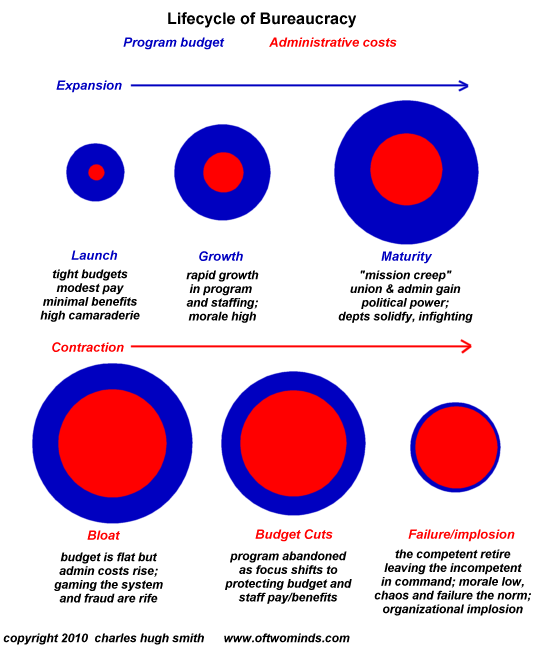
In the present day, this is how The Phantom Legion Problem manifests: the agency / institution is reported at full strength and fully capable of performing all its duties, but beneath the surface it's lacking experienced staff and competent leadership, and much of the staffing is in unproductive, dead-wood administrative positions.

Taking healthcare as an example, we find experienced frontline caregivers are retiring and not being replaced with equivalent numbers of staff with the equivalent experience. We find caregivers are burning out due to crushing workloads, or quitting the profession in order to have a family and get their life back.

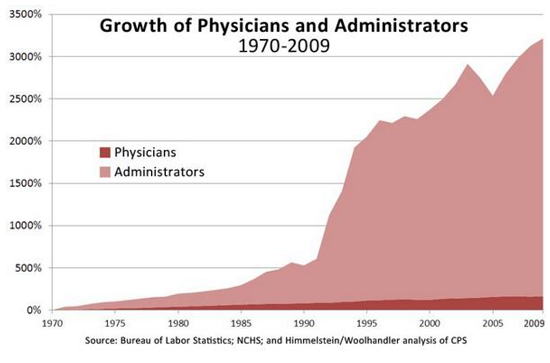
Meanwhile, the number of administrators increases, soaking up the system's funding with endlessly expanding compliance data entry, reports, etc., all of which adds additional burdens on those actually providing care.


There's always enough money to increase administrators' salaries, but not enough to maintain essential systems or hire more caregivers.


The Phantom Legion Problem plays out in many ways in modern bureaucracies. The number of sworn officers in a police department may appear adequate but if many are assigned to desks, the PD is not actually at full strength.

If administrators are advanced due to their PR and financial skills rather than on their competence in actually leading the organization, the Phantom Legion problem is already terminal. the rot starts at the top, and those actually carrying the weight fulfilling the organization's mission burn out, get disgusted and give up.

The problem with The Phantom Legion Problem is there is every incentive to hide the decay of systemic competence and capability behind glowing annual reports and ginned-up numbers. Only those within the organization know the truth and they are under pressure to keep quiet, lest they find themselves on the slow train to Siberia.

Here is how systems decay and collapse: everything is reported at full strength, but the numbers don't reflect reality. Everything is presented as rock-solid until it falls apart. Everyone outside the system is in disbelief while insiders wondered how it held together as long as it did.


New podcast: Opportunities and Benefits of International Cities (49 min)


My recent books:

Disclosure: As an Amazon Associate I earn from qualifying purchases originated via links to Amazon products on this site.

The Asian Heroine Who Seduced Me (Novel) print $10.95, Kindle $6.95 Read an excerpt for free (PDF)

When You Can't Go On: Burnout, Reckoning and Renewal $18 print, $8.95 Kindle ebook; audiobook Read the first section for free (PDF)

Global Crisis, National Renewal: A (Revolutionary) Grand Strategy for the United States (Kindle $9.95, print $24, audiobook) Read Chapter One for free (PDF).

A Hacker's Teleology: Sharing the Wealth of Our Shrinking Planet (Kindle $8.95, print $20, audiobook $17.46) Read the first section for free (PDF).

Will You Be Richer or Poorer?: Profit, Power, and AI in a Traumatized World
(Kindle $5, print $10, audiobook) Read the first section for free (PDF).

The Adventures of the Consulting Philosopher: The Disappearance of Drake (Novel) $4.95 Kindle, $10.95 print); read the first chapters for free (PDF)

Money and Work Unchained $6.95 Kindle, $15 print)
Read the first section for free


Become a $1/month patron of my work via patreon.com.

Subscribe to my Substack for free


NOTE: Contributions/subscriptions are acknowledged in the order received. Your name and email remain confidential and will not be given to any other individual, company or agency.

Thank you, Richard H. ($60), for your monstrously generous contribution to this site -- I am greatly honored by your steadfast support and readership.


Thank you, John D. ($50), for your superbly generous contribution to this site -- I am greatly honored by your steadfast support and readership.


Thank you, David M. ($1/month), for your most generous patronage to this site -- I am greatly honored by your support and readership.


Thank you, Evan R. ($1/month), for your very generous patronage to this site -- I am greatly honored by your support and readership.

Read more...

Thursday, February 08, 2024

Household Belt-Tightening: Will the Trickle Become a Flood?

The top 0.1% will weather a recession just fine, but that will offer cold comfort to the other 130 million American households.

It seems at least some households are realizing they need to rein in spending. This reality is obscured by statistics which distort the financial security of average households. As always, we have to separate the top 10% who collect 40% of the income and own about 90% of the financial assets from the bottom 90%, as the top 10% distort the risks faced by the bottom 90%.

If we include the top 10% and look at all households, the average looks fine, because the wealthiest few skew the median and average upward. If we take total household wealth and divide by the total number of households, it gives the impression that households are doing great--look how much wealth the average household owns.

But this is a distortion. Remove the top 10%'s wealth and income and then re-do the calculation, and then repeat it for the bottom 50% of households. You end up with a much more accurate and much less rosy snapshot of American households' relative precarity.

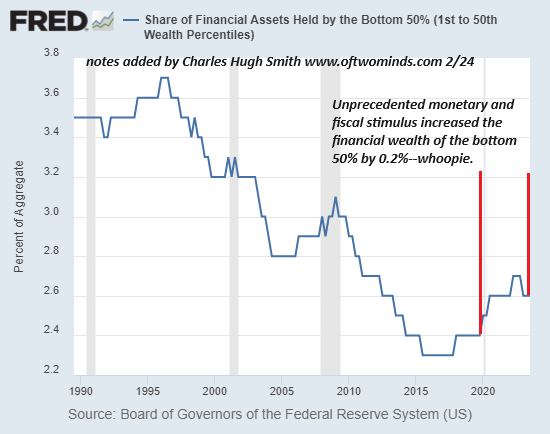
As the chart below illustrates, the share of financial assets owned by the bottom 50% of households rose a meager 0.2% to 2.6% despite trillions of dollars of stimulus flooding the economy.

It's common knowledge that most of the tsunami of cash distributed in pandemic stimulus to the bottom 90% has been spent. Once again, looking at all household savings / cash is deceptive, as the savings of the top 10% have risen because they didn't need the pandemic largesse and just stuffed the extra cash into their investment accounts.

There are many signs of belt-tightening, if we care to look for them. Short-term rentals that were solidly booked now have low occupancy /bookings. Pawn shops are finding that the goodies snapped up with pandemic cash are being pawned and not being redeemed. Restaurant traffic is down.

We're also seeing accounts like this, of households with $200,000 in income realizing there's nothing left of that income at the end of the month unless they trim their free-spending habits. We're struggling to make ends meet: our 6-figure salaries aren't enough to support our lifestyle anymore.

When it comes to cutting low-value expenses, there is a tremendous quantity of low-hanging fruit in many U.S. household budgets. Many costly mobile phone plans are bloated with unused services or bandwidth, while low-cost mobile providers offer plans at $15/month. (Which is why the big telecoms are offering teaser rates of $15/month for a year. After that, you pay the same old bloated rate.)

Cable TV has been losing customers for years, yet the cost of basic cable keeps rising. Our local provider's basic TV service is now $80/month, with a $23/month "broadcast TV surcharge" and $10 in taxes and fees, for a total of $113/month for trash TV filled with adverts. No wonder I see people waiting in line to return their cable TV box: $1,350 a year for what?

Many households have multiple streaming services they can't possibly watch enough of to justify the ballooning cost of these services. (One weird trick: choose one streaming service and go back to reading books borrowed for free from the library.)

Healthcare insurance is another high-cost burden that can sometimes be lightened by switching plans or coverage. Under-utilized gym memberships is another low-hanging fruit.

Fast food, junk food and sweetened beverages is another high-cost, low-value budget item begging to be slashed and burned. Everyone talks about comfort foods, but having some savings is comforting, too, as is improving one's health.

Many households are frugal by necessity, others are frugal by nature, and others are becoming frugal via disciplined budgeting in service of common-sense financial goals such as having some savings as a buffer against unexpected expenses.

As noted in "Outlawing" Recession Has Made a Monster Recession Inevitable, few households anticipate extended periods of unemployment in their future. Jobs are plentiful and the general expectation is they will remain so. But recessions transform abundance to scarcity faster than we might imagine, and so prudence suggest thinking through what we'd do if one of the primary earners loses their job and can't find a replacement job at the same rate of pay.

Should any of the "everything" bubbles pop, even the top 10% might be stunned by a reversal of fortune. When households earning over $200,000 are complaining they can't make ends meet, imagine what they'll feel if their bonuses and investment income plummet, or a high-earner loses their job.

The trickle of budget-tightening we're seeing now could turn into a flood that washes away corporate sales and profits in ways that few even believe is possible. But real recessions don't just trim the fat, they atrophy muscle, too, and they don't end in three months.

Those who slash spending before the recession turns abundance into scarcity will be better prepared than those maxing out their credit card living large and then getting a layoff notice.

The bottom 50% are already in precarious financial straits:


The top 0.1% will weather a recession just fine, but that will offer cold comfort to the other 130 million American households.


New podcast: Opportunities and Benefits of International Cities (49 min)


My recent books:

Disclosure: As an Amazon Associate I earn from qualifying purchases originated via links to Amazon products on this site.

The Asian Heroine Who Seduced Me (Novel) print $10.95, Kindle $6.95 Read an excerpt for free (PDF)

When You Can't Go On: Burnout, Reckoning and Renewal $18 print, $8.95 Kindle ebook; audiobook Read the first section for free (PDF)

Global Crisis, National Renewal: A (Revolutionary) Grand Strategy for the United States (Kindle $9.95, print $24, audiobook) Read Chapter One for free (PDF).

A Hacker's Teleology: Sharing the Wealth of Our Shrinking Planet (Kindle $8.95, print $20, audiobook $17.46) Read the first section for free (PDF).

Will You Be Richer or Poorer?: Profit, Power, and AI in a Traumatized World
(Kindle $5, print $10, audiobook) Read the first section for free (PDF).

The Adventures of the Consulting Philosopher: The Disappearance of Drake (Novel) $4.95 Kindle, $10.95 print); read the first chapters for free (PDF)

Money and Work Unchained $6.95 Kindle, $15 print)
Read the first section for free


Become a $1/month patron of my work via patreon.com.

Subscribe to my Substack for free


NOTE: Contributions/subscriptions are acknowledged in the order received. Your name and email remain confidential and will not be given to any other individual, company or agency.

Thank you, John H. ($60), for your monstrously generous contribution to this site -- I am greatly honored by your steadfast support and readership.


Thank you, Robert B. ($100), for your outrageously generous contribution to this site -- I am greatly honored by your steadfast support and readership.


Thank you, Tony J. ($54), for your splendidly generous contribution to this site -- I am greatly honored by your support and readership.


Thank you, Jim G. ($5/month), for your magnificently generous patronage to this site -- I am greatly honored by your support and readership.

Read more...

Wednesday, February 07, 2024

Irony Alert: "Outlawing" Recession Has Made a Monster Recession Inevitable

Those who came of age after 1982 have never experienced a real recession, and so they're unprepared for anything other than guarantees of rescue and permanent expansion.

The mainstream view is that recession is caused by economic-financial factors. The mainstream view is wrong, for recession is ultimately caused by Wetware1.0--human nature. Human nature--our innate attraction to windfalls and something-for-nothing, our ability to habituate to extremes and normalize counterproductive dynamics--manifest as economic-financial factors, but these are effects, not causes.

The mainstream view is that recessions are bad, so let's make sure they never happen. In other words, let's outlaw them by flooding the economy and financial system with Federal Reserve monetary stimulus and federal stimulus via increased deficit spending.

The history of the past 40 years "proves" these policies effectively eliminate recession: all recessions since 1981-82 have been shallow and brief, basically a spot of bother that lasts one quarter.

Our Wetware1.0 has responded to this "no recession guarantee" in ways that count as unintended consequences. Massive "emergency" stimulus that became permanent policy has created a bubble economy in which low interest rates and unlimited credit for those who are more equal than others has sparked demand for income-producing assets, which then sparked a speculative mania.

We've habituated to both the bubble economy and the speculative mania so that these are now considered normal. But behind the comfortable normalization, something counterproductive has taken hold: we're now addicted to the bubble economy and its crazed twin, speculative mania. If the bubbles pop and speculators go broke, the economy and financial system will both implode.

Without ZIRP (zero-interest rate policy), capital actually has a cost, and the bubble economy cannot survive if capital has a cost. Once capital has a cost, then speculation becomes risky, and speculation cannot survive if risk actually has a cost.

Having made unprecedented, permanent stimulus the bedrock of the economy, there's no stopping the runaway train: should the bubble threaten to burst, the only possible response is to push stimulus to new extremes. These new extremes become normalized and once normalized, the counterproductive internal dynamics of these extremes are conveniently ignored.

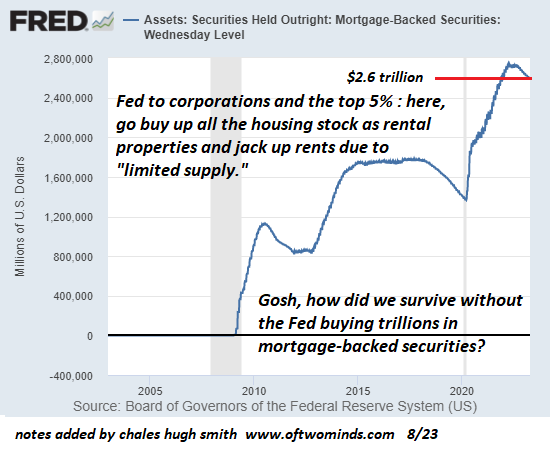
Consider Federal Reserve support of the housing bubble. One wonders how the nation survived without the Fed buying trillions of dollars of mortgage-backed securities--in effect, socializing the mortgage market, along with the federal agency-backed mortgages (FHA and VA mortgages).


Skyrocketing federal borrowing has also been normalized: since the Fed will soon drop interest rates back to zero, there's nothing to worry about here. Carry on doom spending, all is well.


But all this creation of "money" chasing a limited pool of assets, labor and resources has another consequence: inflation, the steady erosion of purchasing power and the value of labor. This generates a feedback loop: wages have stagnated for 40+ years, and as inflation has devoured 20% of the value of wages just since 2020, labor must be compensated at higher rates or only the upper-middle class and elites will be able to pay their bills. This feeds back into inflation, as does money-printing, credit expansion and the artificial scarcities created by monopolies and cartels.

Another consequence of unprecedented, permanent stimulus is the widening of wealth-income inequality. Those at the top of the system could borrow money for next to nothing and use near-infinite lines of credit to scoop up all the income-producing assets, which boosted their unearned income and generated a feeding-frenzy bidding war for these assets which pushed valuations into the stratosphere.

Financiers borrowed at 2%, debt-serfs paid 20% for credit card debt. The bottom 95% coluld not outbid the financiers and corporations for low-risk assets, so they turned to speculative gambling as the only remaining means to increase their wealth.

Since the Fed has implicitly guaranteed that no bubbles will ever be allowed to pop, this gambling has acquired a dangerously thin veneer of safety. Any dip in housing or stock prices will soon be bought, and so valuations will continue their happy ascent to ever higher highs. The trick is to rotate out of one bubble into the next bubble, and leverage the winnings from the first winning bet into a pyramid of assets.

So the first Airbnb rental house was a smashing success, then leverage that into three more, or five more, or 20 more.

This has worked marvelously for the top 10% who own roughly 90% of all financial assets, but it hasn't moved the needle much for the bottom 50%, whose share of financial assets rose a meager 0.2% despite trillions of dollars of stimulus flooding the economy.


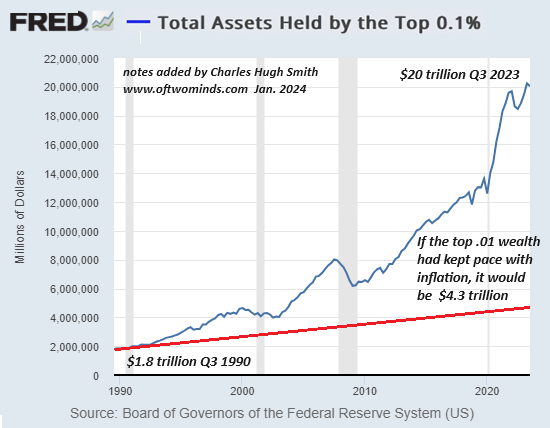
The top 0.1% did a bit better, adding about $10 trillion to the value of their assets.


As a result of the great success of outlawing recessions, everyone is complacent. There will always be plenty of credit, jobs and monetary-fiscal stimulus, and the Fed will always jump in to save the bubbles from popping. Nothing can possibly go wrong because it's all under control, and we have 40 years of "proof" that there's nothing that can possibly break this guarantee.

Beneath this complacency, the counterproductive dynamics are increasing. Inflation limits the Fed from dropping interest rates back to zero, wealth inequality undermines social stability, speculative manias are actually not low-risk, and bubbles find a way to pop despite all the assurances of god-like control.

Rather than guarantee the permanent expansion of all the good things, outlawing recessions guarantees a monster recession as our innate ability to normalize extremes and slip into blissful complacency will shatter in unexpected ways. Those who came of age after 1982 have never experienced a real recession, and so they're unprepared for anything other than guarantees of rescue and permanent expansion.

New podcast: Opportunities and Benefits of International Cities (49 min)


My recent books:

Disclosure: As an Amazon Associate I earn from qualifying purchases originated via links to Amazon products on this site.

The Asian Heroine Who Seduced Me (Novel) print $10.95, Kindle $6.95 Read an excerpt for free (PDF)

When You Can't Go On: Burnout, Reckoning and Renewal $18 print, $8.95 Kindle ebook; audiobook Read the first section for free (PDF)

Global Crisis, National Renewal: A (Revolutionary) Grand Strategy for the United States (Kindle $9.95, print $24, audiobook) Read Chapter One for free (PDF).

A Hacker's Teleology: Sharing the Wealth of Our Shrinking Planet (Kindle $8.95, print $20, audiobook $17.46) Read the first section for free (PDF).

Will You Be Richer or Poorer?: Profit, Power, and AI in a Traumatized World
(Kindle $5, print $10, audiobook) Read the first section for free (PDF).

The Adventures of the Consulting Philosopher: The Disappearance of Drake (Novel) $4.95 Kindle, $10.95 print); read the first chapters for free (PDF)

Money and Work Unchained $6.95 Kindle, $15 print)
Read the first section for free


Become a $1/month patron of my work via patreon.com.

Subscribe to my Substack for free


NOTE: Contributions/subscriptions are acknowledged in the order received. Your name and email remain confidential and will not be given to any other individual, company or agency.

Thank you, Andrew D. ($80), for your monstrously generous contribution to this site -- I am greatly honored by your steadfast support and readership.


Thank you, Steve B. ($50), for your marvelously generous contribution to this site -- I am greatly honored by your steadfast support and readership.


Thank you, Sudheer B. ($25), for your splendidly generous contribution to this site -- I am greatly honored by your steadfast support and readership.


Thank you, Michael E. ($50), for your magnificently generous contribution to this site -- I am greatly honored by your support and readership.

Read more...

Monday, February 05, 2024

The International City Model: Freedom Is the Solution, Coercion Is the Problem

The International City offers a hopeful, practical model for transforming the global economy by giving people a choice.

History is simplifying the choice ahead in terms of solving socio-economic problems: increase coercion or increase freedom. The legacy systems--nation-states and their core institutions--want to increase their power to coerce everyone as the ideal solution, while those being coerced want more choices and freedom, not less. The legacy power structures seek more centralized control, those under the thumb of monopolies and centralized powers want decentralized, localized options.

Stripped of PR niceties, the legacy systems view any problem as a threat to their power: every problem boils down to this: how do we protect the status quo from any change, because the current configuration is the source of our wealth, authority and power.

To the leadership of legacy systems, freedom and agency are the problem and coercion is the solution. To those being coerced, freedom and agency are the solution and coercion is the problem.

Actually solving the problem to the benefit of the citizenry is not viewed as the issue: the issue is how to secure and protect a sclerotic, corrupt status quo ruled by the few at the expense of the many.

This describes every centralized hierarchy in every nation-state, province and city, and in every sector from Big Tech to healthcare to higher education. The goal is not to welcome change and expand citizen-customer options and transparency, it's to restrict anything and everything that doesn't increase their control. That includes decentralization and localization and the expansion of agency and freedom.

From the point of view of the elites at the top of the status quo, the problem is once the masses escape the smothering grip of corruption, exploitation and servitude, they won't choose to remain exploited and controlled.

To secure their power, elites must suppress choice, transparency and the autonomy of citizens and customers, for if given the opportunity to move to a freer, more transparent system, autonomous people will abandon oppressive kleptocracies, both public and private.

And once the productive sheep have fled, who will the elites shear to pile up their wealth? This is why coercion and suppression are increasing globally: the elites in charge of failing legacy systems know they're failing their citizens and customers, and so their only option is to lock down the populace so they have no option but to comply.

The classical forms of coercion include a proliferation of punitive laws, regulations and taxes, show trials, whisking dissidents away so their voices can no longer be heard, suppression of free expression, and so on.

These classical forms are now augmented with new forms of coercion via disempowerment: shadow banning non-cheerleaders of the status quo, demonetizing dissidents via sending them to Digital Siberia, and loading young people up with so much debt that their energy is completely drained by the servitude of debt-serfdom.

A key disempowerment tool is fostering addictions which drain the masses of agency and autonomy: once the populace is addicted to phones, screens, social media, gaming, gambling, meds and junk food, they're too distracted and deranged to pose much of a threat.

Inflation is another form of disempowerment, as it forces everyone to work harder just to keep their head above water. Who has time to escape the matrix when you're stretched thin just to pay all the bills and seek the sad solace of addictions?

The classical forms of coercion are Orwell, the disempowerment forms are Kafka:

Are You Loving Your Servitude Yet? (7/25/12)

Orwell and Kafka Do America: How the Government Steals Your Money--"Legally," Of Course (3/24/15)

Truth Is What We Hide, Cover Stories Are What We Sell (6/2/20)

These are all forms of coercion via disempowerment: sapped of energy and autonomy by the servitude of debt-serfdom, precarity and stress, distracted by addictions and health problems, and impoverished by inflation and junk fees, the masses have no will to contest the erosion of their autonomy, options and freedom.

This is why the legacy states and institutions are all failing: their "solution" to every problem is to increase their power to coerce and disempower those trapped in their systems so they have no choice but to comply. The goal isn't to actually solve problems, it's to protect the elites' power, perquisites and wealth so they can't be threatened by actual solutions.

The problem with this approach is life demands adaptation, and adaptation requires flexibility, freedom of movement, transparency, trial-and-error, experimentation and the potential for innovations to remake the system from the ground up. The law of Nature is simple: adapt or die, and by choosing to protect elites' wealth and power at the expense of potentially transformative adaptations, the legacy states have chosen to decay and fail.

The alternative problem-solving approach is to offer a range of choices and enable everyone to choose their own path in a transparent system of governance. In this approach, every system, entity and institution is competing to attract the most productive people, and to compete they must offer a level playing field (i.e. the rule of law that limits elite predation and monopolization of control), opportunities and transparency.

This approach is the solution to the uneven growth and corruption plaguing many developing (a.k.a. Global South) economies. When the current status quo is little more than a dysfunctional, corrupt bureaucratic quagmire, the primary export is the most ambitious and talented people, who flee to the developed world for opportunities. This isn't a solution, it's a problem, as this talent is precisely what developing economies need to retain and foster.

Rather than attempt the futile project of transforming the sprawling, well-defended monopolies and dysfunctional institutions of the status quo, the better approach is to create an entirely new model that is hosted by existing nation-states--the one state, two systems approach exemplified by the long-established, successful models of Special Economic Zones (SEZ) and Special Administrative Regions (SAR), which are in effect quasi-autonomous jurisdictions within a nation-state that are not crippled by the status quo's corrupt, dysfunctional bureaucracy.

Special Economic Zones are basically business parks / warehouses that are exclusively economic in nature; people come to work and then go home. No one is allowed to live there.

There is a new model which advances these existing templates to from merely economic entities to cities with residents, infrastructure and amenities. It's called the International City model (also known as the Free City model), a fully functioning city that has contracted with the host national government for local autonomy in how the city is run.

Here is a description of the model from the Free Cities Foundation:

"Free Cities are self-governing territories that uphold individual rights and freedoms.

Free Cities usually have a special legal status within their host state, which grants them autonomy to make decisions that affect their local community. This autonomy may allow Free Cities to make their own laws, introduce regulations, raise public funds, and deliver public services independently.

Free Cities differ from other kinds of autonomous territories in that they emphasize upholding individual rights and freedoms. Unlike many other special jurisdictions common in the world today -- such as Free Trade Zones -- Free Cities are focused on providing more freedom and a better life to full residential communities, rather than simply offering advantages to businesses."


The nation-state provides national security and criminal justice laws, but these laws are enforced within the Free City by the Free City staff, not state personnel. In other words, one state, two systems: in exchange for the economic growth generated by the Free City, the city is granted semi-autonomy by the national government, just as governments grant SEZs and SARs the right to trade without duties and other semi-autonomous privileges.

The core difference between the Free City model and the status quo is in the Free City model, government is a service provider which competes with other entities to attract residents and enterprises. The Free City offers residents a contract which obligates the city authorities to secure the pubic safety of residents and their property rights, services which the resident agrees to pay for at a rate / fee stipulated in the contract.

As with any fee-for-service contract, neither party can unilaterally change the terms of the contract. Any changes must be agreed by both parties, and any disputes settled by a contractually stipulated mediation process.

This is an entirely different model of governance, one that is refreshingly competitive and transparent. No one is coerced into signing the residency contract, they do so of their own free will. The Free City obligates itself to protect and enforce basic security and rights, but it doesn't guarantee financial success nor is it attempting to "save the world" all by itself.

As with any open, competitive and transparent system, cities that fail to fulfill their obligations will be abandoned as residents will migrate to competing cities that are successfully fulfilling their contractual obligations to residents.

Compare this to the legacy states and institutions, which fail in their most basic obligations but are impervious to reform because there is no competitive pressure for them to perform: where else can citizens go that is truly functional and responsive? The only way to escape the consequences of dysfunction and incompetence is to move to less coercive, dysfunctional places.

The International City offers a hopeful, practical model for transforming the global economy by giving people a choice. This choice will introduce competitive pressure for the first time on legacy systems to start providing the core services citizens need to be productive.

Richard Bonugli, myself and Titus Gebel, founder of the Free City Foundation, discuss the transformative advantages of this model in this podcast: Opportunities and Benefits of International Cities and Special Administrative Zones (49 min)

(Download the podcast in MP3 format here.)


My recent books:

Disclosure: As an Amazon Associate I earn from qualifying purchases originated via links to Amazon products on this site.

The Asian Heroine Who Seduced Me (Novel) print $10.95, Kindle $6.95 Read an excerpt for free (PDF)

When You Can't Go On: Burnout, Reckoning and Renewal $18 print, $8.95 Kindle ebook; audiobook Read the first section for free (PDF)

Global Crisis, National Renewal: A (Revolutionary) Grand Strategy for the United States (Kindle $9.95, print $24, audiobook) Read Chapter One for free (PDF).

A Hacker's Teleology: Sharing the Wealth of Our Shrinking Planet (Kindle $8.95, print $20, audiobook $17.46) Read the first section for free (PDF).

Will You Be Richer or Poorer?: Profit, Power, and AI in a Traumatized World
(Kindle $5, print $10, audiobook) Read the first section for free (PDF).

The Adventures of the Consulting Philosopher: The Disappearance of Drake (Novel) $4.95 Kindle, $10.95 print); read the first chapters for free (PDF)

Money and Work Unchained $6.95 Kindle, $15 print)
Read the first section for free


Become a $1/month patron of my work via patreon.com.

Subscribe to my Substack for free


NOTE: Contributions/subscriptions are acknowledged in the order received. Your name and email remain confidential and will not be given to any other individual, company or agency.

Thank you, Ria B. ($5/month), for your extremely generous Substack subscription to this site -- I am greatly honored by your support and readership.


Thank you, Greg S. ($50), for your marvelously generous Substack subscription to this site -- I am greatly honored by your support and readership.


Thank you, Mkaamoi ($50), for your splendidly generous Substack subscription to this site -- I am greatly honored by your support and readership.


Thank you, Lars V.T. ($5/month), for your magnificently generous Substack subscription to this site -- I am greatly honored by your support and readership.

Read more...
Thursday, February 01, 2024

Inflation Hits Us All, Even Of Two Minds

Those subscribed as of February 29 will lock in the current rate for the life of the blog, those subscribing on March 1 or later will pay the inflation-adjusted rate.

Inflation hits us all, even Of Two Minds. I started accepting subscriptions in 2011 at $5/month. According to officially calculated inflation (which understates real-world inflation), what $1 bought in 2011 now costs $1.40. Ouch. What $1 bought in January 2020 now costs $1.20. In effect, $5 is now worth in the neighborhood of $3.

Like every other enterprise with expenses, Of Two Minds must get back above water. From March 1, 2024, the subscription rate will be $7/month. (The $1/month option in Patreon will go to $2/month.) This increase gets the rate back to where it was a decade ago in terms of purchasing power.

The good news is current subscribers on every platform (Substack, Patreon, PayPal/checks/quatloos) will keep the current rate for as long as the blog remains active. If you find any value in supporting Of Two Minds, it makes sense to subscribe in February to lock in the current inflation-ravaged rates--in effect, a 40% discount.

OK, so what's the value proposition in subscribing to Of Two Minds? My short-and-sweet "elevator speech" is: Understanding is wealth, too. What I mean by this is a great quantity of commentary and analysis is focused on preserving financial wealth in the tumult ahead. This is common-sense, as having money makes life a lot easier than not having money.

But the vast majority of commentary and analysis implicitly makes two assumptions I find questionable: 1. the status quo will continue operating more or less as it does now far into the future, and 2) financial wealth is the master form of wealth that guarantees all other forms of wealth (health, agency, mobility, etc.)

In my view, there is no way the status quo can chug along virtually unchanged for decades to come. There are two basic reasons: 1) do the math: the limits of the real world cannot be dissolved by trickery, and 2) the core systems of the status quo are obsolete. They are being defended not because they work but because those being enriched by the systems want to maintain their power and perquisites.

Another way of saying this is that the forces that have been tailwinds--hyper-globalization, hyper-financialization and stable global arrangements--have shifted into headwinds. What were deemed solutions have become problems, and doing more of what worked in the past only accelerates the unwinding.

We are accustomed to technological obsolescence, in which a new technology seamlessly replaces previous technologies: DVDs replaced videocassettes/VCRs, etc. This model of obsolescence is consumerist: all we need to do is buy the new technology and toss the old one in the landfill.

Obsolete systems are much more difficult to replace, for everyone being enriched by these arrangements will move Heaven and Earth to keep them firmly in place, lest their share of the gravy train diminish.

The maximization of self-interest comes at the cost of system stability. Put another way, the system can either be optimized for self-enrichment or for dynamic stability, but it cannot be optimized for both, as self-enrichment is best served by monopoly--the destruction of the dynamic stability created by competition--or by reducing adaptability as a means of locking in private gains.

And so various policies are ramped up to keep all the machinery in its current configuration. These policies may be for show, accomplishing little, or they may reach extremes, as only extremes can keep the machinery duct-taped together as obsolescence decays the system's functionality.

We can anticipate the uneven unraveling of systems which no longer respond to extreme policy "saves." I expect healthcare, higher education, commercial real state and banking, and the financial system based on extremes of debt and speculative leverage to all unravel, despite the hasty passage of ever more extreme policies.

Human nature being what it is (as opposed to idealized versions of what we wish it were), by definition any system which is currently enriching us cannot be obsolete. It merely needs some sacrifice-free adjustment to restore its vitality. In other words, the status quo is by definition permanent and forever because we wish it to be so.

As for financial wealth guaranteeing all the other forms of wealth: this assumes the status quo will continue on unchanged, and everyone with gold, bitcoin, farmland, etc. will be able to keep all these forms of wealth as society unravels around them. History suggests this isn't how social disorder works.

Where my analysis differs from the majority is I anticipate a social revolution that cannot be tamped down with financial or political sops. Sociological forces are not as controllable as financial or political forces, and if (as I foresee) sociological forces become the primary drivers of transformation, financial trickery (let's just lower interest rates again, etc.) or political sops (let's increase the childcare tax credit, etc.) will only exacerbate the sense that the system is broken and incapable of adapting to social realities and novel conditions.

For the past 40 years, finance and markets have dominated policy. Politics has done nothing consequential to reverse the decay and stagnation created by globalization and financialization. The political structure has done zero to reverse the wealth inequality driven by Federal Reserve policy, or the speculative mania that the Fed has fueled.

If we're entering the culmination of Turchin's 50-year cycle, the Kondratieff credit cycle and the 4th Turning's 80-year cycle, financial extremes will unwind, either because the people finally demand action or the system will veer completely out of equilibrium and what seems impossible now (the expropriation of all extreme wealth, regardless of source, etc.) will become "obvious" solutions.

There are few limits on what might happen since the status quo is incapable of doing anything other than protecting elite perquisites while wringing its hands in public, as everyone is on the take to the tune of millions and they believe the inequalities that are enriching them can persist forever.

Nothing is forever, and the system is already so far from equilibrium that more of the same policy tweaks have zero chance of stopping an unwinding as extreme in the opposite direction as the current inequality.

Since the vast majority of all commentary and analysis assumes the status quo will continue on virtually unchanged for years or decades to come, what is the value of projections based on such a false premise?

The starting point of my analysis is unstable systems are not predictable, yet everyone is supremely confident in their understanding and projections of what will unfold. I have zero confidence in such projections because the system is no longer linear or predictable. Maybe I'm wrong, but if I'm confident about anything, it's that the system has already crossed the event horizon of nonlinear instability. Nothing's broken on the surface, and so we're living in the eye of the hurricane, thinking the storm has passed.

Self-organizing open systems evolve in unpredictable ways, and life may well become more interesting and demanding than we might expect. Small changes cascade faster than anyone anticipates, and suddely the entire downtown business district is a ghost town, and there's no pathway back to its previous vitality and stability.

That which is obsolete cannot be preserved, though much else can be ruined by throwing good money after bad in vain attempts to restore what is beyond restoration without a bottom-up system reset that sends the current status quo arrangements into the dustbin of history.

One dynamic that is scale-invariant is we only act decisively after crisis has cracked something we took for granted wide open. We ignore all the well-meaning advice to clean up our diet and start exercising until we have a heart attack.

My sense is many of you support Of Two Minds financially as part of your own quest for authenticity and to validate what you sense. I too rely on you for the same two qualities: to cling fast to what shreds of authenticity remain and validate the intuition that the endless loop of cheerleading is little more than hubris and simulacra.

Abundance, blah-blah-blah. OK, so what happened to our leisure? Where's the abundance of leisure? Where's the abundance of quality in goods and services? Where's the abundance of well-earned trust in institutions?

The sense that everything is a self-serving con job of one sort or another is pervasive, and this increases the value of understanding systems and the social dynamics that will drive adaptation and change.

Of Two Minds will never have the audience of those promising to increase and secure your financial wealth, as the focus here is on all forms of wealth and security, which begins with understanding the forces at work beneath the surface and moves on to health, productive real-world assets you control directly, and a home you own in a locale that is conducive to social networks of other productive, willing-to-share people.

It seems to me that we are on a voyage that is best described as spiritual, for it may well demand we learn and adapt in both the practical world of everyday life and in our inner world of insight and grace.

Onward to self-reliance, reciprocity and frugality:


New podcast: Opportunities and Benefits of International Cities and Special Administrative Zones (49 min).


My recent books:

Disclosure: As an Amazon Associate I earn from qualifying purchases originated via links to Amazon products on this site.

The Asian Heroine Who Seduced Me (Novel) print $10.95, Kindle $6.95 Read an excerpt for free (PDF)

When You Can't Go On: Burnout, Reckoning and Renewal $18 print, $8.95 Kindle ebook; audiobook Read the first section for free (PDF)

Global Crisis, National Renewal: A (Revolutionary) Grand Strategy for the United States (Kindle $9.95, print $24, audiobook) Read Chapter One for free (PDF).

A Hacker's Teleology: Sharing the Wealth of Our Shrinking Planet (Kindle $8.95, print $20, audiobook $17.46) Read the first section for free (PDF).

Will You Be Richer or Poorer?: Profit, Power, and AI in a Traumatized World
(Kindle $5, print $10, audiobook) Read the first section for free (PDF).

The Adventures of the Consulting Philosopher: The Disappearance of Drake (Novel) $4.95 Kindle, $10.95 print); read the first chapters for free (PDF)

Money and Work Unchained $6.95 Kindle, $15 print)
Read the first section for free


Become a $1/month patron of my work via patreon.com.

Subscribe to my Substack for free


NOTE: Contributions/subscriptions are acknowledged in the order received. Your name and email remain confidential and will not be given to any other individual, company or agency.

Thank you, Kheng L.T. ($50), for your extremely generous Substack subscription to this site -- I am greatly honored by your support and readership.


Thank you, Greg L. ($50), for your marvelously generous Substack subscription to this site -- I am greatly honored by your support and readership.


Thank you, Bonnie P. ($50), for your splendidly generous Substack subscription to this site -- I am greatly honored by your support and readership.


Thank you, David L. ($50), for your magnificently generous Substack subscription to this site -- I am greatly honored by your support and readership.

Read more...
Terms of Service

All content on this blog is provided by Trewe LLC for informational purposes only. The owner of this blog makes no representations as to the accuracy or completeness of any information on this site or found by following any link on this site. The owner will not be liable for any errors or omissions in this information nor for the availability of this information. The owner will not be liable for any losses, injuries, or damages from the display or use of this information. These terms and conditions of use are subject to change at anytime and without notice.


Our Privacy Policy:


Correspondents' email is strictly confidential. This site does not collect digital data from visitors or distribute cookies. Advertisements served by a third-party advertising network (Investing Channel) may use cookies or collect information from visitors for the purpose of Interest-Based Advertising; if you wish to opt out of Interest-Based Advertising, please go to Opt out of interest-based advertising (The Network Advertising Initiative). If you have other privacy concerns relating to advertisements, please contact advertisers directly. Websites and blog links on the site's blog roll are posted at my discretion.


PRIVACY NOTICE FOR EEA INDIVIDUALS


This section covers disclosures on the General Data Protection Regulation (GDPR) for users residing within EEA only. GDPR replaces the existing Directive 95/46/ec, and aims at harmonizing data protection laws in the EU that are fit for purpose in the digital age. The primary objective of the GDPR is to give citizens back control of their personal data. Please follow the link below to access InvestingChannel’s General Data Protection Notice. https://stg.media.investingchannel.com/gdpr-notice/


Notice of Compliance with The California Consumer Protection Act
This site does not collect digital data from visitors or distribute cookies. Advertisements served by a third-party advertising network (Investing Channel) may use cookies or collect information from visitors for the purpose of Interest-Based Advertising. If you do not want any personal information that may be collected by third-party advertising to be sold, please follow the instructions on this page: Limit the Use of My Sensitive Personal Information.


Regarding Cookies:


This site does not collect digital data from visitors or distribute cookies. Advertisements served by third-party advertising networks such as Investing Channel may use cookies or collect information from visitors for the purpose of Interest-Based Advertising; if you wish to opt out of Interest-Based Advertising, please go to Opt out of interest-based advertising (The Network Advertising Initiative) If you have other privacy concerns relating to advertisements, please contact advertisers directly.


Our Commission Policy:

As an Amazon Associate I earn from qualifying purchases. I also earn a commission on purchases of precious metals via BullionVault. I receive no fees or compensation for any other non-advertising links or content posted on my site.

  © Blogger templates Newspaper III by Ourblogtemplates.com 2008

Back to TOP