



Friday, February 23, 2024

How the Economy Changed: There's No Bargains Left Anywhere

What changed in the economy is now nobody can afford to get by on working-class wages because there's no longer any bargains.

The economy has changed in many ways, and it's difficult to track the glacial movements over decades. One change that few seem to recognize or discuss is the disappearance of bargains: cheap rent, cheap meals at hole-in-the-wall restaurants, cheap transport, cheap travel, cheap services--all gone.

Back in the day, even stupidly expensive cities like San Francisco had working-class districts with cheap rent and cheap eats. One reason the hippie movement arose in San Francisco was the availability of cheap places to rent in what many would dismiss as rundown slums or ghettos. There were plenty of working-class hole-in-the-wall restaurants and cafes that served cheap plates of spaghetti, turkey legs and other affordable fare.

The working-class districts in cities have long been gentrified, or more recently, abandoned to homeless encampments. Gentrification eliminates cheap rents, as the soaring valuations of real estate leads the new owners to charge high rents in order to pay their lofty mortgages.

Affordable apartments disappear, and so do affordable small commercial / retail spaces for hole-in-the-wall bookstores (remember when these were commonplace?), cafes, odd little niche retailers, and low-cost services (shoe repair, etc.)

The extermination of low-cost commercial space eliminated many services which are no longer available, a trend that feeds the "waste is growth" Landfill Economy: there's nobody left to repair anything or move second-hand goods, so everything that once could have been repaired or re-used is tossed in the landfill, replaced by a shoddy, crapified replacement product of the global economy.

One person's affordable housing is another person's slum or ghetto. Urban Renewal destroyed affordable housing and vibrant ethnic neighborhoods, in the name of "improvement" which ended up displacing those who could no longer afford soaring rents.

The end result is many people are spending half or 2/3 of after-tax earnings on rent. Personally, I was only able to work my way through college because there were still nooks and crannies of low-rent dives and rooming houses, and low-cost hole-in-the-wall restaurants and cafes, day-old baked goods outlets, etc.

Lowering the cost of credit for corporations, financiers and the wealthy created unprecedented competition for places to invest all this nearly free money, and real estate has long been a favored market for those seeking to increase income and appreciation by gentrifying low-cost properties.

The net result is nobody can afford to start a business because rents, insurance, fees, utilities and regulatory compliance are all unaffordable, And so downtowns and once vibrant retail streets are half-empty or abandoned. All the little cafes, services, second-hand stores are all gone because these are inherently low-margin businesses that can't afford rent in the thousands per month.

Something else changed, too: the proprietors who operated these small, affordable businesses are gone. The proprietors could charge affordable rates for their services because their own cost of living was low. Once the cost of living skyrocketed, they could no longer afford to get by on the meager earnings of their affordable enterprise. So they sold their building, or retired and moved out of the city to cheaper regions.

Who's left who wants to work the long hours needed to operate small enterprises, and rely on uncertain / low net income? Very few people are willing to take these risks, and few can afford to take these risks.

Financialization--and the resulting competition of those with unlimited access to low-cost credit for real estate to "develop"--eliminated all the bargains. Once rents soared, nobody could afford to offer bargains. The price of everything soared and those with cheap rents were forced out of business by rising rents and gentrification.

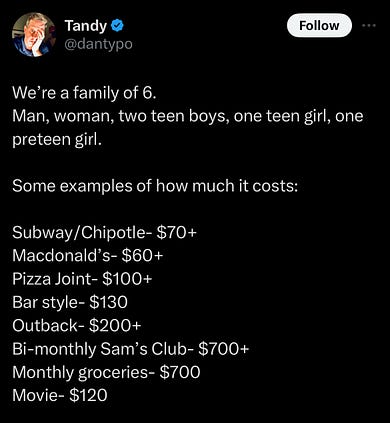
What changed in the economy is now nobody can afford to get by on working-class wages because there's no longer any bargains. Life used to be good for those with modest incomes because there were still bargains to be had. Not any more. Life is now a struggle because it's no longer affordable.


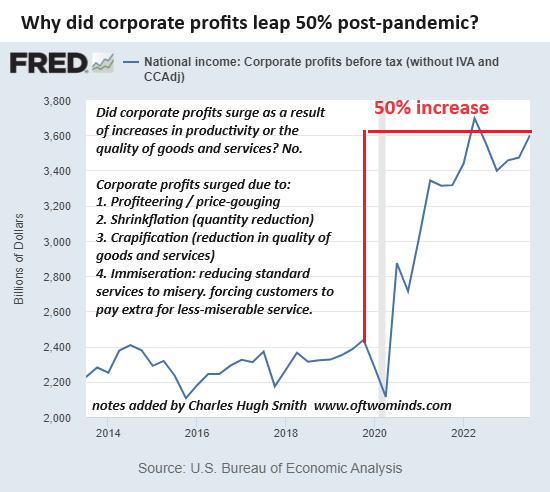
Not everyone is suffering, of course. The corporations selling junk products and services are doing just fine:


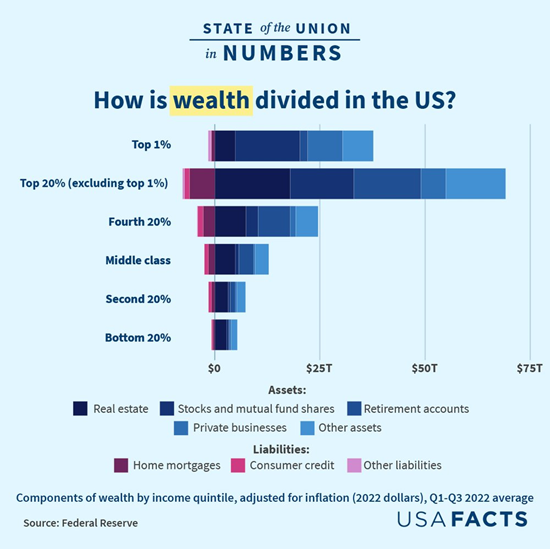
As are those who own 90% of the income-producing assets:


My recent books:

Disclosure: As an Amazon Associate I earn from qualifying purchases originated via links to Amazon products on this site.

Self-Reliance in the 21st Century print $18, (Kindle $8.95, audiobook $13.08 (96 pages, 2022) Read the first chapter for free (PDF)

The Asian Heroine Who Seduced Me (Novel) print $10.95, Kindle $6.95 Read an excerpt for free (PDF)

When You Can't Go On: Burnout, Reckoning and Renewal $18 print, $8.95 Kindle ebook; audiobook Read the first section for free (PDF)

Global Crisis, National Renewal: A (Revolutionary) Grand Strategy for the United States (Kindle $9.95, print $24, audiobook) Read Chapter One for free (PDF).

A Hacker's Teleology: Sharing the Wealth of Our Shrinking Planet (Kindle $8.95, print $20, audiobook $17.46) Read the first section for free (PDF).

Will You Be Richer or Poorer?: Profit, Power, and AI in a Traumatized World
(Kindle $5, print $10, audiobook) Read the first section for free (PDF).

The Adventures of the Consulting Philosopher: The Disappearance of Drake (Novel) $4.95 Kindle, $10.95 print); read the first chapters for free (PDF)

Money and Work Unchained $6.95 Kindle, $15 print)
Read the first section for free


Become a $1/month patron of my work via patreon.com.

Subscribe to my Substack for free


NOTE: Contributions/subscriptions are acknowledged in the order received. Your name and email remain confidential and will not be given to any other individual, company or agency.

Thank you, Jane V.F. ($5/month), for your magnificently generous subscription to this site -- I am greatly honored by your support and readership.


Thank you, McBain ($5/month), for your marvelously generous subscription to this site -- I am greatly honored by your support and readership.


Thank you, Loki Trading Report ($50), for your splendidly generous contribution to this site -- I am greatly honored by your support and readership.


Thank you, Donald J. ($5/month), for your outrageously generous subscription to this site -- I am greatly honored by your support and readership.

Read more...

Wednesday, February 21, 2024

The Pitfalls of Central Planning

If Central Planning can't expand its power, it expands its budget, at the expense of its programs.

Central Planning has an ominous totalitarian undertone, but there is a place for it in the social toolbox. The federal Interstate highway system was central planning, and so is Social Security. Many view America's patchwork electrical grid as not serving the national interest or its citizenry, and a dose of central planning to expand the grid's resilience and capacity might be the best way forward.

But like all tools, central planning has intrinsic limits and flaws. In The U.S. Housing Market: Rent-Serfs and Artificial Scarcity and my weekend Musings Report for subscribers, I laid out the fatal flaws intrinsic to unfettered markets.

The point is there is no "magic solution" that works in all situations, places and times, and it's folly to seek one "fix" to every problem. Humans are drawn to simplified, inspirational stories, and so both "the market" and "Central Planning" appeal to our desire for simplistic, idealized solutions to complex problems. While these are presented as polar opposites, they're both cut from the same cloth: simple. easy-to-grasp ideas that lend themselves to the quasi-religious devotion of true believers.

When each simplified solution fails, true believers always conjure up an excuse, or point out a detail that derailed the "perfect solution." Fix that, they claim, and it would have worked perfectly.

But the flaw is never an easily modified policy tweak; it's intrinsic to the "solution" itself. Just as markets lack mechanisms to recognize, much less price in, externalities and internalities that manifest in the future in complex ways, Central Planning has intrinsic fatal flaws that I described in my book Resistance, Revolution, Liberation.

The ontological imperative of Central Planning is to view the expansion of state power as the solution to every problem. This expansion of power comes at the expense of some other node of social-economic power such as local governments, enterprises and social (i.e. non-political) organizations such as community hospitals, charities, commissions, etc.

This intrinsic imperative to ceaselessly expand regardless of how many failures pile up manifests in a number of ways. One is that the agencies of central planning never close down because they solved the problem they were launched to address: the agency either expands as a reaction to its own abysmal failure to solve the problem, or it engages in mission creep and declares its success grants it the right to start solving other problems beyond its original charter.

This is the organizational equivalent of the Peter Principle: every agency rises to the highest level of its incompetence, and then proceeds to expand its reach and power as the solution to its incompetence.

Central Planning is in bed with corporate monopolies and cartels, the private-sector equivalent of centrally organized, power-hungry agencies. Corporations grease political fundraising, and are "helpful" when retiring bureaucrats need a lucrative second career as lobbyists, board members, etc.--the infamous revolving door. It's a match made in Heaven.

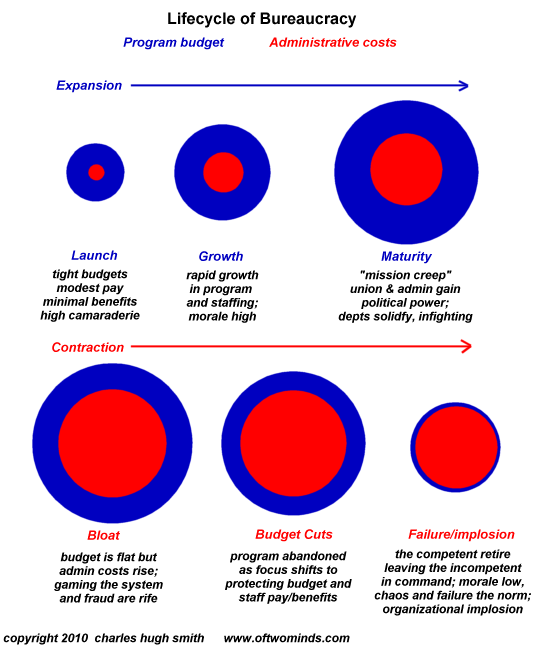
If Central Planning can't expand its power, it expands its budget, at the expense of its programs. This process--the decay from idealistic can-do to self-serving muddle-through--is depicted in the Lifecycle of Bureaucracy chart:


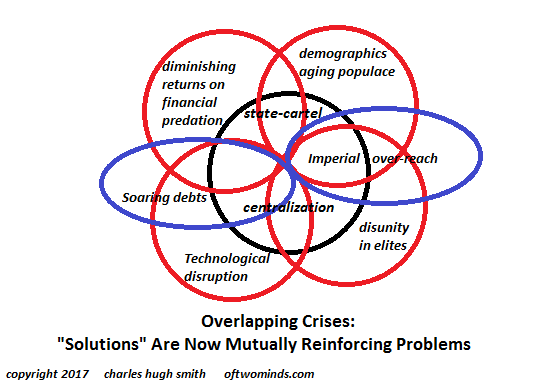
Just as markets require limits, transparency and competitive oversight to serve their intended function, so too does Central Planning. Which of these overlapping crises is tailor-made to be solved quickly and efficiently by Central Planning?


How about state-cartel centralization? Oops, that's the problem, not the solution. How about imperial over-reach? Umm, well... or soaring debt? Ahem, cough... the source of the problem isn't the solution.


My recent books:

Disclosure: As an Amazon Associate I earn from qualifying purchases originated via links to Amazon products on this site.

Self-Reliance in the 21st Century print $18, (Kindle $8.95, audiobook $13.08 (96 pages, 2022) Read the first chapter for free (PDF)

The Asian Heroine Who Seduced Me (Novel) print $10.95, Kindle $6.95 Read an excerpt for free (PDF)

When You Can't Go On: Burnout, Reckoning and Renewal $18 print, $8.95 Kindle ebook; audiobook Read the first section for free (PDF)

Global Crisis, National Renewal: A (Revolutionary) Grand Strategy for the United States (Kindle $9.95, print $24, audiobook) Read Chapter One for free (PDF).

A Hacker's Teleology: Sharing the Wealth of Our Shrinking Planet (Kindle $8.95, print $20, audiobook $17.46) Read the first section for free (PDF).

Will You Be Richer or Poorer?: Profit, Power, and AI in a Traumatized World
(Kindle $5, print $10, audiobook) Read the first section for free (PDF).

The Adventures of the Consulting Philosopher: The Disappearance of Drake (Novel) $4.95 Kindle, $10.95 print); read the first chapters for free (PDF)

Money and Work Unchained $6.95 Kindle, $15 print)
Read the first section for free


Become a $1/month patron of my work via patreon.com.

Subscribe to my Substack for free


NOTE: Contributions/subscriptions are acknowledged in the order received. Your name and email remain confidential and will not be given to any other individual, company or agency.

Thank you, Anthony A. ($5/month), for your magnificently generous subscription to this site -- I am greatly honored by your support and readership.


Thank you, Jay S. ($5/month), for your marvelously generous subscription to this site -- I am greatly honored by your support and readership.


Thank you, Daniel T. ($54), for your splendidly generous contribution to this site -- I am greatly honored by your support and readership.


Thank you, Ryan T. ($5/month), for your outrageously generous subscription to this site -- I am greatly honored by your support and readership.

Read more...

Monday, February 19, 2024

Finding, Creating (and Keeping) a Job in the Era of AI

What's valuable is flexible, entrepreneurial, experiential-based skills that can be applied to a variety of problems--including those that have yet to arise.

Finding or creating a job with real upside--and keeping it--has been increasingly challenging for a long time. Globalization exposed the economy and workforce to unprecedented cost-cutting competition, and automation ate away at work that could be reduced to routines. Now AI is introducing a new level of automation to sectors that had heretofore been protected.

We can summarize the situation thusly: if AI doesn't disrupt the sector you work in, something else will.

I've been thinking about work, jobs, money, automation, AI and the economy for many years, thoughts that resulted in my books Get A Job, Build A Career, And Defy A Bewildering Economy (2014), A Radically Beneficial World: Automation, Technology and Creating Jobs for All (2015), Money and Work Unchained (2017) and Will You Be Richer or Poorer?: Profit, Power and A.I. in a Traumatized World (2019).

If I had to boil it all down to a few paragraphs, I'd start with this:

1. Enterprises and governments are fundamentally problem-solving entities. They organize labor, capital and tools to solve problems. This clarifies our understanding of the value of human work: we're all solving problems of one kind or another. Those who can solve a variety of problems will always be in demand somewhere in the society and economy.

2. We're told to acquire credentials as evidence of our knowledge, but the more direct path is to accredit ourselves by demonstrating and recording our real-world problem-solving skills. Diplomas accredit the completion of a course of study, but they don't actually accredit knowledge or problem-solving skills that can be usefully applied in the real world. We serve our best interests by accrediting those ourselves.

3. The world is over-supplied with credentials which don't actually accredit what employers and customers value most. The net result is the value of credentials is declining, as there is a mismatch of supply and demand: what's valuable is flexible, entrepreneurial, experiential-based skills that can be applied to a variety of problems--including those that have yet to arise.

4. Self-knowledge is as essential as problem-solving skills. We cannot fully realize our potential until we identify our core interests, talents and character traits, and align them with what I call the eight essential problem-solving skills. Nobody is talented in every facet, and so we have to choose work that leverages what we're good at and find interesting, and compensate as best we can for what we're only passable at managing.

As an author, it's a rare and precious thing to receive the highest possible honor, which is to find that something we wrote provided some bit of useful knowledge and encouragement to an individual who made good use of it. I recently received such an honor from reader Jenna Tucker, whose account embodies everything I try to communicate about acquiring self-knowledge, understanding the economy as it changes, accumulating valued skills and finding ways to apply them to further one's own career in ways that benefit employers, customers and our community:

"Dear Charles Hugh Smith, I was so happy to see that you have a presence on Patreon, as I have been wanting to write you a thank you letter for a handful of years now. I read your book Get A Job, Build A Career, And Defy A Bewildering Economy after I had moved across the country to grad school and in the first term of my two year program recognized the career field I was pursuing was rapidly collapsing. I decided to stay and assemble an interdisciplinary study of my own choosing. I knew that I would need to find another career field and was looking for alternative strategies.

Your ideas aligned so well with my own intuitive sense of things. The affirmation and the added clarity and practical advice made all the difference for me. That handful of tools from understanding the S-curve to finding skills with steep and ongoing learning curves to creating a master work history as a basis for creating resumes and seeking references was so thoughtful and potent. Thank you so much for taking the time to write this book. The good will and generosity meant such a great deal to me in the most practical, tangible way.

I was always a talented and responsible kid, and I had been looking for advice from a well-intentioned and wise person older than I was across decades. And I did not find anything as useful as what you conveyed in your little book. I first found and read a book about how to manage money at 18 before going to college and read many more books over the years. They all had what amounted to the same advice, which I followed strictly. And yet I was nearing my 30s still hovering so close to a return to food insecurity, and no amount of responsibility or excellence seemed to be changing the pattern in a truly meaningful way.

I had no example or guidance beyond being told to do great in school, go to college, and keep a strict budget, which I did religiously. Yet in the years before I read your book, the most I had made in a tax year was $27K. Since then, I have pivoted into more lucrative career paths three times, and I just prepared taxes for my first year of making a six-figure income over $100K working as a self- and community-taught software engineer. Please know that your work was very much needed, cherished, and appreciated by this particular reader and patron. And thank you again!

Jenna Tucker"


Thank you, Jenna, for sharing your inspirational journey with us. I honor your well-earned success. You have accomplished so much and by sharing your own story, you're helping others advance on their own journey.

Here are four snapshots of the economy and working in that economy:


My recent books:

Disclosure: As an Amazon Associate I earn from qualifying purchases originated via links to Amazon products on this site.

The Asian Heroine Who Seduced Me (Novel) print $10.95, Kindle $6.95 Read an excerpt for free (PDF)

When You Can't Go On: Burnout, Reckoning and Renewal $18 print, $8.95 Kindle ebook; audiobook Read the first section for free (PDF)

Global Crisis, National Renewal: A (Revolutionary) Grand Strategy for the United States (Kindle $9.95, print $24, audiobook) Read Chapter One for free (PDF).

A Hacker's Teleology: Sharing the Wealth of Our Shrinking Planet (Kindle $8.95, print $20, audiobook $17.46) Read the first section for free (PDF).

Will You Be Richer or Poorer?: Profit, Power, and AI in a Traumatized World
(Kindle $5, print $10, audiobook) Read the first section for free (PDF).

The Adventures of the Consulting Philosopher: The Disappearance of Drake (Novel) $4.95 Kindle, $10.95 print); read the first chapters for free (PDF)

Money and Work Unchained $6.95 Kindle, $15 print)
Read the first section for free


Become a $1/month patron of my work via patreon.com.

Subscribe to my Substack for free


NOTE: Contributions/subscriptions are acknowledged in the order received. Your name and email remain confidential and will not be given to any other individual, company or agency.

Thank you, Gdog ($10/month), for your magnificently generous subscription to this site -- I am greatly honored by your support and readership.


Thank you, Michael J. ($8/month), for your marvelously generous subscription to this site -- I am greatly honored by your support and readership.


Thank you, Foggy ($54), for your splendidly generous contribution to this site -- I am greatly honored by your support and readership.


Thank you, Charles M. ($54), for your outrageously generous contribution to this site -- I am greatly honored by your steadfast support and readership.

Read more...

Friday, February 16, 2024

The U.S. Housing Market: Rent-Serfs and Artificial Scarcity

Unleash the powers of unlimited credit and excess capital on a limited, essential resource such as shelter and this is what we end up with: artificial scarcity, rent-serfs and half-vacant neighborhoods owned by absentee landlords.

Ideologies sound wonderful in the abstract, but run aground in the granular real world. The dominate ideology in the world today isn't a political ideology, it's the ideology of the market: in this ideology, the market is presented as the ideal problem-solving mechanism, as the interplay of supply and demand and the free flow of capital and labor will automatically fill unmet demand with new supply and provide competition that increases quality and reduces costs.

Let's consider how the market functions in the real-world U.S. housing market. Take a mixed-use neighborhood of single-family homes with a scattering of low-rise rental buildings. It's desirable but still affordable to buyers and renters alike.

Enter the bubble economy, the global model for the past 30 years in which unlimited credit is dirt-cheap to corporations and financiers as central banks suppress interest rates to "bring demand forward" by making it cheaper to borrow money to buy assets and products.

This pumps up asset prices as low-cost capital sloshes around the world looking for low-risk cash flows to buy and places to park excess capital that will appreciate as global capital competes for the lowest-risk, most desirable assets.

Real estate in desirable, low-risk locales is an ideal place to park this excess capital. Global capital has no need to rent the flats and homes being snapped up for appreciation; indeed, renting the flats and homes is viewed as troublesome and not worth the hassle.

So global absentee owners start buying properties in the desirable neighborhood. These buyers have zero interest in the livability of the neighborhood or the residents; it's strictly an investment based on the Prime Directive: maximize the return on capital by any means available.

To capital, properties in the neighborhood are commodities, interchangeable with millions of other properties around the world: we own flats in Zurich, Paris, Bangkok, Singapore, Barcelona and Miami.

Next, corporations discover rents in desirable neighborhoods generate profitable cash flow, so corporations start buying single-family homes and converting them from owner-occupied to rentals. These corporations act as a cartel, operating much like a monopoly as they all have the same access to unlimited credit and the same goal of maximizing return on capital.

Then the short-term rental market generates strong demand by investors large and small for vacation / AirBnB rentals, which are initially highly profitable: those with surplus equity / credit / capital hear of stupendous profits being raked in by absentee owners of short-term rentals, and they join the bidding war of global capital and corporations for homes and rental properties.

Now half the housing stock of the neighborhood is owned by absentee owners and corporations, all guided by a single raison-d'etre: maximize the return on capital by any means available. Now that 25% of the housing stock has been removed from owner-occupancy and long-term renter / residents to serve the short-term rental market, there's a scarcity of homes to buy or rent.

Another 15% is empty by design, as the owners are overseas investors solely interested in owning real estate in the U.S. as a low-risk place to park some of their excess capital.

So 40% of the neighborhood's housing stock has been removed from the market for residents, the equivalent of 40% of the housing burning to the ground.

This artificial scarcity enables the corporate owners to jack up rents to nose-bleed heights, and the few non-corporate owners of rentals quickly follow suit. Now the "market rents" are double what they were prior to the arrival of non-resident "market forces."

As home prices soar, residents who work for a living cannot compete with the unlimited credit lines of corporations and overseas wealth, and so those seeking to own a home must look elsewhere farther afield, or give up the dream of owning a home and resign themselves to life as a rent-serf, barely able to pay the sky-high rents charged by corporations and absentee landlords.

Meanwhile, the conviviality and livability of the neighborhood has been destroyed. The short-term rentals are plagues, as non-resident visitors think nothing of hosting loud parties, ruining the lives of working neighbors. The neighborhood is now dominated by transients, empty dwellings and rentals crammed with people who can't afford to rent their own flat.

With rents and home prices now unaffordable, the city is pressured to allow the construction of highrise condos by corporate developers. The handful of subsidized below-market rate condos are quickly snapped up, and the market-rate units are purchased by investors, to be left empty (a place to park excess wealth) or as short-term rentals.

The construction of the condo did nothing to alleviate the artificial housing scarcity as only the few subsidized units are affordable to wage-earning residents.

The destruction of the neighborhood is all perfectly logical within the confines of the market: capital was allocated to maximize profits by any available means, and so the market worked perfectly.

The problem with the market is the market doesn't care about livability or the quality of life or the neighborhood as a social structure, for these are non-market factors. The market views places and people as commodities, interchangeable on a global scale: we own flats in Zurich, Paris, Bangkok, Singapore, Barcelona and Miami. They're all commodities to be bought and sold to maximize the return on capital, nothing more and nothing less.

What's missing in this distorted reduction of life to commodities is housing is fundamentally shelter, and an essential human need. Housing isn't merely an asset that generates cash flow or an asset that serves as a place to park excess wealth. It is first and foremost shelter. But in the market, "shelter" has no meaning except as a source of demand that is no different from the demand generated by capital for cash flows, profits and low-risk places to park excess capital for appreciation.

This is how the U.S. housing market has been transformed by the tyranny of the market: unleash the powers of unlimited credit and excess capital on a limited, essential resource such as shelter and this is what we end up with: artificial scarcity, rent-serfs and half-vacant neighborhoods owned by absentee landlords solely interested in maximizing the return on their capital.

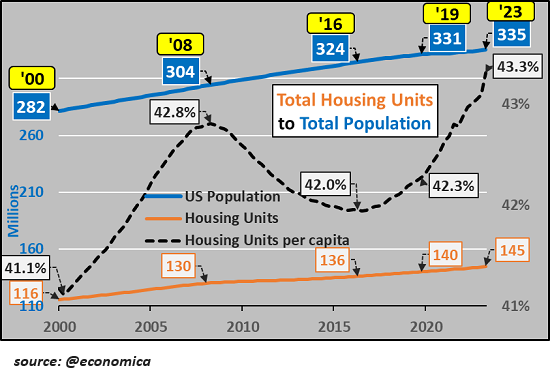
Here we see housing per capita in the U.S. has reached a new high--yet there's a scarcity of housing. If this is mystifying, please consider the drivers of artificial scarcity.


My recent books:

Disclosure: As an Amazon Associate I earn from qualifying purchases originated via links to Amazon products on this site.

The Asian Heroine Who Seduced Me (Novel) print $10.95, Kindle $6.95 Read an excerpt for free (PDF)

When You Can't Go On: Burnout, Reckoning and Renewal $18 print, $8.95 Kindle ebook; audiobook Read the first section for free (PDF)

Global Crisis, National Renewal: A (Revolutionary) Grand Strategy for the United States (Kindle $9.95, print $24, audiobook) Read Chapter One for free (PDF).

A Hacker's Teleology: Sharing the Wealth of Our Shrinking Planet (Kindle $8.95, print $20, audiobook $17.46) Read the first section for free (PDF).

Will You Be Richer or Poorer?: Profit, Power, and AI in a Traumatized World
(Kindle $5, print $10, audiobook) Read the first section for free (PDF).

The Adventures of the Consulting Philosopher: The Disappearance of Drake (Novel) $4.95 Kindle, $10.95 print); read the first chapters for free (PDF)

Money and Work Unchained $6.95 Kindle, $15 print)
Read the first section for free


Become a $1/month patron of my work via patreon.com.

Subscribe to my Substack for free


NOTE: Contributions/subscriptions are acknowledged in the order received. Your name and email remain confidential and will not be given to any other individual, company or agency.

Thank you, Susan M. ($5/month), for your magnificently generous subscription to this site -- I am greatly honored by your support and readership.


Thank you, New Terra Farms ($5/month), for your marvelously generous subscription to this site -- I am greatly honored by your support and readership.


Thank you, Jenna T. ($10.80), for your splendidly generous contribution to this site -- I am greatly honored by your support and readership.


Thank you, Judy G. ($10/month), for your outrageously generous subscription to this site -- I am greatly honored by your steadfast support and readership.

Read more...

Wednesday, February 14, 2024

Digital Service Dumpster Fires and Shadow Work

One wonders what we're paying for via taxes, products and services, when we end up having to do so much of the work ourselves for nothing.

Let's look at a day-to-day reality that is so ubiquitous it doesn't attract the attention it deserves:

Digital services--the foundation of the digital economy--are dumpster fires we're supposed to put out ourselves.
The services are broken, dysfunctional rubbish, and yet somehow the agencies or corporations that are responsible for the endless dumpster fires of their digital interfaces have shifted the burdens of this incompetence onto the consumer / customer, who is supposed to put the fire out ourselves and make do with the smoldering sludge at the bottom of the dumpster.

Digital services are everything relating to customer service or customer portals / interfaces. The latest PR claim is that abysmal customer service will all be fixed by AI-based chatbots and digital assistants. Based on my experience, I beg to differ: the chatbots simply add another layer of incompetence and complexity to the wretched, time-wasting, frustrating mess.

All the work that once was performed by agencies and companies has been offloaded onto the customer. This is called shadow work: work we perform that isn't paid or even counted as "work," though it eats up our time and energy, leaving us less leisure and more frayed.

The ever heavier burdens of shadow work are a major reason modern life is increasingly stressful and harried: what was once done for customers as part of the service being paid for is now the customer's responsibility.

I just spent--or shall we be honest and say "I wasted"-- significant time navigating AI chatbots and a smartphone app which is touted as an AI assistant. The corporate entity is Xfinity (previously Comcast), one of the nation's cartel of Internet-telecom providers.

The internet-service AI chatbot is SMS-based, and it works by offering the consumer-customer a limited menu of options, often only two but occasionally up to four. If your issue isn't covered by the options, then you must begin a wild-goose chase in which you select whatever option you hope might be a way station to resolving the actual issue.

As for the iPhone app, it certainly excels at looking useful, and in pitching an endless scroll of upselling, but in actually identifying the problem and resolving it, the app was a complete failure, misleading, inaccurate and frustratingly limited--in a word, dumb, the opposite of useful and intelligent.

The situation is I'm responsible for a rarely used Internet-Wi-Fi "gateway," what we used to call a modem and router, that's 2,500 miles from my home. So all management of the account and hardware/software must be done remotely. Theoretically, AI-enhanced apps are tailor-made for remote management and trouble-shooting.

The gateway wasn't working, and the source of the problem required an actual human technician to visit the site, for the problem could have been a cut cable, a loose connection, the modem, or any number of other causes. The technician arrives, our friend meets them, and the tech installs a new gateway: problem solved, Wi-Fi works great.

Until the next day, when the Wi-Fi stops working. Turning to the AI app, I test the system, and the app reports that everything is working perfectly: the network connection and the Wi-Fi to our friend's phone and laptop are all strong. Only the Wi-Fi doesn't work, and power-cycling the gateway and restarting Wi-Fi on the phone and laptop accomplishes nothing.

The chatbot generates a series of "verification codes" which don't restore Wi-Fi, they only direct our friend to download the corporate app, which after she does so, fixes nothing and offers nothing.

After wasting a frustratingly large amount of time fiddling with the app on my end, I give up and ask to get a callback from the chatbot. A polite rep (based in the Philippines) calls me back, and after hearing my description of the issue, he reports that he sees the source of the problem right away: an update to the gateway's software did not load properly, and so no amount of restarting would get it to work properly.

One would think the AI app's troubleshooting script would include a check on whether the gateway's software was actually functioning or not, but you would be wrong. The app said everything was nominal even when it didn't work.

While he re-installed the software, I chatted with the rep about his working from home--a real boon as it eliminated his commute and enabled him to help with the family's infant. He said we'd have to restart the gateway and then it should work. For good measure, I changed the Wi-Fi access password, and to my great relief, our friend once again had Wi-Fi.

Let's consider the productivity gains / losses resulting from the chatbot and phone app's troubleshooting and menu of fixes. The AI-enthused analysts only consider the corporate side's measures of productivity: did more profitable work get done by employees and capital / computers, etc.?

Nobody seems to be looking at the consumer-customer side of the productivity equation, where the AI chatbot and AI assistant app were nothing more than hugely unproductive, misleading, inaccurate time-sinks that wasted our valuable time and energy. If we add up the staggering losses of productivity on the customer-consumer side, the entire "AI boosts productivity" claim falls apart: AI reduces systemic productivity once we include the wasted time and energy of the customers-consumers.

What's particularly galling about having to do all this work for immensely profitable corporations is how obviously inadequate their digital services are. It's not like there's an occasional glitch: the most glaringly obvious, most basic functionalities are entirely missing.

I could describe my months-long travails with the California DMV and the IRS (Internal Revenue Service) to correct trivial matters such as my current address, but a more recent example is my shadow work difficulties trying to access Amazon's API, their programmable interface for Amazon Associates--those of us who post links to products (such as my books) on Amazon and earn a modest fee on sales originating through the links on our site.

I've been an Amazon Associate for 20 years, and the program has been useful and relatively easy to manage. All I wanted was a search box so visitors to my site could search Amazon for whatever they might be interested in. The search box used to be a snippet of JavaScript that was easy to insert in a site's HTML code. That feature was eliminated, and now Amazon Associates must jump through hoops to access API and master its technical challenges.

One might think a company selling products through affiliates would offer to generate the tools affiliates use to generate sales upon request, but you would be wrong. The affiliate now does the coding work, with the aid of templates and suggestions.

My frustrations included:

1. Dead links in the emails staffers sent me: yup, "page not found" (404).

2. The video sent to explain how to access API showed a link to click to "request access to API" which never appeared on my API page, so I had no way to request access.

3. Repeated requests to Associates support to sort out how I could request access when there was no link to do so generated multiple emails with the same useless links, each from a different staffer (or bot).

Recall that I've been a loyal Associate for 20 years and have generated a significant quantity of sales. One would imagine that there would be some effort to respond semi-effectively to long-time Associates, but there was no evidence that being a 20-year veteran Associate garnered any more attention than a newbie.

4. Eventually I received an email saying I needed to generate 3 "qualified sales" to qualify for API Access. I replied that I'd logged 197 sales via links in the past 30 days, and what exactly was a "qualified sale"?

5. Next, I received a notice that my API access had been revoked (such a pleasant-sounding word) due to inactivity. Wait a minute--I had access to API? Why wasn't I informed via email? Why isn't there a simple line on my API page indicating my status, for example: "your request has been received," "your request has been approved," "API access status: approved / denied," etc. How hard would it be to insert this one line in Associates' API page?

6. The last email reported that my access had been restored and would I please fill out a customer satisfaction survey. Uh, right.

As for actually navigating the complexities of the API system, I no longer have the energy to do so. All I want is a simple search box, for crying out loud, about a dozen lines of JavaScript. I don't want to watch numerous how-to videos and figure out the complicated process of requesting a sample code and then sorting through the response. Shouldn't this be Amazon's job?

The digital dumpster fires that pass for "customer service" are getting harder to put out, and the shadow work is getting more frustrating, complex and exhausting. One wonders what we're paying for via taxes, products and services, when we end up having to do so much of the work ourselves for nothing.

Shadow Work (1981, Ivan Illich)

Shadow Work: The Unpaid, Unseen Jobs That Fill Your Day (2015, Craig Lambert)


New podcast: Opportunities and Benefits of International Cities (49 min)


My recent books:

Disclosure: As an Amazon Associate I earn from qualifying purchases originated via links to Amazon products on this site.

The Asian Heroine Who Seduced Me (Novel) print $10.95, Kindle $6.95 Read an excerpt for free (PDF)

When You Can't Go On: Burnout, Reckoning and Renewal $18 print, $8.95 Kindle ebook; audiobook Read the first section for free (PDF)

Global Crisis, National Renewal: A (Revolutionary) Grand Strategy for the United States (Kindle $9.95, print $24, audiobook) Read Chapter One for free (PDF).

A Hacker's Teleology: Sharing the Wealth of Our Shrinking Planet (Kindle $8.95, print $20, audiobook $17.46) Read the first section for free (PDF).

Will You Be Richer or Poorer?: Profit, Power, and AI in a Traumatized World
(Kindle $5, print $10, audiobook) Read the first section for free (PDF).

The Adventures of the Consulting Philosopher: The Disappearance of Drake (Novel) $4.95 Kindle, $10.95 print); read the first chapters for free (PDF)

Money and Work Unchained $6.95 Kindle, $15 print)
Read the first section for free


Become a $1/month patron of my work via patreon.com.

Subscribe to my Substack for free


NOTE: Contributions/subscriptions are acknowledged in the order received. Your name and email remain confidential and will not be given to any other individual, company or agency.

Thank you, John K. ($100), for your outrageously generous contribution to this site -- I am greatly honored by your steadfast support and readership.


Thank you, G.D.T. ($150), for your beyond-outrageously generous contribution to this site -- I am greatly honored by your steadfast support and readership.


Thank you, Roger H. ($50), for your splendidly generous contribution to this site -- I am greatly honored by your steadfast support and readership.


Thank you, Mars K. ($50), for your superly generous contribution to this site -- I am greatly honored by your steadfast support and readership.

Read more...

Terms of Service

All content on this blog is provided by Trewe LLC for informational purposes only. The owner of this blog makes no representations as to the accuracy or completeness of any information on this site or found by following any link on this site. The owner will not be liable for any errors or omissions in this information nor for the availability of this information. The owner will not be liable for any losses, injuries, or damages from the display or use of this information. These terms and conditions of use are subject to change at anytime and without notice.


Our Privacy Policy:


Correspondents' email is strictly confidential. This site does not collect digital data from visitors or distribute cookies. Advertisements served by a third-party advertising network (Investing Channel) may use cookies or collect information from visitors for the purpose of Interest-Based Advertising; if you wish to opt out of Interest-Based Advertising, please go to Opt out of interest-based advertising (The Network Advertising Initiative). If you have other privacy concerns relating to advertisements, please contact advertisers directly. Websites and blog links on the site's blog roll are posted at my discretion.


PRIVACY NOTICE FOR EEA INDIVIDUALS


This section covers disclosures on the General Data Protection Regulation (GDPR) for users residing within EEA only. GDPR replaces the existing Directive 95/46/ec, and aims at harmonizing data protection laws in the EU that are fit for purpose in the digital age. The primary objective of the GDPR is to give citizens back control of their personal data. Please follow the link below to access InvestingChannel’s General Data Protection Notice. https://stg.media.investingchannel.com/gdpr-notice/


Notice of Compliance with The California Consumer Protection Act
This site does not collect digital data from visitors or distribute cookies. Advertisements served by a third-party advertising network (Investing Channel) may use cookies or collect information from visitors for the purpose of Interest-Based Advertising. If you do not want any personal information that may be collected by third-party advertising to be sold, please follow the instructions on this page: Limit the Use of My Sensitive Personal Information.


Regarding Cookies:


This site does not collect digital data from visitors or distribute cookies. Advertisements served by third-party advertising networks such as Investing Channel may use cookies or collect information from visitors for the purpose of Interest-Based Advertising; if you wish to opt out of Interest-Based Advertising, please go to Opt out of interest-based advertising (The Network Advertising Initiative) If you have other privacy concerns relating to advertisements, please contact advertisers directly.


Our Commission Policy:

As an Amazon Associate I earn from qualifying purchases. I also earn a commission on purchases of precious metals via BullionVault. I receive no fees or compensation for any other non-advertising links or content posted on my site.

  © Blogger templates Newspaper III by Ourblogtemplates.com 2008

Back to TOP