


Wednesday, March 06, 2024

Global Recession's Winners and Losers

The few winners of global recession will use the decline as a means to break the chokehold of unproductive BAU elites.

That the global economy is slipping into recession is self-evident. What's not yet known is the eventual depth and length of the recession. Given that the extreme policies needed to avoid recession over the past 15 years have reached extremes that are now the problem, not the solution, there won't be any more fiscal-monetary "saves" this time around.

What's also not yet known is how far the few winners will advance and how far the losers will fall. Recall that when it comes to wealth and power, what matters is not absolute gains or losses, but relative gains or losses: how well we do in relation to our peers and competitors.

For example, among 10 households with $1 million in assets, if one household experiences a decline in net worth to $900,000, that's an absolute drop of $100,000--not exactly welcome. But if the other 9 households experienced losses of between $500,000 and $900,000, leaving their net worth between $100,000 and $500,000, the household that lost only $100,000 gained tremendous ground in relation to the rest of their peers.

This will also play out on the grand stage of nation-states and alliances: those nations / alliances that weather a deep, lengthy global recession with modest losses will be much stronger post-recession that those who suffered losses that cannot be replaced that then tipped the nation into destabilization and eventual collapse.

I have long held that in this sense, recession can be weaponized by those with superior core assets in resources, flexibility and adaptability: Weaponizing Global Depression (2/23/23).

Every nation can print money, but the trick is to be able to do so without unleashing currency debasement / hyper-inflation. There are only a few levers that can be pulled to get away with printing money out of thin air to support one's economy in recession, and none are easy to sustain:

1. Print the money by issuing bonds that pay higher yields than competing bonds. Capital flows where it's treated best, and higher yields are attractive--but only if the following two conditions are met:

2. The bonds and the currency are highly liquid and can be traded in size so major players can enter and exit at will. Illiquid securities are inherently risky, as when the time comes to sell and the exit door shrinks down to the size of a dormouse, hefty gains reverse immediately to catastrophic losses.

3. The collateral for the newly issued bonds--the underlying economy and governance structures--are transparent and trustworthy. The collateral for newly issued bonds and currency is the nation's economy and governance structures: the greater the diversity of economic resources and activity, the more transparent the markets, data and regulatory structures, the greater the trustworthiness of the collateral and thus the lower the risk profile and premium.

This is why nations with poor transparency, narrow economic bases and regulations that change without warning with regime zig-zags have to pay extraordinarily high bond yields to attract capital: the risks of default, regulatory reversals or illiquidity are intrinsically high.

You see the problem: it's impossible to broaden one's economic base and establish trust overnight. It takes years or even decades to establish liquid, trustworthy markets that remain trustworthy even as political winds shift.

Those nations that have broad economic bases and trustworthy financial systems are few, and their choice is simple: either squander this collateral by using the newly issued money to prop up unproductive, rentier BAU (business as usual) elites, monopolies and cartels, or use the recession to divert resources and money away from dead-weight BAU and invest it productively.

Those nations that create money to prop up rentier BAU will slide into potentially terminal stagflation as creating new money and giving it to unproductive monopolies, cartels and elites increases the supply of money available to "invest" in asset bubbles--unproductive elites outbidding each other for the pool of productive assets--without increasing the productivity of the economy. This deflates the value of the currency (what we call inflation) even as it guarantees systemic malinvestment that keeps growth of productivity stagnant.

The trick is to use the newly created money wisely, which requires limiting the greed and power of BAU elites--something few nations (if any) can manage, as the BAU elites put their own interests above the interests of the nation and its citizenry.

Those nations that are largely self-sufficient in energy, food and technology will obviously weather recession better than those that depend on other nations for the essentials of life. Those nations that depend on selling resources such as oil and minerals for their national income are also extremely vulnerable, as recessions depress demand which then leads to lower commodity prices. Those selling the resources can attempt to restrict supply to keep prices high, but a deep global recession will suppress demand to the point that restricting supply may not be enough to keep prices high enough to maintain Business As Usual.

Since the easy-to-extract resources have already been exploited, what's left is more expensive to extract. The costs of extraction remain stubbornly high while revenues plummet, leading to a severe compression of net income. Those nations that depend almost entirely on selling resources will face a collapse of net income that will test their status quo to the breaking point.

The story of civilization is BAU elites will do everything in their power to maintain the status quo as it is because this configuration is the source of their wealth and power. Given the power of their self-interest, this configuration is brittle and thus prone to cracking in unpredictable ways.

To survive challenges like deep, lengthy recessions, nations must have the structural flexibility to enable competing elites to replace the BAU elites whose exploitive, unproductive grip has fatally weakened the nation's social, political and economic orders.

Just printing money to prop up a brittle, exploitive, unproductive BAU elite of bureaucracies, monopolies and cartels will not reverse the recession, for just squandering new money can't fix what's broken. Rather, creating more money to maintain the corrupt, extractive BAU can only increase the brittleness and the risks that stagnation and rising debts will lead to unanticipated stresses that break the status quo.

The few winners of global recession will use the decline as a means to break the chokehold of unproductive BAU elites and divert resources to more productive uses. The losers will squander their diminishing resources on propping up the source of their national decay: self-serving BAU elites.



New podcast Vision Series: AI Job Challenges and Trends (34:54 min)


My recent books:

Disclosure: As an Amazon Associate I earn from qualifying purchases originated via links to Amazon products on this site.

Self-Reliance in the 21st Century print $18, (Kindle $8.95, audiobook $13.08 (96 pages, 2022) Read the first chapter for free (PDF)

The Asian Heroine Who Seduced Me (Novel) print $10.95, Kindle $6.95 Read an excerpt for free (PDF)

When You Can't Go On: Burnout, Reckoning and Renewal $18 print, $8.95 Kindle ebook; audiobook Read the first section for free (PDF)

Global Crisis, National Renewal: A (Revolutionary) Grand Strategy for the United States (Kindle $9.95, print $24, audiobook) Read Chapter One for free (PDF).

A Hacker's Teleology: Sharing the Wealth of Our Shrinking Planet (Kindle $8.95, print $20, audiobook $17.46) Read the first section for free (PDF).

Will You Be Richer or Poorer?: Profit, Power, and AI in a Traumatized World
(Kindle $5, print $10, audiobook) Read the first section for free (PDF).

The Adventures of the Consulting Philosopher: The Disappearance of Drake (Novel) $4.95 Kindle, $10.95 print); read the first chapters for free (PDF)

Money and Work Unchained $6.95 Kindle, $15 print)
Read the first section for free


Become a $1/month patron of my work via patreon.com.

Subscribe to my Substack for free


NOTE: Contributions/subscriptions are acknowledged in the order received. Your name and email remain confidential and will not be given to any other individual, company or agency.

Thank you, Gary N. ($50), for your magnificantly generous subscription to this site -- I am greatly honored by your support and readership.


Thank you, Billy ($5/month), for your marvelously generous subscription to this site -- I am greatly honored by your support and readership.


Thank you, John B. ($50), for your splendidly generous subscription to this site -- I am greatly honored by your support and readership.


Thank you, Tomasz G. ($5/month), for your superbly generous subscription to this site -- I am greatly honored by your support and readership.

Read more...

Monday, March 04, 2024

These Four Themes Will Define the Next Decade

Everyone at the trough believes that the transition from liquid water (free flowing credit) to ice cannot possibly happen. So when it happens, everyone will be surprised.

Morgan Stanley recently came out with their 3 Themes that will impact markets for many years: longevity, AI tech diffusion, and decarbonization, i.e. the transition from hydrocarbon fuels to so-called "green energy."

That's the status quo: everything's great! Pills that cost $1,000 a month will make us live longer, AI will increase corporate profits (which is the entire point of the economy, of course) and those who invest in the "green energy" transition will be rewarded with fabulous wealth.

That all sounds peachy, but the real world will be defined by four much different themes: sclerosis, dysfunction, debt saturation and power asymmetry.

Sclerosis: the same old nodes of power cling onto power and so nothing changes because nothing can change: those in power must maintain or expand their power, regardless of what comes along, and that sclerosis is the systemic problem that cannot be resolved.

2. Dysfunction: nothing works due to the consequences of sclerosis: those who cling to power do so by eliminating every dynamic of open, self-correcting systems: they get rid of competition (every sector is dominated by monopolies, cartels or state-cartels), they get rid of transparency (information asymmetry is how they maintain power) and they have a lock on regulatory complexity / capture: first jump through all these hoops and maybe we'll let you propose some worthless policy tweak that leaves our power intact. Or we'll co-opt you by inviting you to become one of our flunkies, PR flacks, factotums, enforcers, lackeys, etc.

In a system rigged to maximize the profit and power of the few at the expense of the many, nothing works because the system is no longer capable of self-correction.

3. Debt saturation: 15 years of expanding credit has created the illusion we can pay for everything, no matter how costly, from future earnings, basically forever. So we need trillions to transition to "green energy," no problem, we'll borrow it. We need more trillions to pay for an aging, increasingly sickly populace, no problem, we'll borrow it. We need to borrow more trillions to fund all the status quo grift and graft, no problem, we'll borrow it.

And since we can pin interest rates to zero forever, we can borrow whatever tiny sums we need to pay the interest on hundreds of trillions in new debt, no problem. Except for one little dynamic called debt saturation: future earnings are not guaranteed, and at some point the income cannot sustain both the eternally expanding consumer and state spending needed to keep the Waste Is Growth Landfill Economy from imploding and the rising debt service on the ballooning debt.

We can afford only one: either borrow and spend to keep the Waste Is Growth Landfill Economy humming, or we can devote that income to servicing rising debt. We can't do both, so one or the other will collapse: either consumer/state borrowing and spending or the Palace of Debt.

This reality increases risk, and capital eventually demands a real return. Interest rates can't stay at zero, so the costs of servicing the soaring debt rises rapidly. At the same time, the immense expansion of credit--money borrowed from future income to be spent today--generates inflation, as the flood of credit needed to keep a sclerotic, dysfunctional status quo afloat outpaces the value being generated by all the trillions being borrowed and blown.

No one at the trough of "free money" will give up their place, and so the system is rigged to fail: we have to keep borrowing trillions to keep all the incumbents, entrenched interests and those collecting benefits happy, but as interest payments rise, we need to borrow more trillions just to pay the interest. And so on, in a self-reinforcing feedback loop.

4. Power asymmetry is my term for the structural inequality and bondage that characterize the global status quo. The many have very little power over anything, while the few hoard the power to make sure they keep what they have and to protect their perquisites from competing elites and populist movements. Debt serfdom is a good example of bondage--you need to borrow to live--and power asymmetry: debt-serfs have essentially zero power in the economy, society or the sclerotic systems of governance.

No amount of AI or new technology will change any of this, because all those tools serve those already in power. In effect, AI and all other new technologies simply serve to solidify power asymmetry and thus sclerosis and dysfunction. And since the system demands "free money" borrowed from the future to keep everyone at the trough happy, it also guarantees debt saturation, which eventually triggers a phase change much like liquid water (liquidity) suddenly freezing into ice.

Everyone at the trough believes that the transition from liquid water (free flowing credit) to ice cannot possibly happen. So when it happens, everyone will be surprised. What do you mean, there are limits?


New podcast Vision Series: AI Job Challenges and Trends (34:54 min)


My recent books:

Disclosure: As an Amazon Associate I earn from qualifying purchases originated via links to Amazon products on this site.

Self-Reliance in the 21st Century print $18, (Kindle $8.95, audiobook $13.08 (96 pages, 2022) Read the first chapter for free (PDF)

The Asian Heroine Who Seduced Me (Novel) print $10.95, Kindle $6.95 Read an excerpt for free (PDF)

When You Can't Go On: Burnout, Reckoning and Renewal $18 print, $8.95 Kindle ebook; audiobook Read the first section for free (PDF)

Global Crisis, National Renewal: A (Revolutionary) Grand Strategy for the United States (Kindle $9.95, print $24, audiobook) Read Chapter One for free (PDF).

A Hacker's Teleology: Sharing the Wealth of Our Shrinking Planet (Kindle $8.95, print $20, audiobook $17.46) Read the first section for free (PDF).

Will You Be Richer or Poorer?: Profit, Power, and AI in a Traumatized World
(Kindle $5, print $10, audiobook) Read the first section for free (PDF).

The Adventures of the Consulting Philosopher: The Disappearance of Drake (Novel) $4.95 Kindle, $10.95 print); read the first chapters for free (PDF)

Money and Work Unchained $6.95 Kindle, $15 print)
Read the first section for free


Become a $1/month patron of my work via patreon.com.

Subscribe to my Substack for free


NOTE: Contributions/subscriptions are acknowledged in the order received. Your name and email remain confidential and will not be given to any other individual, company or agency.

Thank you, Solitaire ($5/month), for your magnificantly generous subscription to this site -- I am greatly honored by your support and readership.


Thank you, Ryan K. ($5/month), for your marvelously generous subscription to this site -- I am greatly honored by your support and readership.


Thank you, Ian J.G. ($5/month), for your splendidly generous subscription to this site -- I am greatly honored by your support and readership.


Thank you, Bob ($5/month), for your superbly generous subscription to this site -- I am greatly honored by your support and readership.

Read more...

Friday, March 01, 2024

If AI Is So Great, Why Is Managing the Digital Realm Eating Us Alive?

The financial analysts gloating over the prospect of higher corporate profits resulting from firing workers overlook the collapse of customer satisfaction, productivity and leisure.

If AI is so great, why are we all wasting so much precious, irreplaceable time deleting spam, unsubscribing from junk email and dealing with multiplying layers of digital incompetence? This is called shadow work: work we perform that isn't paid or even counted as "work," though it eats up our time and energy, leaving us less leisure and more frayed.

Work that once was performed by the companies and agencies offering these services has been offloaded onto the customer. The customer must now delete endless spam, unsubscribe from endless junk emails, deal with security breaches, navigate incompetent third-party providers, fill out endless forms relating to privacy--a Kafkaesque bit of humor, given that our data is constantly plundered by hackers--and find their efforts to get anything fixed in the digital realm foiled by AI-chatbots and phone apps.

The horror stories are becoming ever more Kafkaesque. To cite one recent example from a reader, the process of qualifying as a professional healthcare provider for payment from Medicare was once a relatively straightforward submission of documents. Now it has been offloaded to a third-party provider--keepers of the inner circle of Digital Hell--which charges $3,000 for providing a truly Kafkaesque labyrinth of frustrating incompetence.

Recall that in Kafka's final novel, The Castle, the castle is buzzing 24/7 with office workers who are too busy to answer the phone: the work is endless yet nothing gets done.

I recounted a few of my own experiences with AI-digital incompetence in Digital Service Dumpster Fires and Shadow Work:

Digital services--the foundation of the digital economy--are dumpster fires we're supposed to put out ourselves. The services are broken, dysfunctional rubbish, and yet somehow the agencies or corporations that are responsible for the endless dumpster fires of their digital interfaces have shifted the burdens of this incompetence onto the consumer / customer, who is supposed to put the fire out ourselves and make do with the smoldering sludge at the bottom of the dumpster.

The financial analysts gloating over the prospect of higher corporate profits resulting from firing workers overlook the collapse of customer satisfaction, productivity and leisure. AI is creating additional layers of frustrating, time-sink shadow work, and the only possible conclusion is that AI--as instantiated by corporations and public agencies--is innately incompetent. The entire system of digital services is a wretched mess of incompetence and shadow work dumped on a public corralled by monopolies and cartels and a compliance-obsessed bureaucracy of state/federal agencies.

Cory Doctorow summarized the situation rather neatly: "One of the truest things I know about AI is: 'we're nowhere near a place where bots can steal your job, we're certainly at the point where your boss can be suckered into firing you and replacing you with a bot that fails at doing your job.'"


One wonders what we're paying for via taxes, products and services, when we end up having to do so much of the work ourselves, at the cost of our productivity, leisure and mental health.


New podcast Vision Series: AI Job Challenges and Trends (34:54 min)


My recent books:

Disclosure: As an Amazon Associate I earn from qualifying purchases originated via links to Amazon products on this site.

Self-Reliance in the 21st Century print $18, (Kindle $8.95, audiobook $13.08 (96 pages, 2022) Read the first chapter for free (PDF)

The Asian Heroine Who Seduced Me (Novel) print $10.95, Kindle $6.95 Read an excerpt for free (PDF)

When You Can't Go On: Burnout, Reckoning and Renewal $18 print, $8.95 Kindle ebook; audiobook Read the first section for free (PDF)

Global Crisis, National Renewal: A (Revolutionary) Grand Strategy for the United States (Kindle $9.95, print $24, audiobook) Read Chapter One for free (PDF).

A Hacker's Teleology: Sharing the Wealth of Our Shrinking Planet (Kindle $8.95, print $20, audiobook $17.46) Read the first section for free (PDF).

Will You Be Richer or Poorer?: Profit, Power, and AI in a Traumatized World
(Kindle $5, print $10, audiobook) Read the first section for free (PDF).

The Adventures of the Consulting Philosopher: The Disappearance of Drake (Novel) $4.95 Kindle, $10.95 print); read the first chapters for free (PDF)

Money and Work Unchained $6.95 Kindle, $15 print)
Read the first section for free


Become a $1/month patron of my work via patreon.com.

Subscribe to my Substack for free


NOTE: Contributions/subscriptions are acknowledged in the order received. Your name and email remain confidential and will not be given to any other individual, company or agency.

Thank you, MRC ($100), for your outrageously generous subscription to this site -- I am greatly honored by your support and readership.


Thank you, Dee ($100), for your outrageously generous subscription to this site -- I am greatly honored by your support and readership.


Thank you, SGSW ($50), for your splendidly generous contribution to this site -- I am greatly honored by your support and readership.


Thank you, Skidmark ($5/month), for your superbly generous subscription to this site -- I am greatly honored by your support and readership.

Read more...

Wednesday, February 28, 2024

Who Error-Corrects AI?

Part of why AI chatbots are so dreadful is we know the corporation / agency doesn't care whether our problem gets resolved or not.

Please note: Of Two Minds subscription rates are going up this Friday 3/1/24 from $5/month or $50/year to $7/month or $70/year, so subscribe by Thursday if you want to lock in current rates. If you're considering subscribing, please read the comment from Substack subscriber Kelly at the end of the post.

Click-bait-scary forecasts of hundreds of millions of jobs lost to AI are as ubiquitous as incompetent AI chatbots. Richard Bonugli and I recently took a more nuanced look at AI Job Challenges and Trends, with the goal not of throwing the baby out with the bathwater (i.e. concluding all AI is junk science) but of focusing on AI's limits in real-world problem-solving.

We can summarize these limits in one question: who error-corrects AI? the intrinsic problem here is data harvesting machine learning--the essence of Large Language Model (LLM) AI and other machine learning approaches--is the illusion of precision: the model selects the correct diagnosis 95% of the time, but who's going to error-correct the vital 5%?

Consider being a patient with cancer that receives an all-clear/no-cancer diagnosis from an AI processed scan. In other words, consider the consequences of the AI tool being wrong 5% of the time. In the case of cancer diagnoses, a wrong diagnosis can be a death sentence, or it can open a pathway to unnecessary treatments and surgeries.

The illusion of precision leads to fatal assumptions: if the AI error rate is "only" 5%, but the majority of the 5% errors are the most consequential, then the entire idea of basing accuracy on the percentage of correct / incorrect hits is grievously flawed. In effect, AI might be accurate on the 95% of cases with limited consequences and mostly inaccurate on the cases that really matter, but this reality is lost in the claim that it's 95% accurate.

Data harvesting machine learning is useless when problem-solving boils down to individual cases. Consider a modern vehicle, which is essentially a rolling platform of software. Each vehicle has a diagnostic port that the mechanic uses to detect what system / component has failed, but this doesn't automatically solve 100% of the problems that crop up in complex machines.

Having a model that predicts the likelihood of the source of unidentified mechanical problems is useful in the sense that the model predicts where to start the investigation, but it doesn't actually identify the problem with this vehicle. That requires a physical presence and experience beyond any model's guesstimate. Someone has to actually drop the engine to reach the failed control board. That someone performs both the essential tasks in actually repairing the vehicle: error-correction and the physical work of doing the repair.

The physician who reviews the AI scan results brings real-world experience that cannot be codified in data harvesting.

AI is being touted in cases that largely fall into the service sector such as customer service. (As I've outlined recently, the real-world results have been abysmal, simply reinforcing the trend of making customers do all the work, i.e. shadow work.) Digital Service Dumpster Fires and Shadow Work.

In the real world of work, AI can't actually repair the rotted handrailing or install the piping. AI tools may well offer potentially useful guidelines or help get the needed materials onsite logistically, the but actual work in the field is most cost-effectively performed by humans with long experience.

Another intrinsic limit in AI is the high-touch, low-touch divide. A physician with 40 years of experience recently told me that patients report feeling better after being seen by a nurse or doctor, and we can intuit why: they feel better because someone cares about them and their health enough to actually be physically present. Another experienced physician once told me that he'd concluded many of his patients sought an appointment with him just to have someone listen to them.

These are examples of high-touch experiences that cannot be replaced with low-touch robotic voices and printouts. There are many others. Do you want your hair cut by your barber, who has become a friend of sorts, or a robot? Do you recall with fondness a particular dinner because the wait staff was charming and attentive without being overbearing?

Part of why AI chatbots are so dreadful is we know the corporation / agency doesn't care whether our problem gets resolved or not. Simply put, replacing human interactions with sterile AI interactions fails at the human level. If we grasp this reality, we realize humans cannot be replaced by AI except at the most superficial low-touch level.

In real world situations, AI can't be said to "understand" problems. It's good at statistically identifying the most likely subsets of solutions and presenting those possibilities in a form that can be compared to actual results, and assigning a confidence level to each of its predictions. But this doesn't mean it's diagnoses or solutions are accurate or that it's right in the most critical, consequential situations.

What's interesting is the really hard problem AI is incapable of solving is how to manage the unintended consequences of its runaway expansion in our global socio-economic system. There is more on this in my book Will You Be Richer or Poorer?: Profit, Power and A.I. in a Traumatized World.

Vision Series: AI Job Challenges and Trends (34:54 min)


Comment from Substack subscriber Kelly: "I supported your work because of the ultimate purpose of your writing: taking control of and improving our own well-being and security. Plus, you sound a lot like my father (who has been gone for many, many years and I miss him). I feel like your writing is a reflection of what he would be telling me now about how to deal with the days, weeks and years to come. Thank you."


My recent books:

Disclosure: As an Amazon Associate I earn from qualifying purchases originated via links to Amazon products on this site.

Self-Reliance in the 21st Century print $18, (Kindle $8.95, audiobook $13.08 (96 pages, 2022) Read the first chapter for free (PDF)

The Asian Heroine Who Seduced Me (Novel) print $10.95, Kindle $6.95 Read an excerpt for free (PDF)

When You Can't Go On: Burnout, Reckoning and Renewal $18 print, $8.95 Kindle ebook; audiobook Read the first section for free (PDF)

Global Crisis, National Renewal: A (Revolutionary) Grand Strategy for the United States (Kindle $9.95, print $24, audiobook) Read Chapter One for free (PDF).

A Hacker's Teleology: Sharing the Wealth of Our Shrinking Planet (Kindle $8.95, print $20, audiobook $17.46) Read the first section for free (PDF).

Will You Be Richer or Poorer?: Profit, Power, and AI in a Traumatized World
(Kindle $5, print $10, audiobook) Read the first section for free (PDF).

The Adventures of the Consulting Philosopher: The Disappearance of Drake (Novel) $4.95 Kindle, $10.95 print); read the first chapters for free (PDF)

Money and Work Unchained $6.95 Kindle, $15 print)
Read the first section for free


Become a $1/month patron of my work via patreon.com.

Subscribe to my Substack for free


NOTE: Contributions/subscriptions are acknowledged in the order received. Your name and email remain confidential and will not be given to any other individual, company or agency.

Thank you, John C. ($100), for your outrageously generous subscription to this site -- I am greatly honored by your support and readership.


Thank you, USA-Sunshine ($5/month), for your marvelously generous subscription to this site -- I am greatly honored by your support and readership.


Thank you, Tom B. ($50), for your splendidly generous contribution to this site -- I am greatly honored by your support and readership.


Thank you, John O. ($5/month), for your superbly generous subscription to this site -- I am greatly honored by your support and readership.

Read more...

Monday, February 26, 2024

Rates, Risk and Debt: The Unavoidable Reckoning Ahead

Policy errors have consequences, and we're only in the first inning of those consequences.

Please note: Of Two Minds subscription rates are going up this Friday 3/1/24 from $5/month or $50/year to $7/month or $70/year, so subscribe by Thursday if you want to lock in current rates. Thank you for understanding the necessity of adjusting rates that have been unchanged since 2011.

If we ask, "what's changed?," two under-appreciated dynamics pop out: risk and consequences: risks are rising globally in a multi-dimensional self-reinforcing way, and the consequences of the Federal Reserve's 14-year policy error known as ZIRP--zero interest rate policy--are finally manifesting in unwelcome ways.

The Great Moderation is a term often invoked to describe the multi-decade reduction in global risks from 1990 to 2020. Geopolitical tensions diminished, the entry of China's vast workforce and productive capacity lowered the costs of labor and production, effectively suppressing inflationary forces, and the financial markets responded by demanding less of a risk premium on the price of bonds and credit: a reduction in inflationary pressure and risk led to a gradual reduction in yields and interest rates.

Global risks are now rising, as are inflationary pressures. China's inflationary monetary and fiscal policies have raised wages and costs, ending the era of China exporting deflation. The Federal Reserve's 14-year suppression of interest rates to near-zero as it opened the floodgates of credit has finally generated consequences: inflationary pressures can no longer be put back in the bottle, for a variety of reasons, including unfavorable demographics, global changes in supply chains, resource depletion, and so on.

The Fed's ZIRP policy error also inflated a series of asset bubbles, as those with access to the Fed's nearly free money used this money to bid up income-producing assets, a decade-long behavior-modification program that incentivized rampant leverage and speculation which pushed asset prices into a parabolic rise.

This generated a "wealth effect," long believed to be a core Fed goal: with household wealth soaring, the top 10% who owns the vast majority of the financial assets certainly feel richer. Those living paycheck to paycheck made use of lower interest rates to load up on debt: student loans, auto-truck loans, credit cards, etc.

Federal and local government spending also soared as public-sector borrowing skyrocketed. Super-low borrowing costs invited spending sprees, both public and private.

Now the economy is dependent on historically unprecedented low rates of interest or it collapse in a heap. But the stagflationary forces unleashed by the Fed's 14-year policy error cannot be suppressed; even worse, the Fed's usual "fixes"--flooding the economy with liquidity and lowering rates--actually adds fuel to the stagflationary fires.

What few observers seem to grasp is the Federal Reserve is a closed system, which creates an illusion of godlike control as closed systems have limited inputs and processes, and so the output can be tweaked / controlled.

But the economy is an open, dynamic system, and rock-bottom yields and interest rates generate self-reinforcing feedback loops that generate forces beyond the Fed's control. The Fed's apparent control of yields and interest rates generated an illusory belief that the Fed could also control the consequences of their 14-year ZIRP policy error. This illusion is unraveling in real time, and the consequences cannot be controlled by lowering interest rates or flooding the financial sector with liquidity.

If stagflation and global risks continue to rise, the Fed will have to raise rates, not lower them. Or private capital will demand higher risk premiums regardless of what the Fed does, in effect forcing the Fed's hand.

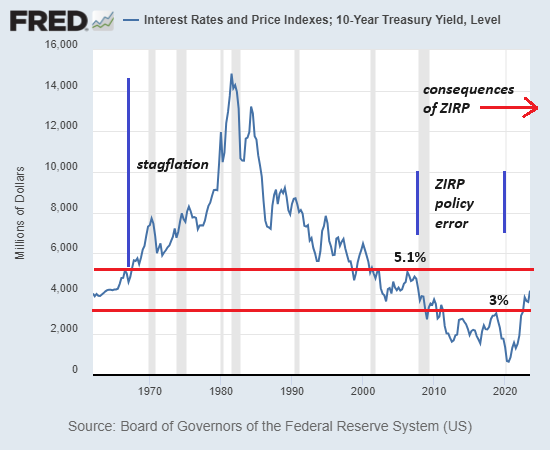
Note that rates are simply within a long-term range of between 3% and 5%. But even 5% rates are crushing the economy, a reality currently being masked by rapid expansion of public and private debt and the resulting doom spending--spending borrowed money like there's no tomorrow.

But there is a tomorrow, and so leverage and speculations that only made sense in a ZIRP fantasy land will implode, popping the speculative mania asset bubbles generating the wealth effect. This will generate the dreaded reverse wealth effect in which the wealthy feel poorer and less motivated to borrow and spend freely.

Recall that every dollar that must be devoted to debt service (paying interest and principal) is a dollar that cannot be spent on consuming goods and services. So rising rates eventually crush consumer spending. Ironically, lowering rates will boost inflation, which has the same effect: the purchasing power of consumers' wages plummets, reducing the quantity of goods and services they can afford to buy.

I've been writing about debt saturation for 15 years, and perhaps we're finally seeing debt saturation take hold: debt saturation means borrowers have maxed out their capacity to borrow more: they lack the income and/or collateral to borrow more, and as rates rise, their spending declines accordingly. This is stagflation: no real growth yet prices continue to edge higher as risks and inflationary feedbacks continue apace.

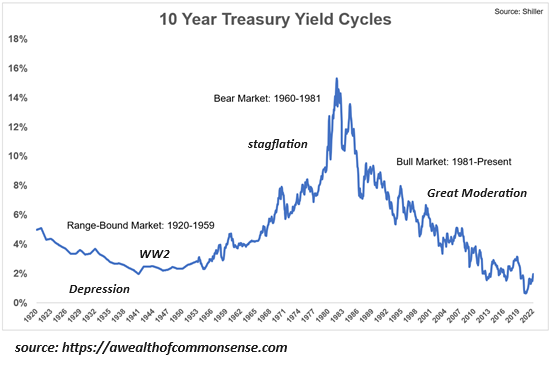
In summary: policy errors have consequences, and we're only in the first inning of those consequences. Here is long-term chart of 10-year Treasury bond yields. The Great Depression and World War II were both unique circumstances, and it is folly to use these as analogs supporting the illusion that rates can hover near zero forever. Note what happens when stagflation takes hold: rates rise, or inflation undermines the economy. There are no painless choices left.


Here we see the long-term range of 10-year Treasury bond yields, and how the Fed made a soon-to-be horrendously painful policy error in imposing ZIRP for 14 long years.


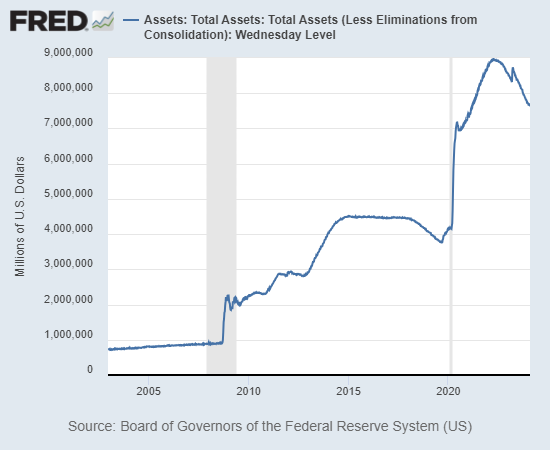
Nothing to see here, just a 10-fold increase in the Fed's balance sheet:


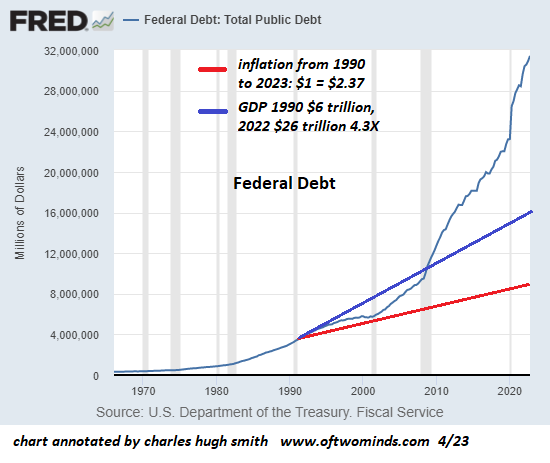
Notice how federal debt took off in the era of ZIRP: free money, hey, might as well grab some and spend it.


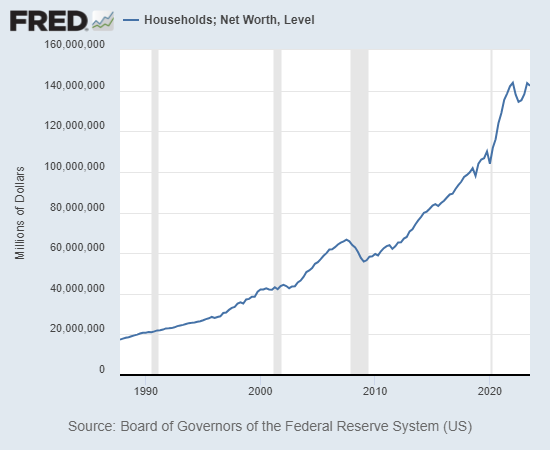
The resulting speculative mania asset bubbles boosted household net worth: OK, so most of the gains went to the top 0.1%, top 1% and top 5%, but in aggregate it paints a pretty picture: everyone's richer, thank you, Fed!


Thank you, Fed, for the coming decade of asset deflation, real-world inflation, debt saturation and the upward spiral of stagflation. Too bad the Fed's levers only control behavior modification, not the real world.


My recent books:

Disclosure: As an Amazon Associate I earn from qualifying purchases originated via links to Amazon products on this site.

Self-Reliance in the 21st Century print $18, (Kindle $8.95, audiobook $13.08 (96 pages, 2022) Read the first chapter for free (PDF)

The Asian Heroine Who Seduced Me (Novel) print $10.95, Kindle $6.95 Read an excerpt for free (PDF)

When You Can't Go On: Burnout, Reckoning and Renewal $18 print, $8.95 Kindle ebook; audiobook Read the first section for free (PDF)

Global Crisis, National Renewal: A (Revolutionary) Grand Strategy for the United States (Kindle $9.95, print $24, audiobook) Read Chapter One for free (PDF).

A Hacker's Teleology: Sharing the Wealth of Our Shrinking Planet (Kindle $8.95, print $20, audiobook $17.46) Read the first section for free (PDF).

Will You Be Richer or Poorer?: Profit, Power, and AI in a Traumatized World
(Kindle $5, print $10, audiobook) Read the first section for free (PDF).

The Adventures of the Consulting Philosopher: The Disappearance of Drake (Novel) $4.95 Kindle, $10.95 print); read the first chapters for free (PDF)

Money and Work Unchained $6.95 Kindle, $15 print)
Read the first section for free


Become a $1/month patron of my work via patreon.com.

Subscribe to my Substack for free


NOTE: Contributions/subscriptions are acknowledged in the order received. Your name and email remain confidential and will not be given to any other individual, company or agency.

Thank you, Federico T. ($5/month), for your magnificently generous subscription to this site -- I am greatly honored by your support and readership.


Thank you, James S. ($5/month), for your marvelously generous subscription to this site -- I am greatly honored by your support and readership.


Thank you, Richard D. ($50), for your splendidly generous contribution to this site -- I am greatly honored by your support and readership.


Thank you, Eric H. ($50), for your outrageously generous contribution to this site -- I am greatly honored by your support and readership.

Read more...

Terms of Service

All content on this blog is provided by Trewe LLC for informational purposes only. The owner of this blog makes no representations as to the accuracy or completeness of any information on this site or found by following any link on this site. The owner will not be liable for any errors or omissions in this information nor for the availability of this information. The owner will not be liable for any losses, injuries, or damages from the display or use of this information. These terms and conditions of use are subject to change at anytime and without notice.


Our Privacy Policy:


Correspondents' email is strictly confidential. This site does not collect digital data from visitors or distribute cookies. Advertisements served by a third-party advertising network (Investing Channel) may use cookies or collect information from visitors for the purpose of Interest-Based Advertising; if you wish to opt out of Interest-Based Advertising, please go to Opt out of interest-based advertising (The Network Advertising Initiative). If you have other privacy concerns relating to advertisements, please contact advertisers directly. Websites and blog links on the site's blog roll are posted at my discretion.


PRIVACY NOTICE FOR EEA INDIVIDUALS


This section covers disclosures on the General Data Protection Regulation (GDPR) for users residing within EEA only. GDPR replaces the existing Directive 95/46/ec, and aims at harmonizing data protection laws in the EU that are fit for purpose in the digital age. The primary objective of the GDPR is to give citizens back control of their personal data. Please follow the link below to access InvestingChannel’s General Data Protection Notice. https://stg.media.investingchannel.com/gdpr-notice/


Notice of Compliance with The California Consumer Protection Act
This site does not collect digital data from visitors or distribute cookies. Advertisements served by a third-party advertising network (Investing Channel) may use cookies or collect information from visitors for the purpose of Interest-Based Advertising. If you do not want any personal information that may be collected by third-party advertising to be sold, please follow the instructions on this page: Limit the Use of My Sensitive Personal Information.


Regarding Cookies:


This site does not collect digital data from visitors or distribute cookies. Advertisements served by third-party advertising networks such as Investing Channel may use cookies or collect information from visitors for the purpose of Interest-Based Advertising; if you wish to opt out of Interest-Based Advertising, please go to Opt out of interest-based advertising (The Network Advertising Initiative) If you have other privacy concerns relating to advertisements, please contact advertisers directly.


Our Commission Policy:

As an Amazon Associate I earn from qualifying purchases. I also earn a commission on purchases of precious metals via BullionVault. I receive no fees or compensation for any other non-advertising links or content posted on my site.

  © Blogger templates Newspaper III by Ourblogtemplates.com 2008

Back to TOP