

Tuesday, June 11, 2024

How Many Millennials Will Be Rich Enough to Buy the Boomers' Millions of Unaffordable Bungalows?

Absent demand from tens of millions of wealthy, high-income buyers, asset valuations will fall as Boomers sell off assets to fund their retirement.

There's a peculiarly flawed logic behind the widely held view that the Baby Boomers will seamlessly transfer tens of trillions of dollars of their wealth to the Gen-X and Millennial generations as they exit stage left. This is flawed for a very basic reason: the extremely overvalued assets that will be transferred--real estate and stocks--only reached such extreme overvaluation because there is a surplus of buyers who are sufficiently wealthy (and willing) to pay bubble-inflated prices.

Since the ownership of both real estate and stocks is concentrated in the hands of the wealthiest 10% who tend to be older, how many Gen-Xers and Millennials have the means to buy million-dollar bungalows and overpriced portfolios? If buyers are scarce due to entrenched wealth-income inequality, then once Boomers start selling their vast holdings of stocks and millions of overpriced homes, prices will plummet if sellers outnumber qualified and willing buyers.

In other words, the bloated valuations Millennials hope to inherit will only remain at the currently overvalued levels if millions of qualified buyers emerge to snap up every Boomer bungalow at today's bubble prices. If there are fewer buyers than sellers, prices will decline accordingly.

Younger generations hoping to inherit million-dollar McMansions and stock portfolios overlook that many aging Boomers are planning to sell their stocks and homes to fund their retirement. Boomers who are wealthy on paper are wealthy due to their ownership of stocks and real estate; they need to liquidate these assets to afford to retire at their desired level of comfort.

Another overlooked factor is inheritances often require selling the house to split the money between heirs. Once again, the inheritance depends on buyers emerging like locusts to buy up every house being sold at absurdly overvalued prices. How many younger people will have the means or willingness to buy the millions of overpriced bungalows being dumped on the market?

Hopeful heirs also overlook that prices are set on the margin. Take a neighborhood of 100 homes. If every home that sells fetches fewer dollars, the sale of only 10 homes can cut the valuations of the other 90 houses in half in a few years.

People are living longer nowadays, and since few retirement / nursing homes are being built, many Boomers will have to stay in their own home as they grow old. Assisted living / nursing home fees run around $10,000 to $12,000 or more a month; private nursing care in residential homes typically runs between $6,000 to $9,000 a month. Few can afford these options unless they sell their house. It's far more affordable to continue living at home until the end of one's life.

That can either consume the inheritance or extend the transfer of assets to the point the heirs are in their 70s. For example, my Mom is 95 years old, bless her heart, and she sold her house 17 years ago to fund her retirement in an assisted living complex. Her house proceeds funded her retirement years; there will be little left (if any) for her heirs.

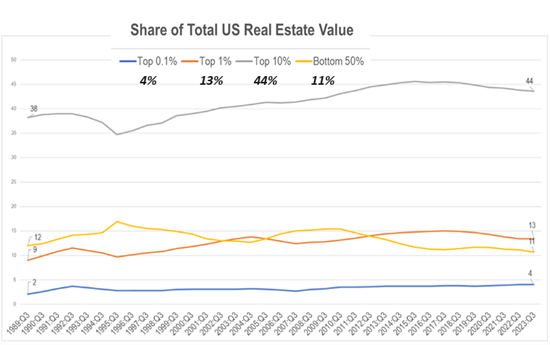
If we consider the vast concentration of wealth in the top 10% (typically the wealthiest Boomers), it's clear there aren't enough young people who can afford to buy assets at today's valuations to keep the prices at nosebleed levels. As this chart shows, the top 10% own 44% of all real estate in the US, while the bottom 50% of households own a meager 11%.


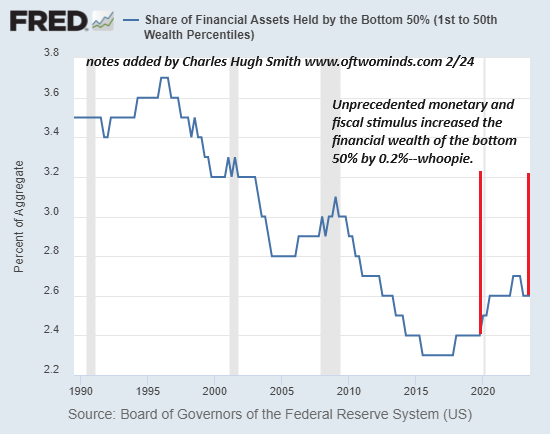
That's much more than their share of the nation's financial wealth, which is a rounding-error 2.6%:


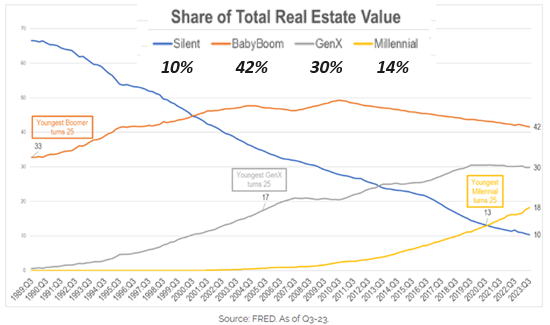
Boomers own 42% of all real estate value, with Gen-Xers holding 30% and Millennials owning 14%. We can surmise that the majority of Gen-Xers who can afford to buy a home have already done so. Given their relatively modest numbers and age, counting on Gen-Xers to soak up millions of Boomer Bungalows for $1 million does not reflect generational / financial realities.


That leaves the buying of millions of Boomer Bungalows for $1 million each to Millennials, who have the numbers but not the wealth to do so. Boomers hold 51% of household wealth, while Millennials hold a mere 9%.
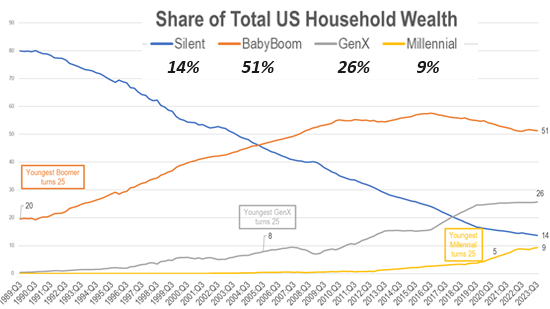


So the expectation that nosebleed valuations for houses and stocks will remain at a "permanently high plateau" is based on flawed reasoning that Millennials will be buying millions of homes being dumped by Boomers to fund their retirement at today's prices, and this buying by Millennials will maintain the high valuations of homes and stocks they will eventually inherit--possibly far later in their own lives than they anticipate.

This doesn't add up. The concentration of wealth in the top 10% and the Boomer generation means there cannot possibly be enough buyers in the ranks of those with few assets, high debt loads and modest incomes with sufficient wealth and income to buy Boomer assets at today's bubble prices.

Since the top tier of older, wealthier folks own 50% of all wealth, there is no way those with lesser means can afford to buy all those assets at today's bubblicious valuations. It simply doesn't compute.

Absent demand from tens of millions of wealthy, high-income buyers, asset valuations will fall as Boomers sell assets to fund their retirement. In many cases, the wealth younger people hope to inherit will be consumed by costly nursing home fees.

This is the price of enabling a concentration of wealth in the hands of the top 10% and the older generations who bought assets at pre-bubble prices and have enjoyed the appreciation created by stupendous bubbles.

But those valuations will only be reaped by the first sellers. Everyone selling as demand falters due to insufficient numbers of buyers who can afford to pay today's prices will find valuations will fall once selling overwhelms demand.

The expectation that tens of trillions of dollars in assets whose value is set on the margins will magically retain their bubble valuations as aging Boomers liquidate their assets en masse in an economy where only 20% of the populace can afford to buy a house at today's prices is not grounded in demographic or financial realities.


New podcast: Financial Nihilism, Inflation & The Collapsing American Dream.



My recent books:

Disclosure: As an Amazon Associate I earn from qualifying purchases originated via links to Amazon products on this site.

Self-Reliance in the 21st Century print $18, (Kindle $8.95, audiobook $13.08 (96 pages, 2022) Read the first chapter for free (PDF)

The Asian Heroine Who Seduced Me (Novel) print $10.95, Kindle $6.95 Read an excerpt for free (PDF)

When You Can't Go On: Burnout, Reckoning and Renewal $18 print, $8.95 Kindle ebook; audiobook Read the first section for free (PDF)

Global Crisis, National Renewal: A (Revolutionary) Grand Strategy for the United States (Kindle $9.95, print $24, audiobook) Read Chapter One for free (PDF).

A Hacker's Teleology: Sharing the Wealth of Our Shrinking Planet (Kindle $8.95, print $20, audiobook $17.46) Read the first section for free (PDF).

Will You Be Richer or Poorer?: Profit, Power, and AI in a Traumatized World
(Kindle $5, print $10, audiobook) Read the first section for free (PDF).

The Adventures of the Consulting Philosopher: The Disappearance of Drake (Novel) $4.95 Kindle, $10.95 print); read the first chapters for free (PDF)

Money and Work Unchained $6.95 Kindle, $15 print)
Read the first section for free


Become a $3/month patron of my work via patreon.com.

Subscribe to my Substack for free


NOTE: Contributions/subscriptions are acknowledged in the order received. Your name and email remain confidential and will not be given to any other individual, company or agency.

Thank you, Spieper61 ($70), for your monumentally generous subscription to this site -- I am greatly honored by your support and readership.


Thank you, Blaine ($7/month), for your exceedingly generous subscription to this site -- I am greatly honored by your support and readership.


Thank you, Mimi A. ($7/month), for your magnificently generous subscription to this site -- I am greatly honored by your support and readership.


Thank you, Anders L. ($7.42/month), for your superbly generous subscription to this site -- I am greatly honored by your support and readership.

Read more...

Monday, June 10, 2024

Financial Nihilism and the Collapsing American Dream

Following the conventional path is a deadend. It isn't easy to carve a path outside the well-worn pathways of debt servitude, but it is possible.

America has become a nation bifurcated into haves and have-nots, and this is generating large-scale, enduring economic, social and political consequences. In a nutshell, older generations who bought homes and other assets at low prices decades ago have benefited enormously as credit-asset bubbles have pushed the value of these assets to the moon. These generations are wealthy not from any boost in national productivity--they're wealthy simply because they happened to buy assets in the early stages of a multi-generational bubble.

Younger generations are experiencing a double-whammy: they're priced out of homes and other assets and they're being crushed by the stagflation that comes with credit-asset bubbles: now that the deflationary impact of globalization has faded, the super-low interest rates of ZIRP (zero interest rate policy) and vast expansions of credit and currency have finally generated embedded inflation and suppressed the only real engine of stable prosperity, increasing productivity.

This generational / class divide has led to giving up on the American Dream--or the Chinese Dream: in China, Financial Nihilism is called lying flat or let it rot, expressions of individual rejection of the social pressures to overwork and sacrifice one's life for a rat-race with rapidly diminishing returns. This is an apt description of Financial Nihilism.

That the American Dream--homeownership and steady improvements in earning and wealth--is out of reach of most young Americans is painfully obvious, and their response is Financial Nihilism: borrowing and spending freely to enjoy whatever is still within reach and giving up on homeownership and retirement, a trend captured in acronyms such as YOLO (you only live once).

This may sound carefree, but it is a profound expression of despair and hopelessness. This reality is visible in headlines such as these:

Consumers are so demoralized by inflation and high rates that they've given up on saving for the American Dream and are spending money instead, economist says.

Key Engines of US Consumer Spending Are Losing Steam All at Once: Americans rely on credit, as disposable income declines.

Gen Zers are paying hundreds for dirty sneakers to show off their 'nonchalant attitude'.

Financial Nihilism is the inevitable result of a Gilded Age level of extreme wealth-income disparity between the haves and have-nots, a stark reality few seem willing to examine as a driver of terminal social decline. What is a young person entering the job and housing market supposed to think about our economy and society after absorbing these realities?

The wealthiest 10% of Americans own 93% of stocks even with market participation at a record high.

An estimated 26% of Fort Worth's single family homes are owned by companies, city says.

Gen Z Sinks Deeper Into Debt: Inflation drives many to credit cards to cover costs, leaving them with bigger balances.

That the ladder of upward mobility is broken is self-evident. The ratio of home prices to median income--at record levels of unaffordability--is telling. So is corporate ownership of vast swaths of America's housing stock: the corporate rich get richer as they jack up rents, while the poor get poorer paying higher rents for zero advance in the quality or quantity of the product.


The bottom 50% of American households own a vanishingly small share of the nation's ballooning financial wealth:


The hopelessness of escaping this downward slide into precarity / financial insecurity is debilitating, and so it is little wonder Why Americans Are Dying from Despair: The unfairness of our economy, two economists argue, can be measured not only in dollars but in deaths.

"Among advanced economies, this deterioration in pay and job stability is unique to the United States. The problem isn't that people are not the way they used to be. It's that the economy and the structure of work are not the way they used to be. This has had devastating effects on the family and on community life.

A more unexpected culprit identified by Case and Deaton is our complicated and costly healthcare system. In order to revive the American Dream for people without college degrees, we must change the way we pay for health care.

The dispiriting politics of stasis and scapegoating can prevail for a very long time, even as the damage comes into clearer view. We are better at addressing fast-moving crises than slow-building ones. It wouldn't be surprising, then, if we simply absorbed current conditions as the new normal. We are good at muddling along."


The decay of everyday life isn't limited to financial precarity: work and unpaid shadow work demand more of us as diminishing returns bleed us dry. Is Anyone Else's Life as Stupidly Complicated by Digital "Shadow Work" as Mine Is? (May 22, 2024)

The Loneliness of the American Worker: More meetings and faceless chats. Fewer work friends. How the modern workday is fueling an epidemic of isolation.

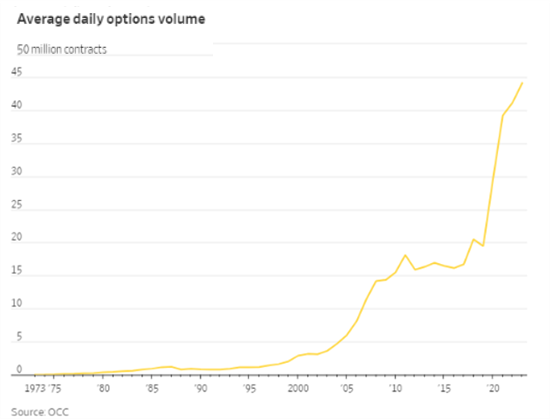
Simply put, the system isn't working for the younger generations and those who didn't have the means to buy assets a generation ago. This drives gambling (as the only available avenue to financial security) and populism (rejecting The Establishment in favor of Outsiders who propose throwing a monkeywrench into the well-oiled machine of those relishing their position atop the status quo).

This chart of option volume reflects the explosion of speculative betting in the stock market:


Following the conventional path is a deadend: borrow a fortune to get a bachelor's degree, sacrifice yourself to enrich your corporate/state masters, borrow an absolutely crushing sum to buy a house--there's a term for this path: debt servitude.

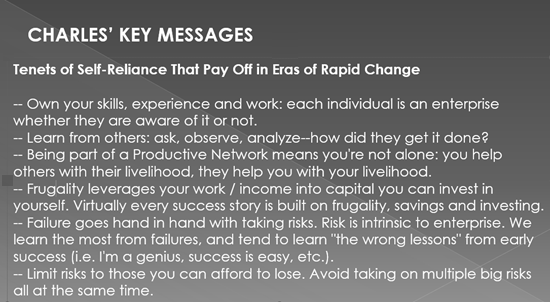
So what solutions are within reach? The unconventional ones that make up the de-risking toolbag of Self-Reliance. Gordon Long and I discuss these tools in our podcast Financial Nihilism, Inflation & The Collapsing American Dream.


Among the many solution-strategies we discuss, here are a few I highlighted:


It isn't easy to carve a path outside the well-worn pathways of debt servitude, but it is possible for those willing to grab a machete and hack their way to a life that works for them. This is why I wrote a general guide to de-risking and solutions that are within our own control, Self-Reliance in the 21st Century.


My recent books:

Disclosure: As an Amazon Associate I earn from qualifying purchases originated via links to Amazon products on this site.

Self-Reliance in the 21st Century print $18, (Kindle $8.95, audiobook $13.08 (96 pages, 2022) Read the first chapter for free (PDF)

The Asian Heroine Who Seduced Me (Novel) print $10.95, Kindle $6.95 Read an excerpt for free (PDF)

When You Can't Go On: Burnout, Reckoning and Renewal $18 print, $8.95 Kindle ebook; audiobook Read the first section for free (PDF)

Global Crisis, National Renewal: A (Revolutionary) Grand Strategy for the United States (Kindle $9.95, print $24, audiobook) Read Chapter One for free (PDF).

A Hacker's Teleology: Sharing the Wealth of Our Shrinking Planet (Kindle $8.95, print $20, audiobook $17.46) Read the first section for free (PDF).

Will You Be Richer or Poorer?: Profit, Power, and AI in a Traumatized World
(Kindle $5, print $10, audiobook) Read the first section for free (PDF).

The Adventures of the Consulting Philosopher: The Disappearance of Drake (Novel) $4.95 Kindle, $10.95 print); read the first chapters for free (PDF)

Money and Work Unchained $6.95 Kindle, $15 print)
Read the first section for free


Become a $3/month patron of my work via patreon.com.

Subscribe to my Substack for free


NOTE: Contributions/subscriptions are acknowledged in the order received. Your name and email remain confidential and will not be given to any other individual, company or agency.

Thank you, Anthony C. ($70), for your monumentally generous subscription to this site -- I am greatly honored by your support and readership.


Thank you, Thomas V. ($70), for your exceedingly generous subscription to this site -- I am greatly honored by your support and readership.


Thank you, Leszek C. ($7/month), for your magnificently generous subscription to this site -- I am greatly honored by your support and readership.


Thank you, Kurtzitzman ($70), for your superbly generous subscription to this site -- I am greatly honored by your support and readership.

Read more...

Friday, June 07, 2024

If AI Is So Great, Prove It: Eliminate All Surveillance, Spam and Robocalling

AI is for the peons, access to humans is reserved for the wealthy.

Judging by the near-infinite hype spewed about AI, its power is practically limitless: it's going to do all our work better and cheaper than we can do, replacing us at work, to name one example making the rounds. It's going to revolutionize everything from science to marketing, all the while reaping trillions of dollars in profits for those who own the AI tools, apps, etc.

All these extravagant claims make good clickbait, but let's set a higher standard: if AI is so great, then prove it by eliminating all the surveillance, spam and robocalling that's making daily life such a chore. If AI is so powerful and can do pretty much anything a human can do only faster, better, cheaper, then why doesn't someone assign it a simple task: make all surveillance, spam and robocalling go away and become a thing of the dreary, dreadful past.

I mean, come on, how hard would that be? Humans can spot spam and robocalling a mile away, so shouldn't AI be even better at completely eliminating these miseries from our already-digitally-overloaded lives? as for surveillance, how hard would it be to identify and block every tracker, data vacuum, etc. on all our connected devices?

How hard would it be for AI to identify the entities and humans profiting from ruining our lives with surveillance, spam and robocalling? Wouldn't a publicly updated list of those responsible, including names, business addresses, email accounts, etc. be transparency in action?

As I outlined in Is Anyone Else's Life as Stupidly Complicated by Digital "Shadow Work" as Mine Is? (May 22, 2024), we're squandering our lives dealing with completely needless, useless complexity imposed on us by monopolies, scammers (oh wait, isn't that a redundancy?), rapacious tech platforms, fraudsters and marketers.

If AI is so great, why doesn't it do all this stupidly burdensome "shadow work" for us? When yet another corporate monopoly's products and/or services fails miserably, then why can't AI get on the phone with a tech-support person halfway around the world and get it sorted?

We all know the reason why AI will only add to our misery and shadow work: there's no profit in making our lives easier unless we pay for the "privilege" of not being surveilled, spammed and robocalled to death. This is the price we're paying for allowing tech/corporate monopolies and cartels to dominate our economy, society, political order and daily lives: the only way AI will reduce our shadow work is if reducing our misery is more profitable than adding to it.

If we lived in a truly well-ordered economy / society, every individual participating in surveillance, spam and robocalling would be renditioned to Devil's Island where they could enjoy the company of all the other grifters and scammers who profited from our immiseration.

But alas, we live in an economy / society that has been optimized for parasitic predation and exploitation. And so AI will be deployed not to eliminate the obvious sources of our immiseration but to increase them, until our desperation reaches such an extreme that we're willing to sign up for a special deal, only $99.99 a month (for six months, then the price reverts to $399.99/month, plus applicable taxes), a service that comes with an AI app to fix everything that's broken and dysfunctional.

If you want to actually fix what's broken, well, that requires speaking with a human being, and that's going to cost you extra. AI is for the peons, access to humans is reserved for the wealthy.


new podcast: Financial Nihilism, Inflation & The Collapsing American Dream with Gordon Long (42 min).


My recent books:

Disclosure: As an Amazon Associate I earn from qualifying purchases originated via links to Amazon products on this site.

Self-Reliance in the 21st Century print $18, (Kindle $8.95, audiobook $13.08 (96 pages, 2022) Read the first chapter for free (PDF)

The Asian Heroine Who Seduced Me (Novel) print $10.95, Kindle $6.95 Read an excerpt for free (PDF)

When You Can't Go On: Burnout, Reckoning and Renewal $18 print, $8.95 Kindle ebook; audiobook Read the first section for free (PDF)

Global Crisis, National Renewal: A (Revolutionary) Grand Strategy for the United States (Kindle $9.95, print $24, audiobook) Read Chapter One for free (PDF).

A Hacker's Teleology: Sharing the Wealth of Our Shrinking Planet (Kindle $8.95, print $20, audiobook $17.46) Read the first section for free (PDF).

Will You Be Richer or Poorer?: Profit, Power, and AI in a Traumatized World
(Kindle $5, print $10, audiobook) Read the first section for free (PDF).

The Adventures of the Consulting Philosopher: The Disappearance of Drake (Novel) $4.95 Kindle, $10.95 print); read the first chapters for free (PDF)

Money and Work Unchained $6.95 Kindle, $15 print)
Read the first section for free


Become a $3/month patron of my work via patreon.com.

Subscribe to my Substack for free


NOTE: Contributions/subscriptions are acknowledged in the order received. Your name and email remain confidential and will not be given to any other individual, company or agency.

Thank you, Uriel C. ($70), for your monumentally generous subscription to this site -- I am greatly honored by your support and readership.


Thank you, Austin B. ($70), for your exceedingly generous subscription to this site -- I am greatly honored by your support and readership.


Thank you, Lee W. ($70), for your magnificently generous subscription to this site -- I am greatly honored by your support and readership.


Thank you, James B. ($70), for your superbly generous contribution to this site -- I am greatly honored by your support and readership.

Read more...

Wednesday, June 05, 2024

Our Crisis of Competence

If this is what passes for competence while we cheerlead "the Roaring 20s", then our delusion has reached "what looks like a permanently high plateau."

That America is mired in a crisis of competence appears to be yet another issue that can't be addressed directly as it might upset the narrative control that all is well and everything is getting better in every way, every day.

And so we sugarcoat the incompetence, the endless delays, the sclerosis and the decline in quality and functionality as if these are all signs of rude, vibrant health rather than signs of systemic decline and decay.

Relatively straightforward infrastructure projects now face years or even a decade of delays / zero real-world progress. I can name several projects in my county where the environmental impact studies and various governmental reports have consumed six years, during which the harbor remains closed, the roads are unpaved gravel, the park is closed and the bridge is awaiting repairs.

When the public rightly complains of years of inaction and foot-dragging, local officials throw up their hands in frustration as all the necessary approvals and funding must wind their way through the impenetrable thickets of state and federal agencies, a leisurely process over which they have no control.

As for the private sector, I've often detailed the immense, systemic decline in the quality of everything from the ingredients in packaged food to "stainless steel", as well as the equally immense burden of unpaid "shadow work" demanded of us all just to manage the complexity thickets generated by "progress."

Stainless Steal (February 26, 2023)

The "Crapification" of the U.S. Economy Is Now Complete (February 9, 2022)

Digital Service Dumpster Fires and Shadow Work (February 14, 2024)

Is Anyone Else's Life as Stupidly Complicated by Digital "Shadow Work" as Mine Is? (May 22, 2024)

If AI Is So Great, Why Is Managing the Digital Realm Eating Us Alive? (March 1, 2024)

No wonder Cory Doctorow's descriptive ens**ttification is the "word of the year." More accurately, it's the word of the decade or the entire era.

Can we dredge up the wherewithal to be honest for a change, and admit that "can do" has decayed to "can't do", as everyone expresses their powerlessness to move anything along with any awareness that time and money are limited? We've reached a state of sclerosis in which near-zero actual progress is deemed not just acceptable but "the best we can do" for a variety of reasons.

One reason is the supremacy of process over results. The system incentivizes and rewards following process, no matter how senseless, inefficient or wasteful that process has become. Those who have mastered narrative control (i.e. "look how wonderfully we're following procedures") and avoidance of accountability for actual results are advanced, and those who chafe at the rank insensibility of over-regulation and processes that prioritize stakeholders' input to the point that nothing gets done are sent to bureaucratic Siberia or quit in disgust.

In this way, the system self-reinforces its most crippling weaknesses. One example is addressed in this article: Departing House Members Ask: 'Why Am I Here?' A wave of retirees from both parties, including committee chairs and rising stars, say that serving in Congress is no longer worth the frustration.

A great many things are longer worth the frustration, and an even greater number of things are no longer worth the price being demanded. Once upon a time, before globalization (a.k.a. arbitraging lower labor costs and lower quality to increase profits) and financialization (a.k.a. the rich get richer by doing nothing) rose to domination, every product cycle delivered improved durability and utility. Now every product cycle delivers reduced durability and less utility, though this is obscured by a flood of "features" that degrade our experience.

Competence has been reduced to 1) increasing profits this quarter; 2) narrative control / social media visibility and 3) following process. If this is what passes for competence while we cheerlead "the Roaring 20s", then our delusion has reached what looks like a permanently high plateau.


new podcast: Financial Nihilism, Inflation & The Collapsing American Dream with Gordon Long (42 min).


My recent books:

Disclosure: As an Amazon Associate I earn from qualifying purchases originated via links to Amazon products on this site.

Self-Reliance in the 21st Century print $18, (Kindle $8.95, audiobook $13.08 (96 pages, 2022) Read the first chapter for free (PDF)

The Asian Heroine Who Seduced Me (Novel) print $10.95, Kindle $6.95 Read an excerpt for free (PDF)

When You Can't Go On: Burnout, Reckoning and Renewal $18 print, $8.95 Kindle ebook; audiobook Read the first section for free (PDF)

Global Crisis, National Renewal: A (Revolutionary) Grand Strategy for the United States (Kindle $9.95, print $24, audiobook) Read Chapter One for free (PDF).

A Hacker's Teleology: Sharing the Wealth of Our Shrinking Planet (Kindle $8.95, print $20, audiobook $17.46) Read the first section for free (PDF).

Will You Be Richer or Poorer?: Profit, Power, and AI in a Traumatized World
(Kindle $5, print $10, audiobook) Read the first section for free (PDF).

The Adventures of the Consulting Philosopher: The Disappearance of Drake (Novel) $4.95 Kindle, $10.95 print); read the first chapters for free (PDF)

Money and Work Unchained $6.95 Kindle, $15 print)
Read the first section for free


Become a $3/month patron of my work via patreon.com.

Subscribe to my Substack for free


NOTE: Contributions/subscriptions are acknowledged in the order received. Your name and email remain confidential and will not be given to any other individual, company or agency.

Thank you, George D. ($70), for your monumentally generous subscription to this site -- I am greatly honored by your support and readership.


Thank you, Mark E. ($7/month), for your exceedingly generous subscription to this site -- I am greatly honored by your support and readership.


Thank you, Daniel S. ($70), for your magnificently generous subscription to this site -- I am greatly honored by your support and readership.


Thank you, Charles ($7/month), for your superbly generous contribution to this site -- I am greatly honored by your support and readership.

Read more...

Sunday, June 02, 2024

Having Too Much Money Leads to Catastrophe

The best thing that could happen to America would be the destruction of its credit card and a deep, prolonged recession that emptied the punch bowl of phantom bubble wealth and the illusion of endless credit.

Money being scarce saves us from many pernicious forms of mischief, and having too much money/credit leads to catastrophe. This is of course the exact opposite of the conventional belief that having lots of money makes life not just easier but expansive and, well, as perfect as human life can be.

On the scale of nation-states, having too much money/credit leads to the catastrophe of wars of choice, as having a couple million silver ducats to play with opens the door to Imperial temptations, for example, assembling a great fleet of warships and sending this Armada to conquer troublesome England.

I just finished reading what is likely the definitive account of the Spanish Armada: Armada: The Spanish Enterprise and England's Deliverance in 1588.

Digging deep into the extensive archives of the era, the authors' translations of Philip II's voluminous correspondence makes it abundantly clear that the galleons of silver arriving annually from Spain's colonies in the Americas gave the Empire and its leadership the means to conduct ongoing wars in the Netherlands and Italy, conquer Portugal and its island possessions, defend the Empire's far-flung holdings in the Caribbean and the Philippines, as well as entertain a variety of other costly Imperial schemes, from a proposed invasion of a chunk of China (Philip II wisely passed on this request) to establishing a fort to defend the freezing, windswept Straits of Magellan from interlopers seeking to plunder Spanish holdings in the Pacific. (This project rather predictably ended in disaster and was abandoned after squandering treasure and lives.)

Sending an invasion fleet to conquer England was a two-fer for Philip: a Holy War to return Protestant England to the Catholic faith, and a means to root out the piracy of Sir Francis Drake and other English privateers at the source.

Without the millions of silver ducats jingling in his pockets, Philip would not have been able to pursue yet another costly military adventure. Updating the dynamic of too much money/credit leads to catastrophe, had the U.S. lacked the ability to borrow a couple of trillion dollars to fund wars of choice in Iraq and Afghanistan, those wars would have remained pipe-dreams of the neoconservatives bent on a secular version of a "holy war" to impose "our way of life" on other nations (never mind nobody else could afford such extravagance).

In the private sector, we might glance at Facebook/Meta's disastrous squandering of billions of dollars on a quixotic race to scoop up the mythical treasures of virtual reality, a quest that would have bankrupted a company with a smaller pile of ducats awaiting the misadventures of the leadership.

All of which leads us to the present, and America's catastrophic splurging with the nation's credit card, a card with no upper limit, or so it seems, until it's too late and the interest payments ruin the party.

Scarcity of resources, time and cash force innovation, experimentation, discipline, accountability, deferred gratification and resourcefulness because these are the only affordable problem-solving tools available.

In contrast, an abundance of ducats and credit encourages the sins of procrastination / avoidance of hard choices, narrative control as a substitute for actual problem-solving, loss of accountability, delusions of grandeur, the destruction of discipline and the normalization of corruption.

Having too much money / credit also gives free rein to all the classic sins: excessive pride, unbridled greed, wrath (take out the frustrations of failure on weaker parties), envy / class warfare, lust for power, gluttony in all things and sloth / incompetence / waste.

The best thing that could happen to America would be the destruction of its credit card and a deep, prolonged recession that emptied the punch bowl of phantom bubble wealth and the illusion of endless credit. Once the ducats and credit disappeared, then we'd finally be forced to start actually solving problems rather than papering them over by borrowing and squandering additional trillions.

Once seated at the banquet of consequences, we'd be forced to surrender the delusion that narrative control accomplishes anything other than putting off the inevitable reckoning.


new podcast: CHS on Gold and What Currency Systems Make Sense (31:37 min).


My recent books:

Disclosure: As an Amazon Associate I earn from qualifying purchases originated via links to Amazon products on this site.

Self-Reliance in the 21st Century print $18, (Kindle $8.95, audiobook $13.08 (96 pages, 2022) Read the first chapter for free (PDF)

The Asian Heroine Who Seduced Me (Novel) print $10.95, Kindle $6.95 Read an excerpt for free (PDF)

When You Can't Go On: Burnout, Reckoning and Renewal $18 print, $8.95 Kindle ebook; audiobook Read the first section for free (PDF)

Global Crisis, National Renewal: A (Revolutionary) Grand Strategy for the United States (Kindle $9.95, print $24, audiobook) Read Chapter One for free (PDF).

A Hacker's Teleology: Sharing the Wealth of Our Shrinking Planet (Kindle $8.95, print $20, audiobook $17.46) Read the first section for free (PDF).

Will You Be Richer or Poorer?: Profit, Power, and AI in a Traumatized World
(Kindle $5, print $10, audiobook) Read the first section for free (PDF).

The Adventures of the Consulting Philosopher: The Disappearance of Drake (Novel) $4.95 Kindle, $10.95 print); read the first chapters for free (PDF)

Money and Work Unchained $6.95 Kindle, $15 print)
Read the first section for free


Become a $3/month patron of my work via patreon.com.

Subscribe to my Substack for free


NOTE: Contributions/subscriptions are acknowledged in the order received. Your name and email remain confidential and will not be given to any other individual, company or agency.

Thank you, Ken B. ($70), for your monumentally generous subscription to this site -- I am greatly honored by your steadfast support and readership.


Thank you, Duane S. ($25), for your exceedingly generous subscription to this site -- I am greatly honored by your steadfast support and readership.


Thank you, Richard S. ($70), for your magnificently generous subscription to this site -- I am greatly honored by your steadfast support and readership.


Thank you, Stephen S. ($25), for your superbly generous contribution to this site -- I am greatly honored by your support and readership.

Read more...

Terms of Service

All content on this blog is provided by Trewe LLC for informational purposes only. The owner of this blog makes no representations as to the accuracy or completeness of any information on this site or found by following any link on this site. The owner will not be liable for any errors or omissions in this information nor for the availability of this information. The owner will not be liable for any losses, injuries, or damages from the display or use of this information. These terms and conditions of use are subject to change at anytime and without notice.

RE: European Union AI Act, and Our Use of Generative AI Tools and Agents Policy

All text on this site is composed by Charles Hugh Smith or by a credited guest-author. No Generative AI Tools are used in the composition / writing of any text or graphic content created by Charles Hugh Smith. This site deploys no AI agents or generative AI tools. This site is not responsible for the disclosures, use or non-use of AI agents or generative AI tools in advertisements displayed by Investing Channel or other ad placement services.

Audio files generated by text-to-audio transcription tools are identified as such.

Our Privacy Policy:

Correspondents' email is strictly confidential. This site does not collect digital data from visitors or distribute cookies. Advertisements served by third-party advertising networks such as Investing Channel may use cookies or collect information from visitors for the purpose of Interest-Based Advertising; if you wish to opt out of Interest-Based Advertising, please go to Opt out of interest-based advertising (The Network Advertising Initiative) If you have other privacy concerns relating to advertisements, please contact advertisers directly.

PRIVACY NOTICE FOR EEA INDIVIDUALS

This section covers disclosures on the General Data Protection Regulation (GDPR) for users residing within EEA only. GDPR replaces the existing Directive 95/46/ec, and aims at harmonizing data protection laws in the EU that are fit for purpose in the digital age. The primary objective of the GDPR is to give citizens back control of their personal data. Please follow the link below to access InvestingChannel's General Data Protection Notice.
https://stg.media.investingchannel.com/gdpr-notice/

Notice of Compliance with The California Consumer Protection Act

This site does not collect digital data from visitors or distribute cookies. Advertisements served by a third-party advertising network (Investing Channel) may use cookies or collect information from visitors for the purpose of Interest-Based Advertising. If you do not want any personal information that may be collected by third-party advertising to be sold, please follow the instructions on this page: Do Not Sell My Personal Information.

Regarding Cookies:

This site does not collect digital data from visitors or distribute cookies. Advertisements served by third-party advertising networks such as Investing Channel may use cookies or collect information from visitors for the purpose of Interest-Based Advertising; if you wish to opt out of Interest-Based Advertising, please go to Opt out of interest-based advertising (The Network Advertising Initiative) If you have other privacy concerns relating to advertisements, please contact advertisers directly.

Our Commission Policy:

Though I earn a small commission on Amazon.com books and gift certificates and gold (BullionVault) purchased via links on my site, I receive no fees or compensation for any other non-advertising links or content posted on my site.

Copyright Notice:

All original images (Drawings and Photographs), text (essays, books and works of fiction), audio and video recordings, musical compositions, graphic design, graphic design elements and HTML coding on this site are the copyrighted work of Charles Hugh Smith unless otherwise credited or noted. They are published as information for the private use of site visitors, and any reproduction or redistribution of this content or coding in any media in any format or distribution channel (text, audio, video/film, web) without the written permission of the copyright holder is strictly prohibited. All rights in all media reserved globally.

  © Blogger templates Newspaper III by Ourblogtemplates.com 2008

Back to TOP