


Sunday, April 28, 2019

There Are Two Little Problems with "Taxing the Rich" to Pay for "Free Everything"

No super-wealthy individual or household is going to pay billions in additional taxes when $10 to $20 million will purchase political adjustments.
The 2020 election cycle has begun, and a popular campaign promise is "free everything" paid for by new taxes on the super-wealthy. Who doesn't like free stuff? Who will vote for whomever offers them free stuff? No wonder it's a popular campaign promise.
As even the most self-absorbed American voter has a latent street-savvy awareness that nothing is truly free, the other popular campaign promise is to "tax the rich" to pay for the proposed "free" programs. Proposals to "Tax the rich" feed off the growing awareness that the financial wealth created since 2000 has largely flowed to the very top of the wealth-power pyramid, and so it's payback time: tax those who have pocketed the lion's share of income and wealth gains.
Fair enough, right? Even the super-rich publicly affirm that the super-wealthy should pay at least the same percentage of federal tax as their employees.
Public pronouncements are of course good PR, but the real issue is what will the super-wealthy do behind closed doors to protect their wealth from additional taxation. There are two issues here: one is that the wealthy already pay most of the federal income taxes, and the second is the compelling cost-benefit of funding political adjustments to the new taxes.
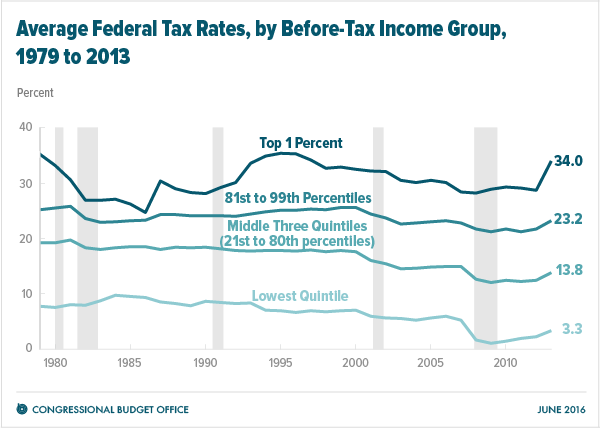
If one has a taste for facts, it turns out the U.S. federal tax system is highly progressive: the top 1% pay the highest tax rates (see CBO chart below) and about 37% of all federal income tax. The top 5% pay almost 60% of all federal income taxes. (Note Social Security payroll taxes are not income taxes; most wage earners pay more payroll taxes than they do income taxes.)
A good source for this sort of data is the Congressional Budget Office reports (scroll down to Distribution of Household Income and Federal Taxes).
The CBO data is noteworthy for including all income, not just wages: capital gains, business income and government transfers (Social Security, social welfare programs, etc.)
The new idea in current "tax the rich" proposals is to increase taxes on the super-wealthy: mega-millionaires and billionaires. Given the outsized gains secured by these mega-wealthy folks, it makes sense to nail them for the tax revenues needed to pay for more free stuff.
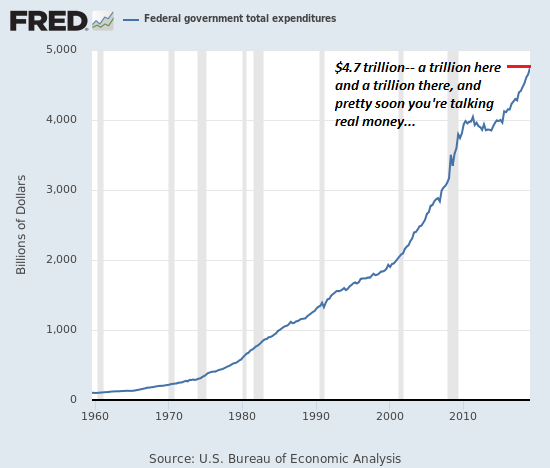
At this point let's reacquaint ourselves with the enormous size of federal expenditures: roughly $4.75 trillion annually out of a GDP of about $20 trillion. State and local governments spend another $3.25 trillion, for total government expenditures of about $8 trillion.
Total personal income is around $10 trillion a year, with the top 1% (about 1.4 million people) getting about $2 trillion of this personal income. Out of this, they pay $538 billion in federal income tax. (Source: Summary of the Latest Federal Income Tax Data, 2018 Update)
According to this excellent overview of the top 1%, Never mind the 1 percent: Let's talk about the 0.01 percent, the super-wealthy (top .01%) earn about 5% of all income, or about $500 billion.
So say some new tax law was actually able to capture 50% (half) of all this income: that would total $250 billion, a nice chunk of change but hardly enough to fund a trillion or two in additional "free" programs.
Since this income is already being taxed at a 34% rate according to the non-partisan CBO, jacking the rate from 34% to 50% is only 16% more, or an additional $80 billion in tax revenues. Look at the chart of current federal expenditures ($4.75 trillion) and then reckon the impact of an additional $80 billion. It's a drop in the bucket, Baby.
Jacking the top tax rate to 70% on the super-wealthy would only raise a total of $180 billion, a nice boost but hardly enough to fund trillion dollar increases in federal spending.
This brings us to the second reality: it's much cheaper to buy political adjustments to the new taxes via lobbying and campaign contributions than paying the extra $180 billion. A mere $10 million will buy a great deal of political adjustments, and $100 million will get pretty much whatever you need in the way of political adjustments.
The list of special dispensations and obscure tax code loopholes is endless: the wealth can be protected in a philanthro-capitalist family trust, or an overseas holding company, or taxed at a much lower rate for creating jobs in America (or equivalent political cover)-- the ways to escape a 70% tax rate via political adjustments is truly infinite.
No super-wealthy individual or household is going to pay billions in additional taxes when a fraction of that will purchase political adjustments. From the point of view of the super-wealthy, 2/3 of whom are self-made via building businesses, they already pay enough taxes, and they have the wherewithal to get politicos to agree with them.
Here are the two little problems with "taxing the rich" to pay for trillions of dollars in new freebies:
1. Taxing the super-rich won't really move the needle much when the federal government spends $4.7 trillion annually.
2. Trying to double the taxes they pay from 35% to 70% will only push them to increase their their spending on political adjustments that cost a fraction of the proposed taxes they will pay if they do nothing.
Tax Rates (CBO):
Federal Expenditures (current fiscal year):
My book Money and Work Unchained is now $6.95 for the Kindle ebook and $15 for the print edition. Read the first section for free in PDF format.


If you found value in this content, please join me in seeking solutions by becoming a $1/month patron of my work via patreon.com. New benefit for subscribers/patrons: a monthly Q&A where I respond to your questions/topics.

NOTE: Contributions/subscriptions are acknowledged in the order received. Your name and email remain confidential and will not be given to any other individual, company or agency.
 
Thank you, Michael S. ($5/month), for your magnificently generous pledge to this site-- I am greatly honored by your support and readership.

Read more...

Friday, April 26, 2019

This Is the End of the Cycle

Both new households and new businesses are in secular decline. Goosing the stock market and GDP doesn't change this reality.
Everyone wants every cycle of expansion to last forever, but alas every cycle ends. The growth cycle that began in 2009 is finally coming to an end. The signs are everywhere, notwithstanding the torrid 3.2% GDP growth for the first quarter of 2019 (which as others have noted, is less than meets the eye.)
Gross Domestic Product (GDP) is the standard measure of expansion, but it is an imperfect metric. GDP can still notch gains while the majority of the economy is stagnating and assets are losing value.
Better guides to expansion than GDP are sales volumes, prices, profits, wage increases and sustained rises in new enterprises and households. All of these measures of expansion are stagnant, indicating that monetary and fiscal stimulus are no longer moving the needle.
Corporate profits are higher as a result of accounting gimmicks, not soaring sales or expanding gross profit margins. Stocks are being pushed higher by the old trick of lowering earnings estimates so that corporations can "beat by penny."
In many once-hot real estate markets, sales are slowing while prices continued edging higher but at much slower rates than in the past. This is classic late-cycle activity: sales are declining as the pool of buyers has been drained while price increases have become marginal.
Global sales of pricey mobile phones and vehicles have slowed, indicating the exhaustion of the cycle is global. Again, this is classic late-cycle activity: trends that powered the narrative of "strong growth everywhere" are fading, despite attempts to hype some blip as a sign that strong growth is about to start up again.
New households and enterprises drive expansion. New households buy homes, furniture, home improvements, appliances and so on, while new businesses buy equipment, hire workers and sign on professional services such as accounting, insurance, etc.
Both new households and new businesses are in secular decline. Goosing the stock market and GDP doesn't change this reality.
Prices are reaching unaffordable levels across the board: homes and rents in big cities are unaffordable, fine dining is unaffordable, property taxes are unaffordable, construction is unaffordable, autos and trucks are mostly unaffordable, fast food is increasingly unaffordable, college tuition is beyond-unaffordable, healthcare and healthcare insurance are insanely unaffordable-- the list includes the vast majority of the costs of living. (Cheap TVs are getting a bit cheaper. Yea for low inflation!)
Rising prices are also classic late-cycle signs. To make a buck, everyone has to raise prices and cut what they can, and rising prices impacts sales.
As for the stock market: a blow-off top based on the misplaced confidence that strong growth is starting up again is also classic late-cycle action. The first doubts triggered the decline from October to December, and the sharp rebound this year once the Federal Reserve signaled "we'll do whatever it takes" is very typical of the late-cycle topping process: price sags as doubts emerge about the aging expansion, then notches a nominal new high to assuage everyone that the long-in-tooth Bull is starting another multi-year expansion.
Those being paid to hype "the Bull market and the expansion will never end" narrative are experts at turning late-cycle blips into evidence that the cycle has plenty of room to run, but the more prudent observers are looking at the preponderance of evidence.


Pathfinding our Destiny: Preventing the Final Fall of Our Democratic Republic ($6.95 ebook, $12 print, $13.08 audiobook): Read the first section for free in PDF format.


My new mystery The Adventures of the Consulting Philosopher: The Disappearance of Drake is a ridiculously affordable $1.29 (Kindle) or $8.95 (print); read the first chapters for free (PDF)
My book Money and Work Unchained is now $6.95 for the Kindle ebook and $15 for the print edition. Read the first section for free in PDF format.


If you found value in this content, please join me in seeking solutions by becoming a $1/month patron of my work via patreon.com. New benefit for subscribers/patrons: a monthly Q&A where I respond to your questions/topics.

NOTE: Contributions/subscriptions are acknowledged in the order received. Your name and email remain confidential and will not be given to any other individual, company or agency.
 
Thank you, Matt L. ($5/month), for your marvelously generous pledge to this site-- I am greatly honored by your support and readership.
 

Read more...

Thursday, April 25, 2019

Push Them Hard Enough and the Productive Class Will Opt Out of Servitude

People love their big paychecks, but they also value their sanity.
One of the most astonishing manifestations of disconnected-from-reality hubris is public authorities' sublime confidence that employers and entrepreneurs will continue starting and operating enterprises no matter how difficult and costly it becomes to keep the doors open, much less net a profit.
The average employee / state dependent reckons that the small business owner / entrepreneur is killing it financially, banking a small fortune in pure profit every month, and that they're doing what they love so they'll continue doing it no matter what. In other words, they're all wealthy Tax Donkeys who can easily afford higher taxes and fees and will tolerate paying more to keep doing what they love.
Wrong on both counts--dead wrong. A far more typical response is the one a house painter emailed me last year: every day, he reported, he wanted to dump his spray rig and power washer in a dumpster and leave the U.S.
The number of small businesses and entrepreneurs hanging on by a thread financially and emotionally is legion. Rather than killing it, they're getting killed by rising rents, wages, labor overhead, taxes, fees, licensing, inspection fees, insurance and so on.
The long hours, financial risks and open-ended responsibilities are ideal conditions for burn-out and bankruptcy.
My partner and I had a ready response when employees hinted that we must be raking in big bucks: here's the keys to the front door, payday is on Friday.That shut them up in short order because they could see we meant it: it's all yours, including meeting payroll in a bad month out of your own pocket.
The craze for early retirement among highly paid workers is a manifestation of burnout: young workers see the destructive toll of stress and overwork on their older peers and vow to scrimp and save to avoid that fate. Young workers who burn out end up back at home or in low-key, low-pay jobs that don't demand their life and their soul in trade for a big salary.
Older workers in senior positions are retiring the second they qualify--or earlier. Their professions are simply no longer fun or rewarding.
The general public and government officials are clueless about the ever-increasing burdens being heaped on small-business employers and entrepreneurs. It's not just financial burdens--it's the stress of being fined for minor violations of complex regulations few small business owners can track, and the constantly increasing regulatory compliance paperwork.
Again, the general assumption is the employer and entrepreneur have no choice but to continue soldiering on, even as the burdens of operating a business are crushing. This assumption aligns with the convenient belief that small business Tax Donkeys can pay more and should pay more, and they should be delighted to earn the privilege of operating in our progressive city/county/state.
The number of small businesses that will shut down in the coming recession will astound governments counting on higher revenues from the Tax Donkeys.The number of highly productive and highly paid workers who quit or retire early will be equally astounding to Corporate America, which blissfully assumes the Productive Class will take every increase in workload and responsibility that's shoved on them because they love the big paychecks so much.
People love their big paychecks, but they also value their sanity; and after years or decades of corporate servitude, an unexpectedly large number will regain their long-lost agency, which they will express by quitting and bailing on their high-cost lifestyle.
When the Productive Class has been pushed hard enough, they will opt out, and the corporations and governments that have counted on their servitude will find that all of their systems no longer function well, if at all, once their most productive peons toss their servitude in the nearest dumpster and opt for a much lower cost and lower-key life.
My book Money and Work Unchained is now $6.95 for the Kindle ebook and $15 for the print edition. Read the first section for free in PDF format.


If you found value in this content, please join me in seeking solutions by becoming a $1/month patron of my work via patreon.com. New benefit for subscribers/patrons: a monthly Q&A where I respond to your questions/topics.

NOTE: Contributions/subscriptions are acknowledged in the order received. Your name and email remain confidential and will not be given to any other individual, company or agency.
 
Thank you, Matt L. ($5/month), for your marvelously generous pledge to this site-- I am greatly honored by your support and readership.

Read more...

Wednesday, April 24, 2019

The Feedback Loop of Doom: When Mobile Creatives and Capital Abandon Unaffordable, Dysfunctional Cities

When the 4% who generate the jobs and tax revenues have had enough and leave, the effects quickly impact the 64%.
At the end of any trend, everyone's a true believer: this trend is so enduring, so broad-based, so based on unchanging fundamentals that it will never ever reverse.
One such trend is the white-hot growth of housing, employment, tax revenues, etc. in major urban magnets for global capital and talent: you know the usual suspects: Dallas, Atlanta, Seattle, Portland OR, Denver, Los Angeles, the San Francisco Bay Area, New York City and so on.
What these urban regions offer are strong job markets, a very desirable dynamic.
For example, over 400,000 jobs have been added to the San Francisco Bay Area in the past few years, basically an entire new city of workers. Very few states have added 400,000 jobs in the past few years, and fewer still have added so many high-wage jobs.
The synergies created by global capital, research universities, a flood of fresh talent and the entrepreneurial drive to conjure up the next IPO Unicorn have been beaten to a pulp. What hasn't been glorified is the net result of these synergies:
1. Infrastructure that wasn't designed to handle an extra million residents, and that can only be expanded at tremendous cost and in timelines of a decade or two.
2. Soaring wealth and income inequality as these urban economies become increasingly "winner take most" and housing has skyrocketed out of reach for all but the top 10%.
3. A zeitgeist of self-congratulatory hubris in which locals are confident "we're so special" that talent and capital will continue to pour in regardless of how fast the quality of life is dropping.
What few seem to realize is much of the talent and capital are mobile and don't actually have to put up with the declining quality of life in unaffordable, dysfunctional cities: the people and the capital can go elsewhere.
I call this class Mobile Creatives, and they are not just another set of workers.I described this class back in 2014, and it has expanded under the mainstream radar over the past five years.
the New Class: Mobile Creatives (May 1, 2014) The Mobile Creative credo: trust the network, not the corporation or the state.
America's Nine Classes: The New Class Hierarchy (April 29, 2014)
Though the Mobile Creative class wields little conventional financial or political power, it has a potentially large leadership role in social and technical innovations. This is the 4% Pareto Distribution that can exert outsized influence on the 64%.
The other eight classes are hidebound by conventions, neofeudal and neocolonial arrangements and a variety of false choices and illusions of choice, including democracy itself.
If capital is treated poorly, it famously goes elsewhere. The same is true of Mobile Creatives. Here's an example that will be familiar to most urban dwellers in these high-growth urban regions: the hot new chef and his/her investors who want to open the hot new bistro in town.
Unbeknownst to the mass of employee-residents, they quickly run into a buzzsaw of regulatory delays and costs. Permits take months, then more months. No apologies are extended: we are doing you a favor to even accept your pathetic little permit application in our fantastic city.
Meanwhile, lease payments muct be made monthly because landlords reckon they can charge an arm and a leg due to the demand for space in "good" locations.
Due to all the regulations and sky-high labor costs, renovation expenses quickly soar into the hundreds of thousands. The new homeless encampment on the sidewalk right outside isn't helping, either.
Pencil in the new minimum wages, the mandatory labor overhead and minimum staffing, new surcharges, and woah, the charge per plate is pushing $40 just to keep the doors open--and this was supposed to be an affordable, casual dining place.
Then there's the hundreds of competing eateries already fighting to survive. A few give up the ghost every month but fools rush in and new entrants continue to gamble they can somehow succeed where more experienced restaurateurs have failed.
When capital and Creatives who can go elsewhere decide the odds of success are simply too low, they bail out and move on. These are the people who generate the jobs, the tax revenues and the "buzz" that draws customers and PR.
The average employee in unaffordable, dysfunctional cities is an immobilized tax donkey: they can't move because they have their job, their mortgage, their kid is in school, and so on. The cities and counties can jack up fees, taxes and surcharges and count on the vast majority of employee-residents staying put and paying the higher taxes.
Even as billions of dollars in new bonds and taxes are poured into problems such as public education, traffic congestion, crumbling infrastructure and homelessness, nothing actually get better. Local politicos can count on the Tax Donkeys to resign themselves to a fast-declining quality of life and pony up the ever higher taxes and fees.
But the average employee-residents aren't starting enterprises, creating jobs or putting capital to work. They are consumers of services, public and private, but they are not in a position to move elsewhere or influence the flow of capital and tax revenues.
So what happens when capital and Creatives start abandoning unaffordable, dysfunctional cities? They start a feedback loop of doom. When the latest trendy cafe closes, the space stays empty. The place next door closes and lays off its employees, who discover jobs are now scarce. Big construction projects are put on hold and then cancelled. Tech incubators that were crowded are now empty.
When the 4% who generate the jobs and tax revenues have had enough and leave, the effects quickly impact the 64%. Political leaders who felt invincible suddenly awaken to declining tax revenues, and as they quickly raise taxes to cover the shortfall, they trigger a larger exodus of Creatives and capital who were hovering on the edge of whether to stick it out or leave.
The increasing taxes and dysfunction make the decision easy: they sell out and leave, and other Creatives take note: better to exit now while there's still a bid for the house, office lease, etc. The trickle becomes a flood, and as the demands for government spending only click higher, tax revenues are in freefall. Welcome to the feedback loop of doom.
My book Money and Work Unchained is now $6.95 for the Kindle ebook and $15 for the print edition. Read the first section for free in PDF format.


If you found value in this content, please join me in seeking solutions by becoming a $1/month patron of my work via patreon.com. New benefit for subscribers/patrons: a monthly Q&A where I respond to your questions/topics.

NOTE: Contributions/subscriptions are acknowledged in the order received. Your name and email remain confidential and will not be given to any other individual, company or agency.
 
Thank you, Matt L. ($5/month), for your marvelously generous pledge to this site-- I am greatly honored by your support and readership.
 

Read more...

Tuesday, April 23, 2019

If "Getting Ahead" Depends on Asset Bubbles, It's Not "Getting Ahead," It's Gambling

Given that the economy is now totally and completely dependent on inflating asset bubbles, it makes no sense to invest for the long-term.
Beneath the endlessly hyped expansion in gross domestic product (GDP) of the past two decades, the economy has changed dramatically. The American Dream boils down to social and economic mobility, a.k.a. getting ahead through hard work, merit and wise investments in oneself and one's family.
The opportunities for this mobility in the post World War 2 era broadened as civil rights and equal rights expanded. The 1970s saw a disruption of working-class mobility as high-paying factory jobs disappeared, leaving services jobs that paid less or required more training, i.e. a college degree.
The U.S. economy took off in the 1980s for a number of reasons, including computer technologies, federal stimulus (deficit spending) and financialization (a topic I've covered many times). With millions more college graduates entering the workforce and the Internet creating entire new industries, the opportunities to "get ahead" increased across the social and economic spectrum.
But something changed in the aftermath of the dot-com bubble bursting. The fruits of financialization--highly leveraged debt gambled for short-term gains in markets--were extended to everyone with a job (or a willingness to lie) via liar loans, no-document loans and subprime mortgages.
Just like bigshot financiers on Wall Street, J.Q. Citizen could leverage a couple thousand dollars in cash (or even better, borrow the closing costs via a 105% of value mortgage and put nothing down) and buy a McMansion worth $250,000 or even $500,000.
The only difference between bigshot financiers and J.Q. Citizen was the scale of the leverage and gamble: J.Q. Citizen could leverage a few grand into hundreds of thousands, while the financier could leverage a bit of collateral into mega-millions.
The goal wasn't homeownership, the purported "official" goal of subprime mortgages: it was short-term speculative gains via "flipping" the house in a few months. Just like the bigshot financiers, the subprime mortgage market enabled marginal borrowers to take control of assets far in excess of their actual capital and sell them to a greater fool for a quick profit far in excess of their earnings.
Wall Street loved this distribution of financialization to the masses because Wall Street made a fortune packaging (securitizing) this toxic debt and selling it to unwary, credulous investors as "low risk" (heh) assets.
After the mortgage-securitization-fraud-housing bubble popped, a secular trend-- wages for the bottom 95% of wage earners stagnating--accelerated. "Getting ahead" via earning a college diploma, working hard and counting on merit no longer worked; families with privileges and capital got wealthier, and everyone else found the purchasing power of their earnings declined even as stocks and housing soared.
The only way to "get ahead" in a globalized, financialized economy is either 1) earn at least $200,000 a year from one's labor or 2) gamble in the inflating bubbles of stocks and housing. In high-cost regions, even $200,000 isn't enough to get ahead (i.e. buy a crumbling bungalow on a tiny lot for $800,000) if the wage-earner has student loans and/or children; the household needs two earners making top-5% salaries.
The more money the central banks throw at stock-housing asset bubbles, the higher they loft, a process that has pushed housing in high-cost regions out of reach of all those with average jobs and incomes. So much for "getting ahead."
The economy has changed dramatically for the worse: getting a graduate degree no longer guarantees getting ahead (millions of other workers globally have the same credentials); working hard is equally iffy, and traditional investments in one's family either no longer yields gains (higher education) or they are gambles in the guise of "investments" (housing).
Given that the economy is now totally and completely dependent on inflating asset bubbles, it makes no sense to invest for the long-term: a short-term gambling mentality is required to avoid getting destroyed when the bubble-du-jour pops.
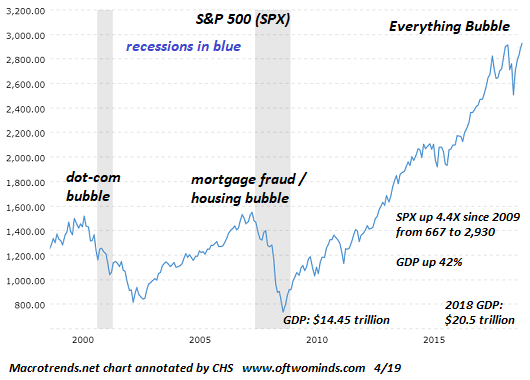
Everyone who believes bubbles never pop, they only expand forever and ever, has never looked at a chart of the S&P 500 (SPX), which illustrates that bubbles always pop, destroying the capital of all who neglected to sell at the top.
If "getting ahead" depends on playing asset bubbles, it's not getting ahead, it's gambling.


Pathfinding our Destiny: Preventing the Final Fall of Our Democratic Republic ($6.95 ebook, $12 print, $13.08 audiobook): Read the first section for free in PDF format.


My new mystery The Adventures of the Consulting Philosopher: The Disappearance of Drake is a ridiculously affordable $1.29 (Kindle) or $8.95 (print); read the first chapters for free (PDF)
My book Money and Work Unchained is now $6.95 for the Kindle ebook and $15 for the print edition. Read the first section for free in PDF format.


If you found value in this content, please join me in seeking solutions by becoming a $1/month patron of my work via patreon.com. New benefit for subscribers/patrons: a monthly Q&A where I respond to your questions/topics.

NOTE: Contributions/subscriptions are acknowledged in the order received. Your name and email remain confidential and will not be given to any other individual, company or agency.
 
Thank you, Matt L. ($5/month), for your marvelously generous pledge to this site-- I am greatly honored by your support and readership.
 

Read more...

Terms of Service

All content on this blog is provided by Trewe LLC for informational purposes only. The owner of this blog makes no representations as to the accuracy or completeness of any information on this site or found by following any link on this site. The owner will not be liable for any errors or omissions in this information nor for the availability of this information. The owner will not be liable for any losses, injuries, or damages from the display or use of this information. These terms and conditions of use are subject to change at anytime and without notice.

RE: European Union AI Act, and Our Use of Generative AI Tools and Agents Policy

All text on this site is composed by Charles Hugh Smith or by a credited guest-author. No Generative AI Tools are used in the composition / writing of any text or graphic content created by Charles Hugh Smith. This site deploys no AI agents or generative AI tools. This site is not responsible for the disclosures, use or non-use of AI agents or generative AI tools in advertisements displayed by Investing Channel or other ad placement services.

Audio files generated by text-to-audio transcription tools are identified as such.

Our Privacy Policy:

Correspondents' email is strictly confidential. This site does not collect digital data from visitors or distribute cookies. Advertisements served by third-party advertising networks such as Investing Channel may use cookies or collect information from visitors for the purpose of Interest-Based Advertising; if you wish to opt out of Interest-Based Advertising, please go to Opt out of interest-based advertising (The Network Advertising Initiative) If you have other privacy concerns relating to advertisements, please contact advertisers directly.

PRIVACY NOTICE FOR EEA INDIVIDUALS

This section covers disclosures on the General Data Protection Regulation (GDPR) for users residing within EEA only. GDPR replaces the existing Directive 95/46/ec, and aims at harmonizing data protection laws in the EU that are fit for purpose in the digital age. The primary objective of the GDPR is to give citizens back control of their personal data. Please follow the link below to access InvestingChannel's General Data Protection Notice.
https://stg.media.investingchannel.com/gdpr-notice/

Notice of Compliance with The California Consumer Protection Act

This site does not collect digital data from visitors or distribute cookies. Advertisements served by a third-party advertising network (Investing Channel) may use cookies or collect information from visitors for the purpose of Interest-Based Advertising. If you do not want any personal information that may be collected by third-party advertising to be sold, please follow the instructions on this page: Do Not Sell My Personal Information.

Regarding Cookies:

This site does not collect digital data from visitors or distribute cookies. Advertisements served by third-party advertising networks such as Investing Channel may use cookies or collect information from visitors for the purpose of Interest-Based Advertising; if you wish to opt out of Interest-Based Advertising, please go to Opt out of interest-based advertising (The Network Advertising Initiative) If you have other privacy concerns relating to advertisements, please contact advertisers directly.

Our Commission Policy:

Though I earn a small commission on Amazon.com books and gift certificates and gold (BullionVault) purchased via links on my site, I receive no fees or compensation for any other non-advertising links or content posted on my site.

Copyright Notice:

All original images (Drawings and Photographs), text (essays, books and works of fiction), audio and video recordings, musical compositions, graphic design, graphic design elements and HTML coding on this site are the copyrighted work of Charles Hugh Smith unless otherwise credited or noted. They are published as information for the private use of site visitors, and any reproduction or redistribution of this content or coding in any media in any format or distribution channel (text, audio, video/film, web) without the written permission of the copyright holder is strictly prohibited. All rights in all media reserved globally.

  © Blogger templates Newspaper III by Ourblogtemplates.com 2008

Back to TOP