Monday, July 11, 2022

Calm Before the Tempest?

Is it beyond conception that the core actually strengthens for a length of time before the unraveling reaches it?

Let's start by stipulating the obvious: no one knows the future, and most of the guesses--oops, I mean forecasts--will be wrong. Arguing about the forecasts now won't make any difference as to which ones are correct and which ones are wrong. Time alone will tell.

That said, here's a scenario that fits the dynamics I see as most consequential: Core-Periphery and the demise of the waste is growth / financialization / globalization model as the reigning model of how the global economy should work.

Core-periphery dynamics are pretty simple: unraveling starts on the periphery and seeps toward the core. The core actually strengthens in the process as capital and talent seek havens where they're treated well, and the core became the core by treating capital and talent well.

The periphery responds to the unraveling of financialization / globalization by tightening its grip on whatever capital and talent is still available, incentivizing the flight of capital and talent to the core.

A great many people think there are many core economies. In my analysis, there is only one, due to the qualifying requirements: 1) issues a reserve currency, i.e. not pegged to another currency 2) liquid global markets for securities, debt, commodities, etc., i.e. anyone anywhere can trade in size in the core markets 3) transparent market and governance mechanisms, i.e. no overnight devaluations, expropriations, capital restrictions, etc. 4) diverse economy not dependent on exports or imports for its well-being and 5) ease of flow: capital, talent, enterprises and employees all have essentially unlimited freedom of movement within the core.

We can argue about which nations qualify as core but it won't change the outcome. Capital and talent will make their own decisions about risk, safety, exposure to devaluation and expropriation and where the odds of being treated fairly are highest. It's a good exercise to put yourself in the shoes of a manager of a $10 billion fund and go through the decision tree of where to put this $10 billion to preserve its purchasing power first and foremost, and secondarily generate a return.

Would you really gamble $10 billion on a 15% return on the bonds of Timbukthree, whose currency has fallen 20% against the U.S. dollar this year? Or Timbukfour, which is dependent on exports of commodities in a shrinking global economy? Or Timbukfive, which is dependent on imports of commodities and exports of consumer goods in a shrinking global economy?? If you answer "yes," you're not actually playing like you are responsible for $10 billion.

As the periphery unravels financially, it also unravels politically and socially. Bordering states are at risk of destabilizing, and any entity with large exposure to the unraveling debt or markets starts unraveling, too. The destabilization spreads to second-tier nations whose exposure to the dynamics of unraveling are structural.

As all these dominoes fall, eventually those closest to the core also crumble, and then core itself is finally destabilized.

Humans have an interesting talent for adjusting to new circumstances, i.e. habituating to new conditions. Those households consuming 14,000 gallons of fresh water a month may well scream that they can't possibly get by on 12,000 gallons, but then if circumstances change and all the water we have is what we can carry in buckets a kilometer over rough terrain, we find that we can live on the few gallons we can carry a kilometer.

The amount of waste in developed economies is beyond easy measure. It's estimated 40% of all food in the U.S. is wasted. Energy, food and fresh water have been treated as if low cost and abundance were birthrights rather than brief explosions of excess. While we're screaming about energy costs, empty buildings are brightly lit, water taps are left running and one individual per idling vehicle in a traffic jam frets about rising costs.

When the 1989 Loma Prieta earthquake closed the Bay Bridge across San Francisco Bay, the main artery between San Francisco and the East Bay, economic doom was predictably predicted. Yet people quickly managed via extra BART (subway) trains that rain beneath the Bay and carpools with four people per vehicle rather than one occupant.

Is it possible that all the predictable predictions of economic doom are somewhat exaggerated by the thrill of sensationalism and projections of past trends, as if people can't possibly make consequential adjustments to their behaviors and consumption?

Systems have constraints, and so there are limits on what adjustments can be made without altering the structure, but in many cases, we're far from reaching limits on basic conservation work-arounds.

Is it possible that things will prove less dire than currently expected? It seems little credence is being given to the potential to adjust to new conditions.

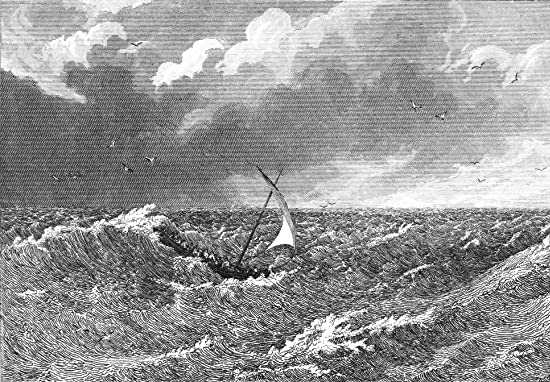
Is it beyond conception that the core actually strengthens for a length of time before the unraveling reaches it? In my crystal ball, it seems not just possible but likely. This will be the calm before The Tempest, when the unraveling reaches the core and structural changes are finally required.


Recent podcasts/videos:

Tectonic Shift of Mercantilism Revalued (Gordon Long, Macro-Analytics, 42 min)

My new book is now available at a 10% discount this month: When You Can't Go On: Burnout, Reckoning and Renewal.

If you found value in this content, please join me in seeking solutions by becoming a $1/month patron of my work via patreon.com.


My recent books:

Global Crisis, National Renewal: A (Revolutionary) Grand Strategy for the United States (Kindle $9.95, print $24, audiobook) Read Chapter One for free (PDF).

A Hacker's Teleology: Sharing the Wealth of Our Shrinking Planet (Kindle $8.95, print $20, audiobook $17.46) Read the first section for free (PDF).

Will You Be Richer or Poorer?: Profit, Power, and AI in a Traumatized World
(Kindle $5, print $10, audiobook) Read the first section for free (PDF).

Pathfinding our Destiny: Preventing the Final Fall of Our Democratic Republic ($5 Kindle, $10 print, ( audiobook): Read the first section for free (PDF).

The Adventures of the Consulting Philosopher: The Disappearance of Drake $1.29 Kindle, $8.95 print); read the first chapters for free (PDF)

Money and Work Unchained $6.95 Kindle, $15 print)
Read the first section for free


Become a $1/month patron of my work via patreon.com.


NOTE: Contributions/subscriptions are acknowledged in the order received. Your name and email remain confidential and will not be given to any other individual, company or agency.

Thank you, Gavin G. ($100), for your outrageously generous contribution to this site -- I am greatly honored by your steadfast support and readership.


Thank you, Shiu Man W. ($100), for your outrageously generous contribution to this site -- I am greatly honored by your steadfast support and readership.


Thank you, Philip O. ($5/month), for your splendidly generous pledge to this site -- I am greatly honored by your support and readership.


Thank you, Mark F. ($5/month), for your superbly generous pledge to this site -- I am greatly honored by your support and readership.

Read more...

Friday, July 08, 2022

Why Nations Fail

The irony is that the suppression of dissent is the suppression of competing ideas that generate systemic stability via rapid adaptation.

Nations that appear stable may fail once they're under pressure. What do I mean by "under pressure"? Pressure can come from many sources: invasion, civil war, prolonged scarcities of essentials, natural disasters, financial crises, droughts, pandemics and social disorder triggered by inequality and corruption.

Pressure diminishes the availability of resources, and exacerbates inequalities as political favoritism divides "winners" (elites protected and enriched by state intervention) at the expense of the "losers," i.e. the commoners, who bear the brunt of job losses, financial risks, scarcities and deprivations.

There are two dynamics in systemic pressure: forces that weaken resilience and adaptability, and forces that strengthen adaptability. Nations fail when their status quo is focused on protecting the ruling elites at the expense of the nation's overall adaptability to rapidly changing circumstances.

1. In ecosystems, as the entire population suffers a reduction in resources, average individual fitness declines. This is why droughts and floods that lead to famine are typically followed by pandemics, as those with weakened immune systems succumb to diseases which spread quickly in refugee camps, crowded cities (where starving rural populations congregate seeking food) and towns where basic sanitation crumbles under the onslaught of reduced tax revenues, scarcities and higher death rates.

In the developed world, even if the populace has enough food, heightened financial and other stresses lead to burnout, breakdowns and other manifestations of social unraveling.

As average individual fitness declines, pressures mount on social, political and economic systems. If these systems are ineffectual, brittle, sclerotic and optimized for corruption and elite incompetence, these second-order effects of systemic pressure may be enough to push the nation into non-linear disorder. (Non-linear = small actions can trigger large consequences in unpredictable ways.)

2. Resilient systems achieve their dynamic equilibrium (i.e. stability) from what Nobelist Ilya Prigogine called "order through fluctuation." This is a concept that manifests in a number of fields, including self-organization and natural selection, in which the constant flow of random mutations generates a pool of fluctuations which enable the species or society to adapt successfully to change.

When there is relatively little pressure from environmental changes, species can remain unchanged for tens of millions of years. The variability of mutations continues but there are few selective pressures to favor a mutation over the existing genome.

In eras of rapid environmental change, organisms can undergo an explosion of genetic experimentation that leads to new adaptations. This is the punctuated equilibrium model of selective pressure and adaptation: when systemic pressure is low, there's no need for bursts of experimentation and adaptation. But when systemic pressure soars, it's adapt or die.

We can understand variability as competition: mutations compete with the existing system's coding and the most successful variants spread because they outcompeted existing processes.

In human political systems, this constant flow of competing variability is dissent and the competition of ideas. Ironically, the first response of human leaders in centralized hierarchies (monarchies, totalitarian and authoritarian regimes, theocracies, plutocracies, kleptocracies, etc.) when their nation comes under pressure is to further consolidate power into the hands of the few and immediately suppress dissent of any kind as a threat to the regime's power and control.

The irony is that the suppression of dissent is the suppression of competing ideas that generate systemic stability via rapid adaptation. Stripping their nation of dissent is in effect stripping it of the dynamics of successful adaptation and rapid evolution-- precisely the traits a nation needs to navigate eras of rapid change.

This is why so many nations and empires fail when they come under pressure: as their subsystems break down and unravel, rather than encourage the competition of ideas and variability, i.e. dissent, they suppress dissent as a threat to their power, effectively dooming their nation to decay and collapse. Once the capacity to adapt and evolve has been crippled, collapse is the only possible outcome.

These dynamics are in play globally. Many and perhaps most nation-states will fail as their elites suppress dissent and new ideas that threaten their power but which ironically are the only means to evolve successfully to rapidly changing circumstances.


Recent podcasts/videos:

Tectonic Shift of Mercantilism Revalued (Gordon Long, Macro-Analytics, 42 min)

My new book is now available at a 10% discount this month: When You Can't Go On: Burnout, Reckoning and Renewal.

If you found value in this content, please join me in seeking solutions by becoming a $1/month patron of my work via patreon.com.


My recent books:

Global Crisis, National Renewal: A (Revolutionary) Grand Strategy for the United States (Kindle $9.95, print $24, audiobook) Read Chapter One for free (PDF).

A Hacker's Teleology: Sharing the Wealth of Our Shrinking Planet (Kindle $8.95, print $20, audiobook $17.46) Read the first section for free (PDF).

Will You Be Richer or Poorer?: Profit, Power, and AI in a Traumatized World
(Kindle $5, print $10, audiobook) Read the first section for free (PDF).

Pathfinding our Destiny: Preventing the Final Fall of Our Democratic Republic ($5 Kindle, $10 print, ( audiobook): Read the first section for free (PDF).

The Adventures of the Consulting Philosopher: The Disappearance of Drake $1.29 Kindle, $8.95 print); read the first chapters for free (PDF)

Money and Work Unchained $6.95 Kindle, $15 print)
Read the first section for free


Become a $1/month patron of my work via patreon.com.


NOTE: Contributions/subscriptions are acknowledged in the order received. Your name and email remain confidential and will not be given to any other individual, company or agency.

Thank you, Paul E. ($54), for your marvelously generous contribution to this site -- I am greatly honored by your support and readership.


Thank you, Pie Rre ($20), for your much-appreciated generous contribution to this site -- I am greatly honored by your support and readership.


Thank you, Adam W. ($08), for your outrageously generous contribution to this site -- I am greatly honored by your support and readership.


Thank you, Blaze B. ($12), for your most generous contribution to this site -- I am greatly honored by your support and readership.

Read more...

Wednesday, July 06, 2022

You Know What Would Be Really Irritating? A Crazy Rally to New Highs

It would be very irritating to have a rally suck in all the bears salivating for a crash from a bear-market rally peak and then decimate the shorts with a rally that soars rather than collapses to new lows.

As a contrarian, I'm always squinting at the consensus and wondering if it is really that easy to be right. Now that everyone is bearish for reasons we all know--global recession, a hot war, energy scarcities and stagflation-- I'm thinking, you know what would be really irritating? A bat-dung crazy rally to new highs in U.S. equities.

Irritating, indeed, because few are positioned for this eventuality due to odds of it happening appearing to be near-zero. What's odds-on is all the assets that bubbled up in the Everything Bubble sagging back to pre-bubble levels, or lower as global growth craters and stagflation stymies the easy fixes of money-printing and fiscal stimulus.

How could stocks soar in such confounding, catastrophic circumstances?

It doesn't seem remotely possible, but when the herd starts running, rationality is not high on its list. When the herd is spooked and panics, rationality is not exactly the order of the day. The herd might thunder off a cliff absolutely convinced of the rightness of the stampede.

Alternatively, rationalists stare with growing annoyance at a rally that makes no sense, and then with great reluctance are forced to join the herd in its irrational euphoria lest the rationalist fail to match the returns of the herd and suffer banishment to Financial Siberia.

What could cause such an irritating, bat-dung crazy rally? I see three potential sources of bat-dung craziness:

1. Market contrariness. As Jesse Livermore observed, the market tends to take along the fewest possible punters in big moves. Some will say sentiment is poor but positioning is still bullish, so sentiment doesn't matter. Perhaps. But a global recession is generally bad news for stocks, ditto hot wars, energy scarcities and stagflation (inflation in essentials and stagnant growth in employment, GDP, etc.).

What's the most punishing move for punters and pros alike--a crash or an irrational rally? I tend to think it's not a crash, as too many people expect that now and punters who HODLed or bought the dip have been ill-treated by this year's erratic decline.

The smart money sold early and heavily, rotated out of tech into commodities, but alas, that hot trade is blowing up, too as the speculative positioning that pushed commodities to the moon is evaporating like mist in high-noon Death Valley.

There are numerous powerful reasons to be in cash and remain wary of bear-market rallies. Given that backdrop, the most punishing move would be higher, tempting punters to short the bear-market rally every step higher, and then forcing them to cover with face-ripping losses.

2. Things aren't as bad as everything now expects. The consensus is the economy is going over the waterfall and the only sound we'll hear above the roar is the screams of punters who went long.

But just suppose the blow-torch of inflation cools, employment holds up and the consumer ignores all the prognosticators of doom. Weirdly, consumers have deleveraged during the pandemic and the debt to income ratio isn't that bad. Corporations that overshot staffing are slashing headcount by attrition and hiring freezes, along with layoffs. But lots of jobs are still going begging.

Corporate profits will take a hit but as commodity inflation cools and their super-costly headcount drops, profits will look better a quarter out, and the market being what it is, a bizarre combination of irrationality, price discovery and forward-looking crystal-ball gazing, the hope for fatter profits a quarter or two out could spark a frenzy.

3. Core and periphery. We tend to forget that we're all currency speculators, regardless of the asset we're holding, be it cash, commodities, bonds, stocks, cryptos or real estate. Everything is arbitraged against the super-liquid currencies, an exclusive club of the yen, euro and U.S. dollar. (The Chinese RMB, being pegged by the Chinese government to the USD, is a derivative of the USD).

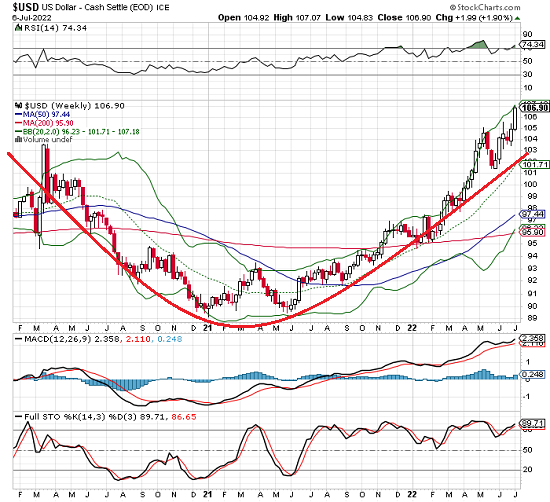
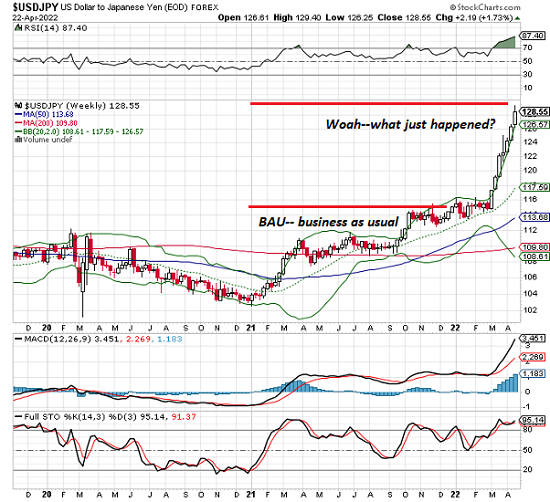
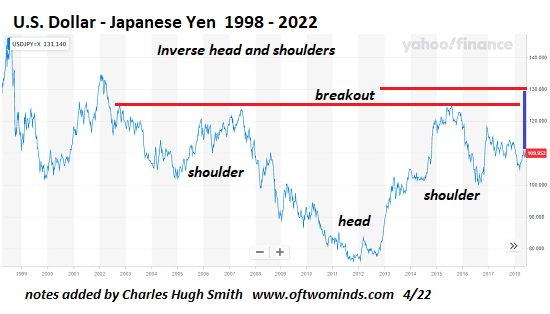
As the charts below reveal, the USD has formed a long-term bowl-bottom and an inverse heads-and-shoulders in the USD-JPY pair.

Yes, the USD may sag back to support but the bottom line is the USD rising makes everything cheaper for those holding U.S. dollars and much more expensive for everyone holding other currencies or assets in other currencies. Capital goes where it's treated well and U.S. markets are 1) a way to capture the gains of the U.S. dollar; 2) liquid and 3) relatively transparent compared to other markets.

A couple of trillion seeking safe haven here, a couple trillion seeking safe haven there and pretty soon that influx of capital starts pushing U.S. markets higher. Note that everyone who sold assets priced in yen in January and moved their stash into USD cash just made 20% in six months. That's a pretty nice return.

Capital moves from the periphery to the core when things start wobbling.

It would be very irritating to have a rally suck in all the bears salivating for a crash from a bear-market rally peak and then decimate the shorts with a rally that soars rather than collapses to new lows. The rally would be even more irritating if it left all the smart money on the sidelines because a rally simply doesn't make sense.

With great weeping and gnashing of teeth, the smart money is then forced to chase the rally higher.

Yes, this is implausible, impossible, etc. That's why it's increasingly likely. Is it really that easy to be right? As a general rule, no.


Recent podcasts/videos:

Tectonic Shift of Mercantilism Revalued (Gordon Long, Macro-Analytics, 42 min)

My new book is now available at a 10% discount this month: When You Can't Go On: Burnout, Reckoning and Renewal.

If you found value in this content, please join me in seeking solutions by becoming a $1/month patron of my work via patreon.com.


My recent books:

Global Crisis, National Renewal: A (Revolutionary) Grand Strategy for the United States (Kindle $9.95, print $24, audiobook) Read Chapter One for free (PDF).

A Hacker's Teleology: Sharing the Wealth of Our Shrinking Planet (Kindle $8.95, print $20, audiobook $17.46) Read the first section for free (PDF).

Will You Be Richer or Poorer?: Profit, Power, and AI in a Traumatized World
(Kindle $5, print $10, audiobook) Read the first section for free (PDF).

Pathfinding our Destiny: Preventing the Final Fall of Our Democratic Republic ($5 Kindle, $10 print, ( audiobook): Read the first section for free (PDF).

The Adventures of the Consulting Philosopher: The Disappearance of Drake $1.29 Kindle, $8.95 print); read the first chapters for free (PDF)

Money and Work Unchained $6.95 Kindle, $15 print)
Read the first section for free


Become a $1/month patron of my work via patreon.com.


NOTE: Contributions/subscriptions are acknowledged in the order received. Your name and email remain confidential and will not be given to any other individual, company or agency.

Thank you, Perry B. ($50), for your marvelously generous contribution to this site -- I am greatly honored by your support and readership.


Thank you, Jim T. ($5/month), for your magnificentlygenerous pledge to this site -- I am greatly honored by your support and readership.


Thank you, John B. ($1/month), for your most generous pledge to this site -- I am greatly honored by your support and readership.


Thank you, Ken W. ($1/month), for your most generous pledge to this site -- I am greatly honored by your support and readership.

Read more...

Tuesday, July 05, 2022

The One Solution to All Our Problems

Pick one, America: national security of the essential material foundation of everything, the industrial base, or "global markets," maximizing greed / corporate profits.

Sorry about the clickbait title. We all know there isn't "one solution" to anything as complex as a socio-economic-cultural-political system.

But this is based on looking at all the problems from one very shaky perspective: that the foundations of any solutions are rock-solid and all we need to do is apply some ideological or financial fix and away we go.

From another, much more practical perspective, if you don't keep the foundation--the industrial base--glued together, then all the high-minded ideological or financial fixes will all be completely, utterly meaningless. When the generator breaks down and can't be fixed due to a lack of critical spare parts, that isn't a problem that has a "Progressive" or "Conservative" fix. Printing money and tax breaks won't fix it either. And neither will ideological fixations like "global markets."

Financial gimmicks and global markets are what got us into this mess in the first place. Greed is good until you sacrifice your national security and industrial base for a few extra bucks.

From this perspective, there is one solution to all the problems, because if you don't fix the industrial base then the whole shebang collapses. All those little things like a judiciary, law enforcement and food supply system all rely on a functional industrial base, by which I mean the interwoven industries that made the millions of essential parts and components of a complex industrial economy.

We all know about fuel and fertilizer, but when you look beneath this superficial surface you find a bunch of stuff without which the entire industrial machine breaks down.

Here is a partial list of the stuff you need or your industrial base collapses in short order: plastics, sealants, solvents, lubricants, gaskets, O-rings, filters, and an astoundingly long list of highly specialized ceramics, wires, piping, fabrics, glass, steel, lenses and so on.

To a sobering degree, much of this essential industrial base has been offshored because "greed is good" and corporate profits are more important than the security of the nation's industrial base. Becoming dependent on frenemies' industrial base is (pick as many as apply): short-sighted, stupid, foolish, insane, traitorous.

The problem isn't just the loss of the capacity to make the stuff we need to keep the whole system from collapsing; it's the loss of the capacity to make all the parts and components. All complex systems, including machines, fail when a critical component fails or a critical fluid runs dry. The machine can be 99.9% functional but the missing 0.1% means the entire machine is down.

Most people are unaware of just how dependent we are on specialty parts produced in only a handful of factories. It simply isn't profitable in the "global marketplace" to produce small batches of parts. The "greed is good" / maximize profit ideology leads to stripping away redundancies and costly local suppliers in favor of a distant supplier totally within the control of frenemies' governments.

Consider the supposedly low-tech kitchen counter toaster. These are cheap, so they must be easy to make, right? Wrong. They're impossible to make without a highly sophisticated industrial supply chain. Thomas Thwaites attempted to make a toaster from scratch and found it was impossible to do so. He described the experience in his book, The Toaster Project: Or a Heroic Attempt to Build a Simple Electric Appliance from Scratch.

Even the simple kitchen toaster requires highly specialized materials from a handful of sources. There is nothing low-tech about the specialty wires, ceramics, etc. needed to manufacture or repair a "simple" toaster.

The one solution without which no other solutions are possible is to reshore our essential industrial base and supply chain as a matter of the highest national security. Production deemed essential to National Security must be located in the U.S. and owned and operated by U.S. firms.

Ideological purists freak out at the prospect that "greed is good, markets fix everything" has failed the nation but these blinded-by-ideology purists overlook how government funding via DARPA, NASA and DoD (Department of Defense) was the one and only driver of the development of microprocessors and the entire semiconductor industry. There was no private-sector market to enable greed, and no way that individuals in a garage could fabricate the first microprocessors. All the really hard stuff was funded lock, stock and barrel, by DARPA, NASA and DoD--government agencies devoted to national security, which includes the government's role in fostering and nurturing innovation. (DARPA was ARPA back in the day).

Pick one, America: national security of the essential material foundation of everything, the industrial base, or "global markets," maximizing greed / corporate profits. You can't have both. Choosing "global markets," maximizing greed / corporate profits has left the nation catastrophically vulnerable in ways few even grasp because they don't understand the fragility of the material foundation of all the goodies and systems they wrongly assume are a permanent birthright. They aren't.

We're getting a taste of the inherent instability of our dependence on "global markets" / maximizing greed, but the full banquet of consequences has yet to be served.

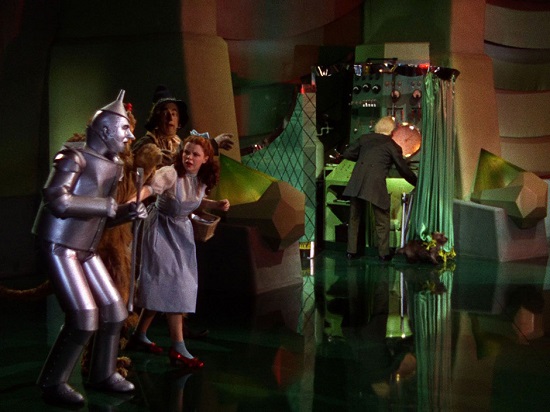
When the machine breaks down due to lack of essential parts, the magic goes away. Do those behind the curtain understand this? Apparently not. Maybe we need a few engineers behind the curtain instead of relying on financiers and legal experts for leadership.


Recent podcasts/videos:

Tectonic Shift of Mercantilism Revalued (Gordon Long, Macro-Analytics, 42 min)

My new book is now available at a 10% discount this month: When You Can't Go On: Burnout, Reckoning and Renewal.

If you found value in this content, please join me in seeking solutions by becoming a $1/month patron of my work via patreon.com.


My recent books:

Global Crisis, National Renewal: A (Revolutionary) Grand Strategy for the United States (Kindle $9.95, print $24, audiobook) Read Chapter One for free (PDF).

A Hacker's Teleology: Sharing the Wealth of Our Shrinking Planet (Kindle $8.95, print $20, audiobook $17.46) Read the first section for free (PDF).

Will You Be Richer or Poorer?: Profit, Power, and AI in a Traumatized World
(Kindle $5, print $10, audiobook) Read the first section for free (PDF).

Pathfinding our Destiny: Preventing the Final Fall of Our Democratic Republic ($5 Kindle, $10 print, ( audiobook): Read the first section for free (PDF).

The Adventures of the Consulting Philosopher: The Disappearance of Drake $1.29 Kindle, $8.95 print); read the first chapters for free (PDF)

Money and Work Unchained $6.95 Kindle, $15 print)
Read the first section for free


Become a $1/month patron of my work via patreon.com.


NOTE: Contributions/subscriptions are acknowledged in the order received. Your name and email remain confidential and will not be given to any other individual, company or agency.

Thank you, Nadir K. ($54), for your marvelously generous contribution to this site -- I am greatly honored by your support and readership.


Thank you, Alain M. ($50), for your much-appreciated generous contribution to this site -- I am greatly honored by your support and readership.


Thank you, Annette ($10.80), for your most generous contribution to this site -- I am greatly honored by your support and readership.


Thank you, Wallace W. ($10/month), for your magnificently generous pledge to this site -- I am greatly honored by your support and readership.

Read more...

Friday, July 01, 2022

The Most Valuable Form of Money Nobody's Seen--Yet

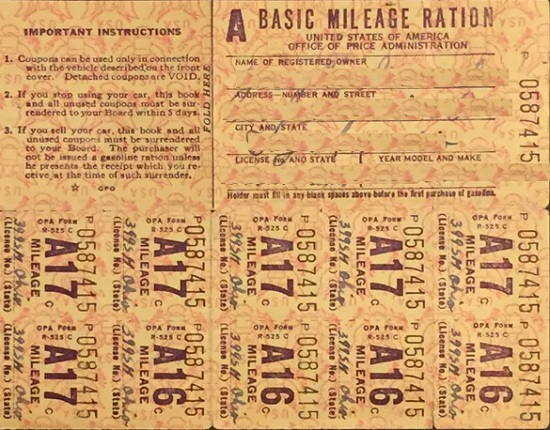
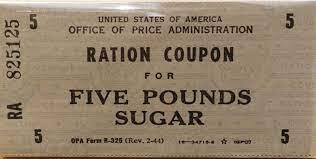
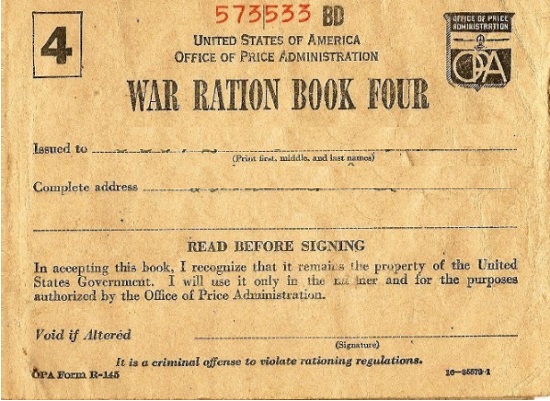
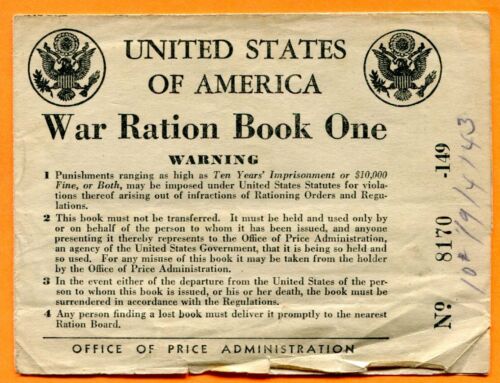
What is "money"? "Money" is a claim on the essentials of life. Ration cards are claims on essentials.

Many people expect "money" will soon be tied to commodities. Agreed. It's called a ration card that grants the holder the right to buy a specific quantity of essential goods at a specified price.

This right is a form of "money" directly tied to the value of commodities.

Ration cards are the only fair way to distribute essentials in times of chronic scarcity. Markets work fine when there's a substitute for whatever is scarce, but there are no substitutes for electricity, food, fuel or fresh water, the FEW essentials (Food, energy, water).

Leaving the distribution of scarce, no-substitutes essentials up to the market leads to the rich eating very well indeed and the poor going hungry. This leads to a little thing called the overthrow of the failed status quo and the destruction of a good chunk of its ruling class (Payback's a witch, etc.). No bread? Let them eat iPhones.

We know ration cards work because a mass experiment in rationing essentials was conducted in World War II. Maybe fairness no longer matters (and if it doesn't, then prepare for the overthrow of the failed status quo and the destruction of a good chunk of its ruling class), but if fairness matters--or the ruling elite wish to keep all their power and all their goodies--then rationing and the ruthless suppression of price gouging are as good as gold.

What is "money"? "Money" is a claim on the essentials of life. Ration cards are claims on essentials, enforced by the state to insure everyone has a minimum of the FEW resources. Beyond that minimum, the market will discover the price of extra goodies. But the point is that ration cards are a fair form of "money."

With a little digital magic, ration cards can't be counterfeited or used by anyone but the person to whom they were issued. If you get your ration and don't need all of it, nobody's stopping you from selling it to somebody else. But at least everyone got the same amount at the same price.

How valuable is ration-card "money"? Let's put it this way: if you're a wealthy, powerful member of the ruling elite, how much would you pay to avoid the overthrow of your regime? If creating ration-card "money" saves your bacon, then what other form of "money" has more value than that?

The other form of "money" that will be valuable isn't even tangible. It's called self-reliance. More on that later.


Recent podcasts/videos:

Tectonic Shift of Mercantilism Revalued (Gordon Long, Macro-Analytics, 42 min)

My new book is now available at a 10% discount this month: When You Can't Go On: Burnout, Reckoning and Renewal.

If you found value in this content, please join me in seeking solutions by becoming a $1/month patron of my work via patreon.com.


My recent books:

Global Crisis, National Renewal: A (Revolutionary) Grand Strategy for the United States (Kindle $9.95, print $24, audiobook) Read Chapter One for free (PDF).

A Hacker's Teleology: Sharing the Wealth of Our Shrinking Planet (Kindle $8.95, print $20, audiobook $17.46) Read the first section for free (PDF).

Will You Be Richer or Poorer?: Profit, Power, and AI in a Traumatized World
(Kindle $5, print $10, audiobook) Read the first section for free (PDF).

Pathfinding our Destiny: Preventing the Final Fall of Our Democratic Republic ($5 Kindle, $10 print, ( audiobook): Read the first section for free (PDF).

The Adventures of the Consulting Philosopher: The Disappearance of Drake $1.29 Kindle, $8.95 print); read the first chapters for free (PDF)

Money and Work Unchained $6.95 Kindle, $15 print)
Read the first section for free


Become a $1/month patron of my work via patreon.com.


NOTE: Contributions/subscriptions are acknowledged in the order received. Your name and email remain confidential and will not be given to any other individual, company or agency.

Thank you, Sherrie B. ($20), for your most generous contribution to this site -- I am greatly honored by your support and readership.


Thank you, Simon M. ($50), for your much-appreciated generous contribution to this site -- I am greatly honored by your steadfast support and readership.


Thank you, Gary R. ($50), for your splendidly generous contribution to this site -- I am greatly honored by your steadfast support and readership.


Thank you, John C. ($50), for your marvelously generous contribution to this site -- I am greatly honored by your support and readership.

Read more...

Terms of Service

All content on this blog is provided by Trewe LLC for informational purposes only. The owner of this blog makes no representations as to the accuracy or completeness of any information on this site or found by following any link on this site. The owner will not be liable for any errors or omissions in this information nor for the availability of this information. The owner will not be liable for any losses, injuries, or damages from the display or use of this information. These terms and conditions of use are subject to change at anytime and without notice.

RE: European Union AI Act, and Our Use of Generative AI Tools and Agents Policy

All text on this site is composed by Charles Hugh Smith or by a credited guest-author. No Generative AI Tools are used in the composition / writing of any text or graphic content created by Charles Hugh Smith. This site deploys no AI agents or generative AI tools. This site is not responsible for the disclosures, use or non-use of AI agents or generative AI tools in advertisements displayed by Investing Channel or other ad placement services.

Audio files generated by text-to-audio transcription tools are identified as such.

Our Privacy Policy:

Correspondents' email is strictly confidential. This site does not collect digital data from visitors or distribute cookies. Advertisements served by third-party advertising networks such as Investing Channel may use cookies or collect information from visitors for the purpose of Interest-Based Advertising; if you wish to opt out of Interest-Based Advertising, please go to Opt out of interest-based advertising (The Network Advertising Initiative) If you have other privacy concerns relating to advertisements, please contact advertisers directly.

PRIVACY NOTICE FOR EEA INDIVIDUALS

This section covers disclosures on the General Data Protection Regulation (GDPR) for users residing within EEA only. GDPR replaces the existing Directive 95/46/ec, and aims at harmonizing data protection laws in the EU that are fit for purpose in the digital age. The primary objective of the GDPR is to give citizens back control of their personal data. Please follow the link below to access InvestingChannel's General Data Protection Notice.
https://stg.media.investingchannel.com/gdpr-notice/

Notice of Compliance with The California Consumer Protection Act

This site does not collect digital data from visitors or distribute cookies. Advertisements served by a third-party advertising network (Investing Channel) may use cookies or collect information from visitors for the purpose of Interest-Based Advertising. If you do not want any personal information that may be collected by third-party advertising to be sold, please follow the instructions on this page: Do Not Sell My Personal Information.

Regarding Cookies:

This site does not collect digital data from visitors or distribute cookies. Advertisements served by third-party advertising networks such as Investing Channel may use cookies or collect information from visitors for the purpose of Interest-Based Advertising; if you wish to opt out of Interest-Based Advertising, please go to Opt out of interest-based advertising (The Network Advertising Initiative) If you have other privacy concerns relating to advertisements, please contact advertisers directly.

Our Commission Policy:

Though I earn a small commission on Amazon.com books and gift certificates and gold (BullionVault) purchased via links on my site, I receive no fees or compensation for any other non-advertising links or content posted on my site.

Copyright Notice:

All original images (Drawings and Photographs), text (essays, books and works of fiction), audio and video recordings, musical compositions, graphic design, graphic design elements and HTML coding on this site are the copyrighted work of Charles Hugh Smith unless otherwise credited or noted. They are published as information for the private use of site visitors, and any reproduction or redistribution of this content or coding in any media in any format or distribution channel (text, audio, video/film, web) without the written permission of the copyright holder is strictly prohibited. All rights in all media reserved globally.

  © Blogger templates Newspaper III by Ourblogtemplates.com 2008

Back to TOP