
Thursday, April 06, 2023

I'm Looking for 15 Readers Willing to Pony Up $1 for the Crazy-Valuable Content Here

Yes, I'm rattling the begging bowl.

Beneath the veneer of normalcy, things are no longer working like they're supposed to. Am I the only one who senses this? Many of you also sense that behind the screens of normalcy, once-reliable systems are unraveling. Things that were once solid are melting into air, and this presents us with a novel challenge. How do we respond to the unmooring without becoming unmoored ourselves?

Consider inflation. First we're told the problem is we don't have enough inflation, then when it soars we're told it's transitory, then we're told it's dropping back to the magic 2%, then it stays stubbornly high and a cacophony of shrill voices declares that either a deflationary collapse or hyper-inflation is around the corner.

In other words, nobody knows what the future holds. Where does that leave us? Searching for ways to understand the instability swirling around us.

Do I have all the answers? Absolutely not. But I do have a framework for understanding the next two decades. This framework isn't a magic ouija board that spits out recommendations for turning $100 into millions via trading zero-day expiration options (alas), but it does suggest pathways to solutions and ways to invest our time, energy and capital that we control.

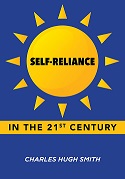
The things that will reliably gain in value are largely ignored in the present mindset: these include control of our lives and assets, real-world skills, authenticity and trustworthy networks of other productive people. None of these can be bought off the shelf. These intangible assets are scarce and difficult to acquire, and so they will become more valuable. I summarize this in my book Self-Reliance in the 21st Century.

The tangible assets often touted as the "solution" are increasingly at risk of being taxed, expropriated, frozen or banned, for if history teaches us anything about eras of instability, it's that the rules change overnight. Everything is predictable and secure until it isn't. That's one source of the feeling that everything that was solid is melting into thin air: the rules just changed, and we know they'll continue to change (usually to our disadvantage) as the status quo attempts to stay ahead of the cracks opening in the ground.

The key skill and asset in the next two decades will be adaptability, which is the difference between grounded optimism and empty optimism: Doom Porn and Empty Optimism.

Clinging to what is unsustainable won't work. What will work is the realistic optimism of adaptation. Adapting to fast-changing conditions is never easy, but it's a grand adventure and the pathway of success.

In sum, I focus on what one reader described in this way: "money richness and wealth are vastly different animals." Indeed. Wealth is far more than money.

I'm interested in what's increasingly scarce and therefore valuable, for example common ground. The number of issues that divide us is expanding like a supernova as polarization disintegrates what few islands of common ground still exist. I'm interested in preserving the remaining islands of common ground and establishing a few new ones.

The global economy is transitioning to degrowth, and this opens a path to a much more sustainable, human-scale way of life that is antifragile rather than unstable and precarious. Sure, we can cling to waste is growth, but why self-destruct when a brighter future beckons?

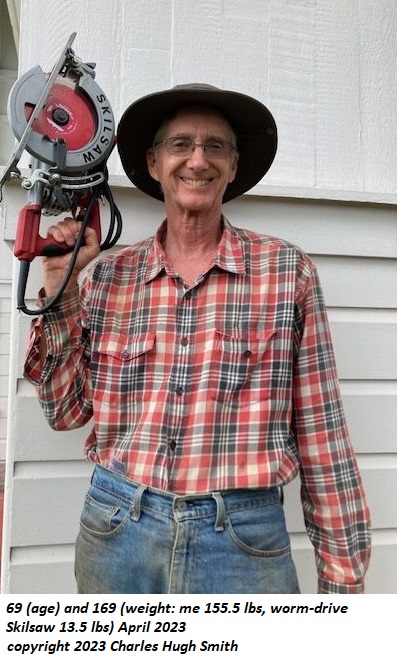
I can't help being frugal (see photo below) in both the tangible world and the world of ideas, where I try to identify the core dynamics in play, for example, What Happens When Complexity Unravels? (May 6, 2022) and Checking In On Five Long-Term Cycles.

I don't expect you to agree with everything I post, or agree with any of it--that's not my goal. I don't see content as a popularity contest, I see it as an opportunity to contribute to our understanding of how best to respond to our shared and individual challenges. A mix of differing proposals and critiques is essential to the process of adapting and moving forward. You and I are part of that process.

What I bring to the table is a lively interest in both real-world skills (see photo below of a favored tool for the past 50 years, a worm-drive Skilsaw) and a curiosity about systems, enterprises, evolutionary dynamics and economic / social transformations. Solutions can be systemic or individual. I'm interested in both, and the two come together in my books on burnout, national renewal and self-reliance.

Yes, I've been shadow-banned by numerous entities, but so far I've avoided being renditioned to a rat-infested cellblock in the 'Stans, so life here on the margins is lively though not exactly lucrative.

Alas, I'm never going to mint a million on TikTok or YouTube. I fear my photos of garden veggies are not going to mint me a million on OnlyFans, either. I confess this is a pure-writing site, leavened with charts from the Federal Reserve. (No wonder I'm shadow-banned, right?)

I tend to keep expectations low, as my experience tracks Churchill's definition of success: going from failure to failure without loss of enthusiasm.

Which brings us back to inflation. Last year I rattled the begging bowl and asked 10 of you tens of thousands of readers to pony up $1 a month for the crazy-valuable (or just plain crazy) content here.

This year, I'm asking for (gasp) 15 of you to pony up $1 for the crazy-valuable (or just plain crazy) content here. Alas, inflation.

So here's my question to you: are you one of the few, the daring, the foolhardy, the insanely generous readers willing to pony up a dollar a month to extend life-sustaining encouragement to the one-person content factory here at Of Two Minds?

Those ponying up a Lincoln ($5) every month get the weekly Musings Reports, an incredible bargain given what you get. The goal here at Of Two Minds is to not just scrape through crises but emerge with greater skills, adaptability, health and real wealth--the kind that can't be frozen or expropriated because it's social and experiential capital. (A cushion of a few extra tools and quatloos is also a goal, as they may come in handy.)

If you are one of those rare and precious souls, please accept my sincere gratitude:

Yes, I'm rattling the begging bowl. Pennies and quatloos are gratefully accepted.

I'm asking you to consider becoming a patron or contributor. If you need a doorstop, paperweight or sleep-aid, buy one of my books. Heck, buy one as a doorstop and another as a paperweight; they work splendidly in these utilitarian roles.

Become a patron of my work via patreon.com

How to Contribute / Subscribe to Of Two Minds

Thank you very much for considering supporting this beggar's content banquet. It's soup to nuts. (Or sometimes, just plain nutty, but there's always a bit of entertainment value in the nuttiness.)



New Podcast: Turmoil Ahead As We Enter The New Era Of 'Scarcity' (53 min)
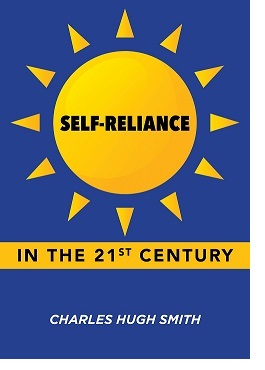
My new book is now available at a 10% discount ($8.95 ebook, $18 print): Self-Reliance in the 21st Century.

Read the first chapter for free (PDF)

Read excerpts of all three chapters

Podcast with Richard Bonugli: Self Reliance in the 21st Century (43 min)


My recent books:

The Asian Heroine Who Seduced Me (Novel) print $10.95, Kindle $6.95 Read an excerpt for free (PDF)

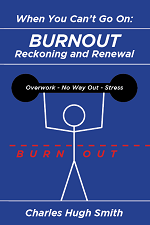
When You Can't Go On: Burnout, Reckoning and Renewal $18 print, $8.95 Kindle ebook; audiobook Read the first section for free (PDF)

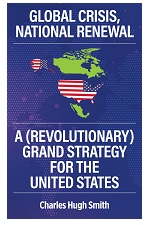
Global Crisis, National Renewal: A (Revolutionary) Grand Strategy for the United States (Kindle $9.95, print $24, audiobook) Read Chapter One for free (PDF).

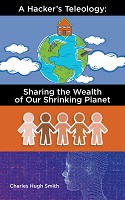
A Hacker's Teleology: Sharing the Wealth of Our Shrinking Planet (Kindle $8.95, print $20, audiobook $17.46) Read the first section for free (PDF).

Will You Be Richer or Poorer?: Profit, Power, and AI in a Traumatized World
(Kindle $5, print $10, audiobook) Read the first section for free (PDF).

The Adventures of the Consulting Philosopher: The Disappearance of Drake (Novel) $4.95 Kindle, $10.95 print); read the first chapters for free (PDF)

Money and Work Unchained $6.95 Kindle, $15 print)
Read the first section for free


Become a $1/month patron of my work via patreon.com.


NOTE: Contributions/subscriptions are acknowledged in the order received. Your name and email remain confidential and will not be given to any other individual, company or agency.

Thank you, James W. ($50), for your magnificently generous contribution to this site -- I am greatly honored by your support and readership.


Thank you, Kevin L. ($5/month), for your marvelously generous subscription to this site -- I am greatly honored by your longstanding support and readership.

Read more...

Wednesday, April 05, 2023

Why Interest Rates Are Not Going Back to Zero

In a system maintained by ever-greater extremes, confidence erodes very quickly once the next extreme fails to move the needle.

Many observers expect interest rates to fall back to zero as inflation dissipates and central banks rush to stimulate flagging economies. This expectation is reasonable based on the events of the past 15 years (2008-2023), but if we zoom out to a 50-year timeline, we get a different perspective and draw a different conclusion.

2023 is not 2008, and the difference can be summed up in one phrase: global risk has been repriced. Interest rates reflect not just inflation expectations and central bank stimulus; interest rates and bond yields also reflect the risk premium on the cost of credit-money, and if the risk profile has changed in fundamental ways, the risk premium and cost of credit-money will reflect that, regardless of inflation and central bank stimulus.

The global economy is changing in fundamental ways, and this is repricing everything: the cost of money/credit, the price of assets, the value of hedges and insurance, and so on. The core driver in all this repricing is risk, for it's the reappraisal of risk that forces the repricing of everything.

When risk is low and transparent, the risk premium is low and this is reflected in low, stable costs. When risk soars and is difficult to assess, the risk premium rises and this pushes costs higher.

In terms of asset valuations, higher risks reprice assets higher or lower based on the risk profile: what happens to the asset if liquidity dries up in a risk-driven crisis? If credit dries up, what happens to demand for the asset?

Risk tends to be self-reinforcing. If we look around and see everyone else is confident that risk is theoretical rather than real, we stop buying hedges against bad things happening, and we pay a premium for assets that do well in low-risk eras.

But if we see other people getting defensive--selling assets, paying down debt, reducing spending and risk-on investing--then we pull in our horns, too.

What changed? The global economy began a cycle in the early 1990s of declining risk throughout the system due to these risk-reducing changes:

1. The dissolution of the USSR and the end of the hyper-expensive, heightened-risk Cold War.

2. The flood of low-cost oil as all the super-giant fields discovered in the 1970s began peak production.

3. China emerged as the low-cost "workshop of the world," enabling 30 years of soaring corporate profits as corporations reduced costs by offshoring production to China.

4. This offshoring boosted profits while deflating the costs of production due to much lower labor costs, lax / non-existent environmental standards and Chinese producers' willingness to accept razor-thin profit margins.

5. The reduction in global risk and the deflationary impact of Globalization (offshoring and opening new markets) enabled central banks to lower interest rates for 30 years without sparking inflation and private-sector banking/lending to expand credit and leverage, effectively globalizing / commoditizing financial instruments that hedged risks (Financialization).

6. After a decade-long lag (the 1980s), the advances in personal computing, software and desktop publishing finally began generating productivity increases.

7. The economic theology of Neoliberalism was embraced globally. Neoliberalism claims "markets solve all problems" and so the universal solution is to turn everything into a market by reducing regulations and state oversight.

All of these forces tended to restrain prices of commodities, goods and services and reduce systemic risks while expanding markets, financial "innovations" and profits. This created a global "virtuous cycle" in which each dynamic reinforced the others.

This "virtuous cycle" ended in the 2008-09 Global Financial Meltdown, but was papered over for a decade by extreme policies:

1. China launched the largest credit expansion in history (Russell Napier's phrase) to counter the meltdown

2. The Federal Reserve and other central banks began a policy of financial repression (i.e. centrally managing financial markets rather than let market forces dictate liquidity, price, risk, etc.), leading to Zero Interest Rate Policy (ZIRP) that was effectively negative-rates since inflation continued sputtering along at 1.5% tp 2%.

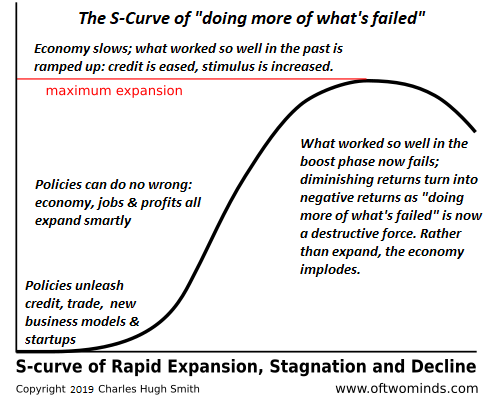
Why did the "virtuous cycle" end? The basic answer is diminishing returns: the returns on any new policy or dynamic such as Neoliberalism, globalization or financialization follow an S-Curve (see chart below), where the initial returns are stupendous (the boost phase) and then as the dynamics become ubiquitous, the returns diminish until they stagnate. At that point, the system decays unless new more extreme measures are applied--for example, China's debt to GDP ratio doubling from 140% to 280% and interest rates being suppressed to zero.

Another factor is the cannibalization of domestic markets once globalization had skimmed the easy returns. Financialization starts out looking "innovative" by claiming it can hedge all risks at low cost, effectively lowering the risk of playing financial games to zero. As Benoit Mandelbrot and other explained, this isn't possible for structural/mathematical reasons (markets are fractals, etc.).

As the easy gains diminish, financialization takes assets that were once low-risk and commoditizes them into "instruments" that can be sold globally as "low-risk assets." This is what happened to home mortgages, which went from being highly regulated and low-risk to being poorly regulated /fraudulent and packaged into highly deceptive mortgage-backed securities that masked the true risk--high--behind flim-flam claims of low risk.

As costs rose in China and other producing nations, labor costs began rising, along with higher taxes and mandates to reduce the choking air pollution and poisoned water/soil that inevitably result from uncontrolled industrialization.

Suppressing the cost of capital/credit to near-zero generated a tsunami wave of private-generated capital, both within the banking sector and the ballooning non-banking (shadow banking) sectors. This low-cost credit was then unleashed into global markets to chase any high-yield investment, which of course means gambling on risky assets while supposedly hedging the bets against losses.

All this financial engineering--ZIRP, cheap, abundant credit, the chase for yield--ultimately depends on liquidity, i.e. the presence of buyers in size to create a market for anyone who seeks to sell an asset. If liquidity dries up for whatever reason--a bank crisis, a market panic, etc.--then sellers run out of buyers abd the market reprices the asset at lower and lower levels until buyers emerge. In a bidless/zero-liquidity market, there are no buyers at all until the price approaches zero.

The potential wipeout of bubble-generated "wealth" would bring down the entire global financial system, for all those assets are collateral for the world's immense mountain of credit/debt.

The evaporation of liquidity in 2008-09 is what former Fed Alan Greenspan identified as the risk he did not anticipate.

So what changed around 2007-09? Globalization and Financialization moved from "virtuous cycle" to stagnation/decline, policies became more extreme to mask rising systemic risks, and the addition of a billion new workers aspiring to all the commodity-consuming luxuries of the middle class lifestyle soaked up excess production of oil and other commodities. With surpluses gone, prices had to start rising.

Post-Covid lockdown and recovery, China's policies changed from "open to the world" and "peaceful rise" to aggressive militarization and the restriction of Chinese society's access to the outside world.

All of these factors exposed the risks that had been successfully masked: the risks that global supply chains can break down or be disrupted by geopolitics; the risk that financialization games can blow up; the risk that Neoliberalism failed to suppress risks of fraud and exploitation; the risks that soaring debt outpaces expansion of the real-world economy, generating debt crises, and the risks of extreme policies generating unintended consequences (moral hazard, extreme risk-taking, etc.) and blowback (re-industrialization, trade wars, etc.).

On top of these risks, there are now demographic, capital, labor and resource sources of risks. Geopolitical tensions are rising, which is historically typical in eras where essential commodities become scarce and/or unavailable /costly. This is incentivizing re-industrialization, reshoring, friendshoring, etc., all of which are national-security issues aimed at reducing dependency on rivals or risky supply chains.

In effect, the nation-state has to take the driver's seat from deregulated markets, the Neoliberal ideal.

This re-industrialization is also driven by the transition to non-hydrocarbon energy sources, a goal that will require far more capital than most expect even as it underperforms unrealistic expectations. The demand for trillions in new investment will pressure credit for consumption (new homes, vehicles, vacations, etc.), pushing the cost of credit higher regardless of any other conditions.

In the past decade, birth rates in many developed and developing economies have cratered while the workforce ages and enters retirement. Both of these developments mean pension and social welfare programs launched when there where 5 workers for every retiree are no longer sustainable now that there are only 2 fulltime workers for every retiree/recipient of social welfare.

The decline of the work force also introduces two other dynamics: potential labor shortages and the stagnation of demand, as older people consume far less than new households having children. As marriage rates and birth rates plummet, so do the prospects for consumption-driven economic growth.

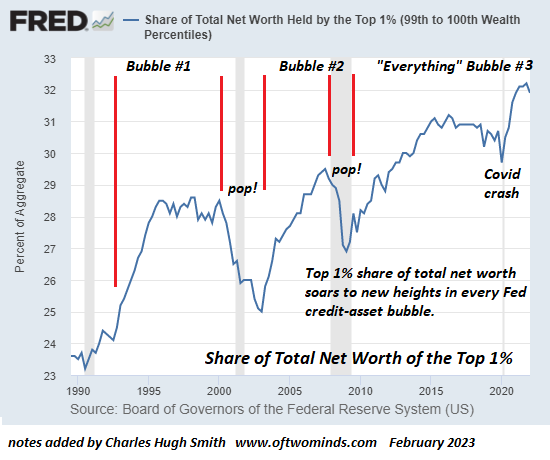
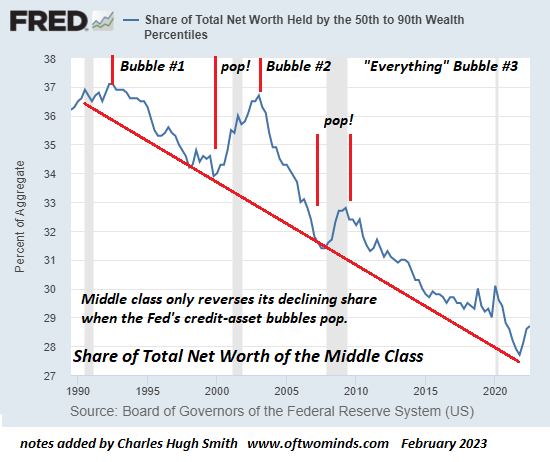
The policy extremes of ZIRP, moral hazard, credit expansion and the chasing of yields has inflated The Everything Bubble which has put the price of housing and vehicles out of reach of the bottom 60% (or in many regions, the bottom 80%) of households.

This rising inequality erodes social cohesion and fosters an alternative lifestyle in which young workers opt out of the rat race to acquire an upper-middle class income and wealth. This diminishes the pool of potential buyers of all the overpriced assets, further reducing liquidity on a demographic/structural basis.

Simply put, the rising tide of wealth and profits hasn't raised all boats. The top 5% have garnered the vast majority of the gains in asset appreciation, capital gains and profits. This generates a background of rising risk of social disorder.

On top of all this, 30 years of moderate inflation have reversed into a era of sustained inflation, which despite the hopes of many commentators, will not be transitory. This era of inflation is driven by:

1. Excessive debt levels that can only be managed by inflating the debt down to manageable levels.

2. Scarcities of essentials which push prices above what consumers can afford while not being high enough to fund massive new investments needed to increase supply.

3. The cost of capital must rise to reflect the rising risk premium globally.

All the tricks deployed to restore confidence in 2008-09 have reached such extremes that now systemic risk--of default, conflicts, broken supply chains, geopolitical blackmail, scarcities of essential commodities and perhaps the least understood risk, the evaporation of liquidity as credit and buyers of risk-on assets become scarce--is rising dramatically.

These risks are difficult to assess or hedge completely, and the inter-dependence of the global economy and financial system--a tightly bound system--mean risk in one area quickly spreads to the rest of the system.

This structural rise in systemic risks raises costs and changes the risk-reward calculation on every asset.

Take housing as an example. When we're confident housing will rise 30% every decade like clockwork, we'll pay today's prices with the expectation that the house will gain 30% in the coming decade. But as the financial risk premium rises, and we have to factor in the risk that the house might lose 30% of its value going forward, we become wary of paying today's high price.

As others also become wary, the recognition of risk reinforces itself and as prices drop, our wariness increases and we decide to wait until the risks of further decline become clearer.

The problem with assessing risk is the full risks are never clear until it's too late.

Everything is being repriced, including risk itself, the cost of capital and labor and the value of all assets. This repricing is currently modest, but as risks manifest, we can anticipate an acceleration of repricing. If liquidity dries up--buyers for houses suddenly withdraw from the market--the price declines can be dramatic and self-reinforcing.

In a system maintained by ever-greater extremes, confidence erodes very quickly once the next extreme fails to move the needle. At that point, all bets are off because confidence in the policymakers' ability to "save the day" vanishes.

Once confidence vanishes, so does liquidity. Once markets are illiquid, the problem isn't limited to the declining valuation--the real problem is finding a buyer who will enable you to convert the asset into cash.

It's clear the global risk premium has increased dramatically and is increasing in an unpredictable arc. This structural trend of higher risks will reprice everything--including bond yields and interest rates.


This essay was first published as a weekly Musings Report sent exclusively to subscribers and patrons at the $5/month ($50/year) and higher level. Thank you, patrons and subscribers, for supporting my work and free website.


New Podcast: Turmoil Ahead As We Enter The New Era Of 'Scarcity' (53 min)

My new book is now available at a 10% discount ($8.95 ebook, $18 print): Self-Reliance in the 21st Century.

Read the first chapter for free (PDF)

Read excerpts of all three chapters

Podcast with Richard Bonugli: Self Reliance in the 21st Century (43 min)


My recent books:

The Asian Heroine Who Seduced Me (Novel) print $10.95, Kindle $6.95 Read an excerpt for free (PDF)

When You Can't Go On: Burnout, Reckoning and Renewal $18 print, $8.95 Kindle ebook; audiobook Read the first section for free (PDF)

Global Crisis, National Renewal: A (Revolutionary) Grand Strategy for the United States (Kindle $9.95, print $24, audiobook) Read Chapter One for free (PDF).

A Hacker's Teleology: Sharing the Wealth of Our Shrinking Planet (Kindle $8.95, print $20, audiobook $17.46) Read the first section for free (PDF).

Will You Be Richer or Poorer?: Profit, Power, and AI in a Traumatized World
(Kindle $5, print $10, audiobook) Read the first section for free (PDF).

The Adventures of the Consulting Philosopher: The Disappearance of Drake (Novel) $4.95 Kindle, $10.95 print); read the first chapters for free (PDF)

Money and Work Unchained $6.95 Kindle, $15 print)
Read the first section for free


Become a $1/month patron of my work via patreon.com.


NOTE: Contributions/subscriptions are acknowledged in the order received. Your name and email remain confidential and will not be given to any other individual, company or agency.

Thank you, Anthony B. ($25), for your much-appreciated generous contribution to this site -- I am greatly honored by your steadfast support and readership.


Thank you, Andreas K. ($50), for your marvelously generous contribution to this site -- I am greatly honored by your support and readership.

Read more...

Monday, April 03, 2023

Here's How We'll Have Labor Shortages and High Unemployment at the Same Time

This is how we'll end up with severe shortages of truly skilled labor and high unemployment of those who lack the necessary skills.

The labor force and the job market are referred to as if they were monolithic structures. But they're not monolithic, they are complex aggregates of very different cohorts of age, skills, mobility, education, experience, opportunity, potential and motivation.

As a result, numbers such as the unemployment rate tell us very little about the labor force and the job market in terms of what matters going forward. So what does matter going forward?

1. Demographics--the aging and retirement of key sectors of the work force.

2. Skills and experience that will be increasingly scarce due to mismatched demand for skills that are diminishing as older workers retire.

3. What skills and experience will be demanded by re-industrialization, reshoring and expanding the electrification of the economy.

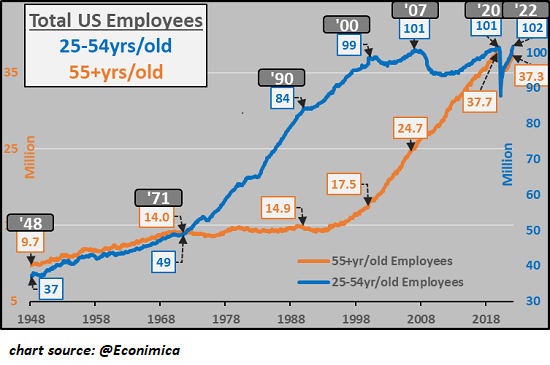
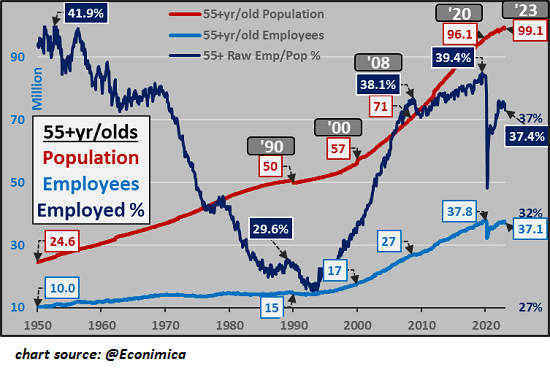
Consider these two charts of the US work force by age. (Courtesy of CH @econimica) In the first chart, Total US Employees, note that the prime working age work force (ages 25-54) has been flatlined for the past 20 years at 101-102 million. In contrast, the 55-and-older cohort of employees soared from 17 million to 37 million. This increase of 20 million accounts for virtually all growth in the employed work force.

A funny thing happens as workers get old; they retire and leave the work force. Their skills and experience are no longer available to employers or the nation's economy. The second chart shows the aging of the American populace, as the 55+ cohort increased from 57 million to 99 million since 2000, as the number of older employees skyrocketed from 17 million to 37 million.

While the total US population increased by 18% from 281 million in 2000 to 331 million today, the 55+ cohort increased 74% (from 57 million to 99 million).

The key takeaway here is the number of experienced workers who will retire in the next decade will track the explosive growth in the 55+ cohort. The general consensus is this will not be a problem because there are plenty of younger workers available to fill the vacated slots.

But this overlooks the qualitative and quantitative differences in the millions leaving the work force and those joining the work force. This is especially consequential in real-world jobs, i.e. all those jobs that require engaging real-world materials rather than staring at screens.

Though few analysts and commentators will admit to it, the implicit assumption is that the jobs that matter all involve staring at screens--processing data, finance, entertainment and shaping narrative make the world go round. All the real-world stuff (boring!) will magically get done by tax donkeys who are out of sight, out of mind.

This mindset has it backwards: it's the real-world work of changing the industrial / energy / energy distribution foundation of the economy that matters going forward, not the staring-at-screens jobs.

What few seem to realize is the work force that's aging and retiring is the cohort with the real-world skills. It's a nice idea to remake the entire electrical grid of the nation to transport much larger quantities of electrical power, but who's going to do all that work? Young people whose career goals are becoming YouTube influencers or day-traders? No. All the ChatAI bots in the world aren't going to get the real work done, either.

In other words, there is a massive mismatch between the skills available to hire in the young-worker cohort and the skills and experience needed to rebuild the material, real-world foundations of the US economy. It's well-known but apparently not worth worrying about that the average age of the US farmer is pushing 60 years of age. Nobody left to grow all our food? Hey, isn't there a ChatAI bot to do all that for us? It can all be automated, right? No? Well, why not? Somebody out there, get it done! Food in super-abundance should be delivered to everyone staring at screens 24/7, it's our birthright.

The average age of skilled tradespeople is also skewed to the aging work force. There is no easy way to quantify real-world skills gained by on-the-job experience. I suspect it follows a power-law distribution: the newly minted worker just out of school / apprenticeship can handle basic functions, but when tough problems arise, the number of workers with the requisite experience to diagnose and fix the problem diminishes rapidly.

This distribution presents an enormous problem for the economy and employers. Once the super-experienced workers who can solve any problem leave, they cannot be replaced by inexperienced workers. So when the really big problems arise, the systems will break down because those who knew how to deal with the problems are no longer available.

This is how you can have 10 million unemployed workers and 1 million unfilled positions that can't be filled because few are truly qualified. You want to erect new electrical transmission lines? Nice, but you're not going to get the job done with green workers accustomed to staring at screens. It takes years of hard labor to acquire even a bare minimum of the skills required. These are not assembly-line jobs that can be filled by unskilled labor, these are jobs in the messy real world, not a distribution center.

As I note in my book on Self-Reliance, individuals with a full spectrum of real-world skills are now extremely rare. Skills that were once common are now performed by specialists. We seem to have all the time in the world to stare at hundreds of cooking programs on TV but how many people actually prepare three meals a day, week in, week out, month in, month out, year in, year out? How many people know how to repair anything, build anything, or maintain a machine?

My direct experience is that many young people don't know how to put air in the tires of the vehicle Mom and Dad gave them. Young people with graduate-level diplomas don't know what a green bean plant looks like. (Eeew, gross, it grows in dirt?) The cultural value system that only values wealth, regardless of its source, and minting money from staring at screens has generated a fundamental mismatch between the skills that will be needed going forward and the skills being presented as oh-so-valuable.

Yes, there are many young workers with sharp real-world skills. The question is, are there enough?

This is how we'll end up with severe shortages of truly skilled labor and high unemployment in the cohort of workers with few real-world skills and a surplus of skills for which there is limited demand. As a real-world experiment, go find a tough old rancher and ask them a series of questions about livestock, machinery, fencing, generators, etc., and then ask the average newly minted college graduate that followed the warped values embedded in our economy the same questions.

Of course the young worker can't match the experience of the old worker, but do they have any experience at all of a spectrum of essential real-world skills? If not, do they have the requisite physical endurance and commitment needed to acquire real-world skills?

Who's going to do all the real-world work going forward? A few people talk about it as an abstraction, but it's not an issue to everyone focused on Federal Reserve policy or GDP. But eventually, the real world will matter more than staring at screens and day-trading, because when the systems break down due to lack of truly qualified employees, we'll all wake up. But by then it will be too late. We'll be staring at dead screens begging for somebody somewhere to restore power so we can continue playing with ChatAI to trade zero-day options.


New Podcast: Turmoil Ahead As We Enter The New Era Of 'Scarcity' (53 min)

My new book is now available at a 10% discount ($8.95 ebook, $18 print): Self-Reliance in the 21st Century.

Read the first chapter for free (PDF)

Read excerpts of all three chapters

Podcast with Richard Bonugli: Self Reliance in the 21st Century (43 min)


My recent books:

The Asian Heroine Who Seduced Me (Novel) print $10.95, Kindle $6.95 Read an excerpt for free (PDF)

When You Can't Go On: Burnout, Reckoning and Renewal $18 print, $8.95 Kindle ebook; audiobook Read the first section for free (PDF)

Global Crisis, National Renewal: A (Revolutionary) Grand Strategy for the United States (Kindle $9.95, print $24, audiobook) Read Chapter One for free (PDF).

A Hacker's Teleology: Sharing the Wealth of Our Shrinking Planet (Kindle $8.95, print $20, audiobook $17.46) Read the first section for free (PDF).

Will You Be Richer or Poorer?: Profit, Power, and AI in a Traumatized World
(Kindle $5, print $10, audiobook) Read the first section for free (PDF).

The Adventures of the Consulting Philosopher: The Disappearance of Drake (Novel) $4.95 Kindle, $10.95 print); read the first chapters for free (PDF)

Money and Work Unchained $6.95 Kindle, $15 print)
Read the first section for free


Become a $1/month patron of my work via patreon.com.


NOTE: Contributions/subscriptions are acknowledged in the order received. Your name and email remain confidential and will not be given to any other individual, company or agency.

Thank you, Bill S. ($50), for your magnificently generous contribution to this site -- I am greatly honored by your steadfast support and readership.


Thank you, Robert S. ($50), for your marvelously generous contribution to this site -- I am greatly honored by your steadfast support and readership.

Read more...

Saturday, April 01, 2023

The Mystery of UFOs/UAPs: Solved

Imagine the immensity of their disappointment in discovering Earth offers few opportunities for trade or investment.

New research has finally solved the mystery of why UFOs/UAPs (Unidentified Aerial Phenomena) have been visiting Earth since the late 1940s. The revelations are even more shocking than we imagined.

As many have surmised, our neighbors detected our nuclear explosions in 1945 and took this as evidence that Earthlings had become, well, of interest.

It turns out our galactic neighbors were bamboozled into a Ponzi scheme involving Planet Earth. Yes, this is the shocker: our technologically advanced neighbors are just as greedy and prone to being conned as we are. (This also suggests their ChatAIv4000 isn't all that infallible, either.)

The Central Bank of Centuri seems to have issued an exclusive license to "develop investment and trade with Planet Earth" to their equivalent of a corporation or Special Purpose Entity (SPV). This financial entity then issued shares in this fabulous new opportunity which soon exploded in value.

Some of this money funded exploratory visits to Earth but so far as we can tell, no actual trade or investment was initiated.

The majority of the money ended up inflating a speculative bubble akin to the South Sea Bubble of 1720 in which a financial entity was granted a monopoly to provide slaves to South Seas islands. (Such a noble venture!) The profits were anticipated to be immense, and hence the bubble. But no actual development or trade occurred, and so the bubble crashed.

Fortunes were made and wiped out in both the South Sea Bubble and the Earth Bubble. The recent uptick in visits from our gullible neighbors appears to be "fact-finding" missions launched by bamboozled investors to see for themselves if any of this gloriously profitable trade and development has actually occurred.

Imagine the immensity of their disappointment in discovering Earth offers few opportunities for trade or investment. The Earthlings are hopelessly violent, short-tempered and hard-wired to focus on short-term exploitation of whatever is available, never mind the eventual consequences.

Any technological transfer would be turned to monopoly and conquest, a nightmare that must be avoided at all costs. Apparently our neighbors have also realized that Earthlings are untrustworthy and will stiff their partners in a heartbeat if the opportunity arises.

The aliens' Special Purpose Entity is now trying to salvage its solvency by pivoting to "Earth as Entertainment." Our neighbors long ago abandoned the cruelty and exploitation that characterizes Earthling endeavors, and so our neighbors view our activities much as the Romans viewed the gory staged battles on the blood-soaked sands of the Coliseum: unmatchable entertainment.

So far, this entertainment value has drowned out the calls of the more prudent aliens who have lobbied for an immediate eradication of humanity, returning Earth to its pre-humanity state of Nature, as a precautionary measure.

But the situation remains dynamic, so we shouldn't count on our entertainment value to save us longer term. The natives on newly surveyed Zoanoak 3 might prove to be even more sex-crazed, blood-thirsty and ruthless than humanity.

This is my April Fools Day post.


New Podcast: Turmoil Ahead As We Enter The New Era Of 'Scarcity' (53 min)

My new book is now available at a 10% discount ($8.95 ebook, $18 print): Self-Reliance in the 21st Century.

Read the first chapter for free (PDF)

Read excerpts of all three chapters

Podcast with Richard Bonugli: Self Reliance in the 21st Century (43 min)


My recent books:

The Asian Heroine Who Seduced Me (Novel) print $10.95, Kindle $6.95 Read an excerpt for free (PDF)

When You Can't Go On: Burnout, Reckoning and Renewal $18 print, $8.95 Kindle ebook; audiobook Read the first section for free (PDF)

Global Crisis, National Renewal: A (Revolutionary) Grand Strategy for the United States (Kindle $9.95, print $24, audiobook) Read Chapter One for free (PDF).

A Hacker's Teleology: Sharing the Wealth of Our Shrinking Planet (Kindle $8.95, print $20, audiobook $17.46) Read the first section for free (PDF).

Will You Be Richer or Poorer?: Profit, Power, and AI in a Traumatized World
(Kindle $5, print $10, audiobook) Read the first section for free (PDF).

The Adventures of the Consulting Philosopher: The Disappearance of Drake (Novel) $4.95 Kindle, $10.95 print); read the first chapters for free (PDF)

Money and Work Unchained $6.95 Kindle, $15 print)
Read the first section for free


Become a $1/month patron of my work via patreon.com.


NOTE: Contributions/subscriptions are acknowledged in the order received. Your name and email remain confidential and will not be given to any other individual, company or agency.

Thank you, Matthew W. ($108), for your outrageously generous contribution to this site -- I am greatly honored by your steadfast support and readership.


Thank you, Cathy L. ($54), for your marvelously generous contribution to this site -- I am greatly honored by your support and readership.

Read more...

Wednesday, March 29, 2023

While We're Obsessing About the Economy and the Fed, Society Is Unraveling

The market and the government will continue to promote and support a neofeudal status quo until they are forced by society to restore the common good and opportunity.

Of the three primary dynamics of human endeavor--the market, government and society--we focus almost exclusively on the first two. Society is rarely considered as a force of its own. It is implicitly viewed as reactive to the market economy and government, the churning wake left as the market and government chart the course.

In other words, society is secondary to the economy and governance, the venue of fashions, trends, entertainment, culture wars, etc., fodder for media and social media, a reflection of what's happening in the market and government.

As I explain in my book Global Crisis, National Renewal, this is a misunderstanding of society's role as a force that changes the economy and governance in profound ways.

We give social transformation short shrift because it's not easy to study or understand. Social change is amorphous and doesn't lend itself to quantification like the market or the legal structures of government policy. We end up relying on snapshots such as opinion polls that are inherently limited in scope and accuracy. Respondents tend to give answers they they believe are expected or reflect their views of the moment. Other data is collected from groups that are self-selecting.

Despite these limitations, it's clear that American society is unraveling and undergoing profound changes that will eventually upend markets and governance. We will come to realize society is transforming markets and governance, not the other way around.

Charts of the stock market and economy in the 1960s do not reflect the social changes in values that made the 1960s so tumultuous and consequential. Three social movements--civil rights, the environment and women's rights--all changed the economy and governance in the 1970s, unleashing forces that continue to shape our economy and government to this day.

The market and government didn't lead these changes, social forces changed the market and government. The market and government were perfectly happy to maintain the status quo of rampant industrial pollution and systemic restrictions of civil rights. Society forced economic and political change: the government was forced to enact environmental regulations limiting pollution and industrial waste, and enact legislation removing barriers that enforced an oppressive, unjust, two-tier society and economy.

In the 1970s, these environmental, women's rights and civil rights advances forced on the market and government transformed the economy for the better. Women entered the workforce en masse and women and minorities gained access to institutions that that had previously excluded them. Environmental and efficiency regulations transformed the American economy and landscape from an industrial dumping ground to a much cleaner, more sustainable, more efficient and productive industrial base.

I discussed this recently in The Forgotten History of the 1970s and The 1970s: From Rotting Carcasses Floating in the River to Kayak Races.

Much work remains to be done, of course, but much has been accomplished by the citizenry concluding the status quo is no longer acceptable.

In my analysis, the nation's social fabric is unraveling due to the breakdown of civic virtue, social cohesion and the social contract. The dominance of finance (hyper-financialization) and corporate self-interest (hyper-globalization) has fatally undermined civic virtue, social cohesion and the social contract. Rather than the market serving society, society now serves the market and finance in a painfully obvious two-tiered neofeudal structure in which the few garner the vast majority of the wealth and political power.

Locking in vast private wealth is now the Prime Directive of the elite, an elite which in previous generations understood that every elite ultimately serves at the behest of those they rule (i.e. consent of the governed), and so the elite must apply some of their wealth and power to pursue the common good rather than their own self-interest.

Soaring wealth-income inequality leads to vast concentration of political power. "The people" rule in name only. Any attempt to end the two-tiered neofeudal structure of our economy at the ballot box is futile.

As for the social contract of equal opportunity for all, in the real world, the rungs in the ladder of social mobility have been broken. Those who bought homes and assets a generation or two ago have acquired wealth in a credit-asset bubble economy, while those who borrowed a fortune for a college degree find the value is uncertain or marginal in all but the top-tier of credentials--and connections still matter.

The net result is people are dropping out, opting out or burning out. This is the result of what I call social defeat: the odds are now stacked against all but the super-achievers and the well-connected. Given the instability and inequality of the financialized, globalized "market economy" (heh), a family and home are out of reach financially for many, so they give up. Others see their hard-won gains wiped out by medical expenses (the leading cause of household bankruptcies) or a collapse in the speculative bubble-du-jour. We see the same trends in stagnant economies elsewhere (Japan, for instance): the decline of marriage, family and having children and the abandonment of social / community ties.

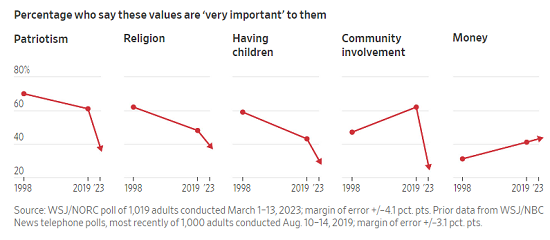
As this Wall Street Journal poll reveals, the traditional forces of social cohesion are collapsing before our eyes. As Peter Turchin has explained, social cycles of integration and disintegration occur every 50 years or so. In integrative phases, people find reasons to cooperate. In disintegrative phases, people find reasons to disagree and fragment into divisive, polarized camps. Clearly, we're well into a disintegrative phase, and what could bring us together is not even visible.

America Pulls Back From Values That Once Defined It, WSJ-NORC Poll Finds (WSJ.com)

The rising emphasis on money reflects the insecurity and instability that characterize the economy. If history teaches us anything, it's that piling up private stashes of wealth can't buy social cohesion, restore the social contract or rebuild social ties. Speculative gain is the ultimate false god. The belief that if we all barricade our own private wealth, everything will be fine is the acme of social dissolution.

We have a great opportunity for national renewal, but there is precious little in the market or governance that offers common ground. The common ground must be found in social changes in what we value and what is no longer acceptable. The market and the government will continue to promote and support a neofeudal status quo until they are forced by society to restore the common good and opportunity.


New Podcast: Turmoil Ahead As We Enter The New Era Of 'Scarcity' (53 min)

My new book is now available at a 10% discount ($8.95 ebook, $18 print): Self-Reliance in the 21st Century.

Read the first chapter for free (PDF)

Read excerpts of all three chapters

Podcast with Richard Bonugli: Self Reliance in the 21st Century (43 min)


My recent books:

The Asian Heroine Who Seduced Me (Novel) print $10.95, Kindle $6.95 Read an excerpt for free (PDF)

When You Can't Go On: Burnout, Reckoning and Renewal $18 print, $8.95 Kindle ebook; audiobook Read the first section for free (PDF)

Global Crisis, National Renewal: A (Revolutionary) Grand Strategy for the United States (Kindle $9.95, print $24, audiobook) Read Chapter One for free (PDF).

A Hacker's Teleology: Sharing the Wealth of Our Shrinking Planet (Kindle $8.95, print $20, audiobook $17.46) Read the first section for free (PDF).

Will You Be Richer or Poorer?: Profit, Power, and AI in a Traumatized World
(Kindle $5, print $10, audiobook) Read the first section for free (PDF).

The Adventures of the Consulting Philosopher: The Disappearance of Drake (Novel) $4.95 Kindle, $10.95 print); read the first chapters for free (PDF)

Money and Work Unchained $6.95 Kindle, $15 print)
Read the first section for free


Become a $1/month patron of my work via patreon.com.


NOTE: Contributions/subscriptions are acknowledged in the order received. Your name and email remain confidential and will not be given to any other individual, company or agency.

Thank you, Matthew W. ($108), for your outrageously generous contribution to this site -- I am greatly honored by your steadfast support and readership.


Thank you, Cathy L. ($54), for your marvelously generous contribution to this site -- I am greatly honored by your support and readership.

Read more...

Terms of Service

All content on this blog is provided by Trewe LLC for informational purposes only. The owner of this blog makes no representations as to the accuracy or completeness of any information on this site or found by following any link on this site. The owner will not be liable for any errors or omissions in this information nor for the availability of this information. The owner will not be liable for any losses, injuries, or damages from the display or use of this information. These terms and conditions of use are subject to change at anytime and without notice.

RE: European Union AI Act, and Our Use of Generative AI Tools and Agents Policy

All text on this site is composed by Charles Hugh Smith or by a credited guest-author. No Generative AI Tools are used in the composition / writing of any text or graphic content created by Charles Hugh Smith. This site deploys no AI agents or generative AI tools. This site is not responsible for the disclosures, use or non-use of AI agents or generative AI tools in advertisements displayed by Investing Channel or other ad placement services.

Audio files generated by text-to-audio transcription tools are identified as such.

Our Privacy Policy:

Correspondents' email is strictly confidential. This site does not collect digital data from visitors or distribute cookies. Advertisements served by third-party advertising networks such as Investing Channel may use cookies or collect information from visitors for the purpose of Interest-Based Advertising; if you wish to opt out of Interest-Based Advertising, please go to Opt out of interest-based advertising (The Network Advertising Initiative) If you have other privacy concerns relating to advertisements, please contact advertisers directly.

PRIVACY NOTICE FOR EEA INDIVIDUALS

This section covers disclosures on the General Data Protection Regulation (GDPR) for users residing within EEA only. GDPR replaces the existing Directive 95/46/ec, and aims at harmonizing data protection laws in the EU that are fit for purpose in the digital age. The primary objective of the GDPR is to give citizens back control of their personal data. Please follow the link below to access InvestingChannel's General Data Protection Notice.
https://stg.media.investingchannel.com/gdpr-notice/

Notice of Compliance with The California Consumer Protection Act

This site does not collect digital data from visitors or distribute cookies. Advertisements served by a third-party advertising network (Investing Channel) may use cookies or collect information from visitors for the purpose of Interest-Based Advertising. If you do not want any personal information that may be collected by third-party advertising to be sold, please follow the instructions on this page: Do Not Sell My Personal Information.

Regarding Cookies:

This site does not collect digital data from visitors or distribute cookies. Advertisements served by third-party advertising networks such as Investing Channel may use cookies or collect information from visitors for the purpose of Interest-Based Advertising; if you wish to opt out of Interest-Based Advertising, please go to Opt out of interest-based advertising (The Network Advertising Initiative) If you have other privacy concerns relating to advertisements, please contact advertisers directly.

Our Commission Policy:

Though I earn a small commission on Amazon.com books and gift certificates and gold (BullionVault) purchased via links on my site, I receive no fees or compensation for any other non-advertising links or content posted on my site.

Copyright Notice:

All original images (Drawings and Photographs), text (essays, books and works of fiction), audio and video recordings, musical compositions, graphic design, graphic design elements and HTML coding on this site are the copyrighted work of Charles Hugh Smith unless otherwise credited or noted. They are published as information for the private use of site visitors, and any reproduction or redistribution of this content or coding in any media in any format or distribution channel (text, audio, video/film, web) without the written permission of the copyright holder is strictly prohibited. All rights in all media reserved globally.

  © Blogger templates Newspaper III by Ourblogtemplates.com 2008

Back to TOP